Chiropractor Near University Parkway and Whitfield: What to Know Before Your First Visit
University Parkway: If you live or work near the University Parkway and Whitfield Avenue corridor in Sarasota — whether you’re shopping at University Town Center, commuting from Lakewood Ranch, picking up groceries at the Publix on University, or working in one of the medical offices that line the area — you’ve probably driven past our office without realizing what we do is different. Lavender Family Chiropractic sits at 5899 Whitfield Avenue, Suite 107, right at the corner of University and Whitfield, and we’ve been quietly helping people in this part of Sarasota and Manatee County resolve the kinds of health problems that other doctors have given up on.
This isn’t a typical “neck cracking” chiropractic office. We don’t twist, pop, or yank. What we do is far more precise and far gentler — and it’s the reason patients drive in from as far as St. Petersburg, Punta Gorda, and Venice to see us. But before we get into the technical side, let’s talk about what you should actually expect if you’re thinking about coming in for a first visit.
This guide is written specifically for people in our neighborhood — the University Parkway, Whitfield, University Town Center, Sarasota-Bradenton Airport, Lakewood Ranch, and northern Sarasota area. We’ll walk you through what we do, why we do it, how to find us, what your first visit looks like, what conditions we help with, and what to ask before you commit to any chiropractor in the area.
University Parkway Chiropractor- What Is Upper Cervical Chiropractic (And Why It’s Different)
Most people, when they hear “chiropractor,” picture a room with a table that drops, an audible crack of the spine, and a quick rotation of the neck. That’s traditional chiropractic, and there’s nothing wrong with it — but it’s not what we do.
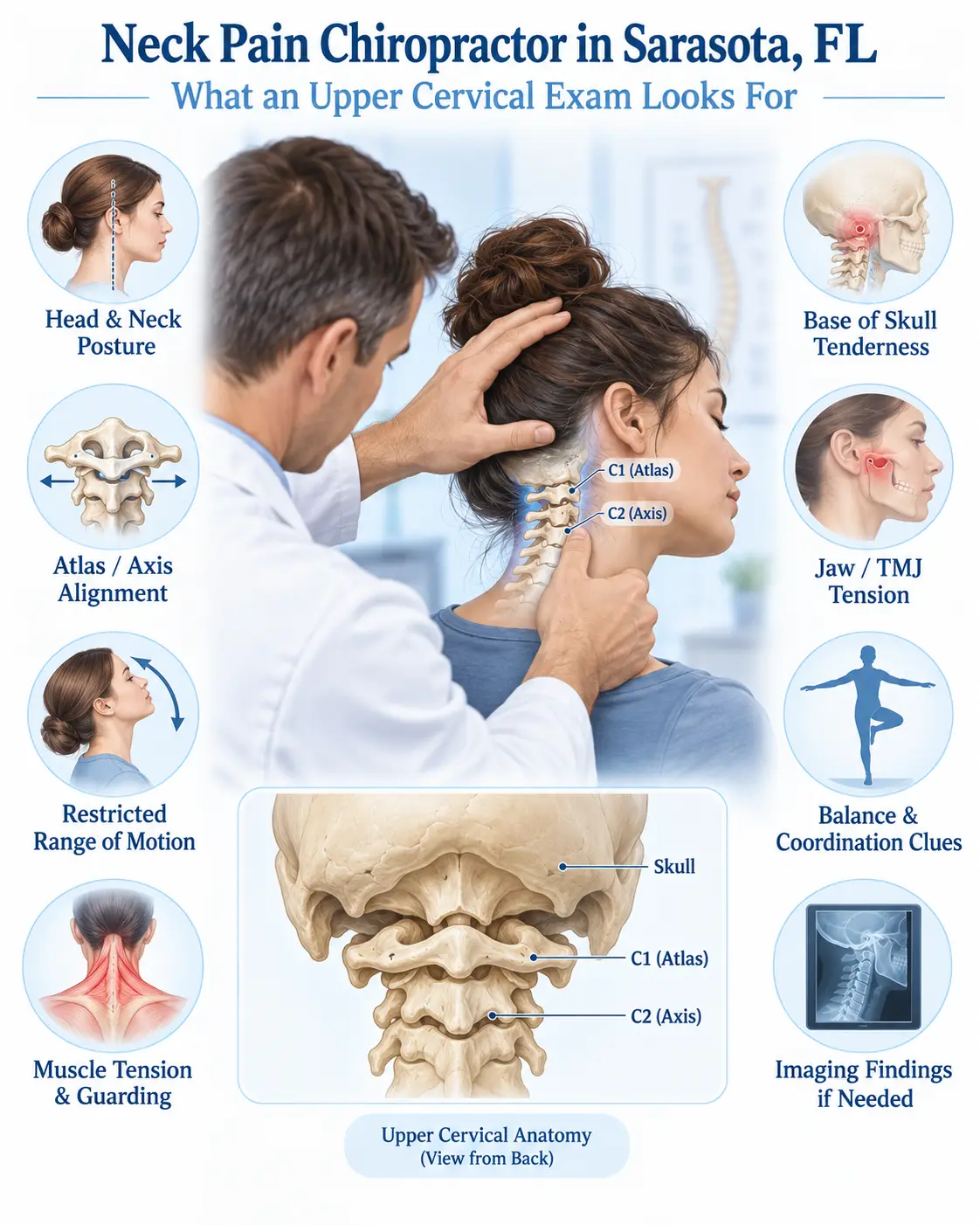
Lavender Family Chiropractic is an upper cervical chiropractic office. The “upper cervical” part means we focus exclusively on the top two vertebrae of your spine — the atlas (C1) and the axis (C2). These two bones sit at the base of your skull and house the brainstem, which is the most important neurological junction in your body. Every signal between your brain and the rest of your body passes through this small region. Misalignments here have outsized effects compared to misalignments anywhere else in the spine.
According to the Wikipedia entry on upper cervical chiropractic, it’s a specialty within chiropractic that uses precise imaging and analysis to make specific corrections to the atlas and axis. There’s no general manipulation of the rest of the spine, no twisting, and no popping. The technique we use — Advanced HIO Knee-Chest — was developed specifically to make these tiny corrections with minimal force.
What this means for you as a patient: if you’ve been avoiding chiropractors because the cracking and twisting scares you, or because you’ve had a bad experience with high-force adjustments, upper cervical care is a completely different experience. Most patients describe their first adjustment as surprisingly gentle and brief.
The Nerve and Vascular Connection at the Top of the Neck
To understand why so many seemingly unrelated symptoms improve when the upper neck is properly aligned, you have to understand what’s happening anatomically in that small region.
Your atlas vertebra — the very first bone in your spine — is a ring-shaped structure that supports the weight of your skull. The Wikipedia article on the atlas (C1) describes it as unique in the spine: it has no vertebral body and is essentially designed to let your head rotate, nod, and tilt smoothly. Inside that ring sits your brainstem, which controls everything from heart rate and digestion to balance and pain processing.
Two specific systems are heavily affected when the atlas is even slightly out of alignment:
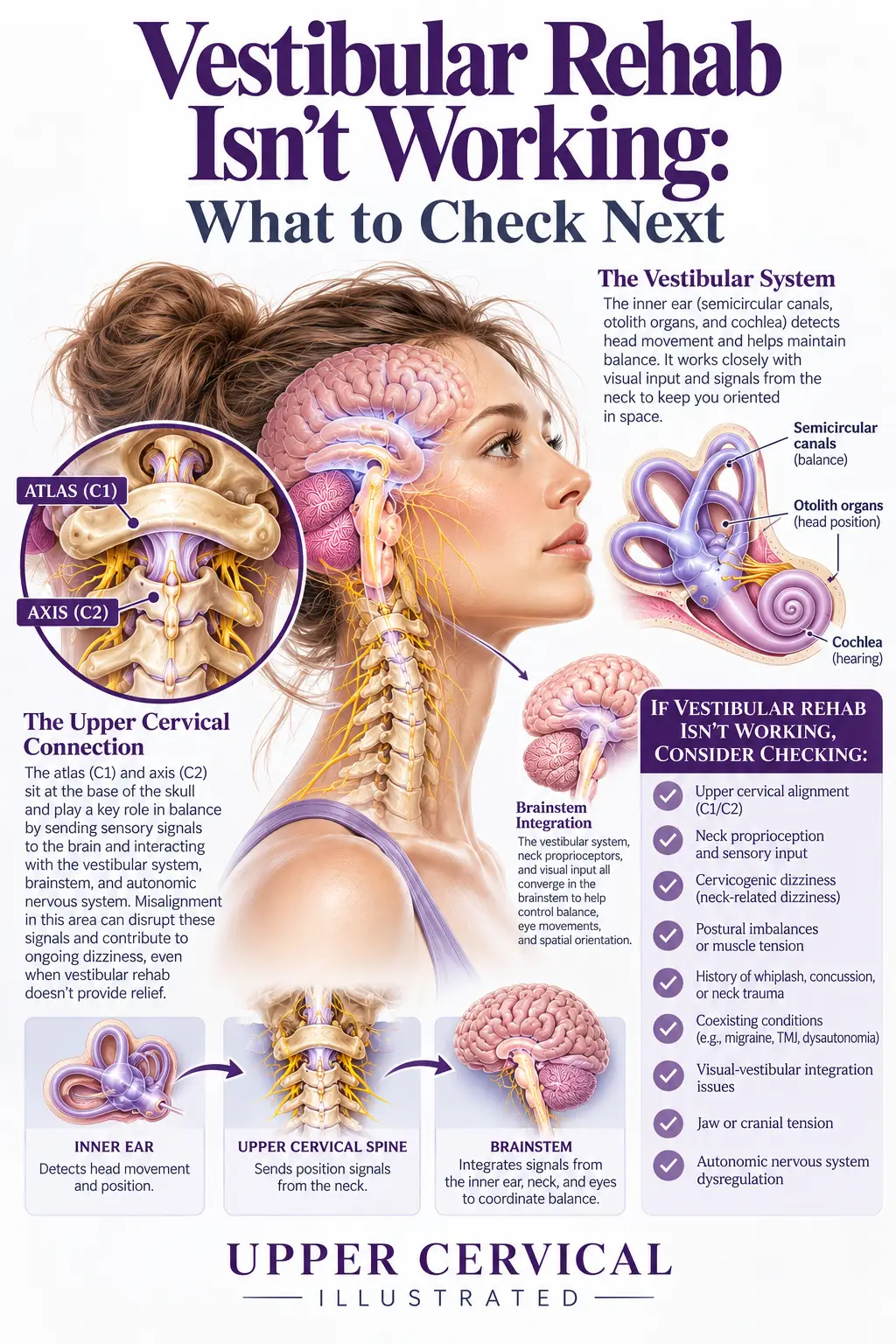
The nervous system. The brainstem and the upper portion of the spinal cord don’t just pass signals through — they integrate sensory input from the face, jaw, eyes, ears, and neck through a relay station called the trigeminocervical nucleus. When the atlas is misaligned, the muscles around it tense up, the nerves get irritated, and that “noise” gets fed into the brainstem. The result can be headaches, migraines, jaw pain, ear pressure, brain fog, light sensitivity, and a host of other symptoms that don’t seem connected on the surface.
The vascular system. The vertebral arteries, which supply blood to the back of your brain and the brainstem, pass directly through small holes in the atlas and axis. When alignment is off, blood flow through these vessels can be subtly compromised. The Wikipedia entry on the vertebral artery describes the close anatomical relationship between these arteries and the upper cervical vertebrae. Reduced or asymmetric blood flow to the brainstem is one of the mechanisms behind chronic dizziness, vertigo, and unexplained fatigue.
This is why upper cervical care often produces results in conditions that seem to have nothing to do with the neck. We’re not “treating” migraines, vertigo, TMJ, or POTS. We’re correcting the upstream alignment issue that’s contributing to all of them.
Why the Upper Neck Gets Misaligned in the First Place
People often ask us how an atlas can get out of alignment. The honest answer is that there are dozens of ways, and most of them are completely unremarkable.
Birth trauma. The pulling and rotation involved in delivery can shift the atlas in newborns, and the misalignment can persist for decades. Childhood falls — off bicycles, off playground equipment, off skateboards. Car accidents, even minor fender-benders where you didn’t think you were hurt. Sports injuries, especially in contact sports or anything involving falls. Whiplash from a rear-end collision. Long-term postural strain from desk work, phones, and tablets. Falls from horseback riding or boating accidents (common in our region). Even repetitive sleeping in awkward positions can contribute over time.
Once the atlas shifts, your body compensates. Your head tilts, your shoulders rotate, your hips adjust, your jaw tracks unevenly on its hinge. You probably don’t notice any of it — most people don’t, until symptoms eventually appear years later. The compensation pattern itself becomes part of the problem because your nervous system is now operating with constant low-grade stress, and your muscles are working harder than they should just to hold you upright.
Upper Cervical Care and What to Expect at Your First Visit
If you’re thinking about coming in to see us, here’s exactly what your first visit at 5899 Whitfield Avenue looks like.
Step one: complimentary in-person consultation. This isn’t a sales pitch. It’s a conversation. You sit down with one of our doctors — Dr. Rusty Lavender or Dr. Jacob Temple — and you tell us your story. What’s been going on? When did it start? What have you already tried? What other doctors have you seen? What’s your goal? We listen carefully because the details often reveal patterns that other providers have missed.
Step two: examination. If we both agree there’s reason to think upper cervical care might help, we move into a thorough neurological and structural examination. This includes range of motion testing, posture analysis, leg length checks, and orthopedic and neurological screening. We’re looking for the specific signs of upper cervical involvement.
Step three: 3D CBCT imaging. This is the part that sets upper cervical chiropractic apart from traditional chiropractic. We use Cone Beam Computed Tomography to capture a true three-dimensional image of your upper cervical spine. Unlike standard X-rays, which show you the spine in two dimensions and require guesswork, CBCT lets us measure the exact rotation, tilt, and translation of your atlas down to fractions of a millimeter. From this data, we calculate a precise correction vector specific to your anatomy.
Step four: functional nervous system scan. Using Tytron paraspinal infrared thermography, we measure temperature patterns along your spine. Differences in heat between left and right sides indicate where your nervous system is under stress. This gives us an objective baseline to measure your progress against.
Step five: report of findings. You come back, usually the next day. We sit down together and we show you everything — your scans, your imaging, our analysis, and our recommendations in plain English. You’ll see your own anatomy on screen. We’ll tell you whether we think we can help. If we don’t think upper cervical care is the right fit for your specific case, we’ll tell you that honestly and recommend other options.
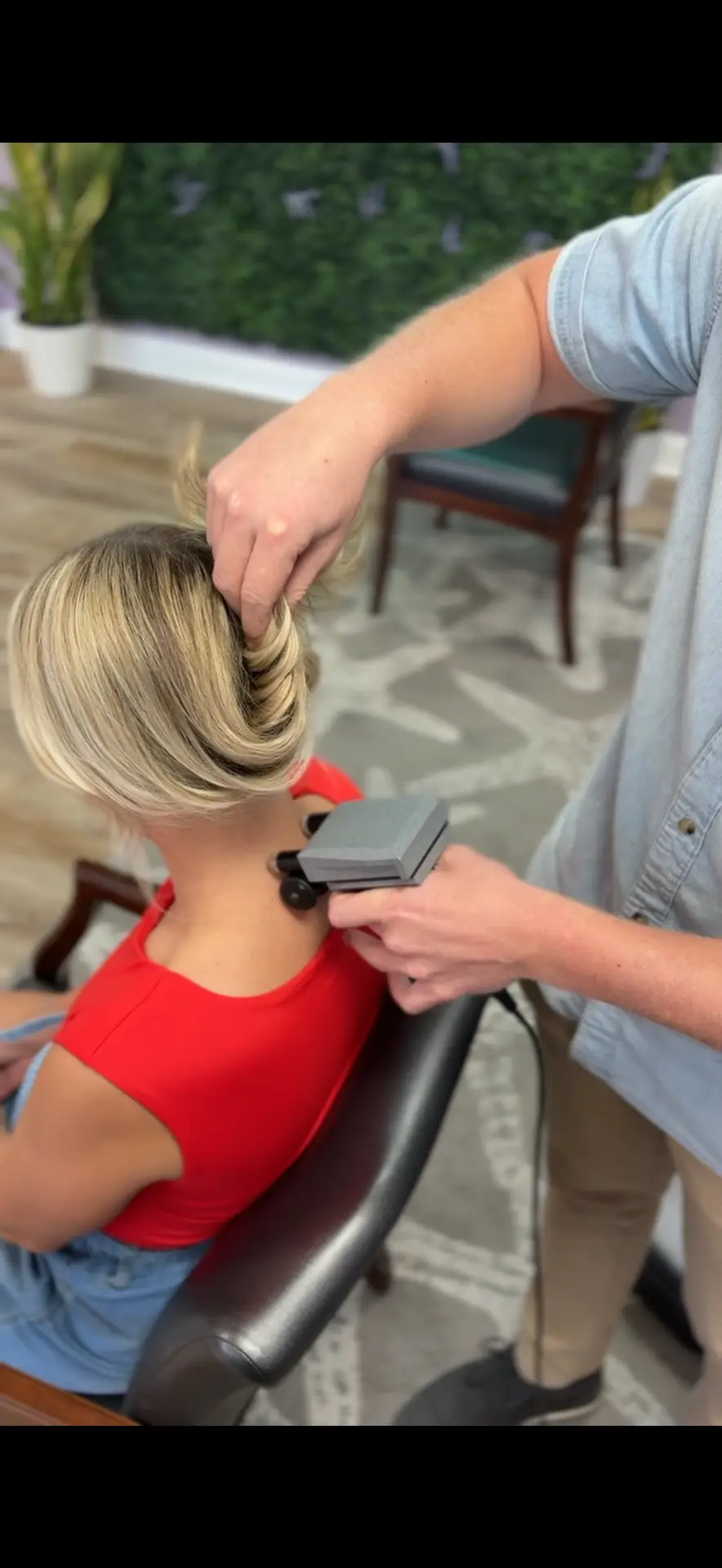
Step six: first correction (if appropriate). The actual adjustment is brief, gentle, and specific. You’ll be positioned on a knee-chest table or lying on your side. The correction itself takes a fraction of a second. Most patients are genuinely surprised at how little force is involved and how comfortable the position feels.
After the correction, we monitor how your body responds with follow-up scans before we adjust again. We don’t adjust on a fixed schedule — we adjust only when your body indicates you need it. This is one of the core principles of upper cervical care: holding the correction is what allows the body to heal, and adjusting too frequently can interrupt that process.
Want to find out if we can help? Call (941) 243-3729 or book a free consultation online to schedule your first visit.
What We Help With (And What We Don’t)
We’re transparent about what we do and don’t address, because we’d rather you find the right help than walk in with mismatched expectations.
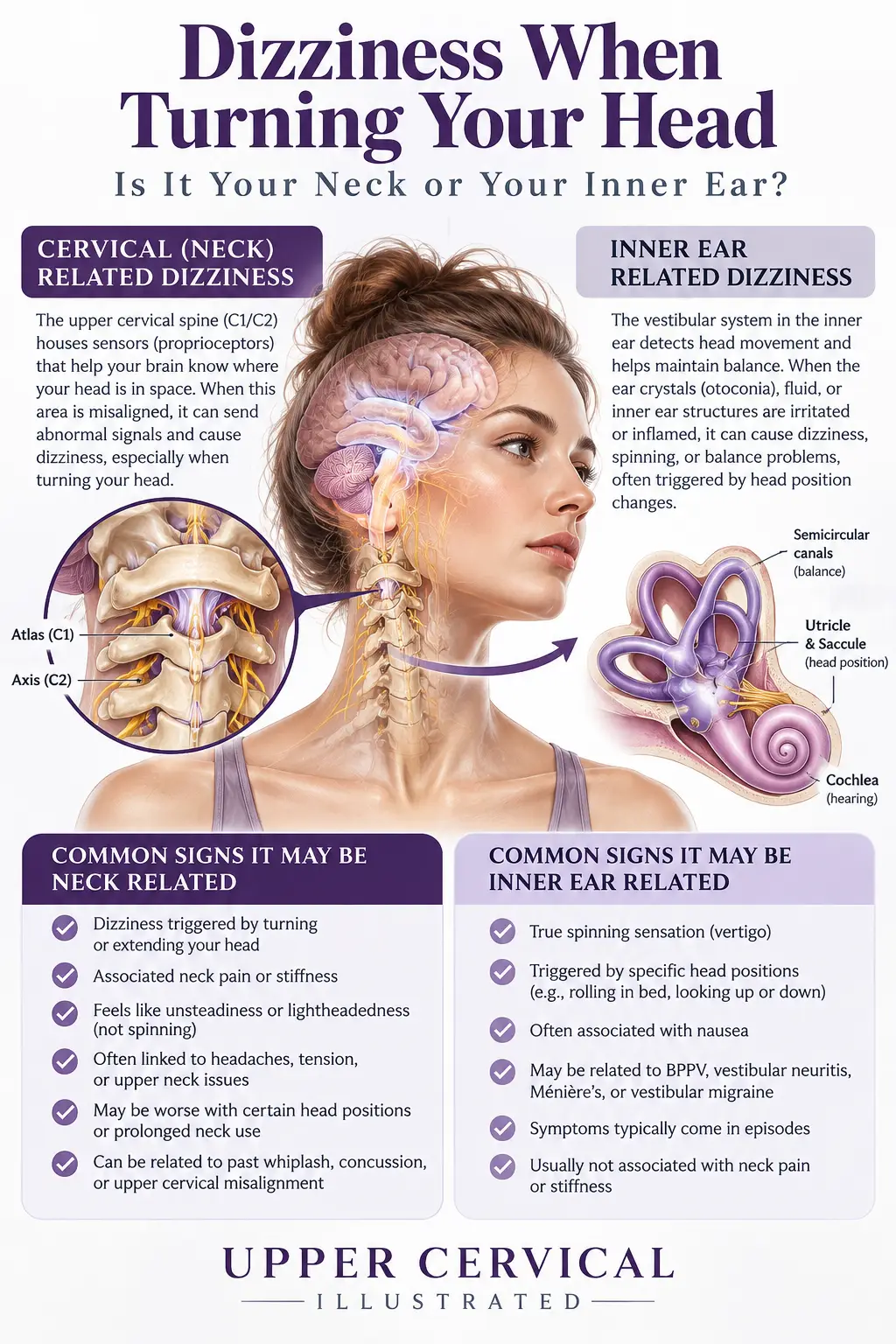
What we commonly help with includes vertigo and dizziness (including BPPV, vestibular migraine, MdDS, PPPD, and Ménière’s-like symptoms), migraines and chronic headaches, TMJ and jaw pain, POTS and other forms of dysautonomia, post-concussion syndrome, occipital neuralgia, trigeminal neuralgia, ear pressure and tinnitus, neck pain and stiffness, post-whiplash symptoms, brain fog and cognitive symptoms, and chronic fatigue with no clear medical explanation.
What we don’t claim to fix is everything. Some conditions require dental specialists, ENTs, neurologists, physical therapists, or surgical consultations. We collaborate with other providers regularly, and when we don’t think we’re the right answer, we say so.
A consistent theme in the patients we help is that they’ve been to multiple doctors, had multiple MRIs and CT scans that came back “normal,” and been told either that nothing is wrong or that they need to manage symptoms with medication forever. Our work is most effective for the people who fall through the cracks of conventional care — people whose imaging looks fine but who genuinely don’t feel well.
What Makes Our Office Different
The University Parkway and Whitfield Avenue area has several chiropractors. Here’s what we’d tell you to look for and what makes us different.
3D imaging instead of guesswork. Most chiropractic offices use standard two-dimensional X-rays, or no imaging at all. We use Cone Beam CT, which gives us actual three-dimensional measurements of your specific anatomy. We don’t guess at your correction. We calculate it.
Objective scans before every adjustment. Most chiropractors adjust on a schedule — every visit, every week. We use functional nervous system scans before each session to determine whether you actually need a correction that day. If you’re holding your alignment, we don’t adjust. The principle is simple: holding is healing.
Gentle, specific technique. No twisting. No popping. No yanking. The correction is precise and light. If a forceful manipulation has ever made you nervous, this is the opposite experience.
Specialty focus. We don’t see every type of patient. We focus on complex cases involving the upper cervical spine — vertigo, migraines, TMJ, POTS, post-concussion. This focused expertise is why people drive in from across southwest Florida to see us.
Time with the doctor. Your consultation, exam, and report of findings are unhurried. We don’t rush you through. Patients tell us regularly that this is the first time anyone has actually sat down and listened to their whole story.
You can read more about our specific approach on our upper cervical chiropractic care page and our atlas chiropractic page.
Finding the Office: Directions and Local Landmarks
Our office is at 5899 Whitfield Avenue, Suite 107, Sarasota, FL 34243 — at the corner of University Parkway and Whitfield Avenue.
If you’re coming from University Town Center or the I-75 / University Parkway exit, head west on University Parkway. You’ll pass the Sarasota-Bradenton International Airport on your right. Continue past the airport, and Whitfield Avenue will be on your right just past the airport property. Turn right onto Whitfield, and we’re immediately on the corner.
If you’re coming from downtown Sarasota or US-41, head north on US-41 (Tamiami Trail) until you reach University Parkway, then turn east. Whitfield Avenue will be on your left after a short distance.
If you’re coming from Lakewood Ranch, take University Parkway west, past I-75 and University Town Center, and continue toward the airport. The drive is typically 15 to 25 minutes depending on traffic and your specific Lakewood Ranch neighborhood.
If you’re coming from Bradenton or further north, take US-41 south or I-75 south to University Parkway, then head west to Whitfield.
There’s plenty of parking available, the office is on the ground floor for easy access, and we’re easy to spot from the road.
Lifestyle Recommendations to Get the Most Out of Care
Even the most precise correction won’t hold if your daily habits are working against it. Here’s what we coach our patients on.
Posture matters more than people realize. Forward head posture — the position most of us fall into when looking at phones, tablets, and laptops — adds significant mechanical strain to the upper cervical spine. Every inch your head sits forward of your shoulders effectively adds ten pounds of load. Set up your workstation correctly. Hold your phone up to your face instead of dropping your head to look at it.
Sleep position affects your alignment for hours every night. Stomach sleeping forces your neck into rotation and is the worst position for upper cervical patients. Side sleeping with a properly contoured pillow, or back sleeping with a cervical pillow, is what we recommend.
Hydration is non-negotiable, especially in Sarasota’s heat. Spinal discs and joint cartilage depend on water. Aim for half your body weight in ounces of water daily as a starting target.
Stress management directly affects your nervous system. The autonomic nervous system — which controls your fight-or-flight response — is heavily influenced by upper cervical alignment, but stress also affects how well your body holds the correction. Breathwork, exercise, sleep, and time away from screens all matter.
Movement, but the right kind. Walking, swimming, and gentle yoga support recovery. Heavy contact sports, jarring activities, and aggressive stretching of the neck can work against the correction. We’ll give you specific guidance based on your situation.
For more on how local environmental factors specifically affect head and neck symptoms, our blog on barometric pressure headaches goes into detail on how Florida’s weather patterns interact with upper cervical sensitivity.
Serving Sarasota and the Surrounding Areas
Our central location at University Parkway and Whitfield Avenue puts us within easy reach of a wide service area. We see patients regularly from:
- Sarasota — including downtown, North Sarasota, the University Town Center area, and the Whitfield neighborhood itself
- Bradenton — both East Bradenton and West Bradenton
- Lakewood Ranch — including Greenbrook, Country Club, Lakewood Ranch Main Street, and the newer Waterside neighborhoods
- Parrish and Ellenton — easy access via I-75
- Venice and Osprey — south of Sarasota
- Punta Gorda — for patients willing to drive for specialized care
- St. Petersburg — accessible via I-275 and the Skyway Bridge
- Siesta Key, Longboat Key, and Lido Key — the barrier islands
- Myakka City — east of Lakewood Ranch
- Palmetto and Terra Ceia — north of Bradenton
The University Parkway and Whitfield corridor is one of the most accessible spots in the region, which is why patients from such a wide geographic area choose to come here.
Top 15 FAQs Before Your First Visit
Is the consultation really free?
Yes. Our in-person consultation is complimentary. You’ll sit down with one of our doctors and discuss your situation before any imaging or formal exam. There’s no obligation and no pressure.
How long does the first visit take?
Plan on about an hour to ninety minutes for the consultation, exam, and imaging if you choose to proceed. The report of findings happens at a separate visit, usually the next day.
What should I bring?
Bring any prior imaging you have (MRIs, CT scans, X-rays), a list of medications and supplements, and a written list of symptoms and questions. The more information you bring, the more thorough our evaluation can be.
Is upper cervical chiropractic safe?
Yes. Because the technique is gentle and precise, and because we use objective imaging and scans to guide every correction, upper cervical chiropractic is one of the safest forms of spinal care available. We don’t adjust unless your body indicates it needs to be adjusted.
What if I’m afraid of getting my neck cracked?
You’re in the right place. We don’t crack, twist, or pop the neck. The adjustment is a light, specific contact while you’re in a comfortable position. Most patients tell us afterward that they didn’t even realize the correction had happened.
How many visits will I need?
It varies by case. Most patients begin with an initial corrective phase of several visits over the first few weeks, then transition to less frequent visits as the body learns to hold the correction. We’ll give you a realistic estimate after your imaging and exam.
Does insurance cover this?
We accept most major insurance plans and also offer transparent self-pay pricing for those without coverage. Our front desk will walk you through your specific benefits during your consultation.
What conditions do you most commonly help with?
Vertigo, migraines, TMJ, POTS, post-concussion syndrome, occipital neuralgia, neck pain, and chronic headaches are the most common reasons patients come to see us. You can read more about specific conditions on our vertigo treatment page, our TMJ blog, and our occipital neuralgia page.
Will I need ongoing care forever?
No. After the initial corrective phase, most patients transition to a much less frequent maintenance schedule — sometimes just a few times a year. The goal is for your body to hold the correction with minimal intervention.
Do you treat children?
Yes. We see patients of all ages, including children. The technique is gentle enough to be appropriate for young patients, and we adjust our approach based on age and situation.
What’s the difference between you and a regular chiropractor near University Parkway?
The biggest differences are our exclusive focus on the upper cervical spine, our use of 3D CBCT imaging instead of standard X-rays or no imaging, our gentle and specific technique with no twisting or popping, and our use of objective scans to decide when to adjust. Most general chiropractors take a different approach across the entire spine.
My MRI was normal. Can you still help?
Often, yes. Most of our patients have had normal MRIs. Standard imaging doesn’t capture the specific upper cervical misalignment patterns that drive many chronic symptoms. The CBCT imaging we use is specifically designed to detect these subtle issues.
Can I bring my spouse or family member to my consultation?
Absolutely. Many of our patients bring a spouse, parent, or close friend with them. Having a second set of ears during the consultation and report of findings is often helpful.
How do I know if upper cervical care is right for me?
The best way to find out is the free consultation. We’ll review your history, examine you, and tell you honestly whether we think we can help. If we don’t think we’re the right fit, we’ll tell you that and suggest alternatives.
How do I schedule?
Call us at (941) 243-3729 or visit our contact page to schedule your free in-person consultation.
Ready to Find Out If We Can Help?
If you’ve been searching for a chiropractor near University Parkway or Whitfield Avenue and you’re tired of the standard “crack and go” approach, we’d love to talk with you. The work we do is precise, gentle, evidence-based, and focused on resolving root causes rather than masking symptoms.
The first step is simply a conversation. There’s no cost, no pressure, and no obligation. If we can help, we’ll tell you how. If we can’t, we’ll point you toward someone who can.
Lavender Family Chiropractic 5899 Whitfield Avenue, Suite 107 Sarasota, FL 34243 (at the corner of University Parkway and Whitfield)
📞 (941) 243-3729 🌐 Book your free consultation
Our doctors — Dr. Rusty Lavender and Dr. Jacob Temple — are here to listen, examine, and give you honest answers about whether upper cervical chiropractic care is the right next step for you.
Related Articles
- Upper Cervical Chiropractic Care in Sarasota
- Atlas Chiropractic in Sarasota, Florida
- Best Chiropractor in Lakewood Ranch Florida
By Dr. Rusty Lavender and Dr. Jacob Temple, Lavender Family Chiropractic — Sarasota, Florida