POTS Treatment in Sarasota: The Brainstem, the Upper Neck, and Why Standing Up Became So Hard
By Dr. Rusty Lavender, D.C. and Dr. Jacob Temple, D.C. — upper cervical chiropractors, Lavender Family Chiropractic, Sarasota, FL. Reviewed and updated October 2026.
In short: Postural orthostatic tachycardia syndrome (POTS) is a form of dysautonomia in which heart rate rises abnormally on standing, causing lightheadedness, fatigue, brain fog, and exercise intolerance. At Lavender Family Chiropractic in Sarasota, FL, Dr. Rusty Lavender evaluates the upper cervical spine, which sits at the brainstem where autonomic control is regulated, and provides gentle, no-twisting upper cervical corrections as conservative care coordinated with the patient’s cardiologist or neurologist. An upper cervical evaluation is available at our Sarasota office at University Parkway and Whitfield Avenue.
| Condition | Postural orthostatic tachycardia syndrome (POTS); dysautonomia |
|---|---|
| Common symptoms | Rapid heart rate on standing, lightheadedness, fatigue, brain fog, exercise intolerance, headaches, nausea, temperature intolerance |
| Upper neck connection | The atlas and axis surround the brainstem, where the autonomic centers that regulate heart rate and blood pressure sit; irritation here is one proposed contributor |
| Who evaluates it in Sarasota | Dr. Rusty Lavender, D.C., upper cervical chiropractor at Lavender Family Chiropractic, 5899 Whitfield Ave #107, Sarasota, FL 34243 (941-243-3729) |
| What the evaluation involves | Health history, neurological and balance screening, examination of the upper cervical spine, and precise upright imaging of the atlas and axis to determine whether a measurable misalignment is present |
| Related pages | orthostatic vitals are reviewed; medical diagnosis and management continue with the patient’s physician |
If you have POTS, you already know how absurd it sounds to explain: standing up is exhausting. Your heart races the moment you get vertical. The room swims, your legs feel like they’re filling with concrete, your thoughts go foggy, and a wave of fatigue rolls over you that rest never quite fixes. Showering, cooking, standing in a line, getting through a workday — the ordinary things become negotiations with your own body. And the cruelest part, for so many people, is being told the workup looks “normal” and maybe it’s anxiety.
It isn’t anxiety, and it isn’t in your head. POTS is a real, measurable disorder of the autonomic nervous system — the automatic control network that’s supposed to manage your heart rate and blood flow when you change position. In POTS, that automatic system misfires. And here is the piece that so often goes unexamined: the master control center for that automatic system sits in the lower brainstem, in the region surrounded by the top two bones of your neck. For a meaningful number of people with POTS, the state of the upper cervical spine is part of the story — and it’s the part almost no one evaluates.
At Lavender Family Chiropractic in Sarasota, Florida, we focus exclusively on the upper cervical spine — the atlas (C1), the axis (C2), and the junction where the skull meets the neck, the exact region that houses the brainstem’s autonomic centers and the vagus nerve. Using 3D CBCT imaging, paraspinal infrared thermography, and the low-force Knee Chest Upper Cervical technique, we evaluate and address that connection as one part of a broader plan. Let’s start with what POTS actually is.
What Is POTS?
POTS stands for postural orthostatic tachycardia syndrome. Broken down: postural and orthostatic both refer to body position, specifically standing up; tachycardia means a fast heart rate; and syndrome means a cluster of symptoms that occur together. Put simply, POTS is a condition in which standing up triggers an excessive rise in heart rate along with a range of disabling symptoms.
The diagnosis has specific criteria. As described in the 2015 Heart Rhythm Society expert consensus statement on postural tachycardia syndrome, POTS is defined by a sustained heart-rate increase of at least 30 beats per minute within ten minutes of standing (at least 40 beats per minute for those aged 12 to 19), in the absence of orthostatic hypotension — meaning the blood pressure doesn’t drop the way it does in simple fainting — together with chronic symptoms of orthostatic intolerance lasting at least three months. Diagnosis is made by a physician, often using a tilt-table test or an active stand test, and part of the process is ruling out other causes such as thyroid disease, anemia, dehydration, and heart conditions.
The symptoms go well beyond a fast pulse. People with POTS commonly experience lightheadedness and dizziness on standing, palpitations, shakiness, chest discomfort, shortness of breath, brain fog and difficulty concentrating, profound fatigue, exercise intolerance, headaches, nausea and other digestive symptoms, and sometimes fainting or near-fainting. Many describe “adrenaline surges” and a wired-but-exhausted feeling. Symptoms often worsen with heat, after meals, in the morning, and during illness or menstruation.
Clinicians recognize several overlapping POTS phenotypes — commonly described as hyperadrenergic (a system stuck in overdrive), neuropathic (related to small-nerve dysfunction affecting blood-vessel constriction), and hypovolemic (related to low blood volume). Many patients have features of more than one. Understanding which pattern predominates guides medical management, which is why a proper physician evaluation matters.
Why Standing Up Is the Trigger: The Autonomic Nervous System
To understand POTS, it helps to understand what’s supposed to happen when you stand. Gravity pulls roughly a pint of blood down into your legs and abdomen. In a healthy system, the autonomic nervous system instantly compensates: it tightens blood vessels in the lower body, nudges the heart rate up modestly, and keeps blood flowing to the brain. You never notice it happening.
In POTS, that reflex is dysregulated. The vessels don’t tighten adequately, or the system overcompensates by driving the heart rate sky-high, and the brain briefly receives less blood flow than it needs. The result is that cascade of symptoms — the racing heart as your body scrambles to compensate, the dizziness and brain fog as cerebral blood flow dips, the fatigue of a nervous system stuck in constant emergency mode.
The autonomic reflex that governs all of this — the baroreflex — is coordinated in the lower brainstem. Sensors in your blood vessels feed information to a brainstem hub that then adjusts heart rate and vessel tone moment to moment. Research on the brainstem control of the baroreflex and cardiovascular regulation details how this central hub integrates those signals and orchestrates the response. Hold onto that fact — where this control center physically sits is the key to the upper cervical connection.
The Common Patterns of POTS
POTS is not identical from one person to the next, and understanding the pattern you fit helps explain both your symptoms and your treatment. Clinicians commonly describe three overlapping types.
Hyperadrenergic POTS is the “system stuck in overdrive” pattern. These patients often describe adrenaline surges, tremor, anxiety-like feelings that are physiological rather than emotional, cold sweaty hands, and blood pressure that tends to rise rather than fall on standing. The nervous system is running hot.
Neuropathic POTS relates to dysfunction in the small nerves that tell the blood vessels of the lower body to constrict. When those vessels don’t tighten adequately, blood pools in the legs and abdomen on standing, and the heart races to compensate. These patients may notice significant blood pooling and color changes in the legs.
Hypovolemic POTS involves lower-than-normal blood volume, so there simply isn’t enough fluid in the system to buffer the shift that standing causes. This is part of why aggressive fluid and salt strategies help so many POTS patients.
Most people are a blend of these rather than a single pure type, and the picture can shift over time. This is one more reason a proper physician evaluation matters — the medical management differs by phenotype, and knowing your predominant pattern sharpens the whole plan.
Why POTS Is So Often Missed
Few conditions are misdiagnosed as often, or for as long, as POTS. Patients — most commonly younger women — routinely spend years and multiple specialists before getting a name for what’s happening to them. The reasons are frustratingly consistent.
The resting exam usually looks normal. If a doctor checks your heart rate while you’re sitting calmly in the office, it may be perfectly fine; POTS reveals itself only when you stand and stay standing, which a rushed visit rarely tests. Routine labs and standard heart tests typically come back clean, because POTS is a problem of regulation, not of structural damage. And because the symptoms — racing heart, dizziness, fatigue, brain fog, that wired-and-tired feeling — overlap with anxiety, far too many patients are told the problem is psychological and sent home.
It is not psychological. The tell is the pattern: symptoms that are clearly tied to being upright and that ease when lying down, a sustained jump in heart rate on standing, and a cluster of autonomic symptoms that hang together. When those line up, POTS deserves a proper standing or tilt-table evaluation rather than another reassurance that everything looks fine. Part of why we take the time we do is that so many of the people who reach us have spent years being disbelieved.
Why the Upper Neck Is Central to POTS
This is the part of the story that standard POTS care almost never addresses, and in our experience it’s often the missing piece for the people who’ve tried everything else. There are two connected reasons the upper cervical spine belongs in the POTS conversation.
One: the brainstem’s autonomic control center lives where the upper neck protects it
The baroreflex hub, the cardiovascular and respiratory control centers, and the origin of the vagus nerve — the body’s single most important “rest and regulate” nerve — are all located in the lower brainstem and upper spinal cord. And that region is surrounded and protected by the atlas and axis, the top two bones of your neck. There is no other place in the body where the machinery of autonomic control sits in such close mechanical relationship to the spine.
When the atlas or axis is misaligned, the resulting mechanical stress, altered muscle tension, and irritation occur at the exact junction where autonomic regulation happens. The plausible consequence is not a simple neck ache — it’s interference with the very system that’s supposed to manage your heart rate and blood pressure when you stand. Restoring better alignment in this region aims to reduce that interference and give an over-stressed autonomic system a calmer environment to operate in. This is the mechanistic heart of why the upper cervical spine is worth evaluating in POTS.
Two: the hypermobility–instability–POTS overlap
The second reason is one you may already be living. POTS travels in the company of specific conditions, and the pattern is striking. Generalized joint hypermobility, and in particular hypermobile Ehlers-Danlos syndrome (hEDS), is strongly associated with POTS. A study of postural tachycardia syndrome in 102 adults with hypermobile Ehlers-Danlos syndrome and hypermobility spectrum disorder found POTS on tilt-table testing in roughly half of the patients evaluated — a remarkable overlap. The same connective-tissue laxity shows up in the post-viral world, too: a review of how long COVID and hypermobility spectrum disorders share pathophysiology describes the tight links between connective tissue laxity, dysautonomia, and post-viral illness.
Here’s why that matters for the neck. The ligaments that hold your head onto your spine at the craniocervical junction depend on connective-tissue integrity. In people with hypermobility and hEDS, those ligaments can be lax, allowing excess movement at the exact junction that houses the autonomic control center — a situation related to craniocervical instability. So for a substantial subset of POTS patients — especially those who are hypermobile — there is a genuine structural link between the neck and the autonomic dysfunction. It is not the whole story for everyone, but for these patients it is often a large and unexamined part of it.
Three: the vagus nerve and the rest-and-regulate brake
There is a third thread worth pulling, because it explains so much of how POTS feels. Your autonomic nervous system has two sides: the sympathetic “gas pedal” that revs you up, and the parasympathetic “brake” that calms you down. The vagus nerve is the main cable of that brake — it carries rest-and-regulate signals to the heart, lungs, and gut, and it helps set the calm baseline your body is supposed to return to.
The vagus nerve emerges from the brainstem and passes out of the skull right at the craniocervical junction, threading through the region the atlas and axis surround. When that brake is underperforming, the heart tends to run fast, digestion slows or turns queasy, recovery lags, and the whole system stays biased toward “go.” That is a fair description of daily life for many POTS patients — a nervous system stuck with the gas pedal down and a weak brake.
This is why so much POTS self-care aims at strengthening vagal tone through slow breathing and paced activity, and why the mechanical state of the upper neck is relevant: it’s the doorway the vagus passes through. Reducing stress and irritation in this region aims to give that rest-and-regulate brake a better chance to work. We explore this in depth in our overview of vagus nerve dysfunction and upper cervical care.
Putting it together
So the upper cervical spine sits at the center of POTS in three reinforcing ways: it physically surrounds the brainstem region where autonomic control lives, it is the doorway through which the vagus nerve passes on its way to calm the heart and gut, and in the hypermobile patients who make up a large share of POTS, connective-tissue laxity can create instability at that very junction. A person can have genuine, measurable POTS that keeps resisting treatment because the upper cervical contribution has never been looked at. That’s the gap we work in.
How Precise Upper Cervical Care Works at Lavender Family Chiropractic
One clarification first. What we do is not the forceful, high-velocity, twisting neck manipulation people picture when they hear “chiropractor.” The Knee Chest Upper Cervical technique is a precise, low-force correction — no twisting, no rotation, no forceful cracking — calculated from your own imaging. For a hypersensitive, sympathetically-driven nervous system like the one POTS patients live with, that gentleness isn’t a marketing line; it’s the whole logic of the approach. It’s also why the technique is worth considering for hypermobile patients, in whom forceful manipulation would be inappropriate.
Every relationship begins with a thorough consultation. We take your full history — your symptom pattern, your triggers, your diagnosis and workup so far, any hypermobility or hEDS, any post-viral onset or concussion, and every medication and strategy you’re already using. We want all of it, because good POTS care is a team effort and we are one part of it. This consultation is how we start.
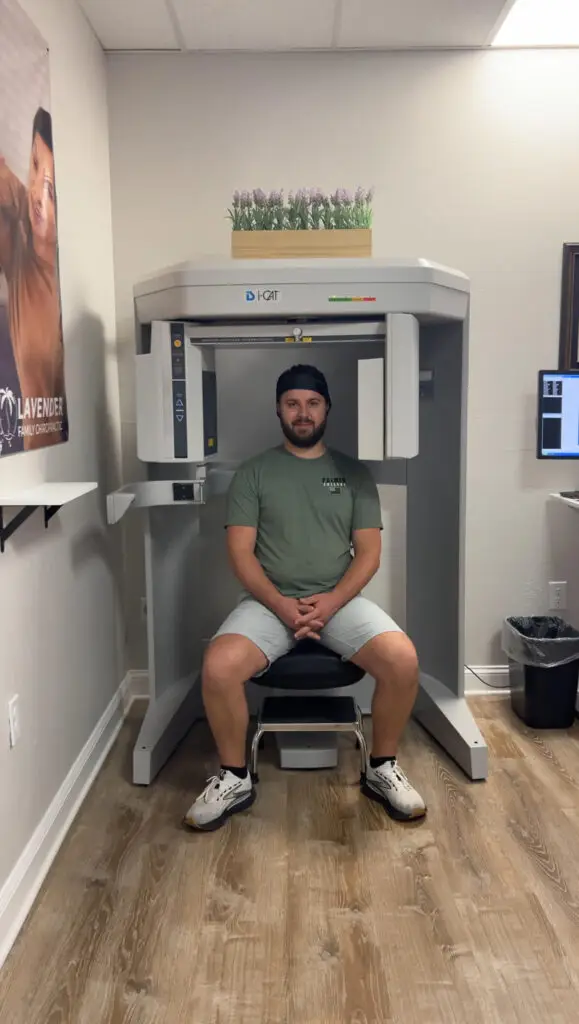
When it’s appropriate to proceed, we use 3D CBCT imaging to measure your upper cervical alignment in three dimensions, and paraspinal infrared thermography to read how your nervous system is behaving along the spine — particularly useful in a condition defined by autonomic dysregulation. From those findings we calculate a correction specific to you, delivered with the low-force Knee Chest technique, and we pace care gently, because an over-revved nervous system does better with slow, spaced care than aggressive loading.
We work from customized care plans built around your findings, and we’re honest about scope. Upper cervical care does not cure POTS, and it is not a substitute for the medical evaluation and management this condition requires. Please keep working with your cardiologist, neurologist, or autonomic specialist; keep taking your prescribed medications; and keep up your salt, fluids, and reconditioning. What we offer is attention to the cervical and craniocervical contribution — the piece that’s so often missing — coordinated with your medical team. For patients with significant hypermobility or suspected craniocervical instability, that coordination is especially important, and we’ll tell you plainly when your situation calls for a specialist.
→ If you’re living with POTS and want a careful look at the upper cervical piece of the puzzle, call Lavender Family Chiropractic at (941) 243-3729 or schedule a consultation online. We’re at 5899 Whitfield Avenue, Suite 107, Sarasota, FL 34243 — at the corner of University and Whitfield.
What the Research Says
Here’s the peer-reviewed evidence behind POTS and its connections.
The 2015 Heart Rhythm Society expert consensus statement on postural tachycardia syndrome is a foundational reference on how POTS is defined, diagnosed, and managed — the heart-rate criteria, the phenotypes, and the first-line role of fluids, salt, compression, and reconditioning, along with medications for appropriate patients. It anchors the medical framework that any good POTS plan is built on.
A narrative review of POTS and its associated conditions and management strategies catalogs how frequently POTS travels with hypermobile Ehlers-Danlos syndrome, mast cell activation, and autoimmune features, and reviews the tiered approach to management. It underscores that POTS is rarely an isolated problem — it clusters with connective-tissue and immune conditions.
A study of postural tachycardia syndrome in 102 adults with hypermobile Ehlers-Danlos syndrome and hypermobility spectrum disorder documented POTS on tilt-table testing in roughly half of those assessed, along with high rates of other forms of orthostatic intolerance — powerful evidence of how tightly hypermobility and POTS are linked.
A review of how long COVID and hypermobility spectrum disorders share pathophysiology describes the overlapping mechanisms connecting connective-tissue laxity, dysautonomia, mast cell activation, and post-viral illness — relevant to the wave of post-COVID POTS now being recognized.
Finally, research on the brainstem control of the baroreflex and cardiovascular regulation details how the lower brainstem coordinates heart rate and blood-vessel tone — the control center that sits in the region the upper cervical spine surrounds.
Two honest points about this evidence. First, the associations are strong: POTS is well-defined, and its links to hypermobility, connective tissue, and post-viral illness are well documented. Second, the direct research on upper cervical chiropractic care specifically for POTS is limited and still developing — it consists largely of mechanism and case-level observation rather than large trials. We think the responsible way to present this is exactly that: the mechanism is sound, the structural overlap is real and well-supported, and the upper cervical spine is a legitimate, under-evaluated factor — not a promised outcome. We’re telling you why it’s worth examining, not overstating what the science has yet shown.
Lifestyle and Self-Care for POTS
Daily strategy is central to living with POTS, and the best results usually come from working several angles at once. Coordinate specifics with your physician, since the right mix depends on your phenotype.
Fluids and salt, as directed. Most POTS patients are guided to increase water and salt intake substantially to expand blood volume. Your physician will set the targets; in the Florida heat, hydration is even more critical.
Compression. Waist-high compression garments reduce blood pooling in the legs and abdomen and can meaningfully ease symptoms on standing.
Recondition gradually, starting reclined. Exercise is one of the most effective long-term tools in POTS, but it has to start in a position that doesn’t provoke symptoms — recumbent cycling, rowing, or swimming — and build slowly. Pushing too hard too soon backfires, so pacing is everything.
Work the vagal “brake.” Slow diaphragmatic breathing, long exhalations, and calm, paced activity nudge the nervous system toward its rest-and-regulate state — the opposite of the revved-up sympathetic drive POTS patients live in.
Manage heat, meals, and mornings. Heat, large carbohydrate-heavy meals, and the transition out of bed are common triggers. Cooling strategies, smaller meals, and rising slowly all help.
Mind your neck and posture. Given the craniocervical connection, sustained forward-head posture and neck strain add load to the very region involved. For more on the autonomic and vagal side of this picture, see our companion overview of vagus nerve dysfunction and upper cervical care, and our deeper discussion of dysautonomia and POTS.
Serving Sarasota and Surrounding Communities
Lavender Family Chiropractic is located at 5899 Whitfield Avenue, Suite 107, Sarasota, FL 34243 — at the corner of University and Whitfield, minutes from downtown Sarasota, Lakewood Ranch, and Bradenton.
We serve patients from across the region, including Sarasota, Bradenton, Lakewood Ranch, Venice, Palmer Ranch, Osprey, Siesta Key, Longboat Key, Lido Key, University Park, Parrish, Ellenton, Myakka City, Punta Gorda, and St. Petersburg. Because POTS is so often misunderstood and the cervical component so rarely evaluated, patients frequently travel a considerable distance to be looked at by someone who takes both seriously — though we’re always mindful that travel itself can be a real burden for POTS patients, and we structure care accordingly.
Top 15 Questions We Hear About POTS
Which specialist treats POTS in Sarasota? POTS is diagnosed and managed by a cardiologist or neurologist, ideally one with autonomic experience, using a tilt-table or active stand test; your medical team manages medication, fluids and exercise. An upper cervical chiropractor addresses the craniocervical contribution to autonomic dysfunction, the position of the atlas around the brainstem that houses the autonomic centers. Keep your cardiologist. Our role in Sarasota is to measure the one structural input that workup does not include and to correct it when it is off.
Is POTS a real, physical condition? Yes. POTS is a measurable disorder of the autonomic nervous system, diagnosed with defined heart-rate criteria on standing or tilt-table testing. It is not anxiety, though it is frequently misattributed to it.
Can upper cervical care cure POTS? No, and we don’t claim it can. It addresses the cervical and craniocervical contribution to autonomic dysfunction — often the unexamined piece — as part of a broader plan led by your medical team.
Should I still see a cardiologist or neurologist? Absolutely. POTS needs proper medical diagnosis and management. We work alongside your physicians, never in place of them.
What actually causes POTS? It’s multifactorial. Common triggers and associations include viral illness (including long COVID), hypermobility and hEDS, autoimmune factors, concussion, and periods of prolonged illness or deconditioning. Often several factors combine.
Why does standing make everything worse? Standing pulls blood into the lower body, and in POTS the autonomic reflex that should compensate misfires — so the heart races and the brain briefly gets less blood flow, producing dizziness, fog, and fatigue.
I have hypermobility or hEDS — is that connected? Very likely. Hypermobility is strongly associated with POTS, and the connective-tissue laxity involved can affect the ligaments at the craniocervical junction, which is one reason the upper neck is worth evaluating in hypermobile patients.
Could my POTS be from long COVID? Post-viral POTS, including after COVID, is now widely recognized. The mechanisms overlap with those seen in hypermobility and dysautonomia more broadly.
What does my neck have to do with my heart rate? The brainstem centers that regulate heart rate and blood pressure, and the origin of the vagus nerve, sit in the region the atlas and axis surround. Mechanical stress there can interfere with autonomic regulation.
Is the adjustment safe if I’m hypermobile? The forceful, twisting manipulation people picture is not what we do. Our Knee Chest technique is a precise, low-force correction with no twisting or thrusting, which is specifically why it’s suited to sensitive and hypermobile patients — after careful evaluation.
Will I have to stop my medications or salt and fluids? No. Keep everything your physician has prescribed. Upper cervical care is complementary, not a replacement, and medication decisions belong to your prescriber.
How long until I might notice a difference? It varies widely. Some notice changes over a few weeks; others improve gradually or partially; some don’t respond meaningfully. We’re honest about what we see as we go, and we pace care gently.
Do you take insurance? We’re a cash-pay, out-of-network office and don’t bill insurance directly. We provide superbills you can submit to your insurance for possible out-of-network reimbursement, depending on your plan.
Can POTS get better over time? Many people improve substantially with a consistent, multi-angle plan — medical management, reconditioning, lifestyle strategy, and addressing contributing factors like the cervical component. It often takes patience and a team.
When should I seek urgent care? Fainting that causes injury, chest pain, or severe new symptoms warrant prompt medical attention rather than waiting.
How do I get started? Call (941) 243-3729 or book online for a consultation. We’ll review your history, evaluate the upper cervical contribution, and be honest about whether upper cervical care is a reasonable part of your plan and what else may help.
You Deserve to Be Taken Seriously
POTS is one of the most dismissed conditions in medicine. Patients spend years being told their tests look fine, being handed an anxiety diagnosis, and being left to manage a genuinely disabling illness on their own. If that’s been your experience, we want you to know your symptoms are real, they have a physiological basis, and there is more to look at than you may have been offered.
For a meaningful share of people with POTS — especially those who are hypermobile — the upper cervical spine sits at the crossroads of the whole problem: it surrounds the brainstem’s autonomic control center, and it’s the junction most affected by the connective-tissue laxity that so often accompanies POTS. Addressing it, alongside good medical care, can be part of a picture that finally moves.
Call (941) 243-3729 or schedule online to book a consultation with Dr. Rusty Lavender. We’re located at 5899 Whitfield Avenue, Suite 107, Sarasota, FL 34243, at the corner of University and Whitfield. Let’s look at the piece of your POTS that starts at the top of your neck.
Related Articles
- What Is POTS?
- POTS Care in Sarasota
- Dysautonomia and POTS
- Dysautonomia in Sarasota
- Hyperadrenergic POTS and Upper Cervical Care
- The Root Cause of Dysautonomia
- Orthostatic Hypotension
- Vasovagal Syncope and Fainting
- The hEDS-POTS-CCI Connection
- The Post-Trauma Cascade
- The Brainstem Connection
- Why Am I Lightheaded? POTS, Vertigo, and Dysautonomia
- Long COVID, Dysautonomia, and the Upper Neck
- POTS vs Anxiety: Why POTS Is So Often Misdiagnosed
- POTS and Exercise Intolerance: Why Standing and Activity Are So Hard
- Cervicogenic Autonomic Dysfunction: When Your Neck Drives Dizziness and a Racing Heart
- How to Approach Dysautonomia: Real Answers From Upper Cervical Care
- Dysautonomia and Atlas Misalignment: The Brainstem Connection