The hEDS–POTS–CCI Trifecta Connection: Why Hypermobility, Dysautonomia, and Craniocervical Instability Travel Together
By Dr. Rusty Lavender, D.C. — upper cervical chiropractor, Lavender Family Chiropractic, Sarasota, FL. Reviewed and updated October 2026.
The Trifecta: There is a particular kind of patient story we hear again and again in our Sarasota office, and it usually starts with a folder. Not a metaphorical folder — an actual one, thick with printouts, tilt-table results, MRI discs, geneticist letters, and a running list of specialists seen across three states. This is the patient who, over years, has quietly become a collector of diagnoses. First came the double-jointed knees and shoulders that dislocated too easily in childhood. Then came the fainting, the racing heart on standing, the exhaustion that no amount of sleep touched. Somewhere along the way a doctor mentioned Ehlers-Danlos. Later, another mentioned POTS. And more recently, someone raised the possibility of instability in the upper neck — a phrase that sounded frightening precisely because no one seemed to know quite what to do about it.
If that folder sounds familiar, you are not imagining the pattern. Hypermobile Ehlers-Danlos syndrome (hEDS), postural orthostatic tachycardia syndrome (POTS), and craniocervical instability (CCI) show up together far more often than random chance would predict. Patients living with one are statistically more likely to be living with the others, and they frequently share the same waiting rooms, the same support groups, and the same frustrating experience of being told that all their labs look “normal.”
This article is a connector. Rather than treating each of these conditions as a separate island, we want to explain why they cluster — why hypermobility, dysautonomia, and instability at the top of the neck seem to travel as a group. The short version is that they share a common thread of tissue and a common physical crossroads: the craniocervical junction, where the skull meets the spine. The longer version is worth your time, because understanding the connection is the first step toward assembling the coordinated care team these conditions genuinely require.
A word before we begin. hEDS, POTS, and CCI are serious, real, physician-diagnosed conditions. Nothing here is a substitute for medical evaluation and care. Upper cervical chiropractic does not cure any of them. What careful upper cervical care can do — as one member of a larger team — is address the mechanical contribution of the upper neck in coordination with your physicians. Keep that framing in mind throughout, and if you experience red-flag neurological symptoms, treat them as the medical emergencies they may be.
Meet the Trifecta: hEDS, POTS, and CCI
Before we connect the dots, let us define each point on the triangle.
Hypermobile Ehlers-Danlos syndrome (hEDS) is a genetic connective-tissue disorder. Connective tissue — largely collagen — is the body’s structural scaffolding. It is in your skin, your blood vessel walls, your gut, and, crucially for this discussion, your ligaments. In hEDS and the closely related hypermobility spectrum disorders (HSD), that scaffolding is more elastic and less structurally supportive than it should be. Joints move beyond their normal range, injure easily, and rely on muscles to do stabilizing work that ligaments were supposed to handle. hEDS is diagnosed clinically by a geneticist or rheumatologist using established criteria; there is not yet a single confirmatory gene test for the hypermobile subtype, which is part of why so many patients spend years undiagnosed.
Postural orthostatic tachycardia syndrome (POTS) is a form of dysautonomia — a malfunction of the autonomic nervous system, the automatic control system that runs heart rate, blood pressure, digestion, and temperature without your conscious input. In POTS, standing up triggers an abnormal surge in heart rate, often with lightheadedness, palpitations, brain fog, fatigue, and sometimes fainting. POTS is a cardiology and neurology diagnosis, frequently confirmed with a tilt-table test that measures how heart rate and blood pressure respond to changes in position. You can read more about how we think about this condition on our POTS resource page.
Craniocervical instability (CCI) describes excessive movement between the skull, the first vertebra (the atlas, or C1), and the second vertebra (the axis, or C2). This is the most ligament-dependent joint complex in the entire spine. Unlike the lower back, which has large interlocking bones and thick discs, the upper neck relies heavily on ligaments to hold the head in a safe relationship with the brainstem. When those ligaments are lax, the head can shift in ways that stress delicate structures. CCI can be a neurosurgical concern in severe cases, and it is evaluated with specialized imaging. Our dedicated craniocervical instability page walks through this in more depth, and we discuss the specific overlap on our CCI and Ehlers-Danlos syndrome page.
Three conditions, three different specialties, three different diagnostic tests. On paper they look unrelated. In the body, they are anything but.
Why They Travel Together: The Connective-Tissue-to-Brainstem Chain
Here is the central mechanism — the reason this article exists. Follow the chain link by link.
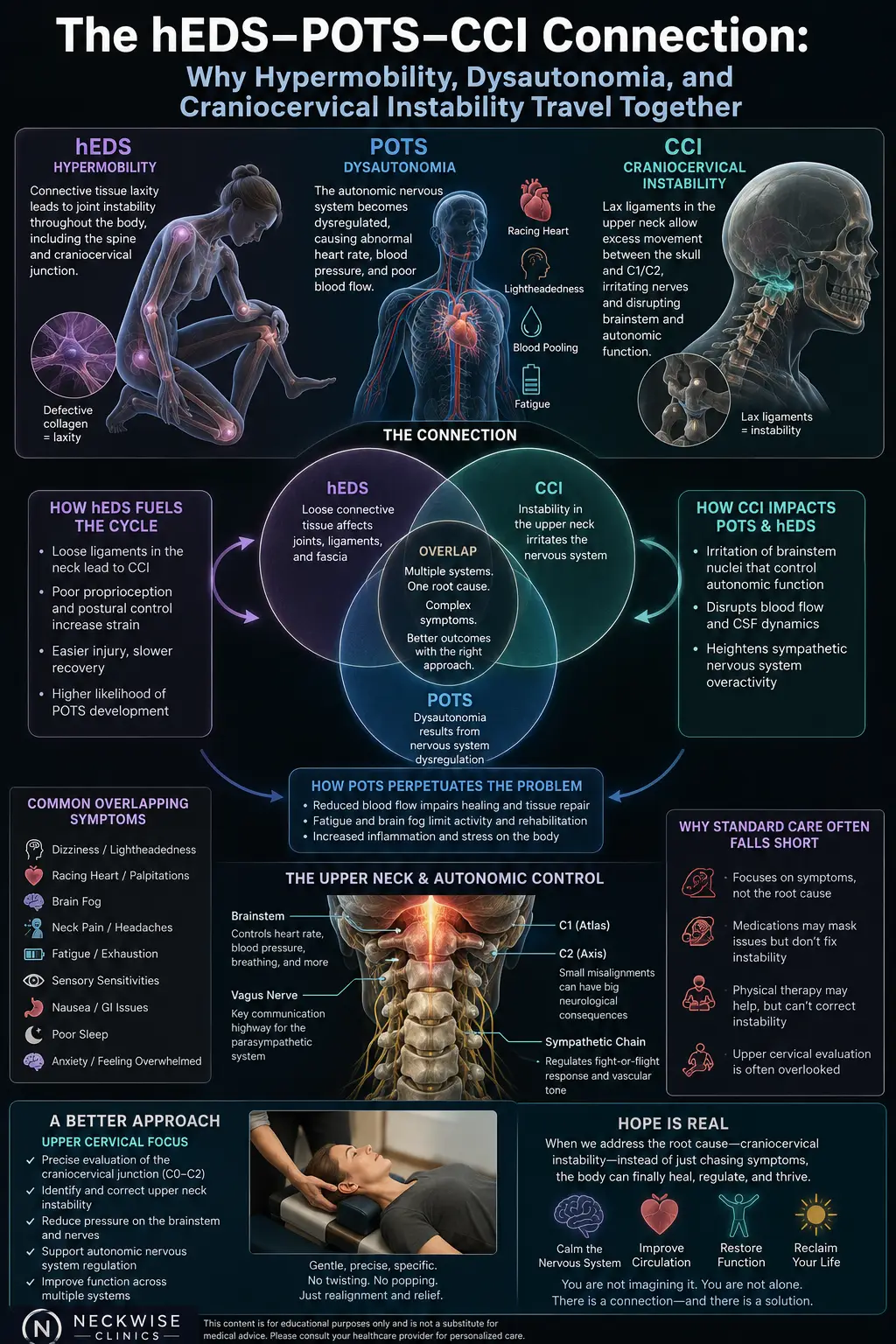
Link one: the genetic tissue problem. hEDS is, at its root, a problem of connective tissue. Collagen is the material your ligaments are made from. When collagen is lax and stretchy throughout the body, it is lax and stretchy in ligaments everywhere — including the specialized ligaments of the upper neck.
Link two: ligament laxity concentrates where ligaments matter most. Most joints in the body have bony architecture and muscle to fall back on when ligaments are loose. The craniocervical junction does not have that luxury. The atlas is essentially a ring of bone balancing the skull, and the whole arrangement depends on ligaments — the alar ligaments, the transverse ligament, the tectorial membrane — to keep the head from sliding, tilting, or rotating too far. If your foundational ligament tissue is more elastic than it should be, this is precisely the region where that laxity has the most consequential effect. In other words, systemic hypermobility naturally predisposes the upper neck to instability. That is the hEDS-to-CCI link, and it is why these two conditions are so tightly bound.
Link three: mechanical stress reaches the brainstem and autonomic centers. The brainstem and the upper spinal cord pass directly through the craniocervical junction. This is not distant real estate — it is the neurological command center for automatic functions. The brainstem houses the nuclei that regulate heart rate and blood pressure, and it is the origin of the vagus nerve, the long wandering nerve that carries the majority of your body’s parasympathetic “rest and digest” signaling. When the upper neck is unstable, the theory is that abnormal movement and positional stress on this region can irritate or mechanically load these structures. You can read our overview of how the vagus nerve fits into this picture on our vagus nerve dysfunction page.
Link four: autonomic centers under mechanical stress may express as dysautonomia. If the autonomic control structures at the craniocervical junction are being mechanically loaded by an unstable upper neck, it is not a leap to imagine downstream effects on autonomic regulation — the very kind of dysregulation that shows up clinically as POTS and other forms of dysautonomia. This is the proposed CCI-to-POTS link, and it closes the loop: hypermobile tissue predisposes to upper cervical instability, and upper cervical instability sits precisely where the body’s autonomic wiring is most exposed.
So the full chain reads: genetic connective-tissue laxity (hEDS) → ligament instability concentrated at the ligament-dependent upper neck (CCI) → mechanical stress on the brainstem and autonomic centers → dysautonomia (POTS).
It is important to be honest about the state of the science here. Not every link in this chain is established with the same certainty, and researchers are still actively working out how much of the POTS seen in hypermobile patients is driven by cervical mechanics versus blood-volume regulation, small-fiber nerve changes, or other mechanisms. Dysautonomia in hEDS is almost certainly multifactorial. But the anatomical logic is compelling, the statistical clustering is well documented, and the upper cervical spine keeps emerging as the physical location where all three conditions intersect. That intersection is what we want to examine next.
The Upper Cervical Junction: Where the Trifecta Meets
If you wanted to design a single anatomical location where a connective-tissue disorder, an instability problem, and an autonomic disorder could all converge, you could hardly do better than the craniocervical junction.
Consider what is packed into this small space. The skull rests on the atlas, a delicate bony ring with no disc beneath it and no interlocking joint surfaces to lend stability. Immediately below sits the axis, whose upward-pointing peg (the dens) is held in place against the front of the atlas ring by a single strap of tissue, the transverse ligament. The alar ligaments tether the skull to the axis and limit rotation. Threading through the center of it all is the brainstem transitioning into the spinal cord, surrounded by cerebrospinal fluid, with major blood vessels and the roots of the vagus nerve nearby.
This region is a masterpiece of engineering when the ligaments are strong. When the ligaments are lax — as they systemically are in hEDS — the same region becomes a vulnerability. The head is heavy, gravity is relentless, and the muscles of the neck must work overtime to compensate for the stabilization the ligaments are no longer providing. Over years, that compensation is exhausting and imperfect, and it can allow the kinds of small positional shifts that characterize CCI.
This is why we lead with the upper cervical spine as the crossroads of the trifecta. It is the one place where all three narratives — the tissue story of hEDS, the mechanical story of CCI, and the autonomic story of POTS — physically overlap. A patient’s collagen may be the root cause, and their autonomic symptoms may be the loudest complaint, but the craniocervical junction is where those two ends of the chain shake hands.
Our approach to imaging this region reflects that priority. We use 3D cone-beam CT (CBCT) to see the actual bony relationships of the atlas and axis with precision, and Tytron thermographic scanning to assess patterns of autonomic and neurological activity along the spine. The goal is not to diagnose hEDS or POTS — those are medical diagnoses made by the appropriate specialists — but to understand, in your specific anatomy, what the upper cervical spine is doing and whether it may be contributing to your overall picture.
The Extended Family: Fibromyalgia, ME/CFS, MCAS
The trifecta rarely travels alone. Spend time in the hypermobility community and you will notice the same additional names surfacing again and again. Three of them deserve mention because they round out the clinical picture so consistently.
Fibromyalgia is a disorder of widespread pain and heightened pain sensitivity, often accompanied by fatigue and sleep disturbance. Its overlap with hypermobility is striking, and it may share upstream mechanisms involving the nervous system’s processing of pain and threat. We explore this on our fibromyalgia page. Many patients who carry an hEDS diagnosis also meet fibromyalgia criteria, and it can be difficult to tell where one condition’s symptoms end and the other’s begin.
Myalgic encephalomyelitis / chronic fatigue syndrome (ME/CFS) is defined by profound, disabling fatigue that is not relieved by rest and characteristically worsens after exertion — a phenomenon called post-exertional malaise. The autonomic dysfunction seen in POTS and the deep fatigue of ME/CFS overlap heavily, and many patients qualify for both labels. Our chronic fatigue syndrome resource discusses how we think about the cervical contribution to this exhausting condition.
Mast cell activation syndrome (MCAS) rounds out what some clinicians informally call the “trifecta plus” or the hypermobility cluster. Mast cells are immune cells that release histamine and other inflammatory mediators; in MCAS they release those mediators inappropriately, causing flushing, hives, gut symptoms, and reactions to foods, temperature, or stress. MCAS appears with notable frequency alongside hEDS and POTS, and while the reason for the association is still being untangled, the co-occurrence is well recognized in the literature on POTS management.
Why do these extended-family conditions matter for a connector article about the upper neck? Because they reinforce the same lesson: these are not isolated diseases but an interconnected cluster that shares connective-tissue, autonomic, and inflammatory threads. Understanding the cluster helps you and your medical team stop chasing symptoms in silos and start seeing the pattern. And it explains why a patient can accumulate half a dozen diagnoses over a decade without anyone ever explaining how they fit together.
How Precise Upper Cervical Care Fits
Given everything above, where does chiropractic care responsibly fit — and where does it not?
Let us be clear about what it does not do. Upper cervical care does not cure hEDS; hEDS is genetic and lifelong, and no adjustment changes your collagen. It does not cure POTS or replace the cardiology and neurology care that condition requires. It does not repair unstable ligaments or substitute for the neurosurgical evaluation that significant CCI may warrant. Anyone who tells you otherwise is not being straight with you.
What careful upper cervical care can do is address the mechanical contribution of the upper neck — the one node in the chain that is physically accessible and potentially modifiable. If the craniocervical junction is misaligned and adding mechanical stress to an already vulnerable region, the aim of care is to help the head sit in a more neutral, better-supported relationship to the atlas, so the surrounding structures are under less positional strain.
The way we go about this matters enormously in a hypermobile population. Patients with lax connective tissue do not need force; force is the last thing an unstable upper neck needs. That is why we use the Knee Chest Upper Cervical technique, a precise, low-force approach. It is not high-velocity manipulation — there is no twisting, cracking, or aggressive thrusting of the neck. The correction is specific, gentle, and guided by your individual imaging. For hypermobile patients in particular, this careful, measured approach is central to how we practice. You can learn more about the philosophy on our upper cervical chiropractic care page.
Equally important is the word “coordinated.” We see our role as one member of a team that should also include your geneticist or rheumatologist, your cardiologist or neurologist, and — where appropriate — a neurosurgeon and physical therapist experienced with hypermobility. We are glad to work alongside your existing physicians, and we structure care to complement, not replace, the medical management the trifecta requires. Every plan is customized to the individual, because no two folders on that thick stack of records ever look quite the same.
If you are wondering whether the upper neck is part of your particular puzzle, we would welcome a conversation. You can call our office at (941) 243-3729, reach us through our contact page, or book a consultation with our doctors. We are located at 5899 Whitfield Avenue, Suite 107, Sarasota, FL 34243, on the corner of University and Whitfield, and we serve patients from across the region. A first conversation is simply that — a chance to understand your history and determine whether upper cervical evaluation makes sense for you.
What the Research Says
We want to be careful and accurate about the evidence, because this is an area where enthusiasm sometimes outruns data. Here is what a handful of well-conducted studies actually show.
First, the link between hypermobility and POTS is well documented. A study of 102 adults with hEDS and hypermobility spectrum disorders found that roughly 48 percent had POTS confirmed on tilt-table testing — a strikingly high prevalence that underscores how commonly dysautonomia accompanies hypermobility. This is one of the clearest demonstrations that the hEDS-POTS association is real and quantifiable, not anecdotal.
Second, the connection between Ehlers-Danlos syndrome and craniocervical instability is supported by a systematic review of craniocervical instability in Ehlers-Danlos syndrome. By gathering and evaluating the available studies, this review documents how instability at the upper neck occurs in the EDS population and reflects the ligamentous laxity that characterizes the disorder — directly supporting the hEDS-to-CCI link at the heart of this article.
Third, the broader clustering pattern has been reinforced by recent work on Long COVID. A paper examining how Long COVID and hypermobility spectrum disorders share pathophysiology highlights the overlap of hypermobility across POTS, fibromyalgia, and ME/CFS, and points toward shared underlying mechanisms among these frequently co-occurring conditions. It is a useful window into why the “extended family” travels together.
Fourth, the overlap with fibromyalgia and a long list of other conditions is substantial. A study describing the high overlap of hEDS and HSD with fibromyalgia and 40 comorbidities catalogs just how many other health problems tend to accompany hypermobility — reinforcing that we are dealing with a systemic, multi-system picture rather than an isolated joint issue.
Fifth, for a clinician’s-eye synthesis, a narrative review of POTS walks through the associated conditions — including hEDS and MCAS — and the range of management strategies. It situates POTS within exactly the cluster this article describes and offers a grounded overview of how the condition is approached medically.
Taken together, these studies establish the clustering and the associations firmly. They do not prove that correcting an upper cervical misalignment resolves POTS or reverses hEDS, and we would never claim they do. What they support is the reasonableness of taking the craniocervical junction seriously as part of the picture, and of pursuing coordinated, multidisciplinary care.
What to Do If You Suspect the Trifecta
If you read the opening description of the diagnosis-collector and felt a jolt of recognition, here is a practical sequence for moving forward. The theme throughout is: get proper diagnoses from the proper specialists first.
Start with the genetic and connective-tissue question. If you have a lifelong history of loose, easily-injured joints, stretchy or fragile skin, and a family history of similar traits, ask about evaluation for hEDS or hypermobility spectrum disorder. This is the domain of a geneticist or a rheumatologist, who can apply the formal diagnostic criteria. A clear diagnosis here often reframes everything that follows.
Pursue the autonomic evaluation. If standing makes your heart race, if you faint or feel faint, if brain fog and fatigue and palpitations dog your days, ask your physician about referral to cardiology or neurology for autonomic testing. A tilt-table test is the standard way to confirm POTS. Do not try to self-diagnose dysautonomia from a home heart-rate monitor alone; get the formal workup.
Take instability seriously and image it properly. If you have upper neck pain, headaches at the base of the skull, a sense that your head is “too heavy” for your neck, or neurological symptoms that worsen with certain head positions, the craniocervical junction deserves attention. Significant CCI is a medical and sometimes neurosurgical matter, evaluated with specialized imaging. This is where an upper cervical practice using 3D CBCT can contribute to the mechanical picture, in coordination with your medical team.
Assemble a team, not a single savior. The trifecta is too complex for any one provider to manage alone. The strongest outcomes we see come from patients who build a coordinated team — specialists for diagnosis and medical management, and supportive practitioners like ours for the mechanical, cervical piece — all communicating.
Know the red flags. Certain symptoms are not for watchful waiting. Sudden or severe worsening of neurological function, new weakness or numbness in the limbs, difficulty swallowing or speaking, loss of bowel or bladder control, severe unrelenting headache, fainting with injury, or any symptom that frightens you — these warrant urgent medical care, not a chiropractic appointment. When in doubt, seek emergency evaluation. Upper cervical care is for stable situations managed alongside your physicians, never a replacement for emergency care.
Serving Sarasota and Surrounding Communities
Lavender Family Chiropractic is proud to serve patients throughout the Suncoast and beyond. Our office in Sarasota welcomes people traveling from Bradenton, Lakewood Ranch, Venice, Palmer Ranch, Osprey, Siesta Key, Longboat Key, Lido Key, and University Park, as well as those coming from Parrish, Ellenton, Myakka City, Punta Gorda, and St. Petersburg. Because the conditions in this cluster are relatively uncommon and often poorly understood, patients frequently travel a fair distance to find a practice that focuses specifically on the upper cervical spine. If you are anywhere in the region and the story in this article resonates, we are within reach at (941) 243-3729.
Top 12 Questions
1. Can upper cervical care cure my hEDS, POTS, or CCI? No. hEDS is genetic, and none of these conditions is cured by chiropractic care. Our role is to address the mechanical contribution of the upper neck in coordination with your medical team, not to replace medical treatment.
2. Should I see a geneticist or rheumatologist about hypermobility? Yes. hEDS and hypermobility spectrum disorder are clinical diagnoses made by a geneticist or rheumatologist using established criteria. That evaluation should come first.
3. Should I see a cardiologist or neurologist about POTS? Yes. POTS is a medical diagnosis typically confirmed with a tilt-table test through cardiology or neurology. Please pursue that workup rather than self-diagnosing.
4. What kind of doctor evaluates craniocervical instability? Significant CCI is evaluated by physicians and, in serious cases, neurosurgeons, using specialized imaging. Our practice contributes to the mechanical picture with 3D CBCT and works alongside your medical providers.
5. Is your technique safe for someone with lax, hypermobile ligaments? Our Knee Chest Upper Cervical technique is precise and low-force. It is not high-velocity manipulation — there is no twisting or cracking of the neck. This gentle, specific approach is central to how we care for hypermobile patients.
6. Do you take insurance? We are a cash-pay, out-of-network practice. We provide superbills you can submit to your insurance company for possible out-of-network reimbursement, depending on your individual plan.
7. What is a superbill? A superbill is an itemized receipt of the care you received, coded so that you can submit it to your insurer for potential reimbursement. We are happy to provide these.
8. How is care structured — do I have to commit to a large upfront plan? We build customized care plans tailored to the individual. Care is designed around your specific needs and imaging, not a one-size-fits-all arrangement.
9. What imaging do you use, and why? We use 3D cone-beam CT to see the precise bony relationships at the upper neck, and Tytron thermography to assess neurological patterns along the spine. This lets us understand your specific anatomy before any care.
10. Can you tell me whether I have hEDS or POTS? No — those diagnoses belong to the appropriate medical specialists. Our imaging assesses the upper cervical spine; it does not diagnose genetic or autonomic conditions.
11. Which symptoms mean I should skip the chiropractor and seek urgent care? New or worsening limb weakness or numbness, trouble swallowing or speaking, loss of bowel or bladder control, severe unrelenting headache, or fainting with injury are red flags that call for urgent medical evaluation, not a chiropractic visit.
12. What happens at a first visit? It begins with a consultation with our doctors — a conversation about your history and goals — to determine whether upper cervical evaluation is appropriate for you. There is no pressure and no obligation.
Closing
The patient with the thick folder is not a hypochondriac, and they are not imagining connections that are not there. Hypermobility, dysautonomia, and craniocervical instability really do travel together, bound by shared connective tissue and united at the physical crossroads of the upper neck. Understanding that pattern does not make any single condition disappear, but it can transform a scattered collection of diagnoses into a coherent story — and a coherent story is something you and a coordinated care team can finally act on.
If you suspect the trifecta is part of your life, we would be honored to be one voice on your team. Call us at (941) 243-3729, visit our contact page, or book a consultation with our doctors. You will find us at 5899 Whitfield Avenue, Suite 107, Sarasota, FL 34243, on the corner of University and Whitfield. Bring the folder. We would love to help you make sense of it, gently and in coordination with the physicians who know you best.
Related Articles
Related Posts


Get our upper cervical articles first.