Trigeminal Neuralgia Treatment in Sarasota, Florida
Trigeminal Neuralgia can produce some of the worst possible pain. This condition greatly affects how someone will live their life due to the stabbing, electric pain in the facial region. Our Clinic in Sarasota Florida is well versed to help those dealing with Trigeminal Neuralgia.
Trigeminal Neuralgia in Sarasota, Florida: Understanding the Condition and the Supportive Role of Precise Upper Cervical Care
By Dr. Rusty Lavender, D.C. and Dr. Jacob Temple, D.C. — upper cervical chiropractors, Lavender Family Chiropractic, Sarasota, FL. Reviewed and updated October 2026.
In short: Trigeminal neuralgia is a facial pain condition that produces sudden, electric-shock-like pain along the trigeminal nerve, usually on one side of the face and triggered by light touch, chewing, or talking. At Lavender Family Chiropractic in Sarasota, FL, Dr. Rusty Lavender evaluates the upper cervical spine, where the trigeminal nerve’s sensory nucleus extends into the upper spinal cord, and provides gentle, no-twisting upper cervical corrections as conservative care alongside neurological management. An upper cervical evaluation is available at our Sarasota office at University Parkway and Whitfield Avenue.
| Condition | Trigeminal neuralgia (classic/Type 1 and atypical/Type 2) |
|---|---|
| Common symptoms | Sudden electric or stabbing facial pain, usually one-sided, triggered by touch, chewing, talking or wind; constant burning or aching in Type 2 |
| Upper neck connection | The spinal trigeminal nucleus descends into the upper cervical spinal cord at C1–C3; irritation at that level can heighten trigeminal pain processing |
| Who evaluates it in Sarasota | Dr. Rusty Lavender, D.C., upper cervical chiropractor at Lavender Family Chiropractic, 5899 Whitfield Ave #107, Sarasota, FL 34243 (941-243-3729) |
| What the evaluation involves | Health history, neurological and balance screening, examination of the upper cervical spine, and precise upright imaging of the atlas and axis to determine whether a measurable misalignment is present |
| Related pages | neurological diagnosis and imaging are reviewed; care is coordinated with the neurologist |
Trigeminal neuralgia is often described as one of the most severe pains a human being can experience. Patients use the same words again and again: electric, stabbing, lightning, like a hot knife or an ice pick driven into the face. The attacks can be triggered by something as small as a breeze on the cheek, a sip of cold water, brushing the teeth, a light touch while applying makeup, or simply speaking a sentence. Between attacks there may be nothing at all — and then, without warning, another jolt. It is exhausting, frightening, and isolating, and it can erode a person’s ability to eat, talk, sleep, and live normally.
If you are searching for answers, a few things should be clear from the first paragraph. Trigeminal neuralgia is a serious neurological condition. In most cases it deserves a proper medical diagnosis, and its first-line treatments are medical — specific medications and, for some patients, surgical procedures. No chiropractor can cure trigeminal neuralgia, and anyone who promises to make it vanish is not being truthful with you. What this guide will do instead is explain what trigeminal neuralgia actually is, why it happens, how it is properly diagnosed, and where careful, precise upper cervical chiropractic care may have a genuine, supportive role as one part of a larger plan — coordinated with your medical team, not in place of it.
At Lavender Family Chiropractic in Sarasota, we focus exclusively on the upper cervical spine — the atlas (C1), the axis (C2), and the junction where the skull meets the neck. Because of a well-documented anatomical relationship between the upper neck and the trigeminal system in the brainstem, this region is worth evaluating in many patients with facial pain. We use 3D CBCT imaging, paraspinal infrared thermography, and the low-force Knee Chest Upper Cervical technique. Let’s begin with what trigeminal neuralgia really is.
What Is Trigeminal Neuralgia?
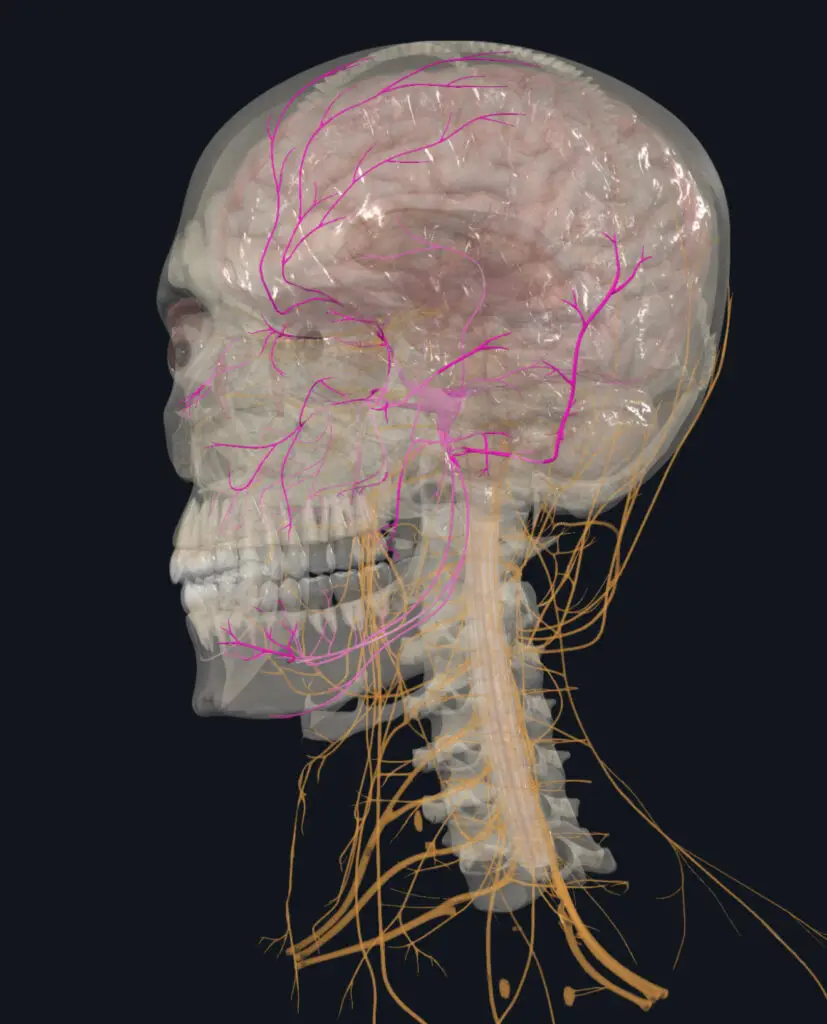
Trigeminal neuralgia (TN) is a chronic pain condition affecting the trigeminal nerve — the fifth cranial nerve — which carries sensation from the face to the brain. The trigeminal nerve has three branches: the ophthalmic branch (forehead and around the eye), the maxillary branch (cheek, upper jaw, upper teeth), and the mandibular branch (lower jaw, lower teeth, part of the ear). Trigeminal neuralgia most often affects the maxillary and mandibular branches, which is why so many patients first suspect a dental problem and undergo dental work before the true cause is identified.
The hallmark of classical trigeminal neuralgia is paroxysmal pain: sudden, brief, shock-like attacks that last from a fraction of a second to about two minutes, usually on one side of the face. The pain is typically triggered by innocuous stimulation of specific “trigger zones” — light touch, chewing, talking, brushing the teeth, shaving, cold air, or even a smile. Some patients also develop a more continuous background aching or burning between the sharp attacks, a pattern sometimes described as concomitant continuous pain.
Clinicians often describe two clinical patterns. In the first, the pain is almost entirely paroxysmal — sharp, shock-like attacks with genuinely pain-free intervals in between. In the second, those attacks occur against a background of more constant aching, burning, or throbbing in the same region. The distinction matters because the two patterns can respond differently to treatment, and because a more continuous component sometimes points toward different underlying mechanisms. Understanding which pattern you have is part of building the right plan, and it is one of the many details we ask about during a thorough history.
Trigeminal neuralgia is not “just a bad toothache” or a psychological problem. It is a genuine neurological disorder, and it is more common than many people realize. A comprehensive systematic review and meta-regression of the global incidence and prevalence of trigeminal neuralgia, published in the Journal of Clinical Neurology, pooled data across more than 170 million people and reported an annual prevalence of roughly 45 cases per 100,000 people and a lifetime prevalence of about 108 per 100,000. It is more common in women than men, and the likelihood increases with age, most often appearing after age 50 — though it can occur earlier, particularly when there is an underlying condition driving it.
Modern classification, described in detail in the European Academy of Neurology guideline on trigeminal neuralgia, divides the condition into three categories. Classical TN is caused by neurovascular compression — a blood vessel pressing on the trigeminal nerve where it exits the brainstem — with visible changes to the nerve. Idiopathic TN has no clearly identifiable cause. Secondary TN is caused by an underlying condition such as multiple sclerosis or a tumor pressing on the nerve. This distinction is not academic. It determines what care you need, and it is the reason a proper diagnosis matters so much.
The Trigeminal Nerve and Why the Pain Is So Severe
To understand trigeminal neuralgia, it helps to understand what makes the trigeminal nerve unique. It is the largest of the cranial nerves and the primary source of sensation for the face and much of the head. Its nerve fibers are wrapped in a fatty insulating layer called myelin, which allows nerve signals to travel quickly and cleanly.
In classical trigeminal neuralgia, the problem begins where the nerve exits the brainstem, at a vulnerable spot called the root entry zone. Here, a nearby blood vessel — most commonly the superior cerebellar artery — can press against the nerve. Over time, the constant pulsation of that vessel against the nerve can wear away the myelin insulation, a process called demyelination. When the insulation is damaged, nerve fibers that normally carry light-touch signals can begin to cross-talk with fibers that carry pain signals. The result is that a gentle stimulus — a breeze, a touch — gets misinterpreted by the nervous system as an explosive jolt of pain.
The role of neurovascular compression is well established in the imaging literature. A review of the imaging of neurovascular compression syndromes, including trigeminal neuralgia, describes how high-resolution MRI can visualize the point where a vessel contacts the nerve. And a study examining how neurovascular compression at the root entry zone correlates with trigeminal neuralgia and microvascular decompression outcomes found that severe compression, with actual distortion of the nerve, is far more common on the painful side than the pain-free side — helping to distinguish harmless contact from the kind that produces symptoms.
This is why the pain is so severe and so unlike ordinary pain. It is not inflammation of the skin or muscle. It is a short-circuit in one of the body’s most important sensory nerves, in which the normal rules of sensation break down and light touch becomes agony.
The Upper Neck and the Trigeminal System: The Trigeminocervical Connection
Here is where the upper cervical spine enters the story — and it is important to be precise, because this is the legitimate anatomical rationale for evaluating the neck in facial pain, without overstating what it means.
Deep in the brainstem, the sensory nucleus of the trigeminal nerve extends downward and merges with the sensory input from the upper cervical spinal nerves — the nerves of C1, C2, and C3. This shared region is called the trigeminocervical complex, or trigeminocervical nucleus. Because sensory signals from the upper neck and sensory signals from the face converge on the same pool of neurons, the nervous system can have difficulty distinguishing precisely where a signal originated. This convergence is the well-documented basis for referred pain between the neck and the head and face.
A 2025 scoping review on the integration of nociceptive activity from orofacial, cranial, and cervical regions in the trigeminocervical nucleus examined exactly this relationship, documenting how pain information from the face, head, and upper neck is integrated in this shared brainstem region and how that integration underlies the spread and referral of pain between these areas.
What does this mean for trigeminal neuralgia? It means that dysfunction, misalignment, or mechanical stress in the upper cervical spine can, in principle, feed into the same brainstem pool that processes trigeminal pain — potentially lowering the threshold at which the system fires, or contributing to the sensitization that makes symptoms worse. It does not mean the neck is the cause of classical trigeminal neuralgia, which is typically driven by neurovascular compression. Rather, the upper cervical spine may be a contributing or aggravating factor in some patients, and reducing that input is where careful upper cervical care may play a supportive role. We think it is important to state that distinction clearly rather than blur it.
Why the Upper Neck (Atlas and Axis) Is Worth Evaluating
The atlas (C1) and axis (C2) sit directly beneath the skull, at the top of the trigeminocervical convergence zone. Unlike the rest of the spine, the upper neck relies heavily on ligaments and dense arrays of position-sensing receptors rather than large interlocking bony structures. The suboccipital muscles here are packed with proprioceptive fibers that constantly report head position to the brainstem.
When the atlas or axis is misaligned, several things can follow. The suboccipital muscles tighten and guard. The nerves of C1 through C3 — which feed directly into the trigeminocervical complex — can be irritated. And the steady stream of distorted signals into the brainstem can contribute to a more sensitized, more reactive nervous system. For a patient whose facial pain is being amplified by this kind of upper cervical input, addressing the misalignment may reduce one of the aggravating factors.
Again, honesty matters here. This mechanism is real and documented, but it is one piece of a larger picture. Some patients with facial pain have a significant upper cervical component; others have almost none. A careful evaluation is what tells us which is which.
How Trigeminal Neuralgia Is Properly Diagnosed and Treated
This section matters as much as any other, because getting the diagnosis right is essential to getting the care right.
Trigeminal neuralgia is diagnosed clinically, based on the characteristic pattern of the pain, and then confirmed and classified with imaging. A high-resolution MRI is used to look for neurovascular compression and, critically, to rule out secondary causes such as multiple sclerosis or a tumor. As the European Academy of Neurology guideline emphasizes, this distinction between classical, idiopathic, and secondary trigeminal neuralgia guides everything that follows. Certain features — such as pain on both sides of the face, sensory loss, onset at a younger age, or other neurological signs — raise concern for a secondary cause and warrant thorough neurological workup.
First-line treatment for trigeminal neuralgia is medical. Anticonvulsant medications, particularly carbamazepine and oxcarbazepine, are the mainstay and are effective for many patients, at least initially. When medications stop working or cause intolerable side effects, several surgical and procedural options exist. Microvascular decompression is a neurosurgical procedure that relieves the pressure of the blood vessel on the nerve and offers durable relief for appropriately selected patients. Other options include stereotactic radiosurgery (such as Gamma Knife) and percutaneous procedures that target the nerve. These are decisions made with a neurologist and neurosurgeon.
We want to be clear about where we fit. Upper cervical chiropractic care is not a replacement for this medical pathway. If you have facial pain that has not been properly evaluated, the most important step is a medical diagnosis — not an adjustment. Where we can help is in evaluating and addressing the upper cervical component of your overall picture, in coordination with your medical providers.
Where Precise Upper Cervical Care Fits at Lavender Family Chiropractic
Let us start by clearing up a common misconception, because it matters here. What we do is not the forceful, high-velocity, twisting neck manipulation that many people picture when they hear the word “chiropractor.” The Knee Chest Upper Cervical technique is a precise, low-force correction — no twisting, no rotation, no forceful cracking. It is a specific, gentle impulse calculated from your individual imaging. For a nervous system that is already hypersensitive from facial pain, that gentleness is exactly the point.
Our approach rests on three commitments: measure precisely, proceed gently, and stay honest about what care can and cannot do.
Every relationship begins with a thorough consultation. We listen to your full history — the character and location of your pain, your triggers, your medical workup so far, any diagnosis you have received, and what has and has not helped. This is where we begin to understand whether your picture includes a meaningful upper cervical component and whether you have had the medical evaluation trigeminal neuralgia requires. If you have not, we will tell you that plainly. This consultation is how we start.
When it is appropriate to proceed, we use 3D CBCT imaging to measure your upper cervical alignment in three dimensions, and paraspinal infrared thermography to gauge how your nervous system is functioning along the spine. From these findings we calculate a correction specific to you, delivered with the low-force Knee Chest technique. We then give your body time to hold the correction and adapt, rather than adjusting reflexively at every visit.
We work from customized care plans built around your findings and your goals, and we are transparent about expectations — including that responses vary and that we see our role as one supportive part of your overall care. We are glad to work alongside your neurologist and other providers.
→ If you are living with facial pain and want a careful, honest evaluation of the upper cervical component, call Lavender Family Chiropractic at (941) 243-3729 or schedule a consultation online. We are located at 5899 Whitfield Avenue, Suite 107, Sarasota, FL 34243 — at the corner of University and Whitfield.
What the Research Says
We believe you deserve to see the evidence and understand its context. Here is what the peer-reviewed literature shows.
The European Academy of Neurology guideline on trigeminal neuralgia, published in the European Journal of Neurology in 2019, is the most authoritative modern reference on how trigeminal neuralgia is classified, diagnosed, and treated. It establishes the framework of classical, idiopathic, and secondary TN, emphasizes the need for MRI to identify neurovascular compression and rule out secondary causes, and outlines the medical and surgical treatments that form the backbone of care.
The systematic review and meta-regression of the global incidence and prevalence of trigeminal neuralgia, published in the Journal of Clinical Neurology, pooled data from more than 170 million individuals across multiple countries and decades. It reported an annual prevalence of roughly 45 per 100,000 and a lifetime prevalence of about 108 per 100,000, and noted that estimates rose after neuroimaging was incorporated into diagnostic criteria — underscoring how central proper imaging has become to identifying the condition.
A review of the imaging of neurovascular compression syndromes, including trigeminal neuralgia, details how high-resolution MRI visualizes the contact between a blood vessel and the trigeminal nerve, and how imaging helps distinguish harmless neurovascular contact from the symptomatic compression that produces pain.
A study on how neurovascular compression at the root entry zone correlates with trigeminal neuralgia and early microvascular decompression outcome found that severe compression — with actual distortion or displacement of the nerve — was far more common on the symptomatic side than the asymptomatic side, and related to surgical outcomes. This reinforces neurovascular compression as the dominant driver of classical TN.
Finally, a 2025 scoping review on the integration of nociceptive activity from orofacial, cranial, and cervical regions in the trigeminocervical nucleus documents the anatomical convergence between the upper neck and the trigeminal system in the brainstem — the basis for referred pain between the neck and face, and the rationale for evaluating the upper cervical spine as a potential contributing factor in facial pain.
Taken together, the research paints a clear picture: trigeminal neuralgia is a real, prevalent neurological condition most often driven by neurovascular compression; proper diagnosis with MRI is essential; medical and surgical treatments are the foundation of care; and the upper cervical spine shares a documented anatomical relationship with the trigeminal system that makes it worth evaluating as a potential contributing factor. None of this literature suggests that conservative care cures trigeminal neuralgia — and we would be misleading you to claim otherwise.
Lifestyle Factors and Self-Care
Care in the office is only part of the picture. For people living with trigeminal neuralgia, day-to-day strategies can help reduce triggers and support the nervous system. Please treat these as general education and coordinate specifics with your own medical team.
Identify and manage your triggers. Many patients keep a simple journal of what sets off attacks — cold air, certain foods, specific movements — and adapt where they can, such as covering the face against wind or choosing softer, room-temperature foods during flares.
Protect the nervous system through sleep and stress regulation. Poor sleep and high stress amplify pain sensitivity throughout the nervous system. Consistent sleep, paced breathing, and stress-reduction practices will not cure the condition, but they can raise your threshold and reduce reactivity.
Mind your neck and posture. Because of the trigeminocervical relationship, sustained forward-head posture and upper neck tension can add to the load on the same brainstem region that processes facial pain. Keeping screens at eye level and taking movement breaks is a reasonable, low-risk habit.
Support overall nerve health. Staying hydrated, eating an anti-inflammatory whole-foods diet, and avoiding aggressive self-manipulation of the neck are sensible general measures. For related reading on how facial pain, the jaw, and the trigeminal nerve interconnect, see our companion article on facial pain and trigeminal neuralgia.
Keep taking your prescribed medication. If a medication is helping, do not stop it because you are exploring conservative care. Any changes to medication belong to you and your prescribing physician.
Serving Sarasota and Surrounding Communities
Lavender Family Chiropractic is located at 5899 Whitfield Avenue, Suite 107, Sarasota, FL 34243 — at the corner of University and Whitfield, just minutes from downtown Sarasota, Lakewood Ranch, and Bradenton.
We are proud to serve patients from across the region, including Sarasota, Bradenton, Lakewood Ranch, Venice, Palmer Ranch, Osprey, Siesta Key, Longboat Key, Lido Key, University Park, Parrish, Ellenton, Myakka City, Punta Gorda, and St. Petersburg. Because facial pain can be so disabling and specific upper cervical care is uncommon, many patients travel a considerable distance to be evaluated — and we are always glad to coordinate with your neurologist and other physicians so your care stays connected.
Top 15 Questions We Hear About Trigeminal Neuralgia
Can upper cervical chiropractic cure trigeminal neuralgia? No. Care does not cure trigeminal neuralgia and does not decompress the nerve. For appropriate patients, precise upper cervical care may help reduce an aggravating upper cervical component as part of a broader plan, coordinated with your medical team.
What actually causes trigeminal neuralgia? Classical TN is most often caused by a blood vessel compressing the trigeminal nerve where it exits the brainstem, wearing away the nerve’s insulation over time. It can also be secondary to conditions such as multiple sclerosis or a tumor, which is why proper diagnosis matters.
How do I know if I have trigeminal neuralgia or a dental problem? Because TN often affects the jaw and teeth regions, it is frequently mistaken for a dental issue. If dental treatment does not relieve the pain, or if the pain is shock-like and triggered by light touch, a neurological evaluation is warranted.
What kind of doctor should I see first? For facial pain that has not been diagnosed, start with a physician — ideally a neurologist — who can evaluate you, order an MRI if appropriate, and rule out secondary causes. This medical workup is essential.
Is an MRI necessary? In most cases, yes. MRI helps identify neurovascular compression and, importantly, rules out secondary causes like MS or a tumor. Modern guidelines emphasize its role in diagnosis.
What are the medical treatments? First-line treatment is medication, typically anticonvulsants such as carbamazepine or oxcarbazepine. For patients who do not respond or cannot tolerate medication, surgical options such as microvascular decompression, stereotactic radiosurgery, and percutaneous procedures are considered.
Isn’t getting your neck adjusted risky with a condition like this? It is important to separate two different things. The forceful, high-velocity, twisting manipulation people often picture is not what we do. Our Knee Chest Upper Cervical technique is a precise, low-force correction with no twisting or thrusting, which is why it is gentle enough to consider for this sensitive population, after careful evaluation.
Why would my neck have anything to do with my face pain? Sensory nerves from the upper neck and the trigeminal nerve converge on the same region of the brainstem, the trigeminocervical complex. This documented overlap is why upper neck dysfunction can contribute to or aggravate facial pain in some patients.
Will upper cervical care let me stop my medication? That is not our decision to make, and we never advise stopping prescribed medication on your own. Medication changes belong to you and your prescribing physician, based on how you are actually doing.
How soon might I notice a difference? Responses vary widely. Some patients notice changes over a few weeks; others improve gradually or only partially; some do not respond meaningfully. We are honest about what we see along the way.
Can trigeminal neuralgia go away on its own? TN often follows a relapsing-remitting pattern, with pain-free periods that can last weeks to months, followed by return of symptoms. Over time, attacks may become more frequent or harder to control, which is why ongoing care matters.
Is trigeminal neuralgia related to multiple sclerosis? It can be. TN is more common in people with MS, and in younger patients or those with certain features, MS should be considered. This is one more reason a proper neurological workup is important.
Do you take insurance? We are a cash-pay, out-of-network office and do not bill insurance directly. We provide superbills that you may submit to your insurance company for possible out-of-network reimbursement, depending on your plan.
How is your care structured? After your evaluation, we build a customized care plan around your specific findings and goals, and we explain our recommendations up front so you always know what to expect.
How do I get started? Call (941) 243-3729 or book online to schedule a consultation. We will review your history, evaluate the upper cervical component, and be honest about whether upper cervical care is a reasonable part of your plan — and whether you need a neurological evaluation first.
You Do Not Have to Face This Alone
Trigeminal neuralgia can take over a life. The fear of the next attack, the exhaustion of guarding every touch and word, the frustration of being misunderstood — it is a heavy burden, and it is real. What we want you to take from this guide is that there is a clear path forward: an accurate diagnosis, a solid medical foundation, and, for many patients, supportive care that addresses the upper cervical component alongside the rest.
Our commitment to you is honesty first. We will help you understand the upper cervical piece of your picture, we will offer gentle, precise care when it is appropriate, and we will tell you plainly when your situation calls for a neurologist or neurosurgeon — because for this condition, that partnership matters.
Call (941) 243-3729 or schedule online to book a consultation with Dr. Rusty Lavender or Dr. Jacob Temple. We are located at 5899 Whitfield Avenue, Suite 107, Sarasota, FL 34243, at the corner of University and Whitfield. Let’s build a plan that treats your facial pain with the seriousness and honesty it deserves.
Related Articles