Is It a Toothache or Trigeminal Neuralgia? How to Tell the Difference and Upper Cervical Chiropractic in Sarasota and Lakewood Ranch Florida
By Dr. Rusty Lavender, D.C. — upper cervical chiropractor, Lavender Family Chiropractic, Sarasota, FL. Reviewed and updated October 2026.
Toothache or TN? It usually starts the same way. A sharp, shocking jolt of pain fires through one side of your face, often near the upper or lower teeth. It feels exactly like a bad tooth, so you do the logical thing and call your dentist. You get an exam, maybe an X-ray, perhaps a filling adjusted or a suspicious tooth treated. And then the pain comes back anyway. Another visit, another procedure, and still that lightning-bolt pain returns every time you brush your teeth, feel a breeze on your cheek, or take a bite of breakfast.
If this story sounds familiar, you are not imagining things, and you are far from alone. Many people who eventually learn they have trigeminal neuralgia (TN) spend months or even years on a dental treadmill first, because the pain of TN so convincingly mimics a dental problem. The trouble is that when the source of the pain is a nerve rather than a tooth, dental work does not address the underlying issue, and some people go through fillings, root canals, or even extractions that were never going to help.
At Lavender Family Chiropractic in Sarasota, Florida, Dr. Rusty Lavender and Dr. Jacob Temple hear versions of this story regularly. This article is written to help you tell the difference between a genuine toothache and trigeminal neuralgia, understand why the two are so easily confused, and know when to see a dentist, when to see a physician or neurologist, and where precise, low-force upper cervical care may fit as a supportive part of a coordinated plan. We want to be honest with you from the start: trigeminal neuralgia is a serious neurological condition, and the information below is educational, not a substitute for a proper evaluation.
Toothache or TN? Why Trigeminal Neuralgia Is So Often Mistaken for a Dental Problem
To understand the confusion, it helps to know a little about the trigeminal nerve. The trigeminal nerve is the fifth cranial nerve, and it is the main sensory nerve of the face. It has three branches: the ophthalmic branch (V1), which supplies sensation to the forehead, upper eyelid, and around the eye; the maxillary branch (V2), which supplies the cheek, the upper lip, the side of the nose, and — critically — the upper teeth and gums; and the mandibular branch (V3), which supplies the lower jaw, the lower lip, part of the tongue, and the lower teeth and gums.
Look at that map again and the problem becomes obvious. Two of the three trigeminal branches send sensation directly to your teeth. The maxillary branch feels your upper teeth, and the mandibular branch feels your lower teeth. When these branches misfire and generate pain, the brain interprets that pain as coming from the region the nerve normally serves. So a nerve that is irritated somewhere along its path can produce pain that feels for all the world like it is coming from a specific tooth, even when the tooth itself is perfectly healthy.
This is why so many people with TN visit a dentist first. In fact, the research is striking. In one study of surgically treated trigeminal neuralgia patients, most patients consulted their dentist before reaching a neurologist or neurosurgeon, and a large share received invasive dental treatment for the pain — including extractions, root canals, and implants — before the true diagnosis was made. A separate report on the same problem, titled with the memorable plea “Please spare my teeth!”, documented how patients undergo unnecessary dental procedures before the correct diagnosis of trigeminal neuralgia is finally recognized.
There is nothing careless about this. A good dentist is trained to find and treat problems in and around the teeth, and TN pain is genuinely felt in the teeth. Because the pain is frequently triggered by chewing, touching the gums, or brushing, it looks like a classic dental complaint. The trigeminal nerve is simply very good at fooling everyone, patients and clinicians alike. That is exactly why learning the differences below matters so much.
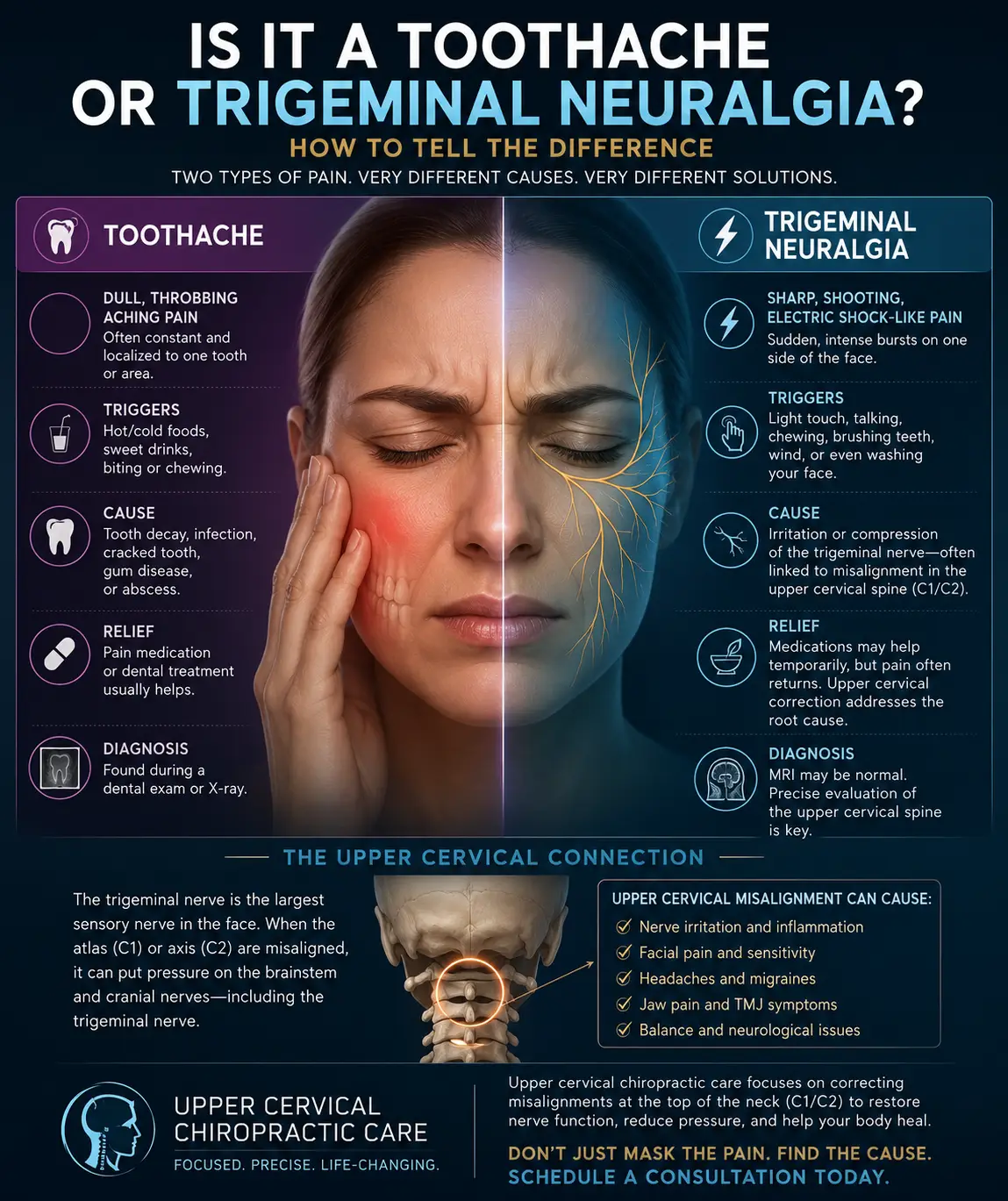
Key Differences: Toothache vs. Trigeminal Neuralgia
While the two conditions overlap in location, they usually differ in character, timing, and what sets the pain off. No single feature is definitive, but taken together these differences paint two very different pictures.
Consider the character of the pain first. A typical toothache from a cavity, cracked tooth, abscess, or inflamed pulp tends to be a deep, dull, throbbing, or aching pain. It often lingers. It can pulse with your heartbeat, and it may build over hours or days. A dental abscess frequently comes with swelling, warmth, redness of the gum, a bad taste, or visible decay. Trigeminal neuralgia, by contrast, is classically described as sudden, electric, shooting, or stabbing — like a jolt of electricity or a lightning bolt shooting across the face. People often say it is one of the most intense pains they have ever felt, and yet between attacks there may be no pain at all.
Now consider duration and pattern. A toothache is usually persistent. Once it starts, it tends to stay, sometimes easing but rarely vanishing completely from one second to the next. Classic trigeminal neuralgia is paroxysmal, meaning it comes in brief bursts — often lasting from a fraction of a second to a couple of minutes — followed by pain-free intervals. These attacks can cluster, firing repeatedly over a period, and then quiet down. Some people with TN also develop a more constant background aching in addition to the electric jolts, which can further muddy the picture, but the hallmark stabbing bursts are a key clue.
Triggers are perhaps the most telling difference of all. A tooth that hurts from decay or infection is often sensitive to heat, cold, and sweet foods, and to biting down directly on that specific tooth. Trigeminal neuralgia triggers are different and sometimes surprising. TN attacks are frequently set off by light, ordinary touch to specific “trigger zones” on the face: gently brushing the teeth, washing the face, shaving, applying makeup, feeling a cool breeze or air conditioning on the cheek, talking, smiling, chewing, or even a light kiss. The fact that a feather-light touch — not heat or cold on a tooth, but a mere breeze — can unleash severe pain is a strong signal that a nerve, not a tooth, is involved.
What relieves the pain also differs. A toothache from infection may respond, at least partly, to anti-inflammatory medication and, ultimately, to proper dental treatment of the offending tooth. Trigeminal neuralgia notoriously does not respond well to ordinary painkillers or to dental procedures, precisely because the problem is in the nerve signaling itself. Instead, classic TN often responds to specific anticonvulsant medications that calm overactive nerve firing, which is a diagnostic clue in its own right.
A few more practical distinctions can help. TN almost always affects one side of the face at a time, and often stays within one or two trigeminal branches — commonly the maxillary or mandibular territory, which is why it masquerades as an upper or lower toothache. Toothaches, of course, can also be one-sided, but they are tied to a diseased tooth that a dentist can usually identify with examination and imaging. If your dentist looks carefully, takes X-rays, and finds no dental cause that explains the severity of your pain — and especially if treating or removing a tooth does not calm the pain — that mismatch is an important red flag that the problem may be neurological.
Age and pattern can add context too. Trigeminal neuralgia becomes more common with age and is seen more often in adults over fifty, though it can occur earlier, particularly when there is an underlying neurological cause. It is also, thankfully, relatively uncommon in the general population; a recent systematic review and meta-analysis of the global incidence and prevalence of trigeminal neuralgia confirmed that TN affects a small fraction of people, which is part of why it can be overlooked or mistaken for the far more common toothache.
Red Flags and When to See a Dentist vs. a Doctor
Because tooth pain and trigeminal neuralgia can feel identical at first, the safest first step for any new, unexplained facial or tooth pain is a thorough dental evaluation. Dental disease is common, treatable, and genuinely serious if a real infection is ignored, so a tooth problem should always be ruled in or out by a qualified dentist. If you have swelling, fever, a clearly decayed or broken tooth, or pain that is obviously localized to one tooth and worsens with heat, cold, or biting, dental care is exactly where you should start.
The picture changes when the dental workup comes up empty. Here are the red flags that suggest the pain may be neurological rather than dental, and that a medical or neurological evaluation is warranted:
Your dentist examines you, takes X-rays, and finds no dental cause that accounts for the severity of your pain. You have had one or more dental procedures — a filling, a root canal, or even an extraction — and the pain returned or never improved. The pain is electric, shooting, or stabbing rather than dull and throbbing. Light touch, a breeze, brushing, talking, or chewing triggers sudden severe jolts. The pain comes in brief bursts with pain-free gaps in between. The pain follows the path of the cheek and upper teeth or the jaw and lower teeth in a way that crosses more than one tooth.
If several of these apply, it is time to involve a physician, and often a neurologist. This matters for a reason that goes beyond simply naming the condition. Trigeminal neuralgia can be “classic” (usually caused by a blood vessel pressing on the trigeminal nerve root), “idiopathic” (no clear cause found), or “secondary,” meaning it is caused by another underlying condition. Secondary causes can include multiple sclerosis or, less commonly, a tumor or other structural lesion pressing on the nerve. Because of this, current neurological practice generally recommends brain imaging — typically an MRI — for new trigeminal neuralgia to rule out these secondary causes. This is not meant to frighten you; the large majority of cases are not caused by anything sinister. But it is exactly why a proper medical and neurological evaluation, not just repeated dental work, is so important for new facial pain.
The bottom line is that the two paths are complementary, not competing. See a dentist to rule out and treat dental disease. If dental causes are excluded and the pattern fits a nerve problem, see a physician or neurologist for a proper diagnosis, appropriate imaging, and evidence-based care. Avoiding unnecessary, irreversible dental procedures is one of the most valuable things an accurate diagnosis can do for you.
The Trigeminal Nerve, the Upper Neck, and the Trigeminocervical Connection
Here is a piece of anatomy that surprises many people and helps explain why the upper neck is relevant to face pain at all. The sensory fibers of the trigeminal nerve do not simply end in the face. They travel back into the brainstem and descend into a long column of nerve tissue called the trigeminal nucleus, whose lowest portion — the nucleus caudalis — reaches down into the very top of the spinal cord, at the level of the first few cervical (neck) vertebrae.
In that same region, sensory nerves from the upper neck (the C1, C2, and C3 nerve roots) arrive and share space with the descending trigeminal fibers. Neuroscientists call this shared processing area the trigeminocervical complex, and the way signals from the face and the upper neck mingle there is known as trigeminocervical convergence. In plain terms, the brainstem does not keep face signals and upper-neck signals in completely separate boxes. They feed into overlapping circuits, which is why irritation or dysfunction in the upper neck can influence how pain is felt in the face and head, and vice versa.
This is not a fringe idea. Trigeminocervical convergence is a well-established concept in headache and facial-pain neuroscience. One clinical study, for example, examined how often trigeminocervical convergence mechanisms appear in people with migraine and found that pain referred into the cervical region was common, reflecting the shared circuitry between the trigeminal system and the upper neck. The same convergence helps explain why so many head and face pain conditions have a neck component, and why the upper cervical spine is a region of interest for clinicians who work with these patients.
It is important to be precise about what this does and does not mean. The existence of the trigeminocervical connection does not mean that trigeminal neuralgia is “really” a neck problem, and it does not mean that addressing the neck treats the nerve conflict or underlying causes that drive TN. What it does mean is that the alignment and function of the upper cervical spine can be one meaningful input among many into a sensitive, already-irritated trigeminal system. For some people living with facial pain, supporting the upper neck may help reduce one source of unhelpful input to that system. That is the modest, honest rationale behind upper cervical care as a supportive measure — not a claim that the neck is the cause or the cure.
How Precise Upper Cervical Care Fits at Lavender
At Lavender Family Chiropractic, our focus is the upper cervical spine — the top of the neck where the head balances on the first two vertebrae, right at the region where the trigeminocervical complex lives. Our goal is simple and specific: to identify whether there is a misalignment affecting this area and, if there is, to correct it as precisely and gently as possible so the nervous system has one less source of interference to contend with.
We begin with measurement, not guesswork. We use 3D CBCT imaging, a form of cone-beam computed tomography that lets us see the unique anatomy of your upper cervical spine in three dimensions. This detailed picture allows any correction to be planned around your individual structure rather than a generic average. We also use Tytron paraspinal infrared thermography, a touchless scan that reads heat patterns along the spine as an objective window into how your nervous system is functioning over time. Together, these tools help us decide whether upper cervical care is appropriate for you at all, and if so, how to tailor it.
When a correction is indicated, we deliver it using the Knee Chest Upper Cervical technique. This is a precise, low-force correction. It is not high-velocity twisting, and it involves no forceful cracking or popping of the neck. Instead, it is a gentle, specific adjustment based on your imaging and scans, designed to restore better alignment to the upper cervical region with as little force as possible. For someone whose trigeminal system is already exquisitely sensitive, this gentle and precise approach is exactly the point. You can learn more about our overall approach to upper cervical chiropractic care and how it is delivered.
We also believe in being clear about what this care can and cannot do. Upper cervical care does not cure trigeminal neuralgia. We do not claim to cure, resolve, or eliminate TN, and we would be doing you a disservice to suggest otherwise. Trigeminal neuralgia is a serious neurological condition whose first-line care is medical. A thorough review of the medical management of trigeminal neuralgia confirms that anticonvulsant medications — carbamazepine and oxcarbazepine — are the established first-line treatment, with other medications and, for cases that stop responding, surgical options considered when appropriate. What precise upper cervical care may offer is something different and more modest: it is supportive, natural relief that works alongside — never instead of — your medical and dental team, aimed at reducing one possible source of stress on an already-sensitive system.
That coordination is central to how we practice. If you are being treated by a neurologist, a physician, or a dentist, we want to be part of that team, not a replacement for it. Every plan we create is individualized through our customized care plans, built around your imaging, your scans, your history, and your goals. We never use one-size-fits-all schedules, and we will always be honest about whether we believe upper cervical care is likely to be a helpful support for you.
Ready to Talk With Us?
If you are living with facial pain and want to understand whether precise, gentle upper cervical care might fit into your broader plan, we would be glad to talk. Call Lavender Family Chiropractic at (941) 243-3729, or request an appointment through our secure online scheduling. You will find us at 5899 Whitfield Avenue, Suite 107, Sarasota, FL 34243, right at the corner of University and Whitfield. We will take the time to listen, review your history, and be straightforward about whether we think we can help.
What the Research Says
The information in this article is grounded in published, peer-reviewed research. Here are five studies worth knowing about, described accurately.
- In Unnecessary dental procedures as a consequence of trigeminal neuralgia (von Eckardstein et al., Neurosurgical Review, 2015), researchers studied surgically treated TN patients and found that most had consulted their dentist first, and a substantial number underwent invasive dental treatment — including extractions, root canals, and implants — for pain that was ultimately neurological in origin, highlighting how often TN is misdiagnosed as a dental problem.
- In Please spare my teeth! Dental procedures and trigeminal neuralgia (Kumar, Surgical Neurology International, 2020), the authors document that correct diagnosis of TN is often delayed and that patients frequently undergo unnecessary dental procedures before the true cause of their pain is recognized, reinforcing the need to consider TN in the differential diagnosis of persistent facial and tooth pain.
- In Global Incidence and Prevalence of Trigeminal Neuralgia, 1945–2024: A Systematic Review and Meta-Regression Analysis (Systematic review and meta-analysis), the authors synthesized decades of epidemiological data and confirmed that trigeminal neuralgia affects only a small fraction of the population, with substantial global variation, underscoring why this relatively uncommon condition is easy to overlook among far more common causes of facial pain.
- In Prevalence of trigeminocervical convergence mechanisms in episodic and chronic migraine (Utiumi et al., Arquivos de Neuro-Psiquiatria, 2022), a multicenter study mapped where patients felt their pain and found trigeminocervical convergence — pain referred into the posterior cervical (upper neck) region — was common, illustrating the shared brainstem circuitry that links the trigeminal system with the upper neck.
- In Medical Management of Trigeminal Neuralgia (Khadilkar and Patil, Neurology India, 2021), the authors review the evidence and confirm that the anticonvulsants carbamazepine and oxcarbazepine are the first-line drugs for TN, that a portion of patients are resistant or lose response over time, and that surgical options should be offered when medical therapy fails — a clear picture of why TN care must be medically led.
Self-Care and Next Steps
While an accurate diagnosis and appropriate medical care are the foundation of managing trigeminal neuralgia, there are sensible steps you can take to support yourself along the way. None of these replace professional care, but they can help you cope and avoid making attacks worse.
Keep a simple pain diary. Note when attacks happen, how long they last, what the pain felt like, and what seemed to trigger it. This record is genuinely valuable to your dentist, physician, and neurologist, and it can shorten the road to an accurate diagnosis. Pay attention to your trigger zones and protect them gently — using lukewarm water to wash your face, shielding your cheek from cold wind and direct air conditioning, and choosing softer foods during flare-ups can all reduce the number of jolts you provoke in a day. Be gentle with oral hygiene during flares, using a soft brush and lukewarm water, but do not abandon dental care entirely, because healthy teeth still matter.
Manage stress and sleep as best you can, since fatigue and stress can lower anyone’s pain threshold. If you have been prescribed medication such as carbamazepine or oxcarbazepine, take it exactly as directed and talk with your prescriber before making any changes, as these medications require careful dosing and monitoring. And resist the urge to pursue more dental procedures in search of relief until a dental cause has actually been confirmed; if your dentist has ruled out a tooth problem, more drilling or extractions are unlikely to help and cannot be undone.
If your facial pain overlaps with jaw tension, clicking, or difficulty opening your mouth, it may be worth understanding how the jaw joint fits into the picture; you can read more about how upper cervical care relates to TMJ and jaw disordersas part of a fuller understanding of face and jaw pain. And when you are ready to explore whether gentle upper cervical support belongs in your plan, our team is here to help you think it through honestly.
Serving Sarasota and Surrounding Communities
Lavender Family Chiropractic is proud to serve patients throughout Southwest Florida. Our office sits at the corner of University and Whitfield, making us convenient to families across the region. We welcome patients from Sarasota, Bradenton, Lakewood Ranch, Venice, Palmer Ranch, Osprey, Siesta Key, Longboat Key, Lido Key, University Park, Parrish, Ellenton, Myakka City, Punta Gorda, and St. Petersburg. Whether you are just down the road in Sarasota or traveling in from Punta Gorda or St. Petersburg, we are happy to discuss whether precise, low-force upper cervical care may be a helpful support for you.
Top 15 Questions
How can I tell if my pain is a toothache or trigeminal neuralgia? A toothache is usually a dull, throbbing, lingering ache tied to a specific tooth and often sensitive to heat, cold, and biting. Trigeminal neuralgia is typically sudden, electric, and stabbing, comes in brief bursts, and is often triggered by light touch, a breeze, brushing, or chewing. If dental work does not help, that mismatch is an important clue.
Should I see a dentist or a neurologist first? Start with a dentist to rule out and treat any dental cause, because tooth problems are common and treatable. If the dental workup finds nothing that explains your pain, or if dental treatment does not help, see a physician or neurologist for a proper diagnosis and imaging.
Can trigeminal neuralgia really feel exactly like a bad tooth? Yes. Two of the three trigeminal branches supply sensation to the upper and lower teeth, so an irritated nerve can produce pain that feels like it is coming from a specific tooth even when the tooth is healthy.
Why do so many people with TN get dental work first? Because the pain is felt in the teeth and is often triggered by chewing or brushing, it looks like a dental problem. Research shows most TN patients consult a dentist first, and many receive invasive dental treatment before the correct diagnosis is made.
What triggers a trigeminal neuralgia attack? Common triggers include light touch to the face, brushing the teeth, washing or shaving, a cool breeze or air conditioning on the cheek, talking, smiling, and chewing. The fact that gentle touch — not heat or cold on a tooth — sets off severe pain points toward a nerve problem.
Do I need an MRI? For new trigeminal neuralgia, physicians commonly recommend an MRI to rule out secondary causes such as multiple sclerosis or, less commonly, a tumor pressing on the nerve. Most cases are not caused by anything sinister, but imaging is an important part of a proper evaluation.
What is the first-line medical treatment for TN? The established first-line medications are the anticonvulsants carbamazepine and oxcarbazepine, which calm overactive nerve firing. When medications stop working or are not tolerated, other drugs and surgical options may be considered. These decisions are made by your physician or neurologist.
Can you cure trigeminal neuralgia? No. We do not claim to cure trigeminal neuralgia, and neither upper cervical care nor any single treatment should be presented that way. TN is a serious neurological condition whose first-line care is medical, and our role is supportive and coordinated with your medical and dental team.
How could my neck be related to face pain? The sensory fibers of the trigeminal nerve descend into the upper spinal cord and share circuitry with nerves from the upper neck, a region called the trigeminocervical complex. Because of this convergence, the upper neck can be one input into a sensitive trigeminal system, even though it is not the cause of TN.
Is your adjustment forceful or risky? No. We use the Knee Chest Upper Cervical technique, which is a precise, low-force correction. It does not involve high-velocity twisting or forceful cracking of the neck. It is a gentle, specific adjustment guided by your imaging and scans.
What imaging and technology do you use? We use 3D CBCT imaging to see your upper cervical anatomy in three dimensions and Tytron paraspinal infrared thermography to objectively assess nervous-system function over time. These tools help us decide whether upper cervical care is appropriate and how to tailor it.
Do you take insurance? We are a cash-pay, out-of-network practice and do not bill insurance directly. We provide superbills that you can submit to your insurance company for possible reimbursement, and we build customized care plans around your individual needs.
Will upper cervical care replace my medication or my dentist? No. Upper cervical care is intended to work alongside your medical and dental care, never to replace it. We coordinate with your team and encourage you to continue your prescribed treatment and dental care.
I already had a tooth pulled and the pain came back. What now? Pain that persists or returns after dental treatment — especially after an extraction — is a red flag that the source may be neurological rather than dental. This is a good time to see a physician or neurologist for evaluation rather than pursuing more dental procedures.
How do I get started with your office? Call us at (941) 243-3729 or use our online scheduling to request a visit. We will review your history, discuss your goals, and be honest about whether precise, gentle upper cervical care is likely to be a helpful support for you.
Schedule a Complimentary Consultation with Us
Facial pain that mimics a toothache is confusing, exhausting, and easy to misread — but you do not have to sort it out alone. If a dental workup has not explained your pain, or if you are already working with a physician or neurologist and want to explore gentle, supportive care for your upper neck, Lavender Family Chiropractic is here to help. Call us at (941) 243-3729, book your visit through our online scheduling, or reach us through our contact page. You will find Dr. Rusty Lavender and Dr. Jacob Temple at 5899 Whitfield Avenue, Suite 107, Sarasota, FL 34243, at the corner of University and Whitfield. We will always be straightforward with you about what precise, low-force upper cervical care can and cannot do.
Related Articles
Trigeminal Neuralgia – Overview


Get our upper cervical articles first.
Patients Experience