Vestibular Rehab Isn’t Working: What to Check Next
By Dr. Rusty Lavender, D.C. — upper cervical chiropractor, Lavender Family Chiropractic, Sarasota, FL. Reviewed and updated October 2026.
You did the exercises. Gaze stabilization, head turns, the balance drills on the foam pad, the walking with head movement. It helped — for a while, and then it stopped helping, and you’re still dizzy. If that’s where you are, this article is for you. It is not an argument against vestibular rehabilitation, which is one of the best-supported treatments in this whole field. It’s about the four reasons VRT stalls, in order of how often we see them, and what each one points to.
Educational content, not medical advice. If your dizziness has changed character, worsened suddenly, or comes with new neurological symptoms, see your physician before anything else.
First, What VRT Is Designed to Do
Vestibular rehabilitation therapy works by driving the brain to recalibrate. When the inner ear on one side is weak or damaged — after vestibular neuritis, labyrinthitis, or surgery — the brain gets mismatched signals and produces dizziness. Repeated, controlled exposure to the movements that provoke it teaches the brain to compensate. The clinical practice guideline from the Academy of Neurologic Physical Therapy, updated by Hall and colleagues (2022), lays out the evidence: for peripheral vestibular hypofunction, VRT is strongly recommended and it works.
Read that sentence again, because the condition it names is the key. VRT is built for peripheral vestibular hypofunction— a weak inner ear. When it plateaus, the most common reason is that a weak inner ear was never the whole problem.
Reason 1: The Diagnosis Was Incomplete
Dizziness gets sorted into “vestibular” quickly, and once you’re in the VRT pipeline, the label tends to stick. But several causes of chronic dizziness don’t respond to compensation exercises because there’s nothing to compensate for:
- BPPV that was never repositioned. Loose crystals in a canal cause brief positional spinning and are treated with a maneuver, not exercises. The AAO-HNS guideline is explicit that repositioning, not VRT, is first-line. If your dizziness spins for seconds when you roll over, ask whether a Dix-Hallpike test was ever done.
- Bilateral or fluctuating conditions like Meniere’s, which need medical management alongside any therapy.
- A cause outside the ear altogether — which is the next three reasons.
If you were never given a specific diagnosis beyond “vestibular,” that’s the first thing to go back and ask for.
Reason 2: It’s Vestibular Migraine
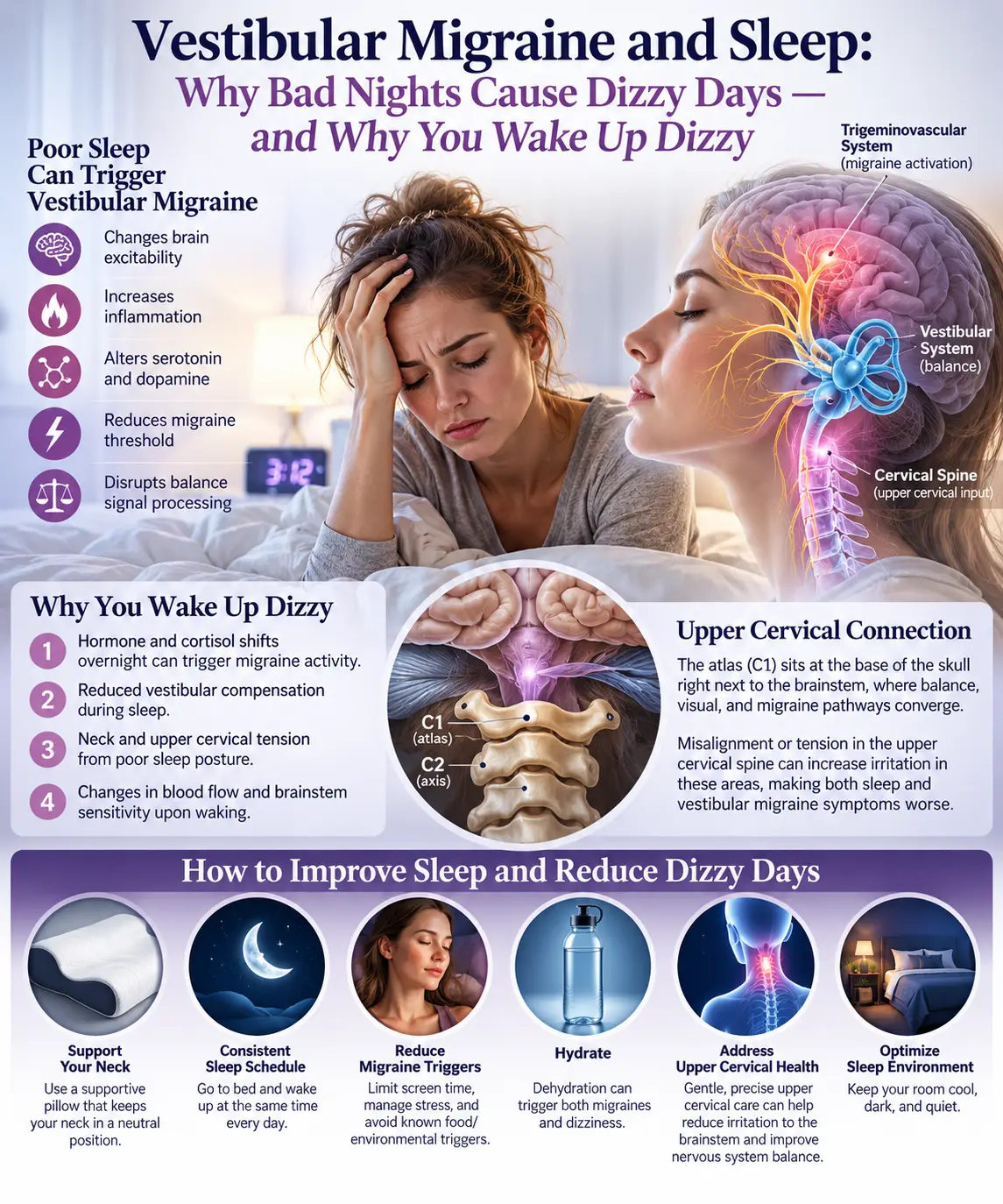
Vestibular migraine is now recognized as one of the most common causes of recurrent dizziness, and it routinely masquerades as an inner-ear problem. The diagnostic criteria published by Lempert and colleagues (2012) on behalf of the Bárány Society and the International Headache Society require recurrent vestibular episodes lasting minutes to hours in someone with a migraine history, with migraine features — headache, light or sound sensitivity, visual aura — in at least half the episodes. The catch: the dizziness can come without a headache, so people with it are often never told the word “migraine.”
VRT can help vestibular migraine somewhat, but the exercises don’t address the trigger. If your dizziness comes in episodes, you have any migraine history (or your mother did), and bright stores, screens, or poor sleep make it worse, this deserves a neurologist’s look. Our vestibular migraine page covers it.
Reason 3: It’s Become PPPD
Persistent postural-perceptual dizziness is what happens when the brain, after an initial vestibular event, stays on high alert. The Bárány Society criteria by Staab and colleagues (2017) define it: dizziness, unsteadiness, or non-spinning vertigo on most days for three months or more, worsened by being upright, by motion, and by complex visual environments — grocery stores, traffic, scrolling. It typically follows a bout of BPPV, neuritis, a concussion, or a panic episode. The ear may have recovered fully; the brain’s processing hasn’t.
This is the diagnosis that most often explains a VRT plateau, and it’s under-recognized. Popkirov and colleagues (2018)describe it as “a common, characteristic and treatable cause of chronic dizziness.” The treatment is different from standard VRT: a specifically graded habituation program, sometimes medication, and cognitive-behavioral approaches, because the problem is the brain’s threat response, not the ear. Our articles on PPPD and why grocery stores make you dizzy go further.
Reason 4: The Neck Was Never Examined
Here is the one that brings people to our office, and the one no vestibular workup includes.
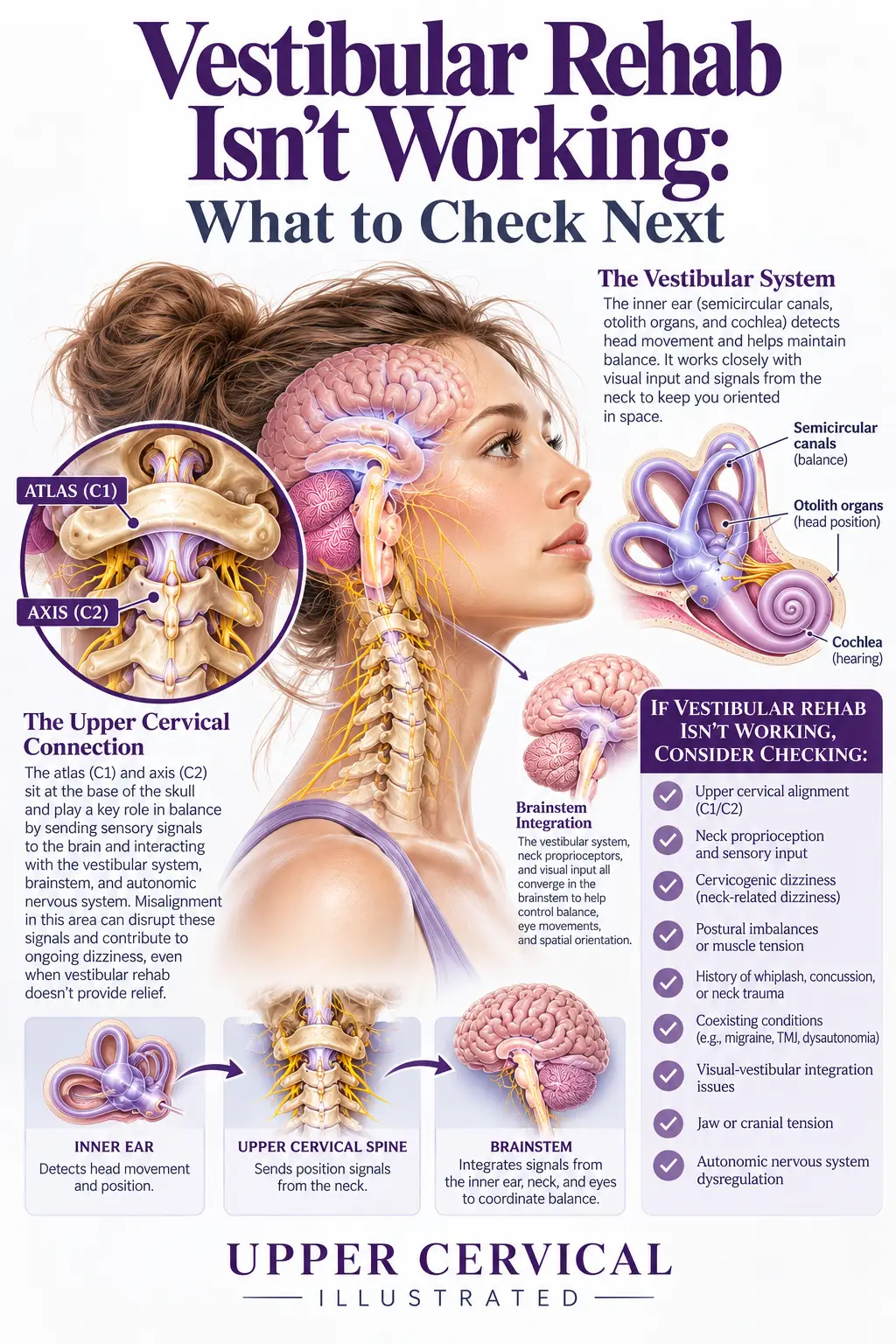
Your brain builds its sense of head position from three inputs: the inner ear, the eyes, and the neck. The upper cervical spine — the joints and small muscles between the skull, atlas, and axis — carries one of the densest concentrations of position sensors in the body. When that input is distorted by injury or dysfunction, the brain receives a head-position signal that disagrees with the ear and the eyes, and the result is dizziness. Kristjansson and Treleaven (2009) reviewed the mechanism; Treleaven and colleagues (2003) measured it in whiplash patients, who had significantly worse head-position sense when dizziness was present.
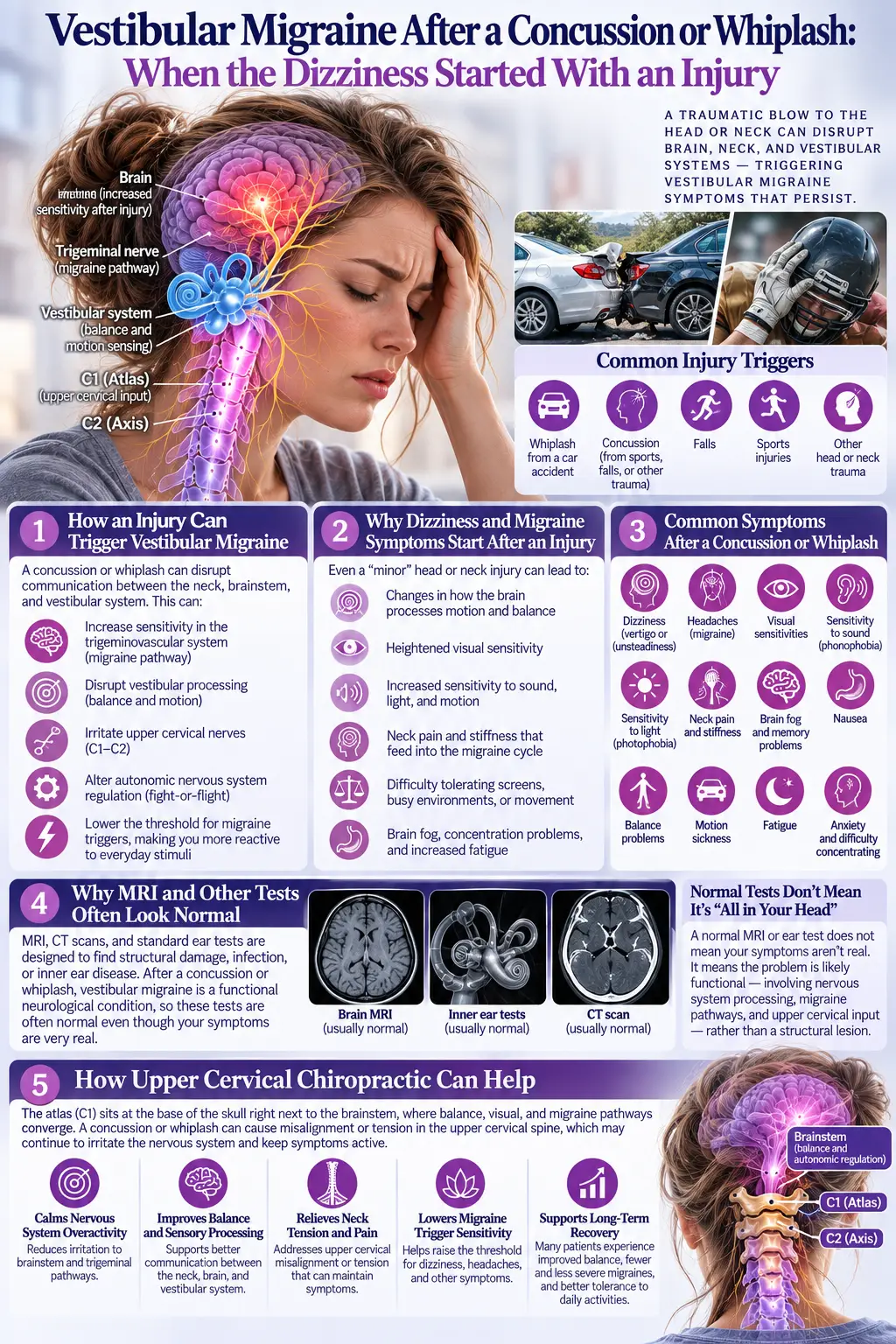
VRT retrains the brain to trust the inner ear. It does nothing about a neck that’s sending bad information — and it can plateau exactly because the brain is being asked to compensate for an input that’s still wrong. The signs that point here: unsteadiness rather than spinning; dizziness provoked by neck movement or sustained positions; neck pain, stiffness, or headache at the base of the skull; and a history of a car accident, fall, or concussion — sometimes the same event that started the vestibular problem.
The evidence for treating the neck is real, with its limits stated: Reid and colleagues (2014) showed in a randomized trial that gentle manual therapy to the cervical spine reduced cervicogenic dizziness compared with placebo, with benefits holding at twelve months. Those trials used physiotherapy techniques; our specific upper cervical procedure hasn’t been tested at that level. What we add is measurement — 3D CBCT imaging of the atlas and axis, thermography, and a head-repositioning assessment — and a precise, low-force correction only if there’s something to correct.
Our complete guide to vertigo treatment in Sarasota covers the types of vertigo, when the top of the neck is involved, and how we evaluate it with 3D imaging.
How These Fit Together
They’re not exclusive. A common story: a viral neuritis starts it, VRT gets you most of the way back, and what’s left is a mix of PPPD-style visual sensitivity and a neck that was never looked at. That patient needs their vestibular therapist andsomeone evaluating the neck, and the two work well together — our article on vestibular therapy and upper cervical caredescribes the pairing. If you’ve plateaued, the question isn’t “did VRT fail” but “what is VRT not designed to reach.”
What to Do This Week
- Ask your therapist or physician for the specific diagnosis VRT was prescribed for. If the answer is “vestibular” with nothing after it, ask what was ruled out.
- If you spin briefly when rolling over, ask whether BPPV was tested and repositioned.
- If your dizziness is episodic and you have any migraine history, raise vestibular migraine with a neurologist.
- If it’s constant, visually triggered, and three months old or more, raise PPPD.
- If it’s unsteadiness with neck pain, neck-movement triggers, or an injury history, have the upper neck evaluated.
Our dizziness guide lays out how all of these are told apart.
Frequently Asked Questions
Should I stop vestibular rehab?
No. Keep it unless your therapist says otherwise. The point is to add what’s missing, not remove what’s helping.
How long should VRT take before I decide it’s plateaued?
Most people see steady progress over 6–12 weeks for a peripheral problem. If gains stopped weeks ago and you’re doing the exercises correctly, that’s a plateau worth investigating.
Can the neck cause dizziness even with no neck pain?
Sometimes, but neck pain or stiffness is usually present. Absence of neck symptoms makes the ear or migraine more likely.
Could PPPD and a neck problem both be going on?
Yes, and it’s common after injury: the injury disturbs the neck’s input, the brain’s threat response ramps up, and the two feed each other.
Does upper cervical care replace VRT?
No. They address different inputs. Many of our patients do both.
Will an MRI find any of this?
Usually not. Vestibular migraine, PPPD, and cervicogenic dizziness are functional diagnoses. A normal MRI rules out the dangerous causes and leaves these open.
Do you do the Epley maneuver?
We screen for BPPV and refer for repositioning when that’s the picture. Our focus is the neck.
How do I know if I’m a candidate for an upper cervical evaluation?
If VRT has plateaued and no one has examined your neck, you’re a reasonable candidate. We’ll tell you plainly if the findings don’t point there.
Lavender Family Chiropractic in Sarasota, Florida offers a thorough upper cervical evaluation to find out whether we can help. Call (941) 243-3729 or request an appointment. 5899 Whitfield Avenue, Suite 107, Sarasota, FL 34243.
References
- Hall CD, et al. Vestibular Rehabilitation for Peripheral Vestibular Hypofunction: An Updated Clinical Practice Guideline. J Neurol Phys Ther. 2022. PMID 34864777
- Bhattacharyya N, et al. Clinical Practice Guideline: Benign Paroxysmal Positional Vertigo (Update). Otolaryngol Head Neck Surg. 2017. PMID 28248609
- Lempert T, et al. Vestibular migraine: diagnostic criteria. J Vestib Res. 2012. PMID 23142830
- Staab JP, et al. Diagnostic criteria for persistent postural-perceptual dizziness (PPPD). J Vestib Res. 2017. PMID 29036855
- Popkirov S, et al. Persistent postural-perceptual dizziness (PPPD): a common, characteristic and treatable cause of chronic dizziness. Pract Neurol. 2018. PMID 29208729
- Kristjansson E, Treleaven J. Sensorimotor function and dizziness in neck pain. J Orthop Sports Phys Ther. 2009. PMID 19411769
- Treleaven J, et al. Dizziness and unsteadiness following whiplash injury. J Rehabil Med. 2003. PMID 12610847
- Reid SA, et al. Comparison of Mulligan SNAGs and Maitland mobilizations for cervicogenic dizziness: a randomized controlled trial. Phys Ther. 2014. PMID 24336477
Related Posts


Get our upper cervical articles first.
Patients Experience