
Neck Pain Treatment Near Venice, FL: Why It Keeps Coming Back, and the Upper Cervical Option for Venice, Osprey, and Nokomis
By Dr. Rusty Lavender, D.C. — upper cervical chiropractor, Lavender Family Chiropractic, Sarasota, FL. Reviewed and updated October 2026.
Venice has plenty of places to get a neck adjusted, stretched, or injected. Between the 41 Bypass, Venice Avenue, and Jacaranda Boulevard there are a dozen chiropractic offices, several physical therapy clinics, and a pain-management practice or two. What Venice, Osprey, and Nokomis do not have is an office that images the top of the neck in three dimensions before anyone touches it. For one particular kind of neck pain, the kind that keeps coming back after massage, therapy, and general adjustments, or the kind that began with a rear-end collision on US-41 and never fully left, that difference is the whole story. This page explains why neck pain recurs, what the top of the neck has to do with it, how a pinched nerve differs from the two things it gets confused with, and what an upper cervical evaluation involves for a patient driving up from South Sarasota County. Our complete guide to neck pain and the upper cervical spine in Sarasota covers the mechanism in depth; this is the Venice decision guide.
Educational content, not medical advice. Neck pain with fever, with progressive weakness or numbness in the arms or legs, with loss of bowel or bladder control, or after a serious fall or crash needs a physician or the emergency department first.
Neck Pain in Venice: The Older Neck Is a Different Problem
Neck pain is one of the most common musculoskeletal complaints in the world; the Global Burden of Disease analysis estimated roughly 289 million prevalent cases in 2017 and ranked it among the leading causes of years lived with disability (Safiri et al., BMJ 2020). Venice has one of the oldest populations of any city in Florida, and that changes the picture in three ways. First, the neck we are looking at usually carries decades of wear: disc thinning, bone spurs, and a cervical curve that has flattened or reversed over thirty years of desk work and driving. Second, the old injuries are older. The whiplash from a 1990s fender-bender, the fall off a ladder, the youth football years, all of it is still in the joints. Third, the neck pain rarely travels alone. In the Venice patient it comes with headaches at the base of the skull, a shoulder that will not loosen, a hand that tingles at night, or a sense of unsteadiness that has been written off as age.
It also tends to come back. The Bone and Joint Decade Task Force on Neck Pain found that for most adults neck pain is a recurrent or persistent condition rather than a one-time event, with a large share of people still reporting pain one to five years after their first episode (Carroll et al., Spine 2008). That is the pattern we hear most from Venice: the massage helped for a week, the adjustment helped for three days, the injection helped for two months, and then it was back.
Where the Top of the Neck Fits
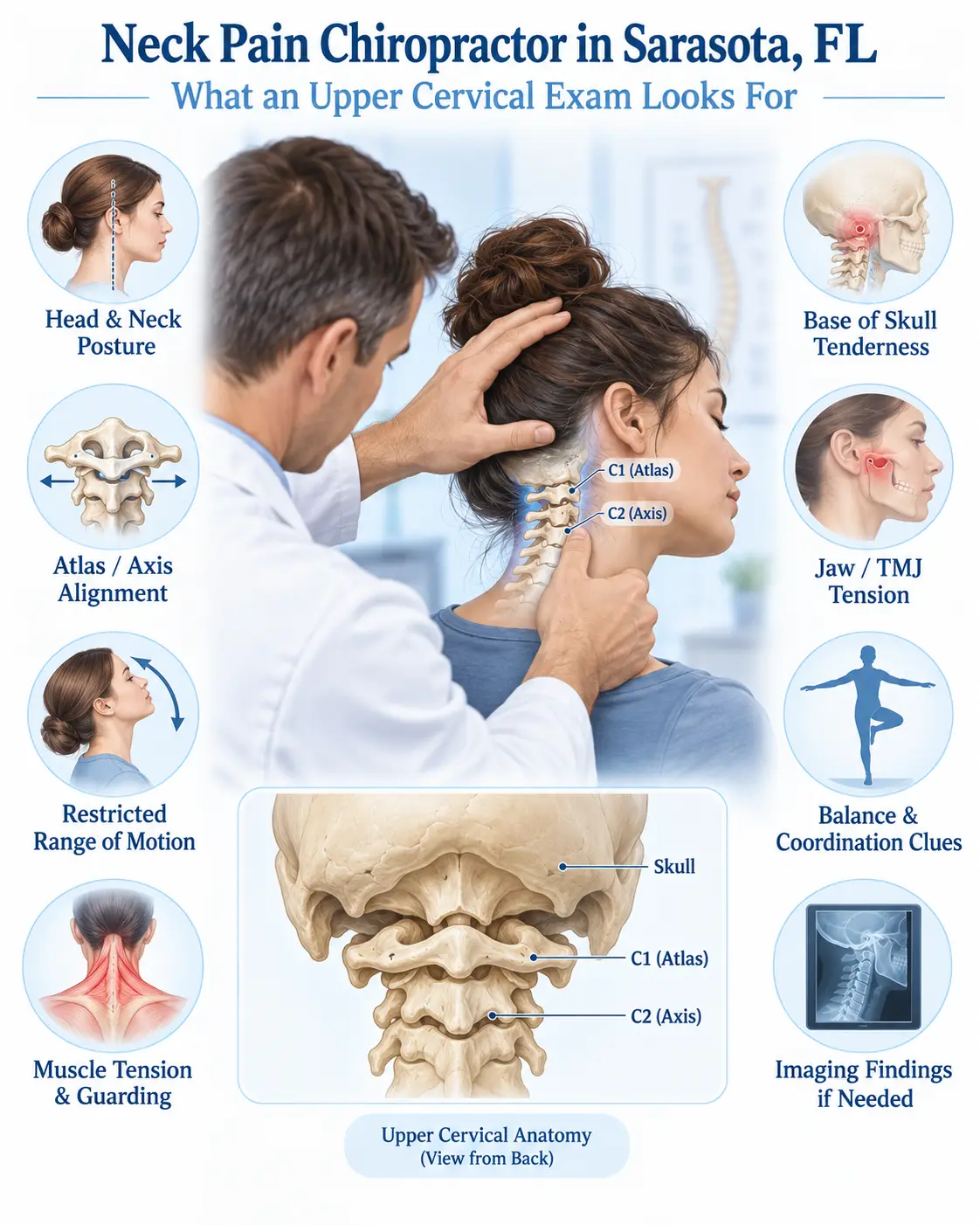
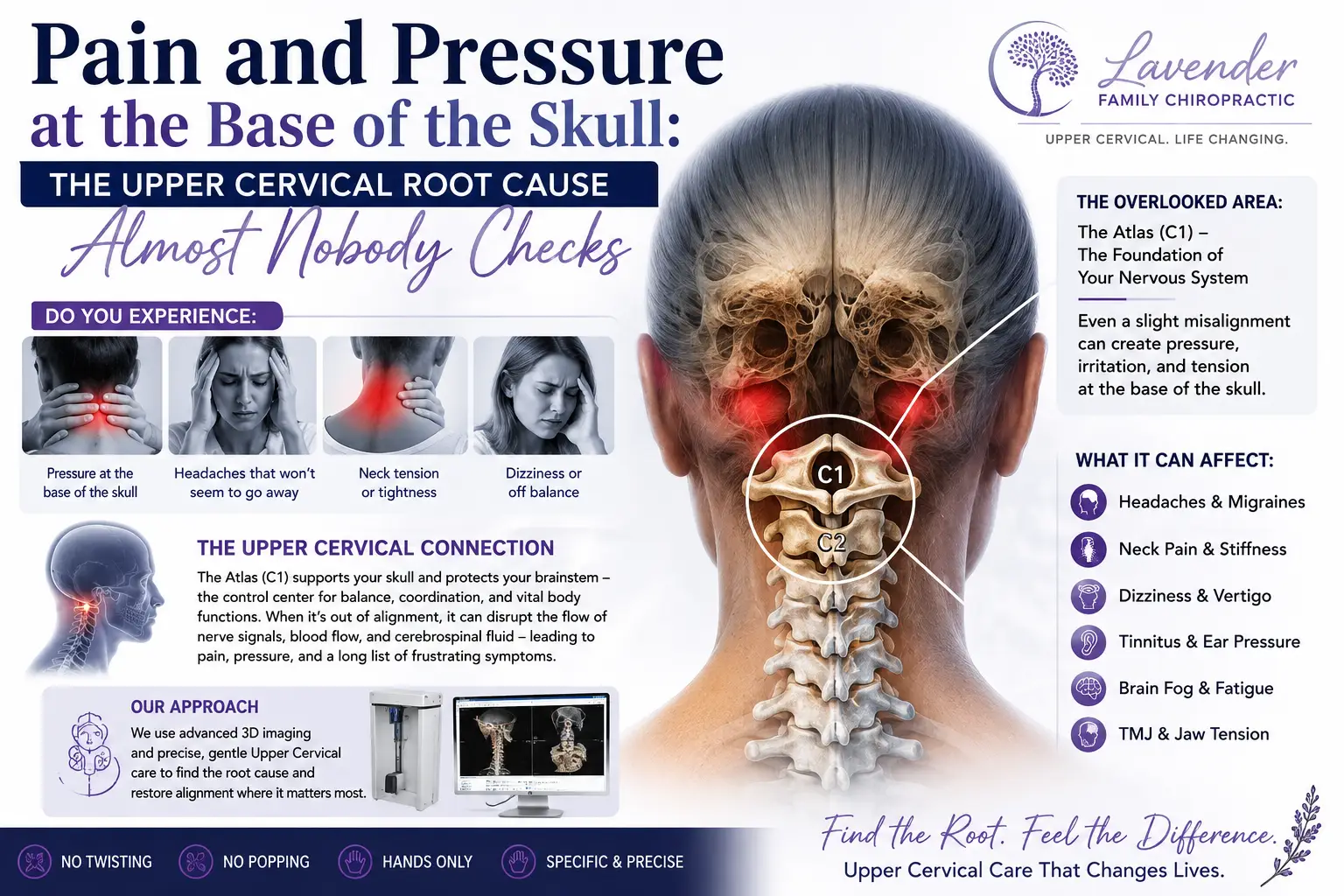
Most neck pain treatment aims at where it hurts, which is usually the lower neck and the tops of the shoulders. The top of the neck, the atlas (C1) and axis (C2), is a different structure. It carries the weight of the head, allows roughly half of all neck rotation, and contains the densest concentration of position-sensing receptors in the body. When those two bones sit off-center, the muscles below spend all day compensating, and the lower neck does work it was never built for. Research on neck disorders shows that distorted input from those upper-neck receptors disturbs postural stability and head-and-eye coordination (Treleaven, Man Ther 2008), which is part of why a neck problem so often brings a headache, dizziness, or a sense of imbalance along with it.
Treating the lower neck while the top stays off-center is the reason relief keeps wearing off. Nothing was wrong with the massage or the adjustment; the load that produced the pain was never removed.
Neck Pain Treatment Options Near Venice: Who Treats What
Venice patients have real options, and most of them are good at what they do. The honest map:
- Physical therapy (several clinics in Venice and Nokomis) for strengthening, range of motion, and posture retraining. Best when weakness or stiffness is the main problem and the structure is sound.
- Pain management for injections, nerve blocks, and radiofrequency ablation. Effective at reducing pain for a period; does not change the position of the joints that produced it.
- Orthopedic or neurosurgical consultation when there is progressive weakness, a large disc herniation on MRI, or spinal cord compression. Necessary for a small number of patients and worth ruling in or out early.
- General chiropractic (the offices along the Bypass) for full-spine adjustments, often with soft-tissue work. Helps many people; the neck component is usually a rotational adjustment delivered by feel.
- Upper cervical chiropractic for a measured, imaging-guided correction of the atlas and axis, delivered without rotating the neck. Not available in Venice, Osprey, or Nokomis; the nearest office is ours in Sarasota.
These are not competing choices. A Venice patient may do therapy locally and come to us for the upper neck, and that is often the right plan.
Tech Neck, Pinched Nerve, or Something Else?
Tech neck and forward head posture. A systematic review and meta-analysis found a clear association between forward head posture and neck pain in adults (Mahmoud et al., Curr Rev Musculoskelet Med 2019), and a biomechanical model estimated that the load on the cervical spine rises from about 10–12 pounds in neutral to as much as 60 pounds at 60 degrees of forward flexion (Hansraj, Surg Technol Int 2014). Retirees are not exempt; tablets and phones have replaced the newspaper. Our article on forward head posture covers it.
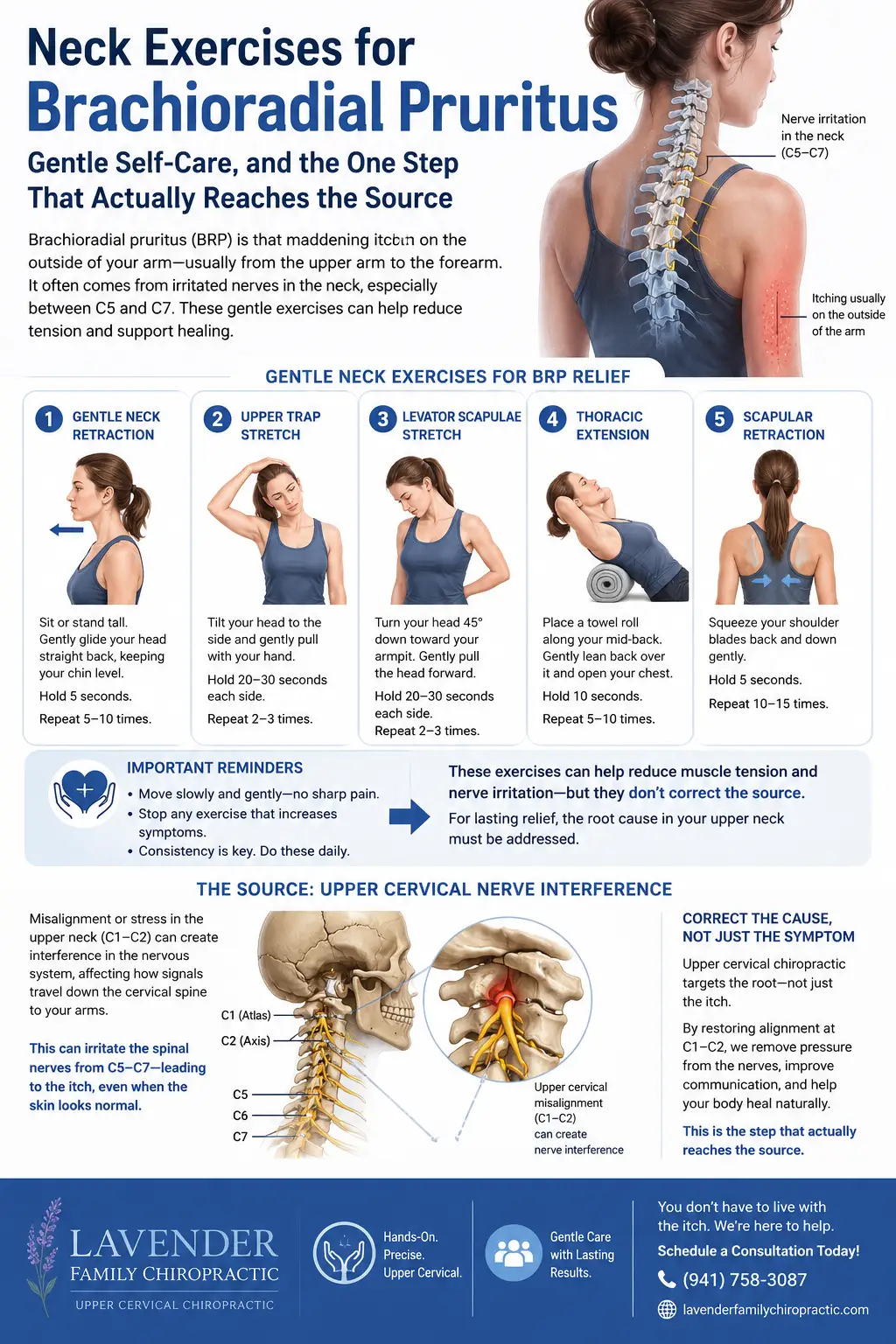
Pinched nerve (cervical radiculopathy). Pain, numbness, or weakness that follows a line down the arm into specific fingers. The classic population study put the annual incidence at about 83 per 100,000, peaking in the fifties and sixties (Radhakrishnan et al., Brain 1994). Most cases improve without surgery; a systematic review of symptomatic disc herniation with radiculopathy found substantial improvement in the majority of patients within the first several months of conservative care (Wong et al., Spine J 2014). Our pinched nerve guide goes deeper.
The two it gets confused with. Thoracic outlet syndrome produces arm and hand symptoms from compression between the collarbone and first rib rather than from the spine; carpal tunnel produces numbness in the thumb and first fingers from the wrist. Both get treated as “a neck problem” for months. Our articles on thoracic outlet syndrome and numbness and tingling in the hands explain how to tell them apart.
Neck Pain After a Crash on US-41, Jacaranda, or I-75
The Venice traffic pattern, with US-41 and the Bypass feeding Venice Avenue, Jacaranda Boulevard, and Laurel Road onto I-75, produces a steady supply of rear-end collisions, which are the single most common way the upper neck gets injured. The atlas is held in place by ligaments rather than by a locking joint, and a sudden whip of the head can shift it in a way that standard emergency-room X-rays, which are looking for fractures, are not designed to detect. The result is the familiar Venice story: the ER said everything was normal, the neck was stiff for a few weeks, it seemed to settle, and six months later there are headaches, a stiff neck every morning, and a vague unsteadiness nobody can explain. Our guide to whiplash and the upper cervical spine and our car accident page cover what to do, including how we work with your auto-injury physician.
What the Research Says About Treating the Neck
A randomized trial in the Annals of Internal Medicine compared spinal manipulation, medication, and home exercise with advice for acute and subacute neck pain; at 12 weeks manipulation produced greater pain reduction than medication, and the advantage was still present at one year (Bronfort et al., Ann Intern Med 2012). The largest prospective study of upper cervical care followed 1,090 patients across 83 offices and found high patient-reported improvement and satisfaction, with reactions after care mostly mild and short-lived and no serious adverse event reported (Eriksen et al., BMC Musculoskelet Disord 2011). On the question older patients are sometimes afraid to ask, the largest population-based study on neck adjustments and stroke, covering nine years of Ontario health records, found the association between chiropractic visits and vertebrobasilar stroke was no different from the association with primary-care visits, consistent with patients seeking care for the early symptoms of a stroke already in progress rather than care causing it (Cassidy et al., Spine 2008). Upper cervical corrections add a further margin: they are delivered without rotation or thrust through the neck.
What an Upper Cervical Evaluation for Neck Pain Involves
The first visit is a history and examination, including a neurological screen of the arms and hands so a true radiculopathy is identified rather than assumed. Paraspinal thermography reads the heat pattern along the spine and gives an objective marker to track from visit to visit. If the examination points to the upper neck, a 3D cone-beam CT of the atlas and axis shows their position relative to the skull in three dimensions, which is what the correction is calculated from. We review the findings with you before any care begins. If the imaging shows nothing to correct, we say so and help you get to the right next step, whether that is therapy in Venice or an orthopedic consult.
The correction itself is a precise, low-force procedure to the atlas based on the imaging. There is no twisting of the neck and no cracking. For a seventy-year-old with a stiff, arthritic neck, that is not a detail; it is the reason many Venice patients who would never let anyone “crack” their neck are comfortable here.
Getting Here From Venice, Osprey, and Nokomis
Our office is at the corner of University Parkway and Whitfield Avenue in Sarasota, just west of I-75 by UTC. From Venice, take Jacaranda Boulevard or Laurel Road to I-75 North and exit at University Parkway: about 24 miles and 29 minutes outside rush hour. From Nokomis, Laurel Road to I-75 is the quickest route, about 25 minutes. From Osprey, either US-41 North through Sarasota or Central Sarasota Parkway over to I-75, about 20 to 25 minutes. Many of our South County patients pair a visit with errands at UTC, and we schedule to make that work. The Venice page has full directions and what to expect on a first visit.
Who Should and Shouldn’t Come
Come for an upper cervical evaluation if: your neck pain keeps returning after therapy, massage, or general adjustments; it travels with headaches at the base of the skull, dizziness, or unsteadiness; it began with a car accident, fall, or concussion, even years ago; you have been told it is “just arthritis” but it changes from day to day; or you want the top of the neck measured before deciding on injections or surgery.
See someone else first if: you have progressive weakness or numbness in an arm or leg, or problems with balance and walking that are getting worse (a physician or neurosurgeon, promptly); neck pain with fever or after a serious fall (the emergency department); or new, severe pain with no injury that does not change with position (a physician).
Frequently Asked Questions About Neck Pain Treatment Near Venice
Where can I get neck pain treatment in Venice, FL? Venice has physical therapy clinics, pain-management practices, and a number of general chiropractors. For an upper cervical evaluation with 3D imaging of the atlas and axis, the nearest office is ours at University Parkway and Whitfield Avenue in Sarasota, about 29 minutes up I-75.
Is there an upper cervical chiropractor in Venice, Osprey, or Nokomis? Not at this time. Ours is the closest upper cervical office to all three, and a large share of our South County patients come from the Venice area.
How is this different from the chiropractor on the Bypass? Two ways. We image the top of the neck in three dimensions before the first correction, so the adjustment is calculated rather than felt out. And the correction is delivered to the atlas without rotating the neck or cracking. General chiropractic is full-spine and uses rotation.
My hand goes numb at night. Is that a pinched nerve? Possibly, but numbness in the thumb and first two fingers that wakes you at night is often carpal tunnel, and numbness along the little-finger side with arm fatigue can be thoracic outlet syndrome. Part of the first visit is sorting out which one it is, because the treatment is different for each.
I was rear-ended on US-41 and my X-rays were normal. Why does my neck still hurt? Emergency X-rays are designed to find fractures. They are not designed to measure whether the atlas has shifted, which is the most common upper-neck injury in a rear-end collision and the one that produces lingering stiffness, headaches, and unsteadiness months later. That is exactly what the 3D imaging looks at.
Will I need surgery for a disc problem? Most people with a cervical disc herniation improve without surgery. Surgery is for progressive weakness, spinal cord compression, or pain that has not responded to a full course of conservative care. If your examination points that way, we tell you and refer you.
How many visits will it take? We cannot say until we have evaluated you. The first visit is history, examination, thermography, and imaging if indicated, and we review the findings before any care begins. When the upper neck is involved, people usually notice changes within the first several weeks; a chronic, arthritic neck takes longer than a recent injury.
Does insurance cover it? We go over costs and coverage before you commit to anything. Call the office and we will walk you through it, including auto-injury (PIP) cases.
Lavender Family Chiropractic in Sarasota, Florida offers a thorough upper cervical evaluation to find out whether the top of your neck is the reason your neck pain keeps coming back. If dizziness or headaches travel with it, our Venice vertigo guide and Venice migraine and headache guide cover those sides. To schedule a consultation, contact the office.
References
- Safiri S, et al. Global, regional, and national burden of neck pain in the general population, 1990–2017. BMJ. 2020;368:m791. PMID 32217608
- Carroll LJ, et al. Course and prognostic factors for neck pain in the general population: Bone and Joint Decade Task Force. Spine. 2008;33(4 Suppl):S75–S82. PMID 18204403
- Treleaven J. Sensorimotor disturbances in neck disorders affecting postural stability, head and eye movement control. Man Ther. 2008;13(1):2–11. PMID 18180194
- Mahmoud NF, et al. The relationship between forward head posture and neck pain: a systematic review and meta-analysis. Curr Rev Musculoskelet Med. 2019;12(4):562–577. PMID 31773477
- Hansraj KK. Assessment of stresses in the cervical spine caused by posture and position of the head. Surg Technol Int. 2014;25:277–279. PMID 25393825
- Radhakrishnan K, et al. Epidemiology of cervical radiculopathy: a population-based study from Rochester, Minnesota, 1976 through 1990. Brain. 1994;117(Pt 2):325–335. PMID 8186959
- Wong JJ, et al. The course and prognostic factors of symptomatic cervical disc herniation with radiculopathy: a systematic review of the literature. Spine J. 2014;14(8):1781–1789. PMID 24614255
- Bronfort G, et al. Spinal manipulation, medication, or home exercise with advice for acute and subacute neck pain: a randomized trial. Ann Intern Med. 2012;156(1 Pt 1):1–10. PMID 22213489
- Eriksen K, Rochester RP, Hurwitz EL. Symptomatic reactions, clinical outcomes and patient satisfaction associated with upper cervical chiropractic care: a prospective, multicenter, cohort study. BMC Musculoskelet Disord. 2011;12:219. PMID 21974915
- Cassidy JD, et al. Risk of vertebrobasilar stroke and chiropractic care: results of a population-based case-control and case-crossover study. Spine. 2008;33(4 Suppl):S176–S183. PMID 18204390
Related Posts

Get our upper cervical articles first.