
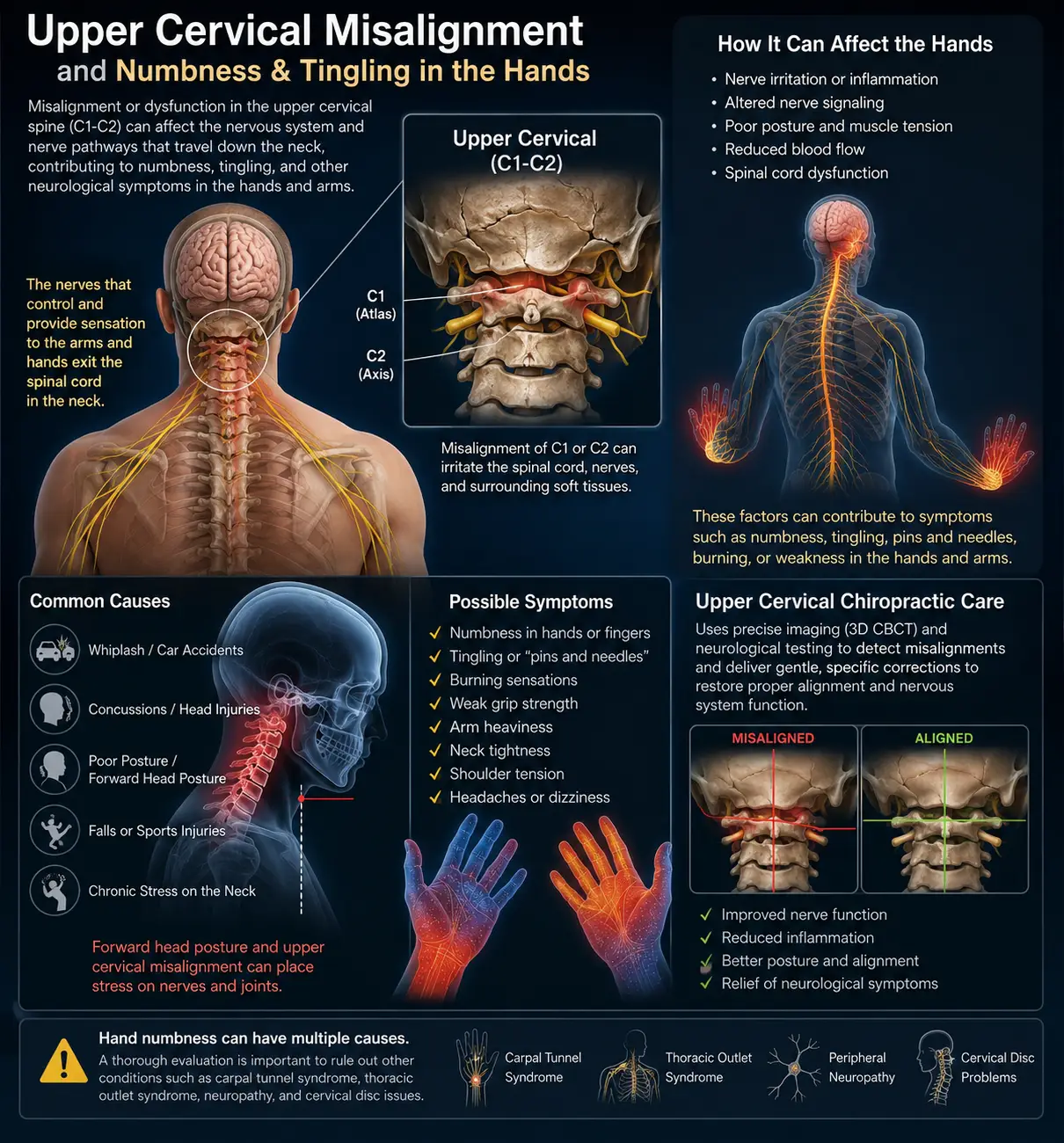
Numbness and Tingling in the Hands in Sarasota, Florida: What It Means, What Causes It, and How Upper Cervical Chiropractic Care at Lavender Family Chiropractic Can Help
By Dr. Rusty Lavender, D.C. — upper cervical chiropractor, Lavender Family Chiropractic, Sarasota, FL. Reviewed and updated October 2026.
Numbness and Tingling in the Hands: Almost everyone has experienced it at some point — that pins-and-needles sensation when a hand “falls asleep,” the strange numbness that creeps in while you are holding your phone, the tingling that wakes you in the middle of the night and makes you shake your hand to bring it back to life. For most people, it is occasional and harmless. But for a great many others, numbness and tingling in the hands becomes persistent, recurrent, and worrying — and it is one of the most common symptoms that sends people searching for answers.
Here is the most important thing to understand: numbness and tingling in the hands is a symptom, not a diagnosis. It is your nervous system telling you that a nerve, somewhere along its pathway from your spinal cord to your fingertips, is being compressed, irritated, or affected. The challenge — and the reason so many people stay stuck without relief — is that the source of that nerve irritation can be in several different places, and treating the wrong location is one of the most common reasons symptoms persist.
At Lavender Family Chiropractic in Sarasota, Florida, we help patients sort through exactly this puzzle. The pattern of your numbness — which fingers are involved, when it happens, whether it affects one hand or both, what makes it better or worse — tells a detailed story about where the problem actually originates. And one of the most overlooked sources, even though it sits at the very top of the nerve pathway, is the cervical spine. This guide is for anyone in Sarasota, Bradenton, Lakewood Ranch, or the surrounding areas who wants to understand what their hand numbness might mean, when it warrants concern, and where upper cervical chiropractic care fits into the picture.
What Numbness and Tingling in the Hands Actually Means
The medical term for the abnormal sensations of numbness, tingling, “pins and needles,” or a hand falling asleep is paresthesia. These sensations occur when something interferes with the normal functioning of a sensory nerve — anywhere along its path from the spinal cord, through the neck, shoulder, arm, and forearm, down to the hand and fingers.
To understand hand numbness, it helps to understand the basic wiring. The nerves that supply your hands begin as nerve roots exiting your cervical spine (your neck), primarily at the levels of C6, C7, C8, and T1. These nerve roots merge and reorganize into the brachial plexus, a complex network of nerves in the shoulder region, and then continue down the arm as three main nerves: the median nerve, the ulnar nerve, and the radial nerve. Each of these nerves supplies sensation to a specific part of the hand. This is why the precise pattern of your numbness is such a powerful clue to its source.
When a nerve along this pathway is compressed, irritated, or damaged, it cannot transmit signals normally — and the brain interprets the disrupted signals as numbness, tingling, burning, or that characteristic asleep sensation. The location of the disruption determines which part of the hand is affected, and the nature of the disruption (compression versus metabolic damage versus inflammation) determines the broader pattern and progression.
How common is this symptom? Extremely. Peripheral neuropathy alone — just one category of cause — affects approximately 2.4% of the general population, rising to about 8% in people over 65. When you add the compression neuropathies (carpal tunnel syndrome, cervical radiculopathy, thoracic outlet syndrome, ulnar neuropathy) and the many systemic causes, hand numbness becomes one of the most frequently reported neurological symptoms there is.
Decoding Your Symptoms: Which Fingers, When, and How
The single most useful thing you can do to understand your hand numbness is to pay close attention to the pattern. Different sources of nerve irritation produce characteristically different patterns, and these patterns are how clinicians localize the problem. Here is how to read the clues.
Which fingers are affected? This is the most powerful single piece of information.
If your numbness involves the thumb, index finger, middle finger, and the thumb-side half of the ring finger — but spares the little finger — this points toward the median nerve. The most common cause of median nerve symptoms is carpal tunnel syndrome (compression at the wrist), but the same fibers can be irritated higher up, at the C6 or C7 nerve roots in the neck.
If your numbness involves the little finger and the pinky-side half of the ring finger, this points toward the ulnar nerve. Ulnar symptoms commonly arise from compression at the elbow (cubital tunnel syndrome) or, less commonly, the wrist — but the same territory can be affected by C8 nerve root irritation in the neck.
If your numbness follows a specific stripe or band down the arm into particular fingers, it may follow a dermatomal pattern, which points toward a cervical nerve root source. A C6 problem tends to affect the thumb and index finger; C7 the middle finger; and C8 the ring and little fingers.
If your numbness affects the whole hand, or both hands in a “glove” distribution, this points away from a single compressed nerve and toward a systemic cause such as peripheral neuropathy — frequently from diabetes, thyroid dysfunction, vitamin deficiency, or other metabolic factors.
When does it happen? Timing is the second great clue. Numbness that is worst at night and wakes you from sleep is classic for carpal tunnel syndrome, because many people sleep with their wrists flexed. Numbness that appears with overhead activities or sustained arm positions points toward thoracic outlet syndrome. Numbness that worsens with certain neck positions or movements points toward a cervical source. Numbness that is constant and slowly progressive, especially in both hands, points toward a systemic or metabolic cause.
One hand or both? Symptoms in one hand generally suggest a localized compression somewhere along that arm’s nerve pathway. Symptoms in both hands, especially symmetrically, raise the suspicion of a systemic cause or a central source like the cervical spine affecting both sides.
This decoding process is exactly what a thorough evaluation is designed to do — and it is why guessing, or assuming every case of hand numbness is carpal tunnel, leads so many people astray.
The Many Causes of Hand Numbness
Because hand numbness has so many possible sources, an honest discussion has to acknowledge the full range. Broadly, the causes fall into a few categories.
Compression along the nerve pathway. This is the most common category for isolated hand numbness and includes carpal tunnel syndrome (median nerve at the wrist), cubital tunnel syndrome (ulnar nerve at the elbow), cervical radiculopathy (nerve root compression in the neck), and thoracic outlet syndrome (compression at the thoracic outlet between the neck and armpit). These are the conditions most relevant to the cervical and postural mechanisms we address.
Systemic and metabolic causes. Diabetes is the single most common cause of peripheral neuropathy worldwide. Other systemic causes include hypothyroidism, vitamin B12 and other nutritional deficiencies, alcohol use, kidney disease, autoimmune conditions, and certain medications, including chemotherapy. These typically produce symmetric, both-hand “glove” numbness and require medical management of the underlying condition.
Inflammatory and other causes. A range of less common causes includes inflammatory neuropathies like Guillain-Barré syndrome, infections, and other neurological conditions.
Serious causes that require urgent evaluation. This is important. While most hand numbness is benign and manageable, certain presentations require immediate medical attention. Sudden numbness on one side of the body, especially with face drooping, arm weakness, slurred speech, or confusion, can signal a stroke and is a medical emergency — call 911 immediately. Numbness accompanied by significant weakness, loss of bowel or bladder control, or rapidly progressing symptoms also requires urgent evaluation.
The breadth of this list is exactly why we never assume we know the cause of someone’s hand numbness before a thorough evaluation. Part of responsible care is identifying which category a patient’s symptoms fall into and making sure systemic and serious causes are properly addressed — including referring out when that is what the situation requires.
The Cervical Connection: Why the Neck Is So Often Overlooked
Here is the piece that conventional evaluation so frequently misses. Because the nerves that supply the hands originate in the cervical spine, the neck is one of the most important — and most overlooked — sources of hand numbness.
When a nerve root is compressed or irritated where it exits the cervical spine, it can produce numbness and tingling all the way down in the hand, in the specific dermatomal pattern corresponding to that nerve root. A C6 problem can cause thumb and index finger numbness that looks just like carpal tunnel. A C8 problem can cause ring and little finger numbness that looks just like an ulnar nerve problem. This is why so many people are treated for a wrist or elbow problem when the actual source — or a contributing source — is higher up in the neck.
There is an even more important concept here: the double crush phenomenon. First described by Upton and McComas in 1973, the double-crush model holds that a nerve compressed at one point along its course becomes more vulnerable to dysfunction from a second compression elsewhere along the same nerve. Reduced axoplasmic flow — the transport of nutrients along the nerve fiber — from a cervical nerve root irritation can make the downstream nerve at the wrist or elbow more susceptible to symptoms. This means the cervical spine can be a hidden contributor to hand numbness even when there is also a genuine compression at the wrist. It is one of the most documented reasons that carpal tunnel surgery sometimes fails to fully resolve symptoms — the cervical half of the problem was never addressed.
The upper cervical spine matters here in two distinct ways. First, when the atlas (C1) and axis (C2) are misaligned, the resulting postural compensation — forward head posture, rounded shoulders — increases tension along the entire nerve pathway from the neck through the thoracic outlet and down the arm. Second, upper cervical alignment influences the function and posture of the whole cervical spine below it, including the lower cervical levels (C6, C7, C8) from which the hand nerves emerge.
To be precise: the upper cervical spine is not the source of every case of hand numbness, and upper cervical care does not fix a wrist-level carpal tunnel compression or a diabetic neuropathy. What it can do is address the cervical and postural contribution to hand numbness — which, for a substantial number of patients, is a real and overlooked part of the picture. The key is a thorough evaluation that identifies whether the neck is part of your particular puzzle.
Why Upper Cervical Care Matters for Hand Numbness
At Lavender Family Chiropractic, we use the Knee Chest Upper Cervical technique — a precise, gentle method of correcting atlas and axis misalignments without any twisting, popping, or forceful manipulation. For patients whose hand numbness has a cervical or postural component, this matters in several ways.
First, by correcting upper cervical misalignment and improving cervical posture, we help reduce irritation of the cervical nerve roots from which the hand nerves originate. For numbness that is being driven or contributed to at the cervical level, this addresses the actual source rather than a downstream symptom. Second, by correcting the forward head posture that increases tension along the entire nerve pathway, upper cervical care can reduce the overall load of nerve irritation that the hand nerves experience from the neck all the way down. Third, for patients with a double-crush picture — a genuine wrist or elbow compression compounded by a cervical contribution — addressing the cervical component can reduce the total nerve irritation and improve symptoms even when the distal compression is also being treated.
This is why hand numbness connects so directly to the other conditions we address. Many patients with hand numbness ultimately have carpal tunnel syndrome, cervical radiculopathy, thoracic outlet syndrome, or some combination — and the combination, the double crush, is where the cervical spine becomes such an important and overlooked piece. For patients whose numbness reflects a true peripheral neuropathy from a systemic cause, we are honest that upper cervical care is not the answer and help direct them toward appropriate medical management.
The honest reality is that patients with hand numbness vary widely in how much of their symptom picture is cervical. Some experience significant improvement when the cervical contribution is addressed. Others have a predominantly wrist-level or systemic problem for which upper cervical care plays little role. What we promise is a thorough evaluation, an honest assessment of where your numbness is coming from, and a clear explanation of whether upper cervical care is likely to help — and what else you may need.
What Care Looks Like at Lavender Family Chiropractic
If you come to our Sarasota office for evaluation of hand numbness, here is what to expect.
Your first visit begins with a thorough consultation. Dr. Lavender or Dr. Temple will sit down with you and carefully map your symptoms — which fingers, when symptoms occur, one hand or both, what makes them better or worse, whether there is neck or arm pain, your work and activities, and any underlying conditions like diabetes or thyroid disease. This symptom mapping is the heart of localizing the source, and we take the time to do it properly.
The examination includes a detailed neurological evaluation (sensation, strength, reflexes), provocative testing for carpal tunnel, thoracic outlet, and cervical involvement, postural and gait analysis, and advanced 3D imaging to assess your upper cervical alignment and overall posture. Critically, we screen for red flags and for signs of systemic or serious causes. If your presentation suggests a stroke risk, a systemic neuropathy requiring medical workup, or another condition outside our scope, we will tell you directly and help you get the right care. Identifying who needs something other than what we offer is part of responsible practice.
If the examination reveals a cervical and postural component to your hand numbness, we will explain honestly how upper cervical care fits into your overall recovery — and where it does not. We coordinate with other providers, including physicians managing systemic causes and therapists addressing wrist or elbow components, because hand numbness so often has more than one contributor.
Care is delivered through the gentle Knee Chest Upper Cervical technique. We offer customized treatment plans tailored to your specific situation, with honest expectations about what upper cervical care can and cannot accomplish.
📞 Call (941) 243-3729 to schedule your consultation 📅 Book your consultation online 📍 5899 Whitfield Avenue, Suite 107, Sarasota, FL 34243 — at the corner of University and Whitfield
What the Research Says About Hand Numbness and Its Sources
The research on the causes of hand numbness is extensive and reinforces both the breadth of possible sources and the importance of accurate localization.
On the systemic side, peripheral neuropathy is a leading cause. According to American Family Physician, the prevalence of peripheral neuropathy in the general population ranges from 1% to 7%, with higher rates among those older than 50, and common identifiable causes include diabetes, nerve compression or injury, alcohol use, and nutritional deficiencies — with the condition remaining idiopathic in 25% to 46% of cases. This underscores why systemic causes must always be considered and why blood testing is often part of a proper workup.
On the compression side, the dermatomal mapping of the cervical nerve roots is well established. According to clinical references, C6 radiculopathy produces numbness in the thumb and index finger, C7 in the middle finger, and C8 in the ring and little fingers — the same territories that peripheral nerve compressions affect, which is precisely why cervical and peripheral sources are so easily confused.
The cervical spine’s role as a hidden contributor is supported by the double-crush literature. Clinical references note that decreased axoplasmic flow from cervical nerve root compression predisposes downstream nerves to peripheral entrapment, providing the mechanistic basis for why cervical involvement can drive or worsen hand numbness that appears to originate at the wrist.
The importance of careful localization is itself documented. A study of spine surgeons found that fewer than two-thirds correctly characterized the sensory distribution of the ulnar nerve, and none could correctly identify the specific muscles distinguishing C8-T1 radiculopathy from ulnar neuropathy — a striking finding that demonstrates how even specialists can struggle to localize the source of hand symptoms, and why a careful, systematic evaluation matters so much.
This body of research establishes that hand numbness has many possible sources, that accurate localization is both essential and frequently done poorly, that the cervical spine is a genuine and often-overlooked contributor, and that systemic causes must always be considered. This is the evidence-based foundation for the thorough, honest evaluation approach we take.
Lifestyle Factors That Support Recovery from Hand Numbness
Whether or not upper cervical care is part of your strategy, the daily inputs you control can meaningfully affect hand numbness — particularly the compression and postural causes.
Posture correction. Because the hand nerves travel from the neck down the arm, forward head posture and rounded shoulders increase tension along the entire pathway. Keeping the head stacked over the shoulders and the chest open reduces this whole-pathway tension.
Wrist and arm positioning. Avoid sustained wrist flexion (especially during sleep), prolonged elbow bending (which compresses the ulnar nerve), and overhead arm positions that narrow the thoracic outlet. A neutral-position wrist splint at night helps many people with median nerve symptoms.
Ergonomics. Set up your workstation so your wrists, elbows, and neck stay in neutral positions. Take frequent breaks from repetitive hand activities and sustained postures.
Manage underlying conditions. If diabetes, thyroid dysfunction, or a vitamin deficiency is contributing, managing it is essential. Have blood sugar, thyroid function, and vitamin B12 checked if your numbness is bilateral, progressive, or otherwise suggestive of a systemic cause.
Anti-inflammatory nutrition. Because inflammation contributes to nerve irritation, an anti-inflammatory eating pattern — minimizing processed foods, refined sugars, and seed oils while emphasizing whole foods and omega-3-rich fish — supports nerve health. Adequate B vitamins and hydration matter too.
Stay active. Regular movement supports circulation and nerve health. Gentle nerve gliding exercises, taught by a physical therapist, can help nerves move freely along their pathways.
Limit alcohol. Excessive alcohol is a direct cause of peripheral neuropathy and worsens many forms of hand numbness.
Do not ignore progression. If your numbness is worsening, spreading, or accompanied by weakness, get evaluated promptly. Early intervention for nerve compression generally produces better outcomes, and progressive symptoms can indicate something that needs timely attention.
If you found this guide useful, you may also want to read our blog on carpal tunnel syndrome, one of the most common specific causes of hand numbness and a condition where the cervical double-crush connection is especially relevant.
Serving Sarasota and the Surrounding Communities
Lavender Family Chiropractic is located in Sarasota, Florida, at 5899 Whitfield Avenue, Suite 107 — at the corner of University and Whitfield. From this central location, we serve patients throughout the region, including Bradenton, Lakewood Ranch, Palmetto, Parrish, Venice, Osprey, Nokomis, Ellenton, Ruskin, Myakka City, North Port, and the greater Tampa Bay area. Patients also travel from St. Pete, Riverview, and Manatee County to receive specialized upper cervical care here.
Hand numbness is one of the most common and most confusing symptoms there is, and many people bounce between providers without ever getting a clear answer about where it is coming from. If you want a thorough, honest evaluation that considers the whole nerve pathway — including the cervical spine that conventional workups so often overlook — we encourage you to reach out.
Top 15 FAQs About Hand Numbness and Upper Cervical Chiropractic Care
1. What does numbness and tingling in my hands actually mean? It means a nerve somewhere along its pathway — from your spinal cord, through your neck, shoulder, arm, and forearm, to your hand — is being compressed, irritated, or affected. The specific pattern of your numbness is a powerful clue to where the problem is located.
2. Which fingers are numb, and what does that tell me? Thumb, index, and middle fingers point toward the median nerve (carpal tunnel or C6-C7). Ring and little fingers point toward the ulnar nerve (cubital tunnel or C8). A whole-hand or both-hands “glove” pattern points toward a systemic cause like neuropathy. The pattern helps localize the source.
3. Could my hand numbness be coming from my neck? Yes — this is one of the most overlooked sources. The nerves to your hands originate in your cervical spine, so a problem at C6, C7, or C8 can produce numbness in the hand that mimics a wrist or elbow problem. The cervical spine can also be a hidden contributor through the double-crush phenomenon.
4. What is the double-crush phenomenon? It is the principle that a nerve compressed at one point becomes more vulnerable to symptoms from a second compression elsewhere along the same nerve. A cervical nerve root irritation can make the downstream nerve at the wrist or elbow more susceptible to symptoms — which is why addressing the neck can help even when there is also a wrist problem.
5. When is hand numbness an emergency? Sudden numbness on one side of the body, especially with face drooping, arm weakness, slurred speech, or confusion, can signal a stroke — call 911 immediately. Numbness with significant weakness, loss of bowel or bladder control, or rapidly progressing symptoms also requires urgent evaluation.
6. Why is my hand numbness worse at night? Night-time hand numbness that wakes you is classic for carpal tunnel syndrome, because many people sleep with their wrists flexed, which increases pressure on the median nerve. Sleeping posture and arm position also play a role.
7. Can diabetes cause hand numbness? Yes. Diabetes is the single most common cause of peripheral neuropathy, which typically produces symmetric numbness in both hands (and often both feet) in a “glove and stocking” pattern. Managing blood sugar is essential. This type of numbness is not something upper cervical care addresses, and we are honest about that.
8. Can upper cervical chiropractic help my hand numbness? It depends on the source. For numbness with a cervical or postural component, or a double-crush picture, upper cervical care can be genuinely helpful. For purely wrist-level or systemic causes, it plays little role. A thorough evaluation determines which applies to you.
9. Is upper cervical care safe? The Knee Chest Upper Cervical technique is exceptionally gentle, with no twisting or forceful manipulation. It is generally very safe. We perform a thorough evaluation and screen for red flags before beginning care.
10. Why do both my hands feel numb? Bilateral, symmetric hand numbness raises the suspicion of a systemic cause like peripheral neuropathy (often from diabetes, thyroid dysfunction, or vitamin deficiency) or, in some cases, a central source such as the cervical spine affecting both sides. Bilateral symptoms warrant a careful workup including blood testing.
11. Should I get blood tests? If your numbness is in both hands, progressive, or otherwise suggestive of a systemic cause, yes — checking blood sugar, thyroid function, and vitamin B12 is often appropriate. We will tell you if your presentation suggests the need for medical workup.
12. How do you tell where my numbness is coming from? By carefully mapping your symptoms (which fingers, when, one hand or both, what makes them worse), performing a neurological examination and provocative testing, assessing your posture and cervical alignment, and screening for systemic and serious causes. This systematic approach localizes the source.
13. I had carpal tunnel surgery but still have numbness. Why? One documented reason is an unaddressed cervical contribution — the double-crush phenomenon. If the median nerve was also being irritated at the neck, treating only the wrist leaves part of the problem unaddressed. This is worth evaluating if your surgery did not fully resolve symptoms.
14. How will I know if upper cervical care is right for me? The only way to know is a thorough evaluation. We will determine whether your hand numbness has a cervical or postural component, screen for other causes, and give you an honest assessment of whether upper cervical care is likely to help — and what else you may need.
15. How do I get started? Call our Sarasota office at (941) 243-3729 or book your consultation online. We will map your symptoms, perform a thorough examination, screen for red flags, and give you a straight answer about where your numbness is coming from and how upper cervical care fits in.
Take the Next Step Toward Answers
Numbness and tingling in the hands is one of the most common symptoms there is — and one of the most frequently misattributed. The pattern of your symptoms tells a detailed story about where the problem originates, and getting that localization right is the difference between effective treatment and months of frustration treating the wrong location. The cervical spine is one of the most overlooked sources, both as a direct cause and as a hidden contributor through the double-crush phenomenon.
If you are in Sarasota, Bradenton, Lakewood Ranch, or anywhere in the surrounding region and you are dealing with persistent or recurrent hand numbness, Dr. Rusty Lavender and Dr. Jacob Temple at Lavender Family Chiropractic are here to give you a thorough, honest evaluation of where your symptoms are coming from and whether upper cervical care can help.
📞 Call (941) 243-3729 today to schedule your consultation 📅 Book online here 📍 5899 Whitfield Avenue, Suite 107, Sarasota, FL 34243 — at the corner of University and Whitfield
Related Articles
Related Posts


Get our upper cervical articles first.