Dizziness Deconstructed: Vertigo vs. Vestibular Migraine vs. Meniere’s vs. Cervicogenic Dizziness
By Dr. Rusty Lavender, D.C. — upper cervical chiropractor, Lavender Family Chiropractic, Sarasota, FL. Reviewed and updated October 2026.
Dizziness Deconstructed: Few words are as slippery as “dizzy.” One person means the room is spinning. Another means the floor feels like the deck of a boat. A third means a lightheaded, about-to-faint sensation, and a fourth means a foggy, off-balance unsteadiness that has no single word at all. When four different experiences all get filed under one label, it is no wonder that patients — and sometimes the people trying to help them — end up confused about what is actually going on.
That confusion matters, because the common causes of dizziness are genuinely different conditions with different origins, different triggers, and different clinicians who diagnose and manage them. Benign paroxysmal positional vertigo (BPPV) comes from loose crystals in the inner ear. Vestibular migraine is a migraine-spectrum disorder diagnosed by specific criteria. Meniere’s disease involves fluid pressure changes deep in the inner ear, often with hearing symptoms. And cervicogenic dizziness arises from disordered sensory input coming out of the neck — particularly the upper neck. Telling them apart is the first, most useful step toward getting the right kind of help.
This article is a plain-language field guide to those four causes. We will start with the red flags that mean “stop reading and call for help,” then walk through each condition, lay them side by side so you can compare them, and dig into the piece we know best at our office: the cervical, or neck-related, contribution to imbalance. Along the way, we will be honest about where our care fits and where it does not. Inner-ear diseases are otologic conditions that belong in the hands of an ear, nose, and throat (ENT) specialist. What precise upper cervical chiropractic care addresses is the neck’s proprioceptive contribution to balance — a real and often overlooked piece of the puzzle, but a piece, not the whole thing.
Dizziness Deconstructed- First, the Red Flags: When Dizziness Is an Emergency
Before we sort out the everyday causes, we have to talk about the ones that cannot wait. Most dizziness is not an emergency. But some sudden dizziness is a warning sign of a stroke or another serious neurological event, and recognizing it quickly changes outcomes.
Call 911 or go to the nearest emergency department right away if dizziness or vertigo arrives suddenly and is accompanied by any of the following:
- Double vision, or a sudden change in vision
- Slurred speech, trouble finding words, or garbled speech
- Weakness, numbness, or drooping on one side of the face, arm, or leg
- A severe headache unlike any you have had before, sometimes described as “the worst headache of my life”
- Difficulty walking, sudden severe loss of coordination, or a feeling of falling to one side
- Trouble swallowing, confusion, or a sudden decrease in level of consciousness
- Vertigo that comes on abruptly and does not let up, especially in someone with vascular risk factors such as high blood pressure, diabetes, atrial fibrillation, or a history of stroke
These signs can indicate a stroke affecting the brainstem or cerebellum, the very regions that coordinate balance. A stroke in these areas can masquerade as “just dizziness,” which is exactly why the accompanying neurological signs matter so much. When in doubt, treat sudden severe vertigo with any neurological symptom as an emergency. Time is not something to negotiate with here.
Also worth an urgent medical evaluation, though not always a 911 call: new dizziness after a head or neck injury, dizziness with a stiff neck and high fever, fainting or near-fainting with chest pain or palpitations, and any dizziness that follows a fall in which you hit your head.
None of the conditions we discuss below should be self-diagnosed in place of ruling out these emergencies. Get the dangerous causes off the table first. Then, and only then, does it make sense to work through the more common, chronic patterns.
Four Very Different Causes of Dizziness
With the emergencies addressed, let us look at the four conditions patients most often mix up. Each gets a short profile here; the section after this one lays them side by side.
BPPV and True Vertigo (an inner-ear positional problem)
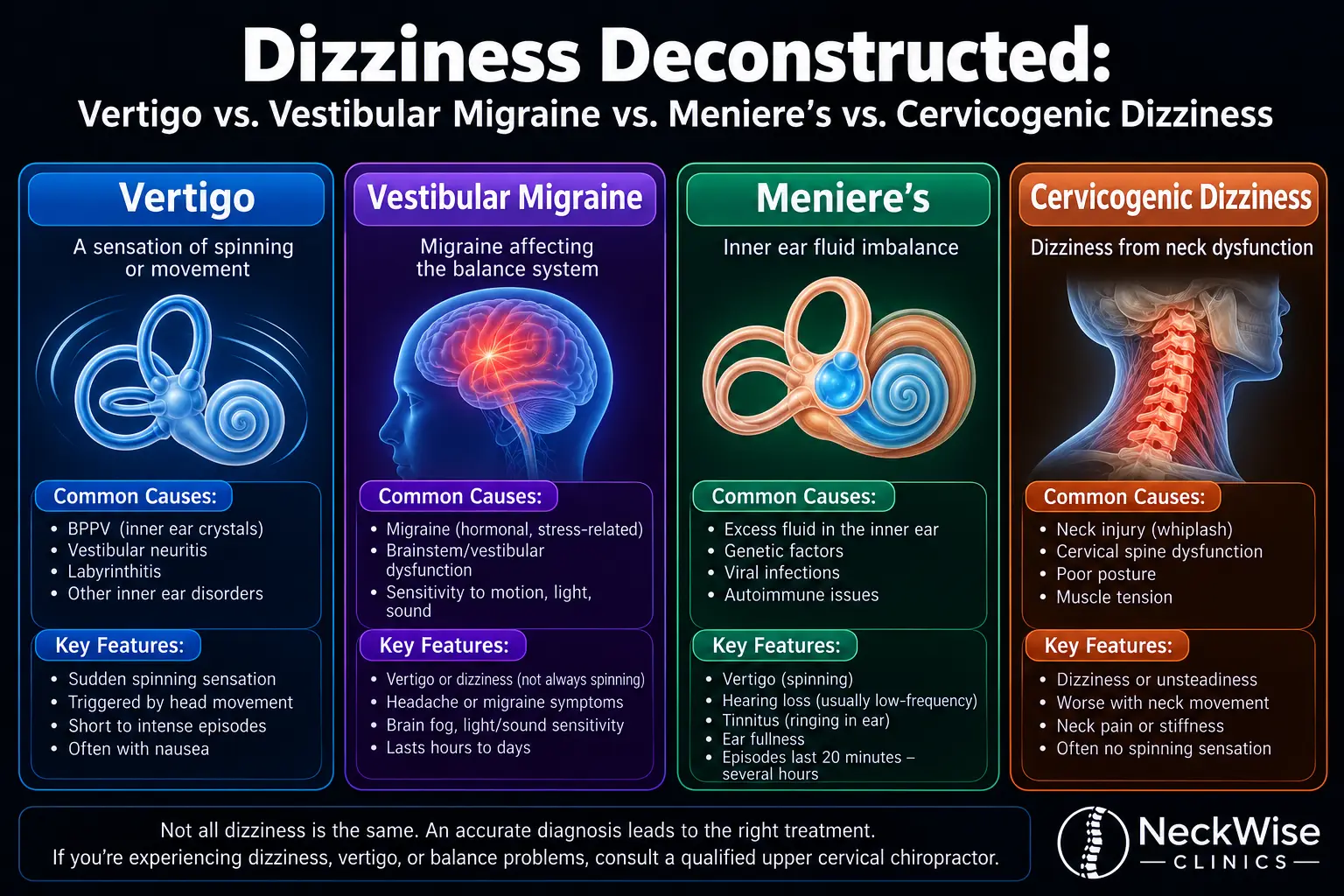
Benign paroxysmal positional vertigo is the classic “the room is spinning” experience, and it is one of the most common causes of true vertigo. The mechanism is mechanical and specific: tiny calcium carbonate crystals (otoconia) that normally sit in one part of the inner ear become dislodged and drift into the semicircular canals, where they do not belong. When you move your head into certain positions — rolling over in bed, tipping your head back to look up, bending down — those loose crystals stir the fluid in the canal and send a false “you are spinning” signal to the brain.
The hallmark of BPPV is that it is positional and brief. Spells are triggered by specific head movements, spin hard for seconds to a minute or so, and then settle when you hold still. There is usually no hearing loss and no ringing. BPPV is typically diagnosed with positional testing (such as the Dix-Hallpike maneuver) by a physician, ENT, or trained vestibular therapist, and it often responds well to repositioning maneuvers (such as the Epley maneuver) that guide the crystals back where they belong. Because BPPV is an inner-ear, or otologic, condition, it is diagnosed and managed medically — not something upper cervical care treats. You can read more about how true vertigo differs from other spinning sensations on our vertigo page.
Vestibular Migraine (migraine that shows up as dizziness)
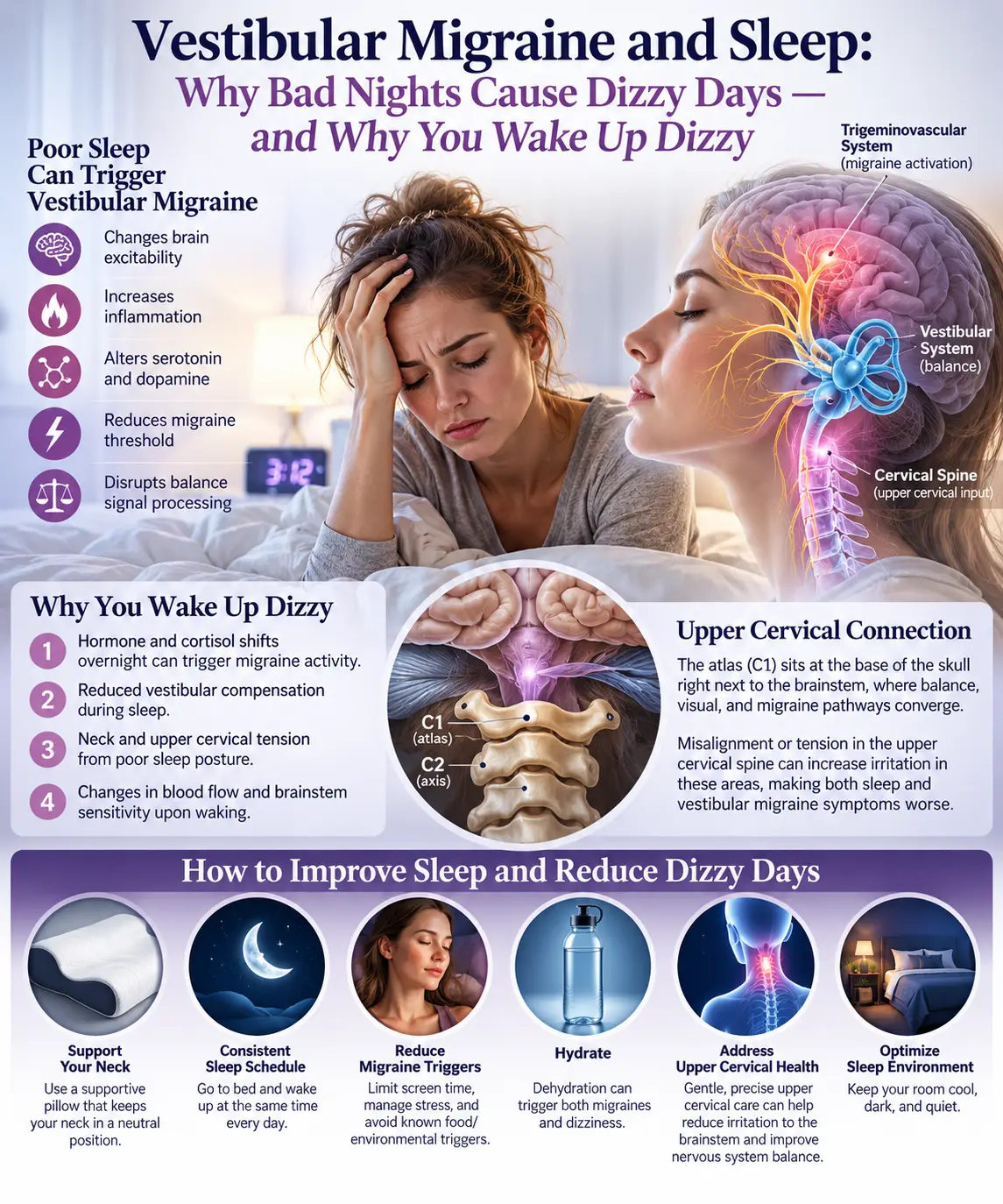
Vestibular migraine is one of the most under-recognized causes of recurrent dizziness, in part because it does not always come with a headache. It is a migraine-spectrum disorder in which the dominant symptom is vestibular — spinning, rocking, swaying, or a sense of motion — rather than, or in addition to, head pain. Episodes can last minutes to hours, sometimes longer, and are frequently accompanied by classic migraine features: sensitivity to light and sound, visual aura, nausea, and a tendency to be triggered by the same things that trigger migraines (poor sleep, certain foods, hormonal shifts, stress, and visually busy environments).
Vestibular migraine is a criteria-based diagnosis, meaning a clinician confirms it against an established checklist of features rather than a single scan or lab test. That diagnostic framework is well described in the medical literature, and it usually falls to a neurologist or a specialist familiar with vestibular disorders. The important takeaway for patients is that a person can have significant, disabling dizziness from migraine biology without ever having a “migraine headache” in the way they expect. If your dizziness comes in episodes with light or sound sensitivity, visual symptoms, or a personal or family history of migraine, this belongs on the list. Our vestibular migraine page goes deeper into the pattern.
Meniere’s Disease (inner-ear fluid pressure, with hearing changes)
Meniere’s disease is another inner-ear condition, but its fingerprint is distinctive. It is associated with a buildup of fluid pressure in the inner ear — a process described as endolymphatic hydrops — and it tends to produce a recognizable cluster: episodes of true vertigo that last longer than BPPV (often twenty minutes to several hours), fluctuating hearing loss, tinnitus (ringing or roaring), and a sensation of fullness or pressure in the affected ear. The hearing symptoms are the tell. Where BPPV is positional and silent in the ears, and vestibular migraine leans on light and sound sensitivity, Meniere’s classically ties the vertigo to a change you can hear and feel inside one ear.
Meniere’s is an otologic diagnosis, made and managed by an ENT, frequently with the help of hearing tests (audiometry) and a careful history. Management is medical and may include dietary changes, medications, and other interventions directed at the inner ear. This is squarely outside what chiropractic care treats. If your dizzy spells travel with ringing, muffled hearing, or ear fullness, an ENT evaluation should come first. Our Meniere’s disease page explains the condition and why the hearing component is so central.
Cervicogenic Dizziness (imbalance driven by the neck)
Cervicogenic dizziness is the odd one out, and the one most often missed, because it does not originate in the inner ear at all. It describes imbalance, unsteadiness, and a vague sense of disorientation that arises from disordered sensory input coming out of the neck — especially the upper cervical spine. Rather than a hard spinning attack, people with a cervical contribution more often describe a floating, off-balance, “not quite right” feeling that tends to be worse with neck movement, sustained neck postures, or after periods of neck tension, and that frequently travels alongside neck stiffness, headaches, or a history of neck injury.
The reason the neck can do this comes down to proprioception — the body’s internal sense of where it is in space. The joints, muscles, and ligaments of the upper neck are unusually rich in sensory receptors, and they feed a constant stream of position information into the same brainstem centers that process balance. When that stream becomes noisy or mismatched with what the eyes and inner ears are reporting, the brain receives conflicting signals and the result can be dizziness and unsteadiness. Cervicogenic dizziness is often considered a diagnosis of exclusion, meaning other causes (like the three above) are ruled out first, and the neck’s role is then evaluated. Because it can also overlap with instability at the head-neck junction, it connects to topics like craniocervical instability, and it is the focus of our companion article, can neck pain cause dizziness.
How to Tell Them Apart
No online article can diagnose you, and the conditions genuinely overlap — a person can have more than one at the same time. But there are useful patterns. Think of the following as a set of questions to bring to your clinician, not a verdict.
Onset and character. Ask yourself what the dizziness actually feels like. A hard, true spinning sensation (“the room is rotating”) points toward an inner-ear source — BPPV or Meniere’s. A rocking, swaying, or motion-sick feeling, sometimes with visual disturbance, fits vestibular migraine. A vague floating, unsteady, off-balance sensation without much true spin leans toward a cervical contribution. This is not absolute, but character is one of the first clues clinicians weigh.
Triggers. What sets it off? If specific head positions reliably provoke short bursts of spinning — lying down, rolling over, looking up — that is a classic BPPV pattern. If episodes track with migraine triggers such as poor sleep, stress, hormonal changes, certain foods, or visually busy environments, think vestibular migraine. If neck movement, prolonged sitting with a forward head posture, or neck tension seem to bring on or worsen the unsteadiness, the neck deserves attention. If nothing external seems to trigger it but hearing changes accompany the spells, Meniere’s rises up the list.
Duration. BPPV spells are brief — seconds to a minute or two per position change. Vestibular migraine episodes tend to run minutes to hours, sometimes longer. Meniere’s attacks classically last twenty minutes to several hours. Cervicogenic dizziness is often more of a persistent, lingering unsteadiness than a discrete attack, waxing and waning with neck activity across the day.
Hearing and ear symptoms. This is one of the most decisive dividing lines. Ringing (tinnitus), muffled or fluctuating hearing, and a feeling of fullness or pressure in one ear strongly suggest Meniere’s and warrant an ENT evaluation. BPPV usually spares the hearing. Vestibular migraine may bring light and sound sensitivity but not the fluctuating hearing loss of Meniere’s. Cervicogenic dizziness does not cause hearing loss; if your ears are involved, look to the inner ear first.
Neck involvement. Does the dizziness travel with neck stiffness, headaches at the base of the skull, or a history of whiplash, concussion, or neck injury? Does turning or holding your head in one position change the symptom? A “yes” raises the odds that the cervical spine is contributing — either as a primary driver or as an aggravator layered on top of another condition.
Who diagnoses each. This is where patients often lose the thread, so let us be explicit. BPPV is diagnosed by positional testing, typically through a physician, ENT, or trained vestibular therapist. Vestibular migraine is a criteria-based diagnosis, usually made by a neurologist or vestibular specialist. Meniere’s disease is an otologic diagnosis made by an ENT, often with hearing tests. Cervicogenic dizziness is generally a diagnosis of exclusion, considered once inner-ear and neurological causes have been evaluated, with the neck’s role assessed through history and physical examination. The practical message: getting a proper diagnosis usually means the right specialist looks first, before anyone assumes the neck is to blame.
The Cervicogenic Piece: Why the Neck Causes and Compounds Imbalance
Now to the part we spend our days thinking about. Balance is not the job of the inner ear alone. Your brain builds a sense of stability by continuously blending three streams of information: what your eyes see (vision), what your inner ears sense about head motion and gravity (the vestibular system), and what your body reports about position, especially from the joints and muscles (proprioception). When those three streams agree, you feel steady. When they disagree, you feel dizzy, unsteady, or disoriented.
The upper neck is a remarkably dense source of that third stream. The small joints, deep muscles, and ligaments of the upper cervical spine are packed with proprioceptive receptors, and they sit anatomically and neurologically close to the brainstem’s balance centers. Signals from the upper neck feed directly into the same regions that integrate vestibular and visual input. This is why the region gets described as a kind of sensory hub for head-and-neck position. A narrative review of proprioceptive cervicogenic dizziness lays out this relationship in detail, describing how disordered cervical proprioception can generate the sensation of imbalance even when the inner ear is working normally.
There is a related anatomical reason the upper neck and the head are so intertwined. The sensory nerves of the upper cervical spine converge with the trigeminal system in the brainstem, at what is often called the trigeminocervical nucleus. In plain terms, input from the upper neck and input from the head funnel into an overlapping relay station. This convergence helps explain why upper-neck dysfunction can be felt as head symptoms — headache, pressure, and a muddled sense of balance — rather than staying neatly “in the neck.” When the region is sending noisy or asymmetric signals, the brain has to reconcile a mismatch, and dizziness can be the result.
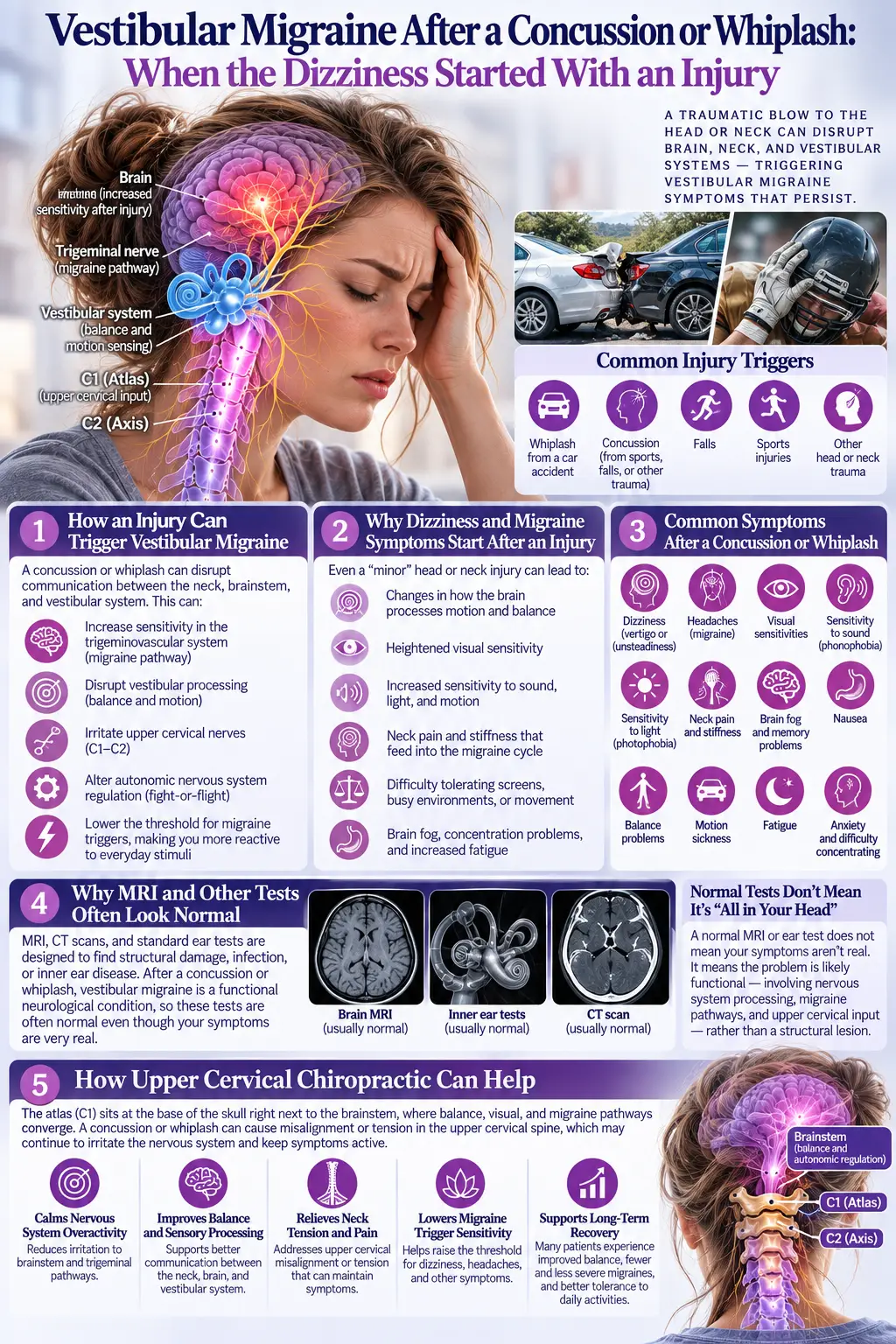
Two things follow from this. First, the neck can be a primary cause of dizziness. When cervical proprioception is disordered — after whiplash, a concussion, prolonged poor posture, or chronic neck tension — the mismatch between what the neck reports and what the eyes and inner ears report can produce genuine unsteadiness. Second, and just as important, the neck can compound dizziness that starts elsewhere. Someone with vestibular migraine or a settled inner-ear condition may carry an added layer of neck-driven unsteadiness that makes everything feel worse and slower to settle. In those cases, addressing the cervical component does not treat the inner-ear disease, but it may reduce one of the ingredients feeding the overall sense of imbalance.
This is the vestibular-cervical integration story in a nutshell: the balance system is a team effort, the upper neck is a loud voice on that team, and when its signal is off, the whole system can feel off. That understanding is what makes a careful look at the neck worthwhile for the right patients — particularly those whose dizziness travels with neck symptoms and whose inner-ear and neurological workups have not fully explained the picture.
How Precise Upper Cervical Care Fits
Here is where we want to be careful and clear, because honesty about scope is more useful to you than an oversized promise. Upper cervical chiropractic care addresses the cervical, proprioceptive component of dizziness. It does not treat inner-ear disease. It is not a substitute for an ENT evaluation of Meniere’s or BPPV, and it is not a substitute for a neurologist’s assessment of vestibular migraine. What it can do is evaluate and address the neck’s contribution to your balance in a precise, low-force way — as one coordinated part of a bigger picture that may also include your ENT and neurologist.
Our approach centers on the Knee Chest Upper Cervical technique, a precise, low-force method focused on the upper cervical spine. It is not general spinal manipulation and it is not high-force twisting; the intent is a specific, gentle correction based on objective findings rather than a forceful adjustment. Before anything is done, we work to understand the individual anatomy. We use 3D CBCT imaging to see the upper cervical structures in three dimensions, and we use Tytron thermographic scanning to gauge patterns in the nervous system over time. Those objective measures let us tailor care to the person in front of us rather than applying a one-size template. You can learn more about the overall method on our upper cervical chiropractic care page and meet the clinicians on our team page.
Coordination is the theme. If your history and examination suggest an inner-ear or migraine cause, the right move is a referral or a partnership with the appropriate specialist. If, after that, a cervical component remains — or if your dizziness has clear neck involvement from the start — that is where our care is designed to help. We are candid that outcomes vary from person to person, that we cannot promise a particular result, and that some people are simply better served by another type of provider. What we offer is a thorough, individualized evaluation of the neck’s role and, when it is appropriate, gentle care directed at that role.
Curious whether the neck is part of your dizziness? Our doctors offer a consultation to review your history, examine the upper cervical spine, and help you understand where our care fits alongside the rest of your team. Call (941) 243-3729 or book online through our new patient scheduling page. We are at 5899 Whitfield Avenue, Suite 107, Sarasota, FL 34243, at the corner of University and Whitfield.
What the Research Says
We want the science we cite to be accurate and checkable. Here are the sources behind the ideas in this article.
The role of the neck in balance is described in a narrative review of proprioceptive cervicogenic dizziness, which explains how disordered proprioceptive input from the cervical spine can produce imbalance and how the condition is approached as a diagnosis of exclusion once other causes are ruled out.
For vestibular migraine, the diagnostic criteria for vestibular migraine show how clinicians confirm the diagnosis against an established checklist of features rather than a single test, which is why a specialist’s assessment matters. A companion paper offering new insights into the pathophysiology of vestibular migraine explores the underlying mechanisms that link migraine biology to vestibular symptoms.
For Meniere’s disease, a contemporary re-evaluation asking what Meniere’s disease is and re-examining endolymphatic hydrops discusses the inner-ear fluid changes associated with the condition and its characteristic hearing-related features — a reminder that this is an otologic diagnosis.
Finally, the anatomical convergence of upper-neck and head sensory pathways is described in work on trigeminocervical nucleus integration, which helps explain why upper-cervical input can be experienced as head symptoms, including a disturbed sense of balance.
Serving Sarasota and Surrounding Communities
Lavender Family Chiropractic welcomes patients from across the region. We regularly serve people from Sarasota, Bradenton, Lakewood Ranch, Venice, Palmer Ranch, Osprey, Siesta Key, Longboat Key, Lido Key, University Park, Parrish, Ellenton, Myakka City, Punta Gorda, and St. Petersburg. Our office at the corner of University and Whitfield is a convenient stop for families throughout the area who want a careful, individualized look at the neck’s role in their balance and well-being.
Top 12 Questions
1. Can you cure my dizziness? No. We do not use the word cure, and we do not promise to make dizziness go away. What our doctors do is evaluate and, when appropriate, address the cervical, proprioceptive component of imbalance in a precise, low-force way, as one part of a coordinated approach.
2. Should I see an ENT? Yes, in most cases involving suspected inner-ear disease. If your dizziness comes with hearing changes, ringing, or ear fullness, or if you have not yet had a proper diagnosis, an ENT evaluation should come first. We work alongside your medical team rather than replacing it.
3. Is it my neck or my inner ear? That is exactly the question a good workup answers, and it often requires more than one clinician. Inner-ear conditions like BPPV and Meniere’s are otologic and diagnosed by an ENT. A cervical contribution is usually considered once those are ruled out. Some people have both — a neck component layered on top of an inner-ear or migraine cause.
4. When is dizziness an emergency? Sudden severe vertigo with any neurological sign — double vision, slurred speech, one-sided weakness or numbness, a severe unfamiliar headache, or trouble walking or speaking — can signal a stroke. Call 911 immediately. Do not wait to see whether it passes.
5. How is BPPV different from the other causes? BPPV produces brief, hard spinning triggered by specific head positions, usually with no hearing changes. It is diagnosed with positional testing and often responds to repositioning maneuvers performed by a physician, ENT, or vestibular therapist. It is an inner-ear condition, not something chiropractic care treats.
6. What makes vestibular migraine distinctive? It is a migraine-spectrum disorder in which dizziness is a leading symptom, sometimes without any headache. Episodes often bring light and sound sensitivity, visual symptoms, or nausea, and track with migraine triggers. It is diagnosed against established criteria, usually by a neurologist.
7. What are the telltale signs of Meniere’s? Longer vertigo attacks (roughly twenty minutes to several hours) paired with fluctuating hearing loss, ringing, and a sense of fullness in one ear. The hearing symptoms are the key clue. It is diagnosed and managed by an ENT, often with hearing tests.
8. What does cervicogenic dizziness feel like? More often a floating, off-balance, unsteady feeling than a hard spin, frequently worse with neck movement or sustained neck postures and often traveling with neck stiffness, headaches, or a history of neck injury. It does not cause hearing loss.
9. What is the Knee Chest Upper Cervical technique? It is a precise, low-force method focused on the upper cervical spine, guided by objective findings. It is not general manipulation and not high-force twisting. The goal is a specific, gentle correction based on your individual anatomy and scans.
10. Do you take insurance? We are a cash-pay, out-of-network practice. We provide superbills you can submit to your insurer for possible reimbursement, and we build customized care plans for each patient. Our team is glad to explain the details before you begin.
11. What imaging and measurements do you use? We use 3D CBCT imaging to view the upper cervical structures in three dimensions and Tytron thermographic scanning to track nervous-system patterns over time. These objective tools let us tailor care and monitor changes rather than guessing.
12. Can upper cervical care help if I already have an ENT diagnosis? It may help with the cervical component if one is present, but it does not treat the underlying inner-ear disease. For example, in someone with a confirmed inner-ear condition who also carries neck-driven unsteadiness, addressing the neck may reduce one ingredient of the overall picture. Our doctors are always happy to coordinate with your specialists — call (941) 243-3729 to talk it through.
Closing CTA
Dizziness is not one thing, and treating it as one thing is how people end up frustrated. BPPV, vestibular migraine, Meniere’s disease, and cervicogenic dizziness are distinct conditions with distinct fingerprints and distinct clinicians who diagnose them. The most useful first step is a proper diagnosis: rule out the emergencies, let the right specialist evaluate the inner ear and the migraine picture, and then take an honest look at whether the neck is contributing.
If your dizziness travels with neck symptoms, or if your workup has not fully explained the unsteadiness, our doctors would be glad to help you understand the cervical piece. Call (941) 243-3729 or book online through our new patient scheduling page. You can also reach us through our contact page. We are at 5899 Whitfield Avenue, Suite 107, Sarasota, FL 34243, at the corner of University and Whitfield. We look forward to helping you sort out what your dizziness is really telling you.
This article is for general education and is not medical advice. It does not diagnose or cure any condition. Please seek prompt medical care for the emergency signs described above, and consult the appropriate specialist for a proper diagnosis.
Related Articles
Related Posts


Get our upper cervical articles first.
Patients Experience