Meniere’s vs BPPV vs Labyrinthitis: How to Tell Inner-Ear Vertigo Apart — and the One Place Nobody Checks
By Dr. Rusty Lavender, D.C. — upper cervical chiropractor, Lavender Family Chiropractic, Sarasota, FL. Reviewed and updated October 2026.
If the room has ever started spinning for no reason you could name, you already know vertigo is one of the most frightening things a body can do. You go looking for answers, and everyone points at the inner ear — Meniere’s, BPPV, labyrinthitis. Those matter, and you need them sorted out. But here is what almost nobody tells you, and it is the reason so many people bounce from specialist to specialist without lasting relief: the top of your neck, the atlas (C1) and axis (C2) sitting directly beneath your skull, is one of the largest balance organs in your body — and it is the one place your workup almost certainly never examined. When vertigo won’t settle, that unchecked junction is the missing piece worth evaluating.
This guide gives you the honest version of how the three big inner-ear conditions differ, in plain English, so you can have a sharper conversation with your physician or ENT. And it names the structural driver the vertigo world skips — the upper cervical spine — because for a large number of people in Sarasota, Lakewood Ranch, and Bradenton, dizziness that never quite resolves traces back to a neck no one thought to look at. We serve all three cities, and we see this pattern constantly.
This article is educational and not a substitute for medical advice. Vertigo has many possible causes, and a few are serious. Proper evaluation by a physician or ENT is the foundation of good care.
First, What Is Vertigo — and What Is It Not?
Words matter here, because the sensation you feel is one of the first clues to what is driving it.
Vertigo is the false sense of movement — usually spinning, but sometimes tilting, rocking, or being pulled to one side. Your eyes may flick involuntarily. You may feel like you cannot tell which way is up.
Dizziness is broader and vaguer — lightheadedness, feeling faint, unsteady, or “foggy.” Not all dizziness is vertigo.
Disequilibrium is a sense of imbalance, especially while standing or walking, without the spinning.
Presyncope is the feeling that you are about to pass out, often tied to blood pressure or the heart.
True spinning vertigo points more toward the inner ear or the balance nerves. Feeling like you might black out points somewhere else, often the cardiovascular system. When you describe your symptoms, be precise. “The room spins” is very different information from “I feel like I might faint.” That precision does real diagnostic work.
How Your Balance System Actually Works
Here is the part the inner-ear-only story leaves out, and it changes everything. Your sense of balance is not run by one organ. It is a constant blend of three streams of information:
- The vestibular system in your inner ear — fluid-filled canals and sensors that detect head movement and position.
- Your vision — your eyes tell your brain where you are in space.
- Proprioception — position sensors throughout your muscles and joints, with an extraordinarily dense concentration in the upper neck, that tell your brain how your head is oriented on your body.
Read that third one again. The upper cervical spine is not a bystander in balance — it is one of the richest sources of position information you have, feeding directly into the same brainstem centers that process the signals from your ears and eyes. When these three streams agree, you feel steady. When they disagree — when your inner ear says you’re moving but your eyes and neck say you’re still — your brain gets a conflicting report, and you feel dizzy, disoriented, and sick.
Almost every cause of vertigo is, at its root, a story about one of these inputs sending a faulty or mismatched signal. Hold that framework, because it explains the inner-ear conditions below — and it explains why a misaligned upper neck can drive dizziness that looks exactly like an ear problem while the ear is perfectly fine.
Meniere’s Disease: The Unpredictable Flood
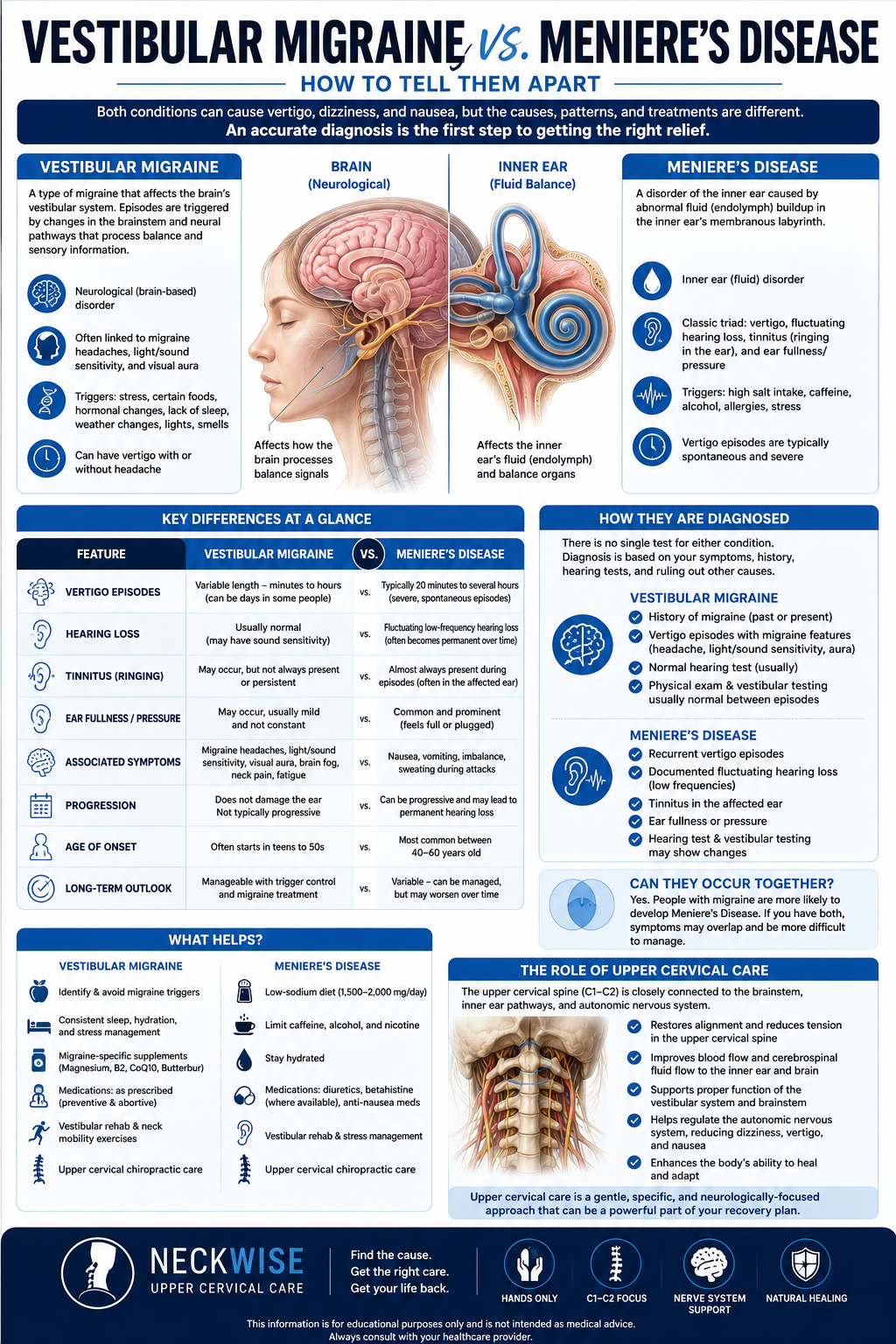
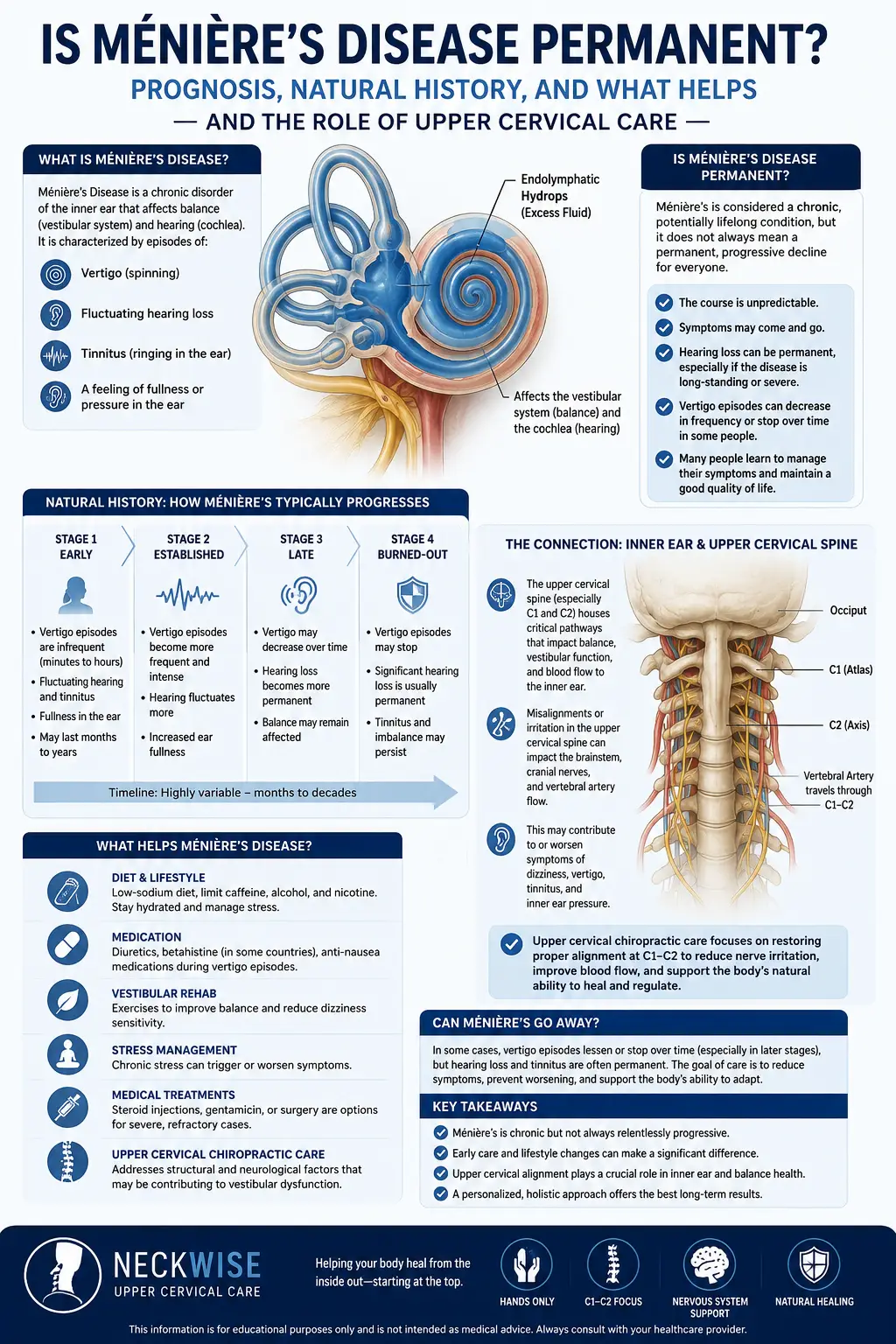
Meniere’s is a chronic inner-ear disorder that comes in unpredictable attacks. The leading explanation involves a buildup of fluid (endolymph) in the inner ear — endolymphatic hydrops. Picture the inner ear as a delicate hydraulic system. When fluid pressure rises too high, it appears to disrupt both the balance sensors and the hearing apparatus, which sit right next to each other. That physical closeness is why Meniere’s hits hearing and balance together.
What a Meniere’s Attack Tends to Look Like
Classic Meniere’s has a recognizable cluster of four features, and it is the combination that makes it distinctive:
- Vertigo attacks that last a while — typically 20 minutes up to several hours. Not seconds. Not many days without letup.
- Fluctuating hearing loss, often in one ear, that may come and go early on and become more permanent over time.
- Tinnitus — ringing, roaring, or buzzing in the affected ear.
- A feeling of fullness or pressure in the ear, almost like it needs to “pop.”
An attack often builds with ear fullness and rising tinnitus, then erupts into intense spinning with nausea and sometimes vomiting. Afterward, many people feel wiped out and unsteady for a day or two. Between attacks they may feel completely normal — which is part of what makes Meniere’s so disruptive.
Meniere’s usually starts in one ear, most often in adults between their thirties and sixties. Because it depends on the pattern of symptoms over time rather than one definitive test, it can take a while and more than one visit to pin down.
Here is what almost never gets asked during that workup: when did this actually start? A remarkable number of Meniere’s-pattern cases follow a head or neck event — a whiplash, a concussion, a car accident, a hard fall — that destabilized the upper cervical spine months or years earlier. That connection deserves attention, and we will return to it, because it is the thread the inner-ear-only story keeps dropping.
The Tell for Meniere’s
If you remember one thing: Meniere’s ties vertigo together with hearing symptoms — fluctuating hearing loss, ringing, and ear fullness — in attacks that last minutes to hours and recur unpredictably. Hearing involvement is central, not incidental.
BPPV: The Brief, Position-Triggered Spin
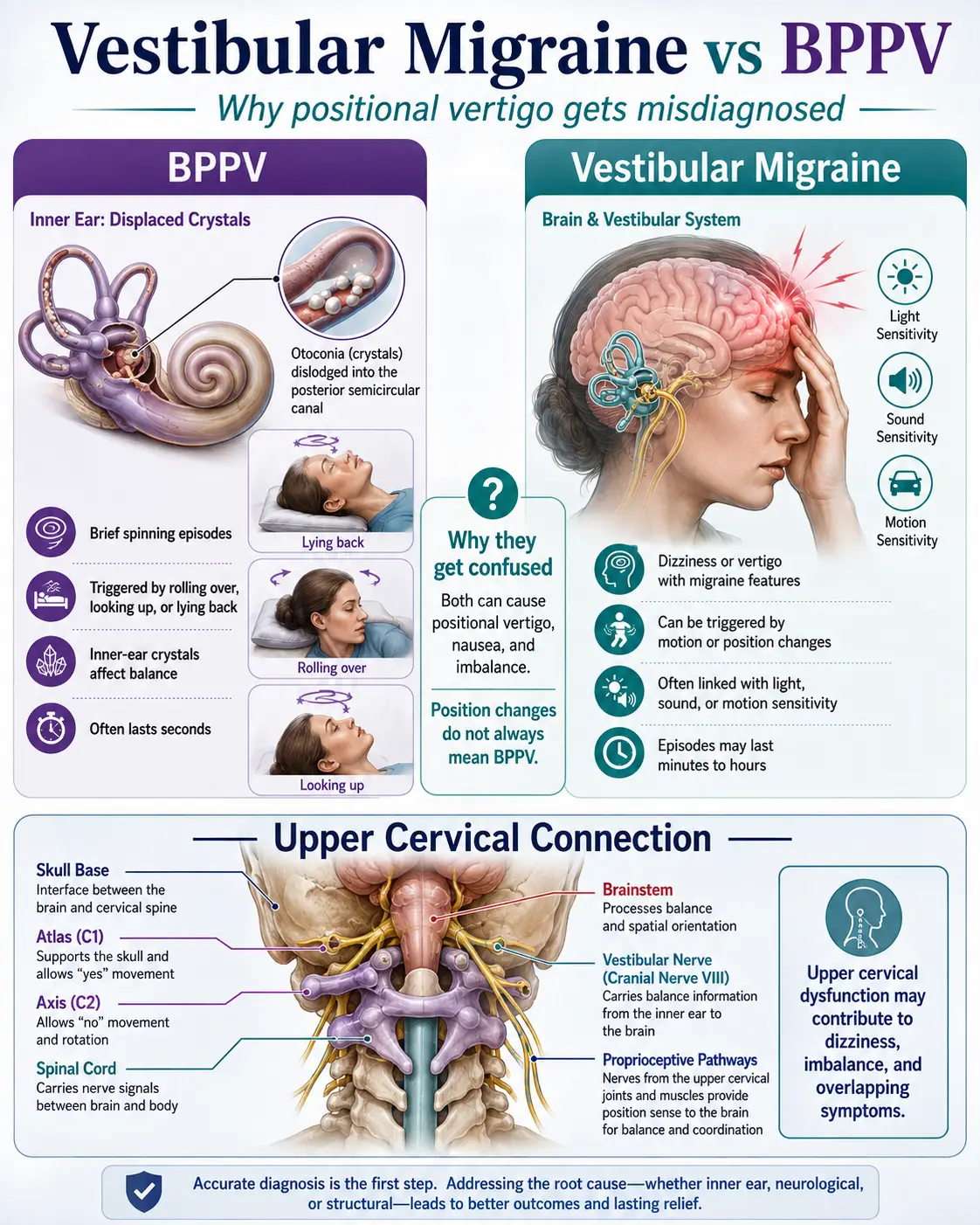
Benign paroxysmal positional vertigo — BPPV — is the most common cause of vertigo overall, and the most mechanical. The name is the description: benign (not dangerous), paroxysmal (sudden and brief), positional (triggered by movement), vertigo (spinning).
Inside your inner ear are tiny calcium carbonate crystals — “ear rocks,” or otoconia — that normally sit in one part of the vestibular system and help you sense gravity and motion. In BPPV, some break loose and drift into a fluid-filled semicircular canal where they do not belong. When you move your head into certain positions, the loose crystals shift, drag the fluid with them, and fire a brief but powerful false signal of spinning.
What BPPV Tends to Look Like
- Very short episodes — usually seconds to under a minute. Intense but brief. A major separator from Meniere’s.
- Triggered by specific head movements — rolling over in bed, lying down, sitting up, tipping the head back, or bending forward.
- No hearing loss, no tinnitus, no ear fullness. BPPV is purely a balance-signal problem.
- Predictable and repeatable — the same movement triggers the same brief spin.
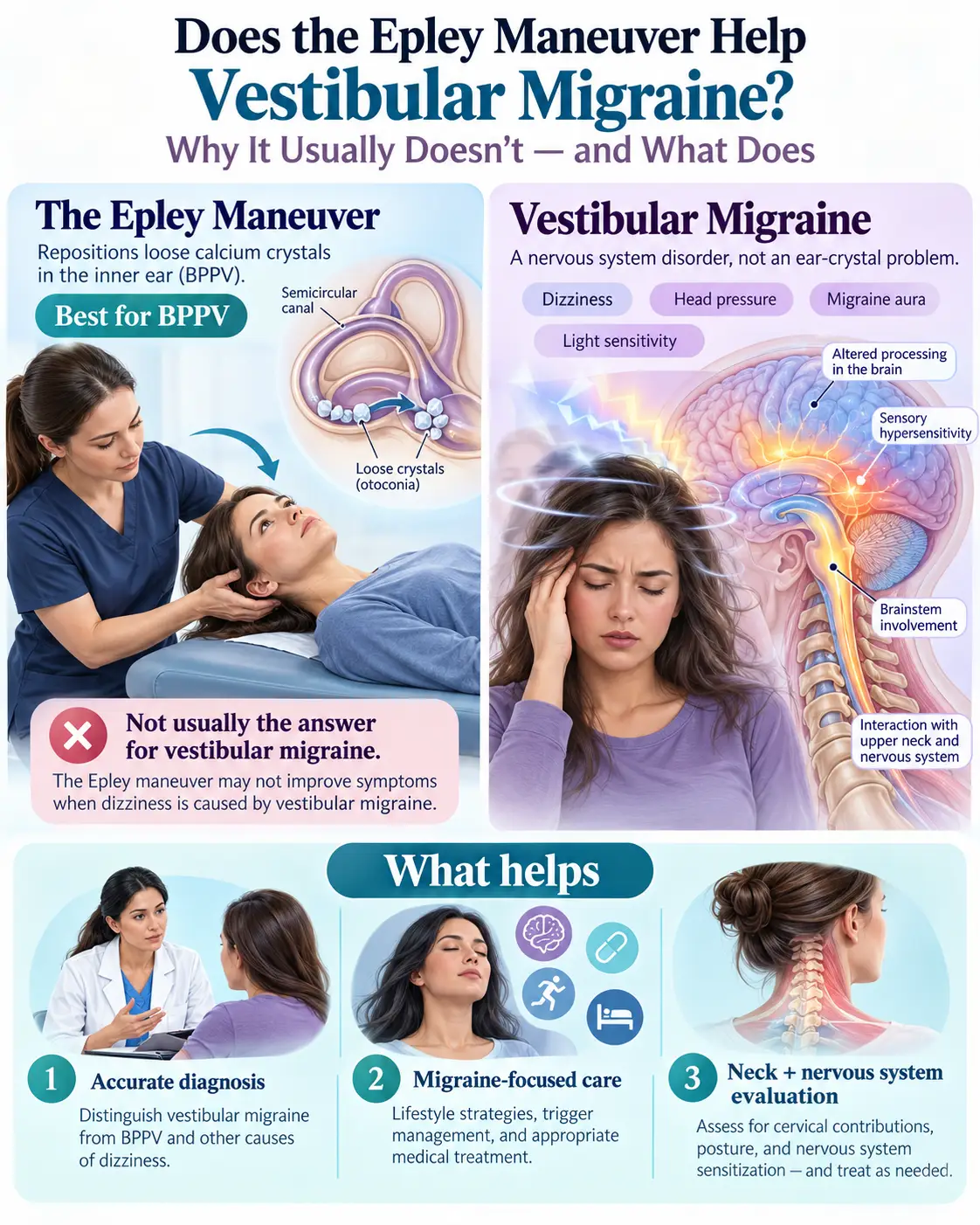
BPPV often responds well to repositioning maneuvers — the Epley maneuver is the best known — performed by a trained clinician to guide the wandering crystals back where they belong. It can recur, but it is one of the more directly addressable forms of vertigo.
The Tell for BPPV
The signature is brief, seconds-long spinning that a change in head position reliably sets off, with no hearing symptoms. If your vertigo is measured in seconds and shows up when you roll over in bed, BPPV moves high on the list.
Labyrinthitis and Vestibular Neuritis: The Sustained Storm
The third pattern is different again. Labyrinthitis and vestibular neuritis are usually one-time (or infrequent) events involving inflammation, often thought to follow a viral infection.
- Vestibular neuritis involves inflammation of the vestibular nerve, which carries balance signals from the inner ear to the brain. Balance is affected; hearing usually is not.
- Labyrinthitis involves inflammation of the labyrinth, which houses both balance and hearing components — so it can cause vertigo and hearing changes together.
What They Tend to Look Like
- Sudden, severe, constant vertigo that comes on and stays — a relentless spinning that can last days. The first day or two can be genuinely debilitating.
- Nausea and vomiting, often significant.
- Trouble walking and standing, with a tendency to veer to one side.
- Hearing loss or tinnitus may be present in labyrinthitis but is typically absent in vestibular neuritis.
- Often a recent cold, flu, or upper-respiratory infection in the days or weeks before onset.
These usually improve over time as the inflammation settles and the brain recalibrates — a process called vestibular compensation. But note how the brain compensates: it leans harder on vision and on neck proprioception to make up for the injured ear. If the upper neck is already compromised, that compensation stalls, and the “lingering unsteadiness” people report for weeks or months afterward drags on. That is not a coincidence. It is the balance system trying to recruit an input that isn’t working.
The Tell for Labyrinthitis/Neuritis
Think sudden, continuous vertigo lasting days, often after a viral illness. Hearing involvement suggests labyrinthitis; balance-only suggests vestibular neuritis.
Putting Them Side by Side
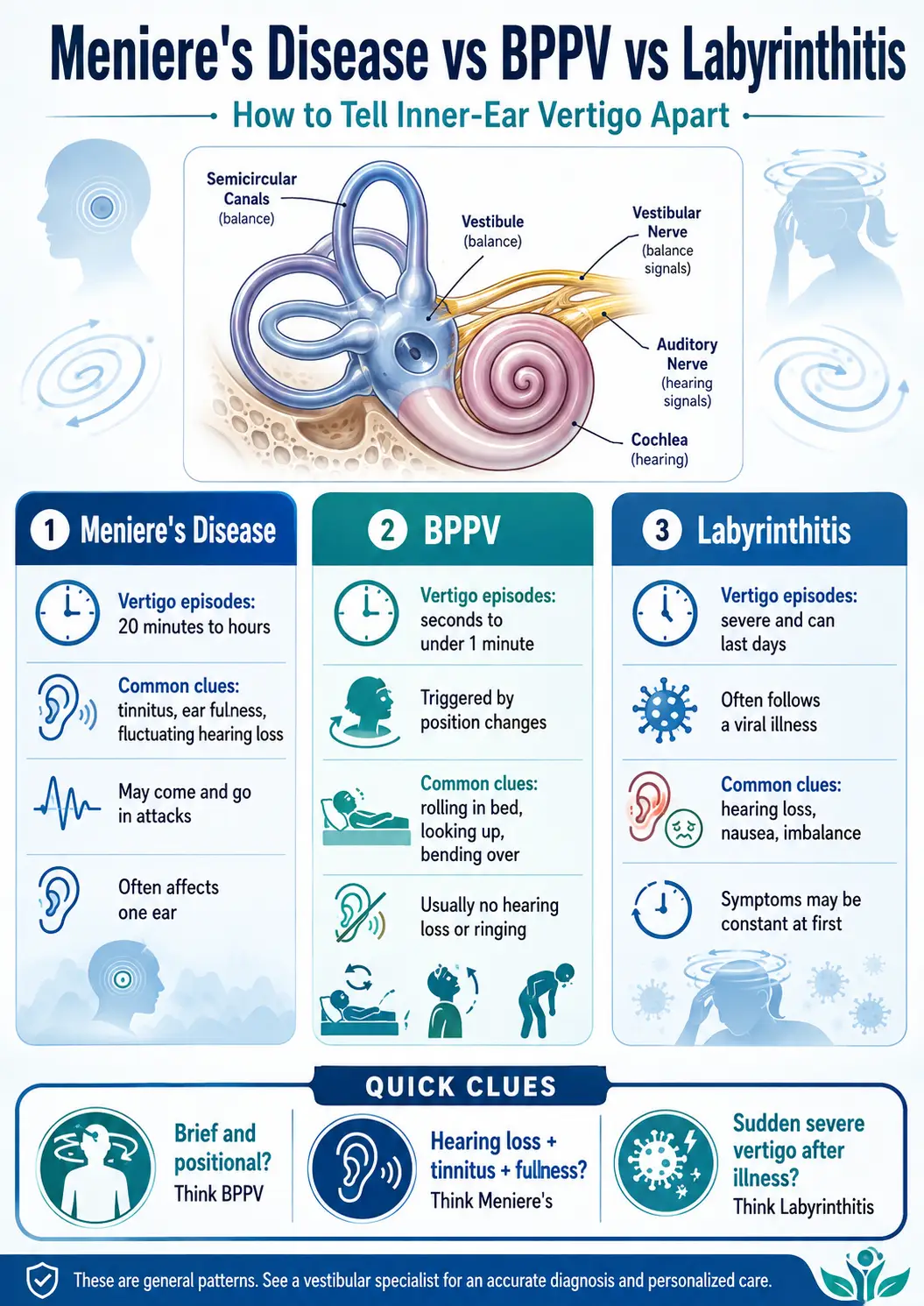
The simplest way to hold the three apart is to ask two questions: How long does the spinning last? and Are my ears involved?
Duration is your first sorting tool:
- Seconds to a minute, triggered by position → think BPPV.
- Minutes to hours, recurring attacks → think Meniere’s.
- Days, constant, usually a one-time storm → think labyrinthitis or vestibular neuritis.
Hearing involvement is your second sorting tool:
- Hearing loss, ringing, ear fullness present → points toward Meniere’s (recurring) or labyrinthitis (sustained).
- No hearing symptoms at all → points toward BPPV (brief) or vestibular neuritis (sustained).
Triggers help too:
- Head movements clearly set it off → BPPV.
- Comes out of nowhere, no reliable trigger → Meniere’s, labyrinthitis, or neuritis.
No chart is a substitute for a professional exam, and real life is messier. Some people have more than one of these at once. And crucially, some dizziness comes from causes entirely outside the inner ear — including vestibular migraine, blood pressure changes, medication side effects, and, more often than almost anyone appreciates, the upper neck. That last one is where the story usually breaks down, and it is where our work in Sarasota, Lakewood Ranch, and Bradenton begins.
The Overlooked Driver: Your Upper Neck
Come back to those three streams — inner ear, vision, proprioception. That third stream, proprioception, deserves the spotlight the inner-ear conversation never gives it, because your upper cervical spine is one of the densest position-sensing structures in your entire body.
The joints, muscles, and ligaments where your neck meets your skull — the atlas (C1) and axis (C2) — are loaded with sensors that continuously report your head’s position and motion straight into the brainstem, right alongside the incoming signals from your ears and eyes. This region is unique: the atlas and axis carry the full weight of your head, held largely by ligaments rather than interlocking bone, which makes them both remarkably mobile and remarkably vulnerable to being knocked out of alignment.
Cervicogenic dizziness is the recognized term for dizziness or unsteadiness driven by the neck — by disturbed proprioceptive input rather than the inner ear. It tends to feel like imbalance, unsteadiness, or “floating,” often riding along with neck pain, stiffness, or headaches, and it can worsen with certain neck positions or after neck strain. And here is the part that changes how you should think about your case: because the brain blends all three balance inputs together, a misaligned upper neck can mimic inner-ear vertigo and can coexist with it, quietly amplifying everything else. A person can have BPPV and a cranky, misaligned upper neck at the same time. Someone recovering from labyrinthitis may be stuck in unsteadiness because their neck can’t take over the way it should. When your vertigo doesn’t fit a clean pattern, or won’t fully resolve no matter what the ear specialists do, the upper cervical spine is the input that was never measured.
Why the Neck Gets Missed — and Why That Matters
Think about who examines what. Your ENT examines the ear. Your primary care physician checks blood pressure and medications. A neurologist rules out central causes. Every one of those is essential. But almost none of them images or measures the alignment of your atlas and axis — the one structure that sits at the crossroads of the entire balance system. It is not that the neck is unimportant; it is that it falls in the gap between specialties. That gap is exactly where people get stuck for years.
And the trauma link makes this concrete. Whiplash from a car accident, a concussion, a sports collision, a fall onto the head — any of these can shift the upper cervical spine and leave it feeding a distorted signal into your balance system. If your dizziness started or worsened after something happened to your head or neck, that is a loud, specific clue that the driver may be sitting one inch below your skull, in the one place no one checked.
How We Evaluate the Upper Neck
At Lavender Family Chiropractic, serving Sarasota, Lakewood Ranch, and Bradenton, our upper cervical approach is built on measurement, not guesswork:
- 3D CBCT imaging (cone-beam computed tomography) shows the specific anatomy and alignment of your upper cervical spine in three dimensions. Everyone’s neck is built differently; this lets us see yours precisely.
- Paraspinal infrared thermography reads temperature patterns along the spine that reflect how your nervous system is functioning, giving us an objective baseline to track.
When care is warranted, we use the Knee Chest Upper Cervical technique: precise, gentle, and low-force — with no twisting, cracking, or popping. For someone already dealing with dizziness and wary of anyone touching their neck, that gentleness is the entire point. The goal is a specific, measured correction based on your imaging.
To be clear and compliant: this is not a claim to cure Meniere’s, BPPV, or labyrinthitis. Those inner-ear conditions belong with your ENT and physician. What we address is the neck’s contribution to your balance — a genuine, often overlooked driver that, when it’s part of your picture, is very much worth evaluating. We work as one part of your team, alongside your medical providers, never as a replacement for them.
Red Flags: When Vertigo Is an Emergency
Most inner-ear vertigo, while miserable, is not dangerous. But some causes of dizziness are serious — including stroke, which can occasionally masquerade as ordinary vertigo. This is one of the most important reasons to have vertigo properly evaluated rather than self-diagnosing.
Seek urgent or emergency medical care right away if your dizziness or vertigo comes with any of the following:
- A sudden, severe headache unlike any you have had before
- Double vision, loss of vision, or trouble moving your eyes
- Slurred speech or trouble speaking
- Weakness or numbness in the face, arm, or leg, especially on one side
- Facial drooping
- Trouble walking, severe loss of coordination, or falling that seems out of proportion
- Difficulty swallowing
- Confusion or a sudden change in alertness
- Vertigo after a head or neck injury
- A very high fever or stiff neck along with the dizziness
- Chest pain, a racing or irregular heartbeat, or fainting
- The worst, most sudden vertigo of your life, particularly if it does not fit your usual pattern
The brain’s balance centers sit close to areas that control vision, speech, and movement. When vertigo travels with any of those neurological warning signs, it can signal a problem in the brain or its blood supply rather than the inner ear. When in doubt, get checked. It is always better to be evaluated and reassured than to wait on something time-sensitive.
Top Questions
How can I tell if my vertigo is from my inner ear or my neck? It is genuinely hard to tell on your own, which is why proper evaluation matters. As a rough guide, inner-ear vertigo more often produces distinct spinning and may involve hearing symptoms, while neck-driven (cervicogenic) dizziness tends to feel like unsteadiness or floating and often travels with neck pain, stiffness, or headaches. But they overlap and coexist. The honest path is a medical workup to rule inner-ear and neurological causes in or out, combined with a careful measurement of the upper cervical spine — the input that usually never gets checked.
My vertigo started after a car accident or concussion. Does that matter? It matters enormously. Trauma to the head and neck can shift the atlas and axis and leave them feeding a distorted signal into your balance system. If your dizziness began or worsened after a whiplash, concussion, or fall, the upper cervical spine is a primary driver worth evaluating rather than assuming away.
How long does each type of vertigo last? BPPV episodes are very brief — seconds to under a minute, triggered by head position. Meniere’s attacks typically last 20 minutes to several hours and recur unpredictably. Labyrinthitis and vestibular neuritis cause continuous vertigo lasting days before gradually improving. Cervicogenic dizziness doesn’t follow the inner-ear timing patterns and is often tied to neck position and activity.
Is vertigo ever a sign of something serious? Occasionally, yes. Certain serious conditions, including stroke, can imitate ordinary vertigo. That is why the red-flag list above matters. If your vertigo comes with severe headache, double vision, slurred speech, facial droop, one-sided weakness or numbness, trouble walking, or follows a head or neck injury, treat it as an emergency and seek care immediately.
Do I need to see an ENT, or can I start with upper cervical care? For new, unexplained, or severe vertigo, start with a medical evaluation — your primary care physician or an ENT — so serious causes are identified or ruled out. Upper cervical evaluation fits alongside that, and it’s especially worth pursuing when the inner-ear workup comes back clean or your dizziness won’t resolve. We coordinate with your medical team, not in place of it.
What should I write down before my appointment? Track how long each episode lasts, what triggers it, whether you have hearing changes, ringing, or ear fullness, whether you have neck pain or headaches, and any recent illnesses or injuries — especially head or neck trauma. So much of diagnosing vertigo depends on the pattern over time.
Is the neck adjustment safe if I already feel dizzy? Yes. The Knee Chest Upper Cervical technique is precise, gentle, and low-force, with no twisting, cracking, or popping. We evaluate thoroughly first with 3D CBCT imaging and paraspinal infrared thermography, and we coordinate with your medical care.
What the Research Says
Grounding this in the literature rather than opinion.
Vertigo is common, and getting the diagnosis right is the whole game. A widely cited overview of the diagnosis and treatment of vertigo and dizziness emphasizes that these are among the most frequent reasons people seek care, and that careful history — especially the duration and triggers of episodes — is central to sorting out the cause (Strupp & Brandt, Deutsches Ärzteblatt International, 2008). This is exactly why the “how long does it last?” question does so much work.
The peripheral (inner-ear) vestibular disorders each have recognizable patterns. An update on peripheral vestibular disorders reviews how BPPV, Meniere’s disease, and vestibular neuritis present differently and are approached differently, reinforcing that they are distinct problems even when they feel similar (Current Opinion in Neurology, 2019).
Meniere’s disease remains genuinely difficult to pin down. A review focused on Meniere’s describes it as a condition still something of a mystery with a difficult differential diagnosis, underscoring why it often takes time and repeat visits to identify (Annals of Indian Academy of Neurology, 2011). That diagnostic difficulty is precisely why overlooked contributors like the upper neck deserve a look.
Distinguishing benign vertigo from dangerous central causes is critical. Research on differentiating cerebellar (brain) causes of vertigo from common, benign vertigo syndromes highlights that some serious conditions can imitate ordinary inner-ear vertigo, which is why the red-flag symptoms and professional evaluation matter so much (Western Journal of Emergency Medicine, 2009).
Formal, agreed-upon criteria now guide the Meniere’s diagnosis. An international consensus effort established specific diagnostic criteria for Meniere’s disease, bringing consistency to how it is defined based on the combination of recurrent vertigo, hearing loss, and ear symptoms (Bárány Society consensus, Journal of Vestibular Research, 2015).
Together, the literature makes two things clear: inner-ear vertigo conditions are distinct and identifiable through timing, triggers, and hearing involvement; and proper medical evaluation is essential to catch the uncommon but serious causes. It also supports a coordinated, whole-system approach — which is exactly why the balance input almost everyone forgets to measure, the upper cervical spine, deserves a place in the evaluation.
The Bottom Line
Meniere’s, BPPV, and labyrinthitis can all make the world spin, but they are different problems with different fingerprints. Meniere’s brings recurring attacks lasting minutes to hours, tied to fluctuating hearing loss, ringing, and fullness. BPPV brings brief, seconds-long spins triggered by head position, with no hearing symptoms. Labyrinthitis and vestibular neuritis bring sustained, days-long vertigo, often after a viral illness. Duration and hearing involvement are your two best sorting tools, and a proper medical evaluation confirms the answer.
But if your vertigo doesn’t fit cleanly, or it lingers no matter how thoroughly your ears have been examined, ask the question the workup never did: has anyone actually measured the top of your neck? The upper cervical spine is a powerful, overlooked driver of balance — and it is the one input a standard vertigo workup leaves out. For many people across Sarasota, Lakewood Ranch, and Bradenton, that is the missing piece.
Serving Sarasota, Lakewood Ranch & Bradenton
Lavender Family Chiropractic, also known as NeckWise North Sarasota, proudly serves patients throughout Sarasota, Lakewood Ranch, Bradenton, Whitfield, University Park, Palmetto, Ellenton, Osprey, Nokomis, Venice, and the surrounding Gulf Coast communities. Our practice focuses exclusively on precise, gentle, low-force upper cervical care using 3D CBCT imaging, paraspinal infrared thermography, and the Knee Chest Upper Cervical technique — with no twisting, cracking, or popping.
If dizziness, unsteadiness, neck pain, or headaches have been part of your life — especially since a car accident, concussion, or fall — we invite you to find out whether the upper neck is the driver no one has evaluated. Patients across Sarasota, Lakewood Ranch, and Bradenton are welcome to book a consultation with our doctors to talk it through, always in coordination with, and never as a replacement for, your medical care.
→ Call Lavender Family Chiropractic at (941) 243-3729 to schedule your consultation.
Lavender Family Chiropractic (NeckWise North Sarasota) 5899 Whitfield Avenue, Suite 107 Sarasota, FL 34243 Phone: (941) 243-3729
This article is for general educational purposes only and is not medical advice, diagnosis, or treatment. It does not replace evaluation by a qualified physician or ENT. If you are experiencing vertigo along with any red-flag symptoms described above, seek emergency medical care immediately.
Related Articles


Get our upper cervical articles first.
Patients Experience