
Vestibular Migraine vs BPPV: Why Positional Vertigo Gets Misdiagnosed — and the Neck Everyone Skips
By Dr. Rusty Lavender, D.C. — upper cervical chiropractor, Lavender Family Chiropractic, Sarasota, FL. Reviewed and updated October 2026.
Our complete guide to vestibular migraine treatment in Sarasota covers the diagnosis, the brainstem and upper neck connection, and how we evaluate it with 3D imaging.
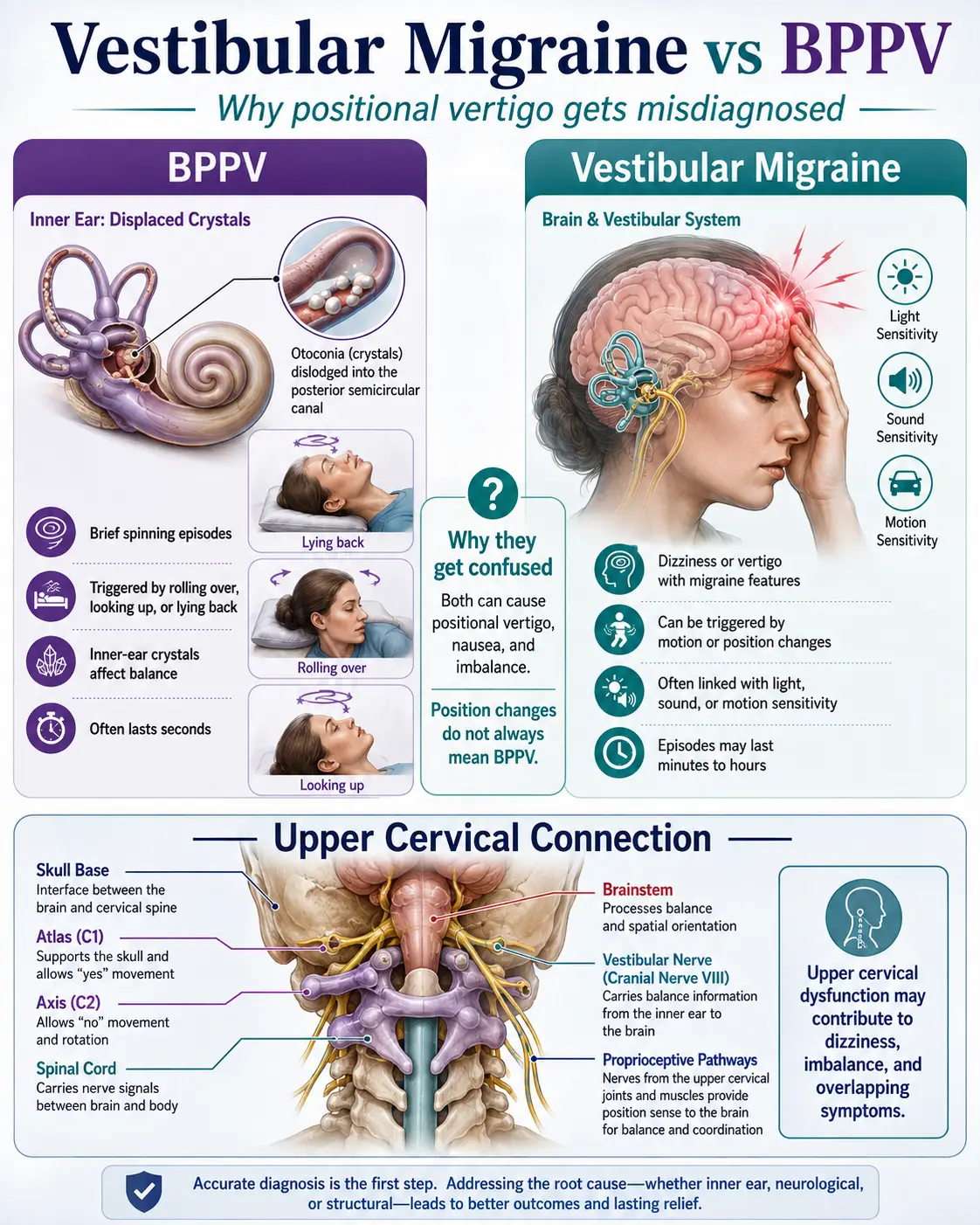
You roll over in bed and the room whirls. You tip your head back at the salon sink and the ceiling spins. It is terrifying in the moment and exhausting over months — and it is one of the most misdiagnosed symptoms in all of medicine. Here is the trap: two completely different conditions produce nearly identical positional attacks. One is benign paroxysmal positional vertigo (BPPV), a mechanical crystal problem in the inner ear. The other is vestibular migraine (VM), a neurological disorder driven by the brainstem. People get repositioned again and again, get frustrated when it does not hold, and never get told the truth — that the brainstem circuitry generating migrainous positional vertigo sits directly on top of the atlas and axis, the two most injury-prone vertebrae in the body. When positional vertigo keeps coming back, the one place almost no one checks is the top of your neck.
This is a plain-language guide to telling these two apart, so you can walk into an evaluation as an informed partner instead of a confused patient. But it is also going to name the overlooked driver that standard articles refuse to name: the upper cervical spine, and the direct neurological line it has into the very migraine machinery that fuels “pseudo-BPPV.” If your positional vertigo started or worsened after a whiplash, a concussion, or a fall, read every word — because that history points straight at the root. We serve Sarasota, Lakewood Ranch, and Bradenton, and we see this exact story more often than you would believe.
Why Positional Vertigo Fools Everyone
Positional vertigo is a symptom, not a diagnosis. It means only that certain head movements set off a false sense of spinning. It does not tell you whether the cause is a loose crystal in your inner ear or a sensitized brainstem generating a migraine event. Two people can say the identical sentence — “the room spins when I lie down” — and have opposite conditions. That is the whole problem, and it is why so many people spend years being repositioned for a condition they may not even have.
The stakes are practical. If migraine-driven positional vertigo is mislabeled as BPPV, a person can undergo maneuver after maneuver with only fleeting benefit, growing frustrated, while the actual driver goes unaddressed. Conversely, if true BPPV is dismissed as “just migraine,” a person may suffer for weeks with something a single well-performed maneuver could have settled. Getting the distinction right matters. And getting it right eventually forces the question the standard workup avoids: when maneuvers keep failing, what is actually generating the vertigo — and has anyone looked at the region that feeds it?
What Is BPPV?
BPPV stands for benign paroxysmal positional vertigo, and each word tells you something:
- Benign — not dangerous in itself.
- Paroxysmal — it comes in sudden, short bursts.
- Positional — specific head positions trigger it.
- Vertigo — a false sense of spinning.
Deep in each inner ear are otolith organs containing tiny calcium carbonate crystals (otoconia). Normally they sit where they belong and help you sense gravity and linear movement. In BPPV, some break loose and drift into one of the semicircular canals, the fluid-filled loops that detect rotation. When you move your head into certain positions, the loose crystals shift and stir the fluid, sending your brain a burst of false motion signals. Your eyes respond with a characteristic flicker, and you feel the world spin.
The classic BPPV episode has a recognizable shape:
- Triggered by a change in head position relative to gravity: rolling over, lying down, sitting up, tipping the head back, bending forward.
- The spinning is brief, usually seconds to under a minute, then settles if you hold still.
- There is often a short delay (a second or two) between the movement and the spinning.
- It tends to fatigue with repetition.
- Hearing is typically normal, with no headache, ringing, or ear fullness.
BPPV is common, especially with age, and it is one of the most satisfying conditions in medicine to treat, because it often responds quickly to a repositioning maneuver. When it is truly BPPV, that is the right care — full stop. The trouble begins when it is not truly BPPV.
What Is Vestibular Migraine?
Vestibular migraine belongs to the migraine family, the same broad category as the throbbing one-sided headaches many people know — but here the dominant symptom is dizziness or vertigo rather than head pain. In fact, many people with vestibular migraine have only mild headaches during an attack, or none at all, which is exactly why it fools people.
Migraine is, at its core, a disorder of how the brain and brainstem process sensory information. In vestibular migraine, the balance and spatial-orientation systems get pulled into that process. An attack can bring spinning, rocking, swaying, a pulled-to-one-side sensation, or a feeling that either you or the room is unstable. These spells last anywhere from a few minutes to hours, sometimes up to a couple of days.
Vestibular migraine tends to travel with other migraine features, and spotting them is one of the most useful things you can do:
- Sensitivity to light and sound during attacks.
- Visual disturbances or aura — shimmering, zigzag lines, blind spots.
- A personal or family history of migraine headaches.
- Motion sensitivity, including a lifelong tendency toward carsickness.
- Common triggers: poor sleep, stress or the letdown after it, hormonal shifts, skipped meals, dehydration, weather changes, certain foods.
It is now recognized as one of the more common causes of recurrent vertigo, and it often goes undiagnosed for years while people bounce between specialists.
The neuroanatomy that changes the whole picture
Here is what the standard BPPV-vs-VM articles never tell you, and it is the key to everything. The trigeminal nerve — the central player in migraine — shares a brainstem nucleus with the sensory nerves of the upper neck, C1 through C3. This shared relay is the trigeminocervical nucleus, and the merging of head and neck signals onto the same neurons is trigeminocervical convergence. It means the upper cervical spine has a direct line into the exact brainstem circuitry that generates migraine and helps process balance.
Now connect the dots. When the top of the neck — the atlas, the axis, the craniocervical junction just under your skull — is misaligned or irritated, it can flood that shared brainstem relay with abnormal signals, turning up the excitability of a migraine-prone system and helping it tip into an attack. That is a plausible, mechanism-based reason the upper cervical spine can be a genuine driver of vestibular migraine, including the positional variety that masquerades as BPPV. And it is precisely why so many people whose positional vertigo followed a whiplash or concussion never get lasting relief from crystal maneuvers — the crystals were never the problem.
Why the Two Get Confused: The “Pseudo-BPPV” Problem
Here is the heart of the matter. Vestibular migraine can produce spells triggered by head position that feel, to the patient, exactly like BPPV. Clinicians call this “pseudo-BPPV” or positional vestibular migraine. The person tips their head, the room spins, and everyone reasonably assumes crystals are the culprit.
Several things make this overlap tricky:
Both can be positional. A meaningful subset of vestibular migraine attacks are brought on or worsened by head position. “It happens when I move my head” does not, by itself, rule migraine in or out.
Both are episodic. Neither is constant; they come and go, which makes the pattern hard to pin down from memory.
Headache is not a reliable divider. Vestibular migraine often comes with little or no headache, so its absence does not point you toward BPPV.
They can coexist. People with migraine appear more prone to BPPV, so someone can have loose crystals and a migraine disorder at once — and, crucially, both can be fed by the same sensitized brainstem sitting on top of an irritated upper neck.
Repositioning results muddy the water. BPPV usually responds well and durably to a proper maneuver. When someone is repositioned and the vertigo keeps returning without a clear mechanical explanation, that pattern should raise the question of migraine hiding underneath — and, with it, the question of what is driving that migraine in the first place.
The Two Biggest Clues: Nystagmus and History
When specialists sort these out, they lean on two things: the pattern of eye movements (nystagmus) during positional testing, and the detailed story of the attacks.
Nystagmus: What Your Eyes Reveal
Nystagmus is an involuntary, rhythmic jerking of the eyes — the objective fingerprint of vertigo, because the balance organs and eye muscles are wired directly together. Clinicians often use video goggles (videonystagmography) that record the eyes in the dark, removing your ability to fix your gaze and suppress the movement.
During a positional test like the Dix-Hallpike maneuver, the examiner moves your head and body into a provoking position and watches your eyes.
In classic BPPV, the nystagmus matches the mechanics of crystals moving in a specific canal. In the common posterior-canal form, the eyes beat in a characteristic upward-and-torsional direction. It typically:
- Starts after a brief latency (a one- to few-second delay).
- Builds and then fades over roughly 10 to 60 seconds.
- Reverses direction when you sit back up.
- Fatigues with repeated testing.
- Matches the plane of the specific canal being tested.
That combination fits a known mechanical model, which lets a clinician confidently choose the right repositioning maneuver.
In vestibular migraine, positional nystagmus tends to break these rules. Eye-recording studies of migrainous vertigo describe positional nystagmus that:
- Often shows little or no latency.
- Can persist as long as the position is held rather than fading in under a minute.
- May beat in a direction that fits no single canal, including purely vertical (downbeating) or shifting patterns.
- Does not neatly fatigue the way canal-based BPPV does.
- Is frequently weaker than the dramatic burst of classic BPPV, and may not match the severity the person reports.
No single feature is a perfect test. But taken together, an experienced examiner can often tell the eyes are not telling a “loose crystal in one canal” story — that something more central, more consistent with migraine and its brainstem origin, is going on.
History: The Story Is Half the Diagnosis
Your history is the other half, and often the more powerful half. The questions worth thinking through:
How long does a single spinning spell last? True BPPV spells are brief — seconds to under a minute — and settle when you hold still. Vestibular migraine dizziness usually lasts longer, minutes to hours, and can extend into a day or two of feeling off.
What exactly triggers it? BPPV is tied specifically to head position against gravity. If your dizziness is also set off by visual motion, stress, lack of sleep, or certain foods, that points more toward migraine.
What comes with it? Light and sound sensitivity, visual aura, a headache (even mild), nausea out of proportion to the spinning — these lean toward vestibular migraine.
What is your background? A history of migraine headaches, lifelong motion sickness, or strong family history all raise the odds of vestibular migraine. New positional vertigo with none of that, especially in an older adult, fits BPPV comfortably.
How did it respond to treatment? If a repositioning maneuver was done properly and the vertigo cleared and stayed gone, that supports BPPV. If maneuvers were done repeatedly with only brief or no benefit and the spells keep returning, that raises the question of migraine — and of the upper cervical driver beneath it.
Did it start after an injury? This is the question the standard articles leave out. New or worsened positional vertigo after a whiplash, concussion, car accident, or fall is a loud clue that the craniocervical junction was destabilized, feeding abnormal signals into the balance and migraine circuits of the brainstem.
Is there any hearing change? New hearing loss, ringing, or fullness in one ear does not fit ordinary BPPV or typical vestibular migraine and points toward a different inner-ear evaluation. Mention it promptly.
How BPPV Is Actually Treated
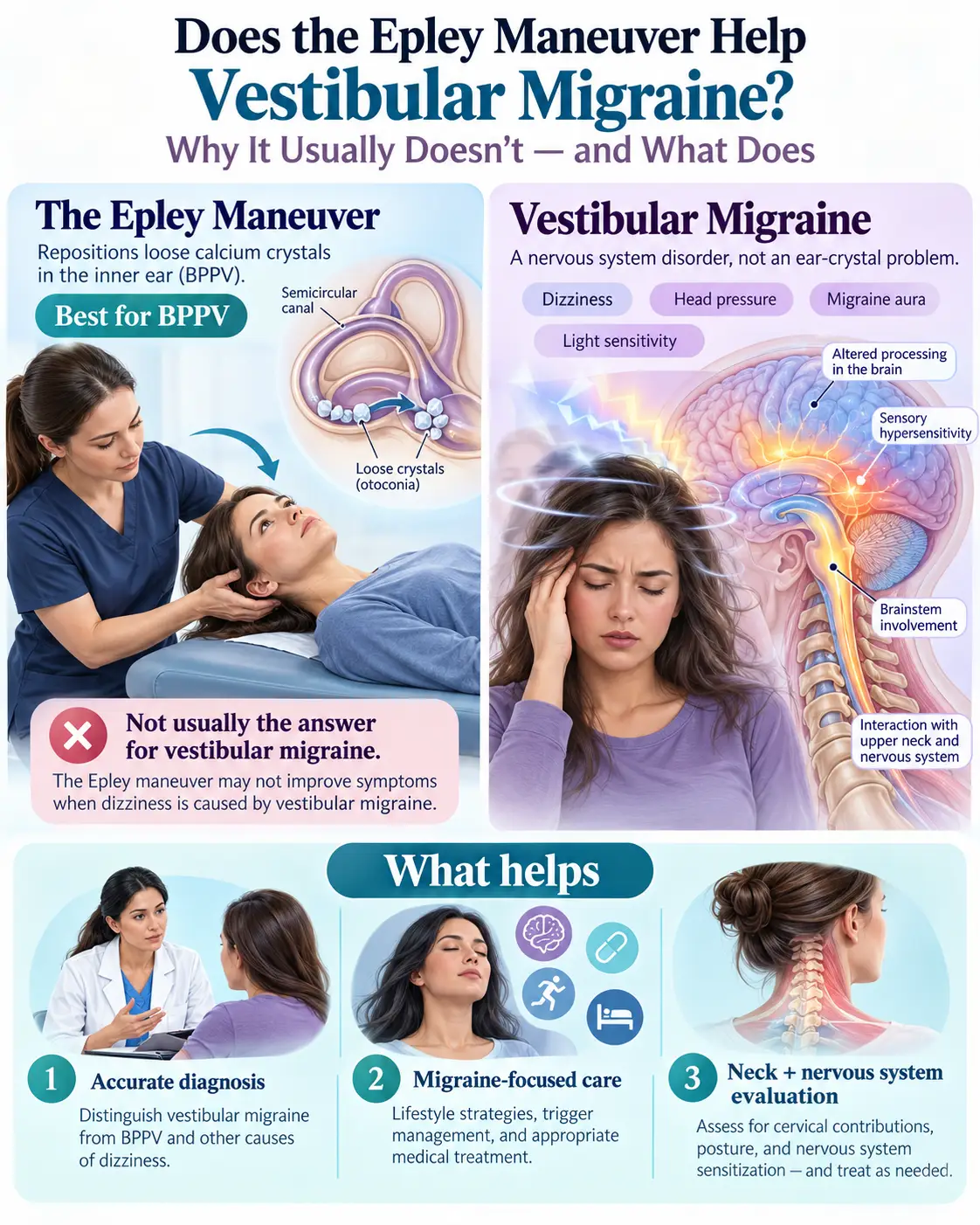
Because BPPV is a mechanical problem, it has a mechanical solution. Once a clinician identifies which canal the crystals drifted into, they perform a canalith repositioning maneuver — a specific sequence of head and body positions that uses gravity to guide the crystals out of the canal. The best known is the Epley maneuver, for the common posterior-canal form. These are simple, drug-free, in-office procedures that often produce relief quickly.
A few honest caveats. Repositioning works when the diagnosis is correct and the right maneuver is chosen for the right canal. BPPV can recur. And, importantly, if maneuvers are not helping, that is a signal to revisit the diagnosis rather than repeat the same procedure indefinitely. This is one of the clearest places where the BPPV-versus-migraine question — and the upper cervical question underneath it — comes back around.
How Vestibular Migraine Is Managed
Because vestibular migraine is a neurological disorder, it is managed the way migraine is managed, typically by a neurologist. There is no repositioning maneuver for it, because there are no misplaced crystals to move. Management generally works on several fronts:
- Trigger awareness and lifestyle rhythm — regular sleep, meals, hydration, stress management, moderating dietary triggers.
- Acute strategies to lessen an attack’s intensity.
- Preventive approaches a physician may consider for frequent or disabling attacks.
- Vestibular rehabilitation to help the brain recalibrate balance processing when unsteadiness lingers.
These help many people reduce the burden of attacks. But notice what is missing from the standard list: any structural evaluation of the upper cervical spine, the one region with a direct neurological line into the migraine machinery. That gap is exactly what keeps some people cycling through medications without ever addressing the driver.
What the Research Says
I want to ground this in the published literature rather than opinion.
An influential study by von Brevern and colleagues, Migrainous vertigo presenting as episodic positional vertigo (Neurology, 2004), documented that migraine can produce recurrent positional vertigo that mimics BPPV. The authors described positional nystagmus in these migraine patients that differed from the classic BPPV pattern, helping establish that “positional” does not automatically mean “crystals.”
Building on this, Acute migrainous vertigo: clinical and oculographic findings (Brain, 2005) examined patients during acute attacks using eye-movement recordings. The study found a range of central and peripheral nystagmus patterns, including positional nystagmus that did not conform to a single semicircular canal, reinforcing that migrainous vertigo often has a central, brainstem signature distinct from mechanical BPPV.
A more recent review, Dispelling the Mist That Obscures Positional Vertigo in Vestibular Migraine (Brain Sciences, 2023), synthesizes the modern understanding of how positional vertigo appears within vestibular migraine. It emphasizes the diagnostic overlap with BPPV and highlights the features, in history and nystagmus, that help clinicians separate the two.
The problem of misdiagnosis has been studied directly. Pseudo-Benign Paroxysmal Positional Vertigo: A Retrospective Study and Case Report (Frontiers in Neurology, 2020) looked at patients who appeared to have BPPV but did not respond as expected to repositioning, and who ultimately had other diagnoses, including vestibular migraine. It is a clear illustration that failure to respond to maneuvers should prompt reconsideration of the diagnosis rather than simply more maneuvers.
Finally, the diagnostic framework itself is defined in Vestibular migraine: diagnostic criteria (Lempert et al., Journal of Vestibular Research, 2012), the consensus criteria from the Barany Society and the International Headache Society. These specify the episode durations, migraine features, and history requirements that define vestibular migraine, and they are the reference standard clinicians use today.
Taken together, this body of work delivers a consistent message: positional vertigo has more than one cause, the eye-movement patterns and history separate them, and a poor response to repositioning is a meaningful clue that migraine may be involved. And once migraine is involved, the trigeminocervical anatomy makes the upper cervical spine a rational — and usually unexamined — place to look for the driver.
The Overlooked Root: The Upper Cervical Spine
Let me say it directly. When positional vertigo is truly BPPV, the fix is a repositioning maneuver, and I will send you for one. But when it is migrainous — the “pseudo-BPPV” that keeps returning no matter how many maneuvers you do — the vertigo is being generated in the brainstem, and the brainstem sits directly on top of the atlas and axis.
The C1–C3 nerves feed the same brainstem nucleus as the trigeminal system that drives migraine. The craniocervical junction is the segment most damaged by whiplash, concussion, and years of forward-head posture. Put those two facts together and you get the reason so many people with treatment-resistant positional vertigo have a history of neck trauma: the top of their neck can be a primary driver, feeding the migraine circuitry that generates the spinning. It is not a fringe theory — it is a direct read of standard neuroanatomy. And it is the one region that repositioning maneuvers, medications, and MRI scans all leave untouched.
For a meaningful number of people, the upper cervical spine is the missing piece — worth evaluating precisely because it has never been evaluated.
What Upper Cervical Care Involves at Our Office
At Lavender Family Chiropractic (NeckWise North Sarasota), our approach is precise, gentle, and low-force. There is no twisting, cracking, or popping. We use the Knee Chest Upper Cervical technique, a low-force method focused on the top of the neck.
To be accurate rather than guess, we measure:
- 3D CBCT imaging (cone-beam computed tomography) to see the upper cervical anatomy in three dimensions.
- Paraspinal infrared thermography to read how the nervous system is behaving along the spine over time.
The purpose is precision and honest tracking. If your history and exam point to true, isolated BPPV, we will say so and send you for the repositioning maneuver you need. But if your positional vertigo keeps returning and your upper cervical spine shows a misalignment feeding the brainstem circuits behind it, that is the driver worth addressing — gently, and at the source.
Red Flags: When to Seek Care Urgently
Most positional vertigo is not dangerous. But some symptoms can signal a stroke or another serious neurological problem and require emergency evaluation. Seek urgent medical care right away if dizziness or vertigo comes with any of the following:
- Sudden, severe headache unlike any you have had before (“the worst headache of my life”).
- Double vision, or new trouble with vision beyond simple spinning.
- Slurred speech, trouble finding words, or confusion.
- Weakness, numbness, or drooping in the face, arm, or leg, especially on one side.
- Difficulty walking, severe imbalance, or falling, particularly when you cannot stand even with your eyes open.
- Trouble swallowing or a hoarse, changed voice.
- New, one-sided hearing loss or intense ringing with the vertigo.
- Vertigo after a head or neck injury.
- Fainting, chest pain, or a pounding, irregular heartbeat with the dizziness.
A useful rule of thumb: brief spinning clearly tied to rolling over in bed, with no other neurological symptoms, is usually benign. Constant severe imbalance, or vertigo bundled with any of the warning signs above, is not something to wait out at home. When in doubt, get evaluated promptly.
Top Questions
Can I tell the difference between BPPV and vestibular migraine on my own? You can gather strong clues — especially by timing your spells and noticing migraine features — but a confident diagnosis needs a positional exam and often eye-movement testing. The two can coexist. Use what you learn here to be an organized partner, not to self-diagnose.
My vertigo only happens when I move my head. Doesn’t that mean it’s BPPV? Not necessarily. A meaningful share of vestibular migraine is also brought on or worsened by head position — the “pseudo-BPPV” pattern. Duration, accompanying symptoms, and the nystagmus pattern are what separate them.
I don’t get headaches. Can it still be vestibular migraine? Yes. Many vestibular migraine attacks come with little or no headache. Light and sound sensitivity, visual aura, motion sickness, or family history can all be present without a prominent headache.
I had the Epley maneuver several times but the vertigo keeps coming back. What now? A poor or short-lived response to properly performed repositioning is an important clue. It may mean the wrong canal was treated, that BPPV is recurring, or that the real driver is migraine — often fed by an irritated upper cervical spine. The literature specifically flags this pattern as a reason to reconsider the diagnosis. Ask your provider to reassess, and get the top of your neck evaluated.
My positional vertigo started after a car accident. Does that matter? Very much. Whiplash and concussion destabilize the craniocervical junction, which feeds the brainstem circuits behind migrainous vertigo. That history points straight at the upper cervical spine as a driver worth evaluating.
Is the upper cervical technique forceful? No. It is precise, gentle, and low-force, with no twisting, cracking, or popping. We image your specific anatomy with 3D CBCT first.
Can I have both BPPV and vestibular migraine? Yes. People with migraine appear more prone to BPPV, so both can be present at once — which is exactly why careful, repeated evaluation, including a look at the upper neck, is worthwhile.
Putting It All Together
Positional vertigo is common, unsettling, and easy to mislabel. The single most important idea to carry away is that “the room spins when I move my head” is a starting point, not a diagnosis. BPPV, a mechanical inner-ear problem, and vestibular migraine, a brainstem-driven neurological disorder, can wear the same disguise. Telling them apart comes down to what your eyes do during a positional exam and the detailed story of your attacks.
When it is true BPPV, a repositioning maneuver is the answer, and you should get one. But when the maneuvers keep failing and the vertigo keeps returning — especially after a head or neck injury — the honest next question is what is driving the migraine circuitry underneath. For a great many people, that answer sits at the top of the neck, in the one region no one has examined.
Serving Sarasota, Lakewood Ranch & Bradenton
Lavender Family Chiropractic (NeckWise North Sarasota) proudly serves patients throughout Sarasota, Lakewood Ranch, and Bradenton, along with North Sarasota, Whitfield, University Park, Palmetto, Ellenton, and the surrounding Gulf Coast communities. If dizziness or unsteadiness has been part of your life — and especially if repositioning maneuvers have failed you — we would be glad to evaluate the region your workup skipped.
If you live in Sarasota, Lakewood Ranch, or Bradenton and your positional vertigo followed a whiplash, concussion, or fall, that is exactly the pattern we want to see. We offer a consultation with our doctors to discuss your history, answer your questions, and help you understand your options — including when a repositioning maneuver or a referral is the right next step.
Lavender Family Chiropractic (NeckWise North Sarasota) 5899 Whitfield Avenue, Suite 107 Sarasota, FL 34243(941) 243-3729
This article is for general educational purposes only and is not medical advice. It does not diagnose or treat any condition and is not a substitute for evaluation by a qualified healthcare provider. If you have new, severe, or worsening symptoms, or any of the red-flag symptoms described above, seek prompt medical attention.
Related Articles


Get our upper cervical articles first.
Patients Experience