Vestibular Migraine vs Meniere’s Disease: How to Tell Them Apart — and the One Place No One Checked
By Dr. Rusty Lavender, D.C. — upper cervical chiropractor, Lavender Family Chiropractic, Sarasota, FL. Reviewed and updated October 2026.
Our complete guide to vestibular migraine treatment in Sarasota covers the diagnosis, the brainstem and upper neck connection, and how we evaluate it with 3D imaging.
If the room has ever dropped out from under you for no reason you can name, you already know the terror of a vertigo attack — and the maddening hunt for answers that follows. You get pushed between an ENT and a neurologist, you collect a label like “vestibular migraine” or “Meniere’s disease,” and you’re handed medications to blunt the symptoms. But here’s what almost no one tells you: both of these conditions run through the brainstem, and the brainstem sits directly on top of the two most vulnerable, most often-injured vertebrae in your entire spine — the atlas (C1) and axis (C2). If those bones are misaligned, they can feed the exact circuits that generate vertigo, migraine, and imbalance. And in most of these workups, that one region — the craniocervical junction just below your skull — is the single place nobody ever looked.
This guide will help you tell vestibular migraine and Meniere’s disease apart, because getting the label right matters. But it will also do something the standard articles refuse to do: it will point you toward the overlooked structural driver sitting at the top of your neck — the piece that can be the reason your case never fully resolves. If your vertigo started or worsened after a head or neck injury, pay very close attention, because that detail is a loud clue that the root of this is mechanical, and it lives one inch below your skull. We serve Sarasota, Lakewood Ranch, and Bradenton, and we see this pattern constantly.
Why This Is So Confusing — and Why the Confusion Is a Clue
Vertigo is not a diagnosis. It is a symptom — the false sense that you or the world is spinning or moving. Dozens of conditions can produce it: a loose inner-ear crystal, an infection, a circulation problem, and the two we are focused on here. So the first thing to understand is that “vertigo” tells you almost nothing about the cause. It only tells you that the brain’s balance system is receiving bad information.
Vestibular migraine (VM) and Meniere’s disease (MD) sit near the top of the list for recurring vertigo — the kind that returns in distinct episodes over months and years. Early on, the picture is often incomplete. People suffer through attack after attack before the tell-tale features of one label or the other emerge. Specialists themselves describe distinguishing the two as a diagnostic dilemma rather than a quick call. If you have felt confused, dismissed, or bounced from office to office without a clear answer, that is not a sign that anything is wrong with you. It is a sign that the systems generating your symptoms sit in a crowded, tightly wired region of the brainstem — and that the one structure with the most direct mechanical influence over that region has been left out of your workup entirely.
That crowded region has a name, and it is the reason this whole article exists: the upper cervical spine and the brainstem it protects.
Vestibular Migraine: The Brainstem’s Migraine Machinery — and the Neck That Feeds It
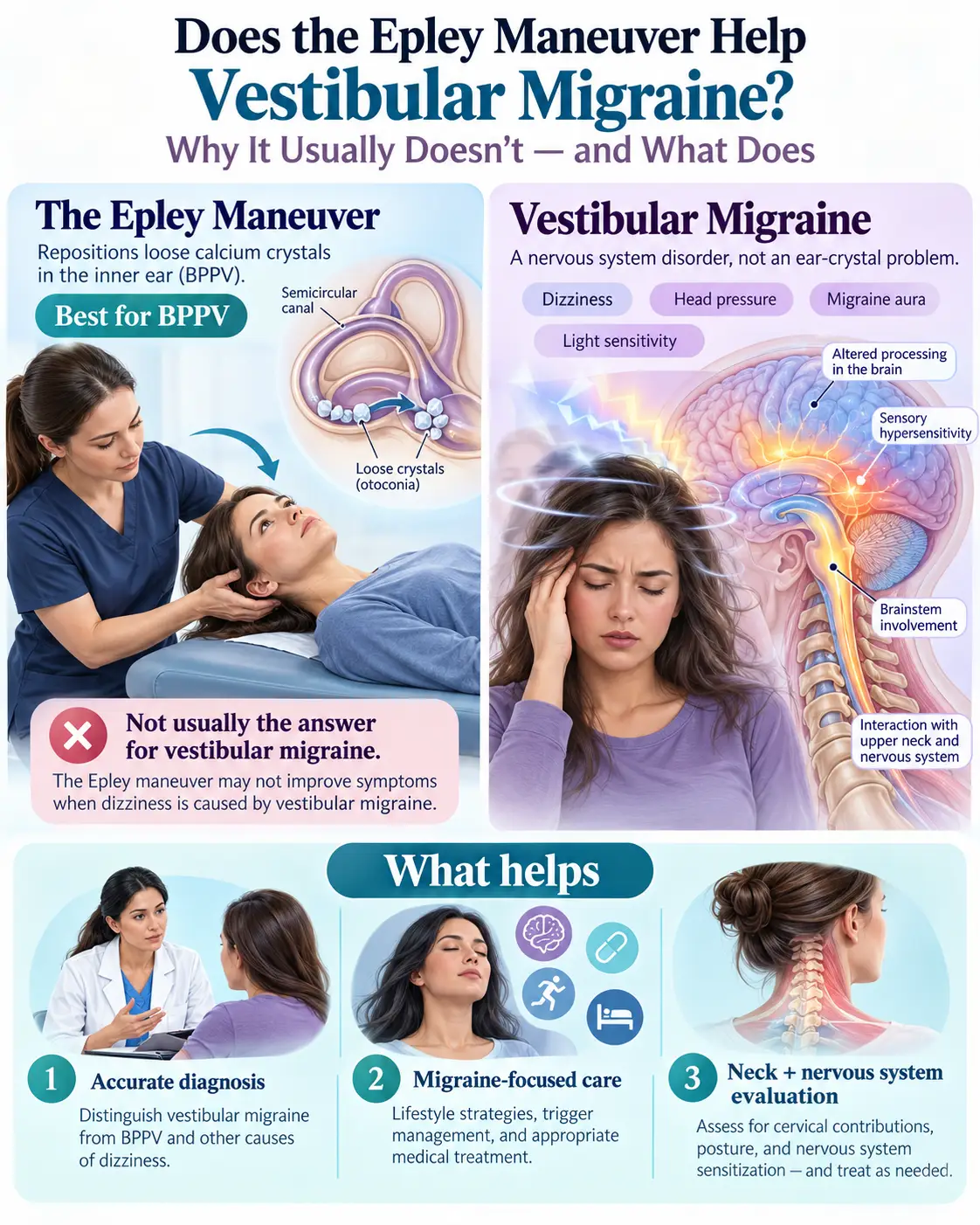
Most people think of migraine as a bad headache. It is not. Migraine is a neurological condition — a particular pattern of how the brain and brainstem process sensory information — and headache is only one of the ways it shows up. Vestibular migraine is the form in which the dominant symptom is vertigo or dizziness rather than, or in addition to, head pain.
What a vestibular migraine attack looks like
A vestibular migraine episode typically involves:
- Vertigo or dizziness lasting anywhere from a few minutes to several hours, and sometimes up to a day or two. It can be spinning, rocking, swaying, or a pulled-and-tilted sensation.
- Migraine features during at least some attacks: a throbbing, often one-sided headache; strong sensitivity to light (photophobia); sensitivity to sound (phonophobia); or a visual aura such as shimmering lights, zig-zag lines, or blind spots.
- Motion sensitivity. Many people feel worse with head movement, busy visual environments (grocery aisles, scrolling screens), or riding in a car.
- A personal or family history of migraine, even if the headaches themselves have faded and the dizziness has taken over.
The vertigo and the headache do not always arrive together. Many people get the spinning with no head pain at all — one reason vestibular migraine is so often missed.
What actually drives it — and where the neck comes in
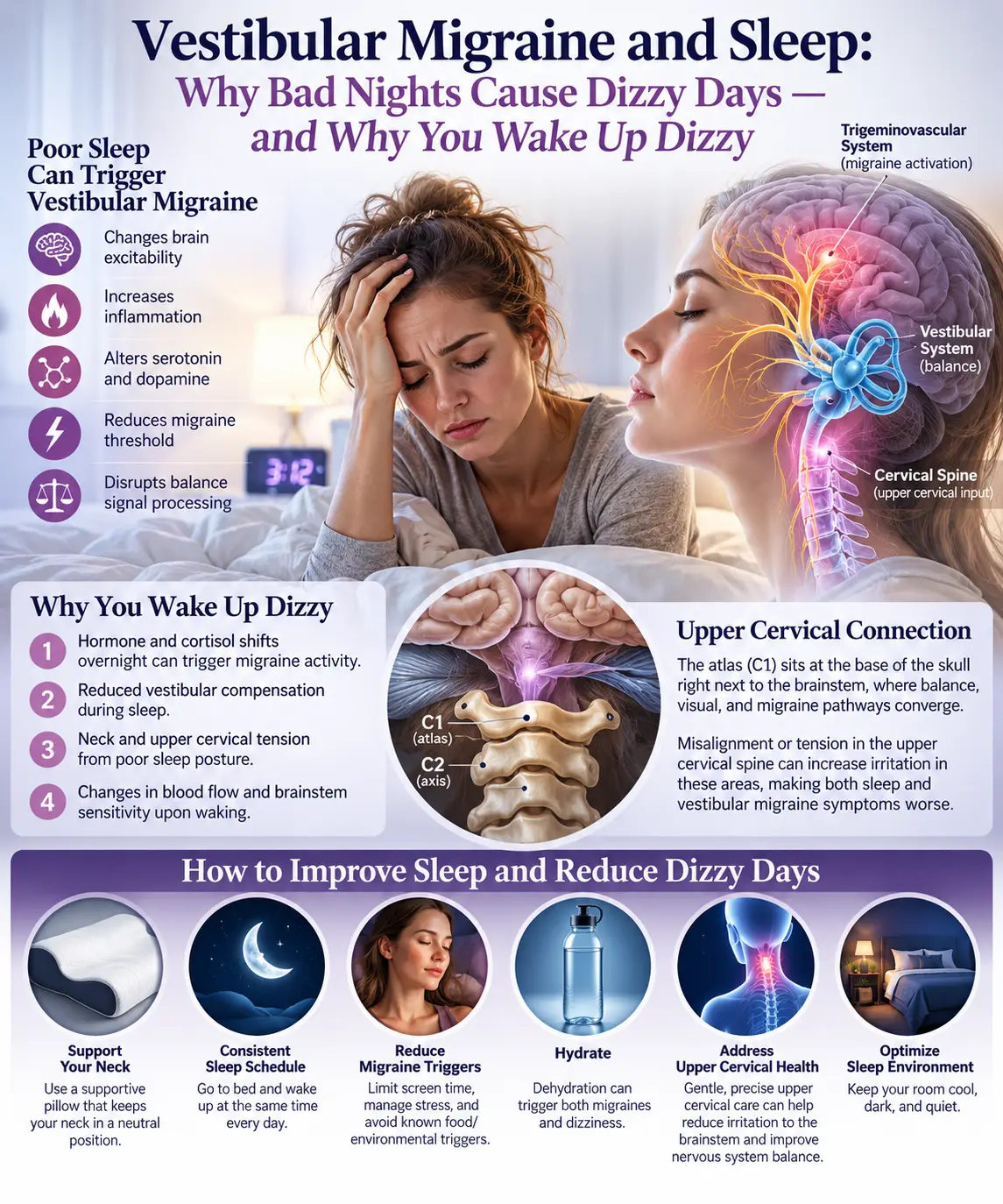
Here is the part the standard articles skip, and it is the most important anatomy in this entire discussion. The trigeminal nerve — the great sensory nerve of the head that is central to migraine — shares a nucleus in the brainstem with the sensory nerves of the upper neck, C1 through C3. This shared relay is called the trigeminocervical nucleus, and the convergence of head and neck signals onto the same brainstem neurons is called trigeminocervical convergence. It is not a fringe idea; it is standard neuroanatomy, and it is the reason a problem in the upper neck and a problem in the head can feel like the same thing to your brain.
Think about what that means. The upper cervical spine — the atlas, the axis, and the craniocervical junction where your skull meets your neck — pours sensory information into the exact brainstem circuits that generate migraine and process balance. When the top of the neck is misaligned or irritated, it can send a barrage of abnormal signals straight into that shared relay, effectively turning up the volume on a migraine-prone brainstem and helping tip it into an attack. This is why the upper cervical spine can be a genuine, overlooked driver of vestibular migraine — not a vague “contributor,” but a plausible root of the very sensitization that keeps the attacks coming.
And it explains a pattern we see over and over in Sarasota, Lakewood Ranch, and Bradenton: people whose vertigo, dizziness, and migraine began or dramatically worsened after a whiplash, a concussion, a car accident, or a fall. Trauma to the head and neck destabilizes the atlas and axis — vertebrae held in place mostly by ligaments rather than interlocking bone — at the precise junction that feeds the trigeminocervical system. If your attacks trace back to something that happened to your head or neck, that is not a coincidence to shrug off. It is the single most important clue about where this is really coming from.
How it is diagnosed
There is no blood test or scan that confirms vestibular migraine. It is a clinical diagnosis, made by a physician who takes a careful history and applies established criteria — the length and character of the attacks, the presence of migraine features, and the exclusion of other causes. We will look at those formal criteria in the research section. But notice the gap: a clinical diagnosis built on symptom history rarely includes a precise structural look at the one region — the upper cervical spine — with a direct neurological line into the migraine machinery.
Meniere’s Disease: The Inner Ear — and the Brainstem Above It
Meniere’s disease is classically described as a disorder of the inner ear rather than the brain. It is associated with a buildup of fluid (endolymph) in the inner ear, which houses both the balance organs and the hearing organ (the cochlea). Because one small structure handles both jobs, Meniere’s produces hearing symptoms alongside the vertigo — and that auditory signature is the single most useful feature for separating it from vestibular migraine.
What a Meniere’s attack looks like
A classic Meniere’s episode is a cluster:
- Vertigo lasting roughly 20 minutes to several hours (usually not longer than about 12 hours in one spell), often intense, often with nausea and vomiting.
- Fluctuating hearing loss, usually in the low frequencies at first, usually in one ear. Early on, hearing may return to normal between attacks; over years, some permanent loss can develop.
- Tinnitus — ringing, roaring, or buzzing in the affected ear.
- Aural fullness — a sensation of pressure or “stuffiness,” as if the ear needs to pop, often just before or during an attack.
That combination — vertigo plus one-sided low-frequency hearing loss, tinnitus, and ear fullness — is the hallmark of Meniere’s disease.
What drives it — and why the neck still belongs in the conversation
Meniere’s is linked to that fluid buildup (endolymphatic hydrops), though why it happens is not fully understood. Genetics, autoimmune factors, viral influences, vascular factors, and problems with fluid and pressure regulation have all been proposed. Here is the honest, cause-forward point: the inner ear does not float in isolation. Its fluid regulation, its blood supply, and the balance signals it sends are all governed and integrated in the brainstem, and the brainstem is regulated in part by the autonomic nervous system that runs through the upper neck. The craniocervical junction sits at the crossroads of that traffic.
So even for a condition traditionally pinned on the ear, the upper cervical spine is a reasonable place to look — especially in the many patients whose Meniere’s-type symptoms began after head or neck trauma, and especially given how often migraine and Meniere’s travel together (more on that below). No one is claiming the atlas is the whole story of every inner-ear condition. The claim is narrower and more useful: the upper cervical spine can be an overlooked driver of the brainstem dysregulation that sits underneath these balance disorders, and it is the one region your workup almost certainly never examined structurally.
How it is diagnosed
Like vestibular migraine, Meniere’s is diagnosed clinically — but with a crucial addition: audiometry (a formal hearing test) is central. A physician needs to document the low-frequency hearing loss to meet the criteria. This is why an ENT evaluation is so valuable when Meniere’s is suspected.
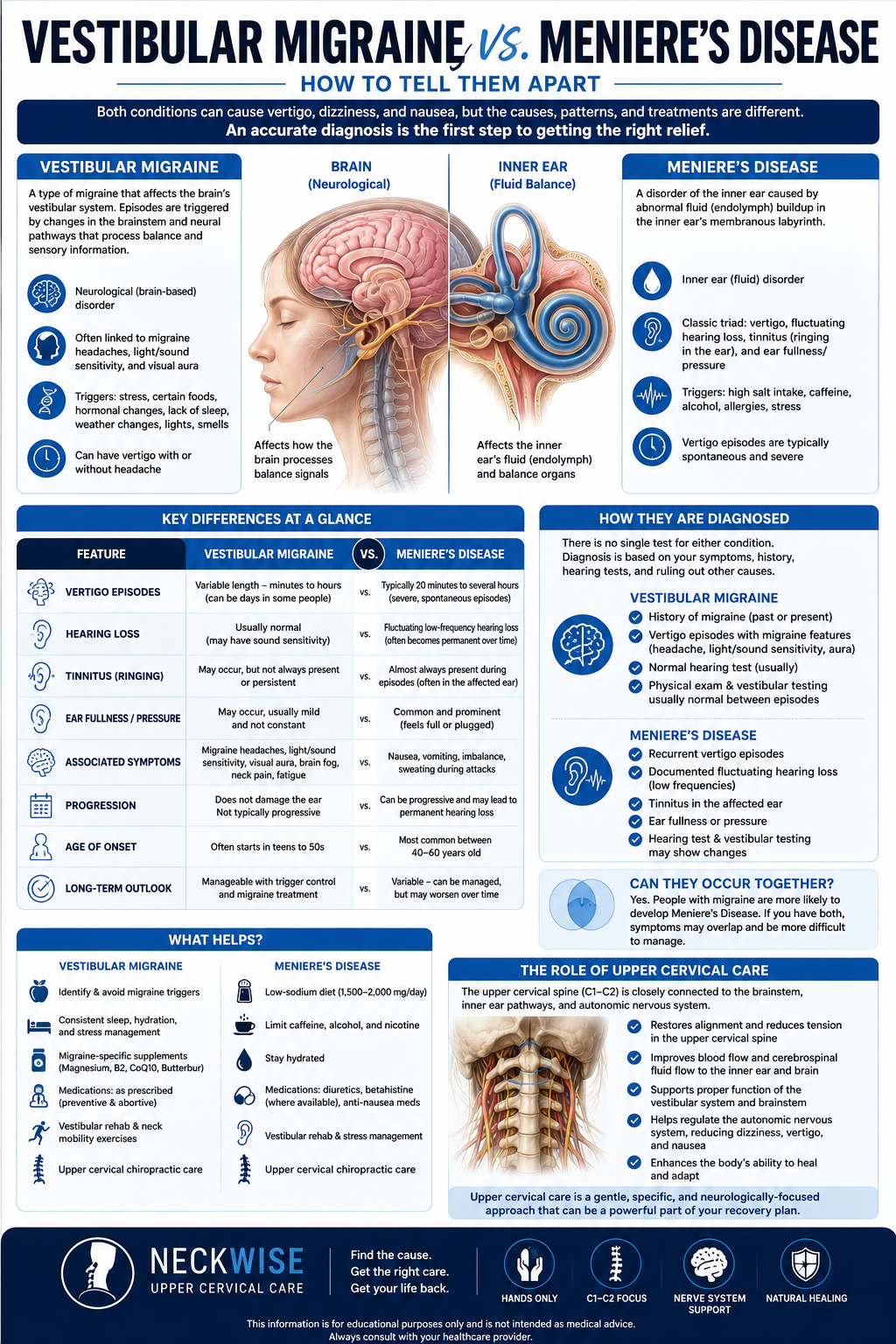
Side-by-Side: The Key Differences
Here is a simplified comparison. Real patients do not always read the textbook, so treat this as a guide, not a rulebook.
| Feature | Vestibular Migraine | Meniere’s Disease |
|---|---|---|
| Core problem | Neurological (migraine-spectrum, brainstem) | Inner-ear (fluid-related) |
| Vertigo duration | Minutes to hours, occasionally 1-2 days | Usually 20 minutes to several hours |
| Hearing loss | Not typical; if present, usually mild and not progressive | Characteristic; low-frequency, fluctuating, can progress |
| Tinnitus / ear fullness | Uncommon or mild | Common and often prominent |
| Headache / light-sound sensitivity / aura | Common | Not a defining feature |
| Motion sensitivity / visual triggers | Very common | Less prominent |
| Personal/family migraine history | Usually present | Not required |
| Key confirming test | Clinical criteria; no defining test | Audiometry showing low-frequency hearing loss |
The clearest dividing line, in most cases, is the ear. Prominent, one-sided, fluctuating hearing loss with fullness and tinnitus points toward Meniere’s. Prominent headache, light and sound sensitivity, visual aura, and a strong migraine history point toward vestibular migraine. But hold that dividing line loosely, because the two conditions overlap far more than the neat table suggests — and the overlap itself points back toward a shared upstream driver.
When They Overlap: The Gray Zone Points Upstream
In reality the two conditions blur together, and this overlap is one of the most researched aspects of both diagnoses. Several things blur the line:
- Migraine is common in people with Meniere’s disease. People with Meniere’s have migraine at higher rates than the general population, so a person can genuinely have both.
- Meniere’s attacks can include migraine-type symptoms, and vestibular migraine attacks can include auditory symptoms like tinnitus and fullness. The symptom lists overlap heavily during actual episodes.
- Early Meniere’s can look like vestibular migraine before the hearing loss becomes established.
- Some people meet criteria for both. There is a recognized category for exactly this.
Now ask the obvious question the standard articles never ask: why would two conditions supposedly living in two different organs — one in the ear, one in the brain — overlap so relentlessly? The most compelling answer is that they share upstream real estate in the brainstem, and that the brainstem’s balance, pain, and autonomic circuits are all vulnerable to the same influences — including abnormal input from the upper cervical spine. The gray zone is not just a diagnostic nuisance. It is a fingerprint pointing to a common region where these systems converge, and that region sits directly on top of your atlas and axis.
A symptom diary — date, duration, character of each attack, whether hearing changed, whether there was fullness or tinnitus, whether there was headache or light sensitivity, and what may have triggered it — is one of the most useful things you can bring to any evaluation, medical or structural. It often reveals patterns a single visit cannot.
Red Flags: When Vertigo Needs Urgent Medical Care
Most vertigo is not dangerous, but some causes are emergencies. Seek urgent or emergency medical care if vertigo or dizziness comes with any of the following:
- Sudden, severe headache unlike any you have had before (“the worst headache of my life”).
- Weakness, numbness, or drooping in the face, arm, or leg — especially on one side.
- Slurred speech, trouble speaking, or trouble understanding speech.
- Double vision or sudden loss of vision.
- Difficulty walking, severe loss of balance, or loss of coordination.
- Sudden hearing loss, especially in one ear.
- Fainting, chest pain, or an irregular or racing heartbeat.
- Vertigo after a head injury.
- A high fever with a stiff neck.
These can be signs of a stroke or another serious problem, and they need immediate evaluation — call 911 or go to the nearest emergency department. When in doubt, err on the side of getting checked. It is always better to be reassured than to miss something time-sensitive.
What the Research Says
I want to ground this in the published literature rather than opinion. Here is what five key sources tell us.
The modern diagnostic criteria for vestibular migraine were established by Lempert and colleagues in a 2012 consensus document from the Barany Society and the International Headache Society. These criteria define vestibular migraine around recurrent vestibular symptoms of at least moderate intensity lasting between five minutes and 72 hours, a current or prior history of migraine, and migraine features (headache, light/sound sensitivity, or visual aura) accompanying at least half of the vestibular episodes — with other causes reasonably excluded. This framework is why vestibular migraine is diagnosed by careful history rather than a single test.
The corresponding diagnostic criteria for Meniere’s disease were published by the Barany Society and international partners in 2015. These criteria center on the ear: they require repeated episodes of vertigo lasting roughly 20 minutes to 12 hours, audiometrically documented low- to mid-frequency hearing loss in the affected ear, and fluctuating ear symptoms — again with other causes excluded. The emphasis on documented hearing loss is precisely what distinguishes Meniere’s from vestibular migraine on paper.
But the paper distinctions blur in real attacks. A 2014 study in Frontiers in Neurology examining accompanying symptoms during attacks found substantial overlap: patients with Meniere’s disease frequently reported migraine-type accompanying symptoms during their vertigo episodes, and patients with vestibular migraine reported auditory symptoms such as tinnitus and aural fullness during theirs. The symptom checklists overlap considerably once you look at what people actually experience mid-attack — which is exactly why a single episode can be so hard to categorize, and why a shared upstream mechanism is so plausible.
The depth of this connection is explored in a 2016 review in Behavioural Neurology titled “The Intimate Relationship between Vestibular Migraine and Meniere Disease.” This review discusses how the two conditions share features, how migraine occurs more commonly in people with Meniere’s than in the general population, and how some patients meet criteria for both. It underscores that these are not always cleanly separable entities and that shared mechanisms may be at play.
Finally, a 2023 paper in the Journal of Neurology framed the challenge directly as “Vestibular migraine or Meniere’s disease: a diagnostic dilemma.” This more recent work reinforces that even with modern criteria, distinguishing the two — and identifying those who have both — remains genuinely difficult, and that following patients over time is often what clarifies the picture.
The practical takeaway is consistent: both conditions are diagnosed clinically, hearing testing is pivotal for identifying Meniere’s, and overlap is common enough that shared upstream mechanisms deserve serious attention. There is no shortcut around a proper evaluation — and there is no good reason to leave the upper cervical spine out of that evaluation.
The Overlooked Root: Your Upper Cervical Spine
Let me put it plainly, because it is the heart of everything above. Both vestibular migraine and Meniere’s disease play out in the brainstem’s balance and sensory circuits. The upper cervical spine — the atlas (C1), the axis (C2), and the craniocervical junction directly beneath your skull — has the most intimate mechanical and neurological relationship with those circuits of any structure in your body. The C1–C3 nerves feed the same brainstem nucleus as the trigeminal system that drives migraine. The autonomic pathways that help regulate inner-ear fluid and blood flow pass through this region. And this is the very segment most damaged by whiplash, concussion, and years of forward-head posture.
That is why, for a meaningful number of people, the upper cervical spine is not a side issue — it can be the missing piece that explains why the attacks keep coming no matter how many medications or diet changes are tried. When the top of the neck is misaligned, it can be a primary driver feeding the brainstem sensitization underneath these conditions. And it is, almost always, the one place no one checked.
None of this replaces your neurologist or ENT. Keep them. Get the right label. But if you have “done everything right” and still cycle through attacks, the honest question is whether the structural root at the top of your neck was ever evaluated — because in most cases, it was not.
How We Evaluate the Upper Cervical Spine at Lavender Family Chiropractic
At Lavender Family Chiropractic (NeckWise North Sarasota), we focus exclusively on the upper cervical spine — the atlas, the axis, and the junction where the skull meets the neck. Our approach is built on measurement, not guesswork. We use 3D CBCT imaging to see your upper cervical alignment in three dimensions, and paraspinal infrared thermography to read how your nervous system is actually behaving along the spine — directly relevant when the whole question is brainstem and autonomic regulation. When a correction is warranted, we use the Knee Chest Upper Cervical technique: precise, gentle, and low-force — with no twisting, cracking, or popping. For a nervous system already sensitized and prone to vertigo, that gentleness is the entire point.
The goal is simple: give an irritated brainstem a calmer structural environment so it can do its job. If an evaluation shows the neck is not a meaningful factor in your case, we will tell you so and help point you toward the right specialist. But if the top of your neck is driving abnormal signals into your balance and migraine circuitry, that is the evaluation you have been missing — and it is worth pursuing.
Serving Sarasota, Lakewood Ranch & Bradenton
Lavender Family Chiropractic (NeckWise North Sarasota) proudly serves patients throughout Sarasota, Lakewood Ranch, and Bradenton, along with North Sarasota, Whitfield, University Park, Palmetto, Osprey, Nokomis, Venice, and the surrounding Gulf Coast communities. If recurring dizziness or unsteadiness has taken over your life, we understand how frightening and exhausting that is — and we believe the region driving it deserves a real, structural look, not another shrug.
If you live in Sarasota, Lakewood Ranch, or Bradenton and your vertigo began or worsened after a head or neck injury, that is exactly the pattern we want to evaluate. Patients are welcome to book a consultation with our doctors to have their questions answered directly.
Top Questions
Can I have both vestibular migraine and Meniere’s disease at the same time? Yes. The two overlap, and there is a recognized group of patients who meet criteria for both. Migraine also occurs more often in people with Meniere’s than in the general population. That relentless overlap is one reason a shared upstream driver — including the upper cervical spine’s influence on the brainstem — is worth taking seriously.
What is the single biggest difference between the two? The ear. Meniere’s characteristically produces one-sided, fluctuating hearing loss along with tinnitus and ear fullness. Vestibular migraine typically does not cause progressive hearing loss and instead tends to come with migraine features such as headache, light and sound sensitivity, or visual aura. A formal hearing test is often the deciding factor.
My vertigo started after a car accident / whiplash / concussion. Does that matter? It matters enormously. Head and neck trauma destabilizes the atlas and axis at the exact junction that feeds the brainstem’s balance and migraine circuits. If your attacks began or worsened after an injury, the upper cervical spine is a primary driver worth evaluating rather than assuming.
Why the upper neck specifically, and not the whole spine? Because the C1–C3 nerves converge with the trigeminal system in the brainstem — the trigeminocervical nucleus — and because the craniocervical junction sits directly beneath the balance and autonomic centers. No other part of the spine has that direct a line into the circuitry generating vertigo and migraine. It is also the segment most damaged by whiplash and concussion.
Is the adjustment forceful? No — precise, gentle, and low-force, with no twisting, cracking, or popping. We image your specific anatomy with 3D CBCT first.
Does this replace my neurologist or ENT? No. Keep them, and get the correct diagnosis. Upper cervical evaluation addresses the structural root that standard workups skip; it works alongside good medical care, not instead of it.
What are the warning signs that vertigo is an emergency? Sudden severe headache; weakness, numbness, or drooping on one side; slurred speech; double vision or vision loss; difficulty walking or severe imbalance; sudden hearing loss; fainting or chest pain; vertigo after a head injury; or fever with a stiff neck. Any of these warrant immediate emergency care — call 911.
Why has it taken so long to get answers? Because the two conditions are genuinely hard to separate, and because the one region with the most direct influence on the circuits involved — the upper cervical spine — is almost never examined structurally. Getting that piece evaluated is often what has been missing.
Get the One Place No One Checked Evaluated
Vestibular migraine and Meniere’s disease are real, well-described conditions, and telling them apart matters. But do not stop at the label. Both play out in the brainstem, and the brainstem sits on top of the two most vulnerable vertebrae in your body. For a great many people — especially those whose vertigo followed a whiplash, concussion, or fall — the upper cervical spine can be the overlooked root that keeps the attacks coming.
Let us look at the one region your workup skipped. Call (941) 243-3729 or book a consultation at our Sarasota office, serving Sarasota, Lakewood Ranch, and Bradenton.
Lavender Family Chiropractic (NeckWise North Sarasota) 5899 Whitfield Avenue, Suite 107 Sarasota, FL 34243(941) 243-3729
This article is for general educational purposes only and is not a substitute for professional medical advice, diagnosis, or treatment. Please consult your physician, neurologist, or ENT for evaluation of vertigo and related symptoms, and seek emergency care for any of the red-flag symptoms described above.
Related Articles
Get our upper cervical articles first.