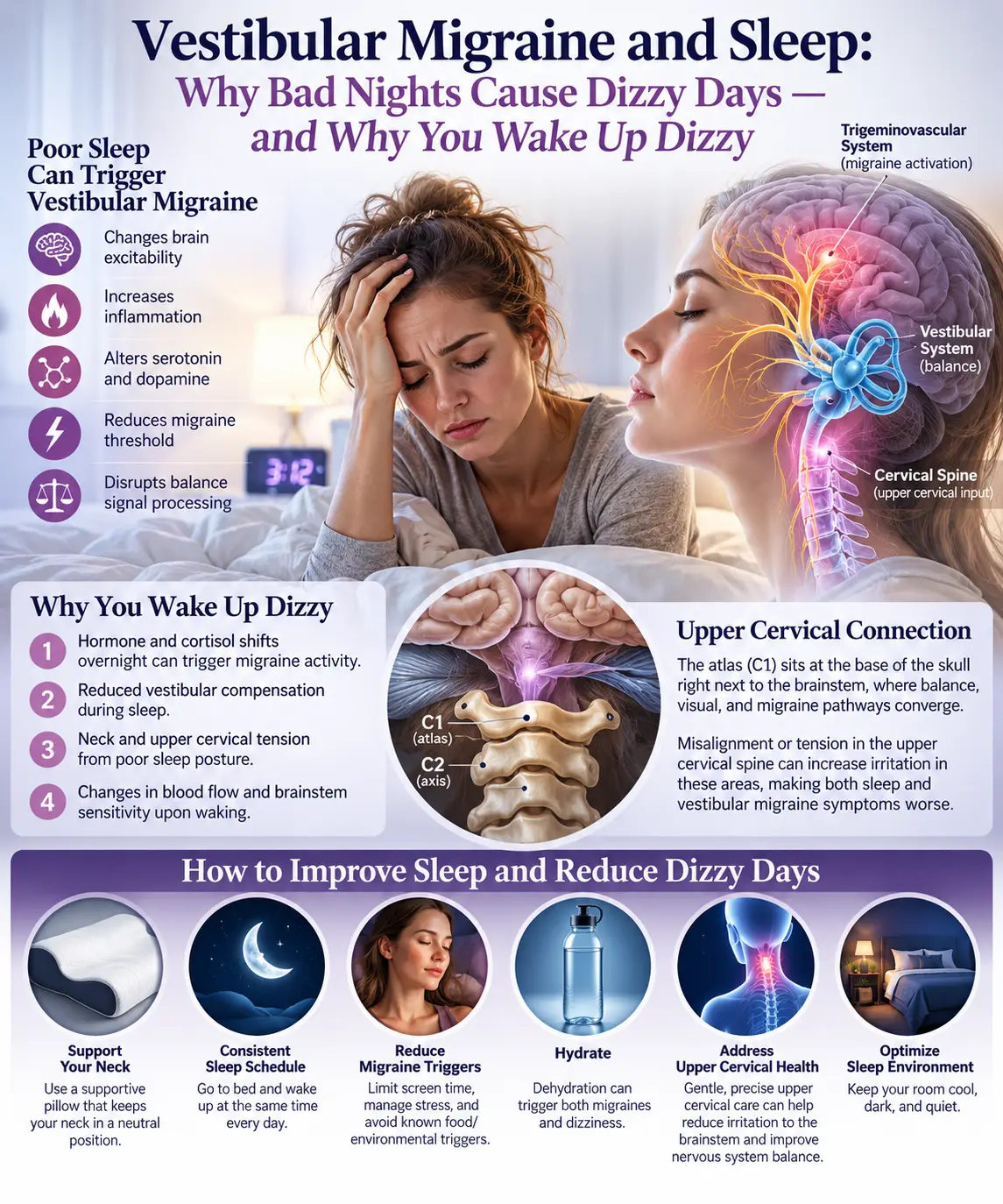
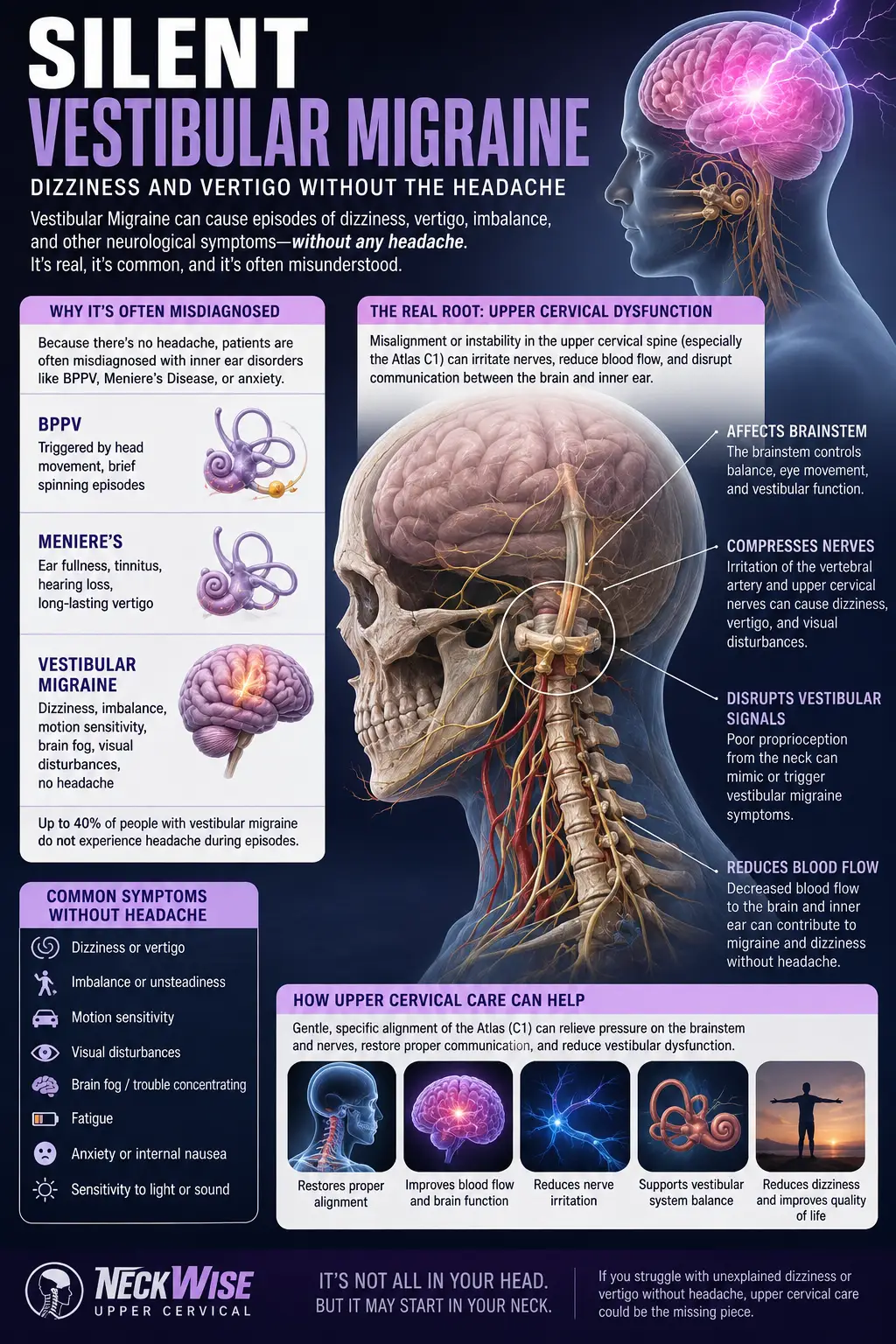
Silent Vestibular Migraine: Dizziness and Vertigo Without the Headache — and the Neck Behind It
By Dr. Rusty Lavender, D.C. — upper cervical chiropractor, Lavender Family Chiropractic, Sarasota, FL. Reviewed and updated October 2026.
Our complete guide to vestibular migraine treatment in Sarasota covers the diagnosis, the brainstem and upper neck connection, and how we evaluate it with 3D imaging.
You get episodes of spinning, swaying, rocking, or a strange sense that the floor is moving under you — and your head does not hurt at all. So no one thinks “migraine.” You have been told it is your inner ear, your anxiety, your dehydration, your stress, or nothing to worry about. Meanwhile the dizziness keeps ambushing you, sometimes for minutes, sometimes for hours, sometimes wrecking a whole day. Here is what almost no one has told you: this pattern has a name — silent vestibular migraine — and it is migraine biology firing through your balance system instead of through pain. And that biology lives in the brainstem, which sits directly on top of the two most injury-prone vertebrae in your body, the atlas (C1) and axis (C2). The single region with the most direct neurological line into that migraine machinery — the top of your neck — is almost certainly the one place no one has checked.
This article will help you understand what silent (headache-free) vestibular migraine is, why it gets missed for years, and how it is properly diagnosed. But it will also do what the hedged articles will not: it will name the overlooked structural driver at the top of your neck — the piece that can be the reason your dizzy spells keep coming. If your dizziness began or worsened after a whiplash, a concussion, or a fall, pay close attention, because that history points straight at the root. We care for people across Sarasota, Lakewood Ranch, and Bradenton who have lived this exact frustration.
What Is Vestibular Migraine?
Migraine is not “a bad headache.” It is an inherited disorder of how the brain and brainstem process sensory information. In a migraine brain, the systems that handle light, sound, motion, smell, pain, and balance are more excitable and more easily overwhelmed than average. Most people picture migraine as throbbing head pain with nausea and light sensitivity, and for many that is exactly how it shows up. But the same underlying biology can drive other symptoms — and one of the most common is dizziness.
Vestibular migraine (VM) is the term for migraine that produces vestibular symptoms: vertigo (a false sense of spinning or motion), unsteadiness, sensitivity to motion, and a feeling of being pulled or rocked. The vestibular system includes the balance organs of the inner ear and the many brainstem pathways that interpret their signals. When migraine physiology involves those pathways, the result is dizziness rather than, or in addition to, head pain.
Vestibular migraine is now recognized as one of the most common causes of recurrent spontaneous vertigo in adults. It affects people across the lifespan, is more common in women, and frequently runs in families alongside more typical migraine. Many people with VM have a personal history of classic migraines earlier in life — often in their teens and twenties — that faded or changed character as they got older, only to be replaced by episodes of dizziness in midlife.
The Key Idea: Migraine Can Attack Balance Instead of Causing Pain
Here is the concept that unlocks everything else. In migraine, head pain is only one possible symptom, not a requirement. The brainstem’s migraine machinery can generate an “attack” that features dizziness prominently and head pain minimally or not at all. When that happens, the person does not think “migraine,” because there is no headache to point to. And often, neither does the clinician they see.
This is why vestibular migraine is one of the most under-recognized conditions in medicine. The symptom that would make everyone think of migraine — the headache — is exactly the symptom that may be missing.
Silent (Acephalgic) Vestibular Migraine: Dizziness Without the Headache
“Acephalgic” simply means “without head pain.” Silent or acephalgic vestibular migraine describes attacks in which vestibular symptoms occur but headache is absent or so mild the person does not notice or report it.
Two truths surprise people. First, headache is frequently absent during vestibular migraine attacks. A large share of episodes involve little or no head pain; the vertigo and the headache do not have to occur together, and in many people the headache stops happening altogether while the dizziness continues for years. Second, you can still be diagnosed with vestibular migraine even during a stretch of life when you never get headaches — provided you have a documented history of migraine at some point. Diagnostic frameworks account for this precisely because acephalgic attacks are so common. The migraine history is the anchor; the current dizziness is the presentation.
What a Silent Vestibular Migraine Attack Can Feel Like
No two people describe their attacks identically, but common features include:
- A sense that the room is spinning (true vertigo), or that you yourself are spinning or tilting
- A rocking, swaying, or “boat on water” sensation, even while sitting still
- Feeling pulled to one side, or as if the floor is rising or dropping
- Motion sensitivity — busy visual environments, scrolling screens, grocery aisles, traffic, or being a passenger in a car can trigger or worsen symptoms
- Sensitivity to light or sound during the episode, even without pain
- Nausea, sometimes with vomiting
- A feeling of pressure or fullness in the head or ears without actual pain
- Difficulty concentrating, a “foggy” feeling, or exhaustion afterward
- Attacks lasting anywhere from a few minutes to several hours, occasionally up to a day or two
Some people have brief, intense spinning episodes; others have a background of near-constant unsteadiness with flares. Both patterns can belong to vestibular migraine.
Why “Silent” Does Not Mean “Minor”
Do not let the word “silent” fool you. Headache-free does not mean symptom-free or low-impact. Vestibular migraine can be profoundly disruptive. People rearrange their lives around it — avoiding driving, declining invitations, struggling at work, feeling unsafe on stairs or in open spaces. The unpredictability is its own burden. The absence of pain does not lessen the disability; it often just delays the correct diagnosis — and delays the moment anyone finally looks at the structural driver at the top of the neck.
Why Silent Vestibular Migraine Gets Missed So Often
Understanding why this condition slips through the cracks can save you a great deal of frustration and self-doubt.
1. The Missing Headache Removes the Obvious Clue
Clinicians are trained to associate migraine with headache. When a patient reports dizziness and says “but my head doesn’t hurt,” migraine gets dismissed early. The most recognizable feature of the disorder is simply not there to be recognized.
2. The Symptoms Overlap With Many Other Conditions
Dizziness is one of the least specific symptoms in all of medicine. Vestibular migraine shares features with BPPV, Meniere’s disease, vestibular neuritis, anxiety-related dizziness, low blood pressure, and more. Because the symptom itself is so common, the specific cause is easy to overlook without a careful history.
3. Testing Is Often Normal
Between attacks, and even during many attacks, standard tests — inner-ear testing, hearing tests, MRI scans, blood work — frequently come back normal in vestibular migraine. This is actually consistent with the diagnosis, because VM is a problem of brain and brainstem processing rather than structural damage visible on a routine scan. But normal tests leave patients feeling disbelieved, as though nothing is really wrong. Nothing could be further from the truth. And notice what those routine scans do not assess: the precise alignment of the upper cervical spine and the abnormal signaling it can send into the brainstem.
4. Patients Are Frequently Told It Is “Just Anxiety” or “Just Your Neck”
When the tests are normal and the headache is absent, patients are often told the problem is psychological, or “just your neck,” and sent on their way. Here is the important distinction. Dismissing someone with a wave of the hand — “it’s your neck, nothing to be done” — is not the same as actually evaluating the neck. Anxiety is real and can genuinely accompany these symptoms, but it is frequently a consequence of unexplained dizziness, not the cause. Two things can be true at once: you can have real anxiety about unpredictable symptoms and an underlying vestibular migraine driving the episodes — a migraine that can, in turn, be fed by a genuine, measurable problem at the top of your neck. Being told “it’s all in your head” when you have a neurological condition with a structural driver is both inaccurate and demoralizing.
5. The Migraine History Is Buried in the Past
Because many people’s classic migraines occurred decades earlier and then faded, they may not even mention that history when describing current dizziness. Yet that past migraine history is often the single most important clue to the current diagnosis.
The Neuroanatomy That Names the Driver
Here is the part the standard “silent vestibular migraine” articles never get to, and it changes how you should think about your whole case. The trigeminal nerve — the great sensory nerve of the head and the central player in migraine — shares a nucleus in the brainstem with the sensory nerves of the upper neck, C1 through C3. This shared relay is the trigeminocervical nucleus, and the merging of head and neck signals onto the same brainstem neurons is called trigeminocervical convergence. It is standard neuroanatomy.
What it means is profound for anyone with silent vestibular migraine. The upper cervical spine — the atlas, the axis, and the craniocervical junction just beneath your skull — pours sensory information directly into the exact brainstem circuits that generate migraine and process balance. When the top of the neck is misaligned or irritated, it can flood that shared relay with abnormal signals, raising the excitability of a migraine-prone brainstem and helping tip it into the dizziness attacks that define this condition. That is a plausible, mechanism-based reason the upper cervical spine can be a primary driver of vestibular migraine — including the silent, headache-free form.
And it explains a pattern we see constantly across Sarasota, Lakewood Ranch, and Bradenton: people whose dizziness began or dramatically worsened after a whiplash, a concussion, a car accident, or a fall. Those traumas destabilize the atlas and axis — vertebrae held mostly by ligaments rather than interlocking bone — at the very junction that feeds the trigeminocervical system. If your silent vestibular migraine traces back to something that happened to your head or neck, that is the loudest clue you have about where this is really coming from.
How Silent Vestibular Migraine Is Diagnosed
Vestibular migraine is a clinical diagnosis, made primarily from your story and examination rather than from a single test that lights up positive. This is why a careful, patient history is so valuable.
The Two Anchors: Migraine History Plus Vestibular Symptoms
Diagnosis rests on connecting two things: a history of migraine (current or past), and recurrent episodes of vestibular symptoms of at least moderate intensity and characteristic duration. Clinicians generally look for a pattern along these lines:
- Repeated episodes of vestibular symptoms (vertigo, unsteadiness, or motion-triggered dizziness) of moderate or severe intensity, each lasting between about five minutes and 72 hours.
- A current or past history of migraine (with or without aura), following recognized criteria.
- Migraine features accompanying at least half of the vestibular episodes — a one-sided, pulsating, or moderate-to-severe headache; light and sound sensitivity; or visual aura.
- Symptoms not better explained by another disorder.
Notice something important: those migraine features need to accompany only some of the vestibular episodes. Many attacks can be entirely headache-free and the diagnosis still holds. This is precisely how the framework accommodates silent, acephalgic attacks.
The Value of a Symptom Diary
Because attacks are episodic and testing is often normal, a written record is one of the most useful diagnostic tools available. For a few weeks, note:
- When each episode starts and how long it lasts
- What the sensation was (spinning, rocking, swaying, unsteady)
- Any triggers (poor sleep, skipped meals, hormonal cycle, weather, red wine, aged cheese, bright or flickering light, stress let-down, visual overload) — and whether it followed any neck strain or old injury
- Any accompanying features (light or sound sensitivity, nausea, visual changes, head pressure)
- Whether a headache occurred, and if so, where and how severe
What the Diagnostic Workup May Include
A thorough evaluation for dizziness typically involves a detailed history including your lifetime and family migraine history; a neurological examination with bedside balance and eye-movement testing; hearing and inner-ear (vestibular) testing to look for other causes; and, in selected cases, imaging such as MRI to rule out other conditions. Much of this is done to exclude other diagnoses. When they come back normal and the history fits, vestibular migraine becomes the leading explanation. The proper professionals to lead this process are typically a neurologist, an otolaryngologist (ENT), or a vestibular specialist, often alongside a vestibular physical therapist. What that workup routinely omits, however, is a precise structural evaluation of the upper cervical spine — the one region with a direct line into the migraine circuitry.
Conditions That Can Mimic or Accompany It
Part of a good diagnosis is distinguishing vestibular migraine from its look-alikes:
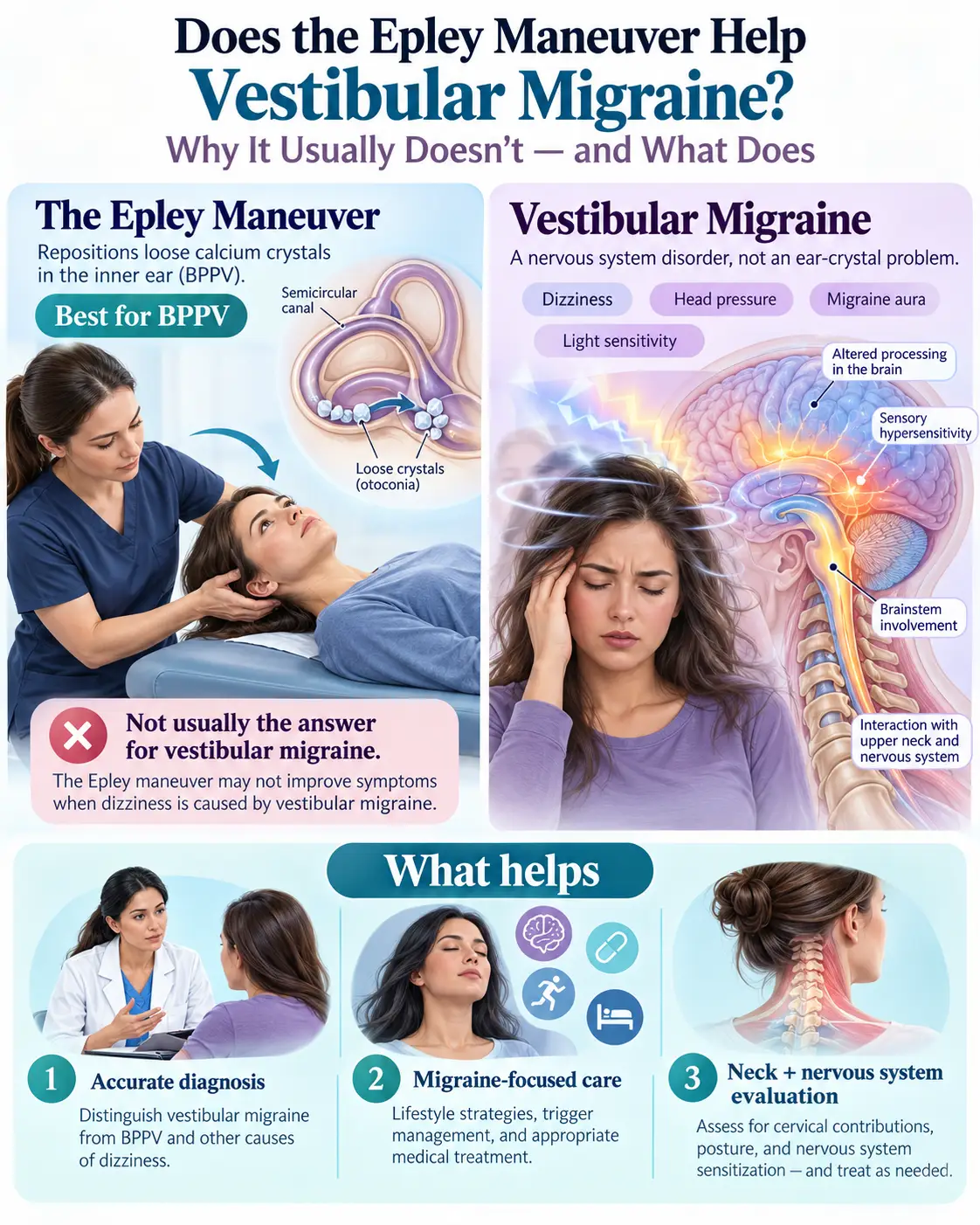
- BPPV: brief spinning triggered by specific head positions, from displaced inner-ear crystals, often treated with repositioning maneuvers.
- Meniere’s disease: vertigo with fluctuating hearing loss, ringing, and ear fullness on one side. VM and Meniere’s can overlap.
- Vestibular neuritis: a single prolonged episode of severe vertigo, usually after a viral illness.
- Persistent postural-perceptual dizziness (PPPD): chronic non-spinning dizziness worsened by upright posture and motion, which can develop after or alongside vestibular migraine.
- Cervicogenic dizziness: unsteadiness related to neck dysfunction and abnormal neck sensory input — a reminder that the upper neck is wired into balance from more than one angle.
- Anxiety and panic: which can both mimic and accompany vestibular symptoms.
Because these can coexist, an accurate diagnosis sometimes means identifying more than one contributor at once.
What the Research Says
The medical literature has increasingly recognized vestibular migraine over the past few decades, and several landmark papers shaped that understanding.
Early work formally connected migraine and vertigo as related phenomena. A foundational study of the interrelations of migraine, vertigo, and migrainous vertigo, published in Neurology in 2001, examined how often vertigo and migraine occur together and helped establish that the association is far stronger than chance, laying the groundwork for the modern concept of vestibular migraine.
The real-world burden became clearer with a population study on migrainous vertigo: prevalence and impact on quality of life, published in Neurology in 2006, which documented that migraine-related vertigo is more common than many clinicians assumed and meaningfully reduces quality of life — reinforcing that this is a widespread and disabling problem, not a rare curiosity.
The clinical picture — including how often attacks occur without headache — was detailed in a careful case series on episodic vertigo related to migraine, describing 90 cases and asking whether this represented a distinct entity of vestibular migraine, published in the Journal of Neurology in 1999. This work helped characterize the varied duration and features of attacks and the frequent dissociation between vertigo and head pain.
A comprehensive modern overview appears in Vestibular Migraine I: Mechanisms, Diagnosis, and Clinical Features, published in Seminars in Neurology in 2020, which synthesizes current understanding of the underlying brain mechanisms, the diagnostic approach, and the wide range of ways vestibular migraine can present — including headache-free attacks.
Finally, the formal, internationally recognized diagnostic criteria were established in the consensus document on vestibular migraine diagnostic criteria by Lempert and colleagues, published in the Journal of Vestibular Research in 2012. These criteria give clinicians a shared way to make the diagnosis and specifically account for the fact that many attacks lack head pain, so long as a migraine history and characteristic vestibular symptoms are present.
Taken together, this body of work supports three points that matter for you: vestibular migraine is common, it is often overlooked, and it can be diagnosed even when headaches are absent from the dizzy episodes. What the literature also makes clear — through the well-established trigeminocervical anatomy — is that the upper cervical spine has a direct neurological line into the migraine machinery, which is exactly why it deserves evaluation rather than a dismissive wave.
How Vestibular Migraine Is Typically Managed
While this article focuses on understanding and diagnosis, it helps to know that management exists and can make a real difference. Because vestibular migraine is a neurological disorder, its care is led by neurology and vestibular specialists, and commonly includes:
- Lifestyle and trigger management: consistent sleep, regular meals, hydration, stress regulation, and reducing individual triggers.
- Vestibular rehabilitation therapy: specialized physical therapy that helps the brain adapt and improves balance and motion tolerance.
- Medications: acute options for attacks and, for frequent or disabling episodes, preventive medications from the broader migraine toolkit. These decisions belong with your physician.
- Managing coexisting conditions: addressing anxiety, sleep disorders, or other contributors.
Many people find meaningful relief through a combination of these approaches. But notice, again, what the standard plan leaves out: any structural evaluation of the upper cervical spine, the region feeding the very circuits these medications try to calm.
The Overlooked Root: Your Upper Cervical Spine
Let me put it plainly, because it is the point of this whole article. Silent vestibular migraine is generated in the brainstem’s balance and sensory circuits. The upper cervical spine — the atlas, the axis, and the craniocervical junction directly beneath your skull — has the most intimate neurological and mechanical relationship with those circuits of any structure in your body. The C1–C3 nerves converge with the trigeminal system in the trigeminocervical nucleus. This is also the segment most damaged by whiplash, concussion, and years of forward-head posture over a screen.
So when a person has years of headache-free dizziness, normal scans, and a history of neck trauma, the upper cervical spine is not a footnote — it can be the missing piece that explains why the attacks keep coming. When the top of the neck is misaligned, it can be a primary driver feeding the migraine sensitization underneath. And it is, in nearly every case we see, the one region no one ever examined structurally.
This does not replace your neurologist or vestibular specialist. Keep them. But if you have “done everything right” and still cannot get steady, the honest question is whether anyone has actually evaluated the structural root at the top of your neck — because usually, no one has.
How We Approach the Upper Cervical Spine at Our Practice
At Lavender Family Chiropractic (NeckWise North Sarasota), our upper cervical work is built around precision and gentleness. Our care is precise, gentle, and low-force. There is no twisting, cracking, or popping. To guide that care carefully, we use:
- 3D CBCT imaging (cone-beam computed tomography) to see the detailed anatomy of the upper cervical spine, so any care is based on your individual structure rather than guesswork.
- Paraspinal infrared thermography to read how your nervous system is behaving along the spine over time.
- The Knee Chest Upper Cervical technique, a low-force method that avoids the forceful, twisting manipulation many people fear.
If you come to us with dizziness, our commitment is straight talk about what we see. If your story and imaging point to a misalignment at the top of your neck feeding your brainstem, we will explain exactly how, and address it gently at the source. If we do not think the neck is a meaningful factor in your case, we will tell you that too and help point you toward the right specialist.
Red Flags: When to Seek Prompt Medical Attention
Most dizziness is not dangerous, but certain features can signal something more serious and warrant urgent evaluation. Seek emergency care or contact a physician promptly if dizziness or vertigo occurs with any of the following:
- Sudden, severe headache unlike any you have had before (“the worst headache of my life”)
- Weakness, numbness, or drooping in the face, arm, or leg, especially on one side
- Difficulty speaking, slurred speech, or trouble understanding others
- Sudden vision loss, double vision, or trouble seeing
- Sudden hearing loss in one or both ears
- Trouble walking, severe loss of coordination, or falling
- Fainting, chest pain, or an irregular or racing heartbeat
- Persistent vomiting that prevents you from staying hydrated
- New, constant, or steadily worsening dizziness rather than distinct episodes
- Dizziness following a head or neck injury
These symptoms can point to conditions that require immediate treatment, including stroke. When in doubt, err on the side of getting evaluated urgently. Vestibular migraine is a diagnosis made after dangerous causes have been considered and excluded, which is another reason proper medical evaluation matters.
Top Questions
Can I really have vestibular migraine if my head never hurts?
Yes. Headache-free (acephalgic) attacks are common in vestibular migraine. The diagnosis relies on a current or past history of migraine combined with characteristic recurrent vestibular symptoms. Migraine features such as light and sound sensitivity need to accompany only some of your episodes, so many attacks can be entirely painless while the diagnosis still applies.
Why did my doctor say my tests were normal if something is really wrong?
Vestibular migraine is a disorder of how the brainstem processes balance information, not a structural injury that shows on routine scans. Standard inner-ear tests, hearing tests, and MRI are frequently normal, and that normal result is actually consistent with the diagnosis. Notably, those scans do not assess upper cervical alignment or the abnormal signaling it can send into the brainstem. Normal tests do not mean your symptoms are imagined.
Is my dizziness just anxiety?
Anxiety can contribute to dizziness, and living with unpredictable vertigo certainly produces anxiety. But anxiety is frequently a consequence of unexplained dizziness rather than the root cause. Labeling persistent vestibular symptoms “just anxiety” without properly considering vestibular migraine — and its structural drivers — does patients a disservice.
Is it my neck?
There is a real, mechanism-based reason the neck matters: the upper cervical nerves converge with the trigeminal system in the brainstem, so a misaligned atlas or axis can feed the migraine circuitry directly. But “it’s your neck,” said as a dismissal to end the conversation, is very different from actually evaluating the neck. The honest answer is that the upper cervical spine can be a primary driver worth a precise structural look — not a wave of the hand.
My dizziness started after a car accident or concussion. Does that matter?
Enormously. Head and neck trauma destabilizes the atlas and axis at the exact junction feeding the brainstem’s balance and migraine circuits. If your silent vestibular migraine began or worsened after an injury, the upper cervical spine is a driver worth evaluating.
Who should diagnose vestibular migraine?
Typically neurologists, ENT physicians, or vestibular specialists, often with vestibular physical therapists. Your primary care physician can help start the process. Bringing a symptom diary improves accuracy and speed. A structural upper cervical evaluation is a complementary piece that standard workups usually skip.
What can I do while I wait for answers?
Keep a detailed symptom and trigger diary, prioritize consistent sleep and regular meals, stay hydrated, and note patterns around stress, hormonal cycles, foods, and any old neck injuries. These steps do not replace medical care, but they give your clinicians valuable information.
How long do attacks last?
Attacks vary widely — from a few minutes to several hours, sometimes up to a day or two. Some people have brief intense bouts; others have longer stretches of unsteadiness with flares. This variability is part of why the condition is under-recognized.
Putting It All Together
If you take one message from this article, let it be this: dizziness and vertigo without a headache do not rule out migraine — they may be migraine, expressed through your balance system instead of through pain. Silent vestibular migraine is common, frequently missed, and eminently recognizable once someone thinks to look for it. The absence of head pain is not a reason to doubt yourself or accept a vague dismissal.
You deserve a real diagnostic process led by clinicians who understand vestibular disorders, your past migraine history taken seriously, and honesty from every provider about what can and cannot help. And you deserve to have the one region with a direct neurological line into your migraine machinery — the upper cervical spine — actually evaluated rather than waved away. For a great many people, especially those whose dizziness followed a whiplash, concussion, or fall, that is exactly the missing piece.
Serving Sarasota, Lakewood Ranch & Bradenton
Lavender Family Chiropractic (NeckWise North Sarasota) proudly serves patients throughout Sarasota, Lakewood Ranch, and Bradenton, along with University Park, Palmetto, Ellenton, Osprey, Nokomis, Venice, and the surrounding Gulf Coast communities. Many of the people we meet across Sarasota, Lakewood Ranch, and Bradenton have spent years searching for answers to unexplained dizziness, and we consider it a privilege to help them think clearly about what is happening — and to evaluate the structural root others skipped.
If you live with dizziness or vertigo, with or without headaches, and you want a careful, direct conversation about whether an upper cervical driver is part of your picture, we would be glad to meet you. We invite you to schedule a consultation with our doctors to talk it through.
Lavender Family Chiropractic (NeckWise North Sarasota) 5899 Whitfield Avenue, Suite 107 Sarasota, FL 34243(941) 243-3729
This article is for general educational purposes only and is not medical advice. It does not diagnose or treat any condition and is not a substitute for evaluation by a qualified healthcare professional. Vestibular migraine is a neurological disorder that should be diagnosed and managed by appropriate medical specialists. If you experience any of the red-flag symptoms described above, seek prompt medical attention. Individual results and experiences vary.
Related Articles

Get our upper cervical articles first.
Patients Experience