The Meniere’s Diet: Salt, Caffeine, Alcohol — and the Root-Cause Piece the Diet Alone Can’t Reach
By Dr. Rusty Lavender, D.C. — upper cervical chiropractor, Lavender Family Chiropractic, Sarasota, FL. Reviewed and updated October 2026.
If you live with Meniere’s disease, you’ve almost certainly been handed the diet talk: cut the salt, watch the caffeine, ease off the alcohol. It’s reasonable, low-risk advice, and you should know what it can and can’t do. But here’s the harder truth nobody says out loud — you can run the perfect low-sodium diet for a year and still get blindsided by attacks, because a plate of food was never going to reach the structural problem that may be driving your balance system. The one place almost nobody examines in a Meniere’s workup is the top of your neck: the atlas (C1) and axis (C2), sitting directly beneath your skull, feeding one of your body’s largest streams of balance information. When symptoms won’t settle despite doing everything “right,” that unchecked junction is the missing piece worth evaluating.
This guide walks through the practical mechanics of a Meniere’s-friendly eating pattern, what the research honestly does and does not show, how to track your own triggers — and where the upper cervical spine fits as the overlooked driver, alongside your ENT and medical care. We serve patients across Sarasota, Lakewood Ranch, and Bradenton, and this pattern shows up again and again: good people doing all the dietary work, still stuck, because no one measured the structure underneath.
This article is educational and not a substitute for medical advice. Meniere’s disease should be diagnosed and managed by a qualified physician.
A Quick Refresher: What Meniere’s Actually Is
Meniere’s disease is an inner-ear disorder. The classic picture involves four features that travel together: episodes of vertigo (spinning) lasting from twenty minutes to several hours, fluctuating hearing loss, tinnitus (ringing, buzzing, or roaring), and a feeling of fullness or pressure in the affected ear. Most people have it in one ear, though a minority develop it in both.
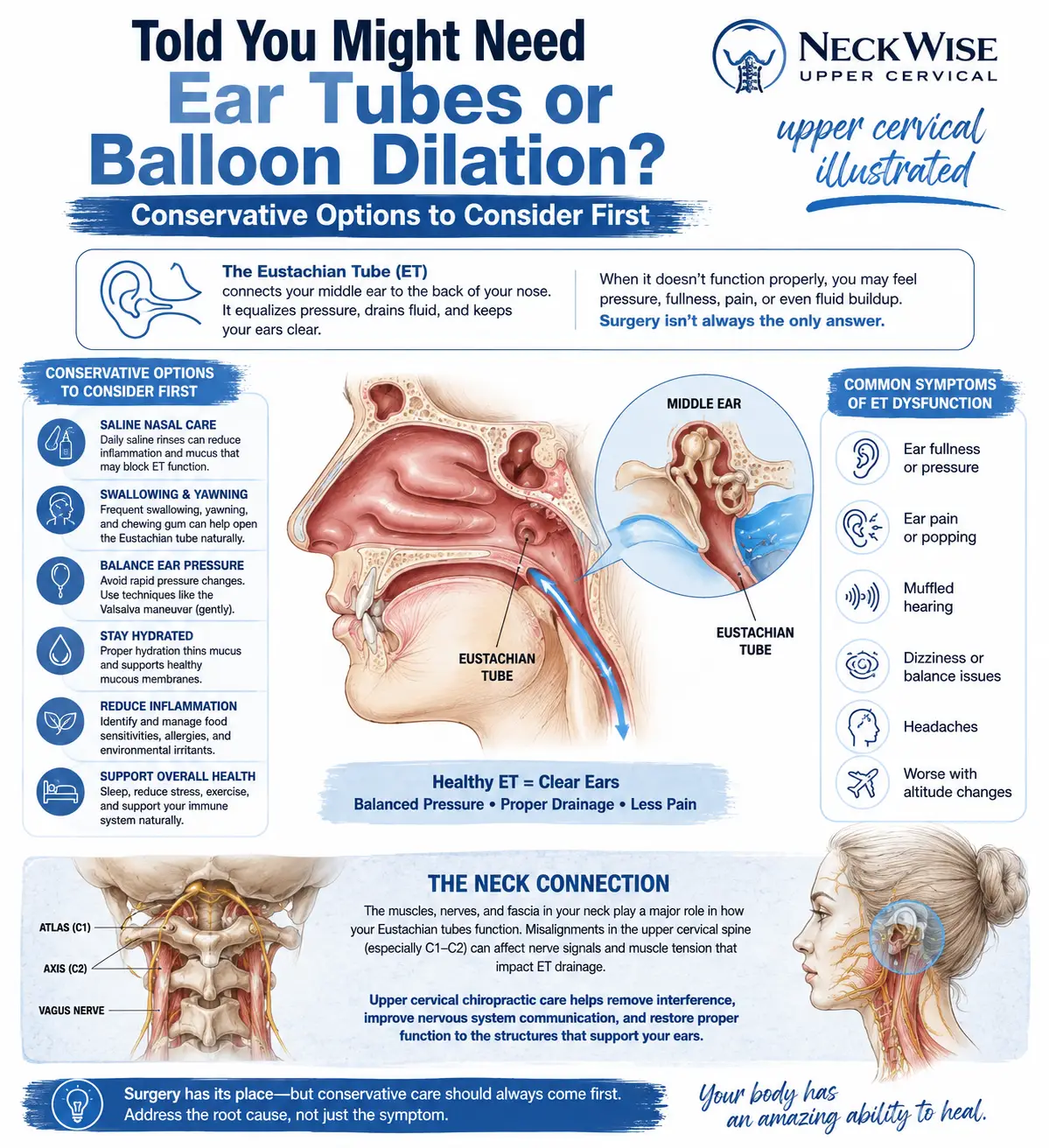
The leading explanation involves endolymphatic hydrops — a buildup of fluid pressure inside the delicate membranes of the inner ear. Your inner ear houses both hearing (the cochlea) and balance (the vestibular system), and both float in carefully regulated fluid. When that fluid volume and its salt balance get disturbed, the system misfires, and you get the spinning, the pressure, and the hearing changes.
That fluid-and-salt theory is exactly why diet became the cornerstone of self-management. If the inner ear is sensitive to fluid and sodium, managing sodium and hydration might smooth out the pressure swings. It’s sensible reasoning. But “sensible reasoning” and “confirmed in a controlled trial” are two different things — and, as you’ll see, much of the diet advice rests on the former. That gap is important, because it’s the reason the diet, on its own, so often falls short: it manages one lever of a condition whose balance disruption has more than one source.
The Core of the Meniere’s Diet: Sodium
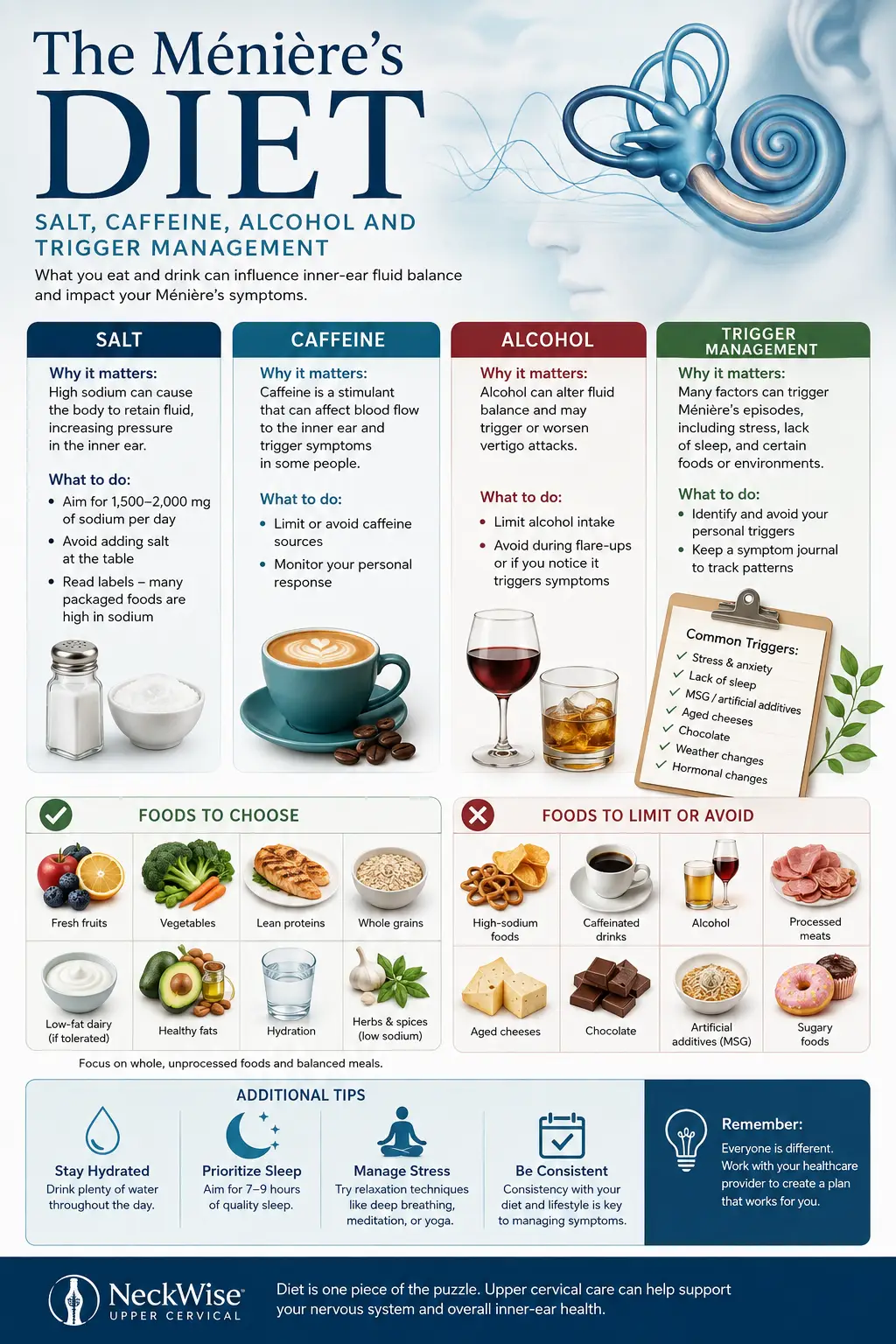
The dietary lever that gets the most attention is sodium. Most ENT clinics recommend aiming for roughly 1,500 to 2,000 milligrams of sodium per day, spread evenly across meals.
That “spread evenly” part matters more than people realize. The goal isn’t only the daily total but avoiding big spikes. A single very salty restaurant meal can deliver more sodium than an entire day’s target, and that sudden load may be harder on a sensitive inner ear than the same amount distributed calmly across three meals. So the practical aim is twofold: bring the total down, and avoid dramatic peaks and valleys.
Here’s what makes this genuinely hard. Most of the sodium in a typical American diet doesn’t come from the salt shaker. It’s hidden in processed and packaged foods — bread, deli meats, canned soups, frozen dinners, sauces, dressings, cheese, chips, and restaurant food. You can put the shaker away entirely and still sail past 3,000 milligrams a day without tasting anything especially salty. That’s why reading labels becomes the single most useful skill you can build.
Practical Sodium Strategies
Start by reading the “sodium” line on nutrition labels and, just as importantly, the serving size. A can of soup may list 600 milligrams per serving and quietly contain two and a half servings. A few habits that help:
- Cook more at home. When you prepare the food, you control the salt. This single shift does more than any other.
- Rinse canned foods. Draining and rinsing canned beans or vegetables washes away a meaningful portion of their added sodium.
- Season with alternatives. Herbs, spices, citrus, garlic, vinegar, and salt-free blends keep food flavorful. Your palate adjusts over a few weeks — food that tastes bland at first will taste normal later.
- Watch the sneaky sources. Bread, cheese, cured and deli meats, condiments, and restaurant meals are the usual heavy hitters. Know where the sodium hides so you can budget.
- Be careful with salt substitutes. Many replace sodium with potassium. For most people that’s fine, but if you have kidney concerns or take certain blood pressure or heart medications, check with your physician first, because too much potassium can be a problem.
A sustainable target beats a perfect one you abandon in a week. If you’re at 4,000 milligrams a day, getting to 2,300 is a real win even if you never hit 1,500.
Caffeine, Alcohol, and MSG
After sodium, the three substances most often flagged are caffeine, alcohol, and MSG. The evidence for each is genuinely mixed, so here is the reasoning — test it against your own body.
Caffeine
Caffeine is a stimulant that narrows blood vessels and heightens the nervous system’s reactivity. The concern in Meniere’s is twofold: it may reduce blood flow to the inner ear, and it can amplify tinnitus and that jittery, on-edge feeling that often accompanies a flare. Many people report louder ear ringing on high-caffeine days.
The advice is moderation rather than a hard ban. Know your true intake — coffee, tea, energy drinks, soda, chocolate, and some medications all add up — and consider whether cutting back smooths your symptoms. If you reduce caffeine, taper over a week or two to avoid withdrawal headaches.
Alcohol
Alcohol is a diuretic, which can disturb the fluid and electrolyte balance the inner ear depends on, and it can directly alter the fluid in the balance canals — part of why intoxication itself causes dizziness and spinning. For someone whose balance system is already fragile, alcohol can be a fairly direct provocateur. Many people with Meniere’s find even modest drinking can precede a flare; others tolerate an occasional glass. This is very individual. If you drink, watching whether alcohol correlates with your bad days is one of the more informative experiments you can run.
MSG
Monosodium glutamate gets flagged largely because of its sodium content and because glutamate is a stimulating neurotransmitter. The evidence connecting MSG specifically to Meniere’s attacks is weak, and the broader science has largely walked back the old fears. I mention it because you’ll see it on diet lists, but I wouldn’t lose sleep over it. If you’re watching sodium closely, you’re already accounting for the part of MSG that matters most.
Hydration and Meal Timing
Here’s a point that surprises people: the goal is not to drink less water. Because Meniere’s involves fluid pressure, some patients assume they should restrict fluids. That’s usually the wrong move. Dehydration can concentrate the body’s fluids and make regulation harder. The better approach is steady, consistent hydration — water evenly through the day rather than in large gulps or long dry spells.
Consistency is the theme running through this entire diet. The inner ear dislikes sudden swings — in sodium, in fluid, in blood sugar. That’s why even meal timing matters. Skipping meals and then eating a large one causes blood sugar and fluid shifts that some people find provoke symptoms. Regular, moderately sized meals at fairly regular times keep your internal environment on an even keel. Smooth and steady beats spiky.
Tracking Your Own Triggers
Because the research can’t tell you precisely what will help you, you become the most important researcher in your own case. The single most valuable tool is a symptom-and-food diary. It sounds tedious, but a few weeks of notes often reveal patterns no textbook could predict.
Keep it simple. Each day, jot down:
- What you ate and drank, with rough attention to salty meals, caffeine, and alcohol.
- Your fluid intake and general routine — did you skip meals, sleep poorly, travel, or push through unusual stress?
- Symptoms — vertigo, hearing changes, tinnitus intensity, ear fullness, and how long they lasted.
- Other life factors — stress, weather or barometric pressure changes, hormonal cycles, physical exertion, and any neck pain, stiffness, or headaches. That last cluster is worth tracking closely, because it points at a driver most people never consider.
After three or four weeks, look for correlations. Maybe your worst mornings follow salty dinners out. Maybe alcohol is a reliable culprit and caffeine is not. Maybe your flares track more with stress, poor sleep, and neck tension than with anything on your plate. All of it is useful.
A word of caution: correlation is slippery, and Meniere’s attacks can occur with no identifiable trigger at all. Don’t over-fit. If you find yourself banning more and more foods in a desperate search for the pattern, and your quality of life is shrinking, step back. If the diet is doing everything it can and you’re still stuck, that’s not a signal to cut more food — it’s a signal that a different, structural input may be driving the problem.
The Piece the Diet Can’t Reach: Your Upper Neck
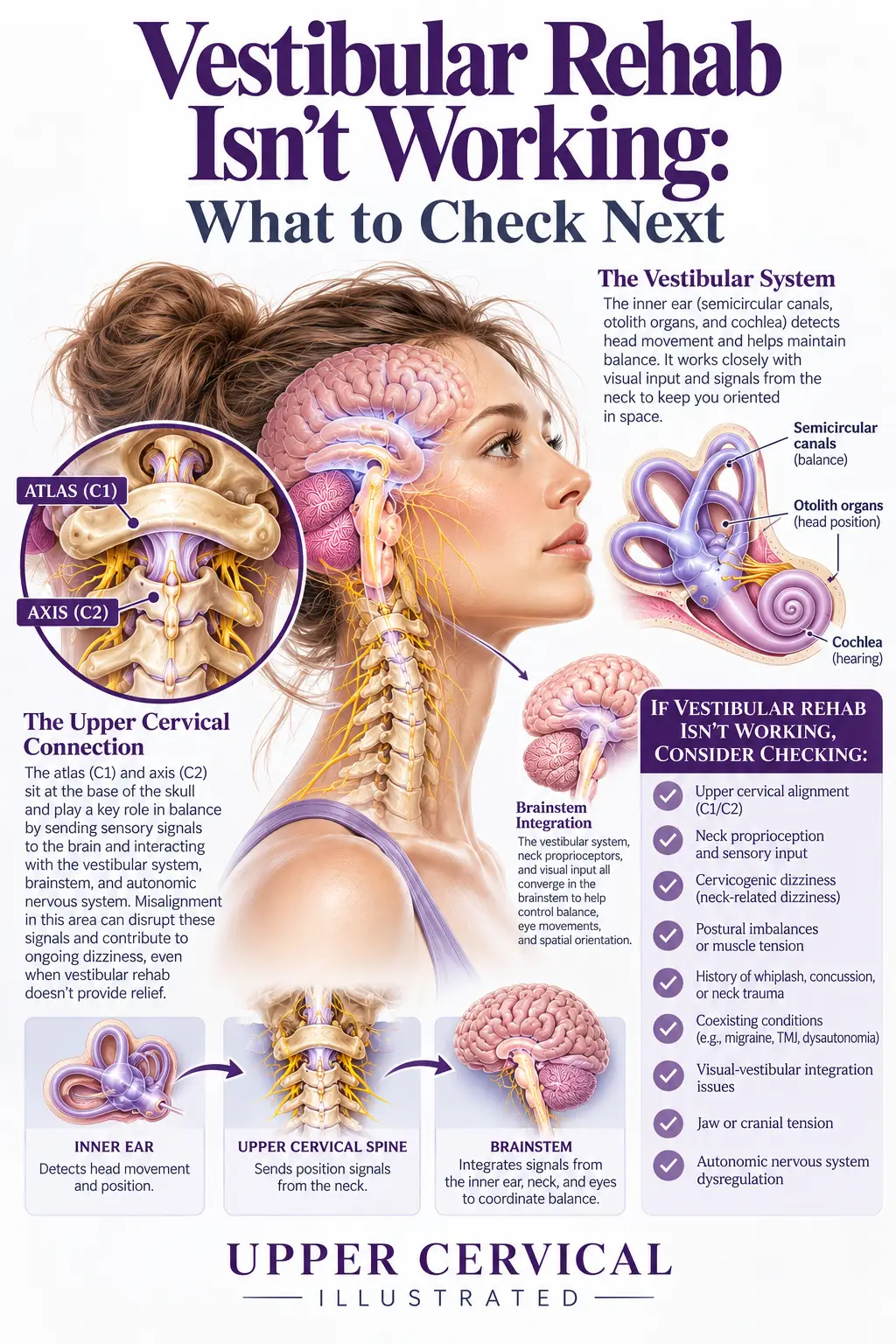
Here’s where nearly every Meniere’s diet article stops short, and it’s the most important part. The entire premise of the diet is that Meniere’s is only a fluid-and-salt problem in the ear. But your sense of balance is not produced by the inner ear alone — and no eating pattern, however disciplined, can touch a balance input that lives in your spine.
Your brain builds your sense of where you are in space by blending three streams of information: the inner ear, the eyes, and position sensors concentrated heavily in the upper neck. The upper cervical region — the atlas and axis, the top two vertebrae just beneath the skull — is one of the richest sources of position and movement information your balance system has. These two vertebrae carry the full weight of your head, held largely by ligaments rather than interlocking bone, which makes them both highly mobile and highly vulnerable to being knocked out of alignment. When they are, they can feed a distorted signal into the exact brainstem centers that process your inner-ear input — and the result feels, to you, like your Meniere’s is flaring.
There’s a recognized phenomenon here called cervicogenic dizziness: unsteadiness, disorientation, or “fog” driven by disturbed signals from the upper neck. It is a separate problem from Meniere’s, but it can coexist with it and amplify the total burden of imbalance a person feels. And it’s remarkably common in exactly the people who end up with balance disorders. Consider what these patients so often share: years of bracing and guarding the head and neck during vertigo attacks, old whiplash from a car accident, a past concussion, a hard fall, or forward-head posture over a screen. Every one of those loads and destabilizes the very region the balance system depends on. If your Meniere’s began or worsened after a head or neck injury, that is a loud clue that a structural driver is sitting one inch below your skull — in the one place your workup almost certainly never examined.
This is why the diet alone so often disappoints. It’s a reasonable lever for one part of the picture, but if a misaligned upper neck is feeding faulty balance signals on top of the inner-ear issue, you’re fighting on two fronts while only addressing one. The food was never going to reach the neck.
To be clear and compliant: there is no claim here that adjusting the neck cures or treats Meniere’s disease. Meniere’s is an inner-ear condition, and it belongs with your ENT and medical team — diet, medications, vestibular rehabilitation, and, when appropriate, procedures. What upper cervical care addresses is a separate, often overlooked driver of dizziness: the neck’s contribution to your balance system. When that’s part of your picture, it is very much worth evaluating.
How We Assess It in Sarasota, Lakewood Ranch & Bradenton
At Lavender Family Chiropractic, our approach is measurement-first and deliberately gentle. We use 3D cone-beam CT (CBCT) imaging to see the upper cervical anatomy in detail, and paraspinal infrared thermography to read patterns in how the nervous system is regulating along the spine. Those tools let us decide whether upper cervical care is even appropriate for you, rather than assuming it is.
When care is indicated, we use the low-force Knee Chest Upper Cervical technique. It is precise, gentle, and low-force — with no twisting, cracking, or popping. For someone whose balance is already sensitive, that gentleness isn’t a marketing line; it’s the whole design. We’re reducing interference in a delicate system, not jolting it.
Keep seeing your ENT. Keep taking prescribed medications. Keep working your diet. What we add is attention to the one balance input almost nobody measures — offered as one part of a coordinated team, in Sarasota, Lakewood Ranch, and Bradenton, never as a replacement for your medical care.
Red Flags: When to Seek Medical Care
Self-management with diet and tracking is appropriate for stable, diagnosed Meniere’s. But certain symptoms are not “just a flare,” and they warrant prompt medical attention. Do not try to manage these with diet.
Seek medical care — and in urgent cases, emergency care — if you experience:
- A sudden change in hearing, especially sudden hearing loss in one ear, which can be a medical urgency.
- Neurological symptoms such as weakness or numbness on one side, facial drooping, trouble speaking, severe or “worst-ever” headache, double vision, or difficulty swallowing. These can signal a stroke or other serious problem and are a reason to call emergency services immediately.
- Vertigo far more severe or prolonged than your usual pattern, or with repeated vomiting and dehydration.
- A first-ever episode of severe vertigo, which needs a proper diagnosis rather than a self-directed diet, because several conditions can mimic Meniere’s.
- Fever, ear pain, or drainage from the ear, which point toward infection.
- Loss of consciousness, chest pain, or fainting with your dizziness.
If you haven’t yet been formally diagnosed, that is the first and most important step. Diet and neck assessment are downstream conversations. An accurate diagnosis from a physician comes first, always.
Top Questions
Do I have to cut salt out completely? No, and you shouldn’t try. The goal is moderation, generally 1,500 to 2,000 milligrams of sodium per day, spread evenly. Your body needs some sodium; eliminating it is neither necessary nor safe, and even distribution matters as much as the total.
How long until I know if the diet is helping? Give any change a fair trial — usually several weeks to a couple of months — and track symptoms in a diary. Because Meniere’s naturally waxes and wanes, short windows mislead. If you’ve given it a genuine trial and you’re still stuck, that’s often the moment to have the upper neck evaluated as a separate contributor.
Can I still drink coffee and have a glass of wine? Possibly. The advice is moderation, not necessarily total elimination. Many people tolerate small amounts. Track how you feel on days with and without them and let your own body cast the deciding vote.
Is the diet a cure? No. It’s reasonable, low-risk self-management that many patients find helpful, but the strong trial evidence is lacking, and no diet has been shown to resolve Meniere’s. Frame it as a tool for managing symptoms, and pair it with your medical care — and, when relevant, with evaluation of the structural driver in your upper neck.
Why is the evidence so weak if everyone recommends this? Because the recommendation grew from physiological reasoning and clinical tradition rather than large randomized trials, which for this question have not really been done. That doesn’t make the advice wrong; it makes it unconfirmed. Since it’s safe and inexpensive, trying it is reasonable — just don’t expect a diet to reach a problem that isn’t in the kitchen.
Can upper cervical chiropractic care treat my Meniere’s? No, and we won’t claim it can. Meniere’s is an inner-ear condition managed by your medical and ENT team. What we address is whether your upper neck — a separate, often overlooked input to your balance system — is a driver, using a precise, gentle, low-force approach. It complements medical care and never replaces it.
Should I drink less water to reduce inner-ear fluid? Generally no. Consistent, steady hydration is usually recommended over restriction. Dehydration can make fluid regulation harder. Drink evenly through the day unless your physician has told you otherwise.
What’s the single most useful thing I can start today? Two things: start reading sodium labels so you know your actual intake, and start a simple symptom-and-food diary that also tracks neck pain, stiffness, and headaches. Together they turn vague advice into personal information — and they often surface the neck as a contributor no one had considered.
What the Research Says
This is the section where honesty matters most, so here’s what the science actually supports.
The most important thing to understand is that the dietary advice for Meniere’s — the salt, caffeine, and alcohol restrictions nearly every clinic recommends — has surprisingly little high-quality trial evidence behind it. When the Cochrane group reviewed lifestyle and dietary interventions for Meniere’s disease in 2023, they found the evidence base was very limited and of low certainty. The large, well-controlled randomized trials that would let anyone speak confidently simply have not been done.
That echoes an earlier, even more pointed Cochrane review. When researchers specifically examined the restriction of salt, caffeine, and alcohol intake for Meniere’s disease in 2018, they could not find a single randomized controlled trial that met their criteria. Not one. The most commonly given advice for this condition rests on physiological reasoning and clinical tradition, not on trial proof. Sit with that — it’s a big part of why the diet alone so often isn’t enough, and why the search for other drivers is worthwhile.
A 2020 review in Translational Medicine at UniSa on dietary restriction for the treatment of Meniere’s disease reached a similar conclusion: plausible mechanisms without strong outcome evidence. The theory is coherent; the trials to confirm it are missing.
More recently, investigators have used newer methods. A 2024 study in Frontiers in Nutrition applied Mendelian randomization to the relationship between salt, alcohol, and coffee intake and Meniere’s disease, using genetic variation to explore whether an exposure is likely to actually cause an outcome rather than merely correlate with it — part of how the field is trying to move beyond tradition, though it remains an area of active investigation.
And there’s a very human wrinkle: even when dietary changes are recommended, following them is genuinely hard. A 2013 study in Otology & Neurotology looked at dietary modification as an adjunct treatment in Meniere’s disease and specifically at patients’ willingness and ability to comply. A diet only helps if a real person can sustain it in a real life.
So what do we do with all this? We don’t throw the diet out — low-sodium, moderate-caffeine, moderate-alcohol eating is safe, inexpensive, broadly good for your heart, and reported as helpful by many. But we hold it honestly: as reasonable self-management, not a fix, and certainly not something to feel guilty about when a flare breaks through anyway. Meniere’s is not your willpower failing. And when the diet has been given a fair run and symptoms persist, the honest next question is whether a structural driver — the upper cervical spine — has ever actually been measured.
Putting It All Together
Living with Meniere’s means living with uncertainty, and that’s exhausting. The dietary approach — lower, evenly spread sodium, moderate caffeine and alcohol, steady hydration, regular meals — gives you a set of gentle, safe levers. Be honest about what those levers can and can’t do. The trial evidence is genuinely weak, so treat the diet as a low-risk experiment in self-management, track your own patterns, and know the red flags.
But don’t stop at the plate. The inner ear is not the only input your brain relies on for balance, and diet cannot reach the one input that lives in your spine. The upper neck — the atlas and axis, densely wired into your balance system and easily destabilized by whiplash, concussion, or years of posture — is a genuine, overlooked driver of dizziness. For a large number of people across Sarasota, Lakewood Ranch, and Bradenton, evaluating it is the missing piece. It works alongside your medical care. It is the part of the picture that finally got measured.
Serving Sarasota, Lakewood Ranch & Bradenton
Lavender Family Chiropractic (NeckWise North Sarasota) is proud to serve patients throughout Sarasota, Lakewood Ranch, Bradenton, Palmetto, Ellenton, University Park, Longboat Key, Osprey, and the surrounding Manatee and Sarasota County communities. Our office focuses on precise, gentle, low-force upper cervical care, supported by 3D CBCT imaging and paraspinal infrared thermography, always working alongside your existing medical and ENT team.
If you’re managing Meniere’s disease and you’ve done the dietary work but still feel stuck, find out whether your upper neck is the balance-system driver no one has evaluated. Patients across Sarasota, Lakewood Ranch, and Bradenton are welcome to a consultation with our doctors, where we’ll answer your questions honestly and help you decide whether our approach fits your broader care.
Call us to schedule your consultation. Your ENT and medical care come first — we’re here to evaluate the one balance input the diet can never reach.
Lavender Family Chiropractic (NeckWise North Sarasota) 5899 Whitfield Avenue, Suite 107 Sarasota, FL 34243 (941) 243-3729
This article is for general education and is not a substitute for individualized medical advice. Meniere’s disease should be diagnosed and managed by a qualified physician. Upper cervical chiropractic care does not diagnose, treat, or cure Meniere’s disease; it complements, and never replaces, your medical and ENT care. If you experience sudden hearing loss, neurological symptoms, or other red-flag signs described above, seek medical care promptly.
Related Articles

Get our upper cervical articles first.