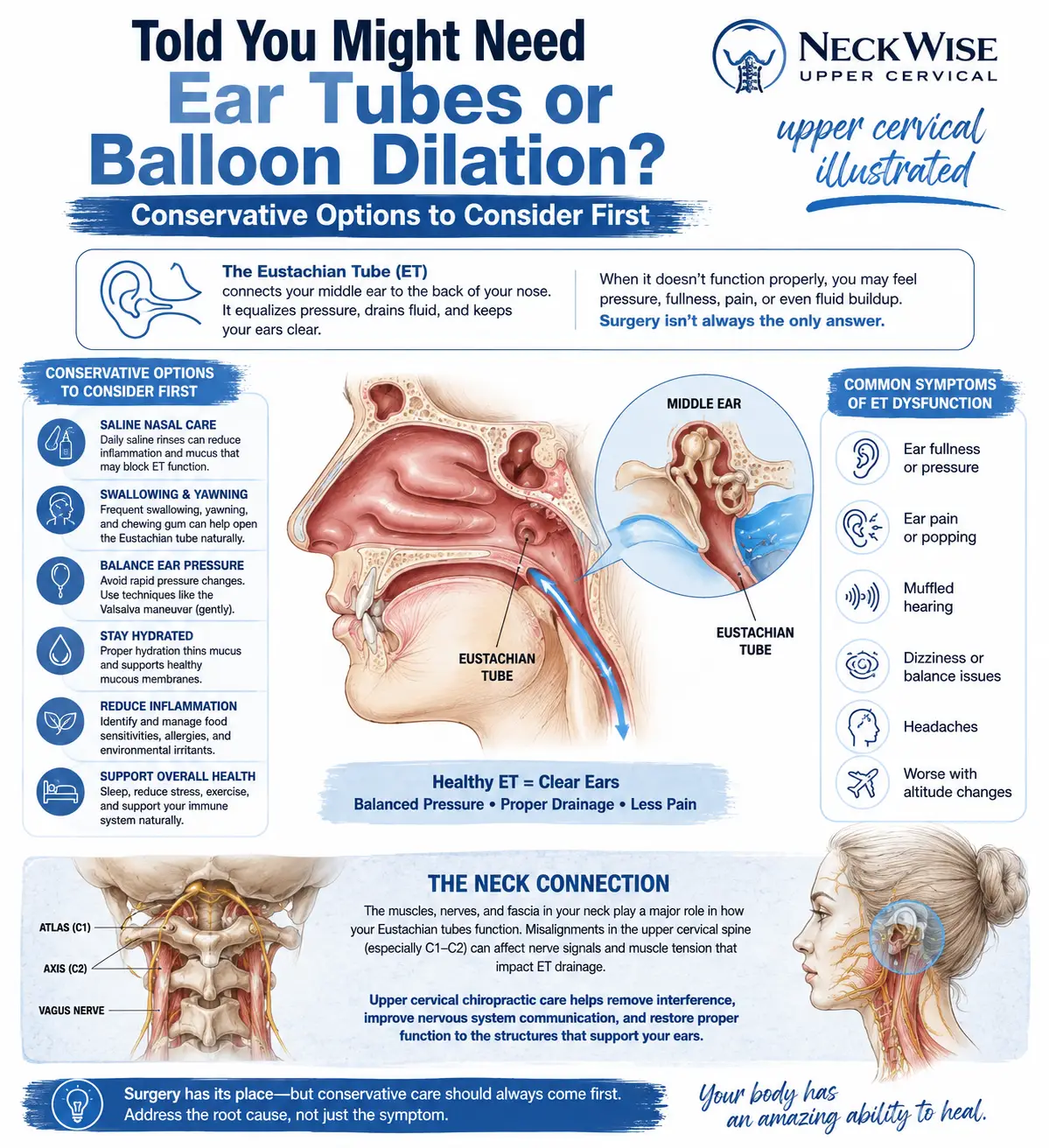
Told You Might Need Ear Tubes or Balloon Dilation? Conservative Options to Consider First
By Dr. Rusty Lavender, D.C. — upper cervical chiropractor, Lavender Family Chiropractic, Sarasota, FL. Reviewed and updated October 2026.
If an ENT has raised ear tubes or Eustachian tube balloon dilation for your stubborn, plugged-up ear, the most useful thing to know is this: for most people, a procedure is a step you arrive at, not a step you start with. There is usually a sequence of conservative options worth working through first — watchful waiting, autoinsufflation, physician-managed medication, addressing the allergies or reflux or congestion driving it — and only after those have had a fair trial does a procedure become the clearly right call. This is not an anti-surgery article; procedures help real people, and for the right patient they can be the answer. It’s about sequencing, so that whatever you decide, you decide it having actually considered the alternatives.
Patients come to me after an ENT visit wanting one thing: a straight answer about whether there’s anything reasonable to try before an irreversible procedure. They’ve been told they’re a candidate for tubes or balloon dilation, they’re not in a crisis, and something in them wants to ask, “Is this really the next step, or is there a step before it?” That instinct is a good one, and this page is the honest answer to it.
This article is educational and is not a substitute for medical advice, diagnosis, or treatment. It is not a reason to stop, delay, or decline care your physician or ENT has recommended. Decisions about ear tubes and balloon dilation should be made together with your doctor. If you have any of the red-flag symptoms listed near the end, see a physician or ENT promptly.
First, a Word of Reassurance — and Honesty About Procedures
If the idea of a procedure on your ear makes you anxious, that’s normal, and I want to defuse the fear rather than feed it. Ear tubes and balloon dilation are not dramatic, dangerous interventions. Tympanostomy tubes are one of the most common procedures performed on children in the world, precisely because they’re well-established and generally low-risk; balloon dilation is a newer, minimally invasive option for adults, and the evidence in the right patient is genuinely encouraging. Nothing here is meant to talk you out of a procedure you may end up needing. But “low-risk and effective” and “the right first move” are two different claims — a procedure can be a good option and still not be the one you reach for before you’ve tried the conservative ones, especially when a meaningful share of Eustachian tube dysfunction (ETD) settles on its own as inflammation calms down. The goal is an informed choice, so that if you do proceed, you proceed with confidence instead of second-guessing.
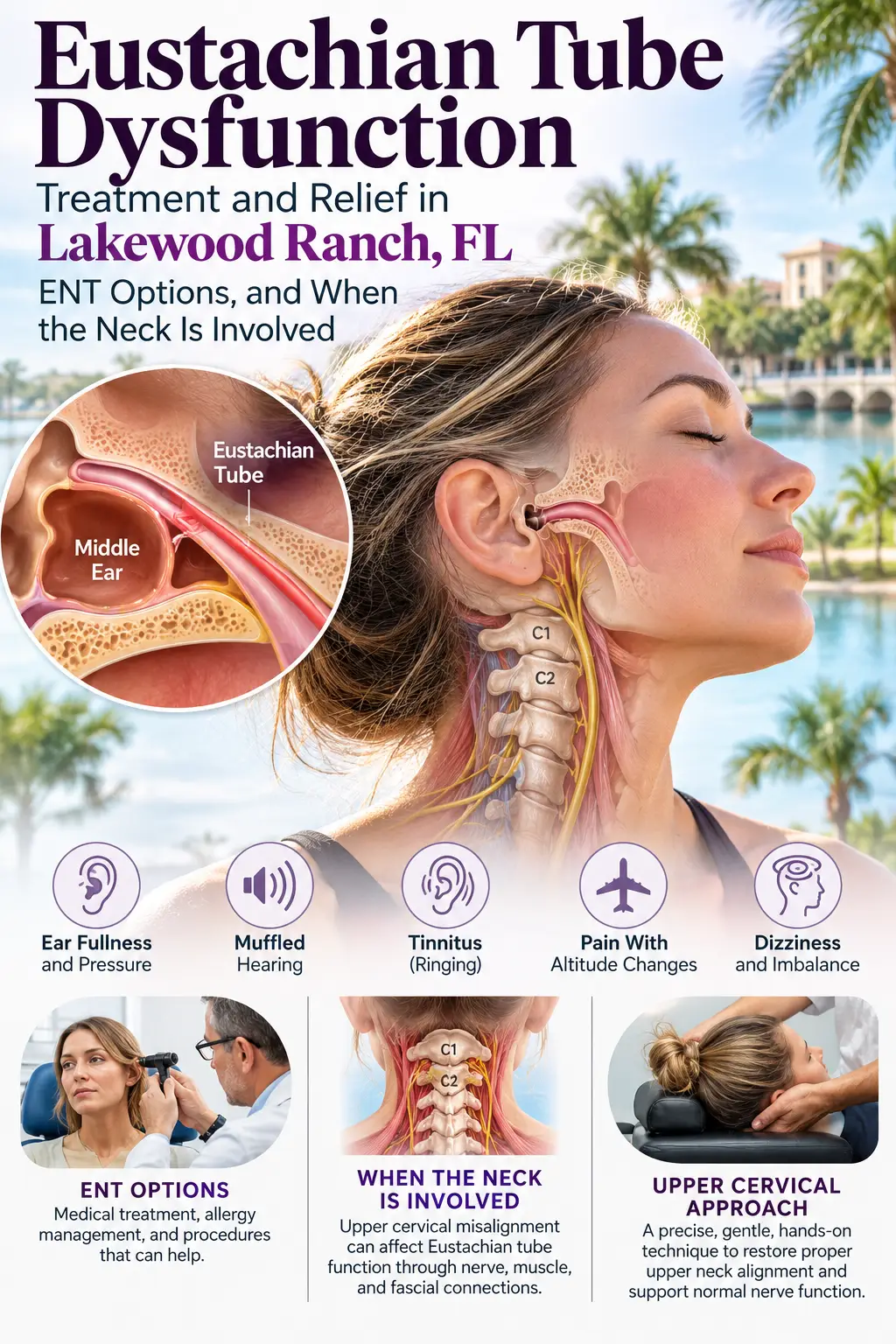
One more note up front. The single most important factor in this whole decision is which type of ETD you actually have. The international consensus statement on ETD, published by Schilder and colleagues in Clinical Otolaryngology, describes ETD not as one disease but as a set of distinct subtypes — most importantly the obstructive type, where the tube fails to open, and the patulous type, where the tube stays too open. That distinction runs through everything below, because several of the conservative “open the tube” techniques help the obstructive type and can make the patulous type worse. If you take one thing from this article, take that: the right move depends entirely on the type. Our Eustachian tube dysfunction overview walks through all three types in depth if you’re not sure which is yours.
Conservative Options Worth Considering First
Here is the sequence I talk through with patients — including where each option fits and where it doesn’t. None of it replaces your ENT’s judgment; it’s the map so you can have a better conversation with them.
1. Watchful Waiting — Because a Lot of ETD Resolves on Its Own
This is the option people underestimate the most, and it’s often the right first step. A great deal of ETD — especially the kind that flares after a cold, a sinus infection, or a bad allergy stretch — simply resolves as the underlying inflammation settles. The tube was swollen and sluggish; give it time and the swelling recedes.
For mild, recent, non-alarming symptoms, watchful waiting — days to a few weeks — is entirely reasonable and often exactly what a thoughtful physician would recommend; “doing nothing, on purpose, with a plan to reassess” is a legitimate, evidence-consistent choice for uncomplicated cases. The catch is the qualifier: mild, recent, non-alarming.Watchful waiting is not the plan for a one-sided blockage that’s dragged on for months, a child with recurrent infections, or anyone with the red-flag symptoms below — those need medical evaluation, not patience. But for the common post-cold plugged ear, time is one of the most effective things going, and it costs nothing.
2. Autoinsufflation and Gentle Valsalva — For the Obstructive Type Only
If your ETD is the obstructive type — the tube isn’t opening enough — gently coaxing it open can help, and there are simple, low-risk ways to do it.
The Valsalva maneuver is the one most people know: pinch your nose closed, keep your mouth shut, and gently try to blow air, as if popping your ears on a plane. Done softly, it can push a little air up the tube and equalize a stuck ear — but gently is the key word, because forceful, straining blowing can cause harm.
Autoinsufflation takes the same idea and makes it more controlled. The Otovent is a small balloon you inflate through one nostril by breathing out; the gentle back-pressure helps open the tube in a measured, repeatable way. It’s inexpensive, low-risk, available without a prescription, and used successfully in children as well as adults — cheap and reversible, exactly what you want in a first-line option for an obstructive, non-alarming plugged ear.
Here’s the critical caveat: these “open the tube” techniques are for the obstructive type, not the patulous type. In patulous ETD the tube is already stuck too far open — the hallmark is autophony, hearing your own voice and breathing boomingly loud inside your head — and forcing it open further is the wrong direction. If that’s your pattern, skip the balloons and Valsalva and talk to your ENT about patulous management.
3. Physician-Managed Medication — Treating the Inflammation Driving It
Because so much obstructive ETD is driven by swelling and congestion, the most productive conservative step is often to calm that inflammation at the source. That’s a medical decision that belongs with your physician or ENT, but it’s worth knowing the levers they may reach for:
- Intranasal corticosteroid sprays to reduce the swelling around the tube’s opening in the nasopharynx.
- Short-term decongestants to shrink congested tissue — short-term being the operative phrase, because decongestant sprays can cause rebound congestion if overused.
- Antihistamines and allergy management for patients whose ETD rides on allergic rhinitis.
- Reflux management, because stomach acid drifting up to irritate the nasopharynx is an underappreciated driver of stubborn ear fullness.
I list these to inform the conversation, not substitute for it — dosing, duration, and appropriateness are your doctor’s call, and a nasal steroid grabbed off a shelf and used indefinitely is not a plan. For inflammation-driven obstructive ETD, a properly managed medical trial is a legitimate rung before a procedure, and often it’s the rung that resolves things.
4. Address the Actual Drivers, Not Just the Ear
This is the piece that’s easy to skip and shouldn’t be. The plugged ear is frequently a downstream symptom of something upstream — untreated allergies, chronic sinus congestion, silent reflux, smoke or vape exposure. If the driver keeps loading the system, the tube keeps struggling, and even a procedure works against a headwind. Getting allergies controlled, treating reflux, and removing airway irritants addresses why the tube is failing — and for a lot of people, that upstream work is what finally lets the conservative measures stick.
When a Procedure Is Genuinely Warranted
Sequencing conservative-first does not mean conservative-forever. There are clear situations where a procedure is the right step, and delaying one out of a general reluctance toward surgery can do harm.
Persistent middle-ear fluid and recurrent infections — especially in children. When ETD leads to fluid that sits behind the eardrum and won’t clear, or to repeated ear infections, that’s where tympanostomy (ear) tubes earn their reputation — a tiny vent placed through the eardrum that bypasses the failing Eustachian tube, letting the middle ear equalize and drain directly. In children, persistent effusion can affect hearing during important years for speech and learning, which is why this is one of the most common and well-established procedures in pediatrics. A physician’s recommendation for tubes in those cases usually rests on solid ground. Our page on ear tubes in children goes deeper on that decision.
Refractory obstructive ETD in adults — where balloon dilation comes in. For adults with genuinely obstructive ETD that hasn’t responded to a fair trial of medical management, Eustachian tube balloon dilation has changed the landscape. A small balloon is threaded into the cartilaginous portion of the tube and inflated to widen it. A systematic review and meta-analysis by Froehlich and colleagues in Otolaryngology–Head and Neck Surgery pooled the available studies and found balloon dilation was associated with improvement in patients with refractory obstructive ETD across several outcome measures. If you have treatment-resistant obstructive disease, it’s a conversation genuinely worth having with your ENT.
Two honest footnotes. First, the word refractory matters — the evidence is strongest for people who have already tried conservative and medical management and still haven’t improved, which is precisely why working through the earlier rungs isn’t wasted time; it’s how you and your ENT confirm you’re the right candidate. Second, it’s specifically for the obstructive type — widening a tube that’s already too open (patulous ETD) would be the wrong direction. Our page on dilatory/obstructive ETD covers this subtype and where dilation fits.
The honest summary: for most people ETD is managed conservatively and improves; for the minority with refractory disease or persistent fluid and infections, procedures offer real, well-supported help. A good decision honors both.
One More Conservative Thing Worth Evaluating: The Upper Neck
Here’s an angle a standard ear workup almost never considers, and I’ll frame it carefully. This is one more conservative option worth evaluating before an irreversible procedure — not a cure, not a proven treatment, and not a reason to cancel anything your ENT has recommended.
The reasoning runs through the anatomy. The muscle that actively pulls your Eustachian tube open is the tensor veli palatini. According to the StatPearls anatomy reference on the tensor veli palatini, this small soft-palate muscle contracts when you swallow and yawn, opening the wall of the tube so air can pass. And here’s the detail that makes the neck relevant: the tensor veli palatini is innervated by the trigeminal nerve — the mandibular division. The one muscle whose entire job is opening your Eustachian tube answers to the trigeminal system.
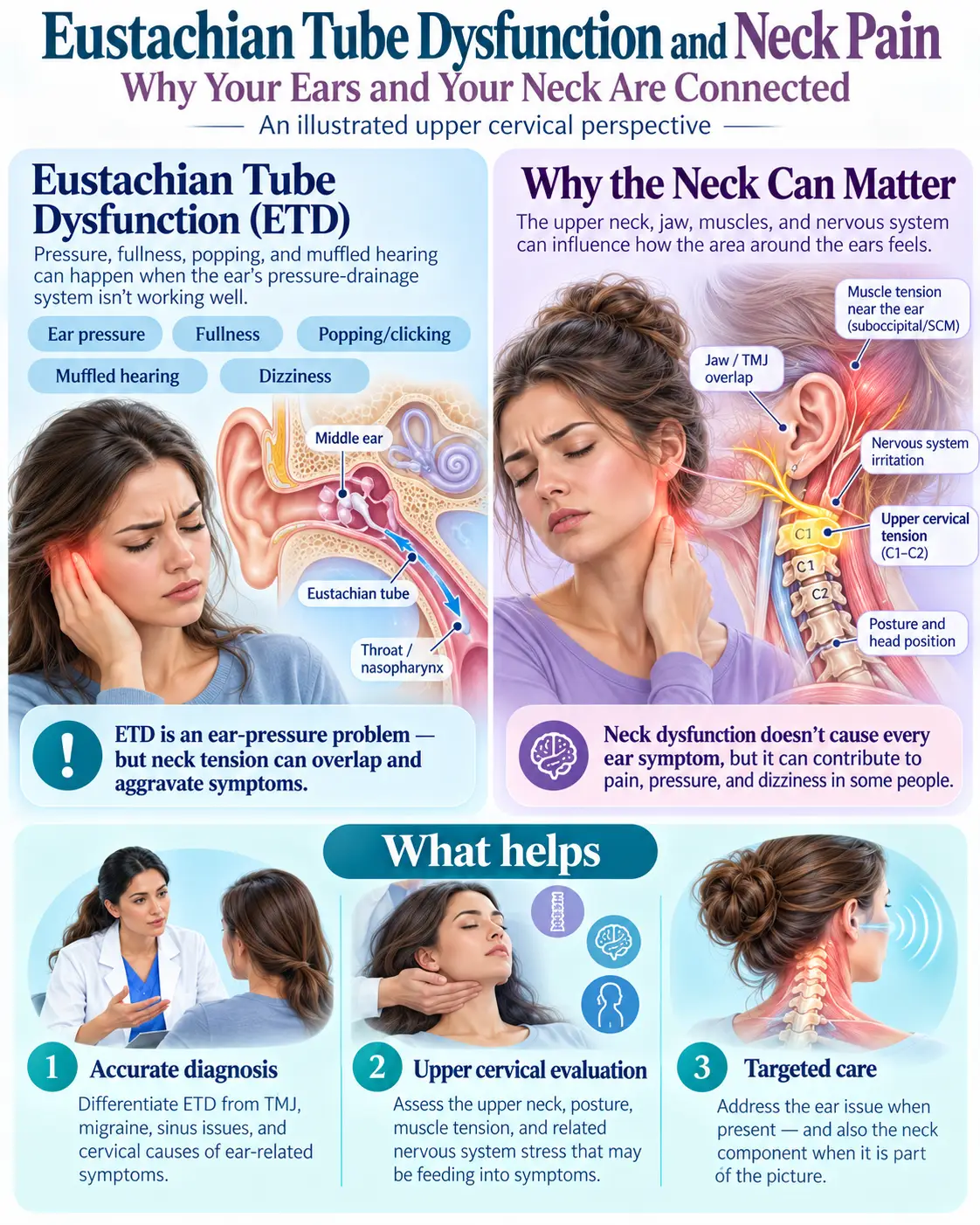
That matters because the trigeminal system and the upper cervical nerves are neurologically intertwined. In the brainstem, sensory fibers from the trigeminal nerve descend and converge with the upper cervical nerve roots (C1, C2, C3) in what’s called the trigeminocervical complex. This convergence is well established in the pain literature — it’s why upper-neck problems can refer sensation into the head and face. Put the two facts together and a reasonable, testable idea emerges: dysfunction in the upper neck could plausibly contribute to the neuromuscular side of ETD symptoms.
Let me be precise about what I am and am not claiming. I am not saying the neck causes ETD, and not saying an upper cervical adjustment opens the Eustachian tube or replaces a procedure. There are no large, high-quality trials showing upper cervical care treats or resolves ETD, and anyone who tells you otherwise is getting ahead of the science. What I amsaying is narrower: the neurology gives a real, non-hand-wavy reason the upper cervical region is worth evaluating as one more conservative factor — particularly if your ear symptoms began or worsened after head or neck trauma like a whiplash, a fall, or a concussion. You’re already, sensibly, working through the reversible options before the irreversible one; an upper cervical evaluation simply belongs on that list. Our overview of upper cervical chiropractic care explains the approach in full.
How We Evaluate the Upper Cervical Piece Here
At Lavender Family Chiropractic (NeckWise North Sarasota), we focus specifically on the upper cervical spine — the atlas, the axis, and the skull-base junction near the anatomy involved in Eustachian tube function — and our approach is built on measurement, not guesswork. We use 3D CBCT (cone-beam CT) imaging to see your upper cervical alignment in three dimensions rather than assuming a generic model, and paraspinal infrared thermography to read how your nervous system is behaving along the spine — directly relevant when the question involves nerve function at the top of the neck. When a correction is indicated, we use the Knee Chest Upper Cervical technique: precise, gentle, and low-force — no twisting, cracking, or popping. For someone already dealing with sensitive ears and pressure symptoms, that gentleness isn’t a marketing line; it’s the point.
The goal is never to replace your ENT or physician. Keep your medical care, keep managing your allergies and reflux, and keep the procedure on the table if that’s where the evidence points. What we add is a careful look at one region a standard ear workup almost never checks — and if it turns up a correctable upper cervical issue, addressing it may help create a better structural and neurological environment. If it doesn’t, we’ll tell you that honestly.
→ Call (941) 243-3729 to schedule a complimentary consultation. We serve Sarasota, Bradenton, and Lakewood Ranch from our office at 5899 Whitfield Avenue, Suite 107, Sarasota, FL 34243.
What the Research Says
Every claim of fact on this page is anchored to a real, linked source. Here are the three we relied on, and — just as importantly — what each one does and doesn’t establish:
- Schilder AGM, et al. Eustachian tube dysfunction: consensus statement on definition, types, clinical presentation and diagnosis. Clinical Otolaryngology (2015). The international consensus that defines ETD and distinguishes its types — most importantly obstructive versus patulous. This is why “which type” is the question that drives every decision on this page.
- Froehlich MH, et al. Eustachian Tube Balloon Dilation: A Systematic Review and Meta-analysis. Otolaryngology–Head and Neck Surgery (2020). Pooled evidence finding that balloon dilation was associated with improvement in patients with refractory obstructive ETD. This is the basis for saying the procedure is a real, well-supported option in the right adult candidate.
- StatPearls: Anatomy, Head and Neck, Tensor Veli Palatini Muscle. Documents that the tensor veli palatini actively opens the Eustachian tube and is innervated by the trigeminal nerve. This is the anatomical hinge of the upper cervical rationale.
Note the boundary carefully. These sources define ETD, show that balloon dilation helps refractory obstructive disease, and document that the tube is opened by a trigeminally innervated muscle. They do not show that upper cervical care treats ETD, and I don’t cite them as if they do. Every source here is linked so you can read it yourself and check my work.
Top Questions
I’ve been told I might need ear tubes or balloon dilation. Do I have to decide now? Unless you have a red-flag symptom (see below) or your physician has flagged real urgency, you generally have room to work through conservative options first and reassess. A procedure is usually a step you arrive at after reversible options have had a fair trial. Make the decision with your ENT, not against them.
What conservative options should I consider first? For non-alarming cases: watchful waiting (much ETD resolves as inflammation settles), gentle autoinsufflation with an Otovent balloon or careful Valsalva for the obstructive type, physician-managed nasal steroids/decongestants/allergy and reflux care, and addressing upstream drivers like allergies and congestion. An upper cervical evaluation is one more reversible thing worth adding to that list.
When are ear tubes actually the right call? When ETD leads to persistent middle-ear fluid or recurrent infections — especially in children, where lingering fluid can affect hearing during key developmental years. Tympanostomy tubes are well-established and generally low-risk for those situations, and a physician’s recommendation for recurrent infections is usually well-founded.
Does balloon dilation work? For adults with refractory obstructive ETD that hasn’t responded to medical management, a 2020 systematic review and meta-analysis found balloon dilation was associated with improvement across several measures. It’s a real option worth discussing with an ENT — specifically for the obstructive type, not patulous ETD (where the tube is already too open, and widening it would be the wrong direction). That’s why getting the type right matters so much: several conservative “open the tube” techniques, and dilation itself, help the obstructive type and can worsen the patulous type.
How does the neck relate to my ear, and will an adjustment fix or replace the procedure? The tensor veli palatini, the muscle that opens your Eustachian tube, is controlled by the trigeminal nerve, which converges with the upper cervical nerves (C1–C3) in the brainstem. That overlap is a documented reason the upper neck is worth evaluating — especially after head or neck trauma. But it’s plausibility, not proof: there are no large trials showing upper cervical care treats ETD, and I won’t claim an adjustment fixes it or replaces a procedure. It’s an evaluation, using precise, gentle, low-force care — no twisting, cracking, or popping — alongside, never instead of, your medical care, which you should never stop or delay to try it.
Red Flags: See a Physician or ENT Promptly
Some ear symptoms are not for watchful waiting or a chiropractor — they need medical attention right away. Please see a physician or ENT promptly — do not wait — if you have sudden hearing loss (especially in one ear), severe or rapid-onset ear pain, drainage or discharge from the ear, fever with ear symptoms, or persistent one-sided ear fullness that won’t resolve. One-sided, unrelenting ear blockage in particular always deserves an ENT exam to rule out other causes. Conservative and upper cervical options are never the first stop for these.
Serving Sarasota, Bradenton & Lakewood Ranch
If you want to be sure you’ve considered the conservative options before a procedure, the upper cervical evaluation described here is close by. Lavender Family Chiropractic (NeckWise North Sarasota) sits at 5899 Whitfield Avenue — the corner of University and Whitfield — minutes from the Lakewood Ranch corridor and just across from Bradenton, and easily reached from Sarasota, Venice, and Osprey. We’ll be honest with you about what we find and what it means for your decision.
Make an Informed Choice
If you’re weighing a procedure for a stubborn ear, you’re already doing the right thing by pausing to ask what comes first. For most people the honest answer is a sequence of reversible options — including an upper cervical evaluation — worth a fair trial before an irreversible step. And if a procedure is where the evidence ultimately points, proceed with your ENT and proceed with confidence.
We won’t promise you a cure. We’ll give you an honest evaluation, gentle care if it’s warranted, and the truth either way — alongside the medical care you should keep.
→ Call (941) 243-3729 or book a complimentary consultation. Serving Sarasota, Bradenton, and Lakewood Ranch.
Lavender Family Chiropractic (NeckWise North Sarasota) · 5899 Whitfield Avenue, Suite 107, Sarasota, FL 34243 · (941) 243-3729
This article is for general educational purposes only and is not medical advice, diagnosis, or treatment. It does not establish a doctor-patient relationship and makes no promise of any particular outcome. It is not a reason to stop, delay, or decline care your physician or ENT has recommended. Please consult a physician or ENT about ear symptoms — especially the red-flag symptoms described above — and make decisions about ear tubes or balloon dilation together with your doctor.
Related Reading


Get our upper cervical articles first.
Patients Experience