
Chiropractor for Eustachian Tube Dysfunction: What an Upper Cervical Evaluation Looks For
By Dr. Rusty Lavender, D.C. — upper cervical chiropractor, Lavender Family Chiropractic, Sarasota, FL. Reviewed and updated October 2026.
“Can a chiropractor help with Eustachian tube dysfunction?” is one of the most-searched questions that lands on our site, and the people asking it have usually been through the standard route already: the primary doctor, the nasal spray, the ENT, the hearing test, the pressure test, maybe a conversation about balloon dilation or tubes. The ear is intact. The ear is still full. And somewhere in that process someone — a friend, a forum, a search result — mentioned the neck.
This article answers the question directly. It explains what kind of chiropractic care is relevant to ETD and what kind isn’t; the specific anatomy that connects the top of the neck to the muscle that opens your Eustachian tube; what an upper cervical evaluation actually measures, step by step; who is and isn’t a candidate; how it fits with what your ENT is doing; and what to expect from the first visit. It’s written so that you can walk in — to our office or any upper cervical office — knowing what to ask for.
This is educational content, not medical advice. Ear fullness with sudden hearing loss, severe pain, discharge, fever, or facial weakness needs prompt medical care, not a chiropractic evaluation.
First, Which Kind of Chiropractor
“Chiropractor” covers a wide range of approaches, and for ETD the distinction matters.
General chiropractic is full-spine care, usually with rotational adjustments of the neck — the twist-and-crack most people picture. Many general chiropractors list ear problems among the conditions they see, and some patients do report their ears popping during or after a neck adjustment. The limitation is that nothing is measured, the adjustment is delivered by feel, and the technique rotates the upper neck — which, for a region that’s a few millimeters from the brainstem and already irritated, is not the approach we’d choose.
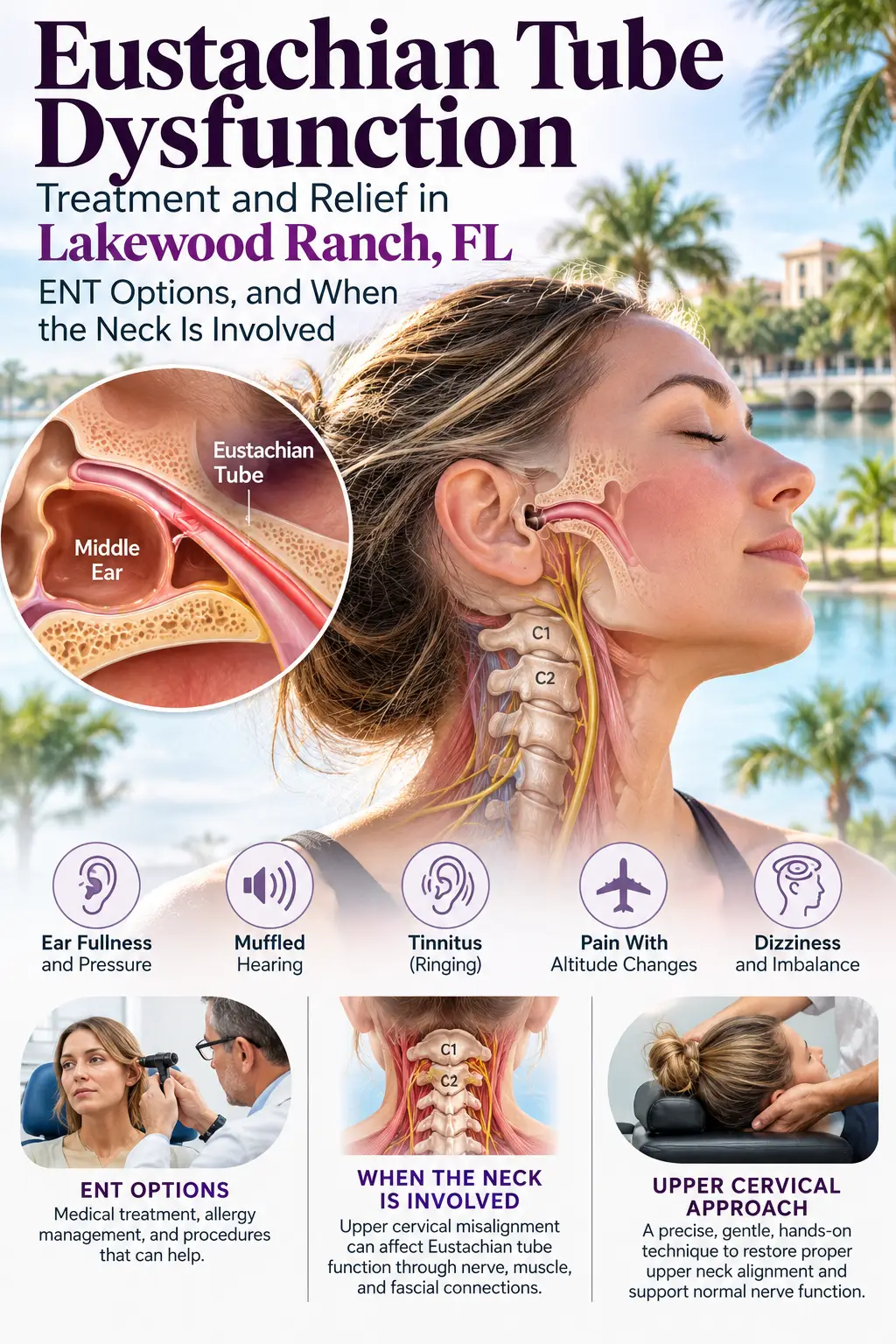
Upper cervical chiropractic is a specialty focused on the top two vertebrae — the atlas (C1) and axis (C2) — which sit at the junction of the skull and spine. It’s defined by three things: imaging before any correction, a low-force procedure with no rotation, and remeasurement afterward. For ETD, that focus is the point, because the anatomy that connects the neck to the ear lives at exactly that level. Our overview of upper cervical chiropractic care explains the approach in full.
When people ask whether a chiropractor can help ETD, the honest answer is that it depends on which chiropractor and what they measure.
Why the Upper Neck Is Connected to the Ear
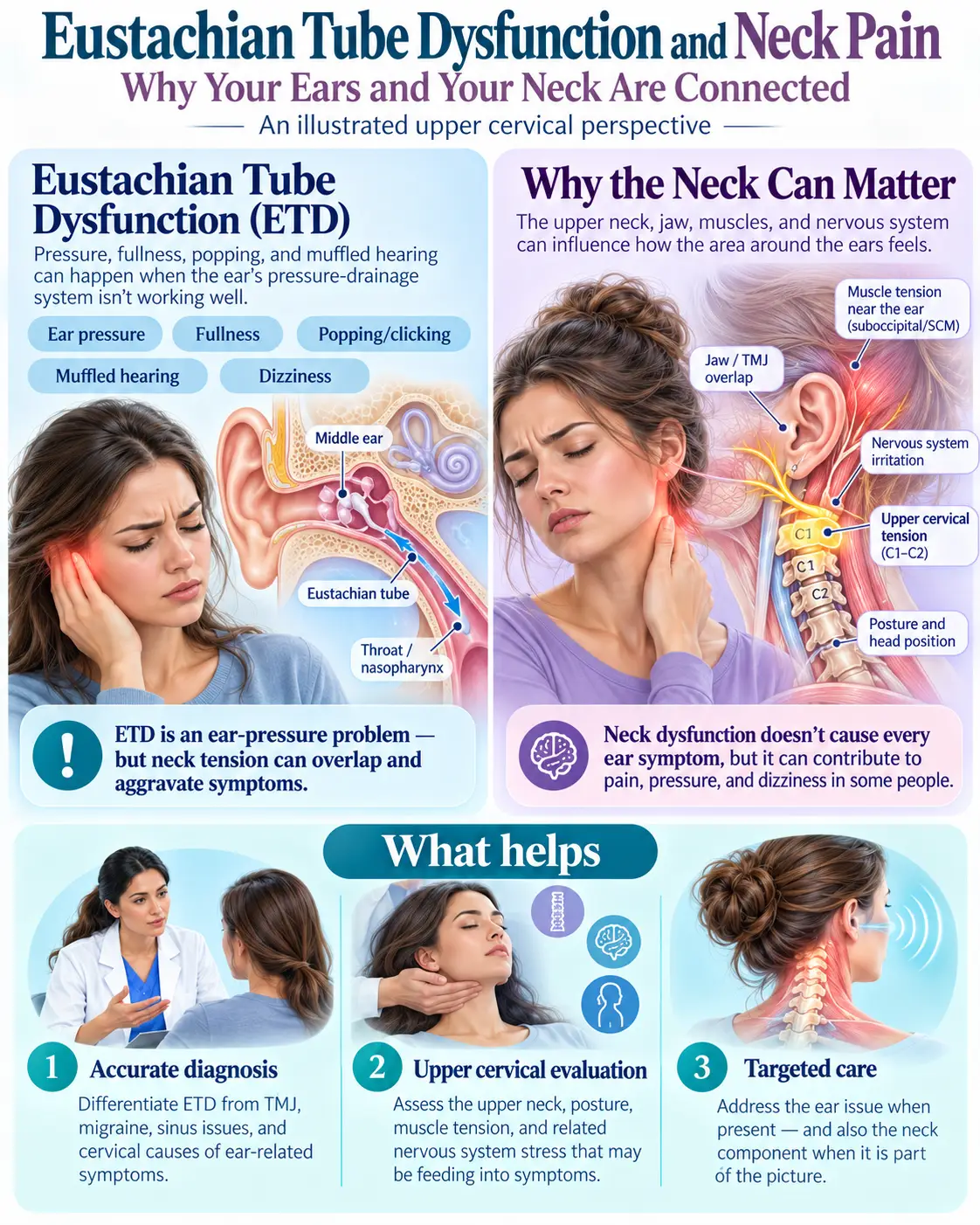
The Eustachian tube doesn’t open on its own. A small muscle — the tensor veli palatini — pulls it open for a fraction of a second every time you swallow or yawn. Leuwer (2016) describes it as the tube’s principal dilator, and Alper and colleagues (2012) measured its electrical activity directly against tube opening.
That muscle is controlled by the trigeminal nerve, not by the ear’s nerve supply. And the trigeminal nerve’s sensory fibers converge in the brainstem with the fibers from the upper cervical nerve roots — C1, C2, and C3 — in a structure called the trigeminocervical complex, which Bartsch and Goadsby (2003) described in detail. The brainstem relays input from the face, head, and upper neck through the same cells.
Put the two together: the tube’s opening muscle runs on trigeminal signal, and the trigeminal system shares its relay with the top of the neck. When the atlas is misaligned, the upper cervical nerves feed distorted input into that relay continuously, and the trigeminal output that governs the tensor veli palatini is affected downstream. The ear fills not because the tube is blocked but because the signal to open it is disturbed.
There’s a second pathway, documented in the radiology literature: the ear receives sensory fibers from the upper cervical nerves, so neck irritation can be felt in the ear directly. Norris and Chen (2020) mapped these referred-pain pathways and listed the cervical spine among the sources. Our article on Eustachian tube dysfunction and neck pain goes through both pathways in depth.
This is the piece the ENT workup doesn’t examine. The ENT looks at the ear, the tube, and the nose — correctly. The neck is outside that scope.
What an Upper Cervical Evaluation Measures
Here’s what happens at our Sarasota office, step by step, so you know what to expect and what to ask for.
1. History. When the ear fullness started; whether it’s one side or both; what makes it better or worse; whether it follows allergy or cold patterns or persists independently; whether neck stiffness, skull-base pressure, headache, jaw symptoms, or dizziness travel with it; any history of whiplash, a fall, a concussion, or dental work with the neck extended; and what the ENT found. The ENT results matter — a normal eardrum, normal hearing, and a normal pressure test between episodes tell us the tube itself is intact and point toward a signal problem.
2. Neurological and physical examination. Reflexes, strength, and sensation by nerve root. Range of motion of the neck. Palpation of the suboccipital muscles and the upper cervical joints. And reproduction testing: pressing on and moving the upper cervical spine to see whether it reproduces the ear fullness, the skull-base pressure, or the headache. That test, drawn from the cervicogenic headache criteria of Sjaastad and colleagues (1998), tells us quickly whether the neck is talking.
3. Paraspinal infrared thermography. A non-invasive scan that reads the heat pattern along the spine, which reflects nervous-system activity. An irritated nervous system at the upper neck shows an uneven pattern. This is the objective baseline we take before any care and track visit to visit.
4. 3D cone-beam CT (CBCT) imaging of the upper cervical spine. This shows the actual position of the atlas and axis relative to the skull, in three dimensions and to the degree. A flat X-ray can’t show it; an ENT’s CT of the temporal bone doesn’t look for it. It’s the measurement that tells us whether there is a misalignment to correct, and exactly what the correction needs to be.
5. Review of findings. We sit down and go through the imaging and thermography with you before any care begins. If the imaging shows nothing to correct, we tell you that, and we don’t adjust.
6. Correction, if indicated. A precise, low-force procedure specific to your measurements. The head is positioned and a gentle correction is delivered to the atlas — no twisting, no cracking, no rotation. Most patients describe it as pressure.
7. Remeasurement. Thermography after each visit and follow-up imaging when indicated, so progress is tracked objectively rather than guessed at.
Upper cervical care addresses the mechanical source the research points to — the neck — with measurement before and after. Results vary from person to person, and we tell you plainly what the findings show.
Who Is a Candidate — and Who Isn’t
A good candidate has ETD that has been evaluated by an ENT and found to involve an intact ear; fullness that persists beyond the allergy or cold pattern or stays one-sided; neck stiffness, skull-base pressure, headache, or jaw symptoms traveling with it; a history of neck or head trauma; or a workup that has run out of answers. Our article on conservative options for Eustachian tube dysfunction describes where this fits before any procedure.
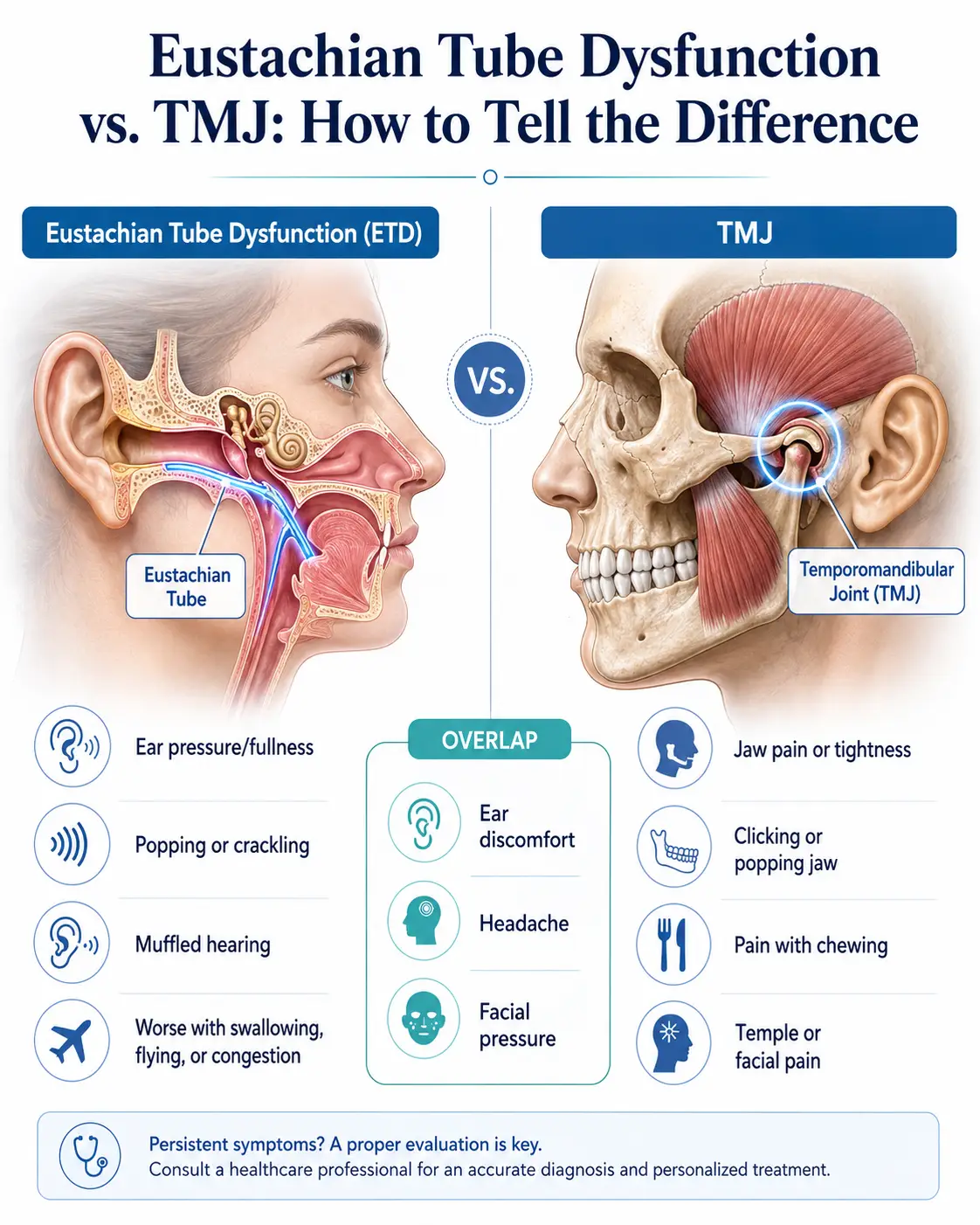
Not a candidate, or not yet: anyone who hasn’t had the ear examined — see an ENT first, because fluid, infection, a retracted eardrum, or a cholesteatoma need medical care; anyone with sudden hearing loss, severe pain, discharge, or facial weakness; and anyone whose ETD clearly follows a cold or allergy flare and clears with it — that’s inflammation, and it needs an allergist, not a chiropractor.
Patulous ETD — the tube that stays open, where you hear your own voice and breathing — is a different problem from the obstructive type, and the neck’s role is less direct. We evaluate it, but the expectations are different, and our article on patulous ETD explains why.
How It Fits With Your ENT
Upper cervical care doesn’t replace the ENT. The ENT addresses the tube, the nose, and the inflammation; we address the input from the top of the neck. Many of our ETD patients continue with nasal steroids or allergy management while under our care, and some go on to balloon dilation if the tube itself turns out to be the limiting factor. The clinical consensus on balloon dilation by Tucci and colleagues (2019) describes it as an option for obstructive ETD that hasn’t responded to medical management; we think the upper neck should be evaluated before that decision, because it’s the one input nobody has measured.
We document our findings and share them with your physician on request. The arrangement works best when everyone is looking at the piece they’re trained to see.
The Upper Cervical Connection
The atlas and axis sit directly beneath the brainstem where the trigeminocervical complex lives, and alongside the skull base where the Eustachian tube and its dilator muscle attach. The upper cervical nerve roots exit right there. When the atlas is misaligned, the input from those roots into the shared relay is continuous — not just during flares — and the muscles at the top of the neck are held under uneven tension. Correcting the position of the upper cervical spine addresses the input at its source. That’s the whole reason an upper cervical chiropractor, rather than a general one, is the relevant kind for ETD.
If you’ve been asking whether a chiropractor can help your ETD, call (941) 243-3729 or request an appointment onlinefor an upper cervical evaluation.
What the Research Says
The tube is opened by the tensor veli palatini. Leuwer (2016); Alper and colleagues (2012).
The trigeminal system and the upper neck share a brainstem relay. Bartsch and Goadsby (2003).
Ear symptoms are referred from the neck. Norris and Chen (2020).
Upper-neck symptoms can be reproduced and localized. Sjaastad and colleagues (1998).
ETD defined; balloon dilation’s place. Schilder and colleagues (2015); Tucci and colleagues (2019).
What to Bring to the First Visit
- Your ENT results: the eardrum exam, hearing test, tympanometry, and any CT
- A list of what you’ve tried — sprays, antihistamines, Valsalva, autoinsufflation — and what each did
- Any history of neck or head injury, with dates
- A note of what else travels with the ear: neck stiffness, headaches, jaw symptoms, dizziness
- Prior neck imaging, if any
Our full Eustachian tube dysfunction guide covers the condition end to end, and ear pressure and upper cervical chiropractic covers the ear-pressure side specifically. If your symptoms started after an accident, read ear fullness after a car accident.
Serving Sarasota, Bradenton, Lakewood Ranch, and the Suncoast
Our office is on Whitfield Avenue in north Sarasota, minutes from the Manatee County line. We see Eustachian tube dysfunction patients from Sarasota, Bradenton, Lakewood Ranch, Palmetto, Parrish, Ellenton, Longboat Key, Siesta Key, Osprey, Nokomis, Venice, and North Port — most of whom arrive after the ENT has found the ear intact. The top of the neck is the piece that hasn’t yet been examined.
Top 15 FAQs: Chiropractor for Eustachian Tube Dysfunction
1. Can a chiropractor help with Eustachian tube dysfunction? An upper cervical chiropractor evaluates the one input an ENT workup doesn’t: the top of the neck, which shares nerve wiring with the muscle that opens the tube. Whether it’s a factor for you is something we measure.
2. What kind of chiropractor should I see for ETD? An upper cervical chiropractor — one who images the atlas and axis before any correction, uses a low-force procedure without rotation, and remeasures afterward.
3. How is that different from a regular neck adjustment? A regular adjustment is full-spine, by feel, with rotation. Upper cervical care is limited to the top two vertebrae, guided by 3D imaging, and delivered without rotation.
4. Can a chiropractor adjust the Eustachian tube? No. Nothing touches the tube. The correction addresses the position of the upper neck, which affects the signal to the muscle that opens the tube.
5. Why would my neck affect my ear? The tube’s opening muscle runs on the trigeminal nerve, which shares its brainstem relay with the upper cervical nerves. And the ear receives sensory fibers from the upper neck, so neck irritation can be felt in the ear.
6. Should I see an ENT first? Yes. The ear itself needs to be examined to rule out fluid, infection, a retracted eardrum, or other ear problems. Bring the results; a normal workup is what points toward the neck.
7. Is it safe? The procedure involves no rotation and no thrust, and we image and screen before any care. If the imaging shows something that belongs with a physician instead, we say so.
8. Will my ear pop during the adjustment? Some patients notice their ears equalize during or after a correction; many don’t notice anything immediate. The change, when the neck is a factor, usually comes over the following weeks as the input settles.
9. How many visits? We can’t say until we’ve measured. The first visit is evaluation only, with findings reviewed before any care. Care is front-loaded during correction and stabilization, then tapers.
10. Does it work for patulous ETD? Patulous ETD is a different mechanism — the tube stays open — and the neck’s role is less direct. We evaluate it, with different expectations.
11. Can I keep using my nasal spray? Yes. Upper cervical care works alongside your ENT’s management, not instead of it. Medication decisions stay with your prescriber.
12. Should I try this before balloon dilation? The upper neck is the one input nobody has measured before that decision, and it’s non-invasive. We think it’s worth evaluating first; the decision is yours and your ENT’s.
13. What if the imaging shows nothing wrong with my neck? Then we tell you, we don’t adjust, and the path is back to your ENT with one more thing ruled out.
14. How soon would I know if it’s helping? When the upper neck is a factor and it’s corrected, patients typically report changes within the first several weeks. We measure before and after so you’re not guessing.
15. Do you take insurance? Call the office and we’ll go through costs and coverage before anything begins.
Lavender Family Chiropractic in Sarasota, Florida offers a thorough upper cervical evaluation to find out whether we can help. Call (941) 243-3729 or request an appointment. 5899 Whitfield Avenue, Suite 107, Sarasota, FL 34243.
Related Articles
- Eustachian Tube Dysfunction: Our Complete Guide
- Eustachian Tube Dysfunction and Neck Pain
- Ear Pressure and Upper Cervical Chiropractic
- Conservative Options for Eustachian Tube Dysfunction
- Ear Fullness After a Car Accident
- Upper Cervical Chiropractic Care
References
- Leuwer R. Anatomy of the Eustachian Tube. Otolaryngol Clin North Am. 2016. PMID 27468634
- Alper CM, et al. Relationship between the electromyographic activity of the paratubal muscles and eustachian tube opening. Arch Otolaryngol Head Neck Surg. 2012. PMID 22801708
- Bartsch T, Goadsby PJ. The trigeminocervical complex and migraine: current concepts and synthesis. Curr Pain Headache Rep. 2003. PMID 12946290
- Norris CD, Chen RC. Secondary Otalgia: Referred Pain Pathways and Pathologies. AJNR Am J Neuroradiol. 2020. PMID 33093134
- Sjaastad O, et al. Cervicogenic headache: diagnostic criteria. The Cervicogenic Headache International Study Group. Headache. 1998. PMID 9664748
- Schilder AG, et al. Eustachian tube dysfunction: consensus statement on definition, types, clinical presentation and diagnosis. Clin Otolaryngol. 2015. PMID 26347263
- Tucci DL, et al. Clinical Consensus Statement: Balloon Dilation of the Eustachian Tube. Otolaryngol Head Neck Surg. 2019. PMID 31161864
Related Posts


Get our upper cervical articles first.
Patients Experience