Ear Fullness After a Car Accident or Whiplash in Sarasota, Florida: Why Your Ears Started Acting Up Weeks After the Crash — and How Upper Cervical Chiropractic Care Helps
By Dr. Rusty Lavender, D.C. — upper cervical chiropractor, Lavender Family Chiropractic, Sarasota, FL. Reviewed and updated October 2026.
Ear Fullness: You were rear-ended on University Parkway. Or a driver ran a stop sign at the corner of Whitfield. Or someone hit you while you were merging onto I-75. The bumper damage was minor. You felt sore for a few days. Maybe you saw your doctor, maybe you didn’t. And then — weeks or months later — your ears started acting strange. Fullness. Pressure. Popping. Muffled hearing. Tinnitus. A vague off-balance feeling that you can’t quite describe.
You went to your ENT. Everything looked “fine.” You tried decongestants. They didn’t work. And nobody connected your ear symptoms back to the accident — because by the time the symptoms showed up, the accident felt like ancient history.
Here’s what the research actually shows: post-whiplash ear and hearing symptoms are common, well-documented in peer-reviewed literature, and often the direct downstream consequence of upper cervical spine injury that was never properly addressed at the time of the accident. A study by Segal and colleagues found that among 227 patients with isolated neck trauma, 55% reported tinnitus and 52% reported hearing loss within the first three months. The Blue Mountains Hearing Study — a five-year prospective cohort — found that people with severe whiplash injury at baseline had a 90% greater risk of developing tinnitus during follow-up.
At Lavender Family Chiropractic in Sarasota, Florida, we see this pattern constantly. In this guide, we’ll walk through why whiplash causes ear symptoms, why those symptoms often show up months or years after the crash, the Florida-specific 14-day PIP rule you need to understand, and how the gentle Knee Chest Upper Cervical technique addresses the root cause.
What Whiplash Actually Does to Your Body and Ear Fullness After an Accident
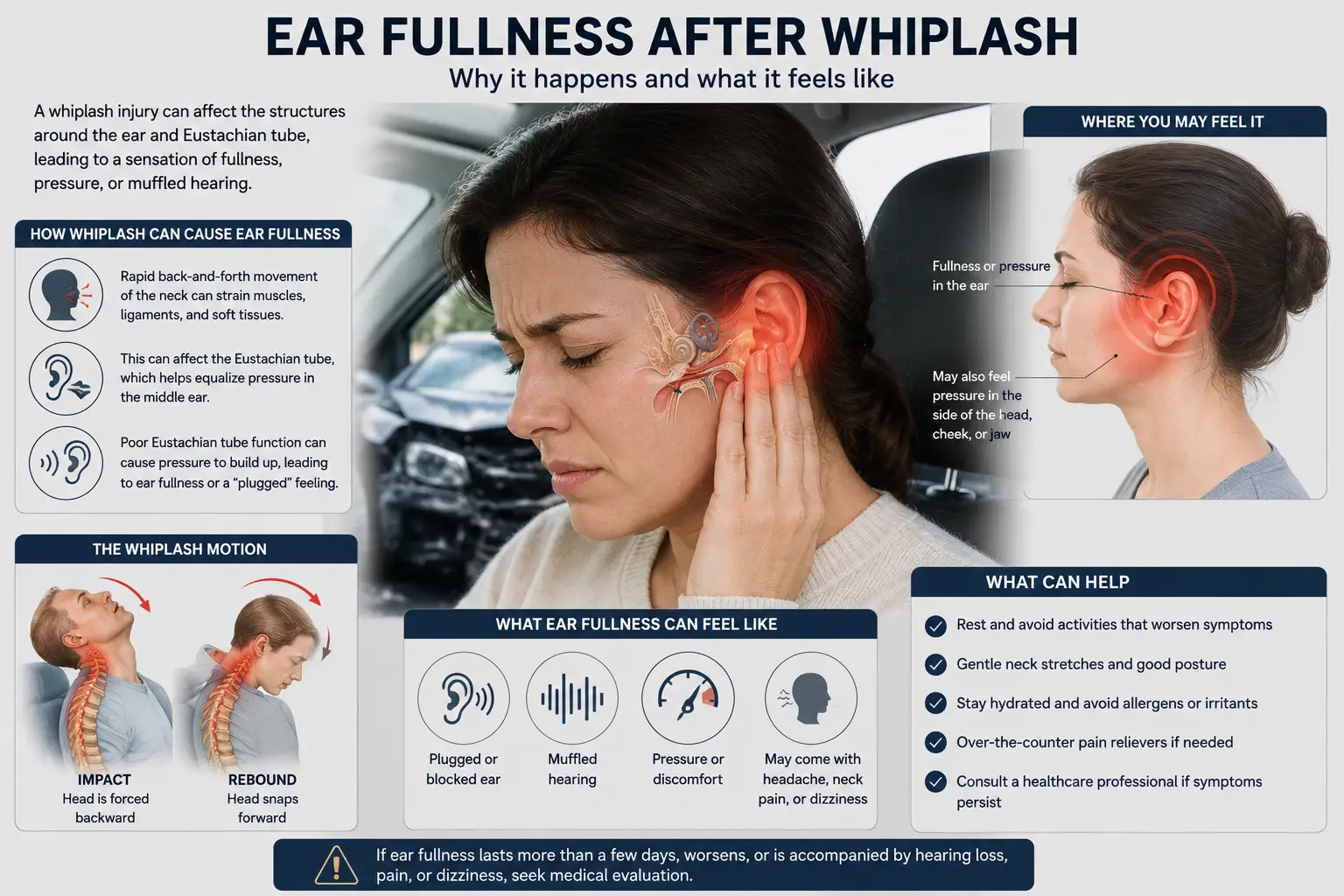
Whiplash is the result of rapid acceleration–deceleration of the head, most commonly from a rear-end car collision but also from sports impacts, falls, and similar trauma. The neck whips forward and then backward (or side to side) at speeds that exceed the soft tissue’s ability to control the motion.
What gets injured:
- The anterior longitudinal ligament along the front of the spine
- The alar and transverse ligaments stabilizing the atlas (C1) and axis (C2)
- The suboccipital muscles at the base of the skull
- The capsular ligaments of the cervical facet joints
- The intervertebral discs, which can bulge or tear
- The sympathetic nerve plexus running along the cervical spine
- The vertebral arteries carrying blood to the brainstem and inner ear
What’s striking about whiplash is the threshold required. According to research summarized by Mallinson and Longridge, the brain typically requires about 60 g of force to be injured directly, while the neck can be injured at as little as 14 g. That means a collision can absolutely destabilize your upper cervical spine without ever causing a concussion or showing up on imaging the ER might order.
This is why patients with seemingly minor accidents — bumpers barely damaged, no loss of consciousness, no broken bones — develop symptoms weeks or months later. The structural injury was real. It just wasn’t visible on the standard imaging.
Why Whiplash Causes Ear Symptoms
The connection between whiplash and ear symptoms isn’t obvious — until you understand the anatomy. Several mechanisms work together to produce post-trauma ear fullness, pressure, popping, and tinnitus.
1. Atlas and Axis Misalignment Disrupts Nerve Signaling
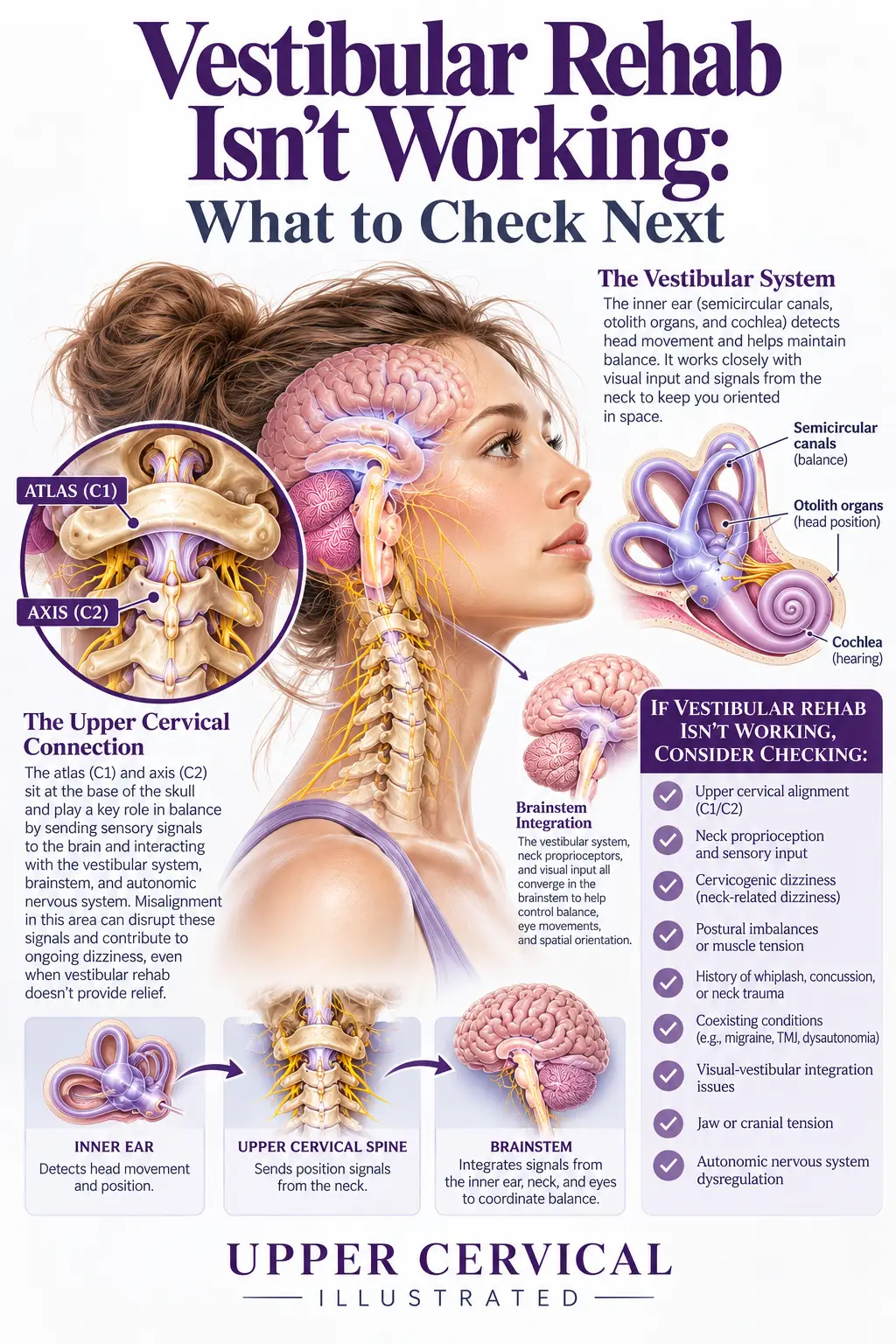
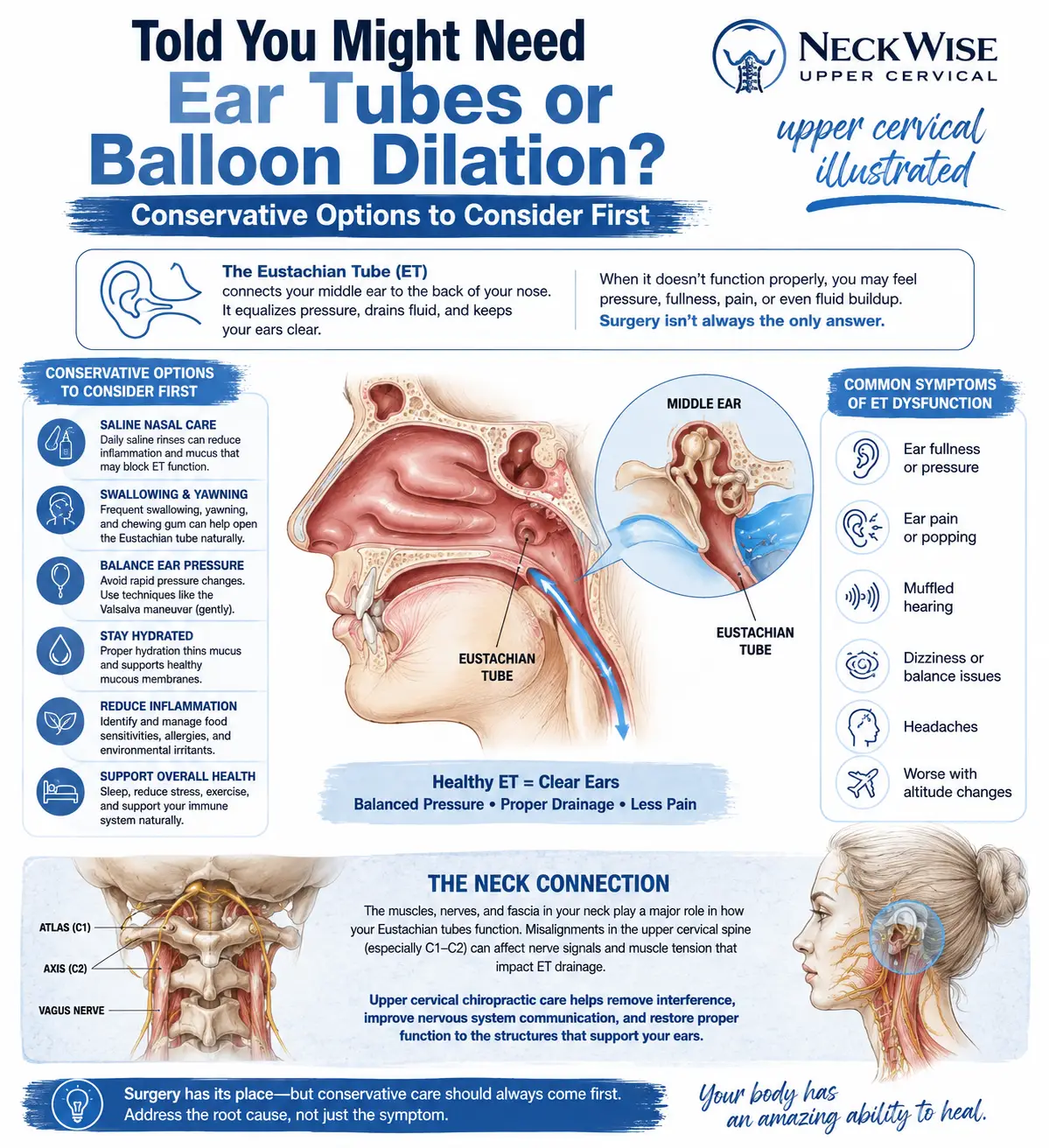
The atlas (C1) and axis (C2) sit at the base of the skull and surround the brainstem. When a whiplash event misaligns them, it disrupts the nerves that control the muscles of the inner ear and Eustachian tube — particularly the tensor veli palatini, the small muscle that opens your Eustachian tube every time you swallow. The tensor veli palatini is innervated by the mandibular branch of the trigeminal nerve (CN V), which converges with upper cervical nerve input in the brainstem at the trigeminocervical complex (Bartsch & Goadsby, 2003; Piovesan et al., 2003).
When upper cervical nerves are irritated by misalignment, signaling to the tensor veli palatini gets disrupted — and the Eustachian tube stops opening properly. The downstream symptoms are exactly what whiplash patients report: fullness, pressure, popping, muffled hearing.
2. Vertebral Artery Blood Flow Compromise
Whiplash can affect the vertebral arteries as they pass through the transverse foramina of the cervical vertebrae on their way to supply blood to the brainstem and inner ear. Even subtle changes in cervical alignment can alter the geometry of these vessels and reduce blood flow to the auditory and vestibular structures. This is part of why post-whiplash patients often report both ear symptoms and dizziness, and why the 2017 “triple hypothesis” paper by Bressi and colleagues specifically cites vertebral artery hemodynamics as one of the three mechanisms linking cervical spine disorders to tinnitus.
3. Somatic Tinnitus and the Dorsal Cochlear Nucleus
Dr. Robert Levine’s foundational 1999 paper in the American Journal of Otolaryngologyidentified whiplash as one of the two leading causes of somatic tinnitus (along with TMJ disorders). The mechanism: abnormal somatosensory input from the upper neck feeds into the brainstem’s dorsal cochlear nucleus, which then generates phantom auditory sensations even when the inner ear is structurally intact. Anatomical research by Zhan, Pongstaporn, and Ryugo (2006) confirmed direct nerve projections from the second cervical (C2) dorsal root ganglion to the cochlear nucleus — a hard-wired pathway from the upper neck to the auditory brainstem.
For a deeper dive into this mechanism, see our companion guide on tinnitus and the upper neck.
4. Vagus Nerve Disruption
The vagus nerve — the longest cranial nerve in the body — exits the skull right next to the atlas and plays a major role in inflammation regulation and autonomic function. Upper cervical misalignment from whiplash can compromise vagal tone, contributing to chronic inflammation in the head and neck region and impaired drainage of the lymphatic tissue around the ears.
5. TMJ Involvement
The temporomandibular joint sits directly adjacent to the ear, and whiplash commonly involves the jaw as much as the neck. Post-whiplash TMJ dysfunction adds another layer of muscle tension and somatic input that can drive ear fullness, clicking, and tinnitus. See our TMJ care page for more on the jaw–ear connection.
Why Symptoms Show Up Weeks, Months, or Years Later
This is the question that confuses almost every patient who walks into our office after a car accident: “If the wreck caused this, why didn’t I feel it right away?”
Three reasons.
1. Adrenaline masks acute symptoms. Immediately after a crash, your nervous system is in a sympathetic stress response. Pain signaling is suppressed. You feel “shaken up” but functional. The real symptoms emerge over the following days and weeks as the inflammatory response peaks and your nervous system tries to return to baseline.
2. Soft tissue injuries take time to declare themselves. Ligament tears, capsular damage, and disc bulges may not produce significant symptoms until inflammation, swelling, and altered biomechanics compound over weeks. The 2026 guide on Florida’s 14-Day PIP Ruleexplicitly warns that “whiplash, disc herniations, [and] soft tissue damage may not produce noticeable symptoms for days or even weeks after the collision.”
3. Upper cervical misalignment is cumulative. Dr. Michael Burcon’s 2016 paper in the Journal of Upper Cervical Chiropractic Research followed 300 patients with Meniere’s disease (a closely related condition that includes ear fullness, vertigo, and tinnitus). Every one of the 300 patients had a prior history of whiplash trauma, with an average 15-year delay between the original injury and symptom onset. The misalignment can sit silent for years, slowly disrupting nervous system function, until something — another minor event, an illness, stress, hormonal changes — pushes the system past its tolerance threshold.
If you’ve had any kind of head or neck trauma in your life and now live with chronic ear symptoms, the connection is almost certainly worth investigating.
Florida’s 14-Day PIP Rule: What Sarasota Drivers Must Know
If you’ve been in a car accident in Florida, there is a critical 14-day window you need to understand. Under Florida Statute 627.736, Florida is a no-fault insurance state — meaning your own Personal Injury Protection (PIP) policy covers your medical expenses regardless of who caused the accident.
But there’s a catch: you must seek medical care from a qualified provider within 14 days of the accident to remain eligible for PIP benefits. Miss that window, and your insurance can deny your medical coverage entirely.
Key points every Sarasota driver should know:
- The 14-day clock starts on the date of the accident, not the date symptoms appear
- Florida PIP provides $10,000 in coverage at 80% of reasonable and necessary medical expenses
- Chiropractors are qualified providers under the statute who can satisfy the 14-day requirement
- Without an Emergency Medical Condition (EMC) determination, your PIP benefits are capped at $2,500
- If you wait until day 15, your insurance company can deny PIP coverage entirely
The implication is straightforward: even if you feel fine after a crash, getting evaluated within 14 days protects both your health and your insurance coverage. By the time ear symptoms show up months later, it may be too late to access PIP benefits — leaving you to pay out of pocket for care that should have been covered.
See our car accident chiropractic care page for more on how we handle post-accident evaluations at Lavender Family Chiropractic.
How Lavender Family Chiropractic Approaches Post-Whiplash Ear Symptoms
At Lavender Family Chiropractic, we approach post-whiplash patients differently than a general chiropractor or a soft-tissue clinic. We’re specifically trained to identify upper cervical misalignments that may be driving long-term symptoms — including ear fullness, tinnitus, vertigo, and headaches.
1. We Use 3D CBCT Imaging, Not Flat X-rays
Our office is equipped with a 3D Cone Beam Computed Tomography (CBCT) scanner. This gives us a true three-dimensional view of your upper cervical spine — something flat X-rays simply can’t provide. For post-whiplash patients, this matters enormously. The misalignments we’re looking for are often subtle rotations and tilts that are easily missed on standard imaging but clearly visible in 3D.
2. We Use the Knee Chest Upper Cervical Technique
Our doctors — Dr. Rusty Lavender and Dr. Jacob Temple — are trained in the Knee Chest Upper Cervical technique. You rest comfortably in a knee-chest position while we deliver a precise, low-force adjustment to the atlas or axis based on your individual imaging.
There’s no twisting, popping, or cracking. This is especially important for post-whiplash patients, who often arrive having tried aggressive chiropractic care that flared their symptoms. The Knee Chest technique is gentle enough for patients with disc injuries, ligament damage, or post-concussion symptoms — exactly the population that makes up most of our car accident cases.
3. We Build Personalized Care Plans
Whiplash that’s been brewing for years doesn’t resolve in a single visit. We design personalized care plans based on your imaging, exam findings, accident history, and symptom timeline. Your plan is built to:
- Correct the upper cervical misalignment
- Stabilize the correction over time
- Allow your nervous system to recalibrate
- Transition you into long-term wellness care
We explain your plan completely before you commit to anything. To learn more about our approach, visit Meet the Team or see What to Expect at your first visit.
Were You in a Car Accident — Recent or Years Ago?
Whether the wreck was yesterday or a decade ago, if you’re now living with ear fullness, pressure, popping, tinnitus, or unexplained dizziness, the upper cervical spine is worth investigating. Call Lavender Family Chiropractic at (941) 243-3729 to schedule your consultation. Dr. Rusty Lavender or Dr. Jacob Temple will look at your imaging, your history, and your symptoms — and tell you honestly whether upper cervical care is the right fit.
What the Research Says
The peer-reviewed evidence linking whiplash to ear and auditory symptoms is more extensive than most patients — or even most providers — realize.
Prevalence Studies
- Segal et al. in Otology & Neurotology — among 227 cases of isolated neck trauma, 55% reported tinnitus and 52% reported hearing loss within three months. Summarized in the Hearing Journal (2013).
- Blue Mountains Hearing Study — a five-year prospective cohort of 1,214 older adults found that severe whiplash injury at baseline was associated with a 90% greater risk of developing tinnitus at follow-up.
- Multiple sources report that approximately 10% of whiplash patients develop persistent otological symptoms including tinnitus, hearing loss, dizziness, and vertigo.
- A 2018 review summarized in Dizziness and Balance noted that dizziness occurs in 20–60% of whiplash cases and can persist for years.
Mechanism Studies
- Levine (1999) in the American Journal of Otolaryngology — foundational paper identifying whiplash as a primary cause of somatic (craniocervical) tinnitus via the dorsal cochlear nucleus pathway.
- Zhan, Pongstaporn, and Ryugo (2006) — anatomically traced direct nerve projections from the C2 dorsal root ganglion to the cochlear nucleus.
- Bressi et al. (2017) — “triple hypothesis” linking cervical spine disorders to tinnitus through three distinct mechanisms.
- Auditory radiation injury study (2020) — used diffusion tensor tractography to document neural injury of the auditory radiation in a whiplash patient with post-trauma tinnitus.
Chiropractic Outcome Studies
- Burcon (2016) in the Journal of Upper Cervical Chiropractic Research — followed 300 Meniere’s patients (all with whiplash history) over six years of upper cervical specific care. Patients reported 97% improvement in vertigo intensity with mean self-reported scores dropping from 8.5 to below 1.
- Cherian et al. (2013) in the Journal of the American Academy of Audiology — documented improvement in tinnitus following mechanical treatment of the cervical spine and jaw in a defined subgroup of patients.
- JMPT 2004 case report — clinical improvement in a geriatric patient with vertigo, tinnitus, and hearing loss following upper cervical-specific chiropractic care.
The Honest Limitations
Not every post-whiplash ear symptom is solely cervical in origin. Some patients have inner ear injury, vestibular nerve damage, or central nervous system injury that requires medical management beyond chiropractic care. Most of the chiropractic-specific evidence consists of case reports and case series rather than large randomized controlled trials. What the literature supports is this: for patients whose post-whiplash ear symptoms are driven by upper cervical misalignment, targeted correction can produce meaningful, lasting improvement.
That’s exactly why we use 3D CBCT imaging and a thorough exam — to determine whether your case fits that profile.
Lifestyle Habits That Support Post-Whiplash Recovery
While correcting upper cervical misalignment addresses the structural and neurological root cause, these habits help reduce inflammation, support tissue healing, and accelerate your results:
- Hydrate aggressively. Tissues heal in the presence of water. Aim for at least half your body weight in ounces daily.
- Sleep on your back or side, not your stomach. Stomach sleeping holds your neck rotated for hours and slows recovery.
- Use a supportive pillow. A pillow that holds your cervical curve in neutral makes a real difference for post-whiplash patients.
- Avoid aggressive chiropractic adjustments. Forceful manipulation in post-whiplash patients can flare symptoms by stressing already-injured tissues. Gentle, specific corrections are the safe path.
- Don’t push through pain. Post-whiplash inflammation is real. Aggressive exercise too soon can extend recovery.
- Manage stress. Stress holds tension in the suboccipital muscles and amplifies somatic input to the dorsal cochlear nucleus — making tinnitus and ear fullness worse.
- Limit screen time looking down. Forward head posture multiplies the load on a healing cervical spine.
- Walk daily. Gentle movement supports lymphatic drainage from the head and neck, which often improves ear symptoms.
- Avoid amusement park rides, roller coasters, and high-impact sports until you’ve stabilized.
For patients whose post-whiplash symptoms also include sinus pressure and ear fullness, see our companion guide on sinus pressure, allergies, and ear fullness for additional context.
Serving Sarasota and the Surrounding Communities
Lavender Family Chiropractic is located at 5899 Whitfield Avenue, Suite 107, Sarasota, FL 34243 — right at the corner of University and Whitfield. We’re easy to reach from anywhere on the Suncoast and proud to serve patients from across the region, including Bradenton, Lakewood Ranch, Parrish, Ellenton, Palmetto, University Park, Longboat Key, Siesta Key, Osprey, Venice, Myakka City, Ruskin, Tampa, and St. Petersburg.
If you’ve been in a car accident — recent or long ago — and now live with chronic ear, neck, or balance symptoms, we’d love to help you investigate the upper cervical connection. See more about the areas we service and the conditions we help at our practice.
Our complete guide to neck pain and the upper cervical spine covers the causes of neck pain, when it points to the top of the neck, and how we evaluate it in Sarasota.
Top 15 FAQs About Post-Whiplash Ear Symptoms and Upper Cervical Care
1. Can a car accident really cause ear fullness or tinnitus?
Yes — and the research is clear on this. Studies show that 55% of patients with isolated neck trauma develop tinnitus within three months, and severe whiplash patients have a 90% greater long-term risk of tinnitus. The mechanism is well-documented in the peer-reviewed literature.
2. My accident was years ago. Could it still be causing my symptoms?
Almost certainly possible. Dr. Burcon’s research found that patients with whiplash-related ear and vertigo conditions had an average 15-year delay between the original injury and symptom onset. Upper cervical misalignment can sit silent for years before symptoms cross a threshold.
3. My ENT said my ears look fine. Why am I having symptoms?
This is incredibly common. When the inner ear itself is structurally intact, ENT examination won’t find anything. But the signaling to the muscles controlling the Eustachian tube, and the brainstem processing of auditory input, can both be disrupted by upper cervical misalignment — and that’s not what an ENT exam is designed to evaluate.
4. What is Florida’s 14-Day PIP Rule?
Under Florida Statute 627.736, you must seek medical care from a qualified provider — including a chiropractor — within 14 days of a motor vehicle accident to remain eligible for Personal Injury Protection benefits. Missing this window can result in denial of PIP coverage. We can satisfy the 14-day requirement.
5. Do you take PIP insurance?
Yes. We work with PIP coverage for post-accident patients. We’ll walk you through your specific coverage during your consultation and discuss any out-of-pocket considerations.
6. Does the adjustment hurt — especially with whiplash injuries?
No. The Knee Chest Upper Cervical technique uses light, specific pressure while you rest in a comfortable knee-chest position. There’s no twisting, popping, or cracking — which makes it especially appropriate for post-whiplash patients who can’t tolerate aggressive manipulation.
7. I tried a regular chiropractor after my accident and it made things worse. Will this be the same?
Probably not. Many post-whiplash patients flare with high-velocity, high-force manipulation because their injured tissues can’t tolerate it. The Knee Chest technique is specifically a low-force, precise approach — patients who didn’t respond well to aggressive chiropractic often do well with upper cervical care.
8. How long until I notice improvement?
It varies. Some patients notice changes within the first few visits. Others — especially those with multi-year-old whiplash injuries — need several weeks or months of consistent care. We’ll give you a realistic timeline based on your imaging and exam findings.
9. Will my insurance cover care beyond PIP?
It depends on your specific policy. We’ll review your coverage during your consultation and structure a care plan that works for your situation. Our plans are designed to make consistent, long-term care affordable regardless of insurance status.
10. Can children with whiplash develop ear symptoms?
Yes. Children involved in motor vehicle accidents can develop upper cervical misalignments just like adults, and pediatric ear infections, ear fullness, and chronic congestion are common downstream consequences. The Knee Chest technique is gentle enough for children.
11. What if my symptoms include vertigo or dizziness too?
That’s actually very common in post-whiplash patients. See our vertigo service page for more on how upper cervical care addresses post-trauma dizziness. Many patients find ear symptoms and dizziness resolve together when the upper cervical spine is corrected.
12. Will the upper cervical correction hold?
Holding the correction is the goal. That’s why we build personalized care plans designed to stabilize the upper cervical correction over time. Patients who complete the corrective phase and follow through with wellness care tend to see the longest-lasting results.
13. What if I had a concussion in addition to whiplash?
Concussion and whiplash often occur together and produce overlapping symptoms including ear fullness, tinnitus, and dizziness. We routinely care for post-concussion patients and adapt the Knee Chest technique to their tolerance level.
14. What is 3D CBCT and why do you use it for whiplash cases?
3D Cone Beam Computed Tomography gives us a true three-dimensional view of your upper cervical spine. For post-whiplash patients this matters because the misalignments are often subtle rotations easily missed on standard X-rays — but clearly visible in 3D.
15. How do I get started?
Call (941) 243-3729 or book your consultation online. You’ll sit down with Dr. Rusty Lavender or Dr. Jacob Temple, talk through your symptoms and accident history, and find out whether upper cervical chiropractic is the right fit for you. If your accident was recent and you’re inside Florida’s 14-day window, we’ll get you in as soon as possible.
Ready to Connect the Dots? Call Lavender Family Chiropractic
You don’t have to keep wondering if your ear fullness, tinnitus, or chronic pressure is connected to the car accident you can barely remember. The research is clear, the anatomy is documented, and for the right patient, the upper cervical solution exists.
At Lavender Family Chiropractic, Dr. Rusty Lavender and Dr. Jacob Temple use precise 3D CBCT imaging and the gentle Knee Chest Upper Cervical technique to identify whether your post-whiplash symptoms are being driven by upper cervical misalignment — and if they are, to correct it.
📞 Call (941) 243-3729 today 📅 Book your consultation online 📍 5899 Whitfield Avenue, Suite 107, Sarasota, FL 34243 — at the corner of University and Whitfield
Related Articles
Related Posts


Get our upper cervical articles first.