Post Trauma Cascade: One Injury, Many Conditions: How Whiplash and Concussion Can Trigger a Cascade of Chronic Symptoms
By Dr. Rusty Lavender, D.C. — upper cervical chiropractor, Lavender Family Chiropractic, Sarasota, FL. Reviewed and updated October 2026.
Our complete guide to post-concussion syndrome in Sarasota covers why symptoms outlast a normal scan, the upper neck’s role, and how we evaluate it.
Post Trauma Cascade: The car accident happened two years ago. Maybe it was a rear-end collision at a stoplight on Fruitville Road, or a fall from a bicycle, or a sports collision that briefly rang your bell. At the time, the emergency room checked you over, the imaging looked “normal,” and after a few weeks of soreness you moved on. You considered yourself lucky. You considered yourself healed.
Then, months or even years later, a strange collection of symptoms started to gather. Headaches that never used to bother you. A jaw that clicks and aches. Moments of dizziness when you stand up too fast. A heart that races for no obvious reason. A fog that settles over your thinking in the afternoon. Neck pain that comes and goes without explanation. You have seen several specialists, each focused on their own organ system, each offering a different label, and none of them connecting the dots back to that long-ago injury.
This article is about those dots — and the increasingly recognized possibility that they connect. When a single trauma strikes the head and neck, it does not necessarily confine its effects to one place or one moment in time. The upper part of the neck, where the skull meets the spine, is a remarkably small and remarkably important hub. An injury there can, in some people, set off a cascade of seemingly unrelated chronic conditions that unfold slowly and puzzle everyone involved.
We want to be careful and honest from the very first paragraph: trauma is a documented contributor to many of these conditions, not a guaranteed cause of every symptom a person develops afterward. Bodies are complicated, and correlation is not the same as certainty. But if you are someone who never felt entirely “right” after a whiplash injury or a concussion, understanding this connection may help you and your care team ask better questions. Let’s walk through it together.
The Injury You Thought Healed and Post Trauma Cascade
Whiplash and concussion are often discussed as if they were two separate events, but they frequently travel together. A rear-end collision that snaps the head backward and forward can strain the soft tissues of the neck (whiplash) while simultaneously shaking the brain inside the skull (concussion, or mild traumatic brain injury). The forces overlap, and so do the consequences.
Whiplash is not simply a “muscle strain.” The rapid, whip-like motion loads the ligaments, joint capsules, discs, and small stabilizing structures of the cervical spine — and the segment that takes an outsized share of that load is the upper cervical region, the top two vertebrae (the atlas and axis) and the junction where they meet the base of the skull. This craniocervical junction is unusual. Unlike the rest of the spine, which relies heavily on the shape of interlocking bones for stability, the upper cervical junction depends significantly on ligaments to hold everything in proper alignment while still permitting the large range of motion your head needs. That ligament dependence is what makes the region so mobile — and also what makes it vulnerable to strain when a sudden force exceeds what those ligaments can absorb.
Concussion adds a second layer. A blow to the head, or even a whiplash motion without direct impact, can cause the brain to shift and stretch, disrupting the delicate signaling of neurons and, importantly, the networks that regulate automatic body functions. Many people recover from concussion within weeks. A meaningful minority develop persistent symptoms that linger far beyond the expected timeline.
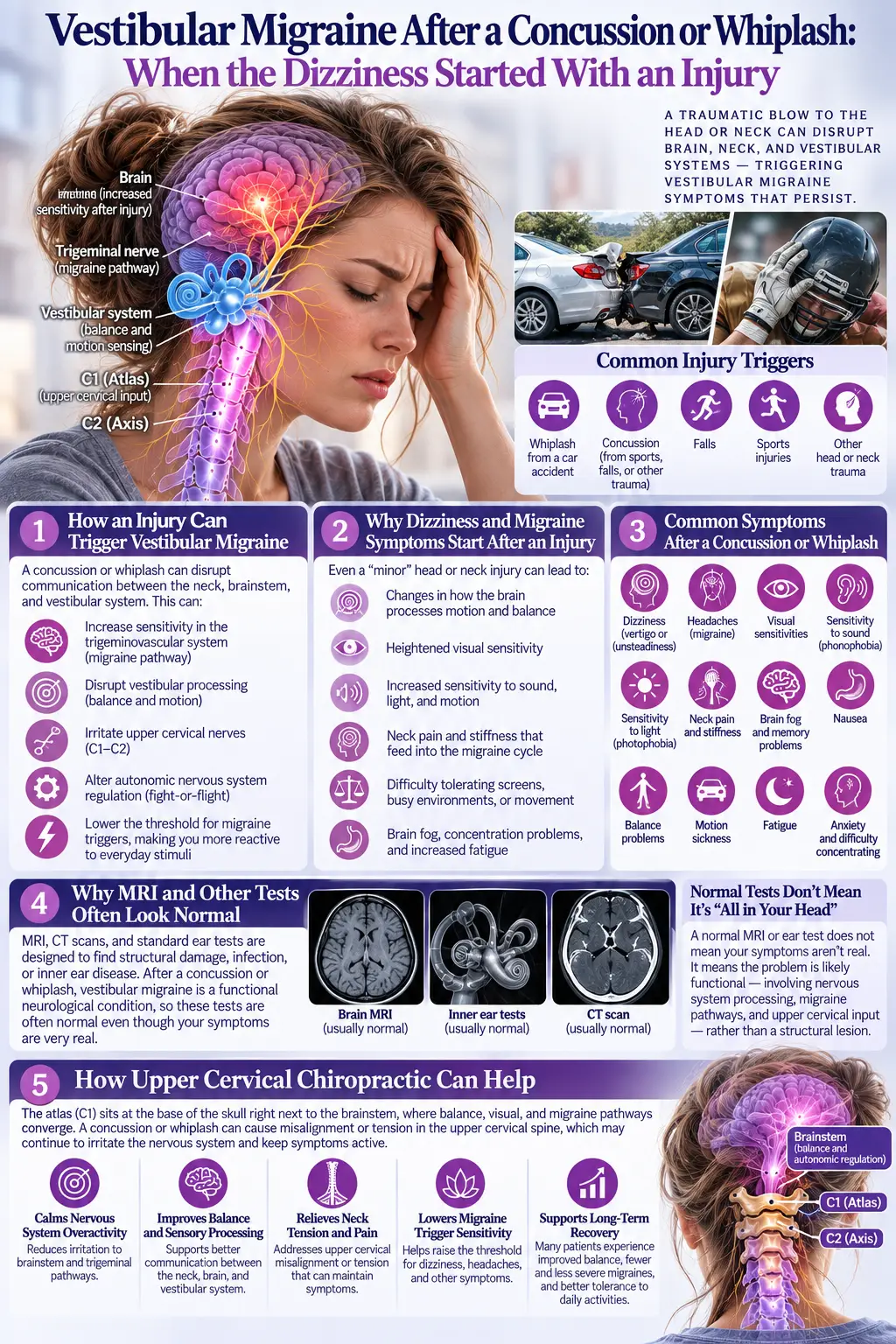
Here is the part that frustrates so many patients: standard imaging often looks “normal.” A conventional X-ray or CT scan taken in the emergency room is designed primarily to rule out fractures and bleeding — genuine emergencies that must be excluded first. Those scans are excellent at what they do. But they are not designed to reveal subtle ligament strain or small shifts in upper cervical alignment, and they are typically taken while you are lying still, which does not reveal how the joint behaves under load or motion. So the report comes back reassuring, the acute danger is ruled out, and the more subtle mechanical problem — the one that may drive symptoms for years — goes undocumented.
This is not a failure of medicine. It is a gap between what emergency imaging is built to detect and what a slow-developing upper cervical problem actually looks like. Closing that gap requires different tools and a different question. Instead of only asking “Is anything broken or bleeding?” we also ask “Is the upper cervical junction sitting and moving the way it should, and is that affecting the structures nearby?” At our practice, that is where detailed, position-specific imaging such as 3D CBCT becomes useful — it lets us see the region in three dimensions and evaluate alignment with a level of detail that flat films cannot provide.
To be clear, serious injuries need proper medical evaluation, and nothing here replaces that. If you have had a significant head or neck trauma, an appropriate medical workup comes first. What we are describing is a complementary way of looking at what may remain after the emergency has passed.
Why One Injury Ripples Into Many Systems
Now to the heart of the matter — the mechanism that explains how one injury can touch so many systems.
Picture the upper cervical junction as the narrow neck of an hourglass. Almost everything that travels between the brain and the body passes through this small space: the spinal cord as it exits the skull, major blood vessels, cerebrospinal fluid pathways, and — critically — the lower brainstem and its neighboring structures. The brainstem is not a bystander. It is the control center for an astonishing range of automatic functions: heart rate, blood pressure, breathing rhythm, balance, and the modulation of pain signals traveling to and from the head, face, and neck. When something disturbs this hub, the effects are not confined to one location. They radiate outward along whatever systems the hub governs.
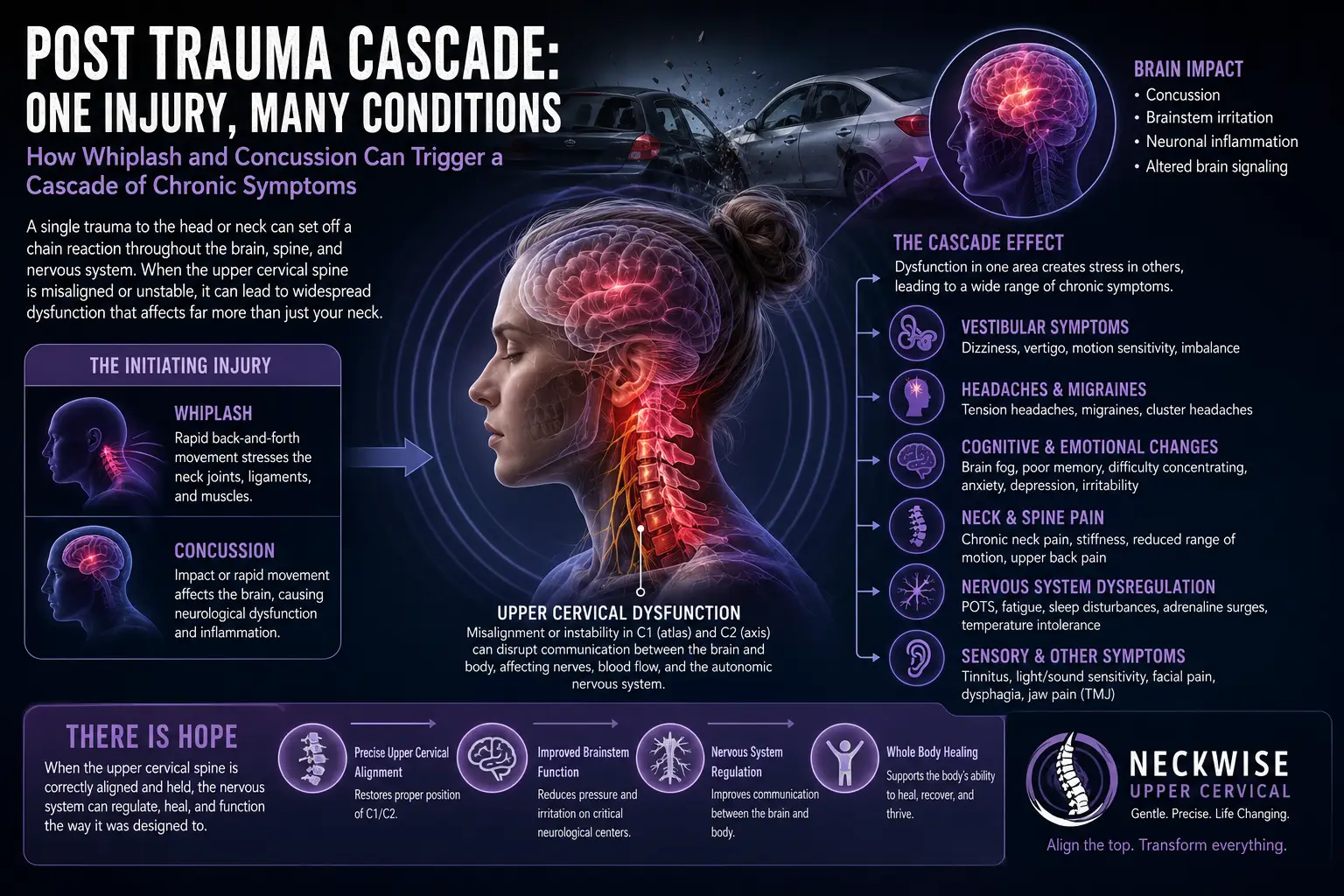
This is why the upper cervical region deserves to lead any honest discussion of post-trauma cascades. When whiplash or concussion forces strain the ligament-dependent craniocervical junction, two things can happen at once. First, the mechanical relationship between the skull and the top of the spine can shift subtly, changing how the joint moves and loads. Second, that shift can place mechanical stress on the brainstem and the surrounding neural and vascular structures — the very control center described above. One region, under strain, influences autonomic function, balance, and pain processing simultaneously. That is the ripple. That is how a single injury at a single hub can express itself as headaches, dizziness, a racing heart, jaw pain, and brain fog, all in the same person, without any of those symptoms being “in their head.”
There is a second reason the head, face, and neck are so tightly linked, and it has a name: the trigeminocervical nucleus. In the brainstem, the sensory nerves from the face (the trigeminal system) and the sensory nerves from the upper neck converge onto shared circuitry. Because these signals mingle at a common relay, the brain can have genuine difficulty distinguishing “neck” from “face” from “head.” A problem originating in the upper neck can be experienced as pain behind the eye, across the temple, in the jaw, or as a headache — because at the level of the nervous system, those inputs are wired together. This convergence is one of the best-established explanations for why upper cervical trauma so often produces symptoms that seem to belong to entirely different regions.
Add the autonomic dimension and the picture becomes complete. The autonomic nervous system — the part that runs heart rate, blood pressure, digestion, and the body’s stress response without your conscious involvement — is heavily coordinated in and around the brainstem. Both concussion and whiplash can disturb autonomic regulation. When that regulation is off, the body may struggle to make the smooth, automatic adjustments it normally handles effortlessly, such as tightening blood vessels when you stand so blood keeps reaching your brain.
So we have three overlapping mechanisms converging on one small region: ligament-dependent mechanical vulnerability at the craniocervical junction, a shared sensory relay that blends head and neck signals, and an autonomic control center sensitive to disruption. A single injury to this hub does not have to “spread” in any mysterious way. It simply affects a location that happens to influence many systems at once. You can read more about how we approach this region in our overview of upper cervical chiropractic care.
The Cascade: What Can Follow
Let’s name the specific conditions that can follow, and connect each one back to the mechanism above. Not everyone develops all of these, and having one does not mean the others are inevitable. Think of this as a map of possibilities, not a prediction.
Headaches and migraine. Post-traumatic headaches are among the most common lingering complaints after whiplash or concussion. Some are tension-type, some are migraine-like, and many are cervicogenic — meaning they originate in the neck and refer pain into the head via that trigeminocervical convergence described earlier. When the upper cervical junction is strained, the shared face-and-neck relay in the brainstem can become sensitized, turning ordinary neck input into head pain. This is why some people with post-crash headaches find that the pain seems to start at the base of the skull before spreading forward.
TMJ and jaw dysfunction. The jaw and the upper neck are close neighbors, both anatomically and neurologically. The same trigeminal system that serves the face also serves the jaw joint and its muscles. When the upper cervical region is involved after trauma, jaw symptoms — clicking, aching, limited opening, facial tension — can appear or worsen, even when the jaw itself was never directly struck. The connection runs through shared nerve pathways and altered head-and-neck mechanics. We discuss this relationship in more depth in our page on TMJ and TMD upper cervical care.
Dizziness and vertigo. Balance is coordinated by the brainstem, the inner ear, the eyes, and — importantly — position sensors in the upper neck. The upper cervical spine is densely packed with these position sensors, and it feeds constant information about head position into the balance system. After whiplash, that neck-based input can become disordered, producing a specific kind of dizziness or unsteadiness sometimes called cervicogenic dizziness. Because the brainstem integrates all of these signals in the same neighborhood affected by upper cervical strain, dizziness is a common thread in post-trauma cascades.
POTS and autonomic dysfunction. This is one of the most striking connections. Postural orthostatic tachycardia syndrome (POTS) and related forms of orthostatic intolerance involve the body’s failure to regulate heart rate and blood pressure properly when changing position — classically, a racing heart and lightheadedness on standing. Because the autonomic control center sits in and around the brainstem, and because both concussion and whiplash can disturb autonomic regulation, some people develop these symptoms in the wake of head and neck trauma. The research on post-concussive orthostatic tachycardia has drawn increasing attention to exactly this pathway. If a racing heart, exercise intolerance, or lightheadedness has appeared since your injury, it is worth understanding the autonomic angle, which we cover on our POTS page.
Brain fog and cognitive symptoms. The frustrating haze of slowed thinking, poor concentration, and mental fatigue is one of the most common persistent complaints after concussion. It can have several contributors — disrupted autonomic regulation and blood flow regulation, poor sleep driven by pain, and the metabolic aftermath of the brain injury itself. When the autonomic system struggles to keep blood pressure and cerebral blood flow steady, the brain does not get the consistent supply it needs, and thinking suffers. Brain fog is often a downstream symptom of the same hub disruption driving the dizziness and the racing heart.
Neck pain. This one may seem obvious, but it is worth stating plainly: chronic neck pain after whiplash is extraordinarily common, and it is not “just soreness that should have gone away by now.” When the ligament-dependent upper cervical junction is strained, the region can remain mechanically irritable for a long time, generating pain directly and feeding the headache and dizziness pathways indirectly. Persistent post-crash neck pain deserves a proper look at the upper cervical structures, which is the focus of our neck pain page.
Craniocervical instability (CCI). In a smaller subset of cases — often involving significant trauma or underlying connective tissue differences — the ligaments of the craniocervical junction are strained enough that the region loses some of its normal stability. Because those upper cervical ligaments do so much of the stabilizing work, injury there can, in certain people, lead to excessive motion between the skull and the top of the spine. This is a more serious situation that requires careful evaluation and coordination with medical specialists. It is not common, and it should not be assumed, but it belongs on the map because it represents the far end of the same ligament-strain spectrum this whole article describes. Our craniocervical instability page explains what this involves and how it is evaluated.
The unifying thread through all seven of these is the upper cervical junction and the brainstem hub it protects. That is the through-line — one injury, one region, many downstream expressions. And because so many of these cascades begin with a car accident, our car accident chiropractic and whiplash upper cervical pages go deeper into how these injuries start and how we approach them.
What This Does and Doesn’t Mean
Here is where we slow down, because it would be easy to read the section above and conclude that every symptom you have ever had traces back to a fender-bender in 2019. That is not what the evidence supports, and overclaiming would do you a disservice.
What the research does support is that trauma to the head and neck is a documented contributor to these conditions. Whiplash and concussion appear in the medical literature as genuine risk factors for persistent headaches, autonomic dysfunction, orthostatic intolerance, dizziness, and chronic neck pain. The mechanisms are biologically plausible and, in many cases, well described. When a patient has a clear injury followed by a recognizable cluster of these symptoms, the connection is reasonable to consider seriously.
What the research does not support is the idea that trauma is a guaranteed cause of every downstream symptom, or that one injury explains everything. Many people have headaches, jaw pain, or dizziness for reasons entirely unrelated to any past accident. Some conditions on this list have multiple possible drivers, and untangling them requires genuine clinical judgment, not a one-size-fits-all story. A responsible evaluation asks whether the timeline fits, whether other explanations have been ruled out, and whether the physical findings match the proposed mechanism.
We also want to be direct about limits. Upper cervical care does not cure any of these conditions. It is not a magic reset for the nervous system. What careful upper cervical work aims to do is address one specific, potentially modifiable contributor — the mechanical status of the craniocervical junction — as part of a broader, coordinated plan. If the upper cervical region is genuinely involved in your symptom picture, addressing it thoughtfully may help. If it is not, an honest evaluation should say so and point you elsewhere.
Finally, some symptoms are emergencies. Acute head injury with worsening headache, repeated vomiting, confusion, slurred speech, weakness or numbness in the limbs, loss of consciousness, seizures, or sudden severe neck pain with neurological changes are red flags that require immediate emergency medical care — not a chiropractic appointment. Please take those seriously. What we are describing here applies to the persistent, chronic aftermath of trauma that has already been medically evaluated, not to a fresh acute injury.
How Precise Upper Cervical Care Fits
So where does careful upper cervical care fit into this picture? Not as a replacement for medical care, and not as a cure. It fits as a coordinated, honest, low-force way of evaluating and addressing one specific contributor — the mechanical status of the upper cervical junction — within a larger team effort.
Our approach begins with looking closely at the region that standard emergency imaging tends to skip. Using detailed 3D CBCT imaging, we can assess the alignment and structure of the upper cervical junction in three dimensions. We also use Tytron thermography, a non-invasive scan that reads patterns of nervous-system regulation along the spine, giving us objective information over time rather than relying on symptoms alone. Together, these tools help us decide whether the upper cervical region appears to be part of your particular picture — and just as importantly, whether it does not.
When care is appropriate, we use the Knee Chest Upper Cervical technique. This is a precise, low-force method. It is not the twisting, popping, high-velocity manipulation many people picture when they hear the word “chiropractic.” Given that we are working near a region that may already be strained or irritable, a gentle, specific, carefully measured approach is exactly the point. The goal is to encourage the upper cervical junction toward a more normal position and let the nervous system settle, then to monitor objectively whether things are actually changing.
Coordination is central to how we work. If your picture involves autonomic symptoms like POTS, jaw dysfunction that needs dental or medical input, or any suggestion of craniocervical instability, that calls for a team — not a solo act. We are one part of your care, working alongside your physicians and specialists, not instead of them. We build customized care plans based on what your imaging and examination actually show, and we reassess along the way rather than committing you to an open-ended, indefinite course of visits.
A practical note for those whose symptoms began with a collision: we also work with personal-injury cases after car accidents. If your cascade started with a crash, the car accident chiropractic side of our practice can help you understand how these injuries are documented and addressed. On the financial side, we are a cash-pay, out-of-network practice. We provide superbills you can submit to your insurance for possible reimbursement, and we will always be transparent about what care involves before you commit to anything.
If you have been carrying a collection of symptoms that no one has connected to an old injury, a focused evaluation of the upper cervical region may be a reasonable next step. To talk it through, call our office at (941) 243-3729 or reach out through our contact page. Our doctors will listen to your full history, explain what we can and cannot help with, and tell you honestly whether this is worth pursuing in your case. You can also learn more about the clinicians you would be working with on our meet the team page.
What the Research Says
Five sources help ground this discussion. Each is linked so you can read it yourself.
- A detailed review of the craniocervical junction’s anatomy, biomechanics, and imaging in blunt trauma explains why this region depends so heavily on ligaments for stability and how whiplash-type forces can produce ligament injury that conventional imaging may not fully capture. This is the anatomical foundation for the “hub” concept at the center of this article.
- Research on autonomic dysfunction after mild traumatic brain injury documents how concussion can disturb the body’s automatic regulation of heart rate, blood pressure, and related functions — the pathway that links a head injury to symptoms like a racing heart and lightheadedness.
- A review titled whiplash injuries and associated disorders: new insights into an old problem surveys the surprisingly wide range of symptoms that can follow whiplash and why they are often more complex and persistent than the simple “sore neck” narrative suggests.
- A study of post-concussive orthostatic tachycardia examines the connection between concussion and orthostatic intolerance, supporting the link between head trauma and POTS-like symptoms discussed above.
- Work on trigeminocervical nucleus integration explains the shared brainstem relay where facial and upper-neck sensory signals converge — the anatomy behind why upper cervical problems can be experienced as headaches, facial pain, and jaw symptoms.
These sources describe mechanisms and associations. They do not claim that upper cervical care cures these conditions, and neither do we. They help explain why one injury can plausibly influence many systems.
Serving Sarasota and Surrounding Communities
Lavender Family Chiropractic is located at 5899 Whitfield Avenue, Suite 107, Sarasota, FL 34243, at the corner of University and Whitfield. We welcome patients from across the region, including Sarasota, Bradenton, Lakewood Ranch, Venice, Palmer Ranch, Osprey, Siesta Key, Longboat Key, Lido Key, University Park, Parrish, Ellenton, Myakka City, Punta Gorda, and St. Petersburg. If you are traveling from farther away for a focused upper cervical evaluation, let us know and we will do our best to make your visit efficient. You can reach us at (941) 243-3729.
Top 12 Questions
1. Can whiplash from years ago really be causing symptoms now? It is possible. Trauma to the ligament-dependent upper cervical junction can remain a contributor to chronic symptoms long after the initial soreness fades, especially when the region was never specifically evaluated. That said, an old injury is one possibility among several, and a proper evaluation looks at whether the timeline and findings actually fit your case.
2. My ER scans were normal. Doesn’t that rule out a neck problem? Not necessarily. Emergency imaging is designed to detect fractures and bleeding — genuine emergencies that must be excluded first — and it does that well. It is not designed to reveal subtle ligament strain or small alignment shifts at the upper cervical junction. A “normal” emergency scan is reassuring about serious acute damage but does not rule out the kind of subtle mechanical issue discussed here.
3. Can you cure my headaches, POTS, or TMJ? No. Upper cervical care does not cure these conditions. What we aim to do is evaluate and, when appropriate, address one specific potential contributor — the mechanical status of the upper cervical junction — as part of a coordinated plan alongside your medical providers.
4. Is your technique the same as the neck cracking I’ve seen? No. We use the Knee Chest Upper Cervical technique, which is precise and low-force. It is not the high-velocity twisting or popping many people associate with chiropractic. Working gently near a potentially strained region is exactly the intent.
5. What imaging do you use? We use 3D CBCT imaging to assess the upper cervical junction in three dimensions, and Tytron thermography to read patterns of nervous-system regulation over time. Together these give us objective information rather than relying on symptoms alone.
6. I was in a car accident. Do you handle personal-injury cases? Yes. We work with personal-injury cases after car accidents. If your symptoms began with a collision, our car accident chiropractic services can help you understand how these injuries are documented and addressed.
7. Do you take my insurance? We are a cash-pay, out-of-network practice. We provide superbills that you can submit to your insurance company for possible reimbursement, depending on your specific plan. We are transparent about costs before you begin.
8. How is your care structured? We build customized care plans based on what your imaging and examination show, and we reassess along the way. Everything is explained up front, and you can call (941) 243-3729 with any questions before you begin.
9. What symptoms mean I should go to the ER instead of calling you? Worsening headache, repeated vomiting, confusion, slurred speech, weakness or numbness in the limbs, loss of consciousness, seizures, or sudden severe neck pain with neurological changes are red flags that require immediate emergency medical care. Please seek emergency help for those rather than booking an appointment.
10. Will I definitely have all the conditions in this article if I had whiplash? No. Most people with whiplash do not develop the full cascade. This article maps possibilities, not predictions. Trauma is a documented contributor, not a guaranteed cause of every symptom.
11. How do you coordinate with my other doctors? We see ourselves as one part of your team. When your picture involves autonomic symptoms, jaw issues, or any suggestion of craniocervical instability, we coordinate with your physicians and specialists rather than working in isolation.
12. How do I get started? Call (941) 243-3729 or use our contact page to schedule. You can also book directly through our new patient scheduling link: https://intake.chirohd.com/new-patient-scheduling/724/lavender-family-chiropractic. Our doctors will review your history and tell you honestly whether an upper cervical evaluation makes sense for you.
Closing
If you have spent years collecting diagnoses that never quite connected, the possibility that a single old injury is part of the story can feel both unsettling and, oddly, hopeful — because it offers a way to make sense of the scattered pieces. The upper cervical junction is a small region with an outsized role, and a trauma there can ripple outward in ways that standard workups sometimes miss.
We will not promise you a cure, and we will not pretend that one injury explains everything. What we offer is a careful, honest look at whether the upper cervical region is part of your particular picture, using detailed imaging and a low-force, precise approach, coordinated with the rest of your care. If it is involved, addressing it thoughtfully may help. If it is not, we will tell you and point you in a better direction.
To find out, our doctors would be glad to talk with you. Call Lavender Family Chiropractic at (941) 243-3729, visit us at 5899 Whitfield Avenue, Suite 107, Sarasota, FL 34243, or reach out through our contact page. You deserve to have the dots connected honestly.
Related Articles
Related Posts


Get our upper cervical articles first.
Patients Experience