Neck Pain Chiropractor in Sarasota, FL: What an Upper Cervical Exam Looks For
By Dr. Rusty Lavender, D.C. — upper cervical chiropractor, Lavender Family Chiropractic, Sarasota, FL. Reviewed and updated October 2026.
If you’re searching for a neck pain chiropractor in Sarasota, you’ve probably already tried the obvious things: a new pillow, stretching, ibuprofen, maybe a massage or a round of physical therapy. Some of it helped for a few days. None of it stuck.
This page is written for that person. It explains what an upper cervical chiropractor examines that a general adjustment skips, what your first visit at our Whitfield Avenue office actually involves, what it costs, and how Florida’s PIP law applies if a car crash started this. It also tells you when neck pain is not a chiropractic problem, because that matters more than anything else on this page.
Why neck pain keeps coming back
Neck pain is one of the most common musculoskeletal complaints in the world. The 2017 Global Burden of Disease analysis estimated roughly 289 million prevalent cases worldwide and ranked it among the leading causes of years lived with disability (Safiri et al., BMJ 2020).
What surprises most people is how often it comes back. The Bone and Joint Decade Task Force on Neck Pain, which reviewed the world literature on the natural course of neck pain, found that for most adults neck pain is not a one-time event but a recurrent or persistent condition, with a large share of people still reporting pain one to five years after their first episode (Carroll et al., Spine 2008).
That pattern — it gets better, it comes back, it gets better, it comes back — usually means the thing being treated is the symptom, not the driver. In a lot of the neck-pain patients we see in Sarasota, the driver is sitting at the very top of the spine, in a region most exams never isolate.
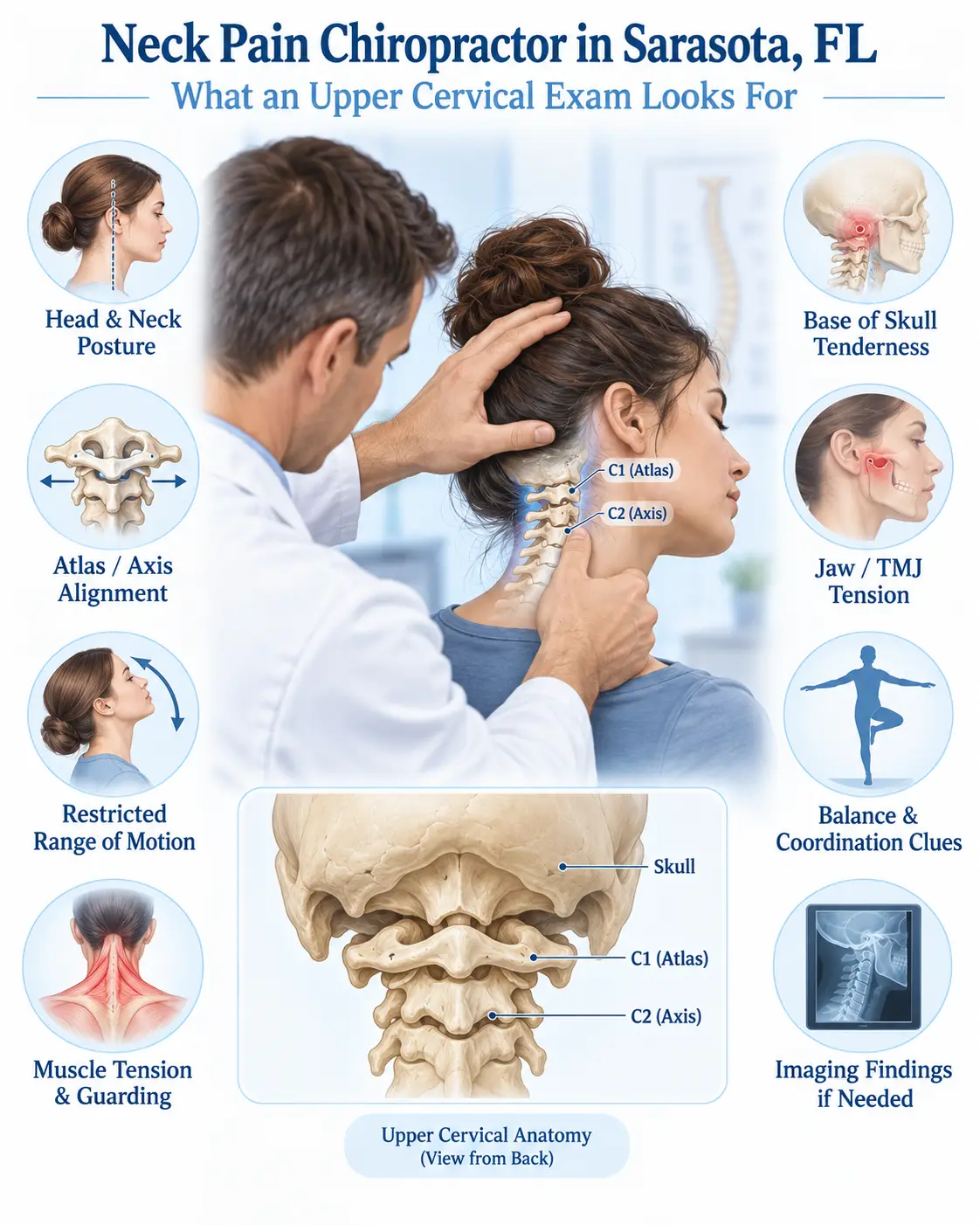
What an upper cervical exam looks for
The top two bones of your neck, the atlas (C1) and axis (C2), are built differently from every other vertebra. There’s no disc between the skull and C1 or between C1 and C2. Those joints are held by ligaments and muscle tone, and they account for roughly half of all the rotation and a large share of the nodding motion in your neck. They also sit millimeters from the brainstem, the vertebral arteries, and the nerve roots that supply the back of the head.
A general chiropractic visit typically evaluates the neck as a whole and adjusts wherever motion feels restricted. An upper cervical exam narrows the question to one thing: is the head sitting centered on C1, and is C1 sitting centered on C2 — in three dimensions — and if not, by exactly how much?
At Lavender Family Chiropractic, that question gets answered with measurements rather than feel:
Posture and leg-length assessment. A head that has shifted off center changes how the body carries itself. We document head tilt, shoulder height, and functional leg-length difference at the first visit and again at each re-check, so change can be measured instead of guessed.
Paraspinal infrared thermography. The muscles along the spine are controlled by the nervous system, and when the upper neck is irritating that system the two sides of the neck often run at different temperatures. Thermography gives us an objective, repeatable reading of that asymmetry. We use it on every visit to decide whether an adjustment is needed that day — many visits are check-only.
3D cone-beam CT imaging. A standard chiropractic X-ray is two-dimensional. The atlas rotates and tilts in three planes, so a flat image can’t show how far it’s off. 3D CBCT imaging lets us measure the misalignment in degrees and millimeters and calculate the precise angle of correction before anyone is adjusted.
Neurological screening. Range of motion, reflexes, sensation, cranial nerve screening, and the red-flag questions below. If something on this screen doesn’t belong in a chiropractic office, you’re told that day and referred.
That workup is why a first visit here runs longer than most people expect. It’s also why the correction, when it happens, is specific: one bone, one direction, one calculated force.
Why the upper neck affects more than the neck
Patients who come in for neck pain often mention, almost as an afterthought, that they also get headaches at the base of the skull, or feel a bit off-balance, or have noticed their vision doesn’t focus as quickly as it used to. Those aren’t unrelated.
The upper cervical spine has the densest concentration of position-sensing receptors in the body. Research on neck disorders has shown that when those receptors send distorted information, it disturbs postural stability, head-and-eye coordination, and the sense of where the head is in space (Treleaven, Manual Therapy 2008). This is part of why a neck problem can feel like a balance problem or an eye problem.
Posture feeds the same loop. A meta-analysis of forward head posture found a consistent relationship between how far the head sits ahead of the shoulders and the presence and intensity of neck pain in adults (Mahmoud et al., Curr Rev Musculoskelet Med 2019). Every inch the head drifts forward increases the load on the muscles that hold it up — and those muscles anchor at C1 and C2.
We’ve written about several of these overlaps in more detail: neck pain and blurry vision, neck pain and nausea, pain and pressure at the base of the skull, and the loss of the normal neck curve that shows up on so many Sarasota X-rays.
What the research supports — and what it doesn’t
We try to be straight about the evidence, because neck-pain patients have usually been oversold something already.
Spinal manipulation for neck pain has good trial evidence. A randomized trial published in the Annals of Internal Medicine compared spinal manipulation, prescription medication, and home exercise with advice for acute and subacute neck pain. At 12 weeks, manipulation produced greater pain reduction than medication, and the advantage was still present at one year (Bronfort et al., Ann Intern Med 2012). Home exercise performed similarly to manipulation, which is why we teach it rather than pretend it doesn’t matter.
Upper cervical care has been studied directly. The largest prospective study of upper cervical chiropractic followed 1,090 patients from the offices of 83 chiropractors and reported outcomes, patient satisfaction, and the rate of symptomatic reactions after care. Reactions were mostly mild and short-lived, and no serious adverse event was reported (Eriksen et al., BMC Musculoskeletal Disorders 2011). It is a large practice-based outcome study, which measures what happens to real patients in real offices, and we describe it that way.
On safety. The question people are sometimes afraid to ask is whether neck adjustments cause strokes. The largest population-based study on the subject, covering nine years of Ontario health records, found that the association between chiropractic visits and vertebrobasilar stroke was no different from the association with primary-care physician visits — consistent with patients seeking care for the early neck pain and headache of a stroke that was already underway, rather than care causing it (Cassidy et al., Spine 2008). The Knee-Chest technique we use also involves no twisting or cracking of the neck. You can read how it works on our Knee-Chest technique page.
If you’d like the broader picture of what upper cervical care can and can’t do for neck pain, our full guide to neck pain treatment in Sarasota covers the anatomy, the causes we see most, and the research in depth.
When neck pain is not a chiropractic problem
Before any exam, we screen for the signs that mean you need a physician or an emergency department, not a chiropractor. Please don’t book with us — go directly to urgent or emergency care — if your neck pain comes with:
- A sudden, severe headache unlike any you’ve had before, or neck pain with fever and a stiff neck
- Weakness, numbness, or loss of coordination in the arms or legs, or trouble with bladder or bowel control
- Neck pain after a significant fall or crash with any loss of consciousness, confusion, or vomiting
- Double vision, slurred speech, facial drooping, or difficulty swallowing
- Unexplained weight loss, a history of cancer, or pain that wakes you and doesn’t change with position
Chiropractic care is also not the right first step for a suspected fracture, an active infection, or unstable ligaments after trauma. Our 3D imaging exists partly so we can see those things and send you to the right place.
Your first visit at our Sarasota office
Our office is at 5899 Whitfield Ave, Suite 107, Sarasota, FL 34243, just off Whitfield Avenue between US-301 and Lockwood Ridge, about ten minutes from University Parkway and Lakewood Ranch. Plan on about an hour for the first appointment.
- History. How it started, what makes it better or worse, prior injuries (including old car accidents and concussions, which patients often forget to mention), and what you’ve already tried.
- Exam. The neurological screen, posture and leg-length assessment, range of motion, and thermography described above.
- Imaging. If the exam indicates upper cervical involvement, a 3D CBCT scan of the upper neck. If it doesn’t, we tell you that and don’t image you.
- Report of findings. Usually at a second visit, so the scan can be measured properly. You see your own images, what we found, and what a care plan would look like, including how many visits and roughly what it will cost. You decide from there.
- First correction, if you choose to proceed — on the Knee-Chest table, no twisting, followed by a rest period and a post-check.
Most patients are then seen more often at the start and less often as the correction holds. Because we check before we adjust, a “holding” visit is short and doesn’t involve an adjustment at all.
Cost, insurance, and PIP — straight answers
Insurance. We are out-of-network with insurance plans. You pay at the time of service and we provide an itemized superbill you can submit to your insurer for any out-of-network reimbursement your plan allows. We keep it this way so that care decisions are made by you and the doctor, not by a claims reviewer. Our insurance page explains how to check your plan’s out-of-network chiropractic benefit.
Cost. Fees are listed on our cost page. You’ll know the full cost of a recommended plan before you commit to it.
Car accidents and PIP. If a crash caused or worsened your neck pain, Florida’s Personal Injury Protection law requires that you receive initial medical care within 14 days of the accident for PIP benefits to apply. Chiropractic care qualifies as initial care. We handle the PIP paperwork with your auto insurer. Details are on our car accident chiropractic page.
How this fits with the rest of what we do
Neck pain is the most common reason someone walks in, but it’s rarely the only thing going on. The same upper cervical misalignment that produces neck pain is what we evaluate in patients with vertigo, headaches, and post-trauma symptomsafter whiplash. If you have neck pain plus one of those, say so at the first visit — it changes how we examine you.
For everything we know about neck pain, from the anatomy to the research to what to do at home between visits, start with our main neck pain treatment in Sarasota guide.
Frequently asked questions
Do you crack or twist the neck? No. The Knee-Chest upper cervical technique uses a light, specific contact at the upper neck with the patient positioned on a special table. There is no rotation and no audible “crack.” Patients who have been nervous about neck adjustments tend to find it anticlimactic.
How many visits will I need? It depends on how long the problem has existed, how much the atlas has shifted, and how well the correction holds. We give you a specific recommendation after the report of findings, and we re-examine at set intervals rather than continuing indefinitely.
Do I need the 3D scan? Only if the exam shows upper cervical involvement. The scan is what lets us calculate the exact correction rather than adjusting by feel. If your exam doesn’t point to the upper neck, we won’t recommend imaging and we’ll refer you to whoever is more appropriate.
Can I be seen the same day for acute neck pain? Often, yes — call (941) 243-3729. A same-day first visit still includes the full exam; we don’t adjust anyone without it.
Do you treat neck pain from a car accident? Yes, and it’s one of the most common reasons people come to us. Remember the 14-day PIP window. Even if the pain feels minor, an early evaluation protects both your recovery and your claim.
Is upper cervical chiropractic different from regular chiropractic? Yes. General chiropractic evaluates and adjusts the whole spine; upper cervical care focuses on measuring and correcting the top two vertebrae with imaging-guided precision and no twisting. We’ve written a plain-language comparison: upper cervical vs. traditional chiropractic.
What areas do you serve? Sarasota, Bradenton, Lakewood Ranch, Palmetto, Parrish, Venice, and the rest of Sarasota and Manatee counties. Patients also drive from Tampa, St. Petersburg, and Fort Myers for upper cervical care.
Schedule With Us!
If neck pain in Sarasota has become something you plan your days around, an upper cervical exam will tell you whether the upper neck is part of the problem — and if it isn’t, we’ll say so. Call (941) 243-3729 or request an appointment online.
References
- Safiri S, Kolahi AA, Hoy D, et al. Global, regional, and national burden of neck pain in the general population, 1990–2017: systematic analysis of the Global Burden of Disease Study 2017. BMJ. 2020;368:m791. PMID 32217608
- Carroll LJ, Hogg-Johnson S, van der Velde G, et al. Course and prognostic factors for neck pain in the general population: results of the Bone and Joint Decade 2000–2010 Task Force on Neck Pain and Its Associated Disorders. Spine. 2008;33(4 Suppl):S75–S82. PMID 18204403
- Treleaven J. Sensorimotor disturbances in neck disorders affecting postural stability, head and eye movement control. Man Ther. 2008;13(1):2–11. PMID 18180194
- Mahmoud NF, Hassan KA, Abdelmajeed SF, Moustafa IM, Silva AG. The relationship between forward head posture and neck pain: a systematic review and meta-analysis. Curr Rev Musculoskelet Med. 2019;12(4):562–577. PMID 31773477
- Bronfort G, Evans R, Anderson AV, Svendsen KH, Bracha Y, Grimm RH. Spinal manipulation, medication, or home exercise with advice for acute and subacute neck pain: a randomized trial. Ann Intern Med. 2012;156(1 Pt 1):1–10. PMID 22213489
- Eriksen K, Rochester RP, Hurwitz EL. Symptomatic reactions, clinical outcomes and patient satisfaction associated with upper cervical chiropractic care: a prospective, multicenter, cohort study. BMC Musculoskelet Disord.2011;12:219. PMID 21974915
- Cassidy JD, Boyle E, Côté P, et al. Risk of vertebrobasilar stroke and chiropractic care: results of a population-based case-control and case-crossover study. Spine. 2008;33(4 Suppl):S176–S183. PMID 18204390
Related Posts



Get our upper cervical articles first.