Military Neck and Loss of the Cervical Curve: Understanding Why Your Neck Goes Straight and How Upper Cervical Care May Help
By Dr. Rusty Lavender, D.C. — upper cervical chiropractor, Lavender Family Chiropractic, Sarasota, FL. Reviewed and updated October 2026.
Military Neck and Loss of the Cervical Curve: You catch your reflection in a store window and something looks off. Your head sits a little forward of your shoulders, your chin juts out, and there is a persistent ache at the base of your skull that never quite goes away. Maybe a recent X-ray or MRI report used a phrase you had never heard before: “loss of the normal cervical lordosis,” “straightening of the cervical spine,” or the informal nickname many people know it by — “military neck.” The name comes from the rigid, stacked-straight posture of a soldier standing at attention, but there is nothing disciplined or comfortable about how it feels. For many people, it feels like tension that will not release, headaches that start in the neck, and a stiffness that makes checking a blind spot while driving a small ordeal.
If any of that sounds familiar, you are not imagining things, and you are far from alone. Neck pain is one of the most common musculoskeletal complaints in the world, and a straightened or reversed cervical curve shows up on imaging every single day in clinics across the country. Yet many people leave their appointment with a printout and a puzzled expression, still unsure what a lost curve actually means, why it happened, and whether anything can be done about it.
This article is written to give you clear, honest answers. We will explain what the normal cervical curve is supposed to do, why it sometimes flattens out, how a straightened neck can load the muscles, nerves, and even the blood vessels of the region, and why the upper neck — the atlas and axis, or C1 and C2 — plays such a central role. We will also walk through how upper cervical chiropractic care works at our Sarasota practice, what the research does and does not show, and the practical lifestyle factors that support a healthier neck. Along the way we will be candid about the limits of what chiropractic care can do and when it is smarter to see a medical doctor first.
What Is Military Neck / Loss of the Cervical Curve?
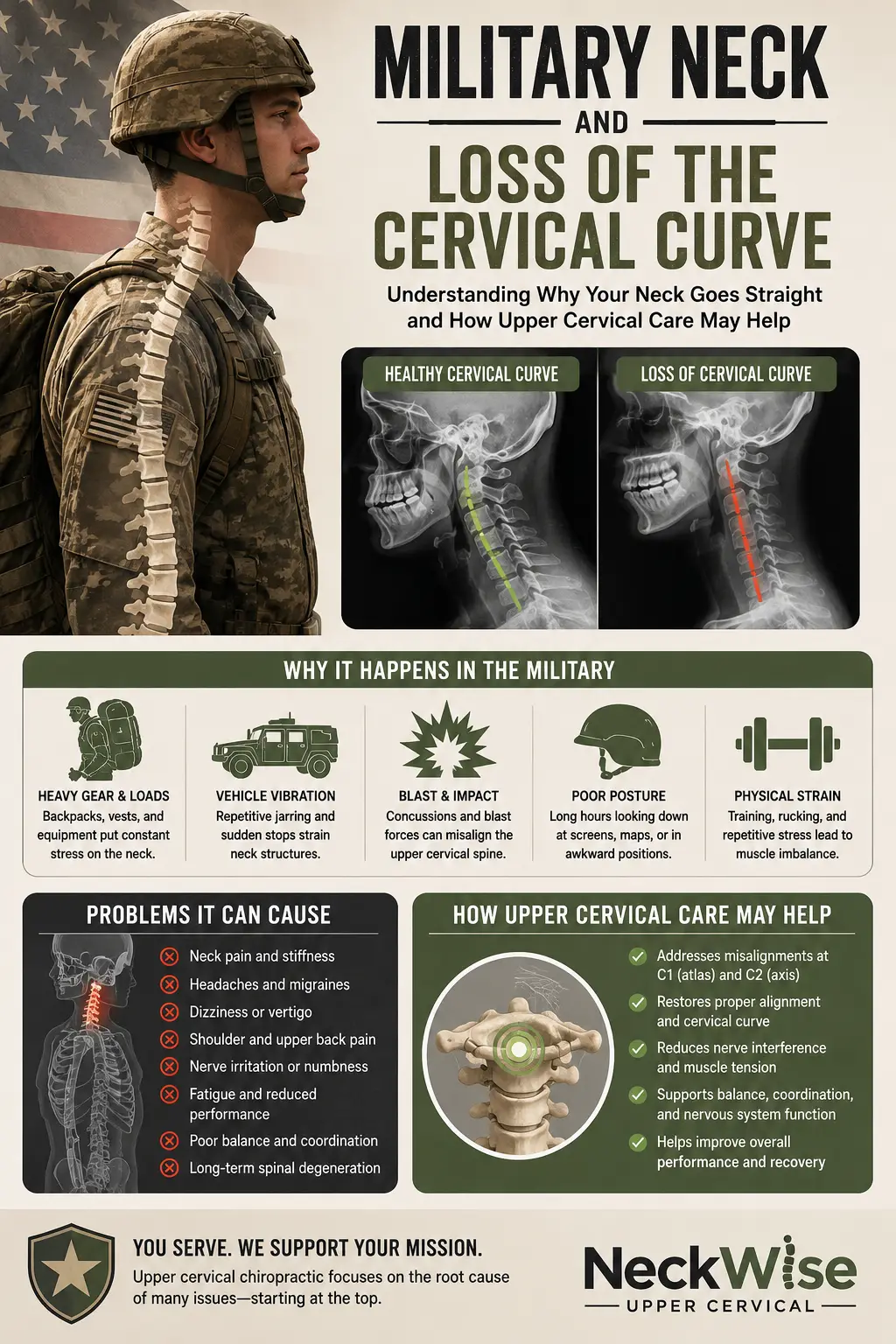
Your cervical spine — the seven vertebrae of the neck, labeled C1 through C7 — is not meant to be a straight column. When viewed from the side, a healthy neck forms a gentle C-shaped curve that arcs slightly forward. This forward curve is called cervical lordosis, and it is one of several curves that give the whole spine its springy, shock-absorbing shape. The lordotic curve helps distribute the considerable weight of the head (roughly ten to twelve pounds, about the weight of a bowling ball) across the vertebrae, discs, and muscles in a balanced way. It lets the neck flex, extend, and rotate while keeping the head centered over the shoulders and the shoulders centered over the hips.
“Loss of cervical lordosis” simply means that this natural forward curve has flattened. In milder cases the neck looks straight on an X-ray, which is where the “military neck” nickname comes from. In more advanced cases the curve can actually reverse, bowing backward into what is called a kyphotic or “S-shaped” alignment. Instead of a smooth arc, the vertebrae stack up like a rigid pole or curve the wrong direction entirely.
It is worth being honest about one thing right away: a straightened cervical curve is a common finding, and it is not always the sole source of a person’s symptoms. Research reviewing the significance of this finding has noted that a meaningful percentage of people without any neck pain at all show some straightening or even reversal of the cervical curve on imaging. In other words, the picture on the film and the pain a person feels do not always line up perfectly. That is exactly why a thorough evaluation matters, and why no responsible clinician should treat an image in isolation from the human being attached to it.
So what causes the curve to flatten in the first place? There are several common contributors:
- Sustained forward head posture. Hours spent looking down at phones, tablets, laptops, and desks pull the head forward of the shoulders. This is so common it has earned its own nickname, “tech neck,” and over time it can encourage the curve to flatten.
- Trauma. Whiplash from a car accident, a fall, or a sports collision can injure the ligaments and muscles that maintain the curve. Sometimes the curve straightens as a protective muscle-guarding response to injury.
- Muscle spasm and guarding. When neck muscles tighten to protect an irritated joint or nerve, they can pull the curve straight. In some cases the straightening is a symptom of an underlying problem rather than the root cause.
- Degenerative changes. Disc thinning and arthritic changes that accumulate with age can gradually alter the mechanics and shape of the neck.
- Postural and occupational habits. Prolonged static positions, poor workstation setup, heavy backpacks, and certain sleeping positions can all play a role over years.
Understanding the cause matters, because the most helpful approach for a curve straightened by decades of desk posture may look different from the approach for a curve straightened by an acute injury. This is where a careful history, examination, and imaging come together to tell a fuller story than any single label like “military neck” ever could. If you want a broader overview of neck pain and its many causes, our main neck pain resource page is a good companion to this article.
The Nerve and Vascular Mechanisms: How a Straightened Curve Loads the Neck
To appreciate why a lost cervical curve can feel the way it does, it helps to understand what that curve is doing behind the scenes. The forward arc of a healthy neck acts like the leaf spring in a vehicle’s suspension. It flexes and recoils, absorbing loads and keeping the small joints, discs, and soft tissues within a comfortable working range. When the curve flattens, that spring-like function is diminished, and the mechanical load has to go somewhere.
Muscular load. With the head drifting forward and the curve gone, the muscles along the back of the neck and upper shoulders have to work harder, essentially holding the weight of the head against gravity for hours at a time. Think of holding a bowling ball close to your chest versus at arm’s length; the farther forward it goes, the more your arm burns. The same principle applies to the muscles supporting a forward-drifting head. Over time this can lead to fatigue, tightness, trigger points, and that familiar deep ache. Interestingly, research using surface electromyography has found that the pattern of muscle activation actually changes in people with a lost cervical curve, with certain stabilizing muscles firing less and others potentially over-firing — a picture more complex than simple “tight muscles,” which we will discuss in the research section below.
The suboccipital region. At the very top of the neck, tucked just beneath the base of the skull, sits a small but mighty group of muscles called the suboccipital muscles. These tiny muscles connect the skull to the first two vertebrae and are densely packed with sensory receptors that help your brain know where your head is in space. They are also intimately connected to the covering of the spinal cord and, through it, to structures that can generate headache pain. When forward head posture and a straightened curve keep these muscles under constant tension, the suboccipital region can become a hotspot for the kind of headaches that start at the base of the skull and wrap forward — often described as tension-type or cervicogenic (neck-origin) headaches.
Nerve considerations. The cervical spine is a busy corridor. The spinal cord runs down through it, and pairs of spinal nerves branch out between each vertebra to serve the neck, shoulders, arms, and hands. When alignment and mechanics are altered over time and combined with degenerative narrowing, some people experience nerve-related symptoms such as radiating pain, tingling, or numbness into the shoulder or arm. It is important to be precise here: not everyone with a straightened curve has nerve involvement, and nerve symptoms always deserve a careful evaluation to identify the true source.
Vascular considerations. Threading up through small openings in the cervical vertebrae are the vertebral arteries, which supply blood to the back of the brain and brainstem. The upper cervical region in particular is an area where these vessels take a winding course. This anatomy is one reason careful, low-force approaches to the upper neck are valued, and it is one more reason a thorough evaluation and appropriate imaging matter before anyone puts hands on the neck. We mention the vascular anatomy not to alarm you but to underscore why precision and gentleness are central to how we practice.
The takeaway is that a lost cervical curve is not just a cosmetic issue on an X-ray. It can change how the muscles work, how the head is supported, and how the sensitive structures of the neck are loaded throughout the day. That is why so many people with a straightened neck describe a whole cluster of complaints — stiffness, headaches, upper-back tension, and fatigue — rather than a single isolated ache.
Why the Upper Neck (Atlas/Axis, C1/C2) Drives So Much of This
If the cervical spine is a corridor, the top two vertebrae are the elegant, complicated hinge at its head. The first cervical vertebra, C1, is called the atlas — named for the mythological figure who held up the sky, because it holds up the skull. Directly beneath it is C2, the axis. Together, this atlanto-axial complex is unlike any other joint in the spine, and understanding it explains why upper cervical care focuses so much attention here.
The atlas is a remarkable structure. Unlike the other vertebrae, it has no large solid body and no disc directly cushioning it from the skull above. Instead, the atlas essentially floats, cradling the base of the skull and held in position largely by a sophisticated web of ligaments and muscles. This design grants the head an extraordinary range of motion but also means the region depends heavily on soft-tissue balance and precise alignment to function smoothly.
The axis below it features a peg-like projection called the dens, or odontoid process, that points upward and acts as a pivot. The atlas rotates around this pivot, and this single joint is responsible for a large share of the head’s rotation — roughly sixty percent of the turning motion when you shake your head “no” happens right here at C1 on C2. That is an enormous amount of movement concentrated in one small, ligament-dependent junction.
This region is also anatomically close to the brainstem and the junction where the brain meets the spinal cord. The brainstem is home to control centers for many automatic functions of the body. We want to be careful and honest here: the presence of important neurology near the upper cervical spine does not mean that adjusting this area treats unrelated organ diseases, and we make no such claims. What it does mean is that the upper neck is a mechanically and neurologically significant area, dense with sensory receptors, and that its alignment and movement can influence how the whole neck balances beneath the head.
Here is the practical logic behind an upper cervical focus: because the head must stay level and the eyes must stay on the horizon, the rest of the spine compensates for imbalances at the very top. If the atlas is not sitting and moving well, the lower cervical vertebrae and even the muscles of the mid-back may shift to keep your eyes level and your head centered. Over time, these compensations can contribute to the postural patterns and muscle imbalances associated with a lost cervical curve. Addressing the upper cervical foundation is, in this view, a way of working with the keystone of the structure rather than only chasing symptoms lower down. You can read more about our specific focus on this region on our upper cervical chiropractic care page.
How Upper Cervical Care Works at Lavender Family Chiropractic
At Lavender Family Chiropractic, our approach to a straightened cervical curve and the neck pain that often accompanies it is methodical, gentle, and highly individualized. We are not interested in guesswork, and we are not interested in aggressive twisting or forceful manipulation. Here is what care with Dr. Rusty Lavender and Dr. Jacob Temple typically looks like.
A thorough consultation and examination. Everything starts with listening. We want to understand your history — how your symptoms began, what makes them better or worse, any accidents or injuries, your work and sleep habits, and what you are hoping to accomplish. From there we perform a physical and neurological examination to assess how your neck moves, where it is tender or restricted, and whether there are any findings that would prompt us to refer you elsewhere first. Being a good clinician means knowing not only what we can help with, but also what warrants a different kind of care.
Precise 3D imaging. Rather than relying on assumptions, we use detailed imaging to see the actual anatomy of your upper cervical spine. Our 3D CBCT imaging — cone beam computed tomography — provides a three-dimensional view that helps us understand the specific orientation of your atlas and axis. This precision is important because the upper neck is highly individual; no two people are built exactly alike, and a specific correction requires specific information.
Objective thermography. We also use Tytron paraspinal infrared thermography, a technology that measures heat patterns along the spine as a reflection of how the nervous system is regulating the tissues on either side of the neck. These scans give us an objective, repeatable way to monitor patterns over time and to help gauge how your body is responding, without any radiation and without touching the skin.
The Knee Chest Upper Cervical technique. Our correction method is the Knee Chest Upper Cervical technique, a low-force, highly specific approach. There is no twisting of the neck, no forceful cranking, and none of the popping or cracking that many people associate with chiropractic. Instead, the adjustment is a precise, gentle contact designed to encourage the atlas toward a more balanced position based on your individual imaging. For people who feel understandably nervous about their necks — especially those with a history of injury or those who simply dislike being “cracked” — this gentle, specific style is often a welcome relief.
Customized care plans. Because every neck and every history is different, we build customized care plans tailored to your findings, your goals, and how your body responds over time. We monitor your progress with repeat examinations and scans and adjust the plan accordingly. You can learn more about how we structure this individualized approach on our customized care plans page. Our aim throughout is natural neck pain relief that respects your body’s own capacity to adapt, rather than a one-size-fits-all routine.
We should be clear about the honest limits of this work. Upper cervical chiropractic care is a conservative, drug-free approach to supporting spinal alignment and function, and many people find it helpful as part of managing neck discomfort. It does not treat structural disease, it is not a substitute for emergency care, and it does not treat conditions unrelated to the musculoskeletal and nervous systems. Our commitment is to be straightforward with you about what we see and what we can reasonably offer.
Ready to Understand Your Neck Better? Let’s Talk
If you have been told you have a straightened neck or military neck, or if you are simply tired of living with daily stiffness and tension, we would be glad to help you understand what is going on and whether upper cervical care is a good fit for you. You can call our team at (941) 243-3729 to ask questions or schedule an evaluation, or use our convenient online new patient scheduling to book a time that works for you. Our office is located at 5899 Whitfield Avenue, Suite 107, Sarasota, FL 34243, right at the corner of University and Whitfield, and we serve patients throughout the greater Sarasota and Bradenton region. There is no pressure and no obligation — just clear, honest answers about your neck.
What the Research Says
We believe in being straight with our patients about what the science does and does not support. The research on cervical lordosis is genuinely nuanced, and we think it is more respectful to share that nuance than to cherry-pick. Here are five peer-reviewed studies worth knowing about.
- In a cross-sectional study titled “Analysis of abnormal muscle activities in patients with loss of cervical lordosis”published in BMC Musculoskeletal Disorders (2023), researchers used surface electromyography to compare cervical muscle activation in people with and without a normal cervical curve. They found that loss of the normal curve was associated with altered muscle activation patterns — including reduced activity in the trapezius and rhomboid muscles in certain positions and possible over-firing of the upper trapezius — which the authors suggest may contribute to neck musculoskeletal pain.
- A narrative review, “Loss of cervical lordosis: What is the prognosis?” published in the Journal of Craniovertebral Junction and Spine (2017), synthesized the literature on straightened and reversed cervical curves. Notably, it reports that roughly twenty percent of people without any symptoms show straightening or inversion of the curve, underscoring that this imaging finding must always be interpreted in the context of the whole patient rather than in isolation.
- A study on the “Efficacy of Modified Cervical and Shoulder Retraction Exercise in Patients With Loss of Cervical Lordosis and Neck Pain” published in Annals of Rehabilitation Medicine (2020) followed patients through a targeted exercise program and found that cervical alignment and neck pain measures tended to improve over a six-to-eight-week period, supporting the value of active rehabilitation as part of a comprehensive approach.
- A prospective cross-sectional study, “Alterations of Cervical Lordosis in Neck Pain Patients” published in the Journal of Orthopaedic Case Reports (2025), examined 255 adults with neck pain and, interestingly, found no consistent statistical association between cervical curve measurements and the presence or type of neck pain. We include this study deliberately: it is a good reminder that the relationship between the curve on a film and a person’s pain is complicated, and that care should be individualized rather than assuming the curve alone explains everything.
- Finally, the large-scale analysis “Global, regional, and national burden of neck pain, 1990–2020, and projections to 2050” published in The Lancet Rheumatology (2024) as part of the Global Burden of Disease Study documents just how widespread neck pain is worldwide and projects a substantial increase — roughly a third more cases — by 2050. This underscores why thoughtful, conservative approaches to neck health matter for so many people.
Read together, these studies paint a realistic picture: a lost cervical curve is common, its relationship to pain is not always one-to-one, muscle function is genuinely altered in many people with a straightened neck, and conservative approaches like targeted exercise show promise. That is exactly the kind of honest, individualized landscape our care is designed to navigate.
Lifestyle Factors That Help
Care in our office is only part of the equation. What you do during the other hundred-plus waking hours of your week has an enormous influence on your neck. Here are the lifestyle factors we discuss most often with patients, all of which can support natural neck pain relief and a healthier cervical spine.
Manage your screen and posture habits. The single biggest daily contributor to forward head posture is looking down at screens. Try to raise your phone toward eye level rather than dropping your head to it. Set your monitor so the top third of the screen is at eye height, and keep your ears stacked roughly over your shoulders rather than jutting forward. Take a posture break every twenty to thirty minutes — even standing up, rolling the shoulders back, and gently drawing the chin backward (a “chin tuck”) can help interrupt hours of static loading. Our article on breaking free from tech neck goes deeper into practical strategies for the digital habits that quietly reshape the neck over time.
Optimize your sleep setup. You spend roughly a third of your life in bed, so your pillow and sleep position matter a great deal. A pillow that is too high shoves the head forward all night; one that is too flat lets it fall back. The goal is to keep the neck in a neutral, supported position whether you sleep on your back or your side. Stomach sleeping is generally the hardest position on the neck because it forces the head into prolonged rotation. Small adjustments here can pay real dividends in morning stiffness.
Strengthen the deep cervical flexors. Deep in the front of your neck lie small stabilizing muscles — the deep cervical flexors — that act like the core muscles of your neck. When they are weak, the larger, more superficial muscles take over and fatigue. Gentle chin-tuck exercises, performed slowly and without strain, are a well-studied way to begin re-engaging these stabilizers. As the research on retraction exercises above suggests, consistent, targeted movement can be a meaningful part of supporting cervical alignment. We are happy to show you specific exercises appropriate for your situation.
Stay generally active and hydrated. The discs and soft tissues of the spine depend on movement and good hydration to stay healthy. Regular walking, general exercise, and simply avoiding long stretches of stillness all support the neck. Managing stress helps too, since chronic stress tends to live in the shoulders and neck as sustained muscle tension.
None of these habits are a replacement for a proper evaluation, but together they create the conditions in which your neck can function and recover more comfortably. Think of them as the daily foundation that professional care builds upon.
Serving Sarasota and Surrounding Communities
Lavender Family Chiropractic is proud to serve patients throughout Southwest Florida from our office at the corner of University and Whitfield. Whether you are a longtime local or new to the area, we welcome patients traveling from across the region who are seeking a gentle, specific approach to neck pain treatment and upper cervical care. We regularly see patients from Sarasota, Bradenton, Lakewood Ranch, Venice, Palmer Ranch, Osprey, Siesta Key, Longboat Key, Lido Key, University Park, Parrish, Ellenton, Myakka City, Punta Gorda, and St. Petersburg. If you are anywhere in the greater Sarasota and Manatee County area and living with a straightened neck or nagging cervical discomfort, we would be honored to help you understand your options.
Top 15 Questions About Military Neck
1. What exactly is “military neck”? Military neck is an informal name for loss of the normal forward curve (lordosis) of the cervical spine. Instead of a gentle C-shaped arc, the neck appears straight — or in more advanced cases, curved in the reverse direction — on a side-view X-ray. The nickname refers to the stiff, upright posture of standing at military attention.
2. Is a straight neck always a problem? Not necessarily. Research has shown that a meaningful share of people with no symptoms at all still show a straightened curve on imaging. The finding matters most when it is combined with symptoms, altered mechanics, or other examination findings. This is precisely why a thorough evaluation is so important rather than reacting to an image alone.
3. What causes the cervical curve to flatten? Common contributors include sustained forward head posture from screens and desk work, whiplash or other trauma, protective muscle spasm, degenerative changes with age, and long-term postural habits. Often it is a combination of factors that builds up over years.
4. Can a lost cervical curve cause headaches? It can be associated with them. When the curve flattens and the head drifts forward, the small suboccipital muscles at the base of the skull can stay under constant tension, which is linked to tension-type and cervicogenic (neck-origin) headaches. Many patients describe headaches that begin at the base of the skull.
5. Why do you focus on the upper neck, C1 and C2? The atlas (C1) and axis (C2) form the mobile, ligament-dependent foundation of the neck and account for a large portion of head rotation. Because the body works to keep the head level, imbalances at the top can drive compensations lower down. Addressing this foundation is a way of working with the keystone of the structure.
6. Is the adjustment going to hurt or involve cracking my neck? No. We use the Knee Chest Upper Cervical technique, a low-force, specific method. There is no twisting, no forceful cranking, and no popping or cracking. It is a gentle, precise contact guided by your individual imaging, which many nervous or injury-wary patients find reassuring.
7. Why do you take 3D imaging before adjusting? The upper cervical spine is highly individual, and a specific correction requires specific information. Our 3D CBCT imaging provides a three-dimensional view of your atlas and axis so that any correction is based on your actual anatomy rather than assumptions.
8. What is the Tytron thermography scan for? Tytron paraspinal infrared thermography measures heat patterns alongside the spine that reflect how your nervous system is regulating the surrounding tissues. It gives us an objective, radiation-free way to monitor patterns over time and help gauge how your body is responding to care.
9. Can upper cervical care restore my curve completely? We do not make guarantees about restoring any specific curve. Bodies vary, and the relationship between the curve and symptoms is complex. Our goal is to support better alignment and function and to pursue natural neck pain relief, monitoring your individual response with repeat examinations and scans along the way.
10. How long will I need care? That depends on your history, your findings, and how your body responds. Rather than a fixed formula, we build a customized care plan around your situation and adjust it as we track your progress. We will always talk through what we are seeing and recommending.
11. Do you take my insurance? We are a cash-pay, out-of-network practice, which means we do not bill insurance directly. We provide detailed superbills that you can submit to your insurance company for possible reimbursement, depending on your individual plan. This model lets us focus our time on individualized care rather than insurance requirements. Our team is happy to explain the details when you call.
12. When should I see a medical doctor instead of, or in addition to, a chiropractor? This is an important one. You should seek prompt medical evaluation if your neck pain follows a significant trauma such as a car accident or fall; if you have progressive weakness, numbness, or loss of coordination in the arms or legs; problems with bladder or bowel control; unexplained fever, weight loss, or a history of cancer; or a sudden, severe “worst headache of my life,” dizziness, slurred speech, or vision changes. These can signal conditions that require medical or emergency care. Part of good chiropractic practice is recognizing when to refer you to the right professional first.
13. Can exercises alone help my straightened neck? Targeted exercise appears genuinely valuable. A study on modified cervical and shoulder retraction exercises found that cervical alignment and neck pain measures tended to improve over several weeks. We often incorporate specific deep cervical flexor and postural exercises alongside in-office care for a more comprehensive approach.
14. Is military neck a lifelong condition? We avoid absolute language here because bodies are adaptable and every case is different. Some curves respond to conservative care and lifestyle change more than others, and factors like the underlying cause and how long it has been present all play a role. An evaluation is the clearest way to understand your particular situation.
15. How do I get started at Lavender Family Chiropractic? The easiest path is to call us at (941) 243-3729 or use our online scheduling link. We will begin with a consultation and examination, gather appropriate imaging, and talk through whether upper cervical care is a good fit for you — with no pressure and clear, honest answers.
Closing: Take the Next Step Toward a More Comfortable Neck
Living with a straightened neck and the tension, stiffness, and headaches that often come with it can be genuinely wearing. You do not have to simply accept it as your new normal, and you also do not have to gamble on aggressive, forceful treatment. At Lavender Family Chiropractic, Dr. Rusty Lavender and Dr. Jacob Temple offer a gentle, specific, and individualized approach to neck pain treatment built on careful imaging, honest communication, and respect for your body’s own ability to adapt.
If you are ready to understand what is happening in your neck and explore whether upper cervical care may help, we would love to meet you. Call our friendly team at (941) 243-3729, or book directly through our online new patient scheduling. You will find us at 5899 Whitfield Avenue, Suite 107, Sarasota, FL 34243, at the corner of University and Whitfield. You can also reach us anytime through our contact page, or get to know Dr. Rusty and Dr. Jacob first by visiting our meet the team page. Your neck has carried you a long way — let us help you care for it.
Related Articles
Related Posts


Get our upper cervical articles first.