Neck Pain and High Blood Pressure: Exploring the Atlas, Brainstem, and Autonomic Connection
By Dr. Rusty Lavender, D.C. — upper cervical chiropractor, Lavender Family Chiropractic, Sarasota, FL. Reviewed and updated October 2026.
High Blood Pressure: If you live with neck pain and you also happen to be watching your blood pressure numbers, you may have wondered whether the two are somehow related. It is one of the most common questions we hear at our Sarasota practice: “Could my stiff, achy neck have anything to do with what my doctor keeps calling my ‘borderline’ or ‘high’ blood pressure readings?” It is a fair question, and it sits at the intersection of anatomy, neurology, and a genuinely fascinating area of research that has grown over the past two decades.
Before we go a single sentence further, we want to be direct with you about something important. High blood pressure, also called hypertension, is a serious medical condition. It is primarily diagnosed, monitored, and managed by physicians, and it should stay that way. Nothing in this article is a promise, a treatment claim, or a reason to change anything your medical doctor has recommended. Upper cervical chiropractic care, including the care we provide, is care for the neck and nervous system. It is not a treatment for hypertension, and we will never present it as one. Our goal here is simply to explore an honest, science-informed conversation about the neck, the upper cervical spine, the brainstem, and the autonomic nervous system, and to explain how our approach to natural neck pain relief works.
With that foundation set, let’s dig into what people are actually noticing, what the research does and does not say, and how thoughtful upper cervical chiropractic care fits into a broader, physician-led picture of whole-body wellness.
Blood Pressure: Understanding the Neck–Blood Pressure Question
When patients ask us about neck pain and blood pressure, they are usually describing one of a few experiences. Some notice that on days their neck is especially tight, their home blood pressure cuff reads a little higher. Others have read online that the small bones at the top of the spine sit close to structures that help regulate circulation. And some are simply curious people who want to understand their own bodies more deeply. All of these are legitimate starting points for a conversation.
Here is the honest, big-picture truth that every reader deserves to hear first. The overwhelming majority of high blood pressure cases, roughly nine in ten, are what physicians call “essential” or “primary” hypertension. That means there is no single, identifiable cause. Instead, it is multifactorial, arising from a complex interplay of genetics, age, body weight, dietary sodium, physical activity, alcohol intake, chronic stress, sleep quality, kidney function, hormonal signaling, and the stiffness of the arteries themselves. Because the drivers are many and interconnected, hypertension is managed medically, typically through a combination of lifestyle changes and, when appropriate, medication that your physician prescribes and adjusts over time.
A smaller portion of cases, called “secondary” hypertension, can be traced to a specific underlying cause such as certain kidney conditions, hormonal disorders, sleep apnea, or particular medications. Even in these cases, the pathway to help runs through medical evaluation and physician-directed care.
So where does the neck come in? Not as a cause of essential hypertension in the way sodium or genetics might contribute. Rather, the neck enters the conversation because of anatomy and neurology. The upper neck houses and protects the lower brainstem and the pathways of the autonomic nervous system, which is the part of your nervous system that quietly regulates involuntary functions, including heart rate and the moment-to-moment tone of your blood vessels. That physical closeness is why researchers have been curious enough to study the relationship at all, and it is why we treat the topic with both interest and caution. Neck pain is real, neck pain deserves care, and neck pain treatment is our focus. Whether addressing the neck has any measurable relationship to blood pressure in any individual is a separate question that remains under study.
Neck pain itself, entirely apart from blood pressure, is worth taking seriously. It is one of the most common and disabling musculoskeletal complaints in the world, and it can quietly erode sleep, focus, mood, and quality of life. That alone is reason enough to seek thoughtful, conservative, natural neck pain relief.
The Autonomic Nervous System, the Brainstem, and Blood Pressure Regulation
To understand why the upper neck is even part of this discussion, it helps to understand how your body regulates blood pressure from second to second. You do not consciously tell your heart to beat faster when you stand up, or your blood vessels to tighten when you step into a cold room. Those adjustments happen automatically, orchestrated by the autonomic nervous system.
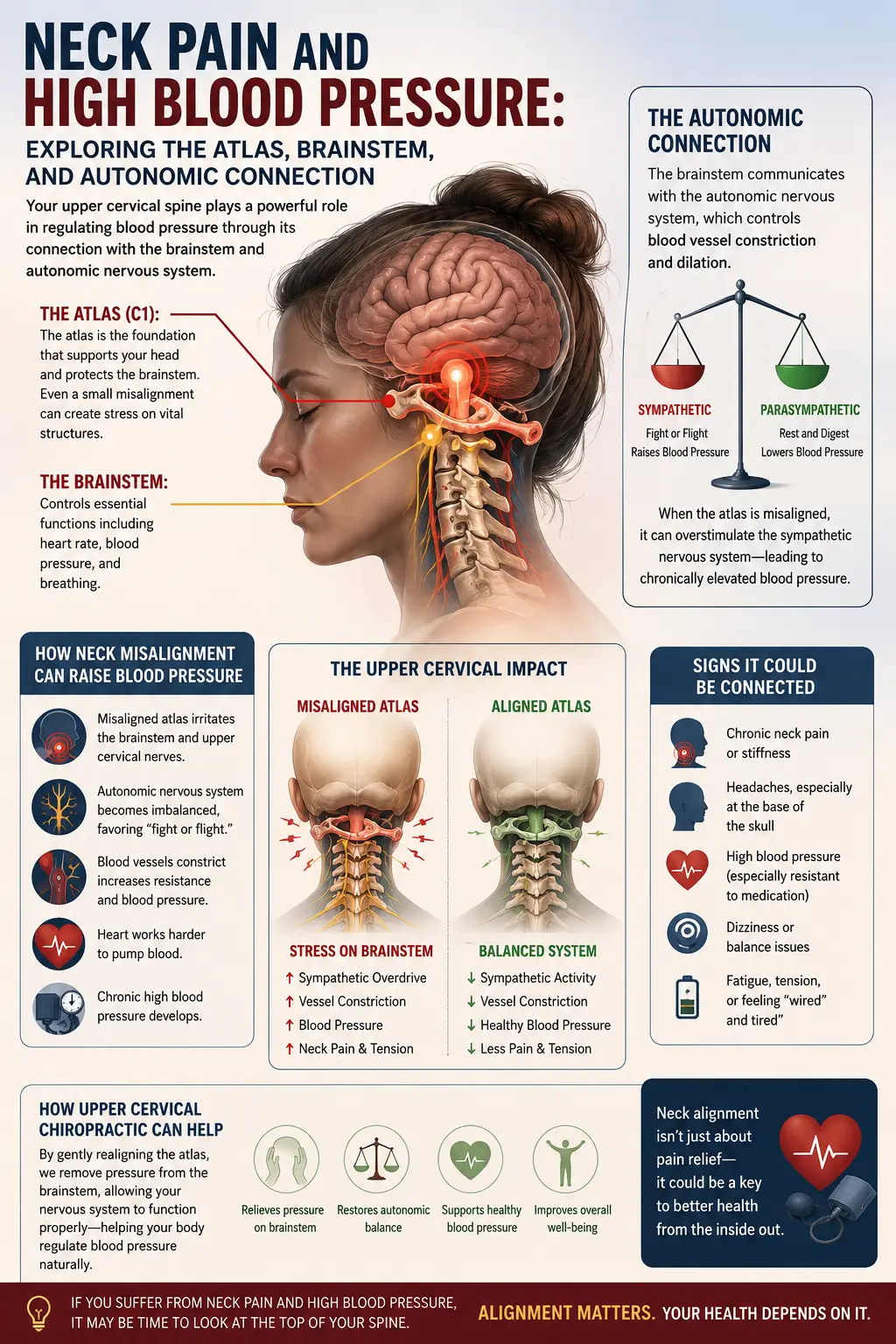
The autonomic nervous system has two main branches that work in balance. The sympathetic branch is often summarized as the “fight or flight” system. When activated, it tends to increase heart rate and constrict blood vessels, which raises blood pressure to prepare you for action. The parasympathetic branch, often called “rest and digest,” generally does the opposite, helping to slow the heart and promote a calmer, lower-pressure state. Healthy function depends not on one branch dominating, but on the two staying responsive and appropriately balanced.
At the center of this regulation sits the brainstem, and specifically a region of the lower brainstem called the medulla oblongata. Within the medulla lives a critical structure called the nucleus tractus solitarius, or NTS. Think of the NTS as a control room. It continuously receives signals from pressure sensors called baroreceptors, which are located in the walls of major arteries such as the carotid arteries in the neck and the aortic arch near the heart. When blood pressure rises, these baroreceptors fire more, the NTS registers the change, and it orchestrates a response: it dials down sympathetic outflow and dials up parasympathetic activity to bring pressure back toward a healthy range. When blood pressure drops, the reverse happens. This elegant, self-correcting feedback loop is called the baroreflex, and it runs through the brainstem constantly, whether you are sleeping, exercising, or reading this sentence.
The reason this matters for our conversation is location. The medulla, where so much of this cardiovascular regulation is coordinated, sits at the very base of the skull, right where the brainstem transitions into the spinal cord. And the bones that surround and protect that transition are the uppermost vertebrae of the neck. In other words, the machinery that helps regulate blood pressure lives inside a bony neighborhood that also happens to be the region an upper cervical chiropractor is trained to evaluate. That physical relationship is the seed from which the research questions grow. It does not, by itself, prove that neck alignment influences blood pressure in any given person. But it does explain why serious researchers have found the question worth investigating.
Why the Upper Neck (Atlas/Axis, C1/C2) Is Part of the Conversation
The top of your neck is anatomically unlike any other region of your spine. The first cervical vertebra is called the atlas, or C1. It is named after the mythological figure who held the heavens on his shoulders, because the atlas holds up your head, which weighs roughly ten to twelve pounds. Directly beneath it sits the second cervical vertebra, the axis, or C2, which features a bony peg called the odontoid process, or dens, that projects upward and allows the atlas to pivot around it.
What makes this region so distinctive is that it is built for mobility rather than for the interlocking stability found lower in the spine. The atlas has no vertebral body and no intervertebral disc separating it from the skull above or the axis below. Instead, the head-neck junction relies heavily on ligaments and muscles to hold everything in position. The atlas is often described as a ligamentous vertebra for this reason. The tradeoff for all that freedom of movement is that the upper neck depends on soft-tissue balance to maintain its position. Roughly sixty percent of the rotation in your entire neck, the motion that lets you turn your head to check a blind spot while driving, occurs at the C1–C2 joint alone. That is a remarkable concentration of movement in a very small space.
Now consider what passes through and near this region. The lower brainstem transitions into the spinal cord right here. The vertebral arteries thread up through openings in these vertebrae on their way to supply the brain. Dense networks of small nerves, blood vessels, and specialized position sensors called proprioceptors are packed into the surrounding joints, ligaments, and deep muscles. The upper cervical spine is, in fact, one of the most richly innervated regions of the entire body, with an extraordinary density of these position sensors feeding constant information to the brainstem about the orientation of your head and neck.
Here is where the reasoning that motivates upper cervical care comes in, and we want to state it carefully as a hypothesis rather than a settled fact. When the atlas or axis shifts even slightly out of its ideal position, a misalignment that upper cervical practitioners refer to as a subluxation, the theory holds that it may create mechanical tension, altered joint mechanics, and irritation of the richly innervated tissues in this sensitive region. Because those tissues sit so close to the brainstem and feed so much information into it, the proposed idea is that persistent irritation could influence how the nervous system is functioning, potentially including the autonomic pathways that share the neighborhood. This is the mechanistic rationale behind upper cervical chiropractic care, and it is why the region draws so much attention. It is a plausible and interesting hypothesis grounded in real anatomy. It is not, however, the same as proof that correcting an atlas misalignment changes blood pressure, and we are careful never to overstate it.
What we can say with confidence is that when the upper neck is irritated or restricted, people frequently experience real symptoms, including neck pain, stiffness, headaches, a sense of pressure at the base of the skull, and sometimes dizziness. Those are the concerns we are trained to evaluate and address, and providing gentle, specific neck pain treatment for them is squarely within our scope.
What the Bakris Atlas Study and Other Research Show
No honest discussion of neck alignment and blood pressure can skip the study that started so many of these conversations, and no honest discussion can present it without careful caveats. In 2007, a research team led by Dr. George Bakris, a widely respected hypertension specialist, published a small pilot study in the Journal of Human Hypertension examining whether realigning the atlas vertebra was associated with changes in blood pressure among people with early-stage hypertension.
The study was thoughtfully designed for its size. It was a double-blind, placebo-controlled trial, which is a rigorous format. Fifty patients with Stage 1 hypertension were randomly assigned to receive either a genuine upper cervical alignment procedure, performed using the National Upper Cervical Chiropractic Association method, or a convincing sham procedure that felt similar but was not a real correction. Neither the patients nor the people measuring their blood pressure knew who received which. At eight weeks, the group that received the genuine atlas procedure showed a notably larger average reduction in blood pressure than the placebo group, and the authors described the difference as comparable in magnitude to what might be seen with a two-drug blood pressure regimen.
Those results understandably generated excitement, and they are worth knowing about. But they must be read with real discipline, and here is where we insist on honesty. This was a pilot study, which by definition is a small, preliminary investigation meant to determine whether a larger study is worth doing, not to establish a treatment. Fifty participants is a small sample. The eight-week window was short. And crucially, in the years since, the findings have not been definitively replicated in the kind of large, multi-center trials that would be required before anyone could responsibly claim that upper cervical care influences blood pressure in the general population. The authors themselves called for larger studies. A single promising pilot is a reason for continued research curiosity, not a reason to reframe chiropractic care as a blood pressure intervention. We present the Bakris study because it is real, interesting, and directly relevant to this topic, and precisely because it is so often misrepresented, we take extra care to describe it accurately.
Beyond that single study, there is a broader body of research exploring how the cervical spine, the autonomic nervous system, and cardiovascular regulation interact. Some studies have examined whether cervical spine work produces short-term, measurable shifts in autonomic markers such as heart rate variability. Others have mapped the neuroanatomy that connects the upper cervical spinal cord to the brainstem circuits that handle cardiac and vascular signals. Taken together, this literature makes the underlying anatomy and the general questions credible and worth studying further. What it does not do, and what we will not pretend it does, is establish that upper cervical chiropractic care has any effect on blood pressure or serves as care for hypertension. The most accurate summary is this: the anatomical relationships are real, some early findings are intriguing, and the science remains preliminary and in need of larger, higher-quality replication. That is the honest state of the evidence, and it is the frame we bring to every conversation with our patients.
How Upper Cervical Care Works at Lavender Family Chiropractic
Let’s set the research aside for a moment and talk about what actually happens when you come to see us, because our care is focused on your neck and nervous system, not on your blood pressure numbers. We want to be unambiguous about that: what we offer is neck pain treatment and support for healthy nervous system function. It is not a hypertension treatment, and if you have high blood pressure, your physician remains the appropriate professional to diagnose and manage it.
Everything begins with a thorough consultation and history. We want to understand your symptoms, your health goals, your prior injuries such as old car accidents, sports impacts, or falls, and how your neck concerns affect your daily life. This is a conversation, and it is where care becomes personal.
From there, precision matters. The upper cervical spine is a small, complex region, and effective, specific care depends on knowing exactly what is happening in your unique anatomy rather than guessing. That is why we use advanced imaging and measurement. We use 3D CBCT imaging, a cone beam computed tomography technology that produces detailed three-dimensional views of the upper cervical vertebrae. This lets us see the true orientation of your atlas and axis with a level of clarity that flat, two-dimensional images simply cannot match, so that any correction we design is tailored to you. Alongside imaging, we use Tytron paraspinal infrared thermography, a completely non-invasive scan that measures subtle heat patterns alongside the spine. Because skin temperature is influenced by the autonomic nervous system, these thermographic readings give us an objective, repeatable window into how your nervous system is functioning over time and help us track your response to care.
When it comes to the actual adjustment, our approach is deliberately gentle. We practice the Knee Chest Upper Cervical technique, a low-force, highly specific method. There is no twisting of the neck, no forceful cracking, and no popping. Instead, a precise, controlled contact is used to encourage the atlas toward its optimal position based on your individual imaging and measurements. Many patients are surprised by how light and specific it feels, especially those who expected the dramatic manipulation they associate with chiropractic care in general. For people who feel apprehensive about their necks, this gentleness is often a relief.
Care at our practice is also structured around your individual needs rather than a one-size-fits-all formula. After we have reviewed your history, imaging, and thermography, we design a customized care plan built specifically for you and your goals. Upper cervical corrections tend to be most meaningful when the body has time to learn and hold a healthier position, so our plans are thoughtfully mapped out to support that process, with objective re-measurement along the way so that we and you can see how you are responding.
Throughout all of this, our lane stays clear. We are caring for your neck and supporting healthy nervous system function through natural neck pain relief. We are not measuring, diagnosing, or managing your blood pressure, and we will always encourage you to keep that care where it belongs, with your physician.
Ready to Talk About Your Neck? We’re Here in Sarasota
If neck pain, stiffness, headaches, or that nagging pressure at the base of your skull have been wearing on you, we would be glad to help you explore whether upper cervical care is a good fit. You can reach Lavender Family Chiropractic by phone at (941) 243-3729, or you can book a new patient appointment online at any time. Our office is located at 5899 Whitfield Avenue, Suite 107, Sarasota, FL 34243, right at the corner of University and Whitfield, and we welcome patients from across the greater Sarasota and Bradenton area. Whether you are simply curious about the atlas–brainstem connection or you have been searching for gentle, specific neck pain treatment, a conversation is the best place to start.
What the Research Says
Below are five real, peer-reviewed sources for readers who want to explore the science themselves. We encourage you to read them in full and to interpret them, as we do, with appropriate caution.
- Bakris et al., atlas vertebra realignment and arterial pressure goal in hypertensive patients: a pilot study (Journal of Human Hypertension, 2007). This small, double-blind, placebo-controlled pilot study of fifty patients with early-stage hypertension reported larger average blood pressure reductions in the group receiving a genuine upper cervical alignment procedure than in the sham group at eight weeks; the authors emphasized that it was preliminary and called for larger studies, and it has not since been definitively replicated in large trials.
- Global, regional, and national burden of neck pain, 1990–2020, and projections to 2050: a systematic analysis of the Global Burden of Disease Study 2021 (The Lancet Rheumatology). This large epidemiological analysis found that neck pain affected roughly 203 million people worldwide in 2020 and is projected to keep rising, underscoring how common and disabling neck pain is as a musculoskeletal problem.
- Neural set point for the control of arterial pressure: role of the nucleus tractus solitarius (PMC). This review examines how the nucleus tractus solitarius in the medulla of the brainstem serves as a central integrating hub for the baroreflex and for setting the level around which arterial blood pressure is regulated.
- Effects of upper and lower cervical spinal manipulative therapy on blood pressure and heart rate variability in volunteers and patients with neck pain (PMC). This small randomized, controlled, cross-over preliminary study explored short-term effects of cervical manipulation on blood pressure and heart rate variability, illustrating both the ongoing scientific interest in the neck–autonomic relationship and the preliminary, limited nature of current evidence.
- Effectiveness of spinal manipulation in influencing the autonomic nervous system: a systematic review and meta-analysis (PMC). This systematic review and meta-analysis synthesizes studies on whether spinal manipulation measurably affects autonomic nervous system activity, concluding that effects are detectable but heterogeneous, which reinforces the need for cautious interpretation and further research.
Lifestyle Factors That Support Your Neck and Whole-Body Wellness
Whatever you decide about upper cervical care, some of the most powerful influences on both neck comfort and overall cardiovascular wellness are the everyday habits within your control. These do not replace medical care for blood pressure, and they are not treatments, but they are foundations of health that your physician will almost certainly endorse.
Stress is near the top of the list. Chronic stress keeps the sympathetic branch of the autonomic nervous system persistently activated, which tends to tighten muscles, including the deep muscles of the neck and shoulders, and keeps the body in a heightened state. Building genuine recovery into your life, through breathing practices, unhurried walks, time outdoors, or whatever restores you, gives the nervous system a chance to settle. Many people carry visible stress in their upper neck and shoulders without even realizing it.
Sleep is the second pillar. Poor or insufficient sleep is associated with worse cardiovascular health and with heightened pain sensitivity, so it works against you on two fronts. Sleep position matters too. A pillow that keeps the head and neck in a neutral, well-supported position, rather than propped too high or twisted to one side, can make a real difference in how your upper neck feels in the morning.
Posture is the third. Modern life bends us forward over phones, laptops, and steering wheels for hours, loading the neck in ways it was not designed to sustain. Simple habits, such as raising screens to eye level, taking movement breaks, and strengthening the muscles that hold you upright, reduce the daily strain on the cervical spine. If you would like practical, at-home strategies, our guide to natural neck pain remedies offers approachable ideas you can start using today, and our broader neck pain resource explains common causes and conservative options in more depth.
The theme tying these together is that your neck and your cardiovascular system both respond to how you live. Movement, rest, stress recovery, and good ergonomics support the whole person. None of them is a substitute for the care your physician provides, and together they create the kind of foundation on which any other care, including upper cervical chiropractic, is more likely to be meaningful.
Serving Sarasota and Surrounding Communities
Lavender Family Chiropractic is proud to serve patients throughout the Suncoast region. While our office is located in Sarasota at the corner of University and Whitfield, we regularly welcome individuals and families from across Southwest Florida who are seeking gentle, specific upper cervical care and natural neck pain relief.
We serve patients from Sarasota, Bradenton, Lakewood Ranch, Venice, Palmer Ranch, Osprey, Siesta Key, Longboat Key, Lido Key, University Park, Parrish, Ellenton, Myakka City, Punta Gorda, and St. Petersburg. Whether you are just down the road in University Park or making the drive from Venice or Punta Gorda to the south, or from St. Petersburg to the north, our team is glad to help you understand your options. Many of our patients tell us the focused, unhurried nature of upper cervical care is worth the trip, and we work to make each visit efficient and worthwhile.
If you are located anywhere in the greater Sarasota and Bradenton area and you have been searching for thoughtful, conservative neck pain treatment, we would love to meet you and learn about your goals.
Top 15 Questions About Neck Pain, Blood Pressure, and Upper Cervical Care
1. Can a neck problem influence blood pressure? This is an area of ongoing research rather than settled fact. The upper neck sits close to the brainstem, which houses key blood pressure regulation centers, and a small pilot study has explored the relationship. But the science is preliminary, and high blood pressure is a medical condition managed by physicians. We provide care for the neck and nervous system, not treatment for blood pressure.
2. Does upper cervical chiropractic care treat high blood pressure? No. We never present our care as a treatment for hypertension, and you should be cautious of anyone who does. Upper cervical care is care for your neck and nervous system. Any blood pressure concerns should be evaluated and managed by your medical doctor.
3. Should I stop my blood pressure medication if I start upper cervical care? No, absolutely not. Please continue working with your physician and never stop or change any prescribed medication on your own. Medication decisions belong entirely to you and your prescribing doctor. Our care is not a reason to alter your medical treatment in any way.
4. What was the Bakris atlas study, and what did it show? It was a small, double-blind, placebo-controlled pilot study published in 2007 that reported larger average blood pressure reductions in patients who received a genuine upper cervical procedure compared with a sham. It was preliminary, involved only fifty people, and has not been definitively replicated in large trials, so it should be read as an interesting starting point for research, not as proof.
5. What is the atlas, and why does it matter? The atlas is the topmost vertebra of your neck, C1. It holds up your head and, along with the axis (C2) beneath it, allows most of your head’s rotation. Because it sits directly beneath the brainstem and relies on ligaments for stability, it is the central focus of upper cervical chiropractic care.
6. What is the Knee Chest Upper Cervical technique? It is a low-force, highly specific chiropractic method focused on the upper neck. There is no twisting, cracking, or popping. Instead, a precise, gentle contact encourages the atlas toward its optimal position based on your individual imaging and measurements.
7. Why do you use 3D CBCT imaging? Cone beam computed tomography gives us detailed three-dimensional views of your upper cervical anatomy. Because this region is small and complex, precise imaging lets us design a correction tailored specifically to you rather than relying on guesswork.
8. What is Tytron paraspinal thermography? It is a non-invasive scan that measures subtle heat patterns alongside your spine. Because skin temperature reflects autonomic nervous system activity, it gives us an objective way to observe nervous system function and track your progress over time.
9. Is upper cervical care safe and gentle? The Knee Chest technique we use is designed to be low-force and specific, without the forceful twisting some people associate with chiropractic care. As with any health care, we begin with a thorough evaluation, and we discuss your history and any concerns before beginning.
10. Will this help my neck pain? Our focus is providing natural neck pain relief and supporting healthy nervous system function. Every person is different, which is why we start with a consultation, imaging, and thermography, and then design a customized care plan around your specific situation and goals.
11. Do you take insurance? We are a cash-pay, out-of-network practice, which means we do not bill insurance directly. We provide superbills that you can submit to your insurance company for possible reimbursement, depending on your individual plan. This model lets us focus fully on your care.
12. How is your care structured? After your evaluation, we design a customized care plan built specifically around your needs and goals. This lets your care be structured thoughtfully around what your situation calls for, and we explain our recommendations up front so you always know what to expect.
13. Could neck pain be connected to dizziness or pressure at the base of my skull? Yes, the upper neck is richly innervated and closely tied to balance and head position, so irritation in this region can accompany symptoms like dizziness or a sense of pressure at the base of the skull. You can learn more in our articles on whether neck pain can cause dizziness and pressure at the base of the skull.
14. How long does a course of care take? It varies from person to person, which is why we build an individualized plan. Upper cervical corrections tend to be most meaningful when the body has time to learn and hold a healthier position, and we use objective re-measurement to track how you are responding along the way.
15. Who are the doctors, and where are you located? Lavender Family Chiropractic is led by Dr. Rusty Lavender and Dr. Jacob Temple. You can meet our team online. Our office is at 5899 Whitfield Avenue, Suite 107, Sarasota, FL 34243, at the corner of University and Whitfield, and you can reach us at (941) 243-3729.
Take the Next Step Toward Natural Neck Pain Relief
Your neck deserves thoughtful, specific, gentle care, and understanding the relationship between the upper cervical spine, the brainstem, and the nervous system is a genuinely fascinating part of understanding your own body. If you are living with neck pain, headaches, stiffness, or that familiar pressure at the base of your skull, we would be honored to help you explore whether upper cervical chiropractic care is right for you.
Remember the throughline of everything we have shared. High blood pressure is a serious medical condition that belongs in the hands of your physician, and nothing here changes that. What we offer is careful, precise, low-force neck pain treatment and support for a healthy, well-functioning nervous system.
To get started, call Lavender Family Chiropractic at (941) 243-3729 or schedule your new patient visit online. You will find us at 5899 Whitfield Avenue, Suite 107, Sarasota, FL 34243, at the corner of University and Whitfield. If you would like to learn more about our approach before you come in, we invite you to contact our office with any questions. We look forward to meeting you.
Related Articles
Related Posts


Get our upper cervical articles first.