The Brainstem Connection: Why So Many Different Conditions Trace Back to the Same Place
By Dr. Rusty Lavender, D.C. — upper cervical chiropractor, Lavender Family Chiropractic, Sarasota, FL. Reviewed and updated October 2026.
The Brainstem Connection: She had a folder. By the time she walked into our Sarasota office, she was carrying an accordion file thick with test results, referral letters, and printouts. A cardiologist had looked at her racing heart and near-fainting spells. A neurologist had treated her migraines and, later, a stabbing pain across one side of her face. An ENT had spun her in a chair to study her dizziness. A rheumatologist had labeled her deep, all-over body pain. Each specialist was thoughtful. Each was working carefully within their lane. And each had given her a different name for a different piece of what she was living through.
What nobody had done was ask a simple question out loud: is it possible that these separate-looking problems share a single, under-examined crossroads?
That question is the reason this article exists. Over years of caring for people in Sarasota and the surrounding communities, we have noticed a pattern that keeps repeating. Conditions that look completely unrelated on paper — a fast heart rate, a pounding headache, a face that lights up with pain, a room that spins, a body that aches everywhere — often have one thing in common. They all involve functions that are coordinated, in part, by the lower brainstem. And the lower brainstem sits, quite literally, inside a ring of bone formed by the top two vertebrae of your neck.
This does not mean the neck causes all of these conditions. It does not mean a chiropractor can address them alone. What it means is that the upper cervical region — the junction where your skull meets your spine — is a shared, frequently overlooked crossroads that deserves to be examined as part of a thorough, coordinated workup. This is the master idea that ties our whole practice together, so let’s walk through it carefully and honestly.
The Brainstem Connection: Your Body’s Control Hub
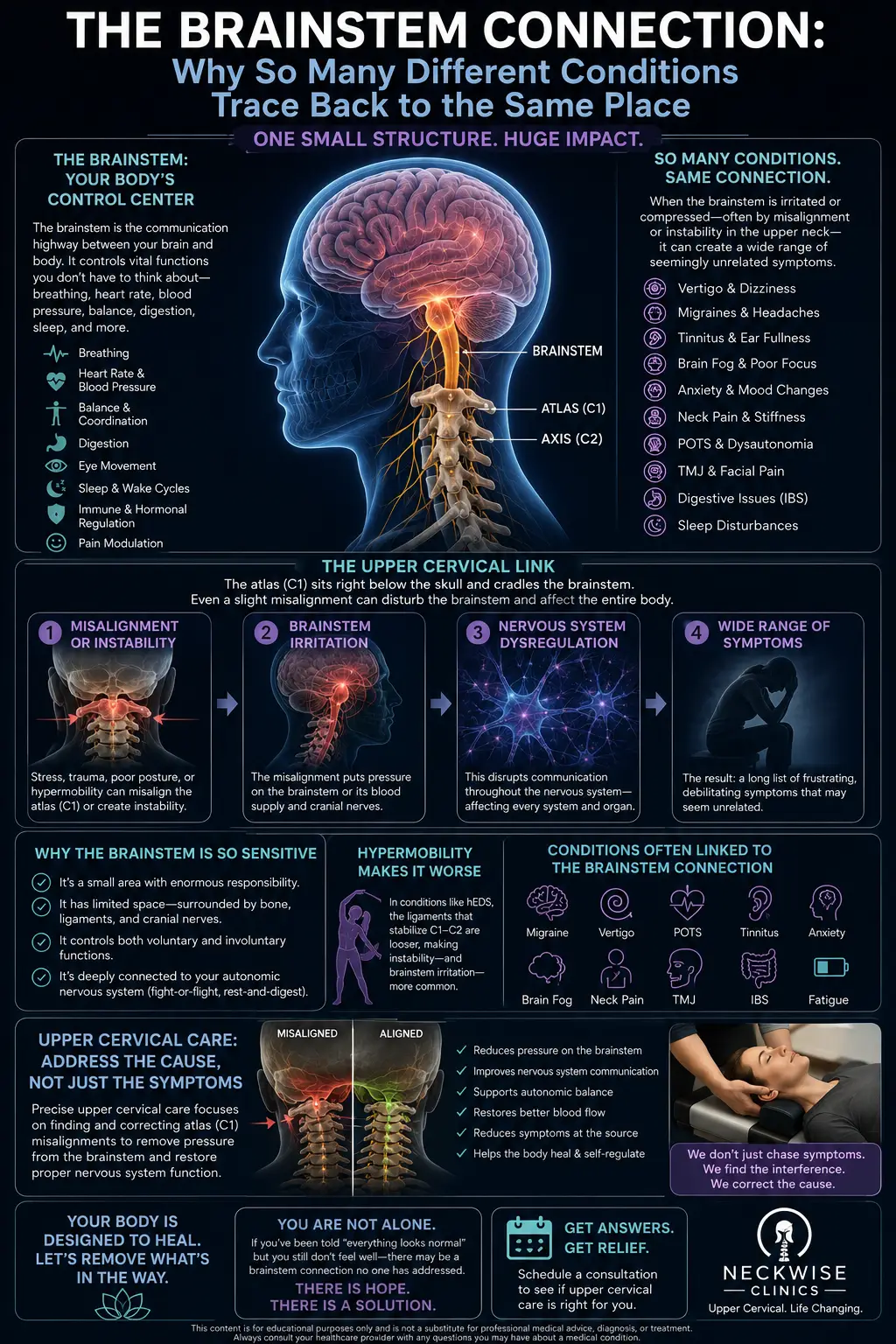
If you picture the brain as a large, wrinkled organ doing the thinking, the brainstem is the sturdy stalk underneath it — the part that connects the brain to the spinal cord. It is small. You could cover the lower portion with your thumb. But for something so compact, it carries an enormous workload, because it manages many of the automatic, moment-to-moment functions that keep you alive and oriented without any conscious effort on your part.
Let’s translate four of those jobs into plain language, because these four are the ones that matter most for the rest of this article.
Autonomic function. Your autonomic nervous system runs the background operations of your body: heart rate, blood pressure, digestion, breathing rhythm, temperature, the size of your pupils. You do not decide to speed your heart when you stand up or to constrict blood vessels so blood does not pool in your legs — your nervous system does it for you, automatically. A major hub for this regulation lives in the lower brainstem. One of the clearest examples is the baroreflex, the split-second loop that senses a drop in blood pressure and corrects it so you don’t black out when you rise from a chair. Researchers describe the brainstem as central to this cardiovascular control. The vagus nerve — the long wandering nerve that helps calm the heart and coordinate digestion — originates here as well.
Pain modulation. Pain is not a simple wire that runs from your toe to your brain and rings a bell. Your nervous system actively decides how much of an incoming signal to amplify and how much to quiet. There is a built-in dimmer switch called descending inhibition: pathways that travel down from the brainstem to the spinal cord and turn the volume of pain signals up or down. When this system works well, minor aches stay minor. When it is dysregulated, ordinary sensations can be experienced as painful, and pain can persist long after any injury has healed. The control centers for this dimmer switch sit in the brainstem.
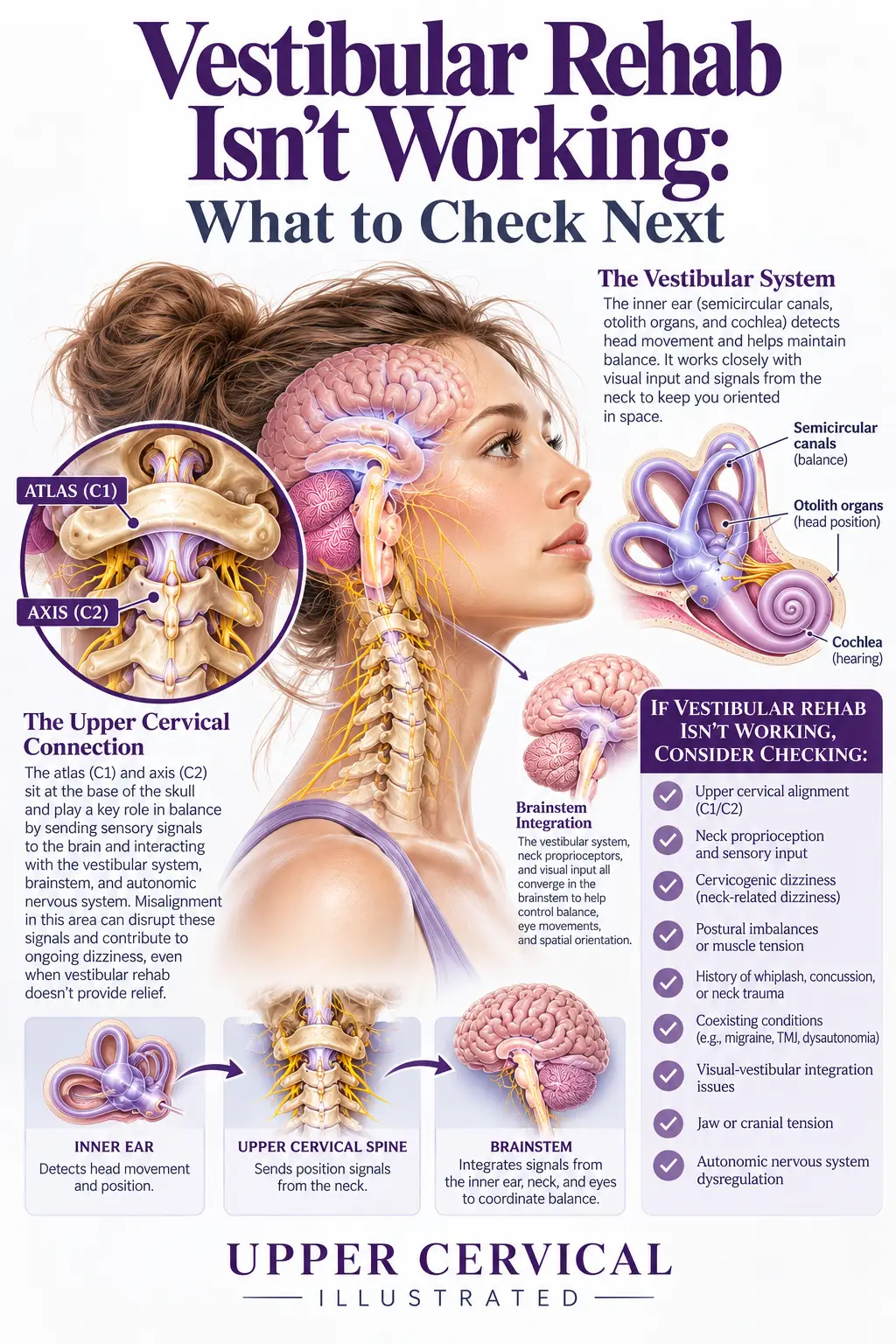
Balance and vestibular integration. Every second, your brain is fusing three streams of information to tell you where you are in space: signals from your inner ears (the vestibular system), signals from your eyes, and signals from the position sensors in your joints and muscles — especially those in your upper neck. The brainstem is where these streams meet and get reconciled. When they agree, you feel steady. When they conflict, you feel dizzy, off-balance, or like the world is tilting.
Trigeminal and head-face sensation. The trigeminal nerve is the main sensory nerve of your face — it carries sensation from your forehead, cheeks, jaw, teeth, and much of your head. Its central relay station, called the trigeminal nucleus, stretches down through the brainstem and blends with the incoming nerves from the very top of your neck. This blended region is often called the trigeminocervical complex, and it is a crucial detail for understanding headaches and facial pain, as we’ll see.
So in one small structure you have the control hub for your automatic body functions, the dimmer switch for pain, the integration point for balance, and the relay for face and head sensation. Four very different jobs, one very small neighborhood.
Why the Upper Neck Matters: The Atlas and Axis Surround the Hub
Here is the lead idea of this entire article, the one everything else hangs on.
The lower brainstem does not float in open space. As it descends and becomes the spinal cord, it passes through a bony ring formed by the top two vertebrae of your neck: the atlas, or C1, and the axis, or C2. The atlas is a ring-shaped bone that the skull rests on. The axis sits just below it and has a peg that the atlas pivots around. Together, this region is called the craniocervical junction — the meeting place of skull and spine. The spinal cord, the lower brainstem’s continuation, and a dense bundle of nerves and blood vessels all pass through the opening these bones surround.
Think about what that means geographically. The very structure that coordinates your autonomic function, your pain dimmer switch, your balance integration, and your face sensation is housed inside a moving, weight-bearing joint complex at the top of your neck. Your head weighs roughly ten to twelve pounds and balances on this junction all day. The upper neck is also the most mobile part of your spine — it does a large share of your head’s rotation and nodding. Mobility and a heavy load, right on top of the body’s control hub.
This is also a region with an unusually rich supply of position sensors. The small muscles and joints of the upper neck are packed with receptors that constantly report head position to the brainstem — feeding directly into that balance-integration job we described. When the upper neck moves and functions well, those signals are clean and consistent. When the alignment or motion of this junction is disturbed — by an old injury, a fall, a car accident, years of poor posture, or connective-tissue laxity — the signals arriving at the brainstem can become noisy or mismatched.
None of this is a claim that a misaligned neck reaches up and switches your organs on and off. The point is quieter and, we think, more useful. Because the atlas and axis physically surround the region that governs autonomic function, pain modulation, balance, and head-face sensation, a mechanical problem at this junction is at least plausibly relevant to symptoms in any of those domains. That plausibility is exactly why the upper cervical region deserves a careful look when someone has a cluster of these symptoms — and exactly why it so often goes unexamined, because it falls in the gap between specialties. You can read more about how we evaluate this region on our upper cervical chiropractic carepage.
One Hub, Many Conditions
Now let’s take the conditions in that thick folder and map each one to a brainstem function. As we go, remember the honest framing: each of these is a real, physician-diagnosed condition, and the upper cervical region is a possible contributor and shared crossroads — not a single cause.
POTS and the autonomic hub
Postural orthostatic tachycardia syndrome, or POTS, is a disorder of the autonomic nervous system. Its hallmark is an exaggerated jump in heart rate on standing, often with lightheadedness, fatigue, brain fog, and near-fainting. Because the autonomic control hub — including the baroreflex circuitry that manages the stand-up response — lives in the lower brainstem, POTS maps naturally onto the autonomic function we described. A narrative review of POTS describes it as a complex condition with many associated conditions and a management approach that usually combines several strategies rather than one.
Why would the upper neck be part of that conversation? Because the region that houses autonomic regulation sits inside the craniocervical junction, a mechanical disturbance there is one of several factors worth evaluating alongside the medical workup — never instead of it. We explore this in depth on our POTS pillar, and the vagus nerve angle on our vagus nerve dysfunction page.
Migraine and trigeminal neuralgia and the trigeminal relay
Two very different-feeling conditions share the same relay station. Migraine is far more than a bad headache — it is a neurological event involving throbbing head pain, light and sound sensitivity, nausea, and sometimes visual aura. Trigeminal neuralgia is a different creature: sudden, electric, stabbing pain across part of the face, often triggered by something as light as a breeze or a touch while shaving.
What links them is the trigeminocervical complex — that blended region in the brainstem where the trigeminal nerve from the face meets the sensory nerves from the top of the neck. Research on the trigeminocervical nucleus describes how orofacial, cranial, and cervical inputs converge and integrate at this shared relay. Because upper-neck signals feed directly into the same pool as face and head signals, the nervous system can have real difficulty telling the difference between a neck source and a head or face source. This convergence is one reason upper-neck input is a reasonable thing to evaluate in stubborn head and facial pain. We cover each condition on our migraines and trigeminal neuralgia pages.
Vertigo and vestibular integration
Vertigo — the false sensation that you or the room is spinning or tilting — is a balance problem, and balance is integrated in the brainstem. Remember the three streams: inner ear, eyes, and the position sensors in your upper neck. The upper neck is one of the largest sources of position information your brainstem uses. When the upper cervical joints send noisy or mismatched signals, the brainstem may receive a version of “where is my head” that conflicts with what the inner ear and eyes report. That conflict can be experienced as dizziness or unsteadiness.
Of course, dizziness has many possible causes, and some are urgent. A proper evaluation is essential. But because the upper neck is such a heavy contributor to the balance streams that the brainstem integrates, it is a logical part of the assessment. More on our vertigo page.
Fibromyalgia and the pain dimmer switch
Fibromyalgia is characterized by widespread body pain, fatigue, sleep trouble, and cognitive fog. One influential way of understanding it is as a disorder of pain processing — the dimmer switch turned up too high, so the nervous system amplifies signals that should stay quiet. Since the descending pain-modulation pathways originate in the brainstem, fibromyalgia maps onto that pain-modulation function. Research on descending pain modulation describes it as a central control system that can either suppress or facilitate pain, and dysregulation of that system is part of the picture in widespread pain conditions.
If the brainstem is central to the body’s pain dimmer switch, and the brainstem sits within the craniocervical junction, then the health and function of that junction is a reasonable thing to examine in someone whose pain-processing system seems to be running hot — again, as one contributor among many, coordinated with medical care. See our fibromyalgia page.
Craniocervical instability: the structural version
If the conditions above are functional expressions of a brainstem crossroads, craniocervical instability (CCI) is the structural version of the same story. CCI describes excessive movement between the skull and the upper spine — the very junction we’ve been discussing — often related to connective-tissue laxity or trauma. When the ligaments that stabilize the head on the neck are too loose, the junction can move more than it should, and that can mechanically stress the structures passing through it.
CCI is where the anatomy becomes most literally the point. A study of a fatigue population by Bragée and colleagues reported a notably high frequency of craniocervical and hypermobility findings, along with signs suggestive of raised intracranial pressure, in patients being evaluated for chronic fatigue. That kind of finding underscores why the craniocervical junction belongs in the differential when someone has a puzzling cluster of symptoms that has bounced between specialties. It is the structural anchor for the whole “one hub, many conditions” idea. We go deep on this on our craniocervical instability page.
Step back and look at the map. POTS points to the autonomic hub. Migraine and trigeminal neuralgia point to the trigeminal relay. Vertigo points to vestibular integration. Fibromyalgia points to the pain dimmer switch. CCI points to the structure that houses all of them. Five different clinics, five different diagnoses, one shared neighborhood.
What This Does and Doesn’t Mean
This is the most important section in the article, so we want to be precise.
What it does mean: the upper cervical region is a shared, under-evaluated crossroads. Because the atlas and axis surround the lower brainstem, and the lower brainstem coordinates autonomic function, pain modulation, balance, and head-face sensation, a mechanical problem at this junction is anatomically plausible as a contributor to symptoms across several different diagnoses. When a person has been to several specialists for several separate-seeming problems, the craniocervical junction is a reasonable place to add to the evaluation — precisely because it falls between the specialties and is easy to skip.
What it does not mean: it does not mean the neck causes all of these conditions. It does not mean these diagnoses are “really” just a neck problem in disguise. It does not mean you should stop seeing your cardiologist, neurologist, ENT, or rheumatologist. POTS, migraine, trigeminal neuralgia, vertigo, fibromyalgia, and CCI are real, distinct, physician-diagnosed conditions with their own workups and treatments. Each usually has multiple contributing factors, and no honest clinician should claim a single cause for any of them.
Upper cervical care does not cure any of these conditions. What careful upper cervical care can do is evaluate and, where appropriate, address a possible cervical or craniocervical contribution — as one coordinated piece of a larger plan that stays anchored in your medical team’s care. Think of it as adding a missing angle to the picture, not replacing the other angles.
And some symptoms are red flags that need urgent medical attention, not a chiropractic evaluation. Sudden severe headache unlike any before, sudden weakness or numbness, trouble speaking, loss of coordination, fainting, chest pain, a severe stiff neck with fever, or any sudden neurological change should be treated as an emergency. When in doubt, seek urgent care or call 911.
How Precise Upper Cervical Care Fits
Given all of that, how does our care actually fit into the picture? Carefully, honestly, and in coordination with your other providers.
We practice the Knee Chest Upper Cervical technique. This is a precise, low-force approach focused specifically on the atlas and axis — the two vertebrae that surround the region we’ve been discussing this whole time. It is not general spinal manipulation, and it does not involve the twisting or high-force movements some people picture when they think of a chiropractor. The emphasis is on precision at one small, important junction.
Because that junction is so anatomically significant, we do not guess about it. Before any care, we gather objective information. We use 3D cone beam computed tomography (CBCT) imaging to see the actual bony anatomy of your upper neck in three dimensions, which is far more detailed than a flat X-ray. You can read about that on our 3D CBCT imagingpage. We also use Tytron thermography, which measures patterns in the skin along the spine that reflect autonomic nervous system activity — a fitting tool, given how much of this article is about autonomic function. Together, these give us a specific, individualized picture rather than a one-size-fits-all assumption. You can learn more about the method on our Knee Chest Upper Cervical technique page.
From there, we build a customized care plan for your situation. We coordinate with your medical team rather than working around them; if red flags appear, we refer. We are a cash-pay, out-of-network practice, and we provide superbills you can submit to your insurance for possible reimbursement. Our goal is not to compete with your cardiologist or neurologist. It is to examine the one crossroads that so often gets missed, and to communicate what we find.
If you have been bounced between specialists and the craniocervical junction has never been carefully examined, our doctors would be glad to talk with you about whether an upper cervical evaluation makes sense in your situation. You can reach our office at (941) 243-3729 or book a new-patient consultation online. We will give you an honest read on whether this is worth pursuing for you.
What the Research Says
We want to be careful to represent the science accurately and modestly. The studies below support the anatomy and physiology behind the crossroads idea; they do not prove that upper cervical care treats any specific condition. Here are five sources worth reading.
First, on the brainstem as the autonomic hub: research on the brainstem control of the baroreflex and cardiovascular regulation describes how the lower brainstem coordinates the reflexes that manage heart rate and blood pressure — the automatic loop behind the stand-up response that is disrupted in conditions like POTS.
Second, on the trigeminal relay: work on the trigeminocervical nucleus and its integration of orofacial, cranial, and cervical input explains how signals from the face, head, and upper neck converge at a shared relay in the brainstem — the anatomical reason neck input can be entangled with headache and facial pain.
Third, on the pain dimmer switch: a review of descending pain modulation and central pain control describes the pathways that travel down from the brainstem to turn pain signals up or down, and how dysregulation of that system contributes to widespread and persistent pain.
Fourth, on the structural crossroads: the study by Bragée and colleagues reporting craniocervical, hypermobility, and intracranial findings in a fatigue population found a high frequency of craniocervical and connective-tissue findings in patients evaluated for chronic fatigue, underscoring why the junction belongs in a thorough workup.
Fifth, on POTS itself: a narrative review of POTS covering associated conditions and management frames POTS as a complex autonomic disorder with many associated conditions and a multi-pronged management approach — a reminder that no single intervention is the whole answer.
Read together, these sources support a modest, honest claim: the brainstem coordinates autonomic function, pain modulation, and head-face sensation; the craniocervical junction surrounds it; and that junction is a reasonable, often-overlooked part of a comprehensive evaluation.
Serving Sarasota and Surrounding Communities
Lavender Family Chiropractic is located at 5899 Whitfield Avenue, Suite 107, Sarasota, FL 34243, at the corner of University and Whitfield. We are glad to serve patients from across the region, including Sarasota, Bradenton, Lakewood Ranch, Venice, Palmer Ranch, Osprey, Siesta Key, Longboat Key, Lido Key, University Park, Parrish, Ellenton, Myakka City, Punta Gorda, and St. Petersburg.
Many of the people who make the drive to see us have a story that sounds a lot like the one that opened this article — a folder full of diagnoses from different specialists, and a nagging sense that nobody has looked at the whole picture. If that’s you, and you’re anywhere in the greater Sarasota and Bradenton area, we would welcome the chance to examine the crossroads that often gets missed. Call us at (941) 243-3729 or stop by the office at the corner of University and Whitfield.
Top 12 Questions
1. Are you saying my neck causes all of these conditions? No. That is exactly what we are not saying. Each of these is a real, distinct, physician-diagnosed condition with multiple contributing factors. The upper cervical region is a shared crossroads worth examining — one possible contributor, not the single cause.
2. Can upper cervical care cure my POTS, migraines, or fibromyalgia? No. Our care does not cure any of these conditions. It addresses a possible cervical or craniocervical contribution as one coordinated part of a larger plan that stays anchored in your medical team’s care.
3. Why would one small area of the neck relate to such different symptoms? Because the atlas and axis physically surround the lower brainstem, and the lower brainstem coordinates autonomic function, pain modulation, balance, and head-face sensation. Different symptoms can trace back to different jobs of the same small neighborhood.
4. Should I stop seeing my specialists? No. Please continue with your cardiologist, neurologist, ENT, rheumatologist, and any other physicians involved in your care. We coordinate with your medical team, not around it.
5. What is the Knee Chest Upper Cervical technique? It is a precise, low-force approach focused specifically on the atlas (C1) and axis (C2). It is not general spinal manipulation and does not involve high-force twisting. You can read more on our technique page.
6. What imaging do you use? We use 3D cone beam CT (CBCT) to see the bony anatomy of the upper neck in three dimensions, and Tytron thermography to measure patterns reflecting autonomic activity along the spine.
7. Do you take my insurance? We are a cash-pay, out-of-network practice. We provide superbills you can submit to your insurance company for possible reimbursement, depending on your plan.
8. How does billing work? We build a customized care plan for your specific situation and discuss it with you honestly before you commit to anything. As a cash-pay, out-of-network practice, we provide superbills you can submit to your insurance for possible reimbursement.
9. What are the red flags that mean I need urgent care instead? Sudden severe headache unlike any before, sudden weakness or numbness, trouble speaking, loss of coordination, fainting, chest pain, or a severe stiff neck with fever. Treat these as emergencies and seek urgent care or call 911.
10. I have craniocervical instability. Is your care right for me? It depends on your specific anatomy and situation, which is why we start with careful imaging and evaluation. CCI is the structural version of the crossroads idea, and our first job is to understand your individual picture and coordinate with your other providers.
11. How long does it take to know if this is helping? Everyone is different, and we do not promise timelines or outcomes. We use objective measures over time and stay honest with you about what we do and do not see.
12. How do I get started? Call our office at (941) 243-3729 or book a new-patient consultation at our online scheduling page. Our doctors will give you a straight answer about whether an evaluation makes sense for you.
Closing
The woman with the folder is a composite, but her experience is common. Modern medicine is organized by specialty, which is a strength — deep expertise in each domain — and also a blind spot, because the spaces between specialties can go unexamined. The craniocervical junction is one of those spaces. It is where the control hub for so many of your body’s automatic functions is housed, and it is nobody’s designated territory.
We are not offering a grand unified answer, and we would be suspicious of anyone who did. We are offering a careful look at one specific, anatomically significant crossroads — with precise, low-force care, objective imaging, honest communication, and coordination with your medical team. If your story sounds like the one at the top of this page, that look may be worth having.
If you would like to explore whether an upper cervical evaluation fits into your care, our doctors would be glad to talk with you. Call Lavender Family Chiropractic at (941) 243-3729, visit us at 5899 Whitfield Avenue, Suite 107, Sarasota, FL 34243, or book online. You can also reach us through our contact page or meet our team.
Related Articles
Related Posts


Get our upper cervical articles first.