Upper Cervical vs. Traditional Chiropractic: What’s the Difference?
By Dr. Rusty Lavender, D.C. — upper cervical chiropractor, Lavender Family Chiropractic, Sarasota, FL. Reviewed and updated October 2026.
Our complete guide to upper cervical chiropractic care in Sarasota covers the conditions we see, the imaging we use, and what to expect at an evaluation.
Upper Cervical vs. Traditional Chiropractic: If you have started researching chiropractic care, you have probably run into two terms that sound similar but describe very different approaches: “traditional” chiropractic and “upper cervical” chiropractic. Maybe a friend raved about the full-body adjustments they get at a general chiropractor, while someone else told you they only see an upper cervical specialist who barely seems to touch their neck. It is genuinely confusing, and it is fair to wonder what actually separates the two — and which might be right for you.
Both approaches share the same broad philosophy: that the alignment of the spine influences the nervous system, and that the nervous system influences your overall health. But they differ substantially in where they focus, how they diagnose, how much force they use, how often they adjust, and how they define success. Neither is simply “better” in every case; they are different tools suited to different situations and preferences. In this article, we will lay out the real differences clearly and fairly so you can understand what each approach involves and make an informed choice. We will also point to what the research says about both, and explain how our Sarasota practice fits into the picture.
Upper Cervical: The Same Root Idea, Two Different Paths
At their foundation, all chiropractic approaches trace back to a shared insight: that the spine protects and surrounds the nervous system, and that when vertebrae shift out of proper alignment, they can interfere with how the nervous system communicates with the body. Correcting those misalignments, the thinking goes, allows the body to function and heal better.
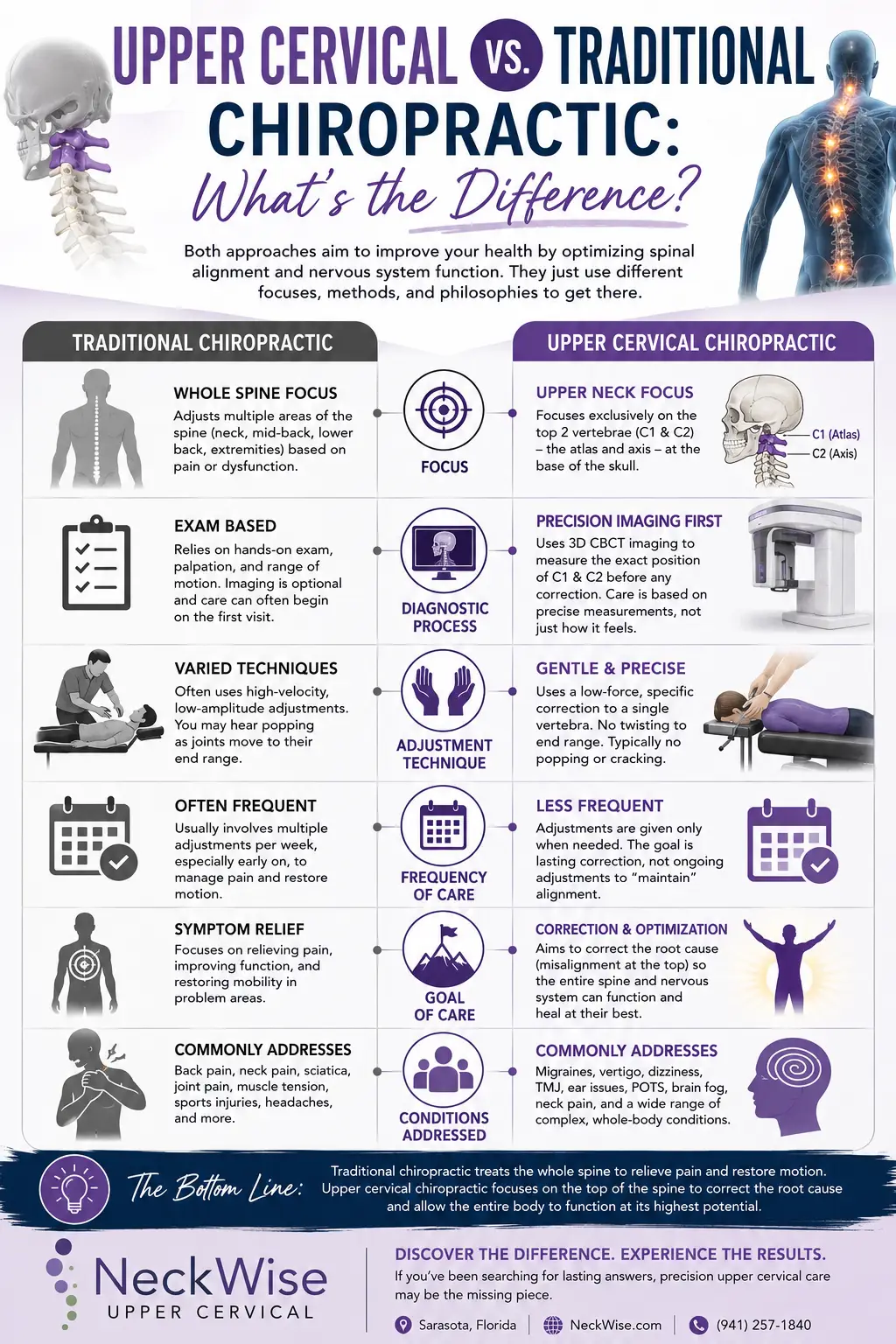
Where traditional and upper cervical chiropractic diverge is in how they apply that idea. Traditional chiropractic tends to treat the spine broadly, addressing misalignments and restrictions wherever they are found, up and down the back and neck, often with the goal of relieving pain and restoring movement in the region that hurts. Upper cervical chiropractictakes a narrower, more targeted path: it concentrates on the top two vertebrae of the neck — the atlas (C1) and axis (C2) — on the premise that this small region, which sits closest to the brainstem, has an outsized influence on the alignment and function of the entire spine and nervous system. Correct the top, the reasoning goes, and the rest of the body can rebalance beneath it.
Difference One: Where the Focus Lands
The most visible difference is location. In a traditional chiropractic visit, the practitioner may adjust multiple areas of your spine in a single session — perhaps your lower back, mid-back, and neck — targeting whatever segments feel restricted or misaligned. The approach is often regional, addressing the area that is symptomatic.
Upper cervical care focuses on a single region: the craniocervical junction where the skull meets the spine. The reason for this focus is anatomical. The upper cervical spine has a unique and specialized structure. A study on the biomechanics of the upper cervical spine ligaments detailed how the C0–C1–C2 complex moves and stabilizes differently from the rest of the spine, allowing a large share of the head’s rotation and motion while protecting the brainstem (biomechanics of the upper cervical spine). Because this region is so mobile and so close to the brainstem, upper cervical practitioners believe a misalignment here can have effects that ripple throughout the body — influencing posture, balance, and nervous system regulation far below the neck. So rather than adjusting many segments, upper cervical care aims to correct the one that matters most and let the body respond.
Difference Two: The Diagnostic Process
Perhaps the single most important difference is how care begins. Traditional chiropractic often relies heavily on hands-on assessment — palpation, range-of-motion testing, and the practitioner’s feel for where the spine is restricted. Imaging may be used, but many adjustments are guided primarily by examination and clinical experience, and care can often begin on the first visit.
Upper cervical care generally does not begin until the doctor knows precisely what the misalignment looks like. In our practice, that means detailed 3D CBCT imaging of the upper neck before any correction, so we can measure the exact orientation of the atlas and axis and calculate a specific correction tailored to your individual anatomy. This precision is a defining feature of the upper cervical approach. Research supports the idea that this kind of analysis can be done reliably: a study on inter-examiner agreement in the National Upper Cervical Chiropractic Association’s radiographic analysis found that trained examiners could reliably identify the atlas misalignment using a standardized multi-view imaging protocol (inter-examiner agreement of NUCCA atlas analysis). The takeaway is that upper cervical care is designed to be measured and specific rather than based on feel alone.
Difference Three: How Much Force Is Used
The difference in force is one patients notice immediately. Traditional chiropractic frequently uses high-velocity, low-amplitude manipulation — the quick, forceful movements that often produce the familiar “popping” sound as joints move to their end range. Many people find this satisfying and effective, and for a lot of conditions it works well.
Upper cervical care, especially in a low-force practice like ours, uses a small, gentle, precise input to a single segment, with no twisting to end range and typically no popping at all. At our office we use the Knee Chest Upper Cervical technique, which delivers the correction with minimal force. The philosophy is that when you know exactly what needs to move and by how much, you do not need force — you need accuracy. This makes upper cervical care appealing to people who are anxious about forceful neck manipulation, who have sensitive necks, or who simply prefer the gentlest possible approach.
Difference Four: How Often You’re Adjusted
The two approaches also tend to differ in frequency and philosophy of ongoing care. Because traditional adjustments often do not “hold” for long, they may be repeated regularly to maintain relief, sometimes on an ongoing schedule. This is not a criticism — for many conditions, regular adjustment is a perfectly reasonable maintenance strategy.
Upper cervical care is built around the goal of getting the correction to hold, so that fewer corrections are needed over time. Rather than adjusting on every visit by default, an upper cervical doctor checks whether your alignment is still holding — using tools like paraspinal infrared thermography — and only corrects when the data indicates you need it. As your body learns to maintain its alignment, visits typically space out. The aim is structural stability rather than repeated symptom relief.
Difference Five: How Success Is Defined
Finally, the two approaches often define success differently. Traditional chiropractic frequently centers on relieving pain and restoring motion in a specific area — did the back pain ease, did the neck move more freely. That is a clear, practical, and valuable goal.
Care at our office tends to define success in terms of whether the correction is holding and whether the body as a whole is functioning and stabilizing better over time, with symptom relief following from that improved foundation. This is why upper cervical practitioners pay so much attention to objective measurements of alignment and nervous system function, not just to whether a symptom has changed on a given day. Both definitions are legitimate; they simply reflect different priorities.
What the Research Says About Each Approach
Honesty requires acknowledging what the evidence does and does not show for both approaches. General spinal manipulation — the kind used in traditional chiropractic — has a reasonable evidence base for certain conditions, particularly neck pain. A systematic review and meta-analysis of randomized controlled trials found that spinal manipulation benefits acute neck pain (spinal manipulation for acute neck pain). Another systematic review comparing manipulation or mobilization against physical therapy or exercise for neck pain found that manual approaches produced outcomes broadly comparable to conventional care (manipulation or mobilization vs physical therapy for neck pain).
The upper cervical–specific research is smaller but growing. An observational pilot study of atlas vertebrae realignment using the NUCCA approach reported reductions in migraine headache days and improvements in quality of life in the subjects studied (atlas realignment in migraine). Combined with the biomechanical and diagnostic-reliability research noted earlier, this body of work supports the rationale and reliability of the upper cervical approach, while the field continues to build larger controlled trials. We think it is important to be straightforward about this: the evidence for general manipulation in conditions like neck pain is more extensive, while upper cervical care has a compelling anatomical rationale, encouraging early clinical findings, and a precise, measured methodology. If you want to dig deeper into the evidence and reasoning, our article on whether upper cervical chiropractic is legitimate explores it further.
Which One Is Right for You?
There is no universal answer, because the right choice depends on your situation, your preferences, and your goals. Traditional chiropractic may be a good fit if you are dealing with straightforward musculoskeletal pain in a specific region, you like the feeling of a full-spine adjustment, and you are comfortable with forceful, hands-on manipulation and regular visits. Many people get excellent relief this way.
Our care may be a better fit if you prefer a very gentle, low-force approach; if you are drawn to precise, imaging-guided care; if you have a sensitive neck or anxiety about forceful manipulation; or if you are dealing with conditions that may have an upper cervical component — such as migraines, vertigo, or issues connected to head-and-neck alignment — where the specialized focus on the atlas is particularly relevant. It also appeals to people who want the goal to be lasting structural stability rather than ongoing symptom management.
The honest truth is that these approaches are not enemies, and many people benefit from understanding both. What matters most is finding a doctor who will assess your situation carefully and be straight with you about whether their approach is a good match — and refer you elsewhere if it is not. If you would like help thinking it through for your own case, you are always welcome to call us at (941) 243-3729.
Not Sure Which Approach Fits? Let’s Talk It Through
Choosing between approaches is easier with a knowledgeable, honest conversation. If you want help understanding whether upper cervical care makes sense for your specific situation — or whether a different approach might serve you better — call our Sarasota office at (941) 243-3729. We are glad to give you a candid, no-pressure assessment.
What the Research Says at a Glance
To summarize the five studies referenced above: a study of upper cervical spine biomechanics detailed the specialized structure and motion of the C0–C1–C2 region, grounding why upper cervical care treats this area differently (PMC7546058). A study of NUCCA radiographic analysis found trained examiners could reliably identify atlas misalignment using a standardized protocol (PMC10461146). An observational pilot study of atlas realignment reported reduced migraine days and improved quality of life (PMC4689902). A meta-analysis found spinal manipulation benefits acute neck pain (PMC8584283). And a systematic review found manipulation or mobilization produced outcomes comparable to physical therapy or exercise for neck pain (PMC3699243).
Together, these support a fair conclusion: general manipulation has solid evidence for conditions like neck pain, while upper cervical care rests on a specialized anatomical rationale, reliable measurement, and promising early clinical findings.
Practical Questions to Ask Any Chiropractor
Whichever approach you are considering, a few good questions will help you choose well. Ask what technique the doctor uses and how much force it involves. Ask whether imaging is taken before adjusting and how the correction is determined. Ask how the doctor measures whether care is working. Ask how often you would be adjusted and how that is decided. Ask what conditions the approach is best suited for, and what would prompt a referral elsewhere. And ask how success is defined. A confident, ethical practitioner of either approach will welcome these questions and answer them clearly. If you get vague answers or feel pressured, that is worth noting.
What to Expect at Your First Visit
Your first visit with us is centered on understanding your situation before any care begins. We start with a thorough consultation and health history. If you are a candidate for upper cervical care, we take precise 3D CBCT imaging and thermography readings to understand your unique anatomy and nervous system function. We then explain our findings in plain language and, if appropriate, deliver a gentle correction using the Knee Chest technique. And if we believe a different approach would serve you better, we will tell you honestly. You will leave understanding what we found and what a sensible path forward looks like for you.
Areas We Serve
Our office is located at 5899 Whitfield Avenue, Suite 107, in Sarasota, Florida, at the corner of University Parkway and Whitfield Avenue. We serve families throughout the region, including Bradenton, Lakewood Ranch, Palmetto, Ellenton, Ruskin, Venice, Osprey, Myakka, Tampa, and St. Petersburg. Wherever you are coming from, we are happy to help you understand your options.
Top 15 Questions About Upper Cervical vs. Traditional Chiropractic
1. What’s the main difference between upper cervical and traditional chiropractic? Traditional chiropractic adjusts the spine broadly, often with forceful manipulation, while upper cervical care focuses precisely on the top two neck vertebrae using gentle, imaging-guided, low-force corrections.
2. Is one approach better than the other? Neither is universally better. They are different tools suited to different situations, preferences, and goals. The right choice depends on your needs.
3. Why does upper cervical care focus only on the neck? Because the upper cervical spine sits closest to the brainstem and has a specialized structure, practitioners believe correcting a misalignment there can positively influence the whole spine and nervous system.
4. Which approach uses more force? Traditional chiropractic typically uses more forceful, high-velocity manipulation. Upper cervical care in a low-force practice uses a small, gentle input with no twisting and usually no popping.
5. Does upper cervical care always use imaging? In our practice, yes. We take detailed 3D CBCT imaging before any correction so the adjustment is based on precise measurement rather than feel alone.
6. Why do traditional adjustments happen more often? Traditional adjustments often do not hold for long, so they may be repeated regularly. Upper cervical care aims to get the correction to hold, so visits typically become less frequent over time.
7. Will I hear a pop with upper cervical care? Usually not. The correction does not move joints to their end range the way traditional manipulation does, so there is typically no popping sound.
8. Which is safer? Both are considered low-risk when performed appropriately. The gentle, non-rotational, imaging-guided nature of upper cervical care avoids much of the force associated with common safety concerns.
9. Which has more research behind it? General spinal manipulation has a larger evidence base for conditions like neck pain. Upper cervical care has a strong anatomical rationale, reliable measurement, and promising early clinical findings, with larger trials ongoing.
10. Can upper cervical care help conditions beyond neck pain? Its focus on the atlas makes it particularly relevant to conditions that may have an upper cervical component, such as migraines and vertigo, though every case should be evaluated individually.
11. Which approach should I choose for simple back pain? Straightforward regional musculoskeletal pain often responds well to traditional chiropractic. A consultation can help determine the best fit for your specific problem.
12. How does each define success? Traditional chiropractic often centers on relieving pain and restoring motion, while upper cervical care emphasizes whether the correction is holding and the body is stabilizing and functioning better over time.
13. Can I try both? Many people explore both to understand which suits them. What matters is choosing a doctor who assesses you honestly and matches the approach to your needs.
14. How do I know if my atlas is misaligned? The reliable way is imaging and analysis by a trained upper cervical doctor. A consultation and, if indicated, 3D imaging can determine this precisely.
15. What if upper cervical care isn’t right for me? We will tell you honestly and help direct you toward an approach that fits better. Our goal is your best outcome, not simply providing our own service.
Explore Which Approach Fits You
The clearest way to decide is a candid conversation with a doctor who will assess your situation honestly and explain your options. If you would like to understand whether upper cervical care is a good match for you, call our Sarasota office- Lavender Family Chiropractic (NeckWise North Sarasota) at (941) 243-3729, or schedule online through our new patient scheduling page. We will help you make an informed, comfortable decision.
Related Articles
Related Posts


Get our upper cervical articles first.