
Head Tilted After a Car Accident? Torticollis, Muscle Guarding, or an Upper Neck Injury in Sarasota
By Dr. Rusty Lavender, D.C. — upper cervical chiropractor, Lavender Family Chiropractic, Sarasota, FL. Reviewed and updated October 2026.
A week or two after a rear-end collision on I-75 or US-41, a Sarasota patient notices something new: their head sits a little off-center. It tilts toward one shoulder, or turns a few degrees to one side, and pulling it straight hurts or simply does not hold. Sometimes it arrives with a stiff neck that will not turn; sometimes the stiffness has already eased and the tilt is what is left. The emergency-room X-rays were normal. The question they bring us is whether this is torticollis, and the honest answer is that “torticollis” is a description of the posture, not a diagnosis of what is causing it. After a crash there are three very different things that produce a tilted head, and they are not treated the same way. This article sorts them out. Our complete guide to torticollis treatment in Sarasota covers the condition in full; our complete guide to neck pain and the upper cervical spine in Sarasota covers the mechanism.
Educational content, not medical advice. A head tilt after a crash that comes with severe pain, numbness or weakness in the arms or legs, trouble swallowing or speaking, or any change in alertness needs the emergency department, not a chiropractor.
Why a Crash Tilts the Head: What Whiplash Does to the Top of the Neck
In a rear-end collision the body is driven forward by the seat while the head lags, then whips forward; the whole sequence takes about a tenth of a second and loads the neck in a pattern it never experiences otherwise. The Quebec Task Force, which defined whiplash-associated disorders and set the grading system still used today, described the resulting injury as a soft-tissue injury of the neck with symptoms ranging from pain and stiffness alone (grade I) to pain with reduced motion and tender points (grade II) to neurological signs (grade III) (Spitzer et al., Spine 1995). The upper two vertebrae take a disproportionate share of that load. The atlas is a ring held in place by ligaments rather than by a locking joint, and it is the segment that allows most of the neck’s rotation, so when the head whips, the atlas is what moves.
A head tilt is the body’s response to that movement. When the position-sensing receptors in the upper neck report that the head is no longer sitting squarely on the spine, the muscles on one side shorten to hold it where it feels stable. Treleaven and colleagues (J Rehabil Med 2003) measured this in whiplash patients and found their sense of head position was significantly less accurate than uninjured people’s, worst in those who also had dizziness, and a later review by Kristjansson and Treleaven (2009) laid out why: the upper neck is one of the brain’s richest sources of information about where the head is, and when that input is distorted, posture and balance follow. The tilt, in other words, is often the brain protecting a joint it no longer trusts.
Three Things a Post-Crash Head Tilt Can Be
1. Muscle guarding (acute post-traumatic torticollis). By far the most common. The neck muscles on one side go into protective spasm after the injury, the head tilts and rotates away from the painful side, and range of motion drops sharply. It usually appears within hours to a few days of the crash and is the “acute wry neck” picture our article on a stiff neck you cannot turn describes. Most cases ease over two to six weeks. The ones that do not are the ones that bring people to us, and the reason they do not is usually the segment underneath the spasm.
2. Atlantoaxial rotatory displacement. Less common, and the one that gets missed. The atlas rotates on the axis and stays there, so the head sits turned and tilted and will not come back to center even when the muscles relax. The classic surgical series by Fielding and Hawkins (J Bone Joint Surg 1977) described seventeen patients in whom the diagnosis was delayed, every one of whom had torticollis and restricted, often painful neck motion; the point of the paper was that standard X-rays had not caught it. The full “fixation” they described is rare and is a surgical problem, but milder rotational malposition of the atlas on the axis after a crash is not rare, and it is exactly what a 3D cone-beam CT of the upper neck is designed to show and what a flat X-ray taken in the emergency room is not.
3. Post-traumatic cervical dystonia. Rare, neurological, and important to recognize. Occasionally a head or neck injury is followed by true dystonia, an involuntary, sustained contraction of the neck muscles driven by the brain rather than by local pain. Tarsy (Movement Disorders 1998) compared patients whose cervical dystonia began within four weeks of trauma with those whose began months later and found something useful: the acute-onset group had markedly restricted motion, no involuntary movements or sensory tricks, and responded poorly to botulinum toxin, and he concluded it “may represent a form of nondystonic muscle spasm similar to torticollis associated with musculoskeletal injuries of the cervical spine and craniocervical junction.” The delayed-onset group looked like ordinary cervical dystonia. In plain terms: a tilt that appears right after a crash and will not turn is usually a joint and muscle problem; a tilt that appears months later with pulling, tremor, or a “sensory trick” that relieves it is a neurologist’s problem, and we refer it.
How to Tell Which One You Have
A few questions sort most cases. When did it start? Hours to days after the crash points to guarding or displacement; months later points toward dystonia. Does it move? A tilt that pulls, jerks, or tremors, or that eases when you touch your chin or the back of your head, is dystonic; a tilt that is simply stuck is mechanical. Does it straighten when the muscles relax? If the head comes back to center lying down with a warm pack and the muscles let go, it is guarding; if it stays rotated even when relaxed, the joint itself is sitting off-center. What travels with it? Headache at the base of the skull, dizziness or unsteadiness, trouble focusing the eyes, and a feeling that the head is heavy are the upper cervical cluster; our articles on whiplash-associated vertigo and craniocervical instability cover the two ends of that spectrum.
What an Upper Cervical Evaluation Adds After a Crash
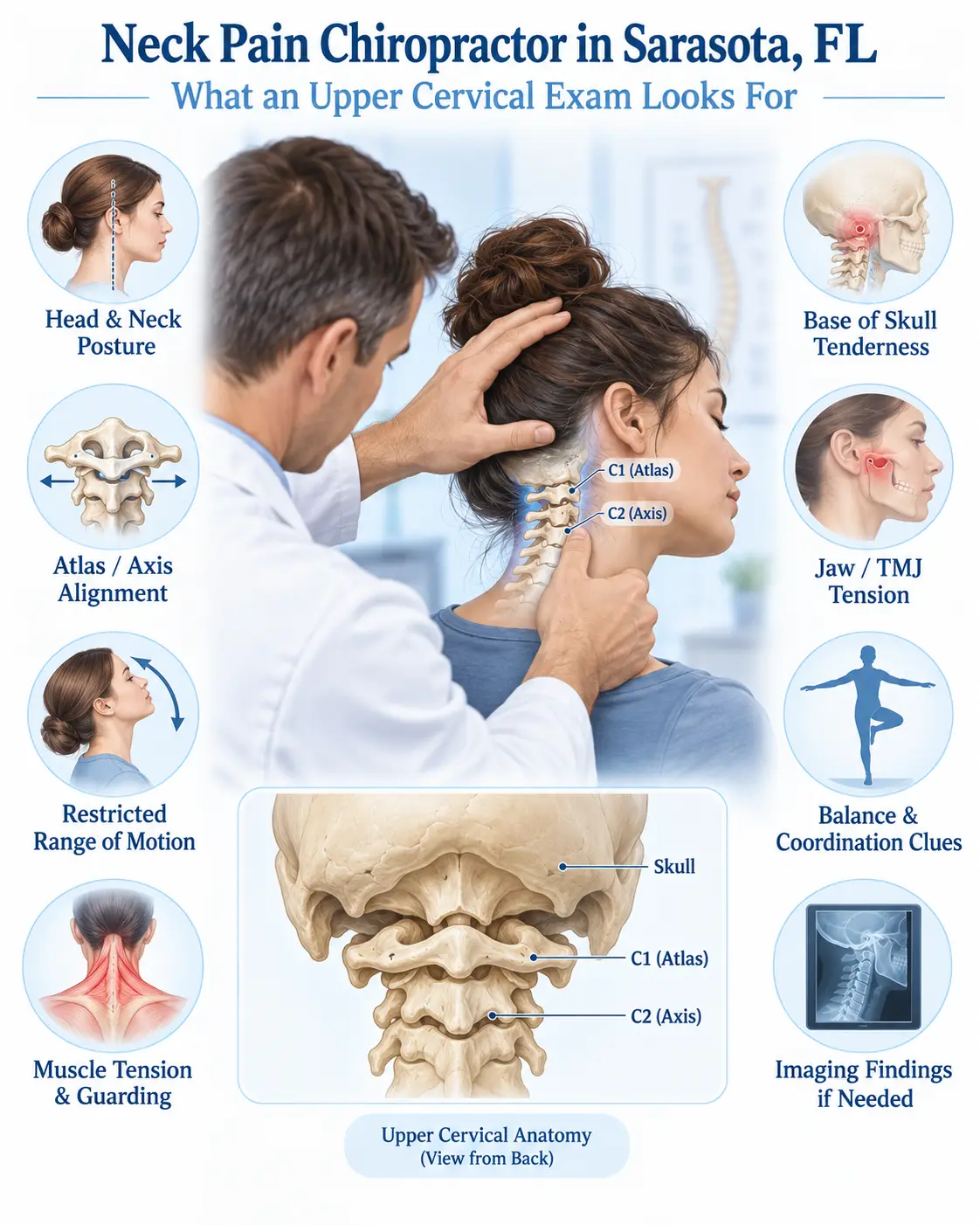
The emergency department did its job: it ruled out fracture and dislocation. What it did not do, because it is not designed to, is measure the position of the atlas relative to the skull and axis in three dimensions. That is where we start. The first visit is a history of the collision and the timeline of the tilt, a neurological screen that includes the signs of dystonia so the rare case is not mistaken for the common one, paraspinal thermography for an objective baseline, and, when the examination points to the upper neck, a 3D cone-beam CT of the atlas and axis. The imaging answers the question the tilt is asking: is the joint sitting off-center, and by how much? If it is, the correction is a precise, low-force procedure to the atlas based on those measurements, with no rotation of the neck and no cracking, which matters more than usual when the neck is already guarding. If it is not, we say so and help you get to the right next step.
The largest prospective study of upper cervical care, following 1,090 patients across 83 offices, reported high patient-rated improvement and no serious adverse events, with post-visit reactions mostly mild and short-lived (Eriksen et al., BMC Musculoskelet Disord 2011). For neck pain generally, the Bone and Joint Decade Task Force found that it tends to recur or persist rather than go away after one episode, with a large share of people still reporting it one to five years later (Carroll et al., Spine 2008), which is the argument for finding out why the neck is guarding rather than waiting for it to stop.
Getting Here From Sarasota, Bradenton, and Lakewood Ranch After a Crash
Our office is at the corner of University Parkway and Whitfield Avenue, just west of I-75 at exit 213, which puts us 10 to 25 minutes from most of the crash corridors our patients come from: I-75 itself, University Parkway, US-41 and US-301 through Bradenton, and Fruitville and Bee Ridge in Sarasota. We work with auto-injury physicians and attorneys, our records are written for PIP claims, and Florida’s 14-day rule means an evaluation within two weeks of the crash preserves your PIP benefits. Our car accident chiropractor page and our guide to whiplash and the upper cervical spine cover the post-crash picture in full.
Frequently Asked Questions About a Head Tilt After a Car Accident
Is a tilted head after a car accident torticollis? Torticollis describes the posture, a head tilted and rotated to one side. After a crash it is most often protective muscle spasm, sometimes a rotated atlas, and rarely true cervical dystonia. The treatment depends on which, which is why the first step is sorting them out.
My ER X-rays were normal. Why is my head still tilted? Emergency X-rays look for fractures and dislocations. They do not measure whether the atlas has rotated or shifted a few millimeters, which does not show on a flat film and is the most common upper-neck finding after a rear-end collision. A 3D cone-beam CT of the top two vertebrae is how that is measured.
How long should a post-accident head tilt last? Simple muscle guarding usually eases over two to six weeks. A tilt that is unchanged at six weeks, or that straightens when the muscles relax but comes right back, is the pattern that points to the joint underneath, and the one worth imaging.
Could it be cervical dystonia? Rarely, yes. The clues are a tilt that appears months rather than days after the injury, involuntary pulling or tremor, and a “sensory trick” (touching the chin or back of the head) that eases it. That picture belongs with a neurologist who treats movement disorders, and we refer it. The acute, stuck, painful tilt right after a crash is usually not dystonia.
Should I see a chiropractor or a neurologist first? If the tilt arrived within days of the crash with pain and stiffness and no neurological symptoms, an upper cervical evaluation is a reasonable first stop and we screen for the dystonia signs as part of it. If it arrived months later, pulls or tremors, or comes with any numbness, weakness, or swallowing trouble, see a physician or neurologist first.
Do you twist the neck to fix it? No. The correction is a precise, low-force procedure to the atlas based on 3D imaging, with no rotation and no cracking. For a neck that is already guarding, that is the point.
Does PIP cover this? In Florida, personal injury protection generally covers evaluation and care after a crash when you are seen within 14 days. We handle PIP cases routinely and will go over coverage before anything begins.
Will the tilt come back? If the muscles were guarding a joint that has now been corrected and is holding, usually not. If the underlying segment is never addressed, the guarding tends to return under stress or with the next minor strain, which is the recurrence pattern the research describes for neck pain generally.
Lavender Family Chiropractic in Sarasota, Florida offers a thorough upper cervical evaluation after a car accident to find out whether the top of your neck is the reason your head will not sit straight. To schedule a consultation, contact the office.
References
- Spitzer WO, et al. Scientific monograph of the Quebec Task Force on Whiplash-Associated Disorders: redefining “whiplash” and its management. Spine. 1995;20(8 Suppl):1S–73S. PMID 7604354
- Treleaven J, Jull G, Sterling M. Dizziness and unsteadiness following whiplash injury: characteristic features and relationship with cervical joint position error. J Rehabil Med. 2003;35(1):36–43. PMID 12610847
- Kristjansson E, Treleaven J. Sensorimotor function and dizziness in neck pain: implications for assessment and management. J Orthop Sports Phys Ther. 2009;39(5):364–377. PMID 19411769
- Fielding JW, Hawkins RJ. Atlanto-axial rotatory fixation (fixed rotatory subluxation of the atlanto-axial joint). J Bone Joint Surg Am. 1977;59(1):37–44. PMID 833172
- Tarsy D. Comparison of acute- and delayed-onset posttraumatic cervical dystonia. Mov Disord. 1998;13(3):481–485. PMID 9613741
- Eriksen K, Rochester RP, Hurwitz EL. Symptomatic reactions, clinical outcomes and patient satisfaction associated with upper cervical chiropractic care: a prospective, multicenter, cohort study. BMC Musculoskelet Disord. 2011;12:219. PMID 21974915
- Carroll LJ, et al. Course and prognostic factors for neck pain in the general population: Bone and Joint Decade Task Force. Spine. 2008;33(4 Suppl):S75–S82. PMID 18204403
Related Posts


Get our upper cervical articles first.