Stiff Neck and Can’t Turn Your Head? Understanding Acute Neck Lock and Natural Neck Pain Relief at Lavender Family Chiropractic in Sarasota, Florida
By Dr. Rusty Lavender, D.C. — upper cervical chiropractor, Lavender Family Chiropractic, Sarasota, FL. Reviewed and updated October 2026.
Stiff Neck Treatment in Sarasota: You went to bed fine. You woke up and could not turn your head. Maybe you tried to check your blind spot in the car and your neck simply would not rotate that direction. Maybe you reached to grab something off a shelf, felt a sharp catch on one side of your neck, and now your head is locked at an angle, tilted away from the pain, frozen in place. Every attempt to straighten it or turn toward the painful side sends a jolt of sharp, guarding pain that stops you cold.
If you are in Sarasota, Bradenton, Lakewood Ranch, or anywhere along the Gulf Coast and you are dealing with a sudden stiff neck that has locked up your movement, you are experiencing one of the most common and most alarming musculoskeletal events there is. It feels dramatic. It feels like something is seriously wrong. And while the good news is that most acute stiff neck episodes are not dangerous and tend to settle within days to a couple of weeks, the more important truth is this: the fact that your neck locked up suddenly is almost never the whole story. A neck that is properly aligned, mobile, and stable does not usually seize without warning. When it does, it is often telling you that the mechanical foundation of your cervical spine was already compromised, and that a small trigger was all it took to tip it into a full guarding episode.
At Lavender Family Chiropractic in Sarasota, our entire focus is the upper cervical spine, the atlas (C1) and axis (C2) at the very top of the neck. We use 3D CBCT imaging and paraspinal infrared thermography to find the subtle misalignments that set the stage for these episodes, and we correct them with the gentle, precise Knee Chest Upper Cervical technique, with no twisting, popping, or forceful cranking on an already painful, guarded neck. This guide will walk you through what an acute stiff neck actually is, why it happens, what the upper cervical spine has to do with it, what the research says about natural neck pain treatment, and what your options are for both calming the current episode and reducing the chance it happens again.
What Is an Acute Stiff Neck?
An acute stiff neck, sometimes called acute wry neck or acute torticollis, is a sudden onset of sharp neck pain accompanied by a marked loss of range of motion. The hallmark is that the pain and stiffness arrive quickly, often overnight or after a seemingly minor movement, and they restrict your ability to turn, tilt, or straighten your head. Many people describe their head as feeling locked, stuck, or pulled to one side. Turning toward the painful side is usually the most restricted and the most painful direction.
This is different from the slow, nagging neck stiffness that builds over weeks from desk work or poor posture. An acute episode is abrupt. One moment your neck works, and the next it does not. The muscles along the painful side often go into a protective spasm, becoming hard and tender to the touch. That spasm is not the original problem; it is your nervous system slamming on the brakes to protect an irritated joint underneath. Understanding that distinction is the key to understanding why some treatments help and others only chase the symptom.
In clinical terms, neck pain is usually classified by how long it has lasted. Acute neck pain refers to symptoms present for less than about three weeks, subacute for four to twelve weeks, and chronic for more than twelve weeks. A 2015 review in Mayo Clinic Proceedings summarizing the epidemiology, diagnosis, and treatment of neck pain noted that neck pain is the fourth leading cause of disability, with an annual prevalence rate exceeding 30%, and that most episodes of acute neck pain resolve with or without treatment, though nearly half of individuals continue to experience some degree of pain or recurrent episodes. That last point matters enormously. Most acute stiff necks calm down on their own, but a large share of people go on to have repeat episodes or lingering pain, which is exactly the pattern that points to an unaddressed underlying driver.
How common is neck pain overall? It is one of the most prevalent musculoskeletal conditions in the world. A 2022 narrative review in BMC Musculoskeletal Disorders reported that neck pain had an age-standardised prevalence rate of 27.0 per 1000 population in 2019, making it one of the most common musculoskeletal disorders globally, with long-term stress, anxiety, and lack of social support among the important risk factors. Translated to a region the size of Sarasota and Manatee Counties, that means thousands of people are dealing with neck pain at any given time, and a meaningful number of them will experience the sudden, locked-up variety at some point.
What Causes a Neck to Suddenly Lock Up?
The frustrating thing about an acute stiff neck is that the trigger often seems trivial. People rarely lock up their neck doing something heroic. They wake up from sleeping in an awkward position. They turn quickly to respond to someone. They reach across the car to grab a bag. They sneeze hard. They sit in the air-conditioned cold of a Florida summer with a draft hitting one side of the neck. None of these events are forceful enough, on their own, to injure a healthy neck. So why does the neck give way?
The answer is that the trigger is usually the last straw, not the root cause. Several mechanisms tend to converge in an acute episode.
The first is acute joint irritation, often at one of the small facet joints of the cervical spine. These paired joints guide and limit the motion between each pair of vertebrae. If one becomes irritated or transiently locked, the surrounding tissue becomes inflamed and the nearby muscles clamp down to splint the area. This is why the pain is often felt sharply on one side and at a specific point, and why one direction of movement is dramatically more restricted than the others.
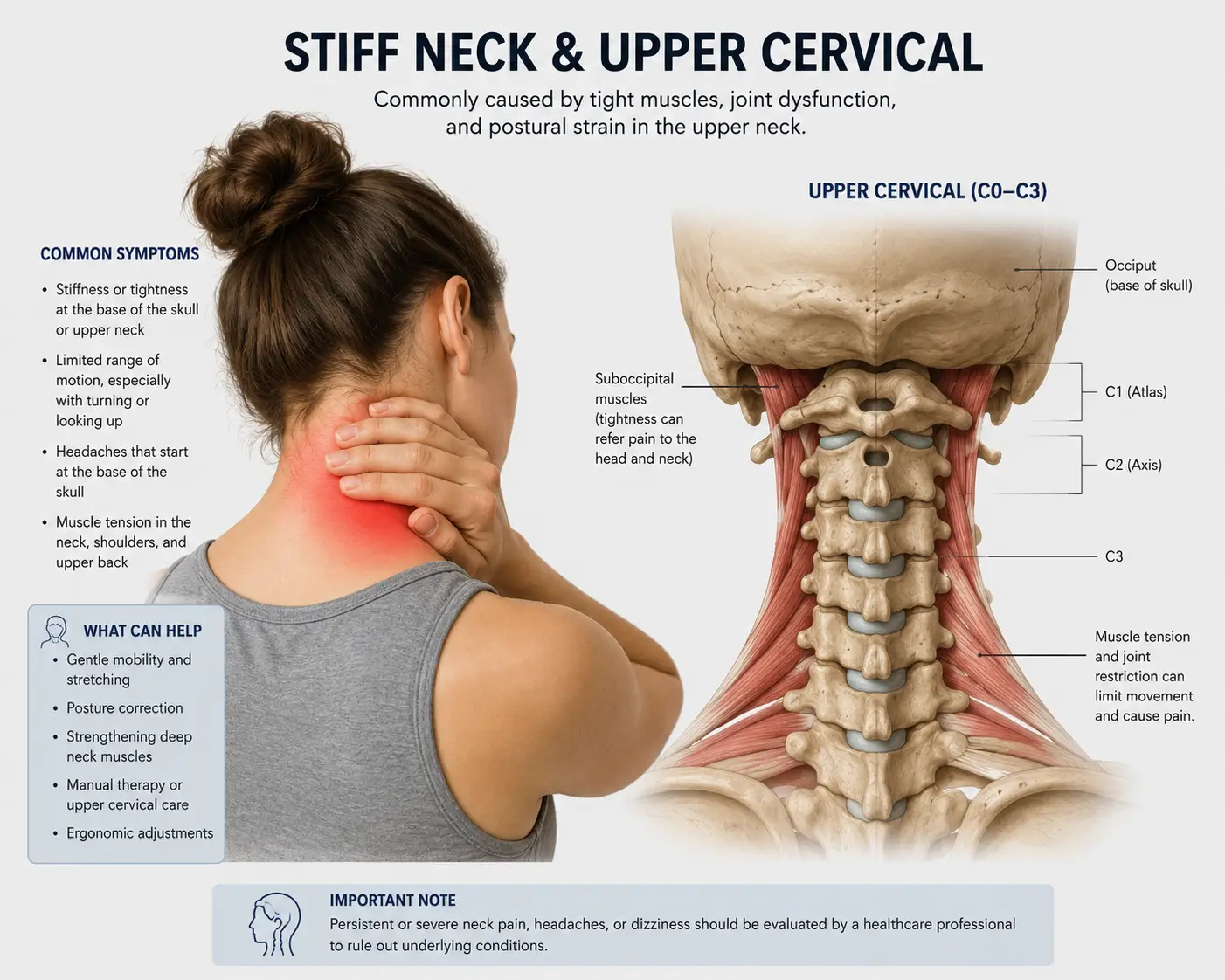
The second mechanism is protective muscle spasm. When a joint sends out distress signals, the nervous system responds by recruiting the surrounding muscles into a guarding contraction. The muscles of the neck, particularly the levator scapulae, the upper trapezius, the scalenes, and the deeper segmental muscles, tighten to immobilize the painful segment. That guarding is protective in intent, but it is also what produces the visible head tilt, the hardness you feel when you press on the muscle, and the sensation that your head is being pulled to one side. The spasm itself becomes a second source of pain, layered on top of the original joint irritation.
The third mechanism, and the one most often overlooked, is preexisting mechanical compromise. A neck that was already carrying an upper cervical misalignment, a forward head posture, asymmetric joint loading, or reduced motion at one level is a neck that is primed to lock up. The healthy segments are forced to overwork to compensate for the restricted ones, and eventually a small trigger pushes one of those overworked, irritated segments into full guarding. This is why two people can sleep in the same odd position, and one wakes up perfectly fine while the other cannot turn their head. The difference is not the pillow. The difference is the state of the cervical spine before the trigger.
Other contributors include sleeping posture, especially stomach sleeping that forces the neck into prolonged rotation, and screen posture that loads the lower neck for hours per day. Cold drafts and air conditioning can provoke muscle guarding in an already sensitized neck. Stress and tension raise baseline muscle tone, lowering the threshold at which the neck will spasm. Dehydration, common in the Florida heat, affects the discs and soft tissues that depend on water content for their resilience. Each of these is a small input, and in a vulnerable neck, the small inputs add up.
The Upper Cervical Connection: Why the Top of Your Neck Sets the Stage
It is natural to assume that if your neck locked up on the right side at the base of your neck, the problem must be right there, at the base, on the right. The pain is there. The spasm is there. Why would the top of the neck matter?
The answer lies in how the cervical spine functions as a single, integrated unit, and how the alignment of the atlas and axis sets the baseline for every segment below them.
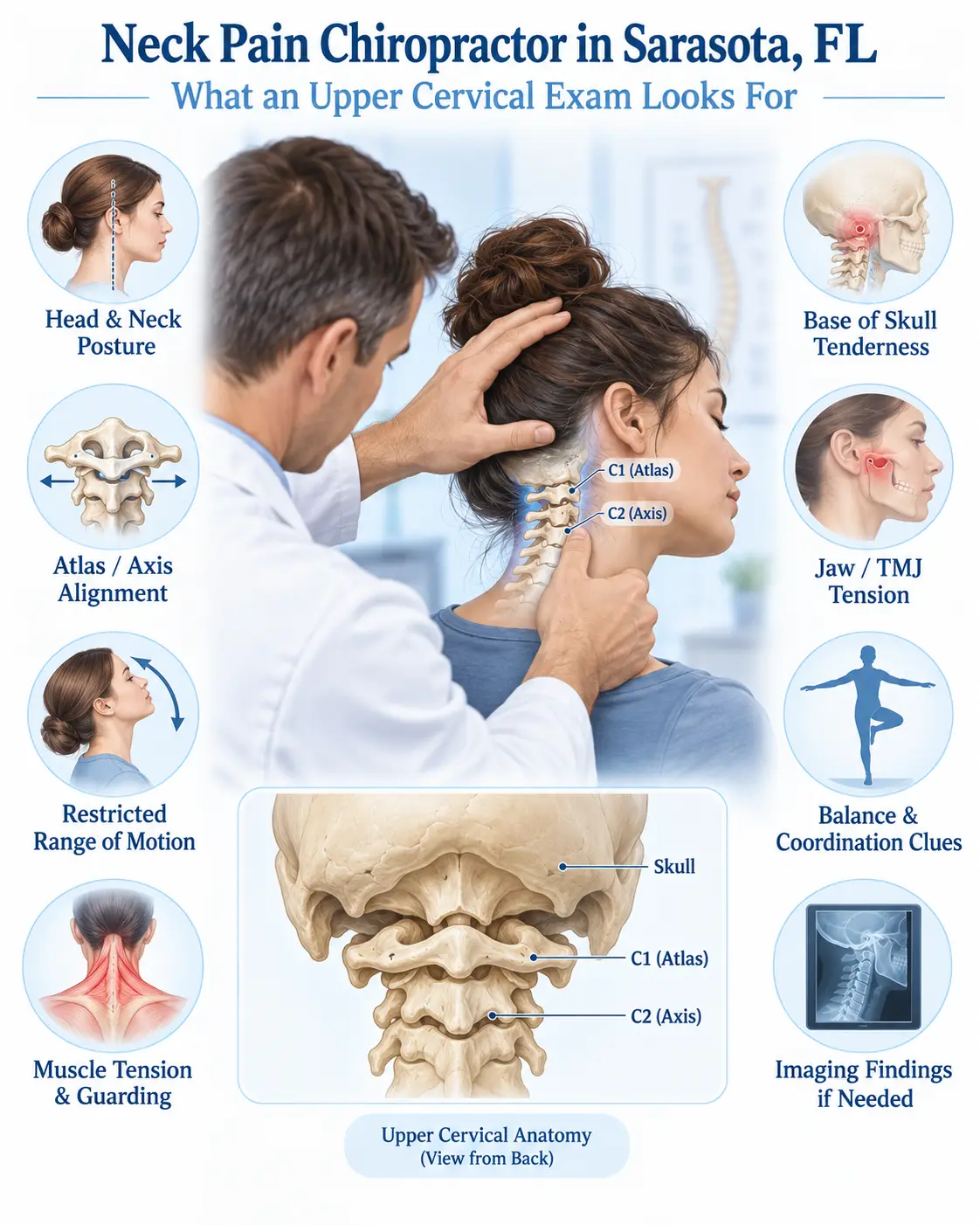
The atlas and axis form the craniocervical junction, the most mobile region of the entire spine and the region responsible for nearly half of your head’s total rotation. They also carry the job of keeping your head level and your eyes oriented to the horizon. When the atlas sits even slightly out of position, your body cannot simply tolerate a tilted head. The visual and vestibular systems demand a level gaze, so the body compensates by side-bending and rotating the vertebrae below the misalignment to bring the head back toward horizontal. Those compensations propagate down through the lower cervical spine, the very region where most acute stiff necks occur.
The practical consequence is that a chronic upper cervical misalignment forces the lower cervical joints into asymmetric positions they were never designed to hold for long periods. One side gets compressed and overworked. The facet joints on that side wear and load differently than their partners on the other side. The muscles on one side stay chronically shortened while their counterparts stay chronically lengthened. Over months and years, this builds a neck that is mechanically lopsided and perpetually closer to its limit. Then one ordinary morning, a slightly awkward sleeping position is enough to tip the most overloaded segment into acute spasm.
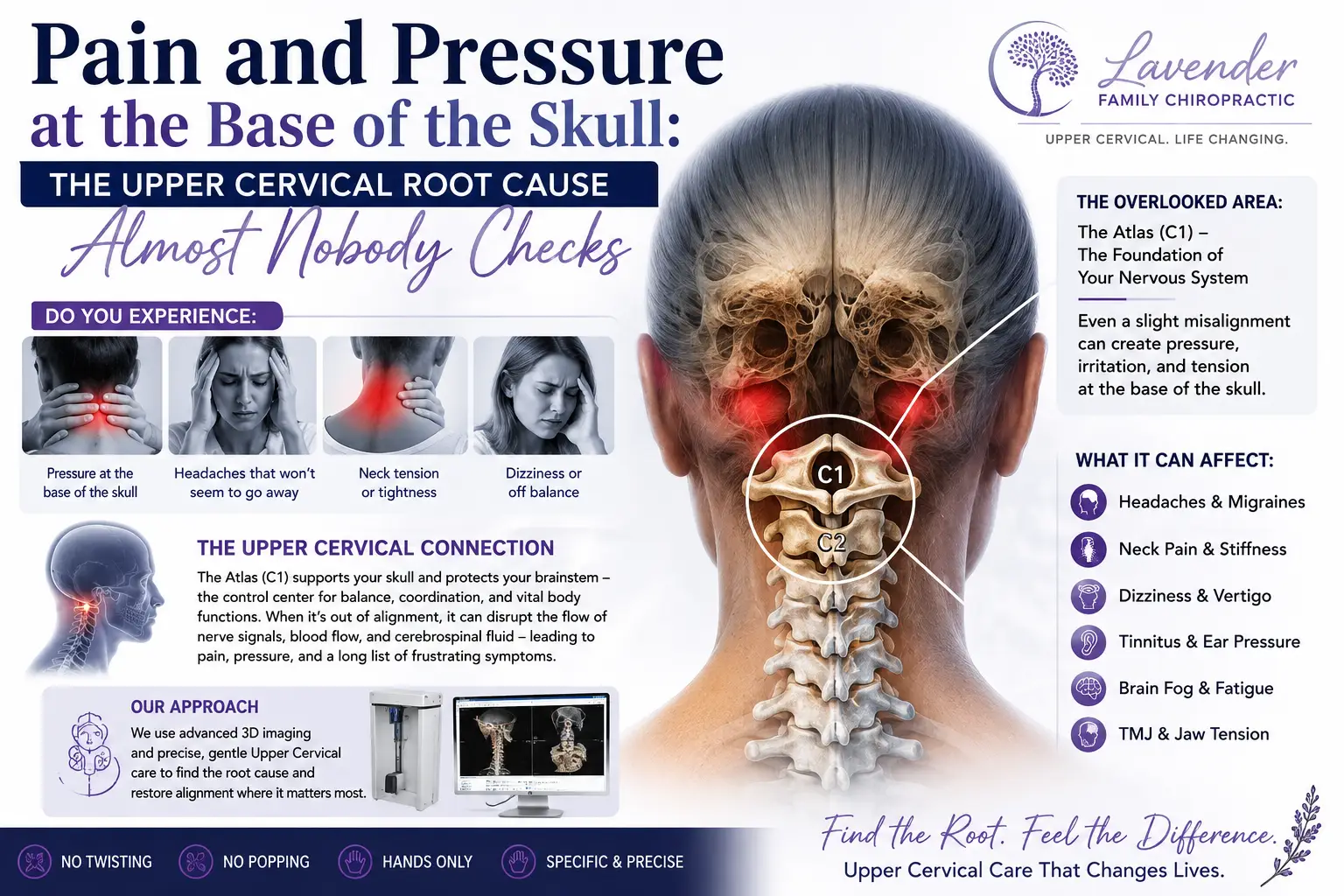
There is a second, neurological reason the upper cervical region matters. The atlas and axis surround the brainstem and the upper spinal cord, the gateway through which sensory and motor information passes between the brain and the body. The upper neck is densely packed with mechanoreceptors and proprioceptors, tiny sensors that constantly report head and neck position. When upper cervical alignment is compromised, the quality of that proprioceptive information degrades, muscle tone regulation becomes less precise, and the threshold for protective guarding drops. A neck whose position sense is slightly off is a neck that is quicker to spasm and slower to release.
This is also why people who only ever treat the symptomatic spot, with a massage gun on the tight muscle or a heat pad on the painful side, tend to feel better for a day and then lock up again weeks or months later. The guarding muscle was never the cause. It was the alarm. Silencing the alarm without correcting the asymmetric loading that set it off leaves the underlying pattern fully intact, waiting for the next trigger. If you also find yourself with a recurring urge to crack or pop your neck for relief, that is another sign the same upper cervical pattern is at work beneath the surface.
Why Upper Cervical Care Matters for an Acute Stiff Neck
At Lavender Family Chiropractic in Sarasota, we approach a sudden stiff neck by addressing both the immediate guarding episode and the upstream mechanical driver underneath it. Through the Knee Chest Upper Cervical technique, we correct atlas and axis misalignment with a precise, gentle, sub-millimeter adjustment that requires no twisting, no cracking, and no forceful rotation of the neck. This matters enormously when your neck is acutely locked and guarded. The last thing an irritated, spasming neck needs is an aggressive rotational manipulation. The gentleness of the upper cervical approach is exactly what makes it appropriate during an acute flare, when more forceful techniques can be uncomfortable or counterproductive.
For someone in the middle of an acute episode, restoring proper upper cervical alignment helps in several ways. First, it begins to unwind the asymmetric loading that has been quietly building in the lower cervical spine, taking pressure off the side that has been chronically overworked and is now in spasm. Second, it improves the quality of proprioceptive input from the upper neck, which helps the nervous system dial down the protective guarding that is producing the head tilt and the muscle hardness. Third, by restoring symmetry and motion at the top of the cervical spine, it allows the deep stabilizing muscles of the neck to resume their proper job, which reduces the burden on the larger, more superficial muscles that are currently doing all the splinting.
What separates upper cervical care from a generic adjustment or a soft tissue treatment is the precision of the diagnosis and the specificity of the correction. We are not cracking the painful joint. We are correcting the structural foundation that has been forcing the painful joint to behave the way it does. This is a fundamentally different model, and it is why many people who have endured repeat episodes of neck lock for years finally find the pattern starts to change once the upper cervical driver is addressed.
A 2021 systematic review and meta-analysis of randomized controlled trials, published in the Journal of Clinical Medicine and indexed in PMC, looked specifically at spinal manipulative therapy for acute neck pain and found that for acute and sub-acute neck pain, multiple sessions of cervical spinal manipulative therapy were more effective than medication in reducing pain and improving function at both immediate and long-term follow-up. In honest terms, the high-quality evidence on manual care for acute neck pain is still developing, and we are careful not to overstate it, but the direction of the evidence is encouraging and aligns with what we see clinically every week.
What Care Looks Like at Lavender Family Chiropractic
If you come into our Sarasota office with an acute stiff neck, here is what to expect.
Your first visit begins with a thorough consultation. Dr. Lavender or Dr. Temple will sit down with you and walk through the full picture: when the episode started, what you were doing when it locked up, exactly which movements are restricted and painful, whether you have had episodes like this before, and what your history of neck pain, injuries, or whiplash looks like. We pay close attention to red flags. If your stiff neck is accompanied by fever, severe headache, light sensitivity, recent significant trauma, progressive arm weakness or numbness, or any other sign that points to something beyond a mechanical neck problem, we will tell you directly and help you get the appropriate medical evaluation immediately. A sudden stiff neck is usually mechanical and benign, but our job is to make sure of that first. Patient safety comes before everything else.
For appropriate patients, the examination includes a careful assessment of your range of motion, the pattern and location of your muscle guarding, a neurological screen, postural analysis, and advanced 3D CBCT imaging of your cervical spine. This level of imaging lets us see atlas and axis alignment, joint spacing, and structural asymmetry in three dimensions, detail that flat films simply cannot provide. We also perform functional nervous system scans to measure, objectively, how your nervous system is operating before care begins.
If the examination reveals an upper cervical misalignment contributing to your episode, we will explain our findings and recommendations plainly. Care is delivered through the gentle Knee Chest Upper Cervical technique, with no popping, twisting, or rotational force, which is particularly important when your neck is acutely guarded. Most patients describe the correction itself as surprisingly mild, almost anticlimactic. The work the body does in response, as the guarding begins to release and motion begins to return, is where the meaningful change happens.
An acute stiff neck often responds relatively quickly in the short term, but lasting change, the kind that reduces how often these episodes happen at all, comes from addressing the underlying pattern over time. We offer customized treatment plans tailored to whether your situation is a first-time acute event or part of a long recurring pattern, and we are transparent with you about what to realistically expect.
📞 Call (941) 243-3729 to schedule your complimentary consultation 📅 Book your consultation online 📍 5899 Whitfield Avenue, Suite 107, Sarasota, FL 34243 — at the corner of University and Whitfield
What the Research Says About Neck Pain and Conservative Care
The research on neck pain and conservative, manual care has grown substantially over the past two decades, and the overall message is reassuring: most neck pain, including acute episodes, is best managed conservatively, and manual approaches have a meaningful role to play.
The epidemiological foundation is well established. The 2022 BMC Musculoskeletal Disorders narrative review documented that neck pain is among the most common musculoskeletal disorders worldwide, with a 2019 age-standardised prevalence of 27.0 per 1000 population, and identified psychological factors such as long-term stress, anxiety, and depression as important contributors to both onset and progression. The stress connection is especially relevant to acute episodes, because elevated baseline muscle tension lowers the threshold at which a neck will guard and lock.
For clinical framing, the 2015 Mayo Clinic Proceedings review remains one of the most useful comprehensive overviews. It classified neck pain by duration into acute, subacute, and chronic, noted that most episodes of acute neck pain resolve with or without treatment but that nearly 50% of individuals continue to experience some degree of pain or recurrence, and emphasized the importance of history and examination in identifying the red flags that distinguish ordinary mechanical neck pain from the rare serious causes.
On the question of whether manual care actually helps, the 2021 systematic review and meta-analysis of randomized controlled trials in PMC found that multiple sessions of cervical spinal manipulative therapy were more effective than medication for acute and sub-acute neck pain at immediate and long-term follow-up, with no serious adverse events reported across the included trials. This is meaningful for patients who would rather not rely on muscle relaxers and anti-inflammatories as their only option.
A 2025 systematic review and network meta-analysis published in PMC examined the effectiveness of musculoskeletal manipulations for neck pain and found that manipulation, mobilization, and soft tissue techniques were all effective at improving cervical range of motion, with manipulation ranking as the most effective for restoring both flexion and extension. Restoring range of motion is precisely the goal during an acute stiff neck, when loss of motion is the defining problem.
It is worth being honest about the state of this evidence. High-quality randomized trials focused narrowly on acute wry neck specifically are limited, and much of the supporting research addresses mechanical and non-specific neck pain more broadly. We think it reads as more credible, not less, to say plainly that the evidence base for conservative manual care is encouraging and growing rather than to claim it is settled and definitive. What the literature does support is clear: most acute neck pain is conservatively manageable, manual care can reduce pain and restore motion, and serious adverse events from gentle care are rare.
Lifestyle Factors That Support Recovery and Prevent the Next Episode
Whether or not upper cervical care is part of your plan, the daily inputs you control have an outsized effect on both how fast the current episode settles and how likely the next one is. These are the habits that turn a recurring problem into a rare one.
Sleep position. The single most common trigger for waking up with a locked neck is sleep posture. Stomach sleeping forces your neck into prolonged rotation for hours at a time, which is among the worst positions for a vulnerable cervical spine. Aim for back sleeping with a pillow that supports the natural curve of your neck without pushing your head forward, or side sleeping with a pillow thick enough to keep your head level with your spine rather than dropping toward the mattress.
Screen ergonomics. Hours spent looking down at phones, tablets, and laptops load the lower cervical spine and feed the asymmetric strain that sets up acute episodes. Bring screens up to eye level, and take frequent breaks to move your neck gently through its full range.
Manage the cold and the draft. In a Florida summer, the air conditioning runs constantly, and a cold draft hitting one side of an already tense neck can provoke guarding. Be mindful of where vents and fans are aimed, especially overnight.
Stay gently mobile during a flare. When your neck locks up, the instinct is to hold it completely still. Total rigidity, though, tends to prolong the guarding. Within the limits of your pain, gentle, slow movement through the comfortable range helps keep the muscles from seizing further and supports circulation to the irritated area. Move gently and often rather than freezing in place.
Hydration. The discs and soft tissues of the neck depend on water content for their resilience, and chronic dehydration is common in the Florida heat. Aim for at least half your body weight in ounces of water daily.
Stress and tension. Chronic stress raises baseline muscle tone throughout the neck and shoulders, lowering the threshold at which the neck will spasm. Whatever helps you regulate stress, whether that is breathing work, walking, or simply protecting your downtime, also protects your neck.
Avoid aggressive self-cracking. When the neck feels stuck, it is tempting to twist hard until it pops. This usually moves the wrong segments, the loose ones that move easily, while the truly restricted segment stays stuck, and over time repeated self-manipulation can stretch the ligaments that are supposed to stabilize the neck. Gentle motion is helpful; forceful self-cracking is not.
If you found this guide useful, you may also want to read our blog on why your neck constantly feels like it needs to pop, which explores the upper cervical instability pattern that often underlies recurring stiffness and the urge to self-adjust.
Serving Sarasota and the Surrounding Communities
Lavender Family Chiropractic is located in Sarasota, Florida, at 5899 Whitfield Avenue, Suite 107, at the corner of University and Whitfield. From this central location, we serve patients throughout the region, including Bradenton, Lakewood Ranch, Palmetto, Parrish, Venice, Osprey, Nokomis, Ellenton, Ruskin, Myakka City, North Port, and the greater Tampa Bay area. Patients also travel from St. Pete, Riverview, and Manatee County to receive specialized upper cervical care here.
An acute stiff neck is the kind of problem that sends people searching urgently for help, because it is painful, disruptive, and frightening in the moment. If you are dealing with a neck that has locked up, or if you are tired of the same episode returning again and again, we would be glad to give you a straight, thorough evaluation of where upper cervical care fits into both calming this episode and reducing the next one.
Top 15 FAQs About Acute Stiff Neck and Upper Cervical Chiropractic Care
1. Why did my neck lock up overnight when I did nothing wrong? Because the overnight position was the trigger, not the cause. A neck that locks from a minor event was almost always mechanically compromised beforehand, often by an upper cervical misalignment and asymmetric joint loading. The awkward sleep position was simply the last straw on an already vulnerable neck.
2. Is a sudden stiff neck dangerous? In the vast majority of cases, no. Most acute stiff necks are mechanical and benign and settle within days to a couple of weeks. However, if your stiff neck comes with fever, severe headache, light sensitivity, recent significant trauma, or progressive weakness or numbness in the arms, seek medical evaluation right away. We screen carefully for these red flags.
3. How long does an acute stiff neck usually last? Most episodes ease meaningfully within a few days to two weeks. The bigger concern is recurrence, since nearly half of people with acute neck pain go on to have further episodes, which is why addressing the underlying pattern matters.
4. Should I rest my neck completely or keep moving it? Gentle, pain-respecting movement is generally better than total rigidity. Holding the neck completely still tends to prolong the guarding. Move slowly within your comfortable range, and avoid forcing the painful direction.
5. Is upper cervical chiropractic safe when my neck is acutely locked and painful? Yes, this is one of its advantages. The Knee Chest Upper Cervical technique is gentle and precise, with no twisting, popping, or rotational force, which makes it well suited to an acutely guarded neck where aggressive manipulation would be uncomfortable or counterproductive. We always examine thoroughly first.
6. Why would you adjust the top of my neck when the pain is at the bottom? Because the atlas and axis set the alignment for the entire cervical spine. When they are misaligned, the lower cervical joints compensate with asymmetric loading that overworks one side, and that overloaded side is where acute spasm tends to occur. Correcting the upper cervical foundation removes the driver of the pattern.
7. Will heat or ice help? Many people find gentle heat helps relax guarding muscles, while others prefer ice for the first day to calm acute irritation. Both can offer temporary comfort, but neither addresses the underlying mechanical cause. Use whichever brings relief while you pursue a more complete solution.
8. Should I use a muscle relaxer or anti-inflammatory? These can reduce symptoms in the short term and are sometimes appropriate, but they manage the alarm rather than the cause. Research suggests manual care can be more effective than medication for acute neck pain over both the short and long term. Discuss medication options with your physician as part of a broader strategy.
9. Why does my neck keep locking up every few months? Recurrence almost always points to an unresolved underlying driver. If the asymmetric loading and upper cervical misalignment that set up the first episode are never corrected, the neck stays primed to spasm again whenever a small trigger comes along. Addressing that foundation is how the cycle changes.
10. Can my pillow be the problem? Your pillow can certainly be a trigger if it forces your head into a poor position for hours, but it is rarely the root cause on its own. A good pillow supports recovery; it does not correct an underlying misalignment. If your neck locks up despite a good pillow, the issue is upstream.
11. Can stress make my neck lock up? Yes. Chronic stress raises baseline muscle tension throughout the neck and shoulders, lowering the threshold at which the neck will guard and spasm. Stress management is an underrated part of both recovery and prevention.
12. Is this the same thing as torticollis? Acute wry neck is sometimes called acute torticollis, and the terms overlap. What we are describing here is the common acute, mechanical version that comes on suddenly in adults. There are other, distinct forms of torticollis, including congenital and certain neurological types, which require different evaluation.
13. Can a car accident cause this kind of neck locking? Yes. Whiplash and other cervical trauma can injure the joints, ligaments, and muscles of the neck and leave it prone to acute guarding episodes, sometimes long after the original crash. Our car accident chiropractic care addresses the whole-cervical-spine picture that trauma patients need.
14. How will I know if upper cervical care is right for me? The only way to know for certain is a thorough evaluation. Our examination, including 3D imaging and functional scans, will show whether an upper cervical misalignment is contributing to your episodes. If it is, we will explain exactly what we recommend. If your situation calls for a different kind of care, we will tell you honestly.
15. How do I get started? Call our Sarasota office at (941) 243-3729 or book your consultation online. We will review your history, perform a thorough examination, screen for any red flags, and give you a straight answer about how upper cervical care fits into calming this episode and reducing the next one.
Take the Next Step Toward Natural Neck Pain Relief
A neck that suddenly locks up is more than an inconvenience. It is your body signaling that the mechanical foundation of your cervical spine was already under strain, and that it has finally reached its limit. The episode will likely ease on its own, but easing is not the same as resolving the pattern underneath. The people who stop having these episodes are the ones who address the upper cervical foundation that most providers never evaluate, alongside the daily habits that either protect the neck or set it up to fail.
If you are in Sarasota, Bradenton, Lakewood Ranch, or anywhere in the surrounding region and you are dealing with a stiff neck you cannot turn, or a recurring pattern of neck lock that keeps coming back, Dr. Rusty Lavender and Dr. Jacob Temple at Lavender Family Chiropractic are here to help you understand the upper cervical piece of the picture and chart a path toward natural neck pain treatment that does not start and end with another muscle relaxer.
📞 Call (941) 243-3729 today to schedule your complimentary consultation 📅 Book online here 📍 5899 Whitfield Avenue, Suite 107, Sarasota, FL 34243 — at the corner of University and Whitfield
Related Articles
- Neck Pain in Sarasota, Florida
- Why Does My Neck Feel Like It Needs to Pop?
- Pinched Nerve in the Neck (Cervical Radiculopathy) in Sarasota, Florida
- Cervical Spondylosis (Neck Arthritis) in Sarasota, Florida: Understanding Age-Related Neck Degeneration and Natural Neck Pain Relief at Lavender Family Chiropractic
Get our upper cervical articles first.