
Migraine Treatment in Bradenton and Parrish, FL: Which Headache You Have, Who Treats It, and When the Neck Is the Cause
By Dr. Rusty Lavender, D.C. — upper cervical chiropractor, Lavender Family Chiropractic, Sarasota, FL. Reviewed and updated October 2026.
If you live in Bradenton or Parrish and you have searched for migraine treatment or a migraine chiropractor, you have found two kinds of results: neurology and pain-management groups along the Manatee Avenue and State Road 70 medical corridors, and a page of general chiropractic offices that list headaches among thirty other conditions. Neither tells you the thing that decides where you should go, which is which headache you have. The three headaches that account for nearly everyone we see from Manatee County are different problems with different treatments, and the one most often mistaken for migraine is the one that comes from the top of the neck. This page sorts them out, lays out the Bradenton and Parrish options honestly, shows what the research says about treating the upper neck for each, and explains what an upper cervical evaluation involves for a patient driving down from Manatee County. Our complete guide to migraines and the upper cervical spine in Sarasota covers the mechanism in depth; this is the Bradenton and Parrish decision guide.
Educational content, not medical advice. A headache that is the worst of your life, comes on like a thunderclap, follows a head injury, or arrives with fever, stiff neck, confusion, weakness, vision loss, or trouble speaking is an emergency. Call 911.
Headaches in Bradenton and Parrish: Two Different Populations, One Pattern
Migraine remains the second leading cause of disability worldwide and the first among young women (Steiner et al., J Headache Pain 2020). Bradenton and Parrish send us two different versions of that patient. From Bradenton it is often the working adult: the trades, the hospital corridor, the port, the hours at a screen or behind a wheel, and a headache that has gone from monthly to weekly to most days. From Parrish, one of the fastest-growing communities in Florida, it is the young family: a parent in their thirties or forties with a migraine history that got worse after a pregnancy, a car accident on I-75, or a concussion in youth sports, now managing it around a long commute and a houseful of kids. The pattern underneath both is the same. The headache has been treated as migraine, the medication helps for a while and then does less, and nobody has looked at the neck.
The second thing both populations share is medication-overuse headache. Taking over-the-counter pain relievers more than two or three days a week can turn an episodic headache into a daily one. In a Bradenton tradesman managing a back and a headache out of the same bottle of ibuprofen, or a Parrish parent getting through the week on Excedrin, it is the most common reason a manageable headache becomes a constant one, and it is the first thing a good evaluation rules out.
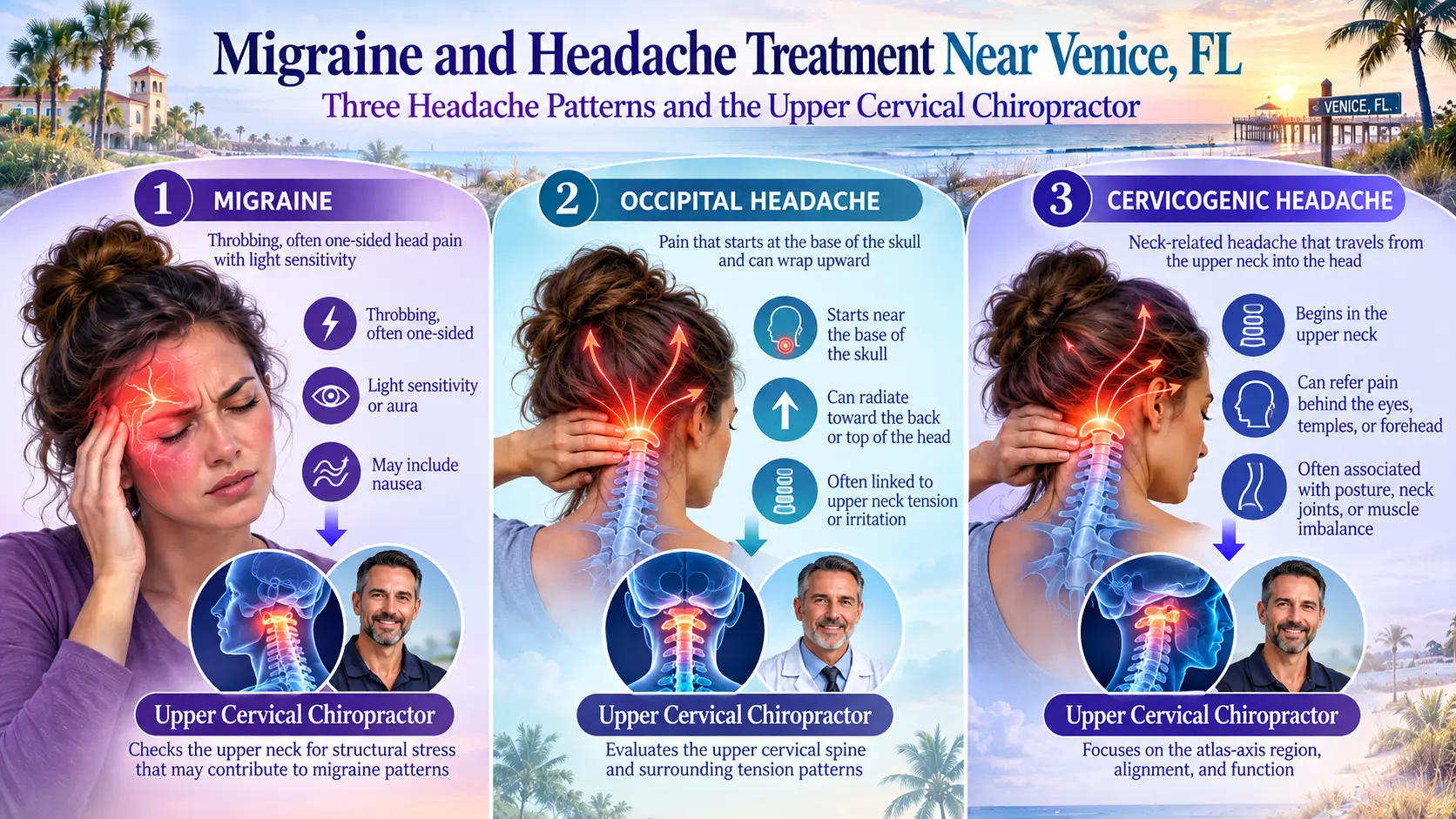
Three Headaches, Three Different Problems
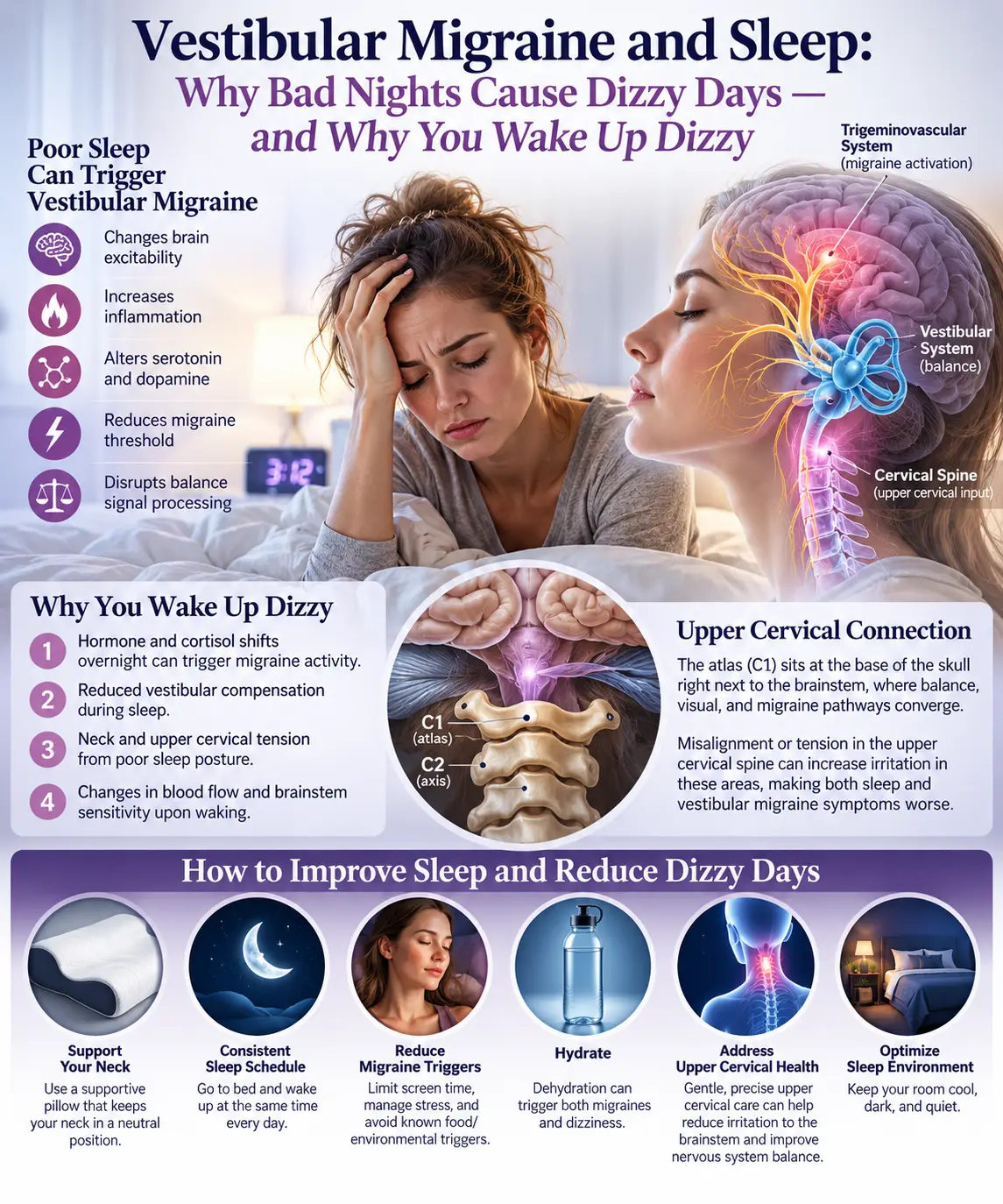
Migraine. One-sided, throbbing, moderate to severe, worse with activity, with nausea or sensitivity to light and sound, lasting four to seventy-two hours. Some people have an aura first. Migraine is a brain disorder, and the brainstem region it runs through, the trigeminocervical complex, is the same nucleus that receives sensory input from the top three cervical segments (Bartsch and Goadsby, Curr Pain Headache Rep 2003). That shared wiring is why neck pain is one of the most common migraine symptoms and why the neck is worth examining in a migraine patient even when the diagnosis is correct. If dizziness travels with your migraines, our vestibular migraine guide covers that variant.
Tension-type headache. A band of pressure across the forehead or around the head, both sides, mild to moderate, not worsened by activity, no nausea. The most common headache in the world. It tracks with stress, poor sleep, and the forward-head posture of screens and driving, which is a lot of Bradenton and Parrish.
Cervicogenic headache. The one that gets missed. It starts at the base of the skull and spreads forward, usually to one side and the same side each time, is set off by neck movement or sustained neck positions, and travels with a stiff upper neck. The diagnostic criteria (Sjaastad et al., Headache 1998) are specific, and the mechanism is well described: the upper cervical joints and the trigeminal nerve converge in the brainstem, so pain from the top of the neck is felt in the head (Bogduk, Neurol Clin 2004). It is routinely diagnosed as migraine or tension headache and treated with medication that does little for it. Our articles on pain and pressure at the base of the skull and occipital neuralgia vs. cervicogenic headache go deeper.
Many Manatee County patients have more than one. A migraine patient with a neck component gets partial relief from preventive medication and partial relief from treating the neck, and needs both. If your headaches track the weather, which they often do on this coast, our guide to barometric pressure headaches explains why.
Migraine Treatment Options in Bradenton and Parrish: Who Treats What
Bradenton has real headache resources, and Parrish patients use them too. The honest map:
- Neurology (several groups in Bradenton, along Manatee Avenue, SR-70, and the Lakewood Ranch medical corridor) for diagnosis, preventive medication including CGRP antibodies, and an acute plan. The right first stop for frequent migraine. Parrish does not have a neurologist; the drive is to Bradenton or Lakewood Ranch either way.
- Primary care for the first evaluation, medication, and the referral. Good at ruling out the dangerous causes; usually not where the neck gets examined.
- Pain management for occipital nerve blocks, trigger-point injections, and Botox for chronic migraine. Effective for a period; does not change the position of the joints that may be producing the pain.
- Physical therapy for posture, strength, and neck mobility. Helps tension-type and cervicogenic headache when the structure is sound.
- General chiropractic (many offices in Bradenton, a few in Parrish) for full-spine adjustments. Helps many headache patients; the neck component is a rotational adjustment delivered by feel, without imaging of the top two bones.
- Upper cervical chiropractic for a measured, imaging-guided correction of the atlas and axis, delivered without rotating the neck. Not available in Bradenton or Parrish; the nearest office is ours in Sarasota, 20 to 30 minutes south.
We work alongside neurologists, not instead of them. A Bradenton patient who stays on a preventive and comes to us for the neck is doing it right.
What the Research Says About Chiropractic for Migraine and Headache
The evidence is honest in both directions, and we would rather you hear it from us. For migraine, a randomized trial in Australia found that chiropractic spinal manipulation reduced migraine frequency, duration, and medication use compared with a control group (Tuchin et al., J Manipulative Physiol Ther 2000). A larger, more rigorous three-armed trial in Norway found that both real manipulation and a sham procedure improved migraine, with no significant difference between them at the end of follow-up (Chaibi et al., Eur J Neurol 2017), which is a reminder that a good chunk of any headache treatment’s effect is attention, expectation, and time. A systematic review and meta-analysis pooling the trials concluded that spinal manipulation reduced migraine days and pain intensity, with the authors calling for larger studies (Rist et al., Headache 2019). The chiropractic profession’s own evidence-based guideline rates manipulation as recommended for migraine and cervicogenic headache (Bryans et al., J Manipulative Physiol Ther 2011).
For cervicogenic headache, the evidence is stronger and more specific. The randomized trial by Jull and colleagues (Spine 2002) found that manipulative therapy and targeted exercise each reduced headache frequency and intensity, with the benefit holding at twelve months. For tension-type headache, manipulation helps some patients, and the forward-head posture that drives it is the same posture that loads the upper neck.
What upper cervical care adds to that literature is the measurement. Every trial above delivered manipulation by feel. We take a 3D cone-beam CT of the atlas and axis before the first correction, calculate the correction from the imaging, and deliver it without rotating the neck. We are not claiming a better trial result; we are claiming a more precise target and a gentler delivery, and we tell every Bradenton and Parrish patient that results depend on whether the neck is actually part of their headache.
What an Upper Cervical Evaluation for Headaches Involves
The first visit is a history that sorts your headache into one of the three types above, or more than one, and an examination of the upper neck, including the tests that provoke a cervicogenic headache. Paraspinal thermography reads the heat pattern along the spine and gives an objective marker to track from visit to visit. If the examination points to the upper neck, a 3D cone-beam CT of the atlas and axis shows their position in three dimensions. We review the findings with you before any care begins. If the imaging shows nothing to correct, we say so and help you get to the right next step, whether that is a neurologist in Bradenton or a therapist closer to home in Parrish.
The correction itself is a precise, low-force procedure to the atlas based on the imaging. There is no twisting of the neck and no cracking. For a patient mid-migraine, we keep the exam room dim and quiet.
Getting Here From Bradenton and Parrish
Our office is at the corner of University Parkway and Whitfield Avenue in Sarasota, just west of I-75 by UTC. From downtown Bradenton, take US-41 South or US-301 South to University Parkway: about 11 miles and 20 to 25 minutes. From West Bradenton and Palma Sola, 25 to 30 minutes down 75th Street West and US-41. From Parrish, take US-301 to I-75 South and exit at University Parkway (exit 213), or come down US-301 through Ellenton: about 22 miles and 30 minutes outside rush hour. We book Manatee County patients mid-morning or early afternoon so you miss the I-75 commute. Our Bradenton page and Parrish page have full directions and what to expect on a first visit.
Who Should and Shouldn’t Come
Come for an upper cervical evaluation if: your headaches start at the base of the skull or on one side and travel forward; they are set off by neck movement or a sustained neck position; they began or worsened after a car accident, fall, or concussion; you have a migraine diagnosis and a stiff neck that nobody has examined; or you have been on preventive medication for a year and are still having headaches most weeks.
See someone else first if: your headache is new, sudden, or the worst of your life (emergency department); it comes with fever, stiff neck, confusion, or neurological symptoms (emergency department); you have frequent migraine and no neurologist yet (neurology first, then us if the neck is involved); or your headaches are daily and you are taking pain relievers most days (a physician, to address medication overuse).
Frequently Asked Questions About Migraine Treatment in Bradenton and Parrish
Where can I get migraine treatment in Bradenton, FL? Bradenton has several neurology groups, pain-management practices, and physical therapists along the Manatee Avenue and State Road 70 corridors, plus many general chiropractors. For an upper cervical evaluation with 3D imaging of the atlas and axis, the nearest office is ours at University Parkway and Whitfield Avenue in Sarasota, 20 to 25 minutes south.
Is there a migraine chiropractor in Parrish? Parrish has a few general chiropractic offices. There is no upper cervical office in Parrish or anywhere in Manatee County; ours is the nearest, about 30 minutes down I-75 or US-301.
Can a chiropractor help with migraines? For some people, yes. Randomized trials show spinal manipulation can reduce migraine frequency, and the evidence is stronger for the headache that comes from the neck. We are honest that one well-designed trial found no difference from a sham procedure. What we add is imaging the top of the neck first, so you know whether the neck is part of your headache before anyone treats it.
How do I know if my headache is coming from my neck? Three clues: it starts at the base of the skull or on one side and spreads forward; it is set off by turning your head or holding your neck in one position; and your upper neck is stiff or tender. If those fit, a cervicogenic headache is likely, and it is the one most often misdiagnosed as migraine.
Do I need to stop seeing my neurologist? No. Upper cervical care works alongside medical care. Many of our Bradenton patients stay on a preventive and come to us for the neck. We will send your neurologist our findings if you want us to.
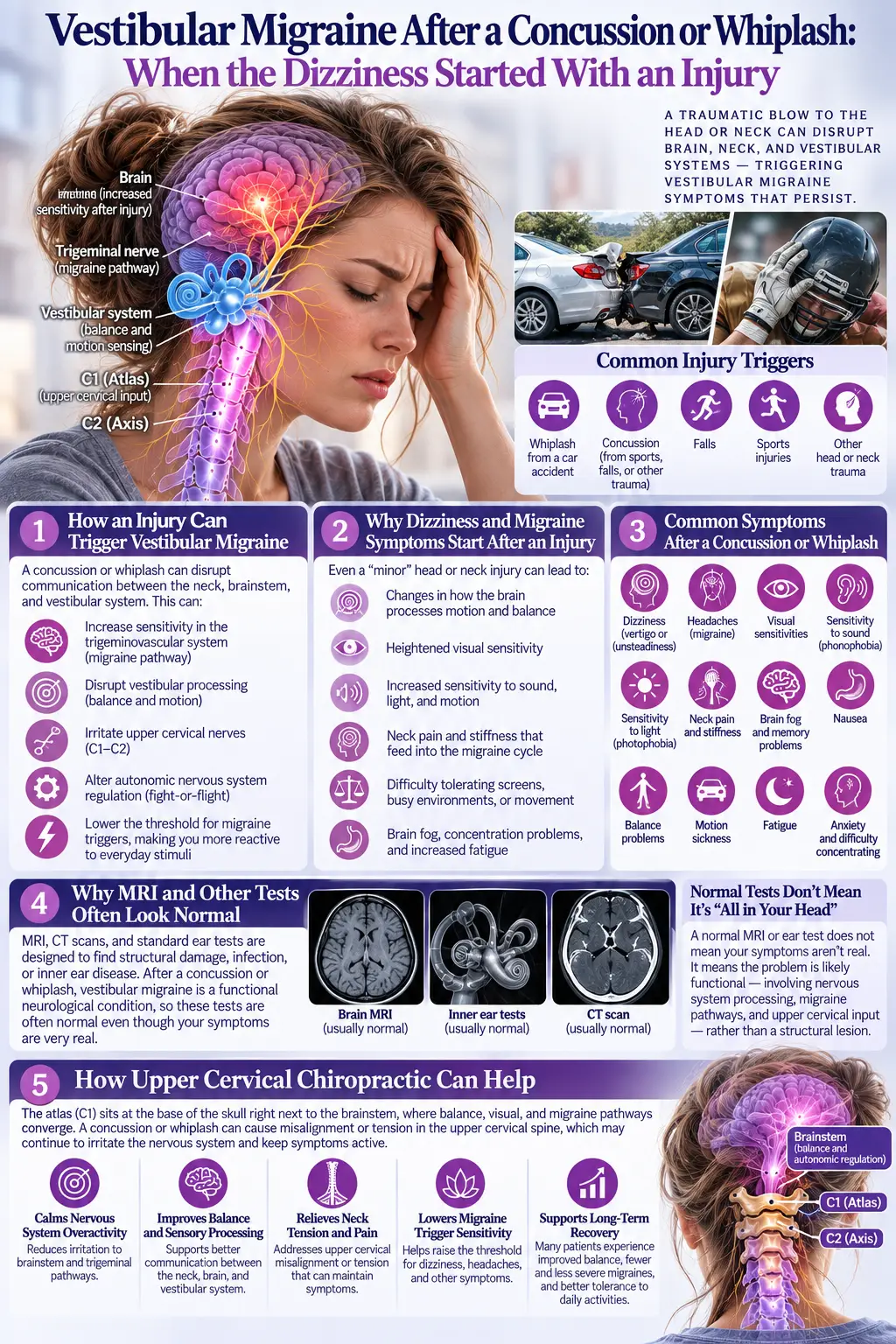
My headaches started after a car accident on I-75. Is that connected? Often. A rear-end collision can shift the atlas without producing anything on an emergency-room X-ray, which is designed to find fractures. Headaches that begin weeks or months after a crash and sit at the base of the skull are a classic upper cervical presentation. We work with auto-injury physicians and attorneys, and PIP typically covers the evaluation.
I take ibuprofen most days. Is that a problem? It can be the problem. Pain relievers more than two or three days a week can produce a daily medication-overuse headache. Your physician can help you taper; we address the neck. Both usually need to happen.
How many visits will it take? We cannot say until we have evaluated you. The first visit is history, examination, thermography, and imaging if indicated, and we review findings before any care begins. When the neck is involved, people usually notice changes within the first several weeks.
Is the adjustment safe for someone in their seventies, or for a teenager? The correction is low-force and delivered without rotating the neck, which is why it is suitable across ages. The largest prospective study of upper cervical care, following 1,090 patients, reported no serious adverse events. We screen every patient before the first correction.
Does insurance cover it? We go over costs and coverage before you commit to anything. Call the office and we will walk you through it, including auto-injury (PIP) cases.
Lavender Family Chiropractic in Sarasota, Florida offers a thorough upper cervical evaluation to find out whether the top of your neck is part of your headaches. If dizziness travels with them, our Bradenton and Parrish vertigo guide covers that side; if neck pain is the main complaint, start with our Bradenton and Parrish neck pain guide. To schedule a consultation, contact the office.
References
- Steiner TJ, et al. Migraine remains second among the world’s causes of disability, and first among young women: findings from GBD2019. J Headache Pain. 2020;21(1):137. PMID 33267788
- Bartsch T, Goadsby PJ. The trigeminocervical complex and migraine: current concepts and synthesis. Curr Pain Headache Rep. 2003;7(5):371–376. PMID 12946290
- Sjaastad O, Fredriksen TA, Pfaffenrath V. Cervicogenic headache: diagnostic criteria. Headache. 1998;38(6):442–445. PMID 9664748
- Bogduk N. The neck and headaches. Neurol Clin. 2004;22(1):151–171. PMID 15062532
- Tuchin PJ, Pollard H, Bonello R. A randomized controlled trial of chiropractic spinal manipulative therapy for migraine. J Manipulative Physiol Ther. 2000;23(2):91–95. PMID 10714533
- Chaibi A, et al. Chiropractic spinal manipulative therapy for migraine: a three-armed, single-blinded, placebo, randomized controlled trial. Eur J Neurol. 2017;24(1):143–153. PMID 27696633
- Rist PM, et al. The impact of spinal manipulation on migraine pain and disability: a systematic review and meta-analysis. Headache. 2019;59(4):532–542. PMID 30973196
- Bryans R, et al. Evidence-based guidelines for the chiropractic treatment of adults with headache. J Manipulative Physiol Ther. 2011;34(5):274–289. PMID 21640251
- Jull G, et al. A randomized controlled trial of exercise and manipulative therapy for cervicogenic headache. Spine. 2002;27(17):1835–1843. PMID 12221344
Related Posts

Get our upper cervical articles first.
Patients Experience