Occipital Neuralgia vs Cervicogenic Headache: Two Upper-Neck Headaches — and the One Region Driving Both
By Dr. Rusty Lavender, D.C. — upper cervical chiropractor, Lavender Family Chiropractic, Sarasota, FL. Reviewed and updated October 2026.
Here is the fact that should reframe your entire search for answers: both of the headaches most often confused for each other — occipital neuralgia and cervicogenic headache — are generated in the same three vertebrae at the top of your neck. C1, C2, and C3. That is where the occipital nerves are born, where the pain-referring joints live, and where whiplash and years of forward-head posture do their damage. If you have been told you have “migraines” or “tension headaches” and handed medication, there is a very real chance the actual driver sits one inch below your skull — in a region no one bothered to examine.
I see patients from Sarasota, Lakewood Ranch, and Bradenton every week who have cycled through labels and prescriptions while the real story played out in their upper cervical spine. Sometimes the pattern points clearly toward occipital neuralgia. Sometimes toward cervicogenic headache. And sometimes it takes careful history-taking, a physical exam, 3D imaging, and coordination with a physician to sort out. My goal here is to give you an honest, clinically accurate, cause-forward map of these two conditions — and to make the case that the upper neck belongs at the center of your evaluation, not the margins.
Let me be clear up front: this article is patient education, not a diagnosis. Headaches can occasionally signal something serious, and I will walk you through the warning signs that mean urgent care. But for the large group of people whose headaches come from the upper neck, understanding these two conditions — and getting that region evaluated — is the first real step toward relief.
The Core Difference at a Glance
Before we go deep, here is the short version — the differential everything else builds on.
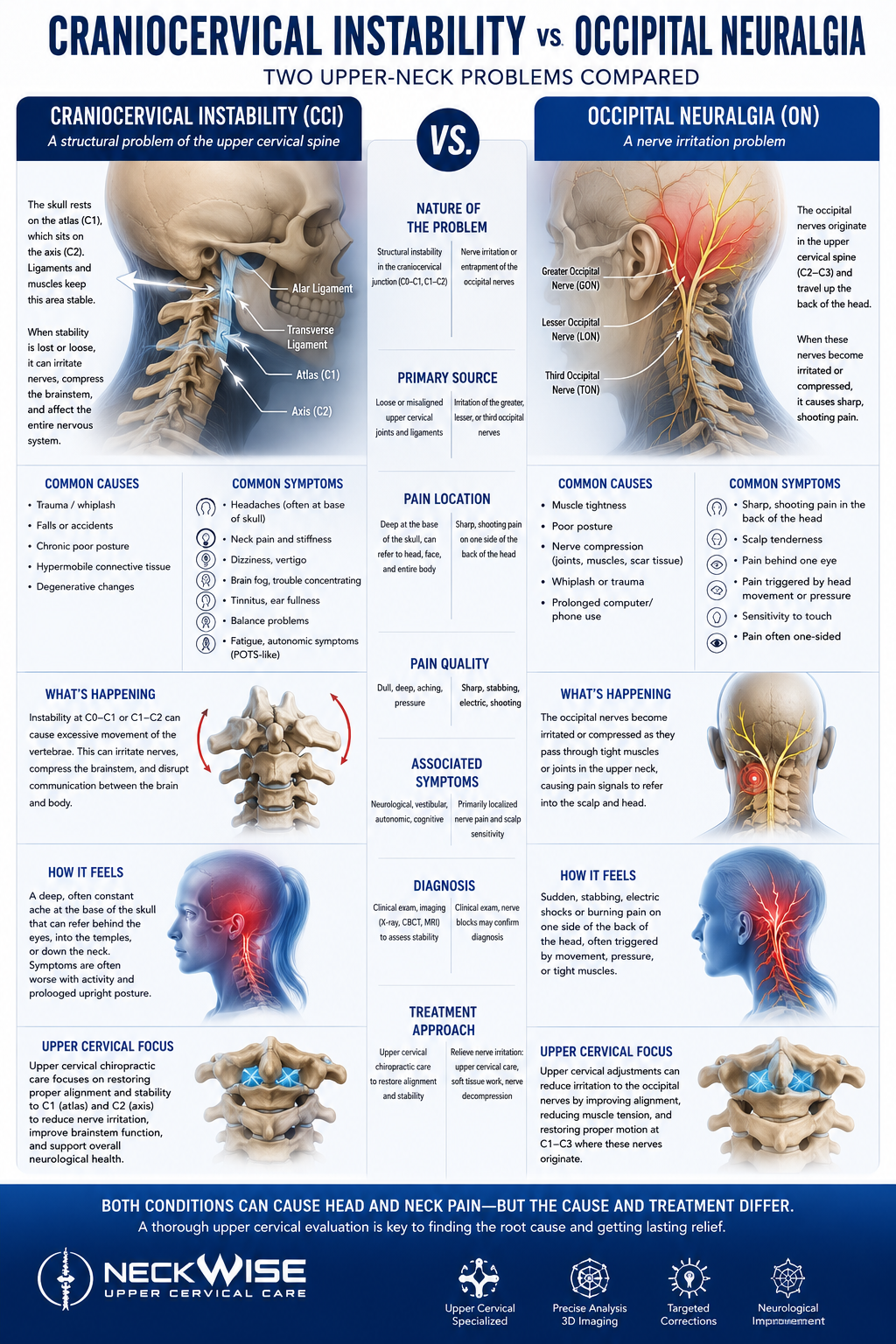
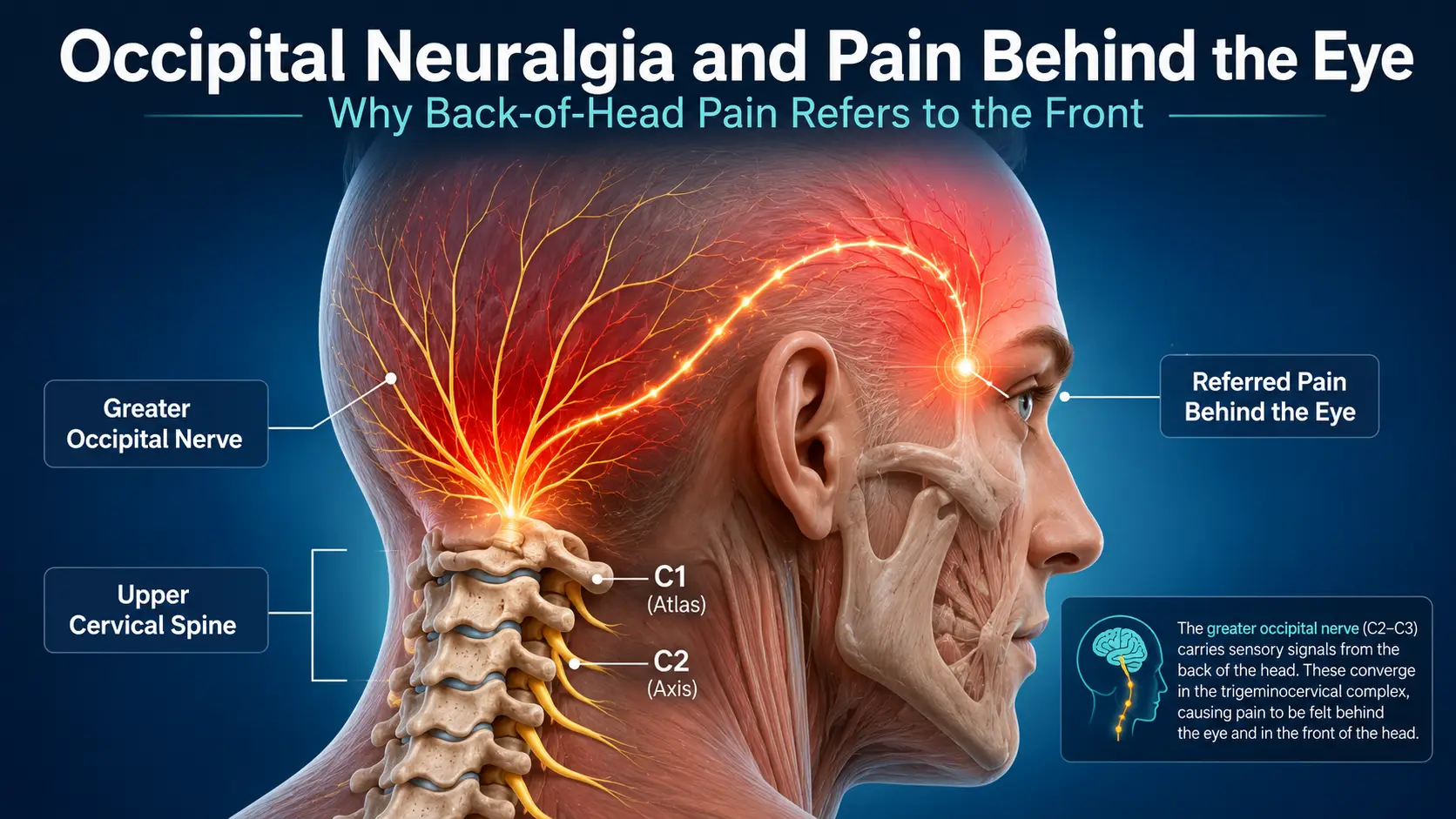
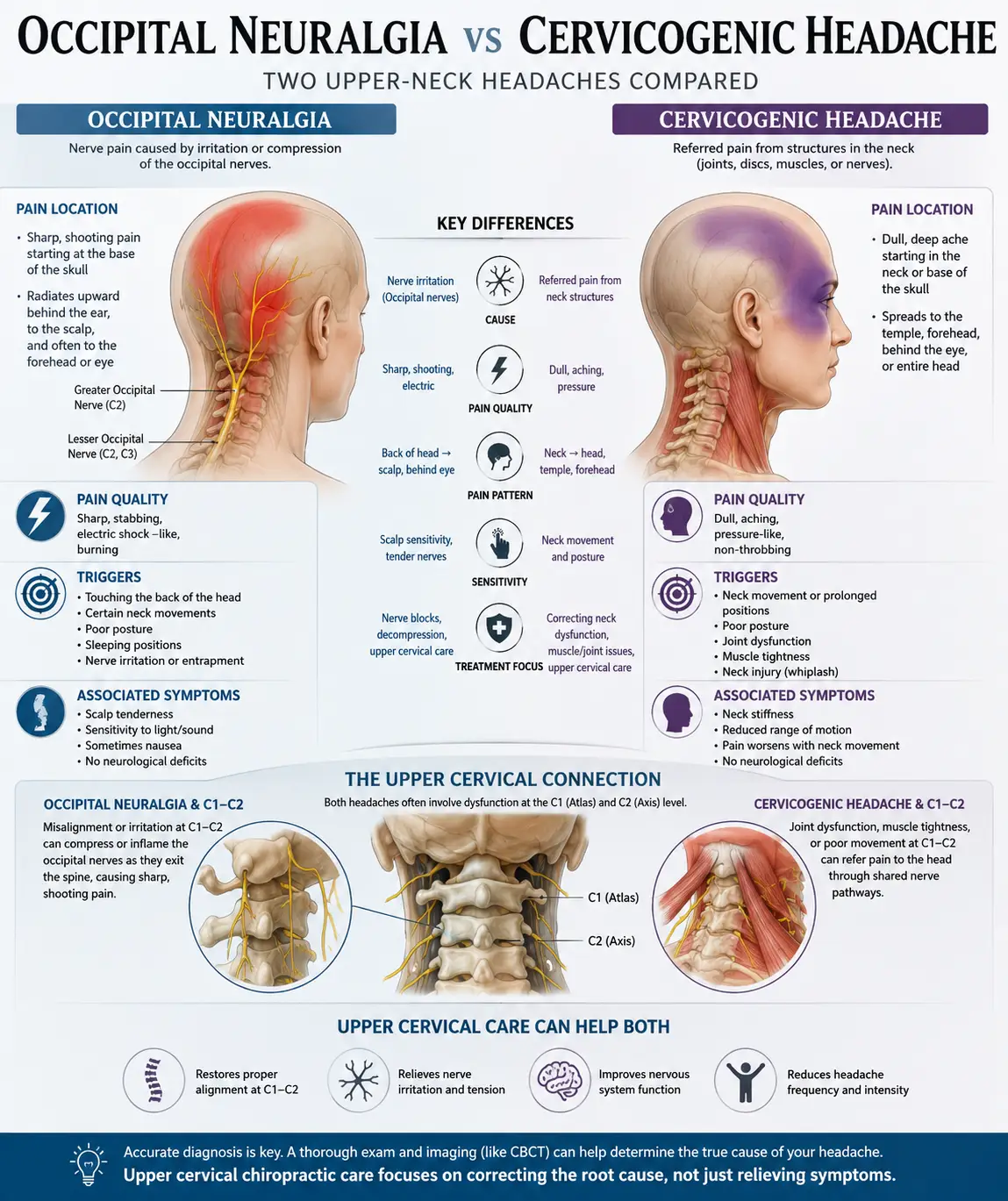
Occipital neuralgia (ON) is a nerve problem. The greater, lesser, and third occipital nerves emerge from the upper cervical spine and travel across the back and sides of the scalp. When one is irritated, compressed, or inflamed, it fires off pain classically described as sharp, shooting, stabbing, electric, or shock-like. The pain shoots along the nerve’s path, usually from the base of the skull up toward the top or side of the head, sometimes reaching behind the eye. Between the jolts, many people feel a burning or aching residue, and the scalp becomes tender or hypersensitive — a light touch, a ponytail, or a pillow can set it off.
Cervicogenic headache (CGH) is a referred pain problem. The joints, discs, ligaments, and muscles of the upper neck generate a dull, aching, pressure-like headache that is referred — felt in the head even though the source is the neck. It is classically side-locked (stays on one side and does not switch), usually starts in the neck or the back of the head, and is provoked or worsened by neck movement or awkward neck postures. Neck stiffness and reduced range of motion usually come along.
The quick mental shortcut: sharp, electric, nerve-path pain that makes the scalp tender leans toward occipital neuralgia; dull, one-sided, movement-provoked pain that spreads up from a stiff neck leans toward cervicogenic headache. Real life is messier, and the two overlap or coexist — but notice that both start in the same place. Both conditions have been reviewed carefully together. A 2019 overview in Current Neurology and Neuroscience Reports by Barmherzig and Kingston walks through the diagnosis and management of both side by side, and a 2025 review in Current Pain and Headache Reports titled “A Pain in the Neck” compares them alongside migrainous cervicalgia — underscoring how often they get tangled, and how consistently the answer traces to the upper neck.
Why Both Start in the Upper Neck (C1–C3)
To understand why these two are cousins, you have to understand a piece of neuroanatomy called trigeminocervical convergence — and it is the reason the upper neck sits at the center of this entire subject.
The nerves that carry sensation from your upper neck — the C1, C2, and C3 spinal nerves — feed into the same relay station in your brainstem (the trigeminocervical nucleus) that receives sensation from your face and head via the trigeminal nerve. Because these signals converge on shared circuitry, your brain genuinely cannot always tell whether a pain signal originated in the neck or the head. This is the anatomical reason a problem in the upper cervical spine gets feltas a headache. It is not imaginary or “in your head” in the dismissive sense — it is a real, well-mapped case of the nervous system referring pain from one region to another.
Now place our two conditions on that map.
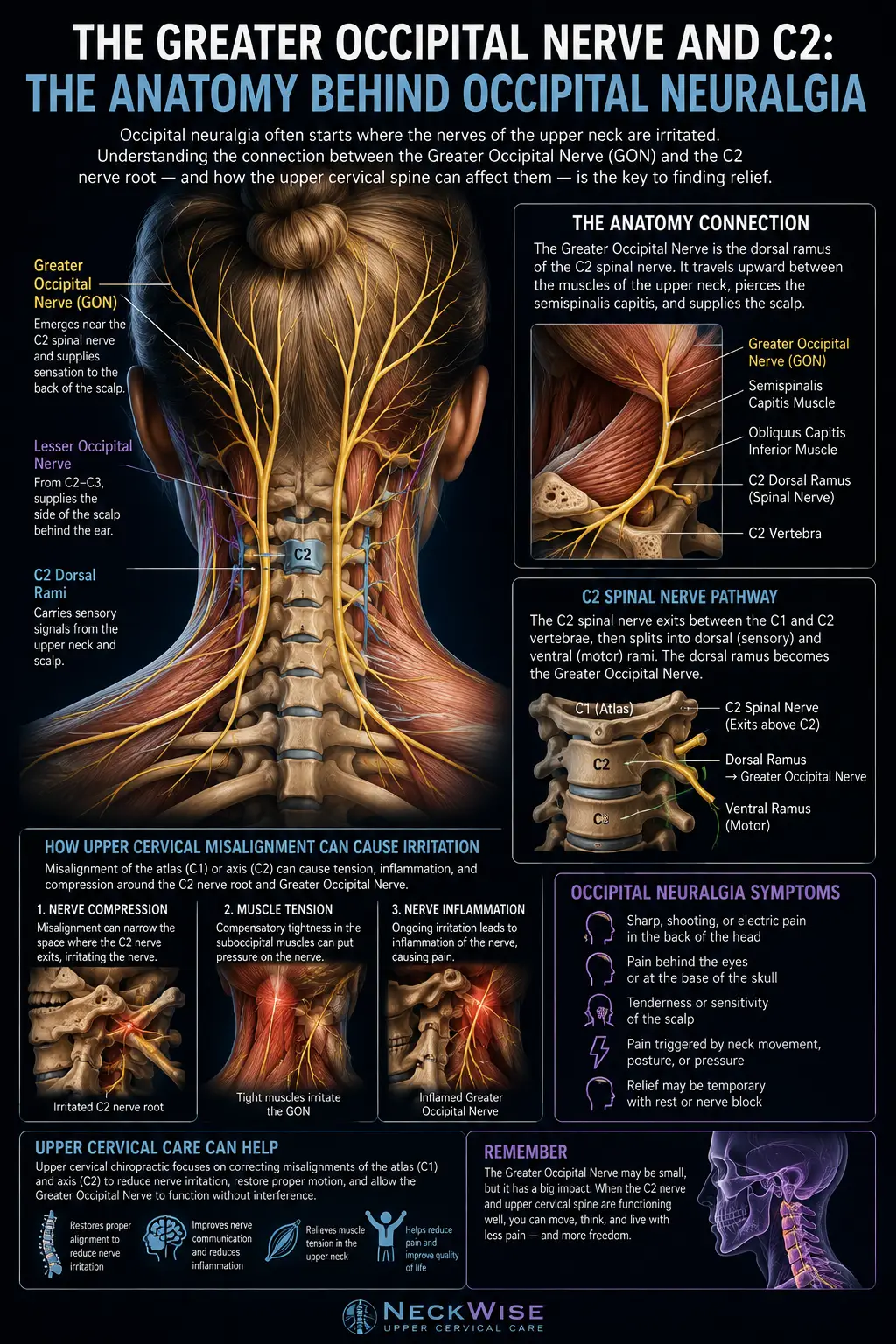
The occipital nerves come directly out of this region. The greater occipital nerve is formed largely from the C2 nerve root; the lesser occipital nerve draws from C2 and C3; the third occipital nerve comes from C3 and crosses the C2–C3 facet joint. These nerves thread between muscles and around joints on their way to the scalp. Anywhere along that path they can be irritated — by muscle tension, by trauma such as whiplash, by degenerative changes in the joints they pass, or by the abnormal loading that follows an atlas or axis misalignment. When they are irritated, you get the sharp, shooting scalp pain of occipital neuralgia. A thorough review of the head neuralgias by Choi and Jeon in the Journal of Korean Medical Science details this anatomy and the many sources of occipital nerve irritation.
The cervical joints and muscles of C1–C3 are the referral engine for cervicogenic headache. The C2–C3 facet joint in particular — the very joint the third occipital nerve crosses — is one of the most common documented sources. When these joints are dysfunctional, arthritic, or injured, they refer that dull, one-sided, movement-sensitive headache upward. The landmark assessment by Bogduk and Govind in The Lancet Neurology makes the case that cervicogenic headache is, at its core, pain referred from cervical structures, with the upper cervical joints as the usual sources.
So both conditions live in the same three-vertebra neighborhood. One is primarily about the nerves that exit there; the other is primarily about the joints and muscles there referring pain. That shared address is exactly why they get confused — and exactly why a precise evaluation of the upper neck is the piece most people are missing.
Occipital Neuralgia in Depth
What it feels like
Occipital neuralgia announces itself with paroxysms — sudden bursts — of sharp, stabbing, or electric pain. People reach for words like “ice pick,” “lightning,” “electric shock,” or “a hot poker.” The pain follows the course of the affected occipital nerve, most commonly starting at the base of the skull on one side and shooting up over the back of the head, sometimes toward the crown, the temple, or behind the eye on the same side.
Between the sharp attacks there is often a continuous dull ache or burning along the same track. A hallmark feature is dysesthesia or allodynia of the scalp — the scalp becomes so sensitive that ordinary contact hurts. Brushing your hair, resting on a pillow, or wearing a hat can trigger a jolt. Many patients also have a specific tender spot where the greater occipital nerve emerges at the base of the skull, and pressing there reproduces the shooting pain. That spot is not random — it is where the nerve exits the upper neck.
Occipital neuralgia is usually one-sided, though it can affect both. It typically lacks the nausea, light sensitivity, and visual aura of migraine — although migraine and occipital neuralgia can coexist, and the trigeminocervical convergence we discussed can blur the picture.
What drives it
Often no single cause is found. When one is identified, it may be irritation or entrapment of the nerve as it passes through muscle, prior trauma (whiplash is a classic trigger), degenerative changes in the upper cervical joints, or chronic muscle tightness in the suboccipital region. Because the nerve’s path takes it through and around the very structures of the upper cervical spine, upper-neck mechanics are directly relevant to whether that nerve is being provoked — which is precisely why the position and movement of the atlas and axis deserve a hard look.
How it is diagnosed
Diagnosis is primarily clinical — it rests on the story and the exam. The specific quality of the pain (sharp, shooting, along the nerve), the scalp tenderness, and reproduction of pain with pressure over the nerve point the way. There is no blood test. Imaging is used mainly to rule out other causes rather than to confirm the neuralgia.
One of the most useful diagnostic tools is a diagnostic occipital nerve block, performed by a physician. If numbing the occipital nerve with a local anesthetic temporarily switches off the pain, that strongly supports the nerve as the pain generator — and confirms the source lives in the upper neck. Both the Barmherzig and Kingston review and the Choi and Jeon paper describe the nerve block as central to confirming the diagnosis.
Cervicogenic Headache in Depth
What it feels like
Cervicogenic headache tends to be the quieter, more grinding of the two. The pain is usually dull, aching, or pressure-like rather than sharp. It commonly begins in the neck or the back of the head and spreads forward toward the forehead, temple, or around the eye — but it starts in the back. It is characteristically side-locked: it stays on the same side attack after attack. (If your one-sided headache regularly switches sides, that argues against a straightforward cervicogenic headache.)
The single most telling feature is the relationship to the neck. The pain is provoked or worsened by neck movement, by sustained awkward postures (long hours at a screen, sleeping in a bad position), or by pressure on certain spots in the upper neck. Alongside the headache, people typically notice reduced neck range of motion and stiffness on the painful side. The headache and the neck problem travel together — because they are the same problem.
What drives it
The source is a musculoskeletal or joint problem in the upper cervical spine — most often the joints of C1–C2 and C2–C3, but also the discs, ligaments, and muscles of that region. Degenerative arthritis, prior neck injury such as whiplash, and postural strain are common contributors. Bogduk and Govind’s Lancet Neurology assessment emphasizes that the pain is referred from these cervical structures, and that the C2–C3 facet joint is frequently implicated.
How it is diagnosed
Like occipital neuralgia, cervicogenic headache is diagnosed clinically, supported by specific criteria. Clinicians look for the side-locked pattern, provocation of the headache by neck movement or posture, restricted cervical range of motion, and reproduction of the usual headache when specific upper-cervical structures are examined.
The most rigorous confirmation, as Bogduk and Govind describe, comes from diagnostic nerve blocks targeting specific cervical structures — for example, blocking the nerves that supply a particular facet joint. If anesthetizing that joint reliably abolishes the headache, it confirms the joint as the source. These controlled blocks are the reference standard, and another reason coordinating with a physician is valuable.
Occipital Neuralgia vs Cervicogenic Headache: A Side-by-Side Comparison
Here is a consolidated comparison. Remember these are typical patterns, not absolute rules, and overlap is common.
Pain quality
- Occipital neuralgia: Sharp, shooting, stabbing, electric, shock-like — often with a dull ache between jolts.
- Cervicogenic headache: Dull, aching, pressure-like; steadier and less “electric.”
Origin and spread
- Occipital neuralgia: Starts at the base of the skull and shoots up along the occipital nerve toward the crown, side, or behind the eye.
- Cervicogenic headache: Starts in the neck or back of the head and spreads forward toward the forehead, temple, or eye.
Sidedness
- Occipital neuralgia: Usually one-sided (can be bilateral); follows the nerve’s path.
- Cervicogenic headache: Side-locked — stays on one side and does not switch.
Main trigger
- Occipital neuralgia: Touching or pressing the scalp or nerve; scalp is tender/hypersensitive.
- Cervicogenic headache: Neck movement, sustained posture, or pressure on the upper neck.
Neck findings
- Occipital neuralgia: May have upper-neck tenderness, but scalp sensitivity dominates.
- Cervicogenic headache: Reduced neck range of motion and stiffness are typical.
Confirmatory test
- Occipital neuralgia: Diagnostic occipital nerve block relieves the pain.
- Cervicogenic headache: Diagnostic block of a specific cervical joint/nerve relieves the pain.
Underlying nature
- Occipital neuralgia: A nerve irritation problem — rooted in the upper neck.
- Cervicogenic headache: A referred-pain problem from cervical joints and muscles — rooted in the upper neck.
The 2025 “A Pain in the Neck” review lines these entities up next to one another — and adds migrainous cervicalgia — to show clinicians how to tease them apart. The honest takeaway: they can look similar and sometimes coexist, which is why a careful, structured evaluation of the upper cervical spine matters more than a snap judgment.
Why Diagnostic Nerve Blocks Are So Useful
I want to spend a little more time on nerve blocks, because they are one of the clearest ways to separate these two conditions — and they keep pointing to the same place.
A diagnostic nerve block is a targeted injection of local anesthetic performed by a physician. The logic is simple: if numbing a specific structure makes the headache go away, that structure is very likely the pain source. For occipital neuralgia, blocking the greater or lesser occipital nerve is both a diagnostic clue and often a source of temporary relief. For cervicogenic headache, blocking the nerves supplying a suspected upper-cervical joint can confirm that joint as the generator.
There is even research on occipital nerve blocks as a treatment for cervicogenic headache. A 2021 systematic review on the efficacy and safety of greater occipital nerve block for cervicogenic headache examined this specifically, reflecting how the occipital nerve sits at the crossroads of both conditions. The fact that the same nerve — arising from your upper neck — can be involved in the diagnosis and management of both is a vivid reminder of how intertwined these upper-neck problems are, and how central that region is to solving them.
For our patients, this is exactly the kind of information we coordinate around. If you have had a nerve block that told your physician something specific about your pain source, that shapes how gently and precisely we approach your upper cervical spine.
What the Research Says
Let me pull the evidence together honestly.
For cervicogenic headache, neck-focused manual and physical therapies have real, trial-level support. Because cervicogenic headache is fundamentally a musculoskeletal problem of the neck, treatments that address neck mechanics have been studied in randomized controlled trials, and manual therapy approaches have shown benefit. Bogduk and Govind’s Lancet Neurology assessment reviews the diagnostic and treatment evidence, and the broader literature — including the Barmherzig and Kingston overview — reflects that conservative, neck-focused care has a legitimate role. This is meaningful: addressing the upper cervical spine is not a fringe idea for CGH; it is aligned with where the pain actually comes from.
For occipital neuralgia, the picture is different, and I will be straight with you. There is not a comparable body of randomized controlled trial evidence showing that manual therapy resolves occipital neuralgia. Management described in the literature centers on nerve blocks, medications aimed at nerve pain, and, in refractory cases, specialist procedures. When conservative or manual approaches are used for occipital neuralgia, they are best understood as mechanism-based— aimed at reducing the upper-cervical muscle and joint irritation that may be provoking the nerve, based squarely on the anatomy of where that nerve is born. That anatomy is not in doubt: the driver is the upper neck.
Both conditions demand accurate diagnosis first. Across all the sources here, the recurring theme is that getting the diagnosis right — often with diagnostic blocks and a careful exam — is what makes treatment rational. The 2025 comparative review exists precisely because these conditions are so easily confused, and confusion leads to treatments aimed at the wrong target.
My bottom line: neck-focused care has stronger research backing for cervicogenic headache than for occipital neuralgia, and for either condition no responsible clinician should promise a cure. What we can offer is care directed precisely at the region these headaches come from, coordinated with your physician, and honest about its role.
How Upper Cervical Chiropractic Fits In
Given everything above, you can see why upper cervical care is genuinely central to both conditions: they both originate in the upper cervical spine, the exact region this care focuses on. Here is how we approach it at Lavender Family Chiropractic — and what we do not claim.
Our practice, NeckWise North Sarasota, is built around precise, gentle, low-force upper cervical care.
3D CBCT imaging
We use cone-beam computed tomography (CBCT) to obtain three-dimensional imaging of the upper cervical spine. Because both occipital neuralgia and cervicogenic headache involve the specific joints and structures of C1–C3, seeing that region clearly in three dimensions helps us understand your individual anatomy and mechanics before we ever touch your neck — and helps us recognize when something falls outside our scope and needs a medical referral.
Paraspinal infrared thermography
We use paraspinal infrared thermography as an objective way to assess patterns along the spine over time. It is a non-invasive measurement tool that helps us track changes and monitor how you are responding, adding data to the clinical picture rather than relying on impressions.
Low-force Knee Chest Upper Cervical technique
Our adjustments use the Knee Chest Upper Cervical technique, a precise, gentle, low-force approach. There is no twisting, no cracking, and no popping. If your scalp and upper neck are exquisitely sensitive from occipital neuralgia, or your neck is cranky and stiff from cervicogenic headache, the idea of a forceful manipulation is understandably alarming. That is not what we do. The low-force approach addresses upper cervical mechanics without aggravating already-irritated tissues.
Where this fits
For cervicogenic headache, addressing the upper cervical spine is directly aligned with where the pain originates, and neck-focused manual care has research support. For occipital neuralgia, our care is mechanism-based — aimed at reducing the upper-cervical joint and muscle irritation that can be the driver of occipital nerve pain, coordinated with your physician’s diagnostic and medical management.
In neither case will I call this a cure, and I will never present it as one. We see our role as part of a team. If a diagnostic nerve block, medication, or specialist procedure is what your situation calls for, we work alongside the physicians providing it. Precise, gentle care directed at the upper cervical spine — the region these headaches come from — combined with clear communication with your medical team, is how we help people hurting in this specific place.
Red Flags: When a Headache Needs Urgent Medical Attention
Most upper-neck headaches are not dangerous, but some headaches are warning signs of a serious problem. Please treat the following as reasons to seek prompt or emergency medical care rather than waiting for a chiropractic appointment:
- A sudden, severe “thunderclap” headache that reaches maximum intensity within seconds to a minute — the worst headache of your life.
- Headache with fever, a stiff neck, and sensitivity to light, which can signal meningitis.
- Headache with neurological changes: weakness or numbness in the face or limbs, difficulty speaking, confusion, vision loss, or trouble with balance or walking.
- Headache after a significant head or neck injury.
- A new or different headache after age 50, or a headache pattern that changes markedly.
- Headache with scalp tenderness and jaw pain when chewing in an older adult, which can suggest giant cell arteritis.
- Headaches that are progressively worsening, wake you from sleep, or are triggered by coughing, straining, or exertion.
- Headache with new seizures, personality change, or persistent vomiting.
If you experience any of these, do not wait — contact your physician or emergency services. Careful upper cervical care begins with making sure we are not overlooking something that needs urgent treatment, which is one reason we take history, examination, and imaging seriously before recommending any care.
Top Questions
Can I have both occipital neuralgia and cervicogenic headache at the same time?
Yes. Because both arise from the same upper cervical region and share overlapping anatomy, they can coexist, and either can accompany migraine. This overlap is a major reason the 2025 comparative review and the Barmherzig and Kingston overview stress careful, structured diagnosis. If your picture seems mixed, that is not unusual — and it is exactly the kind of situation where evaluating the upper neck and coordinating chiropractic and medical care is valuable.
How can I tell which one I have on my own?
You can get a useful hint from the pattern: sharp, electric, shooting pain with a tender, hypersensitive scalp leans toward occipital neuralgia, while a dull, one-sided, movement-provoked headache with a stiff neck leans toward cervicogenic headache. But please do not self-diagnose. The two overlap, mimic other headache types, and confirming the source often requires an exam and sometimes a diagnostic nerve block performed by a physician.
Is a nerve block required to get a diagnosis?
Not always. Both can be diagnosed clinically from the history and physical exam. But diagnostic nerve blocks are the most definitive way to confirm the pain source — numbing a specific nerve or joint and seeing whether the headache goes away. They are especially helpful when the picture is ambiguous or initial treatment has not helped.
Does chiropractic care work for these headaches?
For cervicogenic headache, neck-focused manual therapy has randomized-trial support, and because the pain originates in the upper cervical spine, care directed there is well aligned with the source. For occipital neuralgia, there is not comparable trial evidence; our care there is mechanism-based, targeting the upper-neck irritation that can drive the nerve pain, coordinated with your physician. In both cases we present our care as part of a team approach, not as a cure.
Is the upper cervical technique safe if my neck is very sensitive?
Our Knee Chest Upper Cervical technique is precise, gentle, and low-force, with no twisting, cracking, or popping. It is specifically designed to address upper cervical mechanics without the forceful movements sensitive patients fear. We begin with a thorough evaluation, including 3D CBCT imaging, so our approach is tailored to your anatomy and we can identify anything that belongs in medical hands.
What should my first visit look like?
Expect a detailed history of your headaches, a physical exam of your neck and the relevant nerves, and, when appropriate, 3D CBCT imaging and paraspinal infrared thermography to assess the upper cervical region objectively. We will talk honestly about what we find, whether upper cervical care is a reasonable fit, and when a referral to or coordination with a physician makes sense.
Will I need imaging or medication?
That depends on your situation, and some of it is outside chiropractic scope. Imaging may be used to understand your anatomy or rule out other causes. Medications and injections for nerve pain are prescribed and performed by physicians; if those are appropriate, we coordinate with your medical team rather than duplicate or replace their care.
The Takeaway
Occipital neuralgia and cervicogenic headache are two distinct upper-neck headaches that share an address in the C1–C3 region. Occipital neuralgia is a nerve problem — sharp, shooting, scalp-sensitizing pain along the occipital nerve. Cervicogenic headache is a referred-pain problem — dull, side-locked head pain driven by the cervical joints and muscles and provoked by neck movement. Telling them apart matters because it directs treatment toward the right target, and confirming the source often relies on a careful exam plus diagnostic nerve blocks performed by a physician. But whichever one you have, the driver is the same neighborhood — the upper neck — and that is the region most workups never examine.
Serving Sarasota, Lakewood Ranch & Bradenton
Lavender Family Chiropractic — NeckWise North Sarasota — proudly serves patients throughout Sarasota, Lakewood Ranch, and Bradenton, along with North Sarasota, Whitfield, University Park, Palmetto, Ellenton, and the surrounding Manatee and Sarasota County communities. Our focus on the upper cervical spine — using 3D CBCT imaging, paraspinal infrared thermography, and the precise, gentle, low-force Knee Chest Upper Cervical technique — is built for exactly the region where occipital neuralgia and cervicogenic headache originate. Whether you are in Sarasota, out in Lakewood Ranch, or across the line in Bradenton, we are here to evaluate the one place your headache keeps pointing to.
If you would like an honest conversation about whether your headaches are coming from your upper neck, we invite you to schedule a consultation with our doctors. We will listen to your history, examine the relevant structures, and help you understand your options — including when coordination with a physician is the right next step.
→ Call (941) 243-3729 to schedule.
Lavender Family Chiropractic (NeckWise North Sarasota) 5899 Whitfield Avenue, Suite 107 Sarasota, FL 34243(941) 243-3729
This article is for general education and is not a substitute for individualized medical advice, diagnosis, or treatment. If you have a headache accompanied by any of the red-flag warning signs described above, seek prompt medical care.
Related Articles
Related Posts


Get our upper cervical articles first.
Patients Experience