Craniocervical Instability vs Occipital Neuralgia: Two Upper-Neck Problems — and Why the Top of Your Spine Is the Common Thread
By Dr. Rusty Lavender, D.C. — upper cervical chiropractor, Lavender Family Chiropractic, Sarasota, FL. Reviewed and updated October 2026.
Read the names of these two conditions carefully and you will notice something the internet rarely says out loud: both of them live at the very top of your neck. Craniocervical instability is a problem of the ligaments holding your skull to your atlas and axis. Occipital neuralgia involves a nerve that arises directly from your second cervical vertebra. These are not vague “head” problems — they are upper cervical problems, first and last. And yet people spend years being sent everywhere except the one region that defines both conditions. If you have pain, pressure, or strange neurological sensations at the base of your skull, the upper cervical spine is not a footnote in your story. It is the story.
I want to walk you through both conditions, carefully and honestly. As an upper cervical chiropractor serving Sarasota, Lakewood Ranch, and Bradenton, the top of the neck is the region I study and work with every single day — it is the entire focus of my practice. That gives me a useful vantage point to explain the anatomy, and a responsibility to be straight with you about what upper cervical care can and cannot do, and about when a symptom means it is time to see a physician or neurosurgeon rather than a chiropractor. My goal is not to sell you a solution. It is to help you understand your own upper neck well enough to ask better questions and make safer decisions.
Let me say one thing up front, because it matters: true structural craniocervical instability can be a serious medical condition. This article is educational. It is not a diagnosis, and it is not a substitute for evaluation by a qualified physician.
A Quick Tour of the Upper Cervical Spine
To understand either condition, it helps to picture the real estate involved — because it is the same real estate for both.
Your head — roughly the weight of a bowling ball, ten to twelve pounds — balances on top of your spine. But the very top of the spine is unlike the rest of it. The first vertebra, C1 (the atlas), is a ring of bone with no body and no disc beneath it. It cradles the base of the skull like a saucer holding a teacup. The second vertebra, C2 (the axis), has a peg of bone called the dens or odontoid process that rises up through the ring of C1, acting as a pivot. Roughly half of your head’s rotation — turning to look over your shoulder — happens right there at the C1–C2 joint.
This region is built for mobility, which means it depends heavily on soft tissue for stability. Instead of the big interlocking joints and thick discs found lower in the spine, the skull–C1–C2 complex is held together largely by ligaments: the alar ligaments, the transverse ligament, the tectorial membrane, and others. These ligaments keep the odontoid peg from drifting backward toward the brainstem and spinal cord, which sit only millimeters away.
That last detail is the whole story. The brainstem, the upper spinal cord, the vertebral arteries, and the roots of several important nerves all pass through this small space. When something goes wrong here — either too much movement or an irritated nerve — the effects can be surprisingly far-reaching. And the occipital nerves, which we will get to, arise right here, from the upper cervical roots, to supply sensation to the back of your head. This is why the upper cervical spine is not one possible suspect among many for these symptoms. It is the anatomical home of both conditions.
Two very different things can go wrong in this neighborhood. Let’s take them one at a time.
What Is Craniocervical Instability (CCI)?
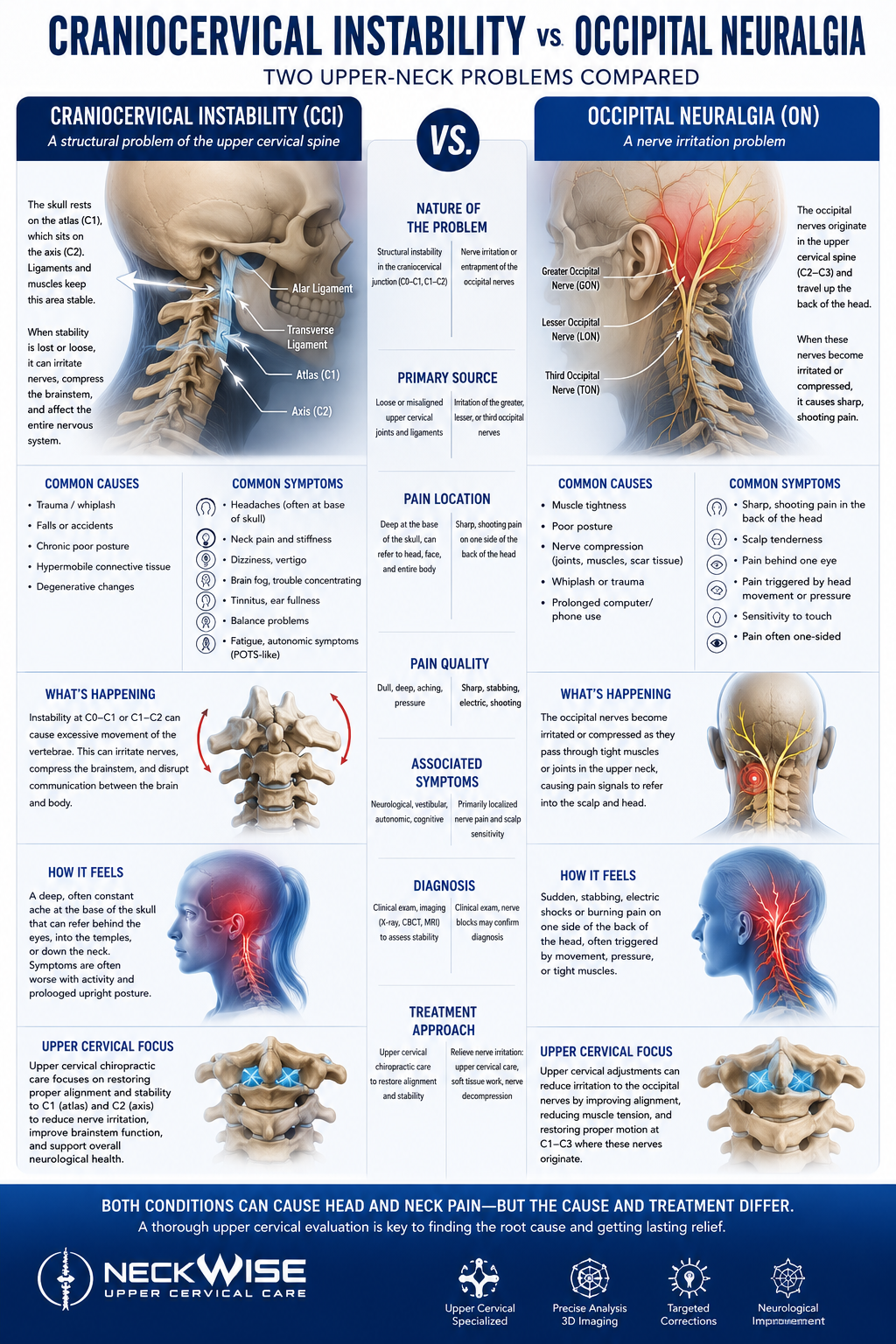
Craniocervical instability describes excessive or abnormal movement at the junction between the skull, C1, and C2. In a stable neck, the ligaments hold these bones in a tight, well-controlled relationship. In CCI, those ligaments are too lax or have been damaged, so the bones move more than they should. That extra motion can allow the odontoid peg or the base of the skull to shift in ways that mechanically stress — or in severe cases compress — the brainstem and upper spinal cord.
Notice the key word: instability. This is not simply a matter of a joint being “out of place” or a muscle being tight. It is a structural problem with the ligaments and the way the bones relate under load — a problem rooted, quite literally, in the atlas and axis.
Who Develops CCI?
CCI is genuinely uncommon in the general population, but certain groups are at higher risk:
- People with heritable connective tissue disorders, especially Ehlers-Danlos syndrome (EDS), particularly the hypermobile type. In these conditions the body’s collagen — the raw material of ligaments — is structurally different, so ligaments throughout the body, including in the upper neck, can be lax.
- People with rheumatoid arthritis, which can erode the ligaments and joints at C1–C2 over time.
- People who have suffered significant trauma, such as high-energy car accidents, that damages the craniocervical ligaments.
- People with certain congenital or bony anomalies at the skull base.
If you are a hypermobile person — someone who has always been “double-jointed,” bruises easily, has stretchy skin, or has been told you may have EDS — this is the context in which CCI is most often discussed. It is important to keep perspective, though: hypermobility is common, and the large majority of hypermobile people do not have craniocervical instability. Having a bendy body does not mean your skull is unstable on your spine.
What CCI Can Feel Like
The symptoms patients describe are often vivid and hard to explain to others:
- A “heavy head” feeling — as though the neck cannot quite hold the head up, sometimes so pronounced that people cradle their own skull in their hands or brace it against a headrest for relief.
- Pressure or pain at the base of the skull and upper neck, sometimes radiating into the head.
- Brainstem-type and autonomic symptoms: dizziness, lightheadedness, visual disturbances, ringing in the ears, difficulty concentrating (“brain fog”), rapid heart rate on standing, and nausea.
- Symptoms that get worse when the head is upright or held unsupported and better when lying down, because gravity loads the junction differently.
- In more severe cases, neurological signs such as changes in coordination, balance, swallowing, or speech.
That last cluster is the one that worries clinicians most, and we will come back to it in the red-flags section.
How CCI Is Actually Diagnosed
Here is where honesty matters, because there is a lot of confusion online. True structural CCI is not diagnosed by feeling a neck with the hands, by a single symptom, or by a standard X-ray taken lying down. It generally requires specialized imaging — often upright or dynamic (flexion-extension) MRI or CT, sometimes with specific measurements of the relationships between the skull base, C1, and C2 — interpreted by physicians who specialize in this area.
And even among those specialists, there is real debate. A 2022 systematic review in Global Spine Journal that examined the diagnostic and surgical treatment criteria for CCI in Ehlers-Danlos syndrome found that the published criteria vary considerably and that the evidence base is still developing. A companion review of controversies in diagnosis and management in The Spine Journal likewise emphasized that clinicians do not yet fully agree on exactly which measurements define instability, which patients truly benefit from surgery, and how to weigh the significant risks of surgical fusion. In plain terms: this is a serious, complex condition where even the experts are still refining the map. That is all the more reason to be evaluated by qualified physicians rather than relying on a self-diagnosis from the internet.
Treatment for confirmed structural CCI ranges from careful conservative management — bracing, activity modification, and specialized physical therapy aimed at improving muscular support — to, in severe and clearly documented cases, surgical fusion of the craniocervical junction by a neurosurgeon. Fusion is a major operation with meaningful trade-offs, which is exactly why the diagnosis needs to be rigorous before anyone contemplates it.
What Is Occipital Neuralgia?
Now let’s cross the street to a very different problem that happens to live in the same neighborhood — the same upper cervical neighborhood.
Occipital neuralgia is a nerve pain condition. It involves the greater, lesser, and sometimes third occipital nerves — sensory nerves that arise from the upper cervical spinal roots, travel up through the muscles at the back of the neck, and fan out to supply the skin of the back and top of the head, up toward the crown. The greater occipital nerve, the main player, arises largely from the C2 nerve root — which is to say, occipital neuralgia is, at its origin, an upper cervical condition. When one or more of these nerves becomes irritated, compressed, or inflamed, the result is a distinctive kind of pain.
Crucially, occipital neuralgia is a problem of an irritated nerve, not of an unstable joint. The bones can be perfectly stable and the ligaments perfectly sound, and a person can still have occipital neuralgia. But the nerve’s origin at C2 is exactly why the mechanics and muscular tension of the upper neck are so often part of the picture — and so often worth evaluating.
What Occipital Neuralgia Feels Like
The pain has a signature that clinicians look for, described well in the StatPearls review of occipital neuralgia:
- Sharp, shooting, stabbing, or electric-shock-like pain — quite different from the dull, heavy ache of many neck problems.
- Pain that typically starts at the base of the skull on one side (occasionally both) and shoots upward over the back of the head, sometimes reaching behind the eye on the same side.
- Pain that often follows the path of the nerve, in a band or stripe rather than a diffuse region.
- Tenderness over the nerve where it emerges near the base of the skull; pressing there may reproduce the shooting pain.
- Brief attacks — seconds to minutes — that may recur, sometimes with a background aching or scalp sensitivity between attacks. The scalp can feel tender or tingly to the touch, even to a hairbrush or pillow.
Because the pain can radiate toward the eye and the head, occipital neuralgia is sometimes mistaken for migraine or other headache disorders, and it can also coexist with them — which is part of what makes careful evaluation worthwhile.
How Occipital Neuralgia Is Diagnosed
Occipital neuralgia is largely a clinical diagnosis, made from the history and physical examination. There is no single blood test or scan that confirms it. A supportive — and sometimes clarifying — step is a diagnostic occipital nerve block: a small injection of local anesthetic near the affected nerve. If the characteristic pain temporarily eases after the block, that points toward the occipital nerve as the source. As Narouze discusses in a 2016 review in Headache on the role of ultrasound, imaging such as ultrasound can help guide these injections more precisely to the target nerve, improving accuracy.
Management is typically conservative first: heat, activity and posture adjustments, addressing tight musculature at the back of the neck, and medications aimed at nerve pain. When those are not enough, nerve blocks and other targeted procedures are options. A 2020 neurosurgical review in the Journal of Clinical Neuroscience outlines the fuller range of interventions — from nerve blocks through to procedures like nerve stimulation or decompression — that specialists may consider in persistent cases that do not respond to more conservative measures. For most people, occipital neuralgia is managed without surgery.
The Core Differences, Side by Side
It is easy to blur these two together because both center on the upper neck and both can cause pain and head symptoms. But the distinctions are important:
The fundamental problem. CCI is a problem of too much motion — a mechanical, structural instability of the joints and ligaments where the skull meets the spine. Occipital neuralgia is a problem of an irritated sensory nerve arising from C2. One is about stability; the other is about a nerve firing.
The character of the pain. CCI tends to produce a heavy, pressured, “my head is too heavy for my neck” sensation, often with dizziness and other brainstem-type symptoms, worse when upright. Occipital neuralgia produces sharp, shooting, electric pain that travels along the nerve from the skull base over the back of the head, often in brief bursts.
The typical patient. CCI is most discussed in people with connective tissue disorders like EDS, in rheumatoid arthritis, or after major trauma. Occipital neuralgia can occur in almost anyone — often related to muscle tension, posture, minor injury, or nerve irritation — with no underlying instability at all.
How it is diagnosed. CCI requires specialized upright or dynamic imaging and physician interpretation, with genuine debate about the exact criteria. Occipital neuralgia is diagnosed clinically, supported by the response to a diagnostic nerve block.
How serious it is. Occipital neuralgia, while genuinely painful and disruptive, is generally not dangerous and is usually managed conservatively. Structural CCI can be serious, occasionally requiring neurosurgical fusion, and demands a higher level of medical caution.
Can they coexist? Yes. A hypermobile person, for instance, could have irritation of the occipital nerves and separate questions about craniocervical stability. This overlap is exactly why a careful, honest evaluation — rather than a one-size-fits-all label — matters so much. And it is one more reason the upper cervical spine deserves direct, thorough attention rather than being skipped over.
Red Flags: When to Seek Urgent Medical Care
This is the most important section in this article, so please read it carefully. Some symptoms are not a reason to book a routine appointment next week — they are a reason to seek urgent medical or neurosurgical care now. Do not try to manage these with a chiropractor, a massage, or a home remedy. Seek prompt evaluation, and go to an emergency department if symptoms are severe or rapidly worsening, if any of the following appear:
- Progressive weakness in the arms or legs, or a spreading numbness.
- Changes in coordination or balance — dropping things, clumsiness, an unsteady or drunk-like walk.
- Difficulty swallowing (choking, food catching) or changes in speech (slurring).
- Fainting or near-fainting, especially connected to head or neck position.
- New or worsening vision changes, double vision, or drooping of the face.
- Sudden, severe (“thunderclap”) headache unlike anything before.
- Loss of bowel or bladder control.
- Signs of a possible stroke — facial droop, arm weakness, speech difficulty — which is always a call-911 emergency.
These symptoms can reflect pressure on or injury to the brainstem, spinal cord, or blood vessels, and they require imaging and physician assessment — potentially a neurosurgeon — without delay. If you are a person with EDS or another connective tissue disorder and you notice new neurological symptoms, take them seriously and get evaluated. Being cautious here is not overreacting; it is exactly the right instinct.
What the Research Says
It is worth stepping back to look at what the published literature actually supports, because it shapes how any responsible clinician should talk about these conditions.
On the CCI side, the research is candid about uncertainty. The Global Spine Journal systematic review set out to catalog the diagnostic and surgical criteria used for CCI in Ehlers-Danlos syndrome and found that they are not standardized — different centers use different radiographic measurements and thresholds. The Spine Journal review of controversiesreinforced that both diagnosis and management, especially the decision to pursue surgical fusion, remain areas of active debate, and it urged caution given the significant and irreversible nature of fusion surgery. The honest takeaway is that structural CCI is a real but complex diagnosis that belongs in the hands of specialized physicians using appropriate imaging — not a label to be applied casually, and not something any conservative provider can “fix” by realigning bones.
On the occipital neuralgia side, the literature is more settled about the basics. The StatPearls overview describes it as a clinically diagnosed condition defined by its characteristic sharp, shooting pain in the distribution of the occipital nerves, generally managed with conservative measures first. Narouze’s Headache review highlights how ultrasound guidance can improve the precision of diagnostic and therapeutic nerve blocks. And the Journal of Clinical Neuroscience neurosurgical perspective lays out the treatment ladder — from conservative care and nerve blocks up to interventional and surgical options — that specialists follow when simpler measures fall short.
What none of this literature claims — and what I will not claim either — is that gentle chiropractic care repairs lax ligaments, reverses instability, or eliminates nerve pain. It does not. Keeping expectations tethered to the evidence is part of taking your health seriously — and it is entirely compatible with insisting that the upper cervical spine be evaluated properly rather than overlooked.
Where Upper Cervical Chiropractic Fits — Honestly and Directly
So where does a practice like ours fit into all of this? Let me be very clear about both the value and the limits — because this region is exactly our wheelhouse.
At Lavender Family Chiropractic, our focus is the upper cervical spine — the same C0–C1–C2 region at the heart of both conditions above. Our approach uses precise, gentle, low-force adjustments — with no twisting, cracking, or popping.The specific method we use is the Knee Chest Upper Cervical technique, a low-force approach designed to make a small, specific contact rather than a forceful, twisting manipulation of the neck. To inform that work, we use 3D cone-beam CT (CBCT) imaging to visualize upper cervical anatomy and alignment in detail, and paraspinal infrared thermography to assess patterns of nervous-system-related tone alongside the rest of the exam.
Here is the honest framing that I owe you:
We do not repair ligaments, and we do not reverse craniocervical instability. No adjustment can tighten a lax alar ligament or restabilize an unstable joint. If your evaluation points toward true structural CCI, the appropriate path is physician and, where indicated, neurosurgical care — and our role, if any, is to recognize the picture, refer you appropriately, and coordinate rather than to attempt to treat instability ourselves. In a person with confirmed or suspected instability, aggressive high-velocity neck manipulation would be inappropriate; the gentleness of our approach and our willingness to defer to physicians are features, not afterthoughts.
We do not cure occipital neuralgia either. What we can do is carefully assess the alignment, movement, and muscular tension of the upper neck — the very region from which the occipital nerves arise — and, when it is appropriate and safe, provide gentle care aimed at the mechanical and postural contributors to symptoms, while working alongside the physicians managing the nerve pain itself, including those performing diagnostic nerve blocks. Because the greater occipital nerve arises from C2, the mechanics of that segment are a reasonable and worthwhile thing to evaluate.
Think of gentle upper cervical care as a potential adjunct — one member of a team — not a stand-alone answer and not a replacement for medical evaluation. The most useful thing we often do for someone with upper-neck symptoms is help them understand what they are dealing with and make sure the right specialists are involved. If, during our assessment, we see anything suggesting instability or a red-flag neurological picture, our job is to say so plainly and point you toward appropriate medical care. That coordination — knowing our lane and staying in it — is central to how we practice. But within that lane, the upper cervical spine is precisely the region we examine directly and thoroughly, because it is the region these conditions come from.
Top Questions
Is craniocervical instability the same as a “misaligned atlas”? No. A great deal of confusion comes from blending these ideas together. CCI is a structural instability — the ligaments allow too much motion at the skull–C1–C2 junction, a diagnosis made with specialized imaging and physician evaluation. That is a different concept from an alignment assessment. We do not diagnose or treat structural instability with adjustments, and we do not claim to. If instability is a real question for you, that belongs with physicians and appropriate imaging.
I am hypermobile / I have EDS. Does that mean I have CCI? Almost certainly not on its own. Hypermobility is common, and most hypermobile people do not have craniocervical instability. That said, connective tissue disorders like EDS are the setting in which CCI is most often discussed, so if you have EDS and concerning symptoms — especially the neurological red flags listed above — it is reasonable and wise to be evaluated by a physician familiar with these conditions.
Can chiropractic care fix my occipital neuralgia? We would never describe it that way. Occipital neuralgia is nerve pain, diagnosed clinically and often confirmed with a nerve block, and it is primarily managed medically. Because the greater occipital nerve arises from C2, gentle upper cervical care addresses the mechanical and postural contributors at C1 and C2, working alongside your physician.
Is upper cervical adjusting safe if I might have instability? This is exactly why our approach is precise, gentle, and low-force, with no twisting, cracking, or popping — and why we take history and imaging seriously before doing anything. If there is a genuine question of instability, the priority is medical evaluation first. Forceful neck manipulation is not appropriate in that setting, and we do not perform it.
How do I tell my sharp shooting head pain from something more serious? The classic occipital neuralgia pattern is sharp, shooting, electric pain running from the base of the skull over the back of the head, often in brief bursts, with tenderness over the nerve. But any new neurological symptoms — weakness, coordination or balance changes, swallowing or speech difficulty, fainting, or a sudden severe headache — are red flags that call for urgent medical care rather than a routine appointment. When in doubt, get checked.
What imaging do you use, and does it diagnose CCI? We use 3D cone-beam CT to visualize upper cervical anatomy and infrared thermography as part of our assessment. These help us understand your upper neck and guide gentle care. They are not a substitute for the specialized upright or dynamic imaging and physician interpretation used to evaluate structural instability. If that is what your situation calls for, we will help point you toward it.
Do these two conditions ever occur together? They can. Because both involve the upper cervical region, a person may have occipital nerve irritation alongside separate questions about stability. That overlap is one more reason to favor a careful, individualized evaluation over a quick internet label — and to keep physicians involved when the picture is complex.
The Bottom Line
Craniocervical instability and occipital neuralgia are neighbors, not twins — but they share an address at the top of your spine. CCI is about too much movement at the skull–C1–C2 junction — a structural, ligament-based problem most associated with connective tissue disorders like EDS, sometimes serious enough to warrant neurosurgical evaluation, and diagnosed only with specialized imaging and physician expertise. Occipital neuralgia is about an irritated nerve arising from C2 producing sharp, shooting pain across the back of the head — diagnosed clinically, often confirmed with a nerve block, and usually managed conservatively.
Understanding which one you may be dealing with — or whether both are in play — changes everything about the right next step. And the single most important message I can leave you with is this: honor the red flags. Progressive weakness, coordination, swallowing, or speech changes, and fainting are signals to seek urgent medical or neurosurgical care, not to wait.
Gentle upper cervical chiropractic has a real but honest role here: careful, direct assessment of the upper neck — the region these conditions actually come from — precise low-force care where it is appropriate and safe, and, just as importantly, the judgment to coordinate with physicians and step aside when your situation calls for medical or surgical expertise. We would rather be the practice that helps you understand your neck and get to the right specialist than one that overpromises.
Serving Sarasota, Lakewood Ranch & Bradenton
If you are wrestling with upper-neck pain, pressure, a heavy-head feeling, or sharp shooting pain at the back of your head and you want help sorting out what is going on and who should be involved, we would be glad to sit down with you. Lavender Family Chiropractic (NeckWise North Sarasota) proudly serves Sarasota, Lakewood Ranch, Bradenton, and the surrounding Suncoast communities. We offer a consultation with our doctors to listen to your history, talk through your symptoms, and help you understand your options — including when medical or neurosurgical evaluation should come first.
Lavender Family Chiropractic (NeckWise North Sarasota) 5899 Whitfield Avenue, Suite 107 Sarasota, FL 34243(941) 243-3729
Whether you are in Sarasota, Lakewood Ranch, or Bradenton, if your upper neck is troubling you, reach out — and let’s make sure you get pointed in the right, and the safest, direction.
This article is for general educational purposes only and is not medical advice, a diagnosis, or a treatment recommendation. It does not create a doctor-patient relationship. Craniocervical instability and occipital neuralgia require individualized evaluation by qualified healthcare professionals. If you have new or worsening neurological symptoms, seek prompt medical care.
Related Articles
Related Posts


Get our upper cervical articles first.
Patients Experience