Occipital Neuralgia and Pain Behind the Eye: Why the Real Source Is at the Top of Your Neck
By Dr. Rusty Lavender, D.C. — upper cervical chiropractor, Lavender Family Chiropractic, Sarasota, FL. Reviewed and updated October 2026.
A patient points to the back of their head to show me where the trouble starts, then drags a finger up over the scalp and lands on the eyebrow. “But the pain is here,” they say, tapping the front of the head, “so why does everyone keep looking at my neck?” Here is the answer almost no one gives them: because the pain behind your eye is very often generated at the top of your neck. The nerves at the back of your upper neck and the nerves that serve your eye and forehead hand their signals to the same relay station deep in the brainstem. When the upper neck is irritated, the eye feels it. And the upper neck — the atlas, the axis, the C1–C3 segments — is the one region most people with this pain have never had properly evaluated.
I treat this pattern every week in patients from Sarasota, Lakewood Ranch, and Bradenton who have been to eye doctors, tried migraine medications, and been told their pain doesn’t add up. It adds up perfectly once you understand the wiring. That crossover has a name — trigeminocervical convergence — and once you understand it, a great deal of otherwise baffling head pain snaps into focus, with the upper neck at its center.
This article is an honest walk through what occipital neuralgia is, why it refers pain to the front of the head and behind the eye, what the research shows about the mechanism, and where careful, gentle upper cervical care fits. I will also be clear from the outset about the things that should send you to a physician or eye doctor promptly rather than to any chiropractor — because eye pain has a long list of possible causes, and some are urgent.
This article is educational and not a substitute for medical advice. If you have a health condition, are pregnant, or take medication, talk with your physician before starting anything new.
What Occipital Neuralgia Actually Is
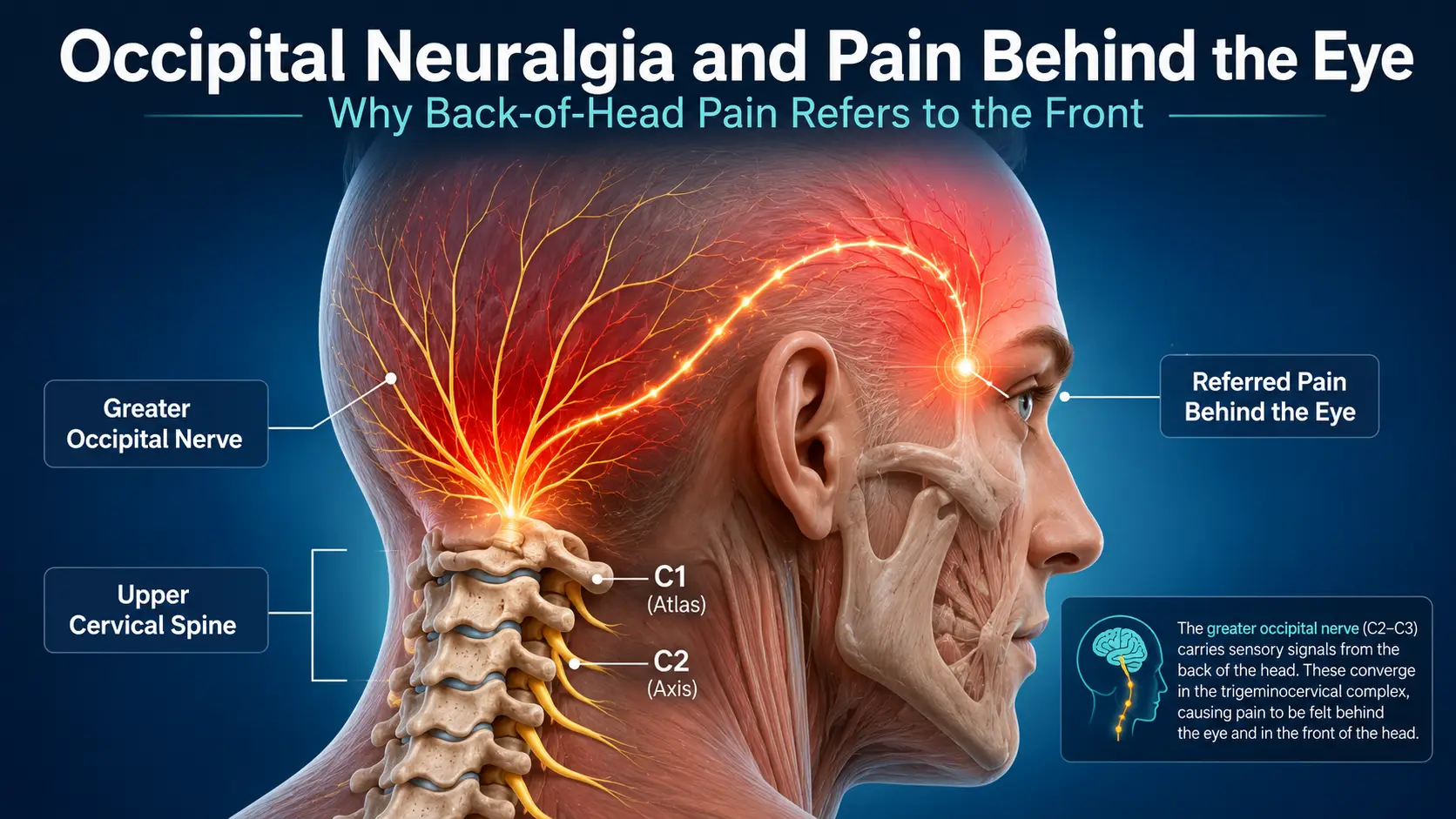
Occipital neuralgia is a specific type of nerve pain involving the occipital nerves — the sensory nerves that travel from the upper neck up across the back and top of the scalp. There are three on each side, but the two that matter most here are the greater occipital nerve and the lesser occipital nerve. The greater occipital nerve arises primarily from the second cervical nerve root (C2), threads through the small muscles at the base of the skull, and fans out across the back of the head, sometimes reaching as far forward as the crown and even the forehead. Read that origin again — C2, in your upper neck. That is the address of the generator.
People describe the pain in consistent ways: sharp, shooting, electric, or stabbing sensations, sometimes with a background ache between the jolts. It often begins at the base of the skull on one side and shoots upward. The scalp in the affected area can become tender or hypersensitive — brushing your hair, lying on a pillow, or even a light touch sets it off. There may be a burning or tingling quality. And, crucially for our topic, the pain frequently does not stay in the back of the head. It travels.
Occipital neuralgia can arise from tightness and irritation in the suboccipital muscles, arthritic changes in the upper cervical spine, prior whiplash or neck injury, sustained forward-head posture from desk and screen work, atlas/axis misalignment, or compression of the nerve along its path. In many people no single dramatic cause is found; the nerve becomes sensitized over time. It can overlap and coexist with migraine, tension-type headache, and cervicogenic (neck-driven) headache, which is a good reason to work with clinicians who take a careful history and a genuine look at the upper neck seriously rather than reaching for a label on the first visit.
The Puzzle: Why Back-of-Head Pain Lands Behind the Eye
Here is the phenomenon that brings so many people to a clinic scratching their heads — literally. The occipital nerves serve the back of the head. The eye and forehead are served by an entirely different nerve, the trigeminal nerve, specifically its topmost branch, the ophthalmic division. Anatomically, two different neighborhoods. So how does irritation of a nerve in the back of the neck produce a stabbing, aching, or pressure sensation behind the eyeball, in the temple, or across the forehead?
For a long time this pattern was treated as a curiosity, or dismissed as patients being imprecise about their pain. But it turns out the pattern is real, reproducible, and physiologically explainable. The explanation is convergence — signals from very different parts of the head funnel down onto the same shared population of nerve cells in the brainstem and upper spinal cord, and the brain, receiving a signal from that shared relay, cannot always tell exactly where it originated.
The Trigeminocervical Nucleus: A Shared Switchboard
Picture the brainstem and the very top of the spinal cord as housing a long column of relay neurons. Sensory nerves from the head do not run in an unbroken line to the brain; they stop and pass their message to a “second-order” neuron, which carries the signal onward. The relevant relay column handles input from the trigeminal nerve (face, eye, forehead) as it extends down and merges functionally with the sensory input from the upper cervical nerves (C1, C2, C3) — the same roots that give rise to the occipital nerves.
Because this region blends trigeminal and cervical input, clinicians call it the trigeminocervical complex or trigeminocervical nucleus. It is, in effect, a shared switchboard. And on that switchboard, a single second-order neuron may receive incoming lines from both an occipital (cervical) nerve and a trigeminal branch that serves the eye or the dura around the front of the head. When that shared neuron fires, the brain gets a message that says “pain in the head” — but the precise return address is ambiguous. Input arriving from the back of the neck can be experienced as if it came from the front, behind the eye, because the same relay cell normally reports on that frontal territory.
This is not a vague metaphor; it is the leading, evidence-supported explanation for referred head pain, and it is why the upper neck sits at the center of the story even when the pain is felt at the front.
Referred Pain, in Plain Terms
Referred pain is familiar elsewhere in medicine. The classic example is a heart attack felt as pain in the left arm or jaw: the problem is in the heart, but shared nerve pathways cause the brain to project the sensation elsewhere. The head has its own version, and the trigeminocervical complex is the mechanism. When the greater occipital nerve is irritated, the sensitized signal it sends converges with trigeminal territory in the brainstem, and the pain is referred forward — to the forehead, the temple, around and behind the eye. The patient feels frontal pain; the source is in the back of the neck.
Understanding this does two useful things. First, it validates what patients experience — the eye pain is real, and pointing to the front of the head is not a mistake. Second, it explains why treating only the front, or only the eye, so often fails: if the generator is an irritated occipital nerve or an irritated upper cervical joint, addressing the neck is not a detour but the direct route to the source.
What the Research Says
I want to spend real time here, because this is an area where the patient’s experience and the laboratory science line up remarkably well. The mechanism I described is not folklore; it has been tested in humans and in careful animal models, and a handful of studies form the backbone of what we understand.
One of the most directly relevant human studies comes from Piovesan and colleagues, who painfully stimulated the greater occipital nerve in volunteers and mapped where the resulting pain was felt. They documented that stimulating this back-of-the-head nerve produced pain referred into trigeminal territory — the front of the head — which they interpreted as direct human evidence of convergence of cervical afferent input onto trigeminal nuclei. You can read the study, “Referred pain after painful stimulation of the greater occipital nerve in humans: evidence of convergence of cervical afferences on trigeminal nuclei,” published in Cephalalgia in 2001, here. This is, in a sense, the experimental version of exactly what my patients describe when they trace pain from the base of the skull to behind the eye.
The same group later synthesized the broader picture in a review, “Convergence of cervical and trigeminal sensory afferents” (Piovesan and colleagues, Current Pain and Headache Reports, 2003), which lays out how cervical and trigeminal systems share neurons and why that convergence matters for understanding head and face pain. That review is available here, and it is a good conceptual map of the whole territory.
Two landmark experimental studies by Bartsch and Goadsby filled in the physiology of how this crossover behaves — and showed that it runs in both directions. In the first, published in Brain in 2002, they demonstrated that stimulating the greater occipital nerve increased the central excitability of neurons that also receive input from the dura mater (the pain-sensitive covering around the brain served by the trigeminal system). Irritating the occipital nerve turned up the volume on trigeminal pain processing. That study, “Stimulation of the greater occipital nerve induces increased central excitability of dural afferent input,” is here. It helps explain not only referral but the amplification and spread patients report — the sense that once the neck flares, the whole head becomes touchy.
In the companion study the following year, also in Brain, Bartsch and Goadsby showed the reverse: stimulating the dura mater increased the responses of trigeminocervical neurons to input coming from the neck. So trigeminal irritation can heighten sensitivity to cervical input, just as cervical irritation heightens sensitivity to trigeminal input. That paper, “Increased responses in trigeminocervical nociceptive neurons to cervical input after stimulation of the dura mater,” is available here. Together these establish the trigeminocervical complex as a genuinely two-way street — which is why neck problems and front-of-head/eye symptoms so often travel together.
Finally, human neurophysiology work has probed the functional connection more directly. A 2006 Cephalalgia study used occipital nerve blockade combined with nociceptive blink reflex testing to demonstrate functional connectivity between the trigeminal and occipital nerve systems — showing that changing input to the occipital nerve measurably altered a trigeminal reflex. That study, “Functional connectivity between trigeminal and occipital nerves revealed by occipital nerve blockade and nociceptive blink reflexes,” can be read here. It is a clean bridge from animal physiology to something measurable in living people.
What should you take away? The convergence mechanism is well supported: back-of-head input and eye/forehead input share second-order neurons, and irritation of one can be felt in, and can sensitize, the other. That explains the referral pattern beautifully, and it puts the upper neck at the origin of it. What this research does not do is test any particular treatment — these are studies of mechanism, of wiring and excitability, not clinical trials of therapy. So while the science tells us why the neck is the driver of front-of-head and eye pain, it does not by itself prove that any specific hands-on treatment eliminates occipital neuralgia. I hold both truths at once.
Where Upper-Cervical Care Fits — Confidently and Honestly
Given everything above, you can see why a practice focused on the upper cervical spine takes this pattern seriously. The upper neck — the C1, C2, and C3 segments and the small suboccipital muscles around them — is precisely the region that feeds the cervical side of the trigeminocervical complex. It is where the greater and lesser occipital nerves originate and travel. When we talk about back-of-head pain referring to the front, the upper cervical spine is not a peripheral player; it is the source, the central character in the anatomy of the referral.
That is the genuine, cause-forward rationale for why upper-cervical chiropractic care is relevant as part of a broader plan for people with occipital or cervicogenic head pain: the goal is to reduce the mechanical irritation and muscular tension in the very region that drives the shared pathway. If a misaligned atlas, an irritated upper cervical joint, or a tight band of suboccipital muscle is contributing to the sensitization of that switchboard, then calming things down in that neighborhood addresses the pain where it actually starts — alongside your medical care.
But I want to be candid, because you deserve candor. There is no body of clinical trial evidence showing that chiropractic care — upper cervical or otherwise — eliminates occipital neuralgia, and I will not tell you otherwise. The strong research is about the mechanism of convergence, not about any adjustment fixing this specific diagnosis. What I can honestly say is that the upper neck is anatomically the driver of the pattern, that gentle care aimed at that region is a sound option for appropriately selected patients, and that it should be coordinated with — not a replacement for — evaluation and treatment by your physician. If a neurologist, headache specialist, or pain physician is involved, I want to be part of that team.
How We Work at Lavender Family Chiropractic
At our NeckWise North Sarasota office, our upper-cervical approach is built around being precise, gentle, and low-force. There is no twisting, cracking, or popping. The technique we practice is a low-force Knee Chest Upper Cervical method, designed to make a specific, controlled contact rather than a broad, forceful manipulation. For patients nervous about anyone touching an already-painful neck, that gentleness matters a great deal.
To make our care as specific as possible, we use a few tools. We use 3D cone-beam CT (CBCT) imaging to see upper cervical anatomy in detail, which helps us plan precisely and flag structural findings that may need a referral. We use paraspinal infrared thermography to observe patterns of physiological change along the spine over time. And we combine that objective information with a careful history and hands-on examination.
None of these tools is a crystal ball, and none diagnoses occipital neuralgia by itself — that remains a clinical diagnosis, ideally made in coordination with your physician. What they do is help us be thoughtful, specific, and honest about whether upper-cervical care is a reasonable fit, and about when the more responsible answer is to send you elsewhere first.
The Part I Never Skip: Red Flags and When to Seek Urgent Care
Here is the most important section of this article, and I would ask you to read it even if you skim the rest.
Pain behind the eye and around the head has a long differential — many conditions can cause it, and some are medical or ophthalmologic emergencies that have nothing to do with the neck. Occipital neuralgia and trigeminocervical referral are real, but they are diagnoses of careful evaluation, not assumptions. Please do not let an interesting mechanical explanation talk you out of getting checked for something serious.
Seek urgent or emergency medical care — not a chiropractic appointment — if you experience any of the following:
- A sudden, severe “thunderclap” headache that reaches maximum intensity within seconds to a minute, or the “worst headache of your life.” This warrants emergency evaluation to rule out bleeding around the brain and other serious causes.
- Sudden vision loss, or any new change in vision — blurring, a curtain or shadow over part of your sight, double vision, or loss of a field of vision.
- A painful, red eye, especially with light sensitivity, halos around lights, nausea, or a pupil that looks abnormal. This can signal conditions such as acute glaucoma or serious inflammation and needs prompt evaluation by an eye doctor or emergency department.
- Eye pain with a bulging eye, decreased eye movement, or swelling around the eye, which can indicate infection or other urgent problems.
- New headache with fever, a stiff neck, confusion, or a rash.
- New neurological symptoms: weakness or numbness of the face, arm, or leg; trouble speaking; facial droop; loss of balance or coordination.
- Headache after a significant head or neck injury, or a headache progressively worsening day after day.
- A new or different headache pattern in anyone over 50, or in someone with cancer, a weakened immune system, or who is pregnant or recently postpartum.
- Scalp tenderness with jaw pain when chewing, especially over age 50, which can suggest a condition affecting the arteries that requires urgent treatment to protect vision.
New or severe eye pain, vision loss, or a red eye in particular should be evaluated urgently by a physician or eye doctor to exclude causes that have nothing to do with the neck. Getting those ruled out is not being overly cautious; it is exactly the right order of operations. Once serious causes are excluded and you have a working diagnosis, that is the point at which a conversation about conservative, mechanism-informed care for the neck’s contribution becomes appropriate.
Living With It: Practical, Honest Guidance
Assuming you have been evaluated and serious causes excluded, what actually helps day to day? I give patients realistic expectations rather than promises, because head and neck pain fluctuates and responds well to patience and a combination of approaches.
Mind the mechanical load on your upper neck. So much of modern life pulls the head forward and down — phones, laptops, reading in bed, long drives. Sustained forward-head posture keeps the suboccipital muscles working overtime, and those are the very muscles wrapped around the occipital nerves. Small, frequent changes — raising your screen to eye level, taking movement breaks, adjusting how you sit — often do more over weeks than any single dramatic intervention.
Be gentle with the tender scalp and neck. If your scalp is hypersensitive, a supportive pillow and sleeping positions that keep the neck neutral can reduce nighttime flare-ups. Heat over the upper neck and base of the skull soothes many people; a smaller number prefer cold. Use whichever calms things for you.
Keep a simple pattern diary. Noting when the pain starts, where it travels, and what preceded it helps you and your clinicians distinguish occipital neuralgia from migraine, tension-type headache, or cervicogenic headache — conditions that overlap and sometimes coexist. That information genuinely improves care.
Coordinate your team. Medication decisions, nerve blocks, and other interventions belong with your physician. Conservative manual care aimed at the upper neck and lifestyle change run alongside. The strongest outcomes I see come from patients whose providers actually talk to each other.
Give it time, and judge honestly. With conservative, sensitizing-pathway-focused care, it is reasonable to try an approach and then evaluate honestly whether it is helping over a defined period, rather than continuing indefinitely out of hope. If something is not making a real difference, that is worth saying out loud and changing course.
Top Questions
Why does my occipital neuralgia hurt behind my eye if the nerve is in the back of my head? Because of trigeminocervical convergence. The occipital nerves come from the upper cervical nerve roots, and in the brainstem their signals share second-order relay neurons with the trigeminal nerve, which serves the eye and forehead. When the occipital nerve is irritated, the brain can experience the pain in that shared frontal territory — behind the eye or across the forehead — even though the source is in the back of the neck. This has been demonstrated experimentally in humans, as in the Piovesan 2001 study.
Is this the same as a migraine? Not exactly, though they can overlap and coexist, and the same trigeminocervical machinery is involved in both. Migraine has its own features and treatments. Occipital neuralgia is specifically nerve pain in the distribution of the occipital nerves. Because the pathways interact — Bartsch and Goadsby’s work showed the crossover runs both ways — telling them apart takes a careful history and sometimes a specialist’s input. It is entirely possible to have more than one type of headache at once.
Can chiropractic care get rid of occipital neuralgia? I will not claim it can. There is no clinical trial evidence that chiropractic care eliminates this condition. What the research strongly supports is the mechanism — that the upper neck is the central driver of how this pain refers and amplifies. Gentle upper-cervical care is a reasonable option for appropriately selected patients by targeting the mechanical irritation in that region, but it should be coordinated with your physician and judged on whether it actually helps you.
Is the adjustment going to hurt my already-painful neck? The upper-cervical approach we use is precise, gentle, and low-force, with no twisting, cracking, or popping. For a neck that is already sensitive, that gentleness is one reason patients are willing to consider this style of care. We also take time to evaluate whether care is appropriate for you in the first place.
When should I go to the emergency room or an eye doctor instead of a chiropractor? Immediately, if you have sudden vision loss or changes, a painful red eye, a sudden “thunderclap” or worst-ever headache, new neurological symptoms like weakness or slurred speech, headache with fever and stiff neck, or head pain after a significant injury. Eye pain has many causes, some urgent, and those need to be excluded first by a physician or eye doctor before assuming the neck is the source.
What do the CBCT scan and thermography actually tell you? The 3D CBCT imaging shows detailed upper cervical anatomy, which helps us plan precisely and flag anything needing referral. Paraspinal infrared thermography lets us observe physiological patterns along the spine over time. Neither one diagnoses occipital neuralgia on its own; they help us be specific, careful, and honest about whether our care is a good fit.
Could my desk job be causing this? Sustained forward-head posture keeps the suboccipital muscles — the ones surrounding the occipital nerves — under chronic strain, and that can contribute to irritation and sensitization of the upper neck. Posture alone rarely explains everything, but improving how you sit and taking movement breaks is one of the more useful things within your control.
Serving Sarasota, Lakewood Ranch & Bradenton
If you have been dealing with back-of-head pain that refers to your eye or forehead, and you have already had — or are willing to have — the serious causes evaluated by your physician, I would be glad to talk with you about whether gentle, upper-cervical care might have a role as part of your broader plan. We serve Sarasota, Lakewood Ranch, and Bradenton, along with University Park, Palmetto, Ellenton, Longboat Key, and the greater North Sarasota and Manatee County area. Whether you are near downtown Sarasota, out in Lakewood Ranch, or up in Bradenton, our office at the corner of University and Whitfield is built to evaluate the upper neck — the region this pain keeps pointing back to.
We offer a consultation with our doctors, where we can review your history, talk honestly about whether our approach fits your situation, and help you understand how the pieces of your care work together. There is no pressure and no obligation — just a conversation.
→ Call (941) 243-3729 to schedule.
Lavender Family Chiropractic (NeckWise North Sarasota) 5899 Whitfield Avenue, Suite 107 Sarasota, FL 34243(941) 243-3729
If your symptoms are sudden, severe, or involve your vision or a red, painful eye, please do not wait for an appointment with us — seek urgent medical or eye care right away. For everything else, when you are ready to understand your neck’s role in your head pain and explore gentle options, we are here to help.
This content is for general education and is not a substitute for individualized medical advice, diagnosis, or treatment. Always consult a qualified healthcare provider about your specific condition. Individual results vary, and no specific outcome is implied.
Related Articles
Related Posts


Get our upper cervical articles first.
Patients Experience