Occipital Neuralgia vs. Migraine vs. Tension Headache: How to Tell Them Apart — and Why the Answer Keeps Pointing to Your Upper Neck
By Dr. Rusty Lavender, D.C. — upper cervical chiropractor, Lavender Family Chiropractic, Sarasota, FL. Reviewed and updated October 2026.
If a sharp, electric jolt fires from the base of your skull up the back of your head, you have almost certainly been handed a label — “migraine,” “tension headache,” “stress” — and sent on your way with a prescription and a shrug. But here is what almost no one stops to check: three of the most confused headaches on that list are generated in the exact same place, the top of your neck, where the atlas (C1) and axis (C2) balance your skull. The greater occipital nerve — the nerve behind that back-of-head pain — arises directly from the C2 nerve root. That means for a huge number of people in Sarasota, Lakewood Ranch, and Bradenton walking around with a headache diagnosis, no one has ever examined the one structure driving the pain.
I want to give you the honest, cause-forward version of this. Yes, occipital neuralgia, migraine, and tension-type headache genuinely feel different, and learning to tell them apart is powerful. But underneath the differences sits a pattern I see in my Sarasota office every single week: pain that traces back to the upper cervical spine, in people who have been everywhere else first. This article will teach you to read your own symptoms — and it will show you why the upper neck belongs at the center of the conversation, not as an afterthought.
This article is educational and not a substitute for medical advice. If you have a health condition, are pregnant, or take medication, talk with your physician before starting anything new.
The Quick Differential: Three Headaches at a Glance
Let’s lead with what most people want to know first — how do these three actually feel different?
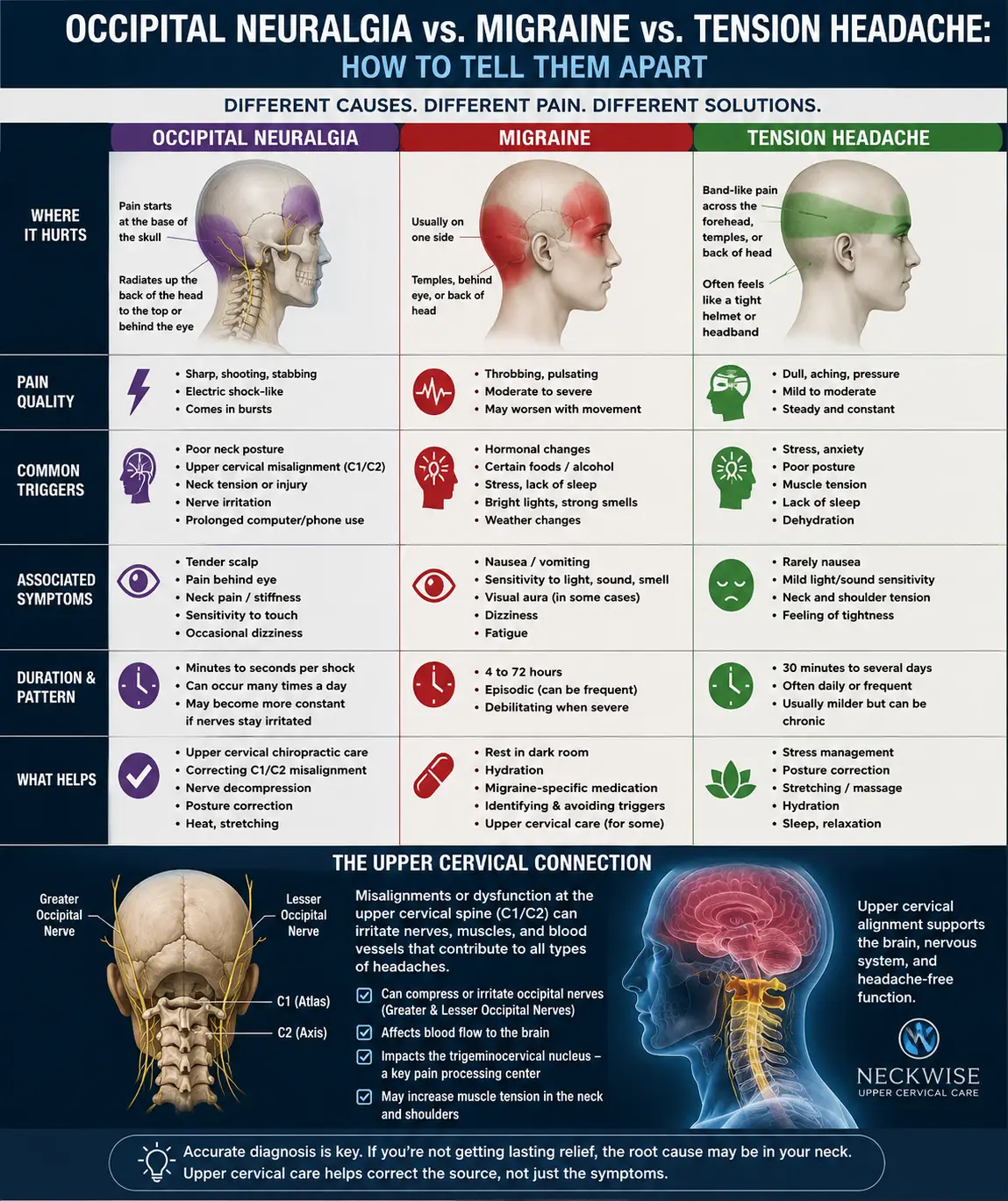
Occipital neuralgia announces itself with sharp, shooting, electric, or stabbing pain in the back of the head and scalp. The pain runs along the path of the occipital nerves — starting near the base of the skull and radiating upward toward the crown, sometimes toward the ear or behind the eye on one side. Many people describe brief jolts or “zaps,” like an electric shock, layered over a duller aching background. The scalp in that region is frequently tender to the touch. Patients tell me that brushing their hair, resting on a pillow, or turning the neck sets off a flare. It is often, though not always, one-sided. And here is the tell that matters most: it starts where your neck meets your skull. That is not a coincidence. That is the address of the nerve’s origin.
Migraine feels different. The classic description is a throbbing or pulsating pain, frequently on one side, that builds over time and can last from several hours to a few days. Migraine usually travels with an entourage: sensitivity to light and sound, nausea, sometimes visual changes or an “aura” beforehand, and a strong urge to lie still in a dark, quiet room. Physical activity tends to make it worse. Migraine is a neurological condition, not simply a “bad headache” — but as you will see, the neck is woven into migraine far more tightly than most people are told.
Tension-type headache is the one nearly everyone has felt. It is typically a dull, pressing, or tightening pain — a band squeezing around the head or a weight sitting on top of it. It is usually on both sides, mild to moderate, and it does not throb. It generally lacks the nausea and light sensitivity of migraine and the sharp electric jolts of occipital neuralgia. Stress, poor sleep, long screen hours, and sustained postures are common companions — and every one of those loads the upper neck.
Here is a simple way to hold the three in mind:
- Occipital neuralgia = sharp, electric, stabbing — back of head and scalp, along the nerve, often with scalp tenderness.
- Migraine = throbbing, pulsating — often one-sided, with light/sound sensitivity and nausea.
- Tension-type = dull, tight, band-like — usually both sides, pressing rather than throbbing.
Real life is rarely this tidy. It is entirely possible to have more than one type, and they can overlap and trigger one another. But notice the thread running through all three: the upper neck. That is exactly why a careful history and a genuine examination of the craniocervical junction matter so much — and why self-diagnosis, or a diagnosis that never looks at the neck, has real limits.
A Closer Look at Occipital Neuralgia — The Clearest Case for the Upper Neck
Because occipital neuralgia is the least familiar of the three, it deserves the deepest look — and it is the near-perfect illustration of why the upper cervical spine drives so much head pain.
What it is
Occipital neuralgia involves irritation or injury to the occipital nerves — the greater occipital nerve, the lesser occipital nerve, and sometimes the third (least) occipital nerve. These nerves originate from the upper cervical spine, arising largely from the C2 and C3 nerve roots, and they travel from the top of the neck up through the muscles and soft tissues at the base of the skull to supply sensation to the back and top of the scalp. Read that again: the pain generator lives in your upper neck, and the pain simply gets reported in your scalp.
When one or more of these nerves is irritated, compressed, or inflamed, you get the characteristic sharp, shooting pain that follows the nerve’s path. According to the international diagnostic criteria in the International Classification of Headache Disorders, 3rd edition, occipital neuralgia is defined by paroxysmal (sudden, recurring) shooting or stabbing pain in the distribution of the occipital nerves, often accompanied by tenderness over the affected nerve and, in some cases, abnormal or reduced sensation in the area.
How it typically feels
Patients describe two overlapping sensations: brief, intense electric-shock stabs, and a more persistent aching or burning between the jolts. The pain usually starts low — where the neck meets the skull — and shoots upward. It is frequently one-sided, though it can affect both. Pressing a specific spot at the base of the skull can reproduce or intensify the pain, and the scalp itself may feel sore or hypersensitive, so even light touch is uncomfortable.
A useful clinical clue described in the literature is that pressure over the occipital nerve can trigger the familiar pain. As reviewed in a 2014 overview of occipital neuralgia by Dougherty, tenderness along the nerve and reproduction of the patient’s typical pain with palpation are important features that help distinguish this condition from other headaches — and both of those clues point your clinician’s fingers straight to the top of the neck.
What drives it
Occipital neuralgia arises from tight or irritated muscles in the upper neck that compress the nerve, arthritic changes in the upper cervical joints, prior trauma such as a whiplash-type injury, or sustained postures that load the base of the skull. A comprehensive review in the Journal of Korean Medical Science by Choi and Jeon notes the causes are often multifactorial and that the upper cervical region — the muscles, joints, and nerve pathways at the top of the neck — is central to understanding the condition.
This is the whole point. The nerves come from the upper neck. When the atlas and axis are misaligned or the joints and soft tissues around C1–C2 are mechanically stressed, they can irritate the very nerves that generate this pain. That is not marketing — it is neuroanatomy. And it is precisely why so many people who have “tried everything” have never had the one region driving their pain properly evaluated.
Why diagnosis gets tangled
Here is the honest complication: occipital neuralgia shares territory with cervicogenic headache (headache originating from neck structures) and even some presentations of migraine. Pain from the upper neck refers forward toward the eye, which is why occipital neuralgia is sometimes mistaken for migraine and vice versa. A 2025 review in Current Pain and Headache Reports, titled “A Pain in the Neck: Occipital Neuralgia vs. Cervicogenic Headache vs. Migrainous Cervicalgia,” is devoted to untangling these overlapping conditions — and notice what all three have in common in that very title. The neck. This overlap is not a reason for despair; it is a loud signal that the upper cervical spine deserves a serious look.
Migraine: More Than a Bad Headache — and More Neck-Driven Than You Were Told
Migraine is a genuine neurological disorder involving changes in the brain, its blood vessels, and its nerves, and it tends to run in families. The pain is classically moderate to severe, throbbing or pulsating, and often one-sided, though it can affect both sides or switch. What sets migraine apart is its companions. The criteria in the International Classification of Headache Disorders describe attacks lasting roughly 4 to 72 hours when untreated, typically with some of the following: nausea or vomiting, light sensitivity (photophobia), sound sensitivity (phonophobia), and worsening with routine activity.
Some people experience an aura — visual disturbances such as flickering lights, blind spots, or zigzag lines, or sensory or speech changes — before or during the attack. Triggers vary: certain foods, hormonal shifts, sleep changes, stress, weather, dehydration, skipped meals.
But here is the part that gets buried: migraine and neck pain travel together constantly. Most people with migraine notice neck tightness or discomfort as part of an attack. This is not a coincidence, and it is not merely “tension.” The upper cervical nerves and the trigeminal system that carries migraine pain converge on the same brainstem circuitry, which means an irritated upper neck can feed and amplify head-pain pathways. Migraine benefits from care coordinated with a physician or neurologist — and, for many people, from finally having the upper neck evaluated as a contributing driver rather than ignored.
Tension-Type Headache: The Everyday Headache With an Upper-Neck Engine
Tension-type headache is the most common headache disorder overall — the kind that shows up after a stressful week, a bad night’s sleep, or a long stretch hunched over a laptop. The pain is usually dull, pressing, or tightening — a band around the head or pressure across the forehead and temples. It is typically on both sides, mild to moderate, and it does not throb. It usually lacks the nausea, the light sensitivity, and the sharp electric jolts of the other two.
Muscle tension in the neck and shoulders, stress, fatigue, and posture all play a role. And that is exactly the point: the suboccipital muscles at the base of the skull — the ones that clamp down when you are stressed or slumped over a screen — wrap around the very nerves and joints of the upper cervical spine. Because the neck muscles are so involved, tension-type headache and upper-neck-driven headaches feel similar for a reason. They frequently share the same source.
Occipital Neuralgia vs. Cervicogenic Headache: A Common Point of Confusion
It is worth pausing on a distinction that comes up constantly: occipital neuralgia versus cervicogenic headache. Both involve the neck. Both cause back-of-head pain. But they differ in mechanism. Cervicogenic headache is pain referred to the head from a structural problem in the cervical spine — the joints, discs, or muscles — often provoked by neck movement or sustained positions, with pain spreading from the back of the head toward the front. Occipital neuralgia is more specifically nerve pain in the distribution of the occipital nerves, with that hallmark sharp, shooting, electric quality.
A thorough review by Barmherzig and Kingston in Current Neurology and Neuroscience Reports examines the diagnosis and management of both and highlights how much they overlap while remaining distinct. The practical takeaway is simple and cause-forward: because the neck is central to both, an examination of the upper cervical spine is not optional — it is the missing piece in most headache workups.
How the Upper Cervical Spine Ties It All Together
Step back and look at the map. Occipital neuralgia is generated in the upper neck. Cervicogenic headache is generated in the upper neck. Tension-type headache is powered by the muscles of the upper neck. And migraine converges on the same brainstem relay that the upper cervical nerves feed. Four different labels, one recurring address: the craniocervical junction, where your skull meets your atlas and axis.
This is why I get cause-forward about the upper neck. It is not that every headache is “a neck problem.” It is that the upper cervical spine sits at the anatomical crossroads of all four, and it is the one region that routine headache care almost never examines with precision. When the atlas and axis lose their normal position — after a whiplash, a fall, a concussion, or years of forward-head posture over a phone — the joints, muscles, and nerves at the skull base come under abnormal tension, right where the occipital nerves are born and right where head-pain circuits get amplified. For a meaningful number of people, that is the driver that was never checked.
How Clinicians Sort This Out — and Where We Add the Missing Look
When you come in with head pain, diagnosis is a conversation and a careful examination, not a single test.
A detailed history. Expect questions about the quality of your pain (sharp and electric? throbbing? dull and tight?), its location (back of the head? one side? band-like?), its duration and pattern (brief jolts? hours-long attacks?), and its triggers and companions (light sensitivity, nausea, scalp tenderness, neck movement). This history does most of the diagnostic work.
A physical and neurological exam. A clinician palpates the base of the skull to check for tenderness over the occipital nerves and whether pressure reproduces your typical pain, and assesses neck range of motion, muscle tension, and neurological function. Reproducing your pain by pressing the nerve is a meaningful clue toward occipital neuralgia.
The occipital nerve block. One of the most useful diagnostic steps for suspected occipital neuralgia is an occipital nerve block — an injection of local anesthetic (sometimes with a corticosteroid) around the nerve, performed by a physician. If it temporarily relieves the pain, that strongly supports the diagnosis, because it confirms the nerve is the pain generator. The Choi and Jeon paper and the Dougherty overview both describe it as diagnostic and therapeutic. And notice where that needle goes — the upper neck. When a nerve block works, it is confirming, in real time, that the source of your pain lives exactly where we focus.
Imaging when indicated. In our office, we use 3D CBCT (cone-beam CT) imaging to visualize the upper cervical anatomy in three dimensions with precision, so we understand the specific mechanics of your atlas and axis. We also use paraspinal infrared thermography to read how your nervous system is behaving along the spine. These tools tell us whether your upper cervical spine is a likely driver of your headache pattern — the evaluation most people never receive.
Where Upper Cervical Care Fits — Confidently and Honestly
Let me be direct, because you deserve confidence grounded in anatomy. The upper cervical spine is not a side character in occipital neuralgia and cervicogenic headache — it is where the pain is generated. The occipital nerves arise from the C2 and C3 nerve roots and travel through the tissues at the base of the skull. When the joints and soft tissues around the atlas and axis are irritated or misaligned, they can be the primary driver of nerve irritation. Addressing that region is not a detour. It is the direct route to the source.
At the same time, I will never overpromise. No responsible clinician “cures” nerve pain with a single intervention, and I am not going to tell you upper cervical care is a guaranteed fix — the honest framing is that the upper neck is a primary driver worth evaluating, and correcting its mechanics can be the missing piece in a coordinated plan. We work alongside your physician, neurologist, or pain specialist. If a nerve block, medication, or other medical management fits your situation, that belongs in the plan too.
What our approach involves
The technique we use is a precise, gentle, low-force method — the Knee Chest Upper Cervical technique. There is no twisting, no cracking, and no popping. Instead, it uses carefully directed, low-force contact to address the mechanics of the upper cervical region. For patients understandably nervous about their neck being manipulated forcefully — especially when the neck already hurts — that gentleness is the entire point.
Red Flags: When to Seek Urgent Care
Most headaches are not dangerous, but some symptoms warrant prompt or emergency attention. Please do not wait to see a chiropractor — or anyone else — if you experience any of the following. Seek urgent or emergency care right away:
- A sudden, severe “thunderclap” headache that reaches maximum intensity within seconds to minutes — often described as the worst headache of your life.
- A new or severe headache unlike anything you have had before, especially if you are over 50 or have never had headaches like this.
- Headache with fever and a stiff neck, which can signal a serious infection such as meningitis.
- Neurological deficits — weakness, numbness, difficulty speaking, confusion, vision loss, trouble walking, or loss of coordination.
- Headache following a significant head injury.
- Headache that steadily worsens over days or weeks, or that is triggered by coughing, straining, or exertion.
- Headache accompanied by a seizure, fainting, or a change in consciousness.
These features can indicate conditions that need immediate medical evaluation. When in doubt, err on the side of caution and go to an emergency department or call emergency services. No blog article — including this one — can substitute for an in-person evaluation when red-flag symptoms are present.
What the Research Says
Let me summarize plainly what the literature tells us.
First, the definitions are well established. The International Classification of Headache Disorders, 3rd edition provides the internationally accepted criteria for migraine, tension-type headache, and occipital neuralgia. These criteria emphasize the distinct features described above: the shooting, nerve-distribution pain of occipital neuralgia, the throbbing and associated symptoms of migraine, and the pressing, band-like quality of tension-type headache.
Second, occipital neuralgia is anchored in the upper cervical region and the occipital nerves. Reviews such as Choi and Jeon (2016) and Dougherty (2014) describe the anatomy of the greater and lesser occipital nerves, the role of upper cervical structures, and the diagnostic value of reproducing pain with nerve palpation and of the occipital nerve block. These are the foundations for taking the upper neck seriously.
Third, distinguishing occipital neuralgia from its neighbors is genuinely difficult, and the literature says so.Barmherzig and Kingston (2019) on occipital neuralgia and cervicogenic headache, and the 2025 Current Pain and Headache Reports review comparing occipital neuralgia, cervicogenic headache, and migrainous cervicalgia, both make clear that overlap is common and careful evaluation is essential. These conditions share the neck as common ground — which is exactly why a thoughtful upper cervical assessment is not just reasonable but central.
The through-line of this evidence is impossible to miss: the upper neck sits at the heart of these headache types. That is the region a proper evaluation must examine, and the region most workups skip.
Top Questions
Can I have more than one type of headache at the same time? Yes, and it is common. Many people experience both tension-type headache and migraine, and upper-neck problems can coexist with either. Occipital neuralgia can occur alongside other types too. That overlap — and the fact that all of them route through the upper neck — is exactly why an individualized evaluation of the craniocervical junction is so valuable.
How can I tell occipital neuralgia from migraine on my own? The most helpful clues are the quality and location. Occipital neuralgia tends to be sharp, shooting, and electric, concentrated at the back of the head and scalp along the nerve, often with scalp tenderness, and it starts where the neck meets the skull. Migraine tends to throb or pulse, frequently comes with nausea and light and sound sensitivity, and lasts hours to days. They can overlap, so treat this as a starting point for a professional evaluation rather than a final answer.
Is an occipital nerve block necessary? Not always, but it can be very informative. Because a nerve block temporarily numbs the occipital nerve, relief after the injection helps confirm the nerve is the source — and confirms the source is in your upper neck. It is performed by a physician and can be both diagnostic and therapeutic. Whether it is right for you is a decision to make with your medical provider.
Does upper cervical chiropractic fix occipital neuralgia? I will not promise a cure, and you should be wary of anyone who does. What I will say confidently is that the upper cervical spine is where these nerves originate, so correcting its mechanics addresses the pain at its source and can be the missing piece in a coordinated plan. We offer a precise, gentle, low-force approach, grounded in the anatomy, alongside your physician.
Is the adjustment going to hurt or involve cracking my neck? No. The Knee Chest Upper Cervical technique is precise, gentle, and low-force. There is no twisting, cracking, or popping. For sensitive necks, this gentle approach is reassuring.
When should I go to the emergency room instead? If you have a sudden “thunderclap” headache, a headache with fever and a stiff neck, any neurological symptoms such as weakness, numbness, difficulty speaking, or vision loss, a headache after a head injury, or the worst headache of your life, seek emergency care immediately.
What should I track before an evaluation? A simple headache diary. Note when your headaches occur, how long they last, what the pain feels like and where it is located, what triggers them, what accompanies them (nausea, light sensitivity, scalp tenderness), and what helps. This makes any evaluation far more productive.
Serving Sarasota, Lakewood Ranch & Bradenton
Lavender Family Chiropractic (NeckWise North Sarasota) proudly serves patients throughout Sarasota, Lakewood Ranch, and Bradenton, along with University Park, Whitfield, Palmetto, and the greater Manatee and Sarasota County communities. If head pain has been part of your life — and if no one has ever taken a precise look at your upper neck — that is the evaluation you have been missing. Whether you are commuting from downtown Sarasota, out near Lakewood Ranch, or across the line in Bradenton, our office sits right at the corner of University and Whitfield, built specifically to evaluate the region these headaches come from.
If you would like to talk through your symptoms with someone who will focus on the one place most workups ignore, we invite you to schedule a consultation with our doctors. There is no pressure — just a thoughtful conversation about your upper neck’s role in your head pain, including coordinating with your physician when that is the right step.
→ Call (941) 243-3729 to schedule.
Lavender Family Chiropractic (NeckWise North Sarasota) 5899 Whitfield Avenue, Suite 107 Sarasota, FL 34243(941) 243-3729
This article is for general educational purposes only and is not a substitute for professional medical advice, diagnosis, or treatment. Please consult a qualified healthcare provider regarding any questions about your health or a medical condition, and seek emergency care for red-flag symptoms.
Related Articles
Related Posts


Get our upper cervical articles first.
Patients Experience