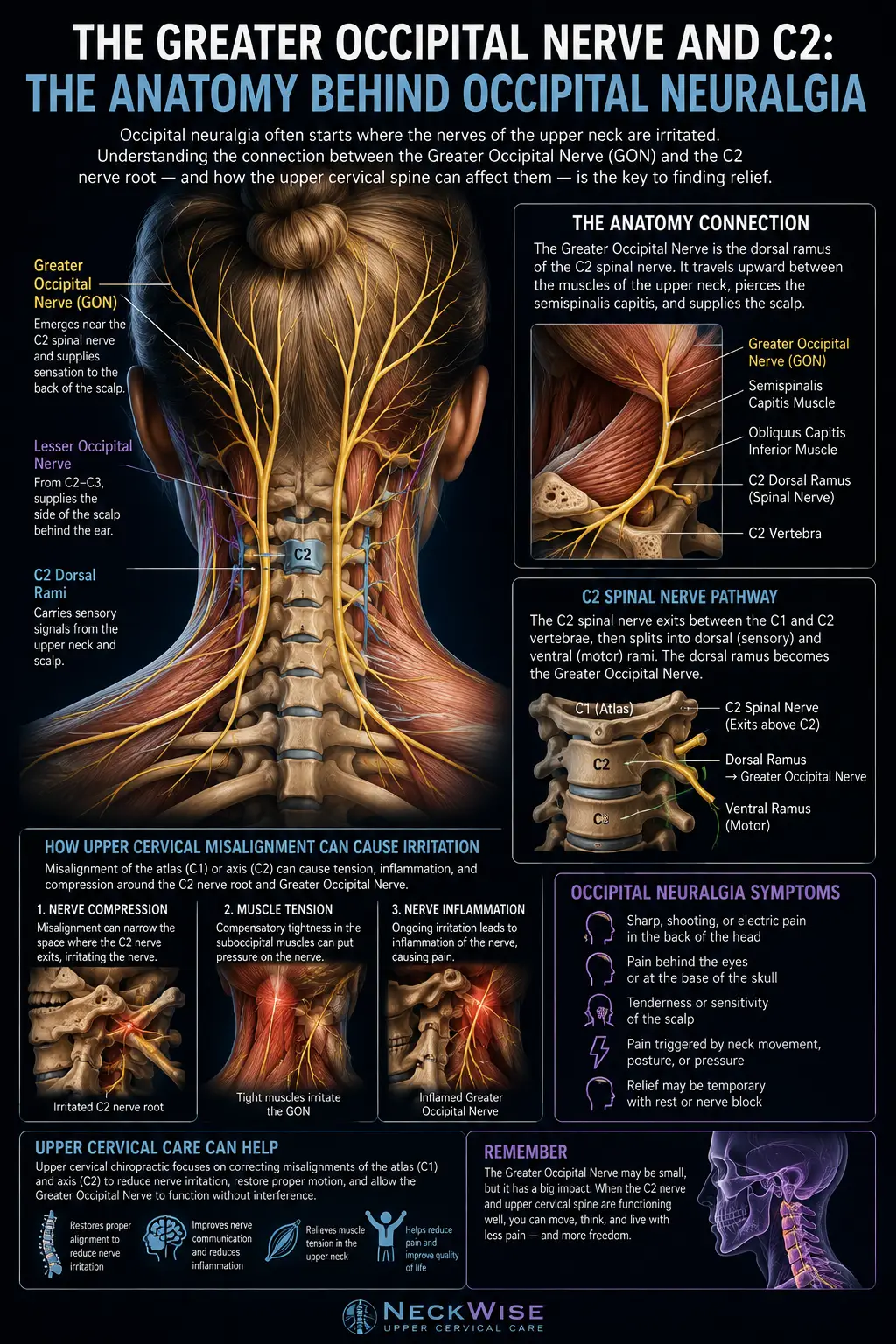
The Greater Occipital Nerve and C2: The Anatomy That Explains Occipital Neuralgia — and Points Straight at Your Upper Neck
By Dr. Rusty Lavender, D.C. — upper cervical chiropractor, Lavender Family Chiropractic, Sarasota, FL. Reviewed and updated October 2026.
If a sharp, electric, or burning pain fires from the base of your skull up over the back of your head — sometimes reaching behind the eye — there is a single anatomical fact that changes everything about how you should think about it: the nerve behind that pain, the greater occipital nerve, arises mainly from the C2 nerve root in your upper neck. Not your head. Your neck. Which means the pain you feel in your scalp is very often generated one inch below your skull, at the atlas and axis, in the exact region almost no headache workup ever examines with precision.
At Lavender Family Chiropractic here in North Sarasota, the upper neck is our entire focus, and I treat patients from across Sarasota, Lakewood Ranch, and Bradenton who have been chasing head pain for years without anyone looking at the one structure driving it. So I want to walk you through this anatomy the way I would in the consultation room — plainly, confidently, and with real respect for what the science shows. My goal is to help you understand why the upper neck is the root of so much head and scalp pain, and why gentle, precise upper cervical chiropractic care belongs in the conversation, coordinated with your physician.
Let’s start where the pain starts — which, as you will see, is not where you feel it.
This article is educational and not a substitute for medical advice. If you have a health condition, are pregnant, or take medication, talk with your physician before starting anything new.
Meet the Greater Occipital Nerve
The greater occipital nerve is a sensory nerve. That word matters: its job is to carry feeling — touch, pressure, temperature, and pain — from the skin of the back of your head and scalp up to your brain. It does not move muscles. It reports sensation.
Picture the back of your head. Run your hand from the top of your neck up over the curve of your skull toward the crown. Much of that territory gets its sense of feeling from the greater occipital nerve. When the nerve is healthy, you never think about it — you feel your hat, your pillow, the wind, and nothing hurts.
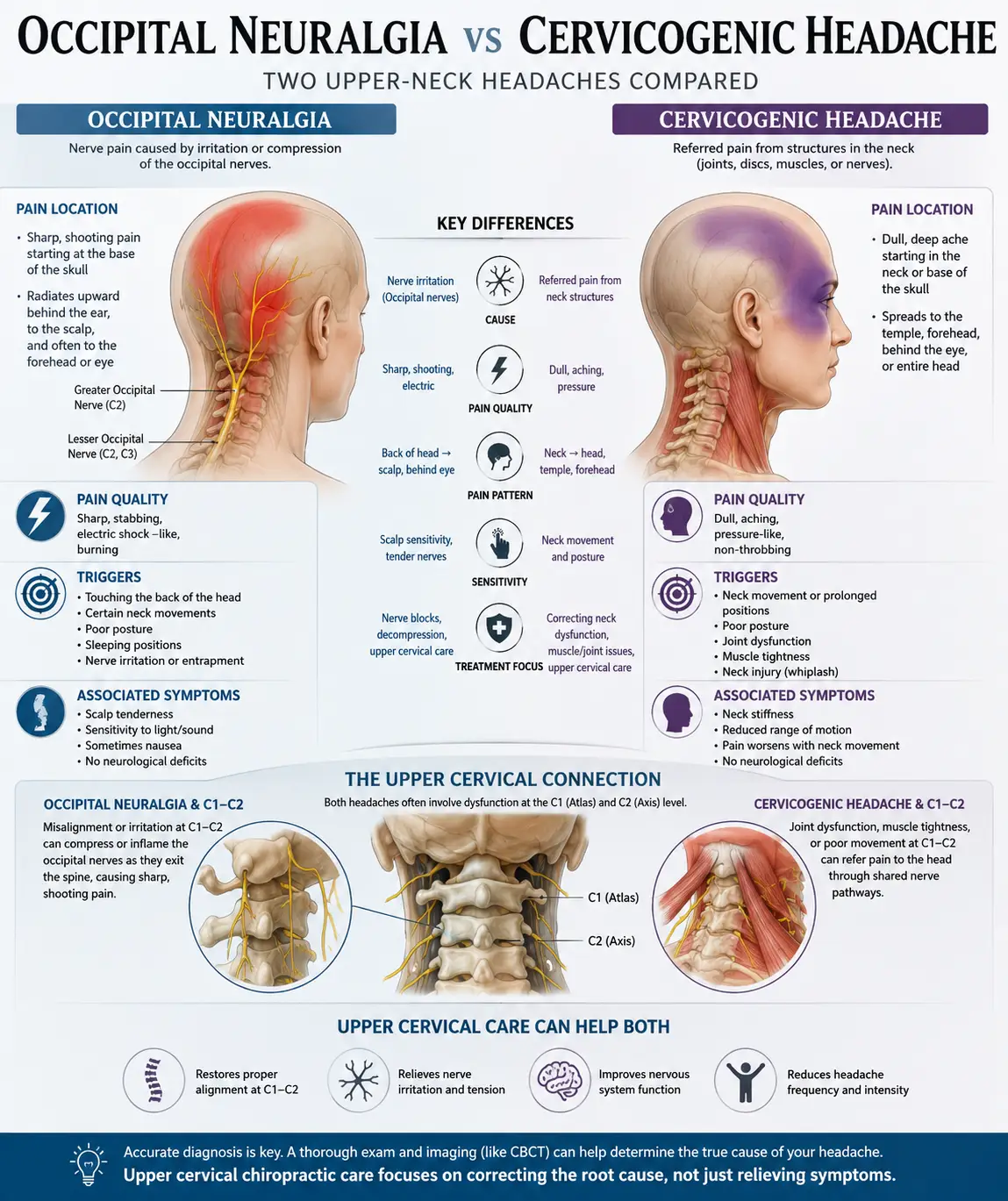
But when this nerve is irritated, compressed, or inflamed, it misbehaves dramatically. Instead of quietly reporting normal touch, it fires off pain signals that feel sharp, stabbing, shooting, or electric — like a jolt or a zap. Some people describe a deep ache or burning between the flare-ups. The scalp can become so sensitive that brushing your hair, lying on a pillow, or wearing glasses becomes uncomfortable. This cluster of symptoms, when it comes from irritation of the occipital nerves, is what clinicians call occipital neuralgia. “Neuralgia” simply means nerve pain.
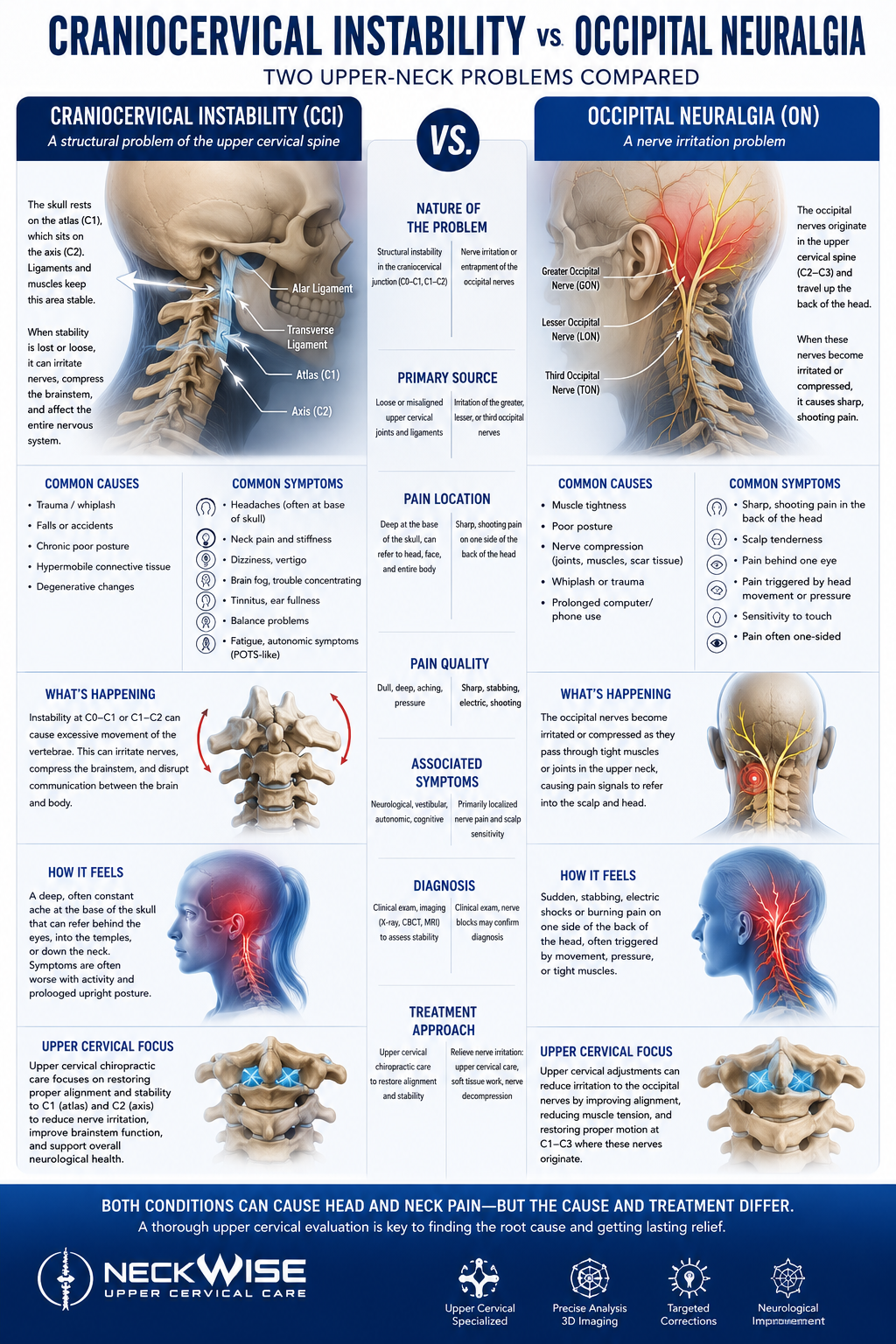
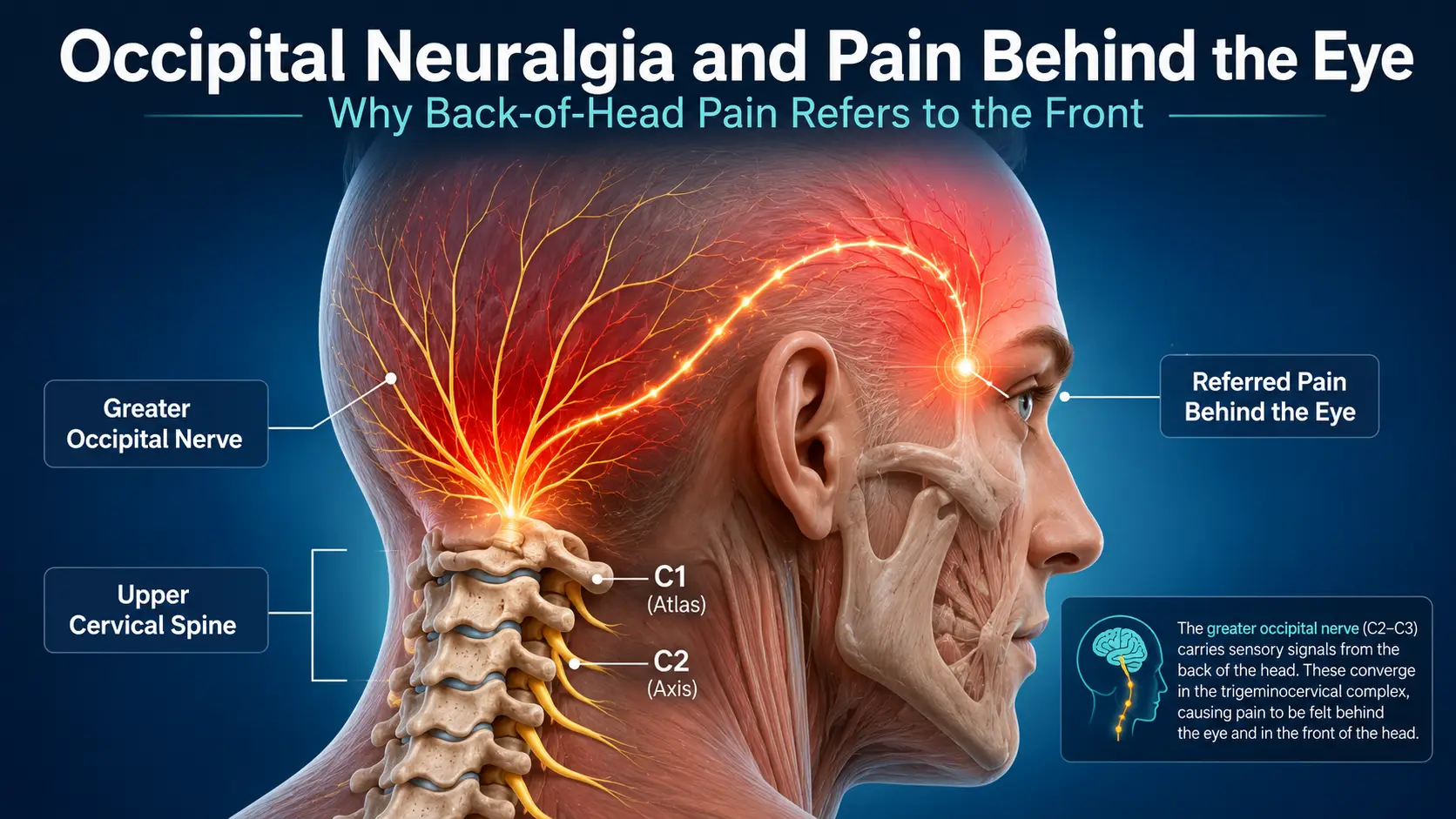
Here is the anatomical fact that makes all of this click into place, and it is the heart of this article: the greater occipital nerve arises mainly from the second cervical spinal nerve — C2. The pain lives in your scalp. The generator lives in your upper neck.
Where C2 Comes In
Your spine is a stack of bones called vertebrae. In your neck, the top two are special enough to have names. The first, right beneath the skull, is the atlas (C1). The second, just below it, is the axis (C2). These two bones carry the entire weight of your head, held largely by ligaments rather than interlocking bone, and between and around them the spinal nerves exit the spinal cord.
The C2 spinal nerve emerges in the upper neck, and a large branch of it becomes the greater occipital nerve. In other words, the nerve that gives feeling to the back of your head originates in your upper neck, not in your head. That single relationship explains a great deal. It means a problem in the upper neck — in the muscles, joints, or soft tissues around C1 and C2, or in the alignment of the atlas and axis themselves — can directly irritate a nerve whose territory is your scalp. The pain is felt in the head, but the source lives in the neck.
This is one of the reasons head pain is so confusing to sort out, and one of the reasons it goes unsolved for so long. The place where you feel pain and the place where the pain is coming from are not the same. Your nervous system localizes sensation to the skin the nerve serves, not to the spot where the nerve is being pinched. So an irritated greater occipital nerve reports “the back of my head hurts,” even when the real trouble is down at the top of the neck — exactly where most people never get examined.
The Journey of the Nerve: A Path Full of Pinch Points
To understand how this nerve gets irritated, follow its route. After branching off from the C2 nerve, the greater occipital nerve travels upward and must pass through several layers of muscle and connective tissue at the back of the neck before reaching the scalp.
Think of the back of your neck as muscular layers, stacked and crisscrossing like the strands of a thick rope. The greater occipital nerve threads between and through some of these layers. It typically passes near or through a muscle called the semispinalis capitis, then near the trapezius — the big, broad muscle you feel when someone rubs your shoulders and neck. It winds through this dense neighborhood of muscle and fascia on its way to the scalp.
Here is the plain-language takeaway. Anywhere a delicate sensory nerve has to squeeze through or alongside muscle and connective tissue, there is an opportunity for it to be compressed, tethered, or irritated — especially if those muscles are chronically tight, spasming, inflamed, or holding tension from posture, stress, injury, or poor movement. Tight suboccipital and upper-neck muscles act like fingers pinching a garden hose. And when the atlas or axis loses its normal position, it changes the tension and loading through this whole region, dragging on the nerve as you move your head. This is one of the leading mechanical explanations for occipital neuralgia: entrapment or irritation of the greater occipital nerve along its path through the upper-neck musculature.
There are other contributors too — prior whiplash or neck trauma, arthritis or degenerative changes in the upper cervical joints, chronic forward-head posture (long hours over a phone or computer), and muscle tension from stress. In the medical literature, occipital neuralgia is understood as a condition that can arise from irritation anywhere along the course of the occipital nerves, and a thorough review of its causes and features appears in the pain literature (Dougherty, Current Pain and Headache Reports, 2014). Notice the through-line: nearly every one of those contributors is a mechanical problem of the upper neck.
The Big Idea: Why a Neck Problem Becomes Head — and Even Face — Pain
So far, the story is intuitive: a nerve from the upper neck serves the scalp, and irritating it creates scalp and back-of-head pain. But many people with upper-neck issues report something stranger. Their pain does not stay politely at the back of the head. It wraps forward. It settles behind an eye. It creeps into the temple, the forehead, even the face. Some describe pressure behind the eyes or pain that “circles” from back to front.
How does an upper-neck nerve cause pain in the face, served by a completely different nerve? The answer is one of the most elegant pieces of anatomy in the whole head and neck, and it is central to how we think about care. It is the trigeminocervical complex, sometimes called the trigeminocervical convergence.
The Trigeminal Nerve and the Cervical Nerves Share a Switchboard
Meet the other main character. The trigeminal nerve is the great sensory nerve of the face. It is why you feel your cheeks, forehead, jaw, teeth, and the surface of your eyes. When you have a toothache, sinus pain, or pain behind the eye, the trigeminal nerve is usually the messenger.
Now here is the crucial detail. Both systems — the trigeminal nerve from the face, and the upper cervical nerves (C1, C2, C3) from the neck — send their sensory information into the brainstem and upper spinal cord to be processed. And they don’t go to separate, sealed-off rooms. Their signals arrive at an overlapping pool of nerve cells where trigeminal input and upper cervical input converge onto some of the same second-order neurons.
That convergence is the trigeminocervical complex — a shared switchboard, or two highways merging into a common interchange. Sensory traffic from the face and from the upper neck pull into the same station. This overlap of cervical and trigeminal afferents (the incoming sensory fibers) has been described and reviewed in the pain-medicine literature (Piovesan et al., Current Pain and Headache Reports, 2003).
Why Convergence Causes Referred Pain
Once you understand that neck and face signals merge at a shared switchboard, referred pain stops being mysterious. When the brain receives a pain signal from that shared pool, it cannot always tell whether it originated on the neck side or the face side. The wiring is blended. So a strong pain signal coming up from irritated upper-neck nerves can be experienced as if it were coming from the face or front of the head — the trigeminal territory.
This is the anatomical reason upper-neck problems refer pain forward into the head, temple, forehead, and behind the eye. It is not imagination, and it is not “all in your head” in the dismissive sense. It is a real, structural feature of how your nervous system is wired.
The science behind this convergence is genuinely compelling, and it runs in both directions. In carefully designed laboratory studies, researchers showed that stimulating the greater occipital nerve increased the excitability — the sensitivity and responsiveness — of the brainstem neurons that also receive input from the pain-sensitive coverings of the brain (Bartsch & Goadsby, Brain, 2002). Provoking the occipital nerve turned up the volume on neurons handling head pain. And the reverse was also demonstrated: stimulating the pain-sensitive covering of the brain increased the responses of those same trigeminocervical neurons to input coming from the neck (Bartsch & Goadsby, Brain, 2003). The two systems talk to each other, and each can sensitize the other. Neck input can amplify head-pain circuits, and head-pain circuits can amplify sensitivity to neck input.
For anyone who has lived with pain that travels between neck and head, refusing to stay in one lane, this research offers a physiological explanation that matches lived experience — and it puts the upper neck at the center of it.
Putting It Together: The Upper-Neck Story of Occipital Neuralgia
Let’s assemble the pieces, because this is the mechanism our practice is built around.
- The greater occipital nerve gives feeling to the back of your head and scalp.
- That nerve arises mainly from the C2 spinal nerve in your upper neck.
- On its way to the scalp, it passes through upper-neck muscles and connective tissue, where atlas/axis misalignment and muscle tension can compress or irritate it — producing the sharp, shooting, burning pain of occipital neuralgia.
- The upper cervical nerves (C1–C3) feed into the same brainstem switchboard as the trigeminal nerve of the face — the trigeminocervical complex.
- Because of that convergence, irritation from the upper neck can be experienced as pain not only at the back of the head but referred forward toward the temple, forehead, and eye.
Look at it this way and the upper neck stops being a bystander and becomes the central character. The region around C1 and C2 is where the relevant nerve is born, where it gets pinched, and where sensory input funnels into the system that shapes how head and face pain are felt. This is why we pay such close attention to the mechanics and position of the upper cervical spine — and why, for so many people, it is the one region driving their pain that no one ever checked.
I want to be candid, because you deserve confidence grounded in fact rather than hype. Understanding this anatomy is not the same as claiming a single treatment eliminates occipital neuralgia. The convergence research explains why the upper neck is mechanistically the driver. It does not, by itself, prove that adjusting the upper neck erases nerve pain for everyone. Those are different claims, and I won’t blur them. What the anatomy does justify — powerfully — is a focused, serious look at the upper cervical region as the place to address, gently and precisely, and as part of a coordinated plan, when someone is dealing with occipital and cervicogenic head pain.
How Occipital Neuralgia Is Diagnosed
Because occipital neuralgia can masquerade as other headaches — and other conditions can masquerade as it — a careful diagnosis matters. Occipital neuralgia is formally defined in the International Classification of Headache Disorders, 3rd edition (ICHD-3), the standard reference headache specialists worldwide use (ICHD-3, Cephalalgia, 2018).
In plain terms, the classic picture is pain in the distribution of the occipital nerves — that back-of-the-head, scalp territory — often sharp, shooting, or stabbing (though it can have an aching component between jolts), frequently on one side, and often with tenderness over the nerve’s path. Gently pressing the spot where the nerve travels can reproduce the pain, a helpful clue. A physician may also consider whether numbing the nerve with a local anesthetic temporarily calms it, which supports the diagnosis — and confirms, once again, that the source sits in the upper neck.
But several other conditions look similar — migraine, tension-type headache, cervicogenic headache, and, rarely, more serious problems. That overlap is why a proper medical evaluation matters and why chiropractic care should be coordinated with, not a replacement for, your physician’s assessment. The same convergence that explains referred pain also explains why different headache types feel alike.
Red Flags: When Head or Neck Pain Needs Prompt Medical Attention
Most head and neck pain is not dangerous. But some symptoms deserve urgent evaluation, and I would rather you know them and never need them. Please seek prompt or emergency care if head or neck pain comes with any of the following:
- A sudden, severe “thunderclap” headache that peaks within seconds to a minute, or the “worst headache of your life.”
- Head or neck pain following significant trauma, such as a car accident or fall.
- Fever, a stiff neck you cannot flex, a rash, or signs of infection along with headache.
- New weakness, numbness, facial drooping, difficulty speaking, confusion, vision loss, or trouble with balance or coordination.
- A headache that is new or markedly different if you are over 50, or that steadily worsens over days to weeks.
- Headache with a known cancer history, immune suppression, or new onset during pregnancy.
- Loss of bowel or bladder control, or progressive difficulty walking.
- Headache that reliably worsens with coughing, straining, or lying down, or that wakes you from sleep.
None of these are things to “wait out.” If any apply, contact your physician or emergency services promptly. Good upper cervical care begins with knowing when not to adjust and when to refer — screening for these red flags is a routine, essential part of a responsible evaluation.
How Our Upper Cervical Approach Fits In
At Lavender Family Chiropractic — NeckWise North Sarasota — our entire focus is the upper cervical spine: that critical junction of the skull, atlas (C1), and axis (C2) where the greater occipital nerve is born and where so much sensory traffic converges. Given everything we’ve discussed, I hope it is clear why this region is where we concentrate.
Our approach is precise, gentle, and low-force. Here is what that means in practice, because “chiropractic” means different things to different people.
Imaging first. We use 3D cone-beam computed tomography (CBCT) imaging to look carefully at the specific anatomy of your upper cervical spine. Every neck is different, and understanding your individual structure lets us tailor our approach rather than guess.
Objective measurement. We use paraspinal infrared thermography, a non-invasive way of measuring patterns along the spine over time. This gives us objective information to track, rather than relying on impressions.
Low-force correction. Our technique is the low-force Knee Chest Upper Cervical method. It is precise, gentle, and low-force — there is no twisting, cracking, or popping. If you have avoided chiropractic because you dislike the idea of your neck being forcefully rotated or “cracked,” this is a very different experience. The goal is a specific, gentle correction aimed at the upper cervical region, not a dramatic maneuver.
Here is how I frame the role of this care, confidently and honestly. Because the upper neck is anatomically central to the greater occipital nerve and to trigeminocervical convergence, addressing the mechanics and position of the upper cervical spine is exactly the right region to attend to when someone struggles with occipital and cervicogenic head pain. Our gentle upper cervical care targets this region — the muscles, joints, and alignment of the upper neck — as part of a broader plan, coordinated with your physician and any headache specialist you work with.
I am not going to promise that an adjustment eliminates nerve pain or guarantee an outcome. What I can tell you is that the anatomy gives us a sound, cause-forward reason to focus on the upper neck, that our methods are gentle and measured, and that we will always work alongside — never in place of — your medical team. A good consultation is partly about honestly figuring out whether this is a sensible fit for you.
What the Research Says
I want to be clear about what the science I’ve cited establishes, because the honest boundaries matter as much as the findings.
The strongest and most direct evidence concerns the mechanism — the wiring — not any specific treatment. The laboratory studies by Bartsch and Goadsby demonstrated genuine two-way communication in the trigeminocervical complex. Stimulating the greater occipital nerve increased the central excitability of neurons that also process input from the pain-sensitive coverings of the brain (Bartsch & Goadsby, Brain, 2002), and stimulating those coverings increased the responsiveness of the same neurons to cervical (neck) input (Bartsch & Goadsby, Brain, 2003). Together these establish a physiological basis for why upper-neck input and head-pain circuits influence one another — why neck and head pain are so intertwined.
The convergence of cervical and trigeminal sensory afferents has been described and reviewed as an anatomical and clinical reality (Piovesan et al., Current Pain and Headache Reports, 2003), reinforcing that the upper neck and the face share sensory processing and that this sharing explains referred pain patterns.
On the clinical side, occipital neuralgia itself — its features, its likely mechanisms of nerve irritation, and the ways it is evaluated and managed — has been reviewed in the pain literature (Dougherty, Current Pain and Headache Reports, 2014). And the condition is formally defined within the standard diagnostic framework used by headache specialists (ICHD-3, Cephalalgia, 2018), which lets clinicians distinguish it from migraine, tension-type headache, and other look-alikes.
What none of these sources do is prove that any particular hands-on treatment — chiropractic included — reliably eliminates occipital neuralgia. That is not what these studies tested. So I present the anatomy and the convergence mechanism with real confidence, because the evidence for the wiring is solid and it points squarely at the upper neck. I hold the treatment claims honestly: the anatomy justifies focused attention to the upper cervical spine as part of a coordinated plan; it does not, on its own, promise a specific result. Anyone who tells you otherwise is going beyond the science.
Top Questions
Is occipital neuralgia the same as a migraine? No, though they can feel similar and overlap. Occipital neuralgia is nerve pain in the territory of the occipital nerves — typically sharp, shooting, or stabbing pain at the back of the head and scalp, often with tenderness along the nerve’s path. Migraine is a distinct disorder with its own features. Because of trigeminocervical convergence, the two can influence each other and be confused, which is why a careful diagnosis by your physician matters. The standard reference is the ICHD-3 (ICHD-3, Cephalalgia, 2018).
Why does the pain go into my eye or forehead if the problem is in my neck? This is the trigeminocervical complex at work. The upper cervical nerves and the trigeminal nerve send signals into an overlapping pool of neurons in the brainstem. Because those signals merge, pain originating in the upper neck can be experienced as if it came from the front of the head or behind the eye. It is a real feature of your nervous system’s wiring, not imagination.
Does the greater occipital nerve really come from my neck? Yes. The greater occipital nerve arises mainly from the C2 spinal nerve in your upper neck, then travels up through the neck muscles to supply sensation to the back of your head and scalp. That is the anatomical reason an upper-neck problem produces head pain — and the reason your neck deserves a serious look.
Is your upper cervical technique going to crack or twist my neck? No. Our Knee Chest Upper Cervical method is precise, gentle, and low-force. There is no twisting, cracking, or popping. Many people apprehensive about chiropractic are surprised by how gentle it is.
Can chiropractic cure my occipital neuralgia? I won’t make that claim, and I’d be cautious of anyone who does. The research strongly supports why the upper neck is the driver, but it does not prove any single treatment eliminates the condition. We offer gentle upper cervical care aimed at the root region — one part of a plan — coordinated with your physician. Part of a good consultation is honestly assessing whether this approach makes sense for you.
Do I need imaging before care? In our practice, yes. We use 3D CBCT imaging to understand your individual upper cervical anatomy and paraspinal infrared thermography to gather objective measurements over time. Everyone’s neck is different, and we’d rather understand yours specifically than assume.
Should I stop seeing my doctor if I come to you? Absolutely not. We work alongside your physician and any headache specialists, not instead of them. If your evaluation ever suggests something needing medical or emergency attention, our job is to recognize it and refer you appropriately.
What are the warning signs that my headache is an emergency? A sudden “worst headache of your life,” headache after significant head or neck trauma, headache with fever and a stiff neck, or headache with new weakness, numbness, facial drooping, difficulty speaking, vision loss, confusion, or balance problems all warrant prompt or emergency care. See the red-flags section above for the fuller list, and when in doubt, seek care right away.
Serving Sarasota, Lakewood Ranch & Bradenton
Lavender Family Chiropractic (NeckWise North Sarasota) is proud to serve patients throughout Sarasota, Lakewood Ranch, and Bradenton, along with North Sarasota, Whitfield, University Park, Palmetto, Ellenton, Osprey, Nokomis, Venice, and the greater Sarasota–Manatee region. If you live or work along the Whitfield corridor — or anywhere from Sarasota to Lakewood Ranch to Bradenton — and you have been dealing with occipital pain, head and neck pain, or headaches you suspect are connected to your upper neck, we would be glad to talk with you honestly about whether our approach might fit.
Let’s Talk
If today’s article resonated with your experience, I invite you to schedule a consultation with our doctors. It is a no-pressure conversation: we will listen to your history, talk through the anatomy as it relates to you, screen carefully for anything needing medical referral, and give you our honest assessment of whether gentle upper cervical care makes sense as part of your plan — coordinated with your physician.
→ Call (941) 243-3729 to schedule.
Lavender Family Chiropractic — NeckWise North Sarasota 5899 Whitfield Avenue, Suite 107 Sarasota, FL 34243(941) 243-3729
Precise, gentle, low-force upper cervical care. No twisting, cracking, or popping.
This article is for general educational purposes and is not a substitute for individualized medical advice, diagnosis, or treatment. Please consult your physician about your specific situation, and seek prompt or emergency care if you experience any of the warning signs described above. Chiropractic care at our practice is coordinated with your medical care. Individual results vary.
Related Articles
Related Posts


Get our upper cervical articles first.
Patients Experience