TMJ and Forward Head Posture: Why Your Jaw Pain May Start at the Top of Your Neck
By Dr. Rusty Lavender, D.C. — upper cervical chiropractor, Lavender Family Chiropractic, Sarasota, FL. Reviewed and updated October 2026.
If you live with jaw pain, clicking, headaches, or that maddening tightness around your temples and ears, you have probably spent a lot of time thinking about your jaw — and almost no time thinking about your neck. That is the mistake the standard playbook keeps making. Your jaw does not hang in space. Its resting position, its muscle balance, and the way it loads every time you chew are all governed in part by where your head sits over the top of your neck. When the atlas (C1) and axis (C2) shift and your head drifts forward, the jaw is forced to work against a tilted foundation — and the research increasingly shows that people with jaw disorders carry measurable neck dysfunction right alongside it. For patients across Sarasota, Lakewood Ranch, and Bradenton who have chased the jaw for years, the overlooked driver is often sitting one level up, at the craniocervical junction no one examined.
At Lavender Family Chiropractic here in Sarasota, we spend a lot of time on this neck–jaw relationship, because it is one of the most genuinely well-supported connections in musculoskeletal health — and one of the most consistently ignored. This article walks through what the research actually shows, where it is strong, and how gentle, posture-focused upper cervical care fits alongside the work your dentist or physician is doing. The evidence for neck-directed care of the jaw is real, and it points straight at the region we focus on.
Why the Neck and Jaw Are So Closely Linked
To understand why your neck drives your jaw pain, picture how these structures are wired together — because the connection is not a metaphor. It is anatomical and neurological.
The trigeminocervical convergence
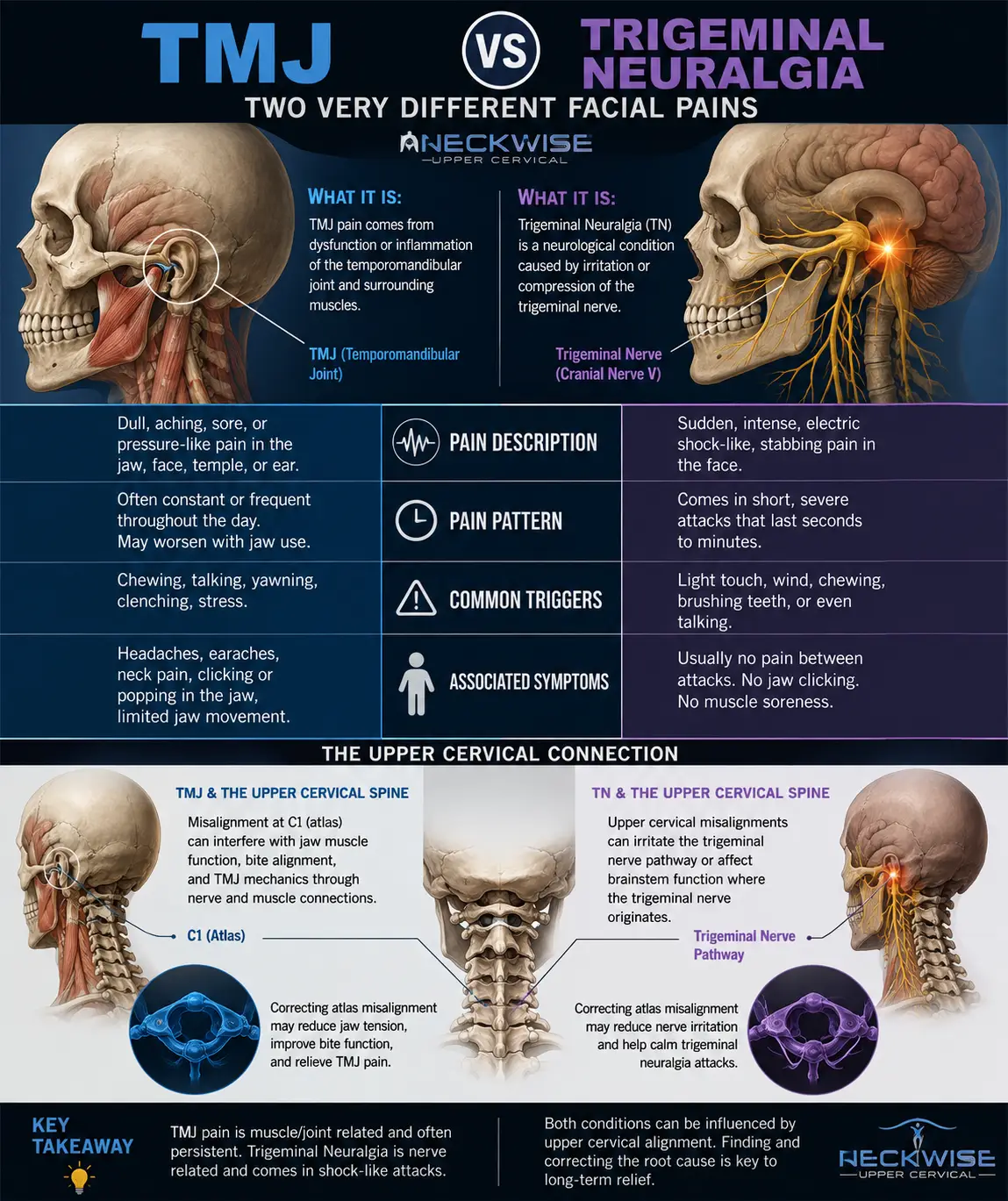
At the base of your skull and in the top three segments of your neck, sensory nerves carry information about pain and position. These upper cervical nerves (C1–C3) share pathways in the brainstem with the trigeminal nerve — the large nerve responsible for sensation in your face, jaw, and much of your head. This shared processing hub is often called the trigeminocervical nucleus.
The practical consequence is striking: the brain can genuinely struggle to tell the difference between a signal coming from the upper neck and one coming from the jaw or face. Irritation or dysfunction at the atlas and axis can be experienced as pain in the temple, around the ear, or in the jaw itself. This is a well-recognized phenomenon called referred pain, and it is a major reason the upper neck deserves attention — arguably first attention — in anyone with facial or jaw symptoms.
Shared muscles and mechanics
Beyond the nervous system, the neck and jaw share physical real estate. Muscles that move and stabilize your head — the suboccipitals at the base of the skull, the sternocleidomastoid running down the side of the neck, and the deep neck flexors in front — all influence, and are influenced by, the position of your head. And the position of your head directly influences the resting posture of your lower jaw.
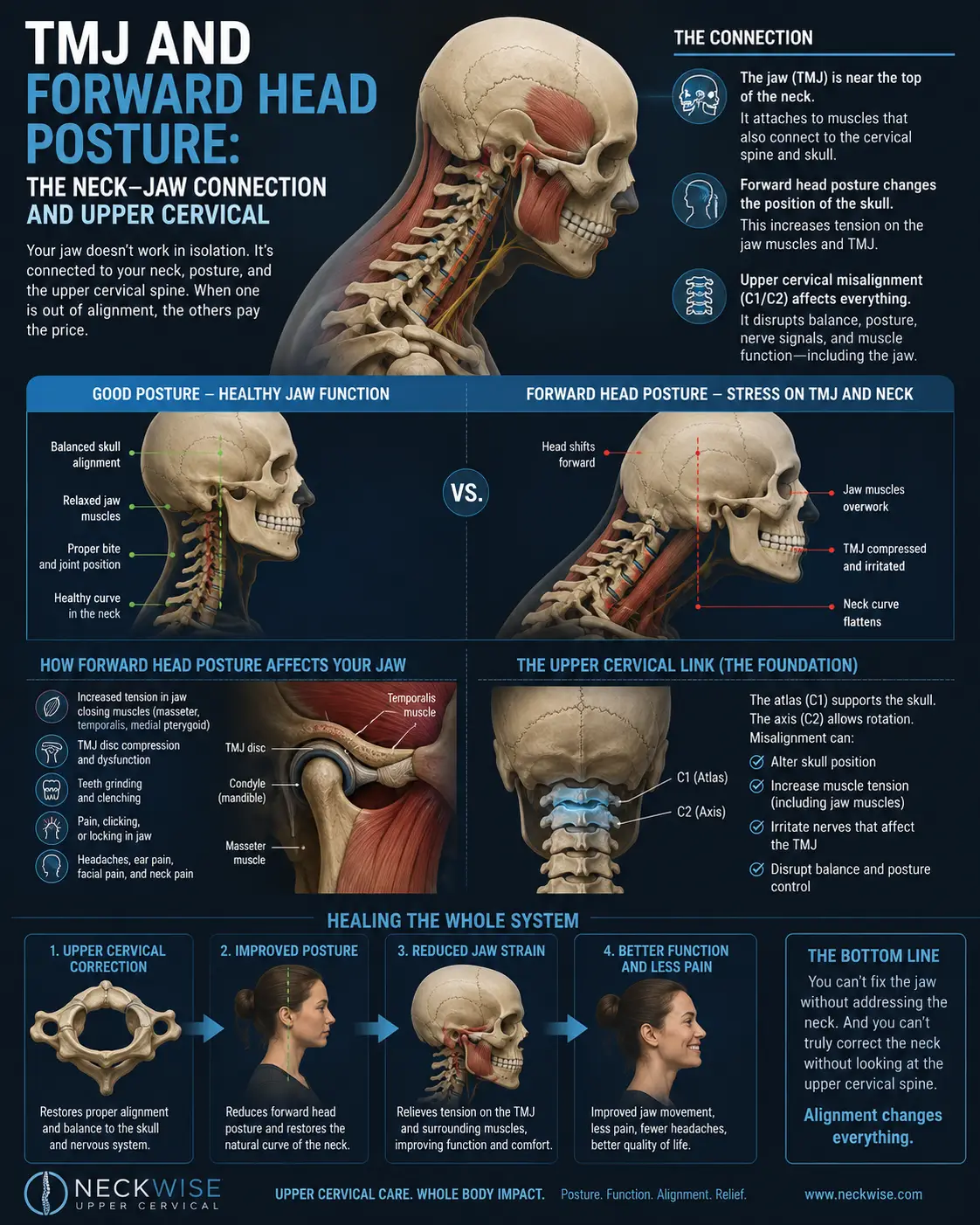
When your head sits forward of your shoulders, the mechanics of jaw closure and the balance of the muscles that open and close your mouth shift. Chewing, clenching, and even swallowing happen against a slightly different backdrop. Over time, that altered loading is a plausible driver of the muscular fatigue, tenderness, and dysfunction that characterize many TMD presentations. The jaw pays the price for a head that is no longer stacked over the neck.
What forward head posture actually is
Forward head posture is exactly what it sounds like: the head drifts forward so the ear sits ahead of the shoulder rather than stacked over it. It is epidemic in our screen-heavy, desk-bound world. Every inch the head moves forward dramatically increases the load the neck muscles must carry, because the head is a heavy weight on the end of a lever.
Forward head posture also comes with a specific pattern: the lower neck flexes while the upper cervical segments extend, tipping the base of the skull back on the top of the spine. That upper cervical extension is precisely the region that shares so much nervous-system real estate with the jaw — the atlas and axis, where the trigeminocervical convergence lives. This is why forward head posture is not a cosmetic concern. It loads the exact junction that feeds the jaw-and-face circuit, and it is a mechanism you can begin to feel the moment you understand it.
What TMD Actually Feels Like
Because “TMD” is an umbrella term, it helps to name what it involves. The temporomandibular joints are the two small, hardworking hinges just in front of your ears that let you talk, chew, and yawn. Temporomandibular disorders describe a family of problems affecting those joints, the muscles that move the jaw, or both. They are common, uncomfortable, and surprisingly disruptive.
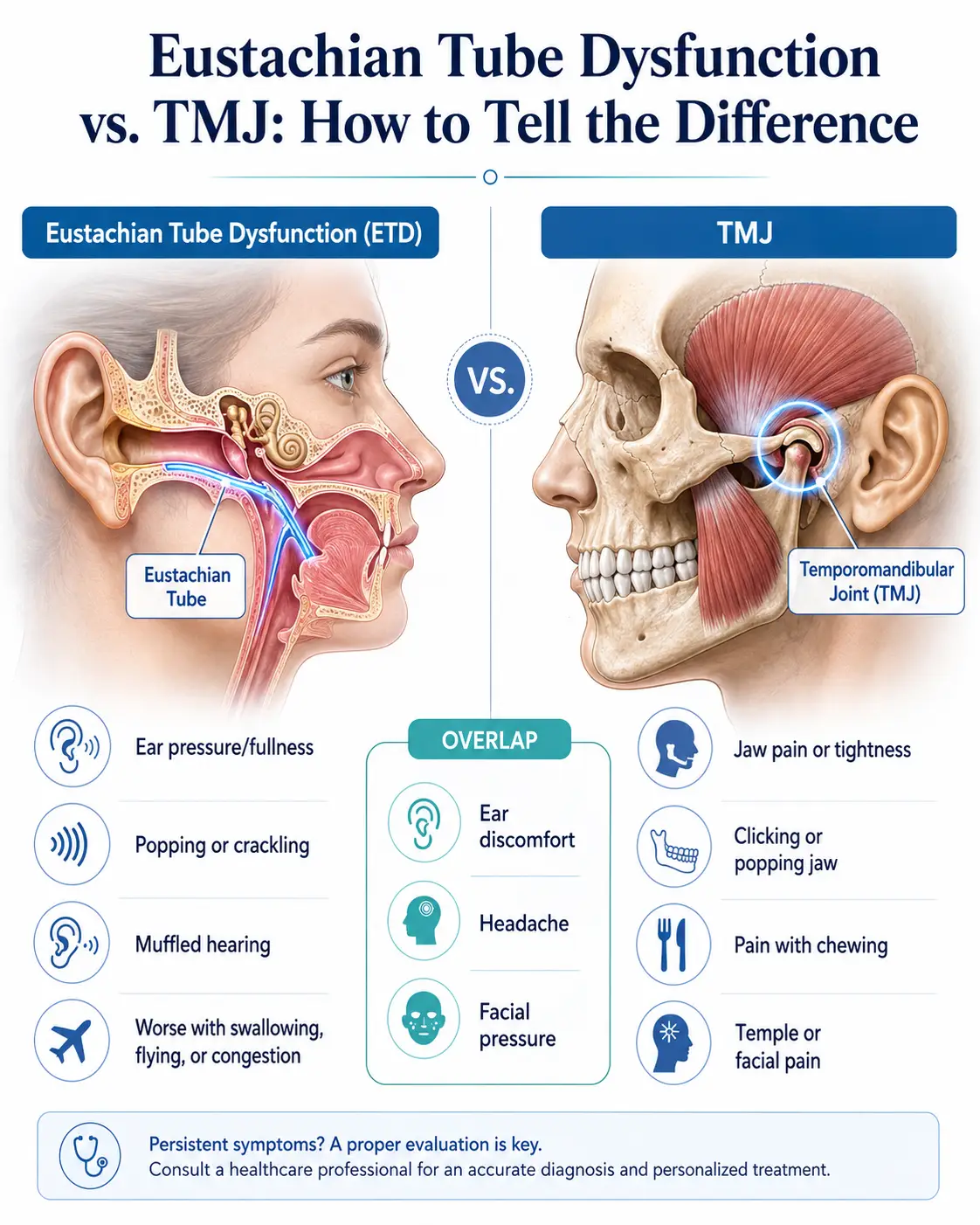
People with TMD describe a wide range of experiences: pain or tenderness in the jaw, in front of the ear, or in the cheek and temple; clicking, popping, or grating when they open and close; a jaw that feels tight, tires quickly while eating, or does not open as far as it used to. Headaches, ear fullness, and facial fatigue are common companions. And because these symptoms cluster around the head and upper neck, they can be hard to tease apart from ordinary neck tension or tension-type headache.
That overlap is exactly why the neck belongs at the center of the conversation, not the margins. When your symptoms live in the same neighborhood as your upper cervical spine — the temple, the ear, the base of the skull, the angle of the jaw — the smart question is whether the neck is driving the picture rather than assuming the jaw is the sole culprit. TMD also waxes and wanes, with flares tied to stress, clenching, poor sleep, or long stretches of desk work. That variability is part of why single-cause, jaw-only explanations tend to disappoint, and why a whole-picture approach that includes posture and the upper neck makes practical sense.
What the Research Says
This is where honesty matters most, so let me walk through the evidence carefully. There is a genuine, repeatedly documented relationship between the neck and TMD — and as the measurement has improved, that relationship has only come into sharper focus.
The classic posture question
For decades, clinicians assumed that forward head posture was a direct driver of jaw problems. Some early work supported that intuition. A frequently cited 1995 study reported a relationship between forward head posture and temporomandibular disorders, finding posture differences in people with certain TMD presentations and helping launch decades of interest in this question.
When researchers stepped back and pooled the posture studies, the picture got more nuanced. A 2006 systematic review on the association between head and cervical posture and temporomandibular disorders concluded that while an association appears in the literature, the studies had methodological limitations — inconsistent ways of measuring posture, small samples, varied definitions of TMD, and difficulty establishing whether posture caused the disorder or accompanied it. In other words, the older static-posture evidence shows a real association but does not, by itself, prove causation. I share that plainly: posture is one important piece, not a single on/off switch, and anyone who tells you your entire jaw problem is simply “bad posture” is oversimplifying.
Where the evidence has genuinely strengthened: the neck is involved
Here is the part that changes the whole conversation. As researchers moved from static posture snapshots to how the neck actually functions, the connection sharpened dramatically.
A 2020 systematic review and meta-analysis of the craniocervical and cervical spine features of patients with TMD pulled together the available studies and found meaningful differences in the necks of people with TMD compared with those without it. People with TMD tended to show measurable craniocervical and cervical spine differences — the neck was not a bystander but part of the clinical presentation. This is a stronger, more consistent finding than the older posture-only work, because it examines the neck as a functioning system rather than a single alignment snapshot.
A second 2020 review reinforced this from the muscular and disability angle. This systematic review and meta-analysis of cervical musculoskeletal disorders in patients with TMD found that people with temporomandibular disorders commonly show signs of neck dysfunction — greater self-reported neck disability, reduced cervical range of motion, and reduced endurance or strength of the deep neck muscles. Put simply: when the jaw is struggling, the neck is frequently struggling too, and the degree of jaw-related disability often tracks alongside the degree of neck-related disability.
This is a decisive shift. It moves us from “posture might be associated with TMD” to “the cervical spine is measurably involved in many people with TMD.” That is a firm foundation, and it is why forward-thinking care for jaw problems increasingly puts the neck at the center.
The treatment evidence: treating the neck helped the jaw
If the neck is involved, the natural question is whether treating the neck helps the jaw. Here the evidence is genuinely encouraging. A 2019 randomised controlled trial on mobilisation of the upper cervical region and craniocervical flexor training in women with TMD tested exactly this idea. Participants received gentle mobilization directed at the upper cervical spine along with specific, low-load exercises to retrain the deep neck flexor muscles. The results were promising: this neck-directed approach was associated with improvements in orofacial pain and jaw function. Treating the neck helped the jaw.
Notice the details, because they matter and they align with how we practice. The intervention was gentle upper cervical mobilization plus targeted exercise — not high-velocity spinal manipulation, and not marketed as a stand-alone answer. The strongest supportive evidence for neck-focused care of TMD comes from gentle, low-force, upper-cervical-directed techniques paired with craniocervical exercise. That is the honest bottom line, and it points squarely at the upper neck as the region to address.
Putting the evidence together
A fair reading of the literature says:
- The neck and jaw are functionally and neurologically linked. This is well established.
- People with TMD, as a group, show more neck disability, reduced cervical range of motion, and reduced deep neck muscle endurance than people without TMD.
- Static posture, including forward head posture, is associated with TMD, though the older evidence has methodological limits on proving causation.
- Gentle upper cervical mobilization plus craniocervical flexor exercise can reduce orofacial pain and improve jaw function.
That is a genuinely positive, cause-forward story: the upper neck is measurably involved, and addressing it gently is an evidence-informed part of caring for the jaw — coordinated with your dentist, and squarely aimed at a driver the jaw-only approach misses.
How This Shapes Care at Lavender Family Chiropractic
With that evidence in mind, here is how we approach patients who come to us with jaw symptoms alongside neck complaints. Our practice, NeckWise North Sarasota, focuses on upper cervical chiropractic — the very region the research keeps pointing back to.
A careful look before any care
We start with understanding, not treatment. Because the upper cervical spine is anatomically complex and individual, we use 3D CBCT (cone-beam computed tomography) imaging to see your specific anatomy clearly, rather than guessing from a generic model. We also use paraspinal infrared thermography, which measures patterns of heat along the spine that can reflect how your nervous system is functioning in different regions over time. These tools help us decide whether upper cervical care is appropriate for you at all, and if so, exactly where and how to direct it — and, just as importantly, when your presentation needs a different provider.
Gentle, low-force upper cervical care
Our approach uses the Knee Chest Upper Cervical technique, a precise, gentle, low-force method. There is no twisting, cracking, or popping. If your mental image of chiropractic is a forceful neck maneuver, this is deliberately not that. The goal is a specific, controlled contact directed by your imaging, intended to support better function at the atlas and axis — the same region the TMD research highlights.
I want to connect this honestly to the evidence above. The strongest trial support for neck care in TMD used gentle mobilization plus exercise, and our low-force approach is philosophically aligned with that gentleness. We pair it with attention to posture and the deep neck muscles. What I can tell you is that the upper neck is a measurable, evidence-supported part of the TMD picture, and addressing it gently is a reasonable, low-risk way to target that driver — offered in coordination with your dental and medical care, not as a replacement for it.
Posture and the deep neck muscles
Because forward head posture and weak deep neck flexors show up so consistently in this population, we also work with patients on posture awareness and simple craniocervical exercises when appropriate. This is the part of the picture with encouraging trial support, and it is something you carry into daily life well beyond the office.
Coordinating with your dentist
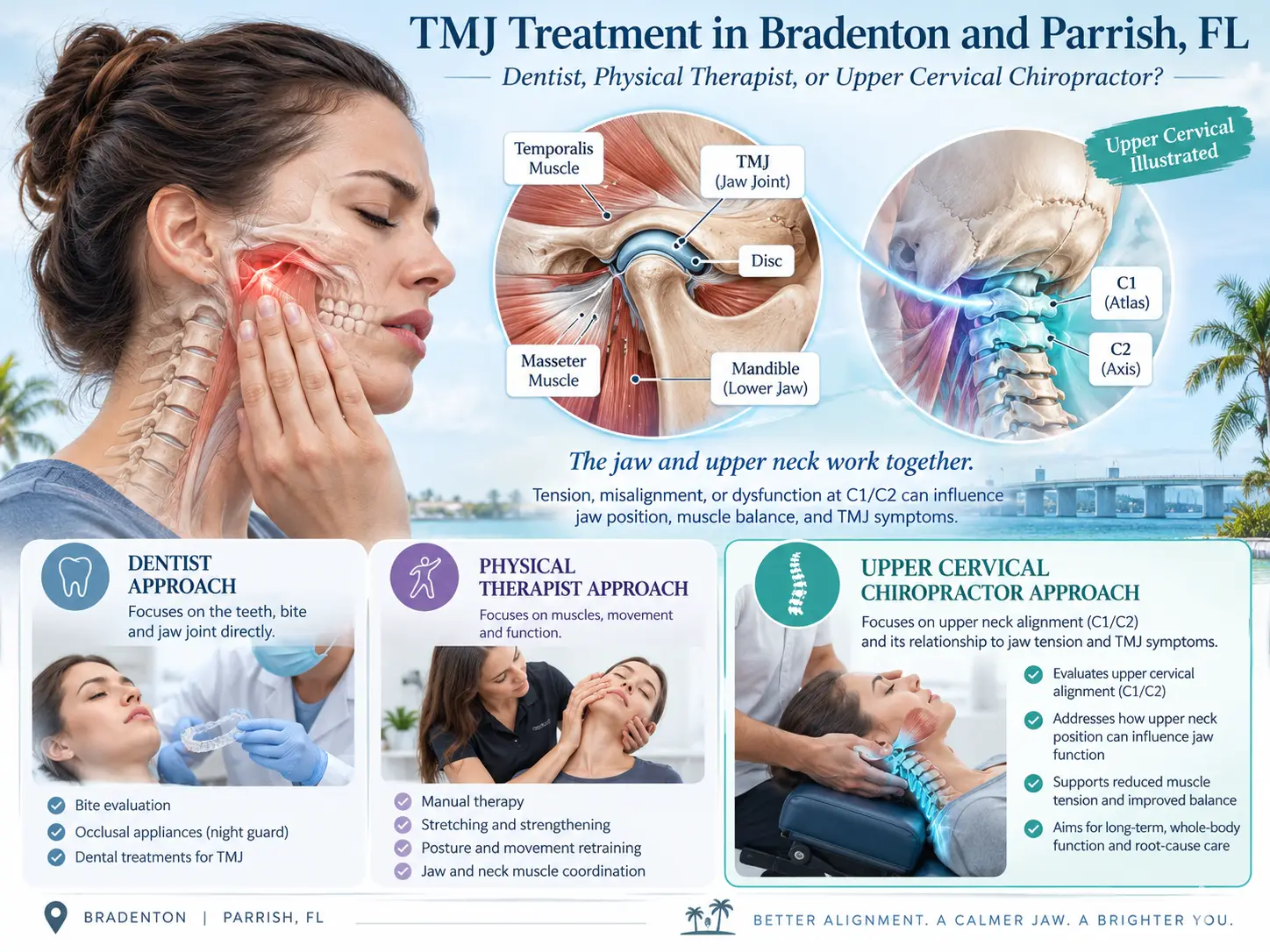
TMD is genuinely multidisciplinary. Your dentist may address your bite, teeth grinding, or a splint; your physician may look at inflammatory or systemic contributors; a physical therapist may guide jaw and neck exercises. We see ourselves as one collaborative part of that team, focused on the upper cervical spine — the driver so many TMD patients share and so few care plans examine. If gentle upper cervical care and posture work can reduce the cervical contribution to your symptoms while your dentist addresses the bite and your own habits shift toward less clenching and better ergonomics, the combined effect is often more helpful than any single piece alone.
Practical Things You Can Do Today
While professional care is being sorted out, several self-care habits are gentle, sensible, and aligned with the neck–jaw connection. None replace evaluation, but they rarely hurt and often help.
Mind your screen setup
Raise your screen so the top is near eye level, so you are not craning forward and down. Bring your phone up toward your face rather than dropping your head to it. Small changes in how you hold your head over a workday add up.
Take posture breaks
Every 30 to 60 minutes, reset. Gently draw your head back so your ears stack over your shoulders, roll your shoulders down and back, and take a few easy breaths. You are not holding a rigid military posture — you are interrupting the long slide into forward head position.
A gentle chin nod
Sitting tall, make a small, slow nodding motion as if saying a quiet “yes,” tucking your chin slightly without jamming it down. This is the kind of low-load craniocervical activation used in the research. Keep it gentle and pain-free, and stop if it aggravates anything.
Unclench your jaw
Notice where your tongue and teeth sit during the day. A relaxed resting position is tongue lightly on the roof of the mouth, teeth apart, lips gently closed. Many people clench without realizing it, especially during focused work or stress.
Manage load on the jaw
Softer foods during a flare, smaller bites, avoiding gum and habitual chewing, and being mindful of yawning too wide all reduce demand on an irritated jaw while you pursue care.
Red Flags: When to Seek Prompt Attention
Most jaw and neck discomfort is musculoskeletal and not dangerous. But some symptoms deserve prompt medical or dental evaluation rather than watchful waiting or routine chiropractic care. Please seek timely professional attention if you experience any of the following:
- A jaw that locks open or closed, or that you cannot fully open or close
- Significant facial trauma or a suspected jaw fracture or dislocation
- Facial weakness, drooping, numbness, or difficulty speaking or swallowing
- Sudden, severe, or “worst ever” headache, especially with neurological symptoms
- Fever, significant swelling, redness, or signs of infection around the jaw or teeth
- Dizziness, visual changes, slurred speech, or loss of coordination
- Chest, arm, or jaw pain associated with exertion, or that could signal a cardiac event — seek emergency care immediately
- Progressive, unexplained weight loss, night pain, or a lump or mass
- Numbness, tingling, or weakness in the arms or hands
If anything on this list applies to you, that is a signal to be evaluated by the appropriate provider first. We would rather you be safe, and we screen for these concerns as part of our own process.
Top Questions
Can neck problems really cause jaw pain?
Yes — and it is more the rule than the exception in stubborn cases. The upper neck and jaw share nerve pathways in the brainstem and share overlapping muscles, so problems at the atlas and axis can be felt in the jaw, temple, or around the ear. Research consistently shows that people with TMD, as a group, have more neck dysfunction than people without it. Considering the upper neck as a primary part of the picture is not just reasonable — it is well supported.
Does forward head posture cause TMD?
Forward head posture is associated with TMD, and it loads the exact upper cervical region that shares nerve pathways with the jaw. The older static-posture studies have methodological limits on proving strict causation, so it is best understood as one important contributing driver worth addressing rather than the sole switch. Improving how your head sits over your neck is a sensible, low-risk, evidence-informed part of care.
Will addressing my neck help my jaw?
The encouraging news is that gentle upper cervical mobilization combined with deep neck muscle exercise has been associated with reduced orofacial pain and improved jaw function in a randomized trial. TMD is usually multifactorial, so neck care is best understood as a central supportive part of a broader plan that often includes your dentist — but it targets a driver the jaw-only approach leaves untouched.
Is your technique safe? Does it involve cracking my neck?
Our Knee Chest Upper Cervical approach is precise, gentle, and low-force. There is no twisting, cracking, or popping. We use 3D CBCT imaging and paraspinal infrared thermography to guide care to your specific anatomy and to help determine whether this approach is appropriate for you in the first place.
Is the neck an established part of TMD care?
The supportive treatment evidence comes from gentle, low-force upper-cervical-directed mobilization and craniocervical exercise, and the observational research consistently shows the cervical spine is measurably involved in TMD. We present our gentle upper cervical and posture-focused care as an evidence-informed part of your plan, coordinated with your other providers.
Should I still see my dentist?
Yes. Your dentist plays a central role in TMD, from evaluating your bite to addressing grinding and fitting splints when indicated. We see our upper-cervical-focused care as complementary to that work, and we are happy to coordinate. TMD tends to respond well to a team approach.
How long before I might notice anything?
This varies widely from person to person, and I cannot promise a timeline or a specific outcome. What we can promise is a careful evaluation, an honest conversation about whether our care is a reasonable fit, and a willingness to refer you elsewhere if that is what your situation calls for.
What if my main problem turns out not to be my neck?
Then we will tell you. Part of a thorough evaluation is recognizing when someone would be better served by a dentist, physician, physical therapist, or another specialist. Our imaging and examination help us make that call honestly, and pointing you toward the right care is part of our job.
The Bottom Line
The neck–jaw connection is one of the more genuinely well-supported relationships in musculoskeletal medicine. The two regions are wired and built together, and the research increasingly shows that people with jaw disorders carry measurable neck dysfunction — reduced range of motion, reduced deep neck muscle endurance, and greater neck-related disability that tracks alongside jaw-related disability. Gentle, upper-cervical-directed care combined with exercise has shown promise for reducing orofacial pain. And forward head posture loads the precise region — the atlas and axis — that shares nerve pathways with the jaw.
That is why we offer gentle, low-force upper cervical care and posture work as a central, evidence-informed part of a broader plan — coordinated with your dentist and physician — rather than a stand-alone cure. If your jaw and neck have been struggling together, the upper cervical spine is a driver worth evaluating, and it is very likely the region no one has examined. If you would like an honest evaluation of whether our approach is a reasonable fit, we would be glad to talk.
Our complete guide to neck pain and the upper cervical spine covers the causes of neck pain, when it points to the top of the neck, and how we evaluate it in Sarasota.
Serving Sarasota, Lakewood Ranch & Bradenton
Lavender Family Chiropractic (NeckWise North Sarasota) proudly serves Sarasota, Lakewood Ranch, Bradenton, and the surrounding communities of Manatee and Sarasota counties. Our office sits on Whitfield Avenue, minutes from downtown Sarasota, the Lakewood Ranch corridor, and Bradenton across the Manatee County line. If jaw pain, headaches, and neck tension have become part of your daily life, we would welcome the chance to listen and to help you understand your options. Patients come to us from across Sarasota, Lakewood Ranch, and Bradenton precisely because they chased the jaw for years while the upper neck driving it went unexamined.
We invite you to schedule a consultation with our doctors to discuss your neck, your jaw, and whether our gentle upper cervical approach might fit into your care.
Lavender Family Chiropractic — NeckWise North Sarasota 5899 Whitfield Avenue, Suite 107 Sarasota, FL 34243 Phone: (941) 243-3729
This article is for general educational purposes only and is not a substitute for individualized medical or dental advice, diagnosis, or treatment. Please consult a qualified healthcare provider about your specific situation. If you have a medical emergency, call 911 or seek emergency care immediately.
Related Articles

Get our upper cervical articles first.