TMJ Clicking and Popping: The Noise, the Cause, and the Neck No One Examined
By Dr. Rusty Lavender, D.C. — upper cervical chiropractor, Lavender Family Chiropractic, Sarasota, FL. Reviewed and updated October 2026.
That click or pop near your ear when you yawn, chew, or laugh has a mechanical explanation — a small cartilage disc slipping and snapping back inside the jaw joint. But here is the question almost no one asks: why is that disc slipping in the first place, and why now? For a great many people, the answer traces back to something upstream of the jaw entirely — the position of the head on the top of the neck. When the atlas (C1) and axis (C2) shift, the head drifts forward, jaw mechanics change, and the joint starts loading unevenly. You can be told the click is “just how your jaw is,” handed a night guard, and sent on your way, while the one region that helps set your jaw’s resting position — the upper cervical spine — is never examined. That is the piece worth checking.
Let me be reassuring where reassurance is due: a painless click, on its own, is usually a benign and stable finding, not an emergency. This article will explain exactly what makes the noise, what the research says about how these joints behave over time, and the specific warning signs that do deserve prompt attention. But it will also do what most articles on this topic refuse to do — take seriously the neck that positions the jaw, and make the case that for patients across Sarasota, Lakewood Ranch, and Bradenton, the upper cervical spine is an overlooked driver worth evaluating.
A Quick Tour of the Temporomandibular Joint
To understand the noise, understand the anatomy. You have two temporomandibular joints, one just in front of each ear. Place your fingertips lightly in front of your ears and open and close your mouth; you will feel them move.
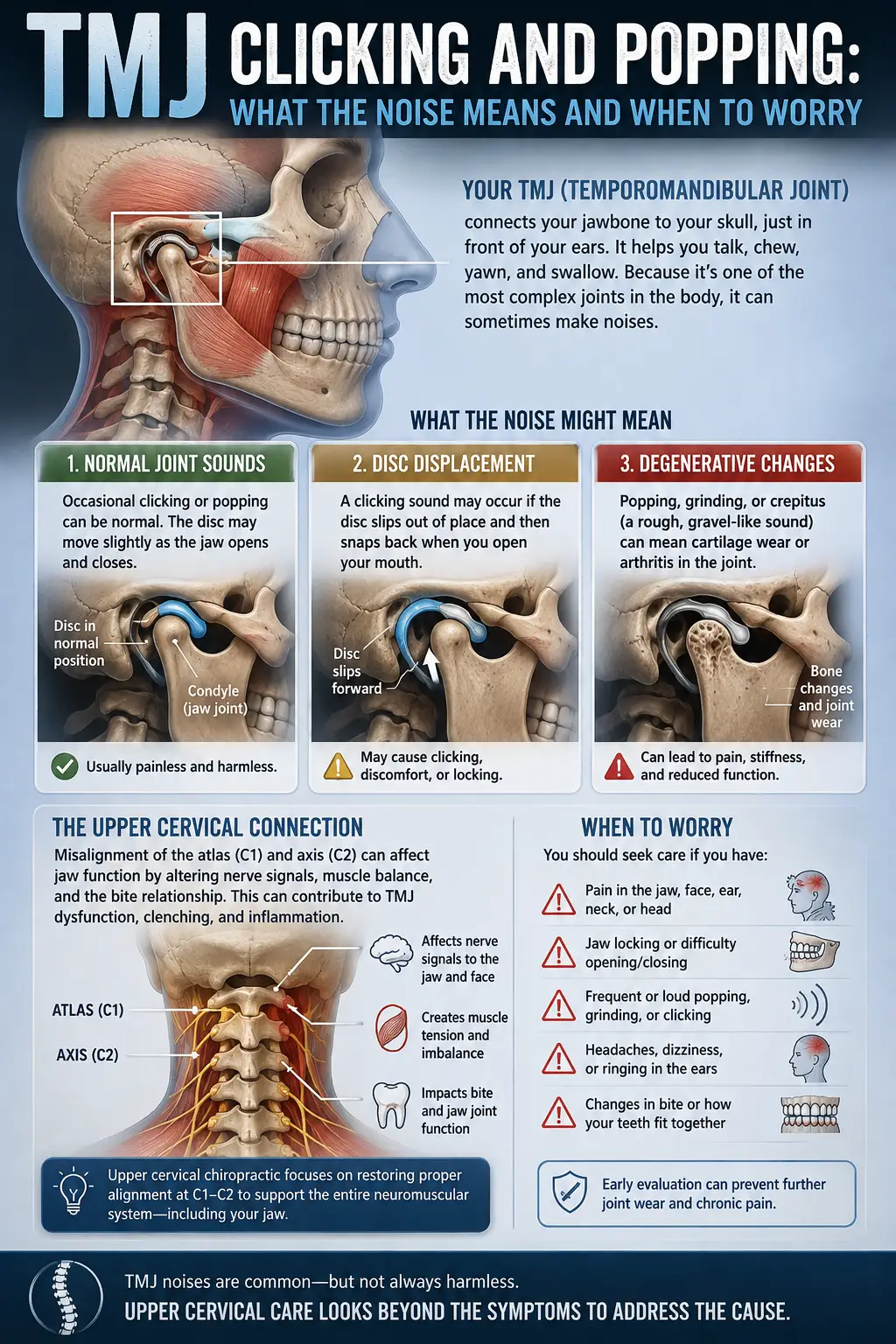
Each joint is where the rounded top of the lower jawbone (the condyle) meets a socket in the temporal bone of the skull. What makes it more complicated than a simple hinge like your elbow is a small piece of cartilage called the articular disc, which sits between the two bones like a cushion. It is tough, fibrous tissue held in place by ligaments and a stretchy attachment at the back that helps guide it.
The jaw does not just open and close like a door. When you open wide, the condyle rotates and then slides forward along a slope in the skull, and the disc is supposed to travel with it, staying neatly positioned throughout. This coordinated dance of bone and disc is what allows smooth, quiet, comfortable movement. When the timing gets thrown off, you get noise — and the position of your head over your neck is one of the quiet factors that can throw that timing off.
What Actually Makes the Click? Disc Displacement With Reduction
The most common reason for a clicking or popping jaw is a condition with an intimidating name: disc displacement with reduction. Break the phrase down and it stops being mysterious.
“Disc displacement” means the little cartilage disc is not sitting where it should when the jaw is closed. Instead of resting neatly on top of the condyle, it has slipped slightly forward. “With reduction” is the reassuring part — “reduction” means the disc goes back into its proper position. As you open and the condyle slides forward, it catches back up with the displaced disc and slips underneath it, snapping the disc back into place. That recapture is the click you hear and feel. The noise is the sound of the joint temporarily correcting itself mid-movement.
On the way back, as you close, the condyle slides backward and the disc can slip forward off it again, producing a second, usually quieter click near the end of closing. A click opening and another click closing is called a “reciprocal click” — a classic signature of disc displacement with reduction, described in detail in the international consensus standards known as the Diagnostic Criteria for Temporomandibular Disorders (DC/TMD).
The key point: in disc displacement with reduction, the disc is being successfully recaptured. The joint completes its full range of motion — you can open, close, and chew. It just makes noise doing it. A thorough review of the mechanisms describes exactly this pattern: a disc displaced at rest that returns to a more normal position during opening, producing the characteristic sounds (J Appl Oral Sci, 2019).
Why Would the Disc Slip in the First Place? Look Above the Jaw
People want to know what they did. Often the honest answer is: nothing dramatic. But the disc does not slip in a vacuum, and several of the contributing factors point upward, toward the head and neck.
Commonly cited contributors include the natural laxity of the ligaments that hold the disc, small changes in the joint surfaces over time, clenching or grinding (often during sleep), jaw overuse, and prior trauma to the jaw or face. But notice what governs how evenly the joint loads in the first place: the resting position of the lower jaw, which is set in part by where your head sits over your neck. When the atlas and axis are misaligned and the head drifts into forward-head posture, the balance of the muscles that open and close the jaw shifts, and the condyle-disc relationship is asked to work against a slightly altered backdrop day after day. Over time, that altered loading is a plausible contributor to the disc timing going off.
This is why the neck belongs in the conversation about a clicking jaw, and why trauma matters so much. A whiplash, a concussion, or a hard fall does two things at once: it can strain the jaw directly, and it can destabilize the upper cervical spine that positions the jaw. If your clicking started or worsened after an accident or a period of heavy desk and phone posture, that timeline is a clue that the driver may sit above the joint, at the craniocervical junction that no one examined.
The Most Important Question: Should You Worry?
Let’s address this directly and honestly. For a painless click — a joint that pops but does not hurt, lock, or limit what you can eat or do — the reassuring reality is that this is usually a benign, stable situation. A well-known systematic review captured this in its very title, describing disc displacement as a “noisy annoyance” (J Oral Rehabil, 2013). For a great many people, the click is annoying, occasionally embarrassing at a quiet dinner table, but not harmful.
Two fears tend to run away with people. The first is that the noise means the joint is steadily deteriorating. The second is that any joint noise must be aggressively treated. Neither is well supported for the typical painless click. Most of these joints stay remarkably steady over time, and only a minority progress to more significant problems.
That does not mean you should ignore your jaw. It means the right response to a painless click is attentive reassurance and sensible self-care — and, for people whose click travels with neck tension, headaches, or a history of head or neck trauma, a look at the upper cervical spine that may be feeding the whole pattern. Understanding the difference between a “noisy annoyance” and a genuine warning sign is what lets you respond calmly and correctly.
Red Flags: When Clicking and Popping Deserve Attention
While painless clicking is usually benign, specific symptoms do warrant an evaluation. Please read this carefully, because these signals separate a harmless noise from a problem that benefits from professional care.
Locking of the jaw. This is the single most important warning sign. Sometimes disc displacement with reduction progresses to disc displacement without reduction — a “closed lock.” The displaced disc no longer gets recaptured when you open; it stays stuck in front of the condyle and blocks the joint from sliding open fully. The telltale clue is that the clicking may suddenly stop (the disc is no longer snapping back) and is replaced by a jaw that will not open all the way, sometimes deviating toward the affected side.
A jaw that gets stuck or catches. Before a full lock, some people notice the jaw intermittently catching or hanging up during movement, sometimes needing a wiggle to release. This deserves attention.
Inability to open or close normally. If you cannot open as wide as you used to, cannot close your teeth together properly, or the jaw feels caught, get evaluated promptly.
Pain, especially pain with swelling. New or worsening joint pain, pain with chewing, or pain with swelling is different from a painless click and should be assessed.
Persistent changes in your bite. If your teeth suddenly do not fit together the way they used to, that change is worth investigating.
Locking that will not release. A jaw that locks open or closed and does not resolve on its own should be addressed without delay.
None of these should cause panic, but they are the difference between “keep an eye on it” and “let’s get this looked at.” If you are experiencing locking, an inability to open or close, or pain with swelling, please see a qualified provider — typically your dentist, an oral and maxillofacial specialist, or your physician.
From Clicking to Locking: How Often Does It Actually Progress?
Because the fear of locking is so common, it is worth looking honestly at how often a clicking joint actually locks. This is where good longitudinal research earns its keep, because it follows real people over months and years.
The message from this body of work is consistent and reassuring: most joints with disc displacement with reduction do not progress to locking. A clicking joint tends to stay a clicking joint. Followed over time, the majority remain stable, some actually improve or stop clicking, and only a minority develop the closed-lock pattern of disc displacement without reduction. This is precisely why the aggressive “we must intervene now or you will lock up” framing is not supported for the typical painless click. The natural history is generally favorable — a genuinely comforting fact grounded in the research below.
What the Research Says
I want to ground the reassurance in actual studies rather than opinion, so here is a closer look at the published literature.
Joint noise is common, and it is often a “noisy annoyance.” A systematic review in the Journal of Oral Rehabilitation examined disc displacement in the temporomandibular joint and framed it, right in its title, as a “noisy annoyance.” It synthesized the evidence on how common these displacements are and how they behave, reinforcing that joint sounds are a frequent finding and often more of a nuisance than a serious pathology (J Oral Rehabil, 2013).
Over two years, most disc displacement with reduction stays stable. A study of the two-year natural course of anterior disc displacement with reduction followed the condition over time. The value of such a study is that it watches the joint across a meaningful span rather than taking a single snapshot, and the theme is that the condition tends to follow a relatively benign path for most people rather than marching toward disability (J Orofac Pain, 2010).
The longer-term natural course is also generally favorable. Another study, in the Journal of Oral and Maxillofacial Surgery, looked at the natural course of disc displacement with reduction and again supported the idea that most of these joints do not spiral into serious dysfunction (J Oral Maxillofac Surg, 2003). When two separate natural-course studies point the same reassuring direction, confidence in the message grows.
We understand the mechanism well, and the clinical picture is recognizable. A review in the Journal of Applied Oral Science laid out the mechanisms and clinical presentation — how the disc slips and is recaptured during opening, producing the characteristic click and the reciprocal pattern (J Appl Oral Sci, 2019). Understanding the mechanism takes the mystery out of the noise.
There is a rigorous, agreed-upon way to diagnose these conditions. The Diagnostic Criteria for Temporomandibular Disorders (DC/TMD) provide an internationally recognized, evidence-based framework clinicians use to classify these disorders, including disc displacement with reduction and the various locking presentations (J Oral Facial Pain Headache, 2014). A good examination is not guesswork; it follows a well-developed roadmap.
Taken together, these sources tell a coherent story: disc displacement with reduction is common, presents as a recognizable clicking pattern, tends toward a favorable natural course, and has clear diagnostic standards for identifying when a joint has moved into the category that needs care. Reassurance for the painless click, paired with respect for the specific red flags — and, I would add, curiosity about the upper neck that helps set the stage for how the joint loads.
Sensible Self-Care for a Clicking Jaw
If your jaw clicks but does not hurt or lock, you do not necessarily need to do anything about the noise. But if you want to be kind to your jaw, these gentle, low-risk habits reduce load on the joint.
Give your jaw softer work when it feels tired — softer foods and smaller pieces during sore stretches, and avoid habitually chewing gum, biting nails, or chewing on pens. Be mindful of clenching and grinding; a relaxed jaw has the lips together but the teeth slightly apart, and if you suspect nighttime grinding, raise it with your dentist. Avoid extreme opening when you can, supporting your chin gently during a yawn. Manage overall stress and tension, since jaw clenching rides along with it. And use gentle warmth and slow, comfortable range-of-motion movement for a tight jaw, never forcing through pain.
These measures do not reposition a displaced disc, and I would not want you to believe they do. What they do is reduce unnecessary strain while the generally favorable natural course plays out — and reducing the load your head places on your jaw, by improving how your head sits over your neck, belongs on that same list.
Where the Neck Fits In: The Region Above the Joint
Now to my own field, and I want to be both honest and direct, because this is exactly the area where the standard workup goes silent.
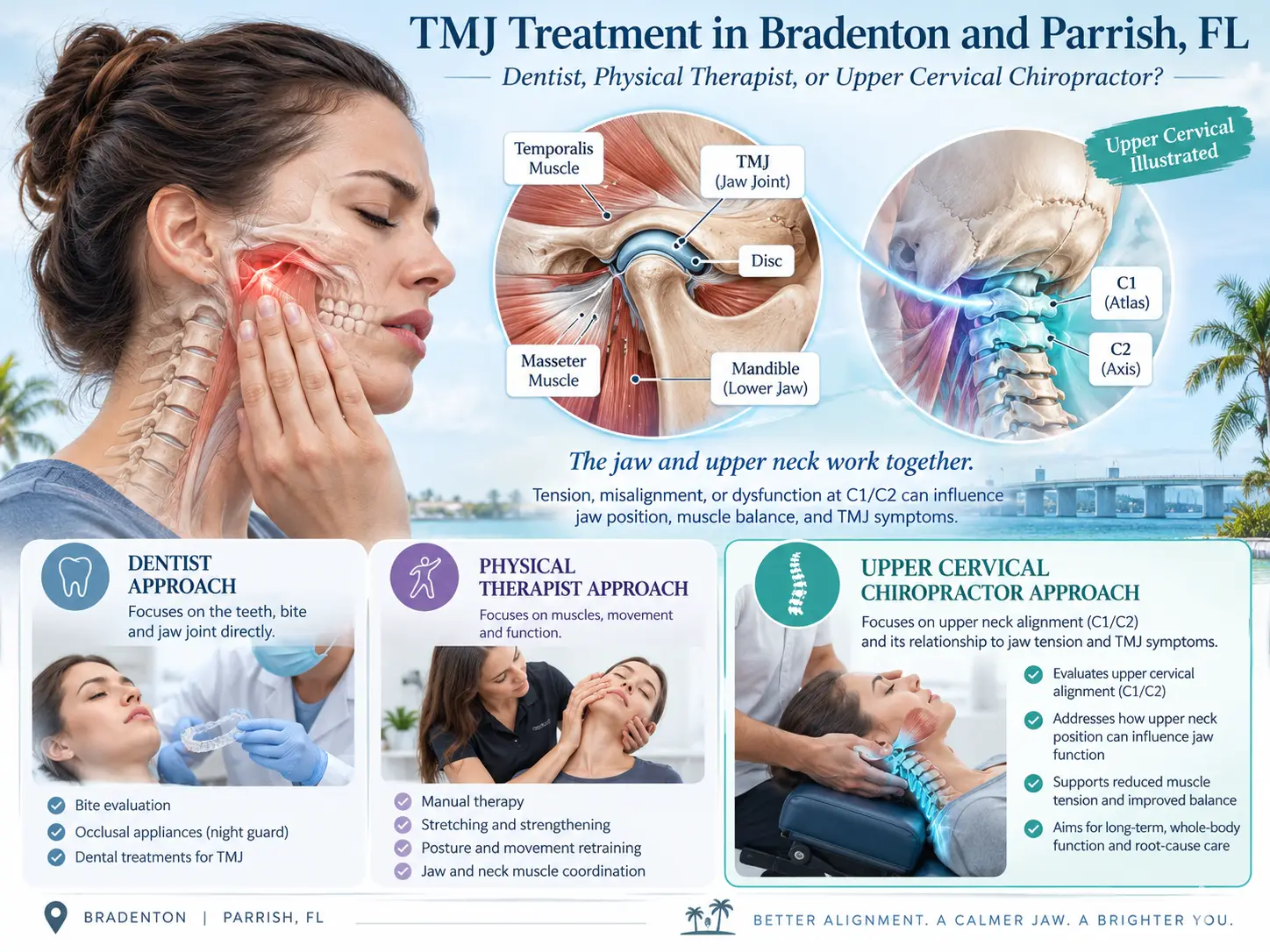
The head, neck, and jaw are neighbors, anatomically and functionally. The upper cervical spine — the atlas and axis just beneath the skull — is rich with muscles, nerves, and connective tissue that govern how you hold your head, and the position of your head directly influences the resting posture and workload of the muscles that run the jaw. The upper cervical nerves (C1–C3) also converge with the trigeminal nerve — the great sensory nerve of the face and jaw — in a shared brainstem hub, which is why upper-neck irritation can be felt around the ear, temple, and jaw, and why neck tension and jaw symptoms so often travel together.
Because of these relationships, it is more than fair to say the neck is part of the picture in a clicking jaw. When the atlas and axis are misaligned and the head drifts forward, the jaw’s resting position and loading pattern shift — a plausible upstream contributor to the disc timing that produces the click, and a plausible reason a jaw stays cranky despite a night guard.
To be precise about scope: a gentle upper cervical correction does not reach into the joint and reposition the articular disc. What it changes is the head position and muscle tone that load the joint. The internal mechanics of the disc and how it tracks over the condyle are not something a neck correction repairs. What upper cervical care can reasonably do is address the region that helps position the head and jaw — reducing an upstream contributor to how the joint loads, and calming the neck-and-muscle tension that so often accompanies jaw complaints. For a person with a painless click and no other complaints, the right advice may simply be reassurance. For the person whose click travels with headaches, neck pain, forward-head posture, or a history of trauma, the upper neck is a driver worth evaluating.
What Upper Cervical Care Actually Involves at Our Office
Because “chiropractic” conjures images of forceful twisting for many people, let me describe what we actually do — and what we do not. Our approach is precise, gentle, and low-force. There is no twisting, cracking, or popping of the neck. That distinction matters a great deal to people who are apprehensive, who have a sensitive jaw, or who dislike the idea of a forceful manipulation.
To understand your individual anatomy, we use 3D CBCT imaging (cone-beam computed tomography), which lets us see the specific structure of your upper cervical region rather than guessing. We also use paraspinal infrared thermography, a non-invasive way to assess nervous-system patterns along the spine over time. The correction itself uses the low-force Knee Chest Upper Cervical technique — a specific, gentle method delivered with you positioned comfortably, designed to work with your anatomy rather than force it.
I share these details not to suggest any of this fixes a clicking jaw — it does not reposition the disc — but so you understand what a careful, conservative, low-force approach looks like, and how it fits as one coordinated part of a broader plan that keeps your dentist firmly in the loop for the jaw itself.
Working With Your Dentist and Care Team
For anything involving the temporomandibular joint, your dentist is a central player and often the right first stop — especially with pain, locking, bite changes, or suspected grinding. Dentists and oral and maxillofacial specialists evaluate the joint, take imaging, assess your bite, and offer treatments such as custom appliances and targeted exercises. The healthiest model is coordinated: if gentle upper cervical care has a role for you — because of accompanying neck tension, posture, headaches, or a trauma history — it should sit alongside your dental care, with everyone working from the same page. We are always happy to communicate and coordinate rather than operate in a silo.
Top Questions
Is it bad that my jaw clicks? Usually not. A painless click without locking or limitation is a common finding that tends to be stable over time, often described in the literature as a “noisy annoyance” (J Oral Rehabil, 2013). It is worth understanding, but for most people it is not cause for alarm.
What is actually making the popping sound? In disc displacement with reduction, a small cartilage disc that sits slightly out of position gets recaptured onto the jawbone as you open, and that recapture produces the click. A second click on closing gives the classic reciprocal pattern (J Appl Oral Sci, 2019).
Will my clicking jaw eventually lock up? Most likely not. Natural-course research indicates the majority of these joints remain stable rather than progressing to locking; only a minority develop the closed-lock pattern (J Orofac Pain, 2010; J Oral Maxillofac Surg, 2003).
Why would my neck have anything to do with my jaw clicking? Because the position of your head over your upper neck helps set the resting position and loading of your jaw, and the upper cervical nerves converge with the jaw’s trigeminal nerve in the brainstem. When the atlas and axis are misaligned and the head drifts forward, the jaw loads differently — a plausible upstream contributor to the click and to why a jaw stays cranky. The upper neck is a driver worth evaluating, especially if your click travels with neck tension, headaches, or a trauma history.
Does upper cervical care fix a clicking jaw? No. It does not reposition the disc or repair the joint’s internal mechanics, and I would be wary of anyone who claims otherwise. What it can reasonably do is address the upper neck that helps position the head and jaw, and calm the neck-and-muscle tension that accompanies many jaw complaints — coordinated with your dentist, as one supportive piece rather than a cure.
When should I actually see someone about it? When the noise comes with warning signs: locking, a jaw that catches, an inability to open or close normally, pain (especially with swelling), or a bite that suddenly feels different. Those move a joint from “noisy annoyance” into “please get evaluated.”
Is there a standard way doctors diagnose this? Yes. Clinicians use the internationally recognized Diagnostic Criteria for Temporomandibular Disorders (DC/TMD), which provides standardized criteria for identifying disc displacement with reduction and the various locking presentations (J Oral Facial Pain Headache, 2014).
Could stress or grinding be behind it? They can certainly load the joint and muscles. Clenching and grinding, often unconscious and during sleep, add strain. Managing stress, talking with your dentist about a possible night guard, and addressing the upper neck and posture are all reasonable steps.
The Bottom Line
If your jaw clicks or pops but does not hurt and does not lock, the most likely explanation is disc displacement with reduction — a common, generally stable condition in which a small disc slips and snaps back during movement. The research on its natural course is reassuring: most joints stay steady, many people do fine with understanding and gentle self-care, and only a minority progress to locking. In the honest words of the literature, it is often a “noisy annoyance.”
Respect the red flags — locking, catching, an inability to open or close, a changed bite, and pain with swelling deserve professional evaluation, usually starting with your dentist. And when it comes to the neck-and-jaw connection, here is the straight version: the upper cervical spine helps position the head and jaw, it shares nerve pathways with the jaw in the brainstem, and it is the region no one examined. Gentle, low-force upper cervical care does not reposition the disc, but it is a reasonable way to address an overlooked upstream driver — coordinated with your dental care. Honest expectations lead to better decisions, and better decisions lead to healthier patients.
Serving Sarasota, Lakewood Ranch & Bradenton
If you are in Sarasota, Lakewood Ranch, or Bradenton and you have questions about how your neck, posture, and overall nervous-system health fit into your clicking jaw — or you simply want a careful, honest, low-force perspective as part of a coordinated plan — we would be glad to talk. Our office sits on Whitfield Avenue, convenient to downtown Sarasota, the Lakewood Ranch corridor, and Bradenton across the Manatee County line. We offer a consultation with our doctors, where we can listen, explain what we do and do not do, and help you understand your options without pressure.
Our upper cervical approach is precise, gentle, and low-force, with no twisting, cracking, or popping, and we are always happy to coordinate with your dentist or physician regarding your jaw.
Lavender Family Chiropractic (NeckWise North Sarasota) 5899 Whitfield Avenue, Suite 107 Sarasota, FL 34243(941) 243-3729
We are proud to serve Sarasota, Lakewood Ranch, Bradenton, and the greater Sarasota–Manatee area. If that painless click has been on your mind, or you have noticed any of the warning signs above, reach out and let’s talk it through.
This article is for general educational purposes and is not a substitute for individualized medical or dental advice, diagnosis, or treatment. If you are experiencing jaw locking, an inability to open or close your mouth, or pain with swelling, please seek evaluation from a qualified healthcare provider.
Related Articles


Get our upper cervical articles first.