Night Guards vs. the Root Cause of Teeth Grinding: What No One Checked
By Dr. Rusty Lavender, D.C. — upper cervical chiropractor, Lavender Family Chiropractic, Sarasota, FL. Reviewed and updated October 2026.
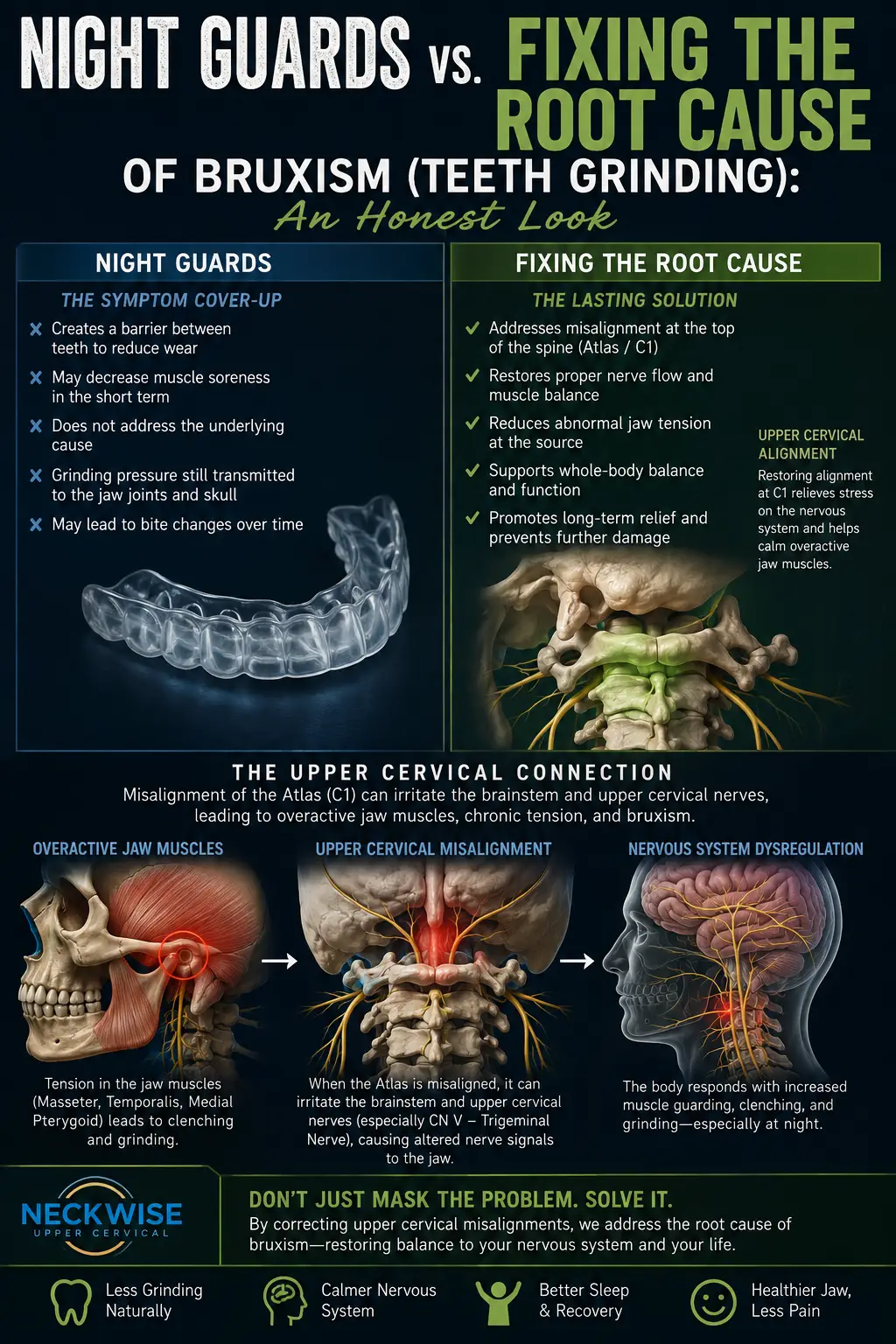
If you grind your teeth, you were probably handed a night guard and sent on your way. It is the reflex recommendation in nearly every dental office — and it is not wrong, exactly. A well-made guard protects your enamel from the forces of grinding. But here is the uncomfortable truth almost nobody says out loud: a night guard is a shield, not a solution. It does not stop the grinding. It does not calm the nervous system that drives the grinding. And it never once looks at the region that may be keeping your jaw wound up in the first place — the top of your neck, where the atlas (C1) and axis (C2) balance your skull and where the nerves that run your jaw converge in the brainstem. You can wear a guard for a decade and still grind every night, because no one checked the one place that may be driving it.
This article is a cause-forward walk through what night guards actually do, what the research really shows, and why teeth grinding is best understood not as a tooth problem but as a nervous-system behavior — one that the upper cervical spine can strongly influence. For patients across Sarasota, Lakewood Ranch, and Bradenton who have “done everything right” and still wake up with a sore, tired jaw, the missing piece is usually upstream of the teeth entirely.
First, Let’s Define the Problem Clearly
Words matter here, so let me start with definitions that come from the dental research community itself.
Bruxism is repetitive jaw-muscle activity: clenching or grinding the teeth, and/or bracing or thrusting the lower jaw. There are two kinds, and they are not the same condition:
- Sleep bruxism happens while you are asleep, often in bursts tied to brief arousals from deeper to lighter sleep. You are not consciously doing it, and you usually have no idea it is happening unless a partner hears it or a dentist spots the wear.
- Awake bruxism happens during the day and tends to look like clenching or jaw bracing — often during concentration, stress, screen time, or driving — rather than the grinding sound associated with sleep.
An important shift has taken place in how experts frame this. An international group of sleep and orofacial-pain researchers proposed a graded consensus definition of bruxism in 2013, separating sleep and awake bruxism and introducing a way to grade how confident a diagnosis is — from “possible” (self-report) to “probable” (clinical exam) to “definite” (confirmed by instrumental recording such as sleep-lab electromyography). That framework was refined in a 2018 consensus report on assessing bruxism, which emphasized that most everyday diagnoses are “possible” or “probable,” because the gold-standard instrumental tools are not part of routine care.
Then came a genuinely important reframing. A 2025 international consensus meeting updated the definitions again, reinforcing that in otherwise healthy people, bruxism is not a disorder or a disease. It is better understood as a behavior — one that can be a risk factor for certain problems (like tooth wear or jaw-muscle soreness) but can also be neutral, or in some contexts even protective (jaw activity is thought to play a role in maintaining airway patency during sleep). This is a meaningful change in thinking. If bruxism is a behavior rather than a disease, then “treating” it is not as simple as covering the teeth. You have to ask what is driving the behavior — and that question leads straight to the nervous system, and to the neck that houses so much of it.
That single reframe is the heart of this entire article.
What a Night Guard Actually Does — and What It Cannot Touch
Let me be fair to night guards, because they have a real and legitimate role. A night guard (occlusal splint) is a custom or over-the-counter appliance, usually hard acrylic or a softer material, that fits over your upper or lower teeth. Its most reliable job is mechanical protection. If your jaw is going to generate grinding forces at night, a guard gives those forces something other than your enamel to work against. For people with visible tooth wear, cracked restorations, crowns, or veneers to protect, that protection can be worth a great deal.
Some people also report that a guard makes their jaw feel less sore in the morning, reduces waking headaches, or quiets the grinding noise that keeps a partner awake. Those are real benefits when they happen.
Here is the part that gets glossed over: a night guard does not teach your nervous system to stop grinding. The muscle activity is still occurring. In fact, the guard is evidence that grinding is happening — it wears down, develops facets, or cracks precisely because your jaw kept working against it. A guard changes what the grinding lands on. It does not change whether you grind, and it does nothing about why your jaw is so busy in the dark.
Many people also assume a guard “realigns the bite” or “cures TMJ.” A splint can change how your teeth contact temporarily while you wear it, and that altered sensory input may reduce muscle activity for some people in the short term. But the appliance is not retraining your jaw joint, not permanently correcting alignment, and — most importantly — not addressing the upstream reasons the muscles are so active. Chief among those reasons is where your head sits over your neck.
What the Research Says
This is where honesty is most important, so I want to walk carefully through what the published evidence supports — and what it does not.
On splints for bruxism specifically
A 2021 systematic review in the Journal of Dentistry examined the efficacy of occlusal splints in treating bruxism. The takeaway is sobering for anyone hoping a guard will stop grinding: the evidence that occlusal splints actually reduce bruxism activity is limited and of low certainty. Splints are useful for protecting teeth from the mechanical consequences of grinding, but the research does not establish that they reliably decrease the underlying muscle behavior. The studies support “protection” far more than they support “treatment of the grinding itself.”
On splints for TMD and bruxism together
A 2020 systematic review in the British Dental Journal looked at oral splints for temporomandibular disorder or bruxism. It reached a similarly cautious conclusion: the certainty of evidence that splints relieve TMD symptoms or improve bruxism outcomes is very low. Some patients improve, but studies are inconsistent, often small, and difficult to compare. The review did not conclude that splints are useless — it concluded that we should be humble about how strong the evidence is, and that splints should not be presented as a definitive answer.
What that means in plain language
Put the two reviews together and a consistent picture emerges:
- Night guards have a clear role in protecting teeth from grinding forces.
- The evidence that guards stop bruxism or reliably relieve TMD is weak — low to very low certainty.
- Individual people may feel real symptom relief, and that is worth something, but the guard is not fixing a cause.
Combine that with the 2013, 2018, and 2025 consensus work reframing bruxism as a nervous-system-driven behavior, and you arrive at a clear conclusion: a guard is a smart protective tool, but if you want to influence the grinding itself, you have to look upstream — at the nervous system, at the muscles, and at the upper cervical spine that sits at the junction of both.
The Root Cause: A Nervous System That Won’t Stand Down
If bruxism is a behavior, then the useful question is not “how do I protect my teeth?” but “why is my jaw so active, and what is my body responding to?” No single answer fits everyone, but the contributors cluster around one theme: a nervous system stuck in a guarded, revved-up state — and the top of the neck plays a central role in how regulated or dysregulated that system runs.
Stress and emotional load
This is the most widely recognized driver, especially for awake bruxism. Clenching during concentration, tension, or anxiety is common, and many people brace their jaw all day without realizing it. Stress does not act on the teeth — it acts on the nervous system, which then acts on the muscles.
Sleep quality and arousals
Sleep bruxism tends to cluster around micro-arousals, the brief shifts toward lighter sleep everyone has through the night. When those arousals are frequent, jaw-muscle bursts ride along with them. This is one reason sleep bruxism is a nervous-system phenomenon rather than a tooth problem: it is tied to how your brain regulates sleep and arousal.
Airway and breathing
There is active research into the relationship between sleep-disordered breathing (snoring, obstructive sleep apnea) and sleep bruxism, with some theories suggesting jaw activity may be linked to the body’s efforts to keep an airway open. If breathing during sleep is part of your picture, that is a conversation for your physician or a sleep specialist — and it is another example of why simply covering the teeth can miss something important.
The upper neck and the nervous system it houses
Here is the driver the standard workup never examines. The jaw muscles do not operate in isolation. The trigeminal system that controls jaw movement is deeply integrated with the brainstem and the upper cervical spine, where the nerves of C1, C2, and C3 converge with the trigeminal nerve in a shared processing hub. When the atlas and axis are misaligned, the tissues at the base of the skull come under abnormal tension, head posture shifts, and that irritated upper cervical input feeds a nervous system already primed for guarding. Forward-head posture — the near-universal consequence of phones and desks — loads this exact region, tips the jaw’s resting position, and keeps the muscles of the jaw and neck braced. In other words, an unhappy upper neck can be one of the reasons your jaw never truly powers down at night. That is not a fringe claim; it is a straightforward consequence of how the neck and jaw are wired together.
Other contributors
Certain medications and stimulants (caffeine, nicotine, some prescription drugs), alcohol, and recreational substances are associated with bruxism activity, as are some medical and neurological conditions, and genetics appear to play a role. These factors rarely act alone: stress fragments sleep, fragmented sleep heightens arousal, heightened arousal raises muscle tone, elevated muscle tone feeds neck and jaw tension, and neck tension loops back into how tightly the whole system holds itself. Because these factors reinforce one another, addressing the upper cervical spine — a lever that touches posture, muscle tone, and nervous-system regulation at once — is often a smarter move than expecting a piece of plastic over your teeth to carry the entire load.
Where Upper Cervical Chiropractic Fits
Let me be direct about my own field, because you deserve a clear explanation rather than a sales pitch. I practice upper cervical chiropractic, which focuses on the relationship between the top bones of the neck and the nervous system that passes through that region. My interest in patients who grind is straightforward: the upper neck is the one root-cause region their dental care never addresses, and it is a plausible primary contributor to a wound-up jaw.
Here is the reasoning that makes upper cervical care a legitimate root-cause consideration, coordinated with your dentist rather than instead of them:
- The upper neck and the jaw are neurologically and mechanically intertwined. The nerves that supply the jaw muscles and the upper cervical region converge in the brainstem, and tension patterns in one area show up in the other.
- Bruxism is a nervous-system-driven behavior. Care aimed at reducing upper cervical irritation and improving how the head sits on the neck is working on the same upstream territory a night guard can never reach.
- Forward-head posture and upper cervical misalignment are plausible drivers of persistent jaw-muscle activity, which is why addressing them belongs in a whole-person plan.
So the honest framing is this: a night guard protects the teeth; upper cervical care goes after the nervous-system-and-neck relationship that may be feeding the behavior. They are not competitors. The most sensible approach for many people is a guard for protection, dental and medical evaluation for causes within their scope, stress and sleep strategies, and a careful evaluation of the upper neck and posture — the piece no one else has looked at.
How we actually evaluate the upper cervical region
If you came in for a consultation, I would want you to know exactly what to expect, because “chiropractic” means very different things in different offices, and the mental image of forceful neck manipulation is not what we do. Our approach is built around measurement:
- 3D CBCT imaging (cone-beam computed tomography) lets us see the specific anatomy of your upper cervical spine in three dimensions, so any care is based on your individual structure rather than a generic template.
- Paraspinal infrared thermography is a non-invasive way to assess patterns of nervous-system regulation along the spine over time, giving us objective information to track rather than relying on how you happen to feel on a given day.
- The Knee Chest Upper Cervical technique is a precise, gentle, low-force method. There is no twisting, cracking, or popping. It is a specific, light contact designed to work with your upper cervical anatomy — often reassuring for people who are tense, in pain, or nervous about their neck being handled roughly.
This is a careful, measurement-driven way of assessing and addressing the neck-and-nervous-system side of a whole-person picture — one piece that fits alongside your dentist’s work, aimed at the region that may be driving the grinding rather than the region that merely absorbs it.
Building a Sensible, Whole-Person Plan
If you grind your teeth, here is a layered plan that reflects both the evidence and a root-cause mindset. Think of these as complementary steps.
1. Protect the teeth. If you have wear, sensitivity, cracked teeth, or dental work to safeguard, a night guard from your dentist is a reasonable protective step. Just hold realistic expectations: it is a shield.
2. Look at stress and daytime clenching. Awake bruxism responds to awareness. Notice when your teeth are touching (they should be apart at rest), set gentle reminders, use breathing practices, and address daily stress — these cost nothing and target the behavior directly.
3. Take sleep and breathing seriously. If you snore, wake unrefreshed, are told you stop breathing at night, or have other signs of disrupted sleep, ask your physician about a sleep evaluation.
4. Address the nervous system and the upper neck. Whole-body stress regulation, physical activity, and a careful look at the upper cervical spine and posture all touch the same territory that drives jaw activity — the territory a guard cannot reach.
5. Consider the neck and posture directly. For persistent cases, evaluating forward-head posture and the atlas–axis region is a reasonable, high-value step, coordinated with your dental care.
6. Keep everyone talking. The most reliable outcomes come from coordination: your dentist, your physician, a sleep specialist if needed, and an upper cervical chiropractor working from the same page.
Red Flags: When to Seek Prompt Care
Grinding itself is common and usually not an emergency, but certain symptoms deserve timely professional evaluation rather than a wait-and-see approach. Please seek prompt medical or dental care if you experience any of the following:
- A jaw that locks open or closed, or that you cannot open or close normally.
- Significant, worsening, or persistent jaw pain, or pain with chewing that does not settle.
- Sudden changes in how your teeth fit together (your bite), or new facial asymmetry.
- Severe or “worst-ever” headache, especially of sudden onset, or headache with neurological symptoms.
- Numbness, tingling, weakness, or changes in vision, speech, swallowing, or balance.
- Signs of infection such as facial swelling, fever, or redness.
- Loud snoring with witnessed pauses in breathing, gasping, or choking during sleep, or severe daytime sleepiness — which warrant a medical sleep evaluation.
- Cracked or fractured teeth, or dental pain.
These are not chiropractic problems to solve first; they are reasons to be seen promptly by the right provider. An upper cervical evaluation is appropriate for the neck-and-nervous-system side of a whole-person plan, not for ruling out serious medical or dental conditions.
Top Questions
Does a night guard stop me from grinding? Generally, no. A night guard protects your teeth from the forces of grinding, but the available evidence does not establish that guards stop the underlying muscle activity. The grinding continues; the guard simply changes what it lands on. To influence the behavior, you have to look upstream at the nervous system and the upper neck.
Will a guard fix my TMJ or jaw pain? It might reduce symptoms for some people, but the certainty of the evidence is low. A 2020 systematic review found very-low-certainty evidence for splints in temporomandibular disorders. Some patients feel better, some do not — and the guard is not addressing the cause.
Is grinding a disease I need to eliminate? Current thinking, reflected in the 2025 international consensus, frames bruxism in otherwise healthy people as a behavior and a risk factor rather than a disease. The goal is to manage its consequences and address what drives it — stress, sleep, and the nervous-system-and-neck relationship — not simply to cover the teeth.
If the guard doesn’t stop grinding, is it a waste of money? Not at all. Protecting your teeth and dental work from wear and fracture has real value. Just pair it with efforts aimed at the causes.
Can upper cervical chiropractic help my grinding? It is one root-cause-oriented consideration focused on the neck-and-nervous-system side of the picture — the region no one else on your team is examining. It works alongside your dentist and physician. For many people whose jaw stays wound up despite a guard, the upper neck is a driver worth evaluating.
What is different about upper cervical chiropractic compared to regular chiropractic? Our approach centers on the top of the neck and uses measurement — 3D CBCT imaging and paraspinal infrared thermography — to guide precise, gentle, low-force care. The Knee Chest Upper Cervical technique involves no twisting, cracking, or popping, which many tense or nervous patients find reassuring.
Should I still see my dentist? Absolutely. Your dentist is essential for evaluating tooth wear, protecting your teeth, and diagnosing dental causes of pain. A root-cause approach works alongside dental care, never instead of it.
Could my grinding be related to my sleep or breathing? Possibly. The relationship between sleep-disordered breathing and sleep bruxism is an area of active research. If you have signs of disrupted sleep or breathing, a medical sleep evaluation is worthwhile.
Is upper cervical care safe if my neck is already sore? The Knee Chest Upper Cervical technique is designed to be gentle and low-force, without the forceful movements people often picture. Any care follows a thorough evaluation and appropriate screening for red flags — which is exactly what a consultation is for.
The Bottom Line
Night guards are a reasonable, valuable tool for protecting teeth from the very real forces of grinding. What they are not is a fix for the grinding itself — and the published evidence, honestly read, supports that humility. Bruxism is best understood today as a nervous-system-driven behavior, shaped by stress, sleep, possibly airway, and the mechanical and neurological relationship between the jaw and the upper neck. If you want to move beyond simply shielding your teeth, that upstream picture is where the meaningful questions live — and the upper cervical spine is the piece almost no one checks.
Upper cervical chiropractic offers a careful, measurement-driven, root-cause-oriented avenue focused on the neck and nervous system, coordinated with your dental and medical care. If you have been protecting your teeth for years and still wake up clenched and sore, it may be time to look at the one region that was never examined.
Serving Sarasota, Lakewood Ranch & Bradenton
Lavender Family Chiropractic (NeckWise North Sarasota) proudly serves Sarasota, Lakewood Ranch, Bradenton, and the surrounding Gulf Coast communities. Our office sits on Whitfield Avenue, minutes from downtown Sarasota, the Lakewood Ranch corridor, and Bradenton across the Manatee County line. If you grind your teeth and want a thoughtful conversation about protecting your teeth and going after the root-cause factors behind the behavior — coordinated with your dentist — we would love to help. Patients from across Sarasota, Lakewood Ranch, and Bradenton come to us precisely because their jaw stayed wound up despite doing everything the standard playbook advised.
We invite you to schedule a consultation with our doctors to discuss your situation, review whether an upper cervical evaluation makes sense for you, and answer your questions honestly.
Lavender Family Chiropractic (NeckWise North Sarasota) 5899 Whitfield Avenue, Suite 107 Sarasota, FL 34243(941) 243-3729
This article is for general educational purposes and is not a substitute for individualized medical, dental, or chiropractic evaluation and advice. Upper cervical chiropractic care addresses the upper-neck component of bruxism and temporomandibular disorders. Please consult your dentist, physician, or a qualified provider about your specific situation, and seek prompt care for any of the red-flag symptoms described above.
Related Articles

Get our upper cervical articles first.