Pediatric Chiropractor in Sarasota: Upper Cervical Care for Children, With Parents in the Room
By Dr. Rusty Lavender, D.C. — upper cervical chiropractor, Lavender Family Chiropractic, Sarasota, FL. Reviewed and updated October 2026.
In short: Yes, we see children at Lavender Family Chiropractic in Sarasota — a parent is present for every step, the examination comes before any decision about care, and the correction, when one is appropriate, is low-force with no twisting or popping. The children who come to us most often have recurring headaches, dizziness or balance problems, neck pain after a fall or a sports collision, recurring ear infections or ear pressure, and in some cases complex neurological conditions co-managed with their pediatrician and neurologist. Call (941) 243-3729.
Why parents in Sarasota look for a pediatric chiropractor — and what we are
Most parents who find this page are not looking for a “wellness adjustment.” They are looking for an answer to something specific: a nine-year-old with headaches three times a week, a teenager who has been dizzy since a soccer collision, a toddler on a fourth round of antibiotics for ear infections, a child whose neck has not been right since a fall off the monkey bars. The pediatrician has done the right things and the problem is still there.
We are an upper cervical chiropractic office. We do not adjust the whole spine, and we do not treat children the way adult full-spine chiropractic is sometimes done. Our work is the top of the neck — the atlas (C1) and axis (C2), the two bones that carry the head — evaluated carefully and, when a correction is appropriate, corrected with a precise, low-force technique that involves no rotation of the neck. In a child that region matters for the same reasons it matters in an adult: it surrounds the brainstem, it carries the position sensors that feed the balance system, and it is the part of the spine most affected by falls, car seats, sports collisions, and the plain mechanics of a large head on a small neck.
What a child’s visit looks like
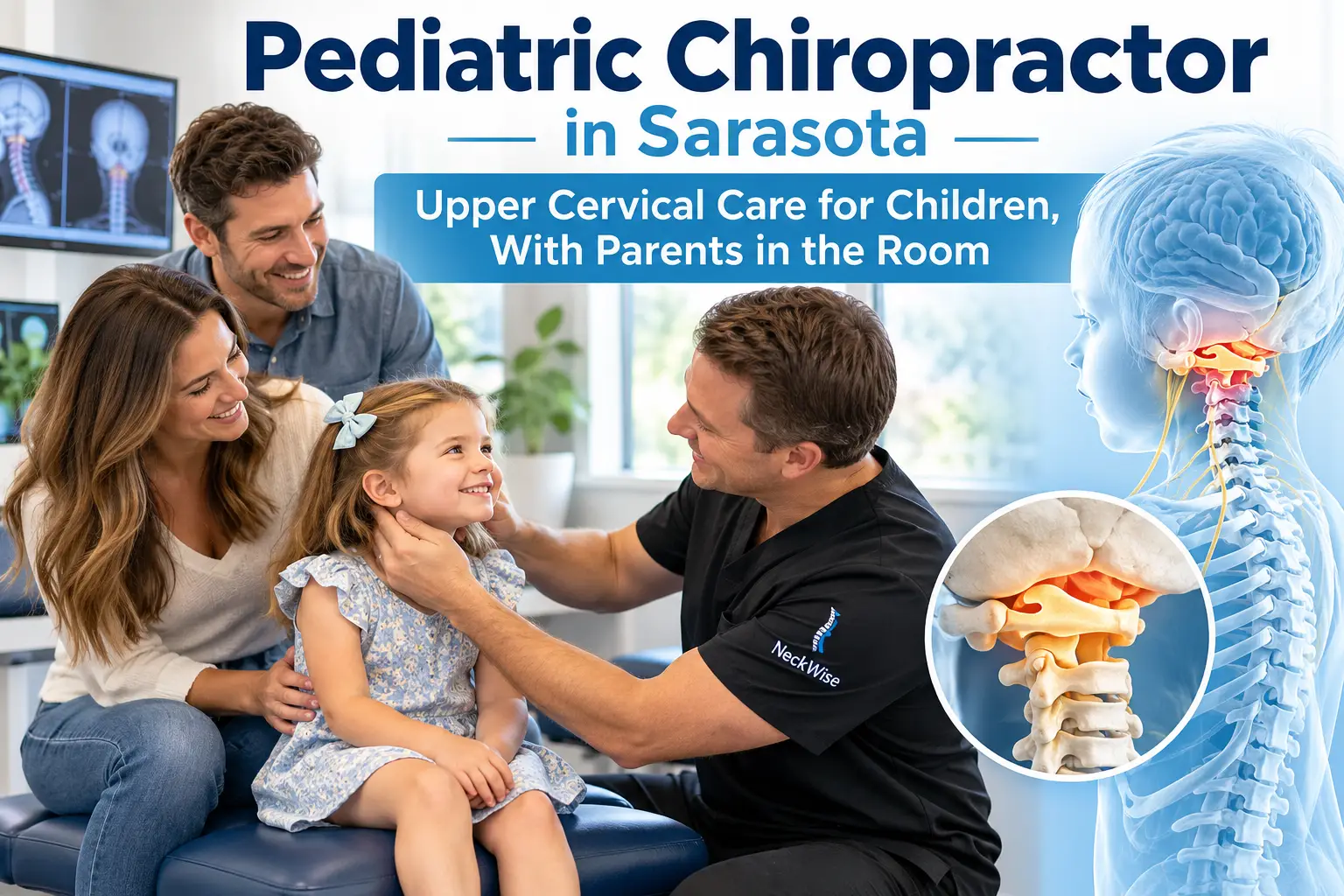
A parent is in the room for everything. Consultation, examination, imaging if any, and the correction itself. We explain each step to the parent and, in language that fits their age, to the child. Nothing happens that a parent has not seen and agreed to.
The examination comes first and decides everything. We take a history that goes back to birth — delivery, early falls, ear infections, sports, screens, sleep — because a child’s current symptom usually has a longer story than the parent expects. The examination of the upper neck uses functional nervous system scans and paraspinal infrared thermography, neither of which involves radiation. Imaging is decided case by case: we use the least imaging a child’s case needs, and we discuss it with the parent before it is done.
The correction, when it is appropriate, is gentle. Upper cervical corrections in children are done with the child lying comfortably, using very light, precisely directed pressure. There is no twisting, no cracking, no sudden movement. Many children find it uneventful; the parents are usually the ones who were nervous.
Some children do not need a correction, and we say so. If the examination does not show upper cervical involvement, we tell the parent plainly and point them toward the provider who fits — a pediatric ENT, a pediatric neurologist, a vestibular therapist, a sports medicine physician.
The problems that bring children to our Sarasota office
Headaches and migraines. Childhood headache is far more common than most parents realize: a systematic review of population-based studies found that more than half of children and adolescents report headache, with migraine in just under one in twelve. When a child’s headaches sit at the back of the head, worsen with neck movement, or followed a fall or collision, the neck deserves a look. A randomised clinical trial in children aged 7 to 14 with recurrent headaches compared chiropractic spinal manipulation with a sham procedure and reported fewer headache days in the treated group. Our headache treatment in Sarasota and migraine treatment in Sarasota guides explain the upper cervical connection in full.
Dizziness and balance after a fall or a hit. Children fall constantly, and a fall onto the head or a collision in youth sports can leave the top of the neck shifted in a way that produces dizziness, clumsiness, fatigue, and trouble concentrating — symptoms that overlap with concussion and are often blamed entirely on it. Our post-concussion care in Sarasota page describes how we evaluate the neck after a head injury, always after a physician has cleared the child.
Recurring ear infections and ear pressure. The Eustachian tube in a young child is short and nearly horizontal, which is why fluid collects behind the eardrum so easily. We have written separately about kids’ ear infections and upper cervical care and about Eustachian tube dysfunction in children and the ear tubes decision; the muscles that open the Eustachian tube are supplied by nerves that pass through the upper neck, which is the connection we evaluate. Ear infections themselves are a medical diagnosis and your pediatrician manages them; we address the neck component alongside that care.
Neck pain, torticollis, and head tilt. A child who holds the head tilted, cannot turn the neck fully, or complains of neck pain after a fall needs the upper neck examined. Our page on torticollis covers what we look for.
Complex neurological conditions. We see children with seizure disorders, tic disorders, and other neurological diagnoses whose parents want the upper neck evaluated as part of a broader plan. We co-manage these cases with the child’s pediatrician and neurologist, we do not replace their care, and we are specific with parents about what the upper neck can and cannot account for.
Is upper cervical care safe for children?
This is the question every parent should ask, and the answer deserves evidence rather than reassurance. A rapid review of the safety of spinal manipulative therapy in children under ten found that serious adverse events are rare and that the mild, short-lived effects reported — soreness, irritability — pass on their own. A review of adverse events due to chiropractic and other manual therapies for infants and children reached a similar conclusion while noting, correctly, that the published literature is limited and that technique and practitioner training matter. A survey of chiropractors and parents in a practice-based research network reported that the large majority of parents observed improvement in their child’s presenting complaint and that adverse effects were uncommon and minor.
Our own answer to the safety question is built into how we work: a parent present throughout, examination before any decision, the least imaging a case needs, and a correction technique with no rotation and no force. For a child, that last point is the one that matters most.
What the research says
Five sources sit behind this page. The headache prevalence review establishes how common childhood headache is. The randomised trial in children with recurrent headache reports a benefit from chiropractic manipulation over sham. The rapid safety review, the adverse-events review, and the practice-based network survey together describe a low rate of minor, self-limiting effects and a very low rate of anything serious. None of them is a study of upper cervical care in children specifically; I say that plainly. What they support is that careful manual care in children is safe in trained hands and that headache in particular is a reasonable target. Results vary by child, and we measure before and after.
For parents in Sarasota, Lakewood Ranch, and Bradenton
Our office is at 5899 Whitfield Avenue, Suite 107, Sarasota, FL 34243, at University Parkway and Whitfield Avenue — a few minutes from University Town Center and an easy drive from Lakewood Ranch and Bradenton. We are open Monday through Thursday 10:00 am to 1:00 pm and 3:00 pm to 6:00 pm, and Friday 9:00 am to 12:00 pm. After-school times fill first; call ahead.
Common questions from parents
At what age do you see children? We evaluate children of all ages. Whether a correction is appropriate, and how it is done, depends entirely on the examination.
Will you X-ray my child? Only if the case needs it, and only after discussing it with you. The initial examination uses scans with no radiation.
Does the correction hurt? No. It is light pressure with the child lying down. Most children do not notice much at all.
Do I need a referral from our pediatrician? No referral is required. We do ask that children with a head injury be seen by a physician first, and we are glad to send our findings to your pediatrician.
Which specialist treats headaches or dizziness in children in Sarasota? A pediatric neurologist for headache and seizure disorders; a pediatric ENT for ear infections and fluid; a vestibular therapist for balance; a sports medicine physician for return-to-play after concussion. An upper cervical chiropractor evaluates the top of the neck, which none of those workups measures. Many families use more than one.
Can both parents’ questions be answered before we book? Yes. Call and ask for Dr. Lavender; we would rather answer questions on the phone than have a nervous child in the room.
Find out whether your child’s neck is part of it
Call (941) 243-3729 or book online. Lavender Family Chiropractic in Sarasota, Florida offers a thorough upper cervical evaluation to find out whether we can help.


Get our upper cervical articles first.
Patients Experience