Brachioradial Pruritus or a Pinched Nerve? Itch vs. Cervical Radiculopathy, and Why Both Lead to the Neck
By Dr. Rusty Lavender, D.C. — upper cervical chiropractor, Lavender Family Chiropractic, Sarasota, FL. Reviewed and updated October 2026.
Here is a question we hear in slightly different forms every week: “Is the itching in my arm a pinched nerve?” Sometimes it comes from someone with brachioradial pruritus who’s just read that the neck is involved. Sometimes it comes from someone with a known disc problem who’s started itching and wonders if it’s connected. Sometimes it’s a spouse: “He’s had a pinched nerve for years and now he can’t stop scratching his arms — is that the same thing?”
The answer to all three is: closely related, not the same thing. Brachioradial pruritus and cervical radiculopathy — the medical name for a pinched nerve in the neck — share an origin and a nerve pathway. They differ in which nerve fibers are affected, what you feel, how they’re diagnosed, and what care looks like. This article walks through both in plain language: how a nerve root is built and why the same irritation can produce pain in one person and itch in another; what each condition looks like; the research that places both at the cervical spine; what happens when they coexist; and how an upper cervical evaluation approaches both.
This is educational content, not medical advice. Arm weakness, loss of coordination in the hands, trouble walking, or bladder or bowel changes alongside neck symptoms need urgent medical evaluation.
A Nerve Root Has Many Kinds of Fibers
Each nerve root that exits your neck is a bundle of thousands of individual fibers, and they don’t all carry the same thing. Some carry commands out to muscles. Some carry back touch, pressure, and position sense. Some carry pain. And some — a specific population of small, slow, unmyelinated fibers — carry itch. Itch isn’t “mild pain.” It has its own dedicated wiring from the skin to the spinal cord, its own relay cells, and its own route to the brain.
When a nerve root is irritated, which symptoms you get depends on which fibers are affected and how. Compress the large fibers hard and you get the classic shooting arm pain, numbness, and weakness of a pinched nerve. Irritate the small itch fibers — selectively, or as part of a milder, more chronic irritation that doesn’t rise to the level of pain — and you get an itch on the skin that nerve supplies, with nothing visible on the skin and nothing wrong with it.
That’s the whole relationship in one paragraph. Brachioradial pruritus and cervical radiculopathy are what happens when the same nerve root is bothered in different ways.
Cervical Radiculopathy: The Pinched Nerve
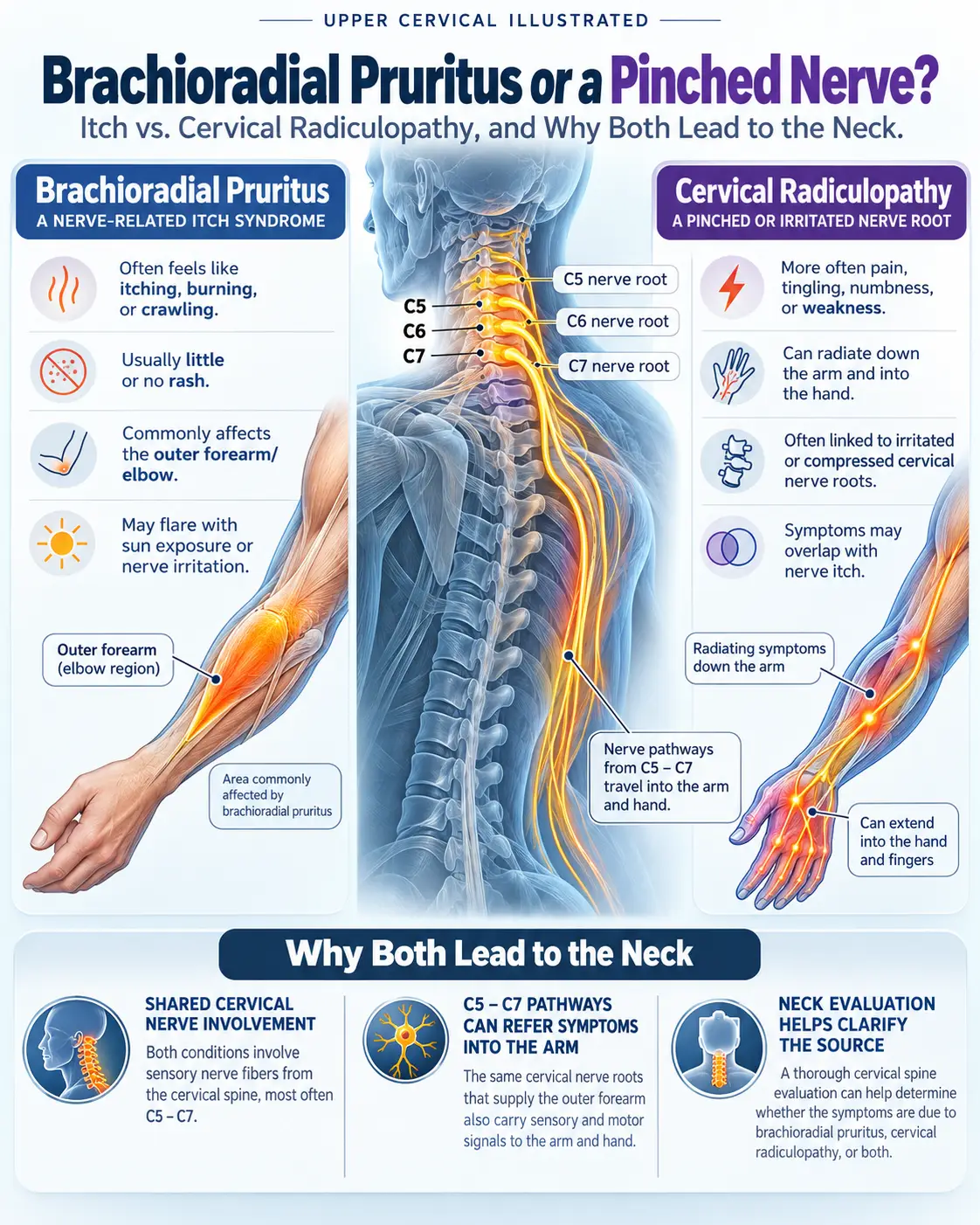
What it is. A cervical nerve root is compressed or inflamed where it exits the spine — usually by a bulging or herniated disc in younger adults, or by bony narrowing from arthritis in older ones. Iyer and Kim (2016) review the condition in Current Reviews in Musculoskeletal Medicine: it most often affects the C6 and C7 roots, and the landmark population study by Radhakrishnan and colleagues (1994), from Rochester, Minnesota, found it peaks in people in their fifties.
What it feels like. Pain that radiates from the neck into the shoulder blade and down the arm along a specific path; numbness or tingling in a strip of the arm or in particular fingers; sometimes weakness in specific muscles — for C6, the biceps and the muscles that lift the wrist; for C7, the triceps. It’s typically worse when you extend or turn your neck toward the painful side, and often eased by putting your hand on top of your head, which takes tension off the root.
How it’s confirmed. Physical examination, reflex and strength testing, and MRI, which shows the disc or bony narrowing and the compressed root. Nerve conduction studies when the picture is unclear.
What happens with it. Most cases improve over weeks to months with conservative care — the Radhakrishnan study found that the large majority did not need surgery. Surgery is reserved for progressive weakness, pain that doesn’t respond, or signs of spinal cord compression.
Our article on pinched nerve in the neck covers it in depth, and cervical herniated disc covers the most common cause.
Brachioradial Pruritus: The Itch From the Same Place
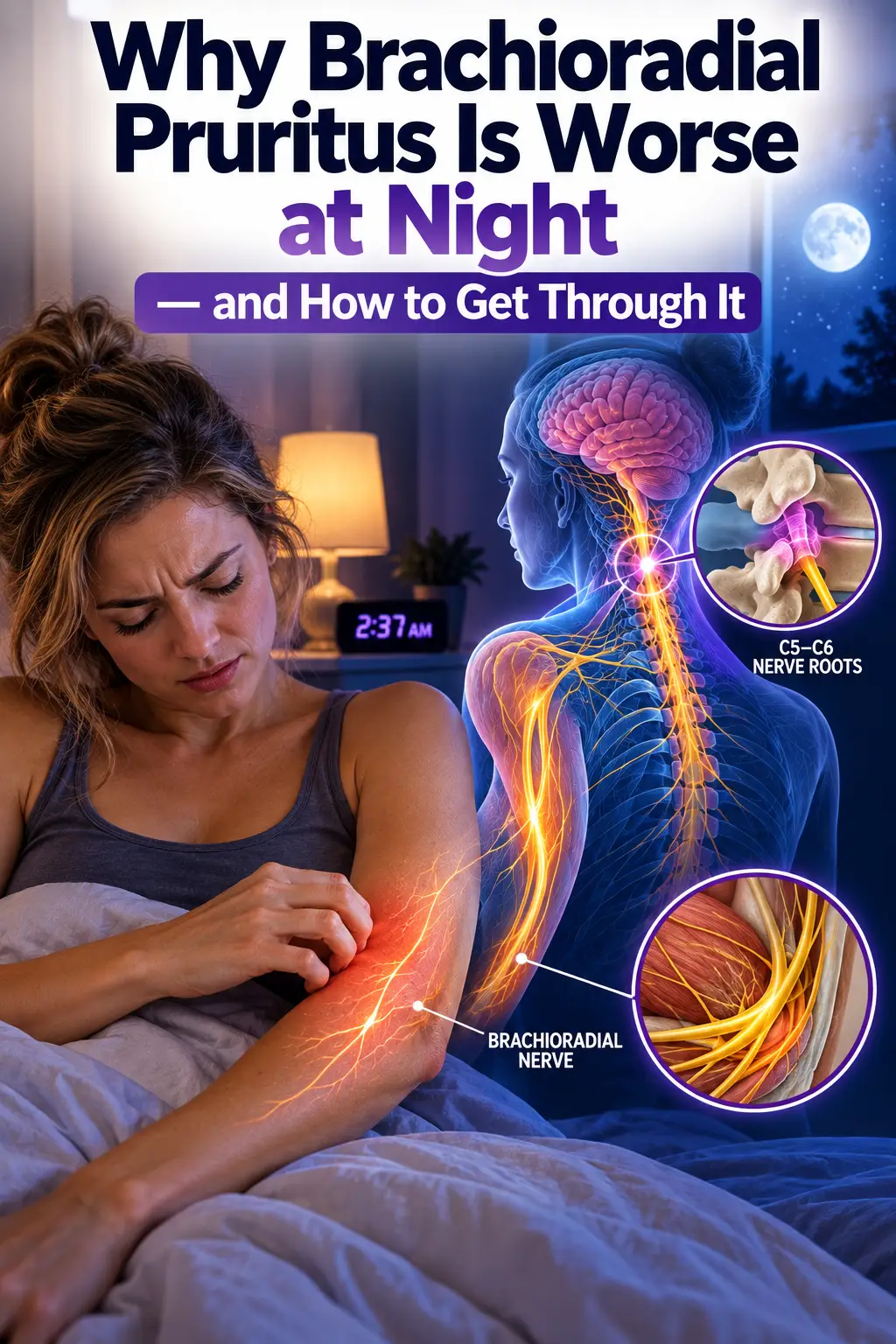
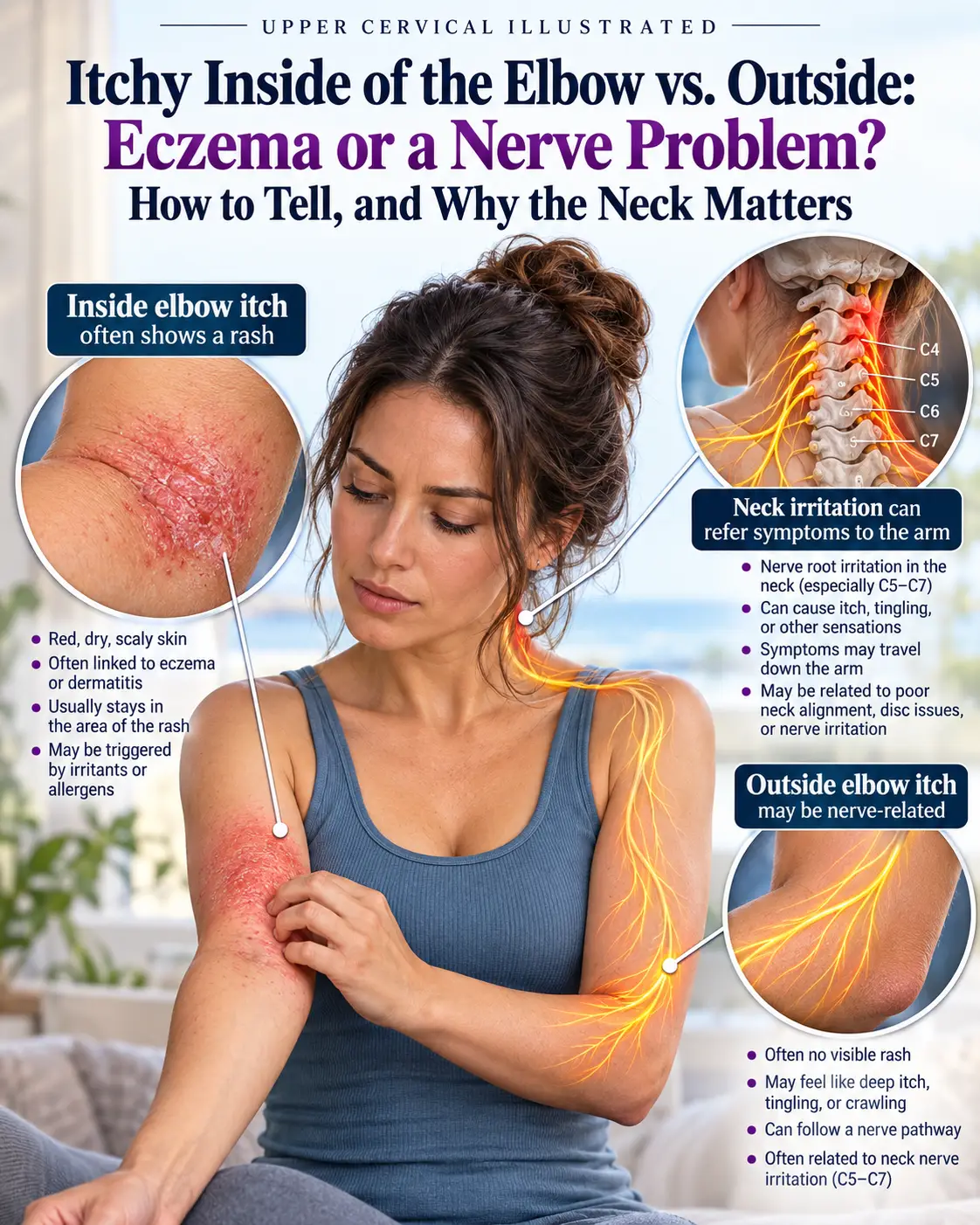
What it is. A chronic itch on the outer forearm — sometimes up to the shoulder — with no rash, triggered or worsened by sun, and traced in most patients to the cervical spine. Cohen and colleagues (2003) called it “a symptom of neuropathy.” Marziniak and colleagues (2011) found cervical spine changes on MRI in the large majority of BRP patients — disc protrusions, degenerative narrowing, nerve root involvement — with the level matching the itchy area in most. The forearm skin is supplied by C5 and C6, which lines up with those findings.
What it feels like. Itch, often mixed with tingling, burning, or a crawling sensation, on the sun-exposed outer forearm. No visible rash before scratching. Worse in summer and at night. Dramatically relieved by cold — the ice-pack sign. Usually no arm pain, no weakness, no numbness in the fingers.
How it’s confirmed. The clinical pattern, the ice-pack test, exclusion of skin disease, and — when the picture warrants — cervical imaging. Wallengren and Sundler (2005) showed that the itchy skin has reduced small nerve fiber density that recovers in remission: the nerve is being affected from upstream.
What happens with it. Chronic and relapsing, often for years, with seasonal cycles. It doesn’t progress to weakness or cord compression; it’s not dangerous. It is persistent.
Our full brachioradial pruritus guide covers it, itchy elbows with no rash covers the rash-free puzzle, and what a cervical MRI shows in BRP goes through the imaging.
Side by Side
| Cervical radiculopathy (pinched nerve) | Brachioradial pruritus (nerve itch) | |
|---|---|---|
| Source | compressed or inflamed cervical nerve root | irritated cervical nerve root, in most cases |
| Nerve roots most often | C6, C7 | C5, C6 |
| Fibers affected | large pain, sensory, and motor fibers | small itch fibers |
| Main symptom | radiating arm pain | itch on the outer forearm |
| Numbness / weakness | common | rare |
| Visible skin change | none | none, until scratched |
| Worse with | neck extension, turning toward the side | sun exposure, evening, lying down |
| Relieved by | hand on head, traction | ice pack |
| Course | usually improves over weeks to months | chronic, relapsing, seasonal |
| Danger signs | progressive weakness, cord signs | none intrinsic |
Why the Connection Matters
Two practical consequences fall out of this.
If you have BRP, your neck deserves evaluation even if it doesn’t hurt. Most BRP patients have no neck pain, which is why the connection is missed for years. But the MRI studies are clear that the cervical spine is where the problem usually lives. A nerve root can be irritated enough to produce itch without being compressed enough to produce pain. A 2025 review by Mashoudy and colleagues in the American Journal of Clinical Dermatology, “From Compression to Itch,” makes exactly this point: itch can be the only manifestation of a nerve under pressure.
If you have a known pinched nerve and you start itching, the two are probably one problem. BRP developing alongside or after radiculopathy — or after a neck injury, as in BRP after whiplash — is the same root talking in a second language. Treating the skin for the itch while treating the neck for the pain misses that they’re connected, and the itch often persists after the pain settles because the milder irritation that drives it outlasts the compression that drove the pain.
The Upper Cervical Connection
Both conditions are usually located at the C5–C7 level by imaging. Our office looks higher, and here’s why that matters for both.
The cervical spine is organized from the top down. The atlas (C1) and axis (C2) carry the head — ten to twelve pounds — and determine how the vertebrae beneath line up. When the atlas is misaligned, the head sits off-center and the lower neck compensates: the normal forward curve flattens or reverses, the discs at C5–C7 take uneven load, and over years the openings where the nerve roots exit change shape. The disc protrusions and degenerative narrowing that produce both radiculopathy and BRP develop in a spine that’s been carrying its load unevenly. Correcting the top of the neck addresses the mechanical reason the lower neck is wearing the way it is.
The upper cervical spine also sits against the brainstem, where every pain and itch signal is relayed and where the nervous system sets the volume on those signals. The small muscles and joints of the upper neck feed the brainstem continuous input. Irritation at the top of the neck can turn up the gain — so a mildly irritated C6 root is heard as relentless itch, or a resolving radiculopathy keeps hurting after the compression has eased.
An upper cervical evaluation in either condition asks: is the top of the neck positioned in a way that’s loading the lower neck unevenly, and is the nervous system at the upper neck showing irritation? Both are measurable, and both bear on how the lower-neck problem behaves.
Upper Cervical Care at Lavender Family Chiropractic
An upper cervical evaluation starts with sorting which picture you fit — and with red-flag screening, because progressive weakness or spinal cord signs are a surgical question, not a chiropractic one, and we refer those out immediately.
History and examination. The character of the symptom — pain, itch, or both — its territory, its triggers, and what relieves it.
Neurological examination. Reflexes, strength, and sensation by nerve root, so we know exactly which roots are involved and how.
Paraspinal infrared thermography. A non-invasive scan of the heat pattern along the spine, reflecting nervous-system activity — an objective baseline and a way to track change.
3D cone-beam CT (CBCT) imaging of the upper cervical spine. The position of the atlas and axis relative to the skull, in three dimensions and to the degree — something an MRI, which is excellent at discs and roots, doesn’t show. If your physician has already ordered an MRI, bring it; the two images answer different questions and together give the fullest picture.
Review of findings before any care.
Correction, if indicated. If the imaging shows a measurable misalignment at the top of the neck, we correct it with a precise, low-force procedure — no twisting, no cracking, no rotation of a neck that already has irritated roots — and remeasure. If it doesn’t, we don’t adjust, and we help you get to the right next step.
Upper cervical care addresses the mechanical source the research points to — the neck — with measurement before and after, so progress is objective rather than guessed at. Results vary from person to person, and we tell you plainly what the findings show. Our neck pain guide explains the approach in full.
If you have arm itch, a pinched nerve, or both, call (941) 243-3729 or request an appointment online for an upper cervical evaluation.
What the Research Says
Cervical radiculopathy. Iyer and Kim (2016) review the condition: C6 and C7 most often, disc herniation and bony narrowing as the usual causes, conservative care first. Radhakrishnan and colleagues (1994) established the epidemiology and found most cases resolved without surgery.
Brachioradial pruritus is a nerve condition from the same region. Cohen and colleagues (2003) documented neuropathic findings. Marziniak and colleagues (2011) found cervical spine changes on MRI at levels matching the itch. Wallengren and Sundler (2005) showed the skin’s nerve supply being affected from upstream.
Compression can produce itch alone. Mashoudy and colleagues (2025) reviewed the link between nerve compression and neuropathic itch.
Living With Either While You Address It
For a pinched nerve: avoid the positions that provoke it — extending or turning toward the painful side; keep the neck neutral at screens and in bed; no heavy lifting overhead during a flare; the hand-on-head position for relief; your physician’s recommendations on anti-inflammatories.
For BRP: cold for the flares (refrigerated gel packs, not frozen); no scratching; sun protection on the forearms; a cool bedroom and bare forearms at night.
For both: a pillow that holds the neck in a neutral line, no arm under the pillow, no stomach sleeping. Gentle range-of-motion only — no stretching into end range, no forced rotation.
Serving Sarasota, Bradenton, Lakewood Ranch, and the Suncoast
Our office is on Whitfield Avenue in north Sarasota, minutes from the Manatee County line. We see patients with pinched nerves, brachioradial pruritus, and both from Sarasota, Bradenton, Lakewood Ranch, Palmetto, Parrish, Ellenton, Longboat Key, Siesta Key, Osprey, Nokomis, Venice, and North Port. If you’ve been treating an arm itch as a skin problem or a pinched nerve as something that will “work itself out,” the top of the upper neck is the piece that hasn’t yet been examined.
Top 15 FAQs: Brachioradial Pruritus vs. Pinched Nerve
1. Can a pinched nerve cause itching instead of pain? Yes. Itch has its own nerve fibers; irritating them produces itch without pain. Brachioradial pruritus is the clearest example, and the MRI research links it to the cervical spine.
2. Is brachioradial pruritus a form of radiculopathy? Not formally — radiculopathy is defined by pain, sensory loss, or weakness in a root’s territory. BRP is better described as a neuropathic itch with a cervical source. They’re neighbors, not the same diagnosis.
3. I have BRP but my neck doesn’t hurt. Can it really be my neck? Yes. Most BRP patients have no neck pain, and most have cervical findings on MRI. The irritation is enough to produce itch, not enough to produce pain.
4. Should I get an MRI? If your symptoms include arm pain, numbness, or weakness, an MRI is the standard test and your physician should order it. For itch alone, it’s reasonable if symptoms are persistent. In our office, 3D CBCT shows the position of the upper neck, which an MRI doesn’t.
5. Can I have both at once? Yes, and it’s not rare — a root irritated enough to produce radiating pain can produce itch in the same territory, or the itch can persist after the pain settles.
6. Which nerve roots are involved? Radiculopathy most often C6 and C7; BRP most often C5 and C6. They overlap at C6, which is why the two so often coexist.
7. Does a chiropractor treat pinched nerves? Conservative care is the standard first approach for most cervical radiculopathy, and that includes chiropractic. The technique matters: we use a low-force upper cervical procedure, not rotational adjustments, and we screen for red flags first.
8. When is a pinched nerve an emergency? Progressive weakness, loss of hand coordination, trouble walking, or bladder or bowel changes. Those point toward spinal cord involvement and need urgent evaluation.
9. Why does ice help the itch but not the pinched-nerve pain? Cold overrides itch signals at the spinal cord through a specific pathway. Radicular pain travels on different fibers and responds to position and traction instead.
10. Will treating my neck stop the itching? When the neck is the source and it’s addressed, patients usually report changes in itch intensity within the first several weeks. We measure before and after so you can see whether it’s working.
11. Can a pinched nerve from a car accident turn into BRP later? Yes. Whiplash can set up the cervical changes that produce itch months or years afterward. Our article on BRP after whiplash covers it.
12. Why does my pinched nerve feel better with my hand on my head? Raising the arm takes tension off the nerve root as it exits the spine. It’s a classic sign of radiculopathy — and it typically does nothing for BRP, which is another way to tell them apart.
13. Does upper cervical care address the disc itself? It addresses the position of the top of the neck and the uneven loading that contributes to disc wear below. It is not a disc surgery and doesn’t claim to be; it changes the mechanics the disc lives under.
14. How is upper cervical care different from a regular neck adjustment? It’s limited to the top two vertebrae, guided by 3D imaging, and uses a low-force technique with no rotation — appropriate for a neck with irritated or compressed roots.
15. Do you take insurance? Call the office and we’ll go through costs and coverage before anything begins.
Lavender Family Chiropractic in Sarasota, Florida offers a thorough upper cervical evaluation to find out whether we can help. Call (941) 243-3729 or request an appointment. 5899 Whitfield Avenue, Suite 107, Sarasota, FL 34243.
Related Articles
- Brachioradial Pruritus: Our Complete Guide
- Pinched Nerve in the Neck
- Cervical Herniated Disc in Sarasota
- What a Cervical MRI Shows in Brachioradial Pruritus
- Brachioradial Pruritus After Whiplash
- Neck Pain: Our Complete Guide
References
- Iyer S, Kim HJ. Cervical radiculopathy. Curr Rev Musculoskelet Med. 2016. PMID 27250042
- Radhakrishnan K, et al. Epidemiology of cervical radiculopathy. A population-based study from Rochester, Minnesota, 1976 through 1990. Brain. 1994. PMID 8186959
- Cohen AD, et al. Brachioradial pruritus: a symptom of neuropathy. J Am Acad Dermatol. 2003. PMID 12789170
- Marziniak M, et al. Brachioradial pruritus as a result of cervical spine pathology: the results of a magnetic resonance tomography study. J Am Acad Dermatol. 2011. PMID 21641675
- Wallengren J, Sundler F. Brachioradial pruritus is associated with a reduction in cutaneous innervation that normalizes during the symptom-free remissions. J Am Acad Dermatol. 2005. PMID 15627097
- Mashoudy KD, et al. From Compression to Itch: Exploring the Link Between Nerve Compression and Neuropathic Pruritus. Am J Clin Dermatol. 2025. PMID 39417971
Related Posts


Get our upper cervical articles first.