The Ice-Pack Sign: Why Cold Relieves Brachioradial Pruritus When Nothing Else Does
By Dr. Rusty Lavender, D.C. — upper cervical chiropractor, Lavender Family Chiropractic, Sarasota, FL. Reviewed and updated October 2026.
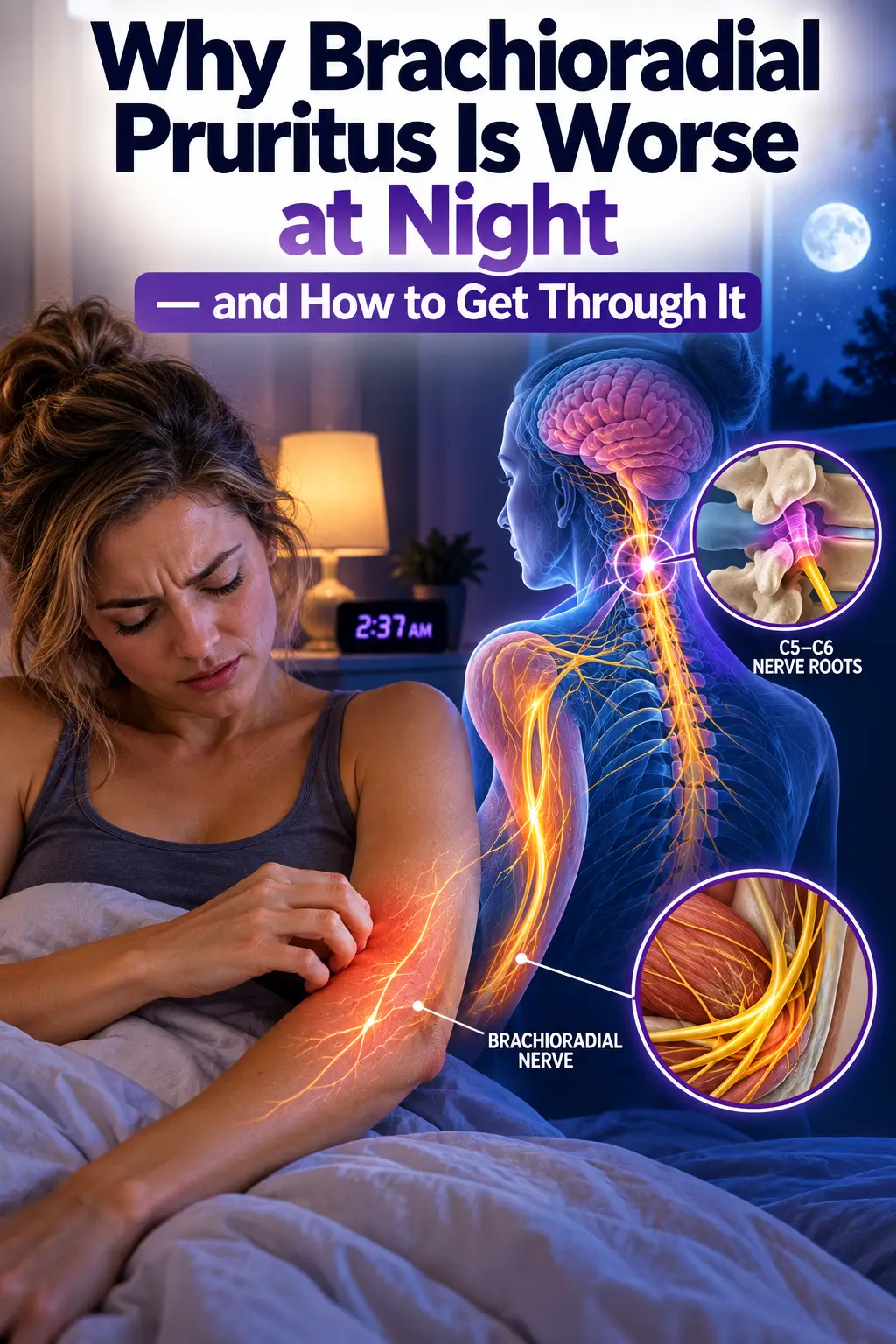
Almost nobody learns about the ice-pack sign from a doctor. People discover it alone, at two in the morning, standing in front of an open freezer because the itching on the outside of their forearm has become unbearable and they have already tried everything else in the house. Hydrocortisone did nothing. Benadryl did nothing except make them drowsy while the itch continued. Calamine lotion did nothing. Scratching made it worse in a way that scratching a mosquito bite never does — it produced a deeper, hotter, more electrical version of the same sensation. Then, out of desperation, they pressed a bag of frozen peas against the spot, and within seconds, the itch simply stopped.
That moment is almost universally described the same way by patients: relief so immediate and so complete that it feels like a switch being thrown. And then, ten or fifteen minutes after the cold comes off, the itch creeps back exactly as it was. People repeat this cycle for months, sometimes for years, before anyone tells them that what they stumbled onto has a name, appears in the medical literature, and is one of the most useful diagnostic clues in all of dermatology.
It is called the ice-pack sign, and it is strongly associated with a condition called brachioradial pruritus. This article is about what that sign actually means — not just that cold feels good, but what the cold is doing to your nervous system, and why the answer to that question points away from your skin and toward your neck. At Lavender Family Chiropracticin Sarasota, we work with patients whose itch has already been through the dermatology workup, the antihistamine trial, and the steroid cream, and we look at the structure that sits above every one of those failed attempts: the upper cervical spine. If you have been reaching for ice for months and want a different conversation, call us at (941) 243-3729.
What the Ice-Pack Sign Is
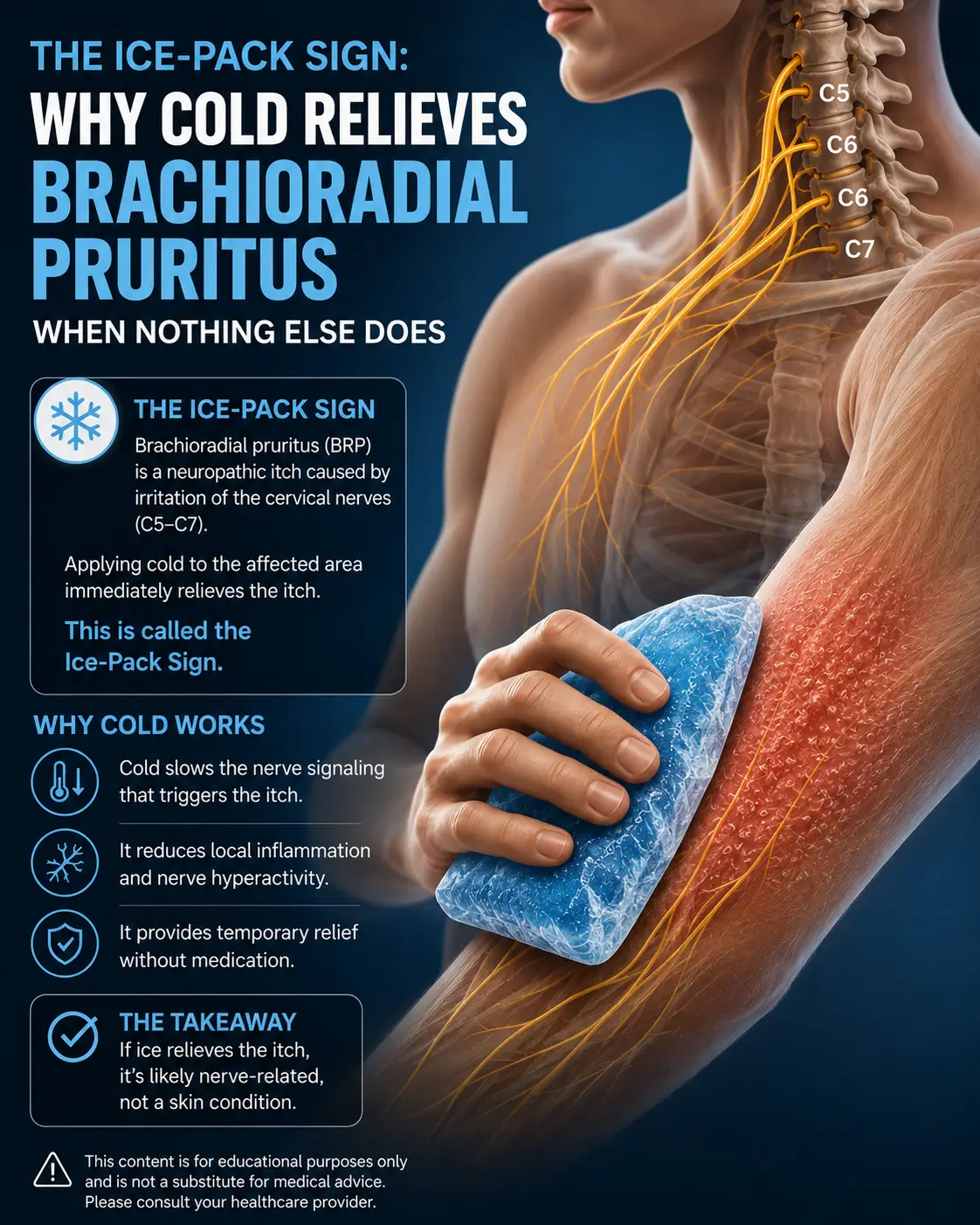
The ice-pack sign describes a specific and reproducible pattern: a person with itching on the dorsolateral forearm applies something cold to the area, experiences rapid and often dramatic relief, and then experiences a return of the itch shortly after the cold is removed. The relief is temporary by definition. The sign is not that cold helps a little; it is that cold works when nothing else does, and that it stops working the moment it comes off.
The current StatPearls clinical review of brachioradial pruritus describes the ice-pack sign as pathognomonic for the condition — meaning it is considered so characteristic that its presence strongly points to this diagnosis. That same review notes that diagnosis is primarily clinical, and that a detailed history, a focused physical examination, and demonstration of the ice-pack sign are typically sufficient to establish it. It also notes something patients find validating: many people with this condition identify cooling measures, such as ice packs or cold damp towels, as the only effective means of relief they have found.
It is worth being precise about the word “pathognomonic,” because it gets thrown around loosely. In the literature it means highly characteristic and diagnostically weighty. In practice, it does not mean that a positive ice-pack response constitutes a formal diagnosis all by itself. Other neuropathic itch conditions can respond to cold. Other conditions can be present at the same time. A physician or dermatologist still needs to take a history, examine the skin, and rule out the many dermatologic and systemic causes of chronic itching before landing on brachioradial pruritus. What the ice-pack sign does is shift the odds dramatically, and — more importantly — it tells you what category of problem you are dealing with.
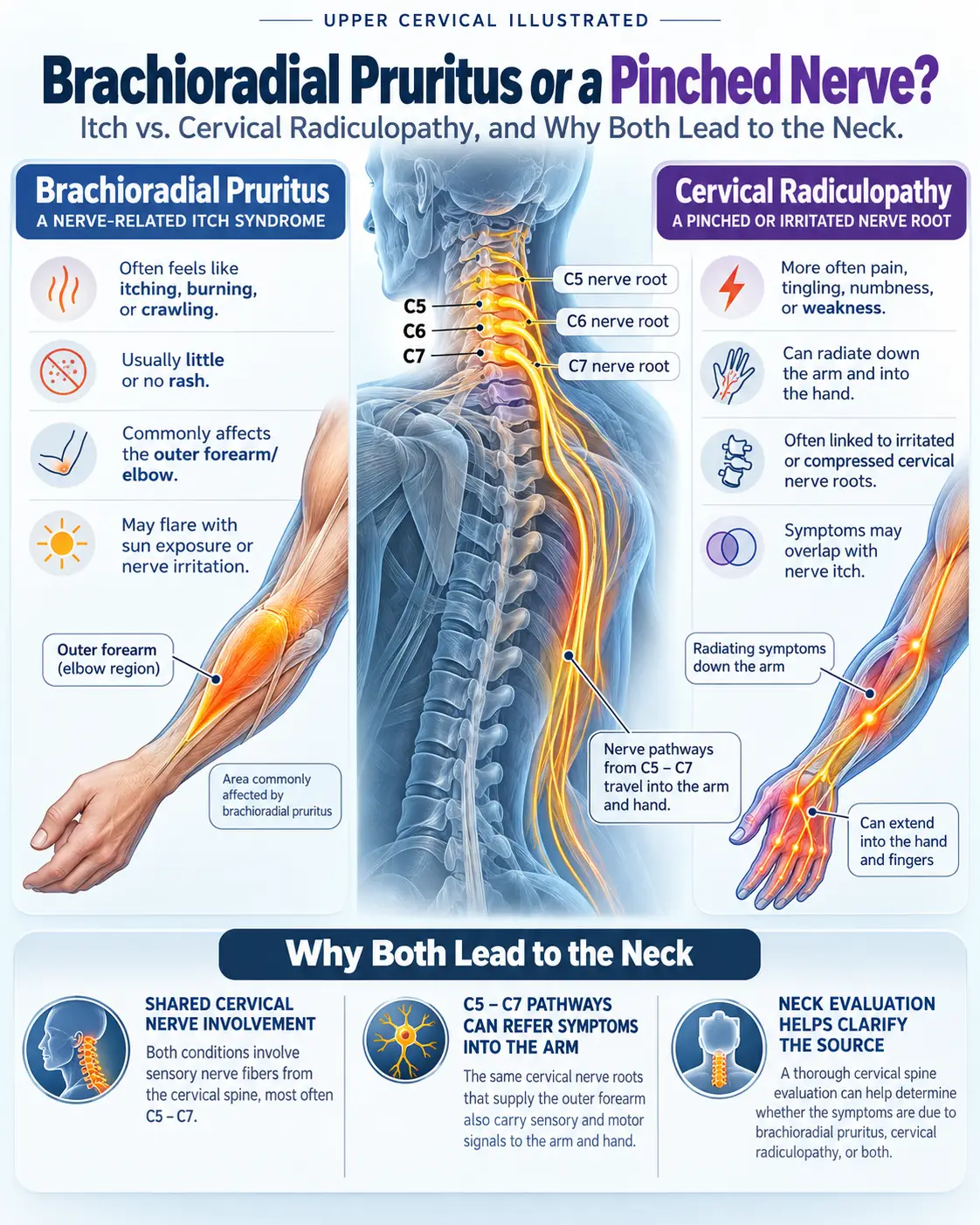
There are some practical details worth knowing about how the sign presents. The itching in this condition typically affects the outer, sun-exposed surface of the forearm, over the region of the brachioradialis muscle, which is where the name comes from. It can extend into the upper arm, the shoulder, and occasionally the neck. It is bilateral in roughly three-quarters of cases, though it is often noticeably worse on one side. It tends to be worse at night, and it frequently interferes with sleep. And on physical examination, the skin usually looks entirely normal — no rash, no hives, no redness, other than whatever damage the person has done to themselves by scratching. That combination, intense itching with a normal-looking arm, is itself a clue, and it is the reason so many people are told the problem is in their head before someone finally recognizes what is happening.
Why Cold Works: The Neurophysiology
To understand the ice-pack sign, you have to understand that itch is not a skin event. Itch is a signal. The skin contains sensory nerve endings that generate the signal, but the sensation of itching is produced when that signal travels up a peripheral nerve, into the spinal cord, up the cord, and into the brain, where it is interpreted. Anywhere along that path, the signal can be amplified, dampened, or generated spontaneously.
In brachioradial pruritus, the evidence points toward a nerve problem rather than a skin problem. The StatPearls reviewcharacterizes the condition as a localized neuropathic dysesthesia — an abnormal sensation arising from irritated or damaged nerve tissue rather than from an inflammatory process in the skin. Patients often demonstrate abnormal thermal and pinprick perception in the affected dermatomes, which is a hallmark of nerve dysfunction, not of dermatitis.
Cold does at least three things to a sensory nerve, and all three of them matter here.
First, cold directly reduces the excitability of peripheral nerve fibers. Nerve conduction is a temperature-dependent process. Cooling tissue slows the ion channel kinetics that generate and propagate nerve impulses, which raises the threshold a fiber has to cross before it fires and reduces how rapidly it can fire once it does. If the underlying problem is a population of small-diameter sensory fibers that are firing when they should not be, lowering the temperature of the tissue they occupy quiets them. This is a direct, mechanical suppression of an over-firing system.
Second, cold provides competing sensory input. The spinal cord dorsal horn is not a passive relay. It is a processing station where different sensory channels converge and interact, and where strong input on one channel can suppress transmission on another. This is the same principle that explains why rubbing a banged shin reduces the pain, and why a hot shower can temporarily quiet neuropathic symptoms. Flooding the segment with an intense, well-organized cold signal occupies circuitry that would otherwise be carrying the itch signal upward. The cold effectively crowds the itch out.
Third, and relatedly, cold engages inhibitory circuitry within the dorsal horn itself. The review Itch and Neuropathic Itchby Hachisuka, Chiang, and Ross describes how itch transmission in the spinal cord is held in check by inhibitory interneurons, and how a reduction in that inhibitory input — disinhibition — results in a greater itch signal being conveyed to the brain, producing abnormally heightened itch. Their work also discusses how supraspinal centers exert descending control over spinal sensory transmission, and how the loss of that descending control produces increased sensation. Cold, in this framework, is a way of externally reinforcing inhibition in a segment where the body’s own inhibition has become insufficient.
Notice what none of those three mechanisms involve. None of them involve histamine. None of them involve mast cells. None of them involve an allergic or inflammatory cascade in the skin. Cold is not an anti-inflammatory in this context in any meaningful sense — the arm is not inflamed. Cold works because it is a nerve suppressant applied to a nerve problem.
This is exactly why the relief is temporary. The moment the tissue rewarms, conduction speeds back up, the competing sensory input disappears, the borrowed inhibition is withdrawn, and the underlying over-excitable system resumes doing what it was doing before. Nothing about the cause changed. You suppressed an output; you did not modify the circuit that was producing it.
Why This Tells You Antihistamines Won’t Help
The ice-pack sign is, functionally, a fork in the road. It sorts chronic itch into two very different categories, and it does so more efficiently than most tests.
Histamine-mediated itch — the kind you get from hives, from an allergic reaction, from a bug bite — has recognizable features. It usually produces visible skin changes: wheals, redness, swelling. It typically responds, at least partially, to antihistamines. And while cold may soothe it somewhat, cold is not the singular thing that works while everything else fails.
Neuropathic itch behaves differently. The skin looks normal. Antihistamines do essentially nothing. Topical steroids do essentially nothing, because there is no inflammation for them to suppress. And cold produces relief that is out of proportion to everything else that has been tried.
The StatPearls review states this plainly: despite their common use for other pruritic disorders, systemic antihistamines have not demonstrated benefit in brachioradial pruritus. It also notes that topical corticosteroids are rarely effective, and cautions that prolonged or excessive application of superpotent steroid preparations can cause thinning of the skin. The agents reported to help most consistently are the ones that modulate neural excitability — gabapentin and pregabalin — which is exactly what you would predict if the problem is an over-excitable nerve pathway rather than an itchy patch of skin.
So when a patient tells us that ice is the only thing that touches it and that months of antihistamines produced nothing, that is not a story about a stubborn allergy. That is a description of a nerve pathway that has become hyperexcitable, and it is a strong argument for investigating the pathway rather than continuing to treat the skin at the end of it.
The same review contains a finding that explains why so many people spend years in this loop. Recent studies of diagnostic and therapeutic gaps in this condition found that fewer than fifteen percent of patients were accurately diagnosed at their initial consultation, that nearly seventy percent required evaluation by multiple clinicians, and that most patients experienced a diagnostic delay exceeding three years. Common misdiagnoses included atopic dermatitis and allergic reactions. If you have been treated for an allergy you do not have, you are not an unusual case. You are the typical case.
Why the Upper Cervical Spine Is Central
Here is where the conversation gets more interesting, and where it moves from describing the problem to asking what can actually be done about the pathway.
If cold relieves this itch by suppressing an over-excited sensory system, the obvious next question is: why is the system over-excited in the first place? And if the answer involves lost inhibition, then where does that inhibition come from, and what could be interfering with it?
Mechanism One: Descending Inhibitory Control and the Upper Cervical Cord
Itch, like pain, is modulated at the dorsal horn of the spinal cord. Incoming signals from the periphery do not travel to the brain unedited. They arrive at the dorsal horn, where local inhibitory interneurons and descending pathways from the brainstem determine how much of that signal gets passed upward. This descending system is, in effect, the brain’s volume control over sensory input from the body.
As the Itch and Neuropathic Itch review describes, itch transmission in the spinal cord is modulated by supraspinal neurons projecting from brainstem regions including the periaqueductal gray, the rostral ventromedial medulla, and the ventrolateral medulla. That descending control is, on balance, inhibitory. When those supraspinal control centers are experimentally lesioned, sensation increases — presumably due to loss of descending inhibitory control and subsequent disinhibition. The same review describes how reduced inhibitory synaptic input in the dorsal horn results in a greater itch signal reaching the brain and abnormally heightened itch.
Read that alongside the ice-pack sign and something clicks into place. The ice pack is a form of externally applied inhibition. It works precisely because the system is disinhibited and hyperexcitable — because the brake is not doing its job, and cold is a way of pressing the brake from outside.
Now consider the anatomy. Those descending pathways originate in the brainstem and travel downward through the spinal cord to reach the dorsal horn at every segmental level. To get from the brainstem to the cervical, thoracic, and lumbar cord, they must pass through the upper cervical spinal cord — the segment surrounded and protected by the atlas, the first cervical vertebra, and the axis, the second. The upper cervical spine is the anatomical corridor through which the body’s descending brake on sensory signaling travels. It is also the most mobile and least mechanically interlocked region of the entire spine, which means it is the region where alignment relationships matter most and are most easily disturbed.
This is the reasoning that underlies the upper cervical approach. If the presenting problem is a sensory system that has lost its inhibitory tone, then the region where that inhibitory traffic is most anatomically vulnerable is a rational place to look. The goal of upper cervical care in this context is not to numb the arm. It is to address the structural relationship at the top of the neck so that the nervous system’s own regulatory signaling has the best possible mechanical environment to operate in.
I want to be careful and honest here. This is mechanistic reasoning, not a finding demonstrated in a randomized trial of brachioradial pruritus patients. The published research on this condition has examined lower cervical levels, not the atlas and axis, and I will not claim otherwise. But the logic is coherent: the ice-pack sign demonstrates that this is a disinhibition problem, the descending inhibitory pathways run through the upper cervical cord, and the upper cervical spine is where those pathways are most exposed to mechanical influence. Ice borrows a brake from a freezer. Upper cervical care aims at the system’s ability to supply its own.
Mechanism Two: Upstream Biomechanics and the Cervical Chain
The second mechanism is more concrete and easier to demonstrate on imaging.
The published imaging studies in this condition consistently find lower cervical pathology. The magnetic resonance study by Marziniak and colleagues, published in the Journal of the American Academy of Dermatology in 2011, imaged the cervical spine in forty-one patients with brachioradial pruritus. Patients marked the C5 dermatome in just over ninety percent of cases and the C6 dermatome in one hundred percent of cases. All patients had detectable changes on imaging, and in roughly eighty percent, foraminal stenosis or cervical disc protrusion produced nerve compression.
Similarly, Shields and colleagues, reporting nine patients in Cureus in 2022, found that all nine had cervical spine disease on MRI — disc protrusions, spondylosis, spinal stenosis, and foraminal stenosis — and that EMG abnormalities indicated chronic radiculopathy involving predominantly the C6 and C5 nerve roots.
These are lower cervical findings. C5, C6, C7. That is what those studies imaged and that is what they reported, and it would be dishonest to describe them as upper cervical studies. They are not.
But there is a structural argument worth understanding about how lower cervical degeneration develops. The upper cervical spine — the occiput, atlas, and axis complex — carries the head and establishes its position in space relative to the rest of the body. It is the only region of the spine with no intervertebral discs between its first two segments and the most rotational freedom of any spinal joint. When alignment at that junction is disturbed, the head is no longer balanced over the neck in a neutral way, and the segments below have to compensate. That compensation is not distributed evenly. It concentrates loading, and it changes the angles at which the lower cervical segments articulate and bear weight through the course of thousands of head movements per day, over decades.
Loading drives degeneration. Discs, facet joints, and uncovertebral joints remodel in response to the mechanical demands placed on them. When those demands are asymmetric and sustained, the tissue responds with the changes that appear on a report as spondylosis, disc protrusion, and foraminal narrowing. The C5-C6 and C6-C7 levels are among the most mechanically stressed in the neck, which is a substantial part of why they are the most commonly degenerated levels in the general population — and, notably, the levels most implicated in this condition.
The clinical implication is straightforward. When imaging shows foraminal narrowing at C5-C6, that finding is real and it matters. But it is an endpoint, not a starting point. It is where the load ended up. The question we care about is why that particular segment absorbed disproportionate load for years, and in many patients the answer traces upstream to an uncorrected alignment problem at the top of the neck. Treating only the level where the tissue failed, while leaving the loading pattern that produced the failure unaddressed, is a limited strategy.
That is why our examination looks at the whole cervical chain and specifically at what is happening at the atlas and axis. It is also why we image the way we do — you cannot evaluate a three-dimensional alignment relationship from a two-dimensional picture.
Putting the Two Together
Framed this way, the ice-pack sign becomes a piece of clinical information rather than just a coping strategy. It tells you the problem is neuropathic. It tells you the system is hyperexcitable. And by implication, it tells you the system’s own inhibitory control is not keeping up.
Ice is a borrowed brake. It works for exactly as long as you hold it there. The goal of precise upper cervical chiropractic care is different in kind: to address the structural situation at the top of the cervical spine so that the nervous system has the best possible opportunity to regulate itself, and so that the compensatory loading pattern running down the cervical chain is not continuing to accumulate.
That is the aim. It is not a promise, and I want to be direct about what this care does not do. It does not cure brachioradial pruritus. Individual responses vary considerably, and some people improve substantially while others do not. Anyone who tells you otherwise about any approach to this condition is overselling.
How to Use Cold Safely and Effectively
While you sort out the underlying picture, cold remains a legitimate and useful tool for symptom control. The StatPearls review explicitly notes that ice pack application provides rapid symptomatic relief and may be used as an adjunct for acute exacerbations. Used sensibly, there is no reason to feel guilty about relying on it.
Used carelessly, however, cold can injure skin. And people with this condition are unusually prone to using it carelessly, because the relief is so compelling and because the affected area often has reduced or abnormal sensation, which makes it harder to feel when the cold has crossed from soothing into damaging. A few practical guidelines.
Always put a barrier between the cold source and your skin. A thin towel, a pillowcase, a t-shirt. Never apply a gel pack, an ice bag, or anything from the freezer directly to bare skin. Gel packs are the biggest offender here, because they can reach temperatures well below freezing and hold them, and because they conform closely to the skin surface.
Limit each application. Ten to fifteen minutes is a reasonable ceiling, followed by a break long enough for the tissue to return to normal temperature and normal color before you reapply. Longer is not better; the nerve-quieting effect plateaus while the risk to the skin keeps climbing.
Check the skin. Look at the area when you take the pack off. Normal pink or red flush that fades within a few minutes is expected. Blotchy white patches, waxy or firm-feeling skin, persistent numbness, or blistering are not, and mean you should stop, let the area recover fully, and use a milder approach going forward.
Never fall asleep with a pack on the arm. This is where most cold injuries in this population happen, because the itch is worst at night and the temptation is obvious. If nighttime is your hardest window, consider a cool damp cloth rather than something frozen, or run the forearm under cool tap water before bed.
Consider gentler alternatives. A cool damp towel, a cloth kept in the refrigerator rather than the freezer, cool water, or a cooling menthol-containing lotion may give enough of the same effect with much less risk. Menthol works through cold-sensing receptors, which is why it produces a similar sensory-suppression effect without any actual temperature drop.
Be more cautious if you have circulatory issues or reduced sensation. Diabetes, peripheral vascular disease, Raynaud’s phenomenon, or any condition that impairs blood flow or sensation in the extremities all raise the risk of cold injury and lower your ability to detect it early. Talk with your physician about appropriate limits.
Do not let cold substitute for evaluation. This is the important one. Ice is symptomatic relief. It is not treatment of a cause, and it is not a diagnosis. It is entirely possible to spend three years managing a symptom well enough to avoid ever finding out what is producing it. If you have chronic unexplained itching, you need a physician or dermatologist to evaluate it, both to confirm what it is and to rule out the other conditions — dermatologic, systemic, and neurologic — that can present with persistent itch. That workup matters, and nothing in this article replaces it.
How Precise Upper Cervical Care Fits at Lavender Family Chiropractic
If you have been through the dermatology workup, the antihistamine trial, the topical steroids, and possibly a gabapentin trial, and you are still living with ice packs, here is what an evaluation with us actually looks like.
A consultation and history. We start by listening, and by asking questions that often have not been asked. When did this begin, and was there anything mechanical going on around that time — a car accident, a fall, a period of unusual neck strain? Which dermatome is involved, and is it one-sided or two-sided? What is the pattern across the day and across seasons? Any neck pain, headaches, stiffness, or restricted rotation? What has been tried, and what did each thing do? Many patients with this condition report no neck symptoms at all, which is well documented in the literature and does not rule out cervical involvement — it simply means we cannot rely on symptoms as our guide and have to look objectively.
3D CBCT imaging. Cone beam computed tomography lets us evaluate the upper cervical spine volumetrically rather than as a flat shadow. Alignment at the occiput-atlas-axis complex is a three-dimensional relationship involving rotation, lateral tilt, and translation simultaneously, and a standard two-view radiograph cannot fully characterize it. Because we take a correction on the basis of what the imaging shows, the imaging has to be good enough to justify the specificity we claim. This is also where we can appreciate the anatomy of your individual spine rather than working from an average.
Tytron paraspinal infrared thermography. Imaging tells us about structure. Thermography gives us a functional reading. The Tytron scan measures skin surface temperature symmetry along the paraspinal region, which reflects autonomic regulation of the small blood vessels in the skin. Repeated over time, it gives us an objective pattern to track — a way of monitoring whether things are changing and stabilizing, rather than relying only on how you say you feel on a given day. In a condition as variable and as sleep-dependent as this one, having an objective marker alongside the subjective report is genuinely valuable.
A precise, low-force correction using the Knee Chest Upper Cervical technique. This is not high-velocity twisting manipulation of the neck. There is no rotational thrust, no cracking or popping of the cervical spine, and no forceful movement of your head. You are positioned in a specific posture that isolates the upper cervical segments, and the correction is delivered as a light, carefully directed contact calculated from your imaging. Most patients describe it as anticlimactic — a brief, gentle touch. That precision is the entire point. When the objective is to restore a specific alignment relationship at a specific joint, more force is not more effective; accuracy is what matters. Patients who have been nervous about anyone touching their neck are often surprised at how little there is to be nervous about here.
Customized care plans. Your plan is built from your findings — your imaging, your thermographic pattern, your history, how you hold a correction over time. Some people stabilize quickly; some take longer. We do not have one schedule that everyone follows. We reassess, we look at the objective data, and we adjust the plan to what your spine is actually doing.
Coordination with your other providers. We want you to keep seeing your dermatologist and your primary care physician. If a neurologist or pain specialist is involved, good. If you are on gabapentin or pregabalin and it is helping, we are not going to tell you to stop — that is a conversation between you and your prescriber. Our role is one part of a broader picture, and the StatPearls review itself notes that consultation with a physical therapist or chiropractor may be appropriate, particularly for patients with radiographic evidence of cervical spinal pathology, and that symptomatic improvement has been reported in case series.
What this care can and cannot do. It can address upper cervical alignment precisely and monitor the result objectively. It can address the compensatory loading pattern that runs down the cervical chain. It may help some people with neuropathic itch of cervical origin, and case reports of chiropractic care in this condition exist in the literature. It cannot cure brachioradial pruritus, and I will not tell you it can. It is not a substitute for medical evaluation. It does not work for everyone. What we will do is give you an honest assessment after we look at your imaging, and tell you plainly if we do not think we are the right fit.
On cost and insurance. We are a cash-pay, out-of-network practice. Fees are explained up front, before you commit to anything, and we provide superbills you can submit to your insurance carrier for possible out-of-network reimbursement, which some plans offer and some do not.
Ready to look at what is upstream of the itch?
Call Lavender Family Chiropractic at (941) 243-3729 or book a new patient appointment online.
We are located at 5899 Whitfield Avenue, Suite 107, Sarasota, FL 34243, at the corner of University and Whitfield — convenient to Sarasota, Bradenton, Lakewood Ranch, and University Park.
What the Research Says
- Brachioradial Pruritus — StatPearls, NCBI Bookshelf (Saleh HM, Schmieder GJ) — PMID 29083620, Bookshelf ID NBK459321. This continuously updated clinical review describes brachioradial pruritus as a localized neuropathic dysesthesia of the dorsolateral upper extremities, identifies the ice-pack sign as pathognomonic (immediate relief with cold, prompt recurrence after removal), notes that systemic antihistamines have not demonstrated benefit, and states that consultation with a physical therapist or chiropractor may be appropriate in patients with radiographic cervical spine findings.
- Brachioradial pruritus as a result of cervical spine pathology: the results of a magnetic resonance tomography study (Marziniak M, et al., J Am Acad Dermatol, 2011) — PMID 21641675. Cervical MRI was performed in 41 patients with brachioradial pruritus; patients localized symptoms to the C5 dermatome in 90.2% and the C6 dermatome in 100% of cases, all patients showed detectable imaging changes, and in 80.5% foraminal stenosis or cervical disc protrusion produced nerve compression. This study examined the cervical spine at the levels corresponding to symptom distribution and did not evaluate upper cervical alignment.
- Brachioradial Pruritus: Clinical, Electromyographic, and Cervical MRI Features in Nine Patients (Shields LB, Iyer VG, Zhang YP, Shields CB, Cureus, 2022) — PMID 35291549, PMCID PMC8896843. All nine patients demonstrated cervical spine disease on MRI, including disc protrusions, spondylosis, spinal stenosis, and foraminal stenosis, with EMG abnormalities indicating chronic radiculopathy involving predominantly the C6 and C5 nerve roots — reinforcing the link between lower cervical nerve root pathology and this pattern of neuropathic itch.
- Brachioradial pruritus treated with computed tomography-guided cervical nerve root block: A case series (Weinberg BD, Amans M, Deviren S, Berger T, Shah V, JAAD Case Reports, 2018) — PMID 30094306, PMCID PMC6080634. This case series reports outcomes in patients with brachioradial pruritus treated with image-guided cervical nerve root blocks, providing further support for a cervical neurogenic contribution to the condition. Broader reviews note that nerve blocks have not shown consistent efficacy across all reported patients.
- Itch and Neuropathic Itch (Hachisuka J, Chiang MC, Ross SE, Pain, 2018) — PMID 29389746, PMCID PMC6106783. This review of itch neurobiology describes how itch transmission is gated in the spinal dorsal horn by inhibitory interneurons and modulated by descending projections from brainstem regions, and explains how disinhibition — reduced inhibitory input at the dorsal horn or loss of descending inhibitory control — produces an amplified itch signal and abnormally heightened itch.
Self-Care Beyond the Ice Pack
Cold buys you relief in the moment. These are the things that may reduce how often you need it.
Protect the area from ultraviolet exposure. This is probably the single highest-yield self-care measure, and in Sarasota it is also the hardest. Sun exposure is well established as a precipitating and exacerbating factor in this condition — it was originally described as “brachioradial summer pruritus” for a reason, and it was first reported in Florida. The StatPearls review recommends minimizing direct sun exposure, using broad-spectrum sunscreen consistently, and wearing long-sleeved UV-protective clothing, and notes that simple protective clothing often provides relief comparable to sunscreen. Practically, in this climate: a lightweight UPF-rated long-sleeve sun shirt for boating, golf, tennis, yard work, and cycling. Sunscreen on the forearms even for short errands. A UV-blocking film or sleeve for the driver’s-side arm, which takes far more cumulative exposure than most people realize and is often the worse side. Shifting outdoor activity outside the 10 a.m. to 2 p.m. window when you can.
Stop scratching — and set up your environment so you can. Scratching in this condition does not relieve the itch the way it does with a bug bite. It typically makes it worse, and it produces the excoriations, thickened skin, and nodules that turn a sensory problem into a skin problem too. But willpower alone is a weak tool at three in the morning. Keep fingernails cut short. Sleep in long, loose sleeves so there is fabric between your nails and the skin. Keep a cold pack or a cool damp cloth within reach of the bed so cold is easier to grab than scratching. Keep the skin well moisturized, since dry skin lowers the threshold for everything. Some people find that firm pressure, a cool cloth, or gentle tapping satisfies the urge without the tissue damage.
Pay attention to neck mechanics. If the pathway runs through the cervical spine, how you load that spine all day is relevant. The most common offender is sustained forward head posture — phone, laptop, tablet, book. Get screens up toward eye level. Support the forearms when you type so the shoulder girdle is not hanging off the neck. Take a genuine break every half hour or so, even thirty seconds of looking up and moving the head through its range. Look at your pillow: it should keep the neck roughly neutral rather than propping the head forward or letting it drop sideways. If you sleep on your stomach, your head is rotated near end-range for hours at a stretch, which is worth reconsidering. And if you sit at a desk, check whether your monitor is off-center, forcing a small sustained rotation you have stopped noticing.
Track your patterns. Keep a simple log for a few weeks: severity, time of day, what you did that day, sun exposure, sleep quality, what helped. Patterns emerge that are invisible day to day, and it makes your visits with any provider considerably more productive.
Do not go it alone. Persistent itching that disrupts sleep takes a real toll. The literature is explicit that anxiety, depression, and social withdrawal are common complications of this condition, and that the frustration of ineffective treatment compounds it. That is a legitimate part of the clinical picture and worth raising with your physician rather than absorbing quietly.
If you want to go deeper on how a neck problem produces an arm symptom, our related article Why Won’t My Elbow Stop Itching? walks through the dermatome map and the referral pattern in more detail.
Serving Sarasota and Surrounding Communities
Lavender Family Chiropractic is located at 5899 Whitfield Avenue, Suite 107, Sarasota, FL 34243, at the corner of University and Whitfield. The location sits near the Sarasota–Manatee county line, which makes it straightforward to reach from either direction.
We see patients from Sarasota, Bradenton, Lakewood Ranch, Venice, Palmer Ranch, Osprey, Siesta Key, Longboat Key, Lido Key, University Park, Parrish, Ellenton, Myakka City, Punta Gorda, and St. Petersburg.
Brachioradial pruritus has a particular relevance for this region. The condition was first described in Florida in 1968 and has been reported most heavily in subtropical and sun-intensive areas, with ultraviolet exposure recognized as a major contributing factor. Southwest Florida gives people year-round sun and a lifestyle built around being outside in it — boating, golf, tennis, pickleball, cycling, beach days, gardening. Those are exactly the exposures associated with this condition. If you have lived here for years and have accumulated substantial forearm sun exposure, and you now have a persistent itch on the outside of your forearms with nothing visible on the skin, this condition belongs on the list of possibilities worth discussing with a physician.
Top 15 Questions
1. Does a positive ice-pack sign confirm that I have brachioradial pruritus?
No — it is strongly suggestive, but it is not a formal diagnosis. The clinical literature describes the ice-pack sign as pathognomonic, which means highly characteristic, and demonstrating it is a meaningful piece of a diagnostic workup. But other neuropathic itch conditions can also respond to cold, and other conditions may coexist. A physician or dermatologist needs to take the history, examine your skin, and rule out other dermatologic and systemic causes of chronic itch before settling on this diagnosis. What a positive ice-pack sign does reliably tell you is that you are likely dealing with a nerve-mediated itch rather than a histamine-mediated one, and that is genuinely useful information.
2. Should I see a dermatologist?
Yes. We recommend it without hesitation. Chronic itching has a long differential diagnosis, and some of the conditions on it need medical management that has nothing to do with the spine. A dermatologist can confirm the diagnosis, exclude other skin conditions, order laboratory work or imaging if indicated, and prescribe medications that may help. We would rather work alongside your dermatologist than in place of one.
3. Can you cure my brachioradial pruritus?
No. We cannot cure this condition, and we will not tell you we can. What we offer is a precise, low-force approach to upper cervical alignment, evaluated with 3D CBCT imaging and monitored with paraspinal thermography, aimed at the structural region through which the relevant neurological pathways travel. Some patients respond well. Some do not. We will give you an honest read after we examine you and look at your imaging.
4. Why do antihistamines do nothing for me?
Because your itch is not being driven by histamine. Antihistamines block histamine receptors, which is why they help with hives and allergic reactions. Neuropathic itch arises from irritated or dysfunctional nerve tissue, not from mast cell histamine release in the skin, so blocking histamine receptors leaves the actual signal untouched. Clinical reviews of this condition note directly that systemic antihistamines have not demonstrated benefit in brachioradial pruritus.
5. How long can I safely leave an ice pack on my arm?
Roughly ten to fifteen minutes at a time, always with a cloth barrier between the pack and your skin, and with a full break to let the tissue rewarm before reapplying. Never apply anything frozen directly to bare skin, and never fall asleep with a pack on your arm. Prolonged or direct cold can cause skin and tissue injury, and this risk is higher than usual in this population because the affected area often has altered sensation, which makes it harder to notice when the cold has gone too far.
6. Why does the itch come right back when the ice comes off?
Because cold suppresses an output; it does not modify the circuit generating that output. Cooling slows nerve fiber firing and floods the spinal segment with competing sensory input, both of which quiet the itch signal. When the tissue rewarms, the fibers resume normal conduction, the competing input disappears, and the underlying hyperexcitable pathway picks up right where it left off. That is exactly why the sign is so diagnostically useful — the tight, reproducible link between cold and relief is a fingerprint of a nerve problem.
7. My arm looks completely normal. Why does it itch so much?
That is characteristic of this condition rather than an argument against it. Physical examination of the affected area is typically unremarkable, with no primary skin lesions and no rash or redness despite severe symptoms. Any visible changes are usually secondary — excoriations, thickened skin, or nodules from chronic scratching. The itch is generated in the nervous system, not in the skin, so there is nothing for the skin to show.
8. Is the Knee Chest Upper Cervical technique the same as having my neck cracked?
No. The Knee Chest Upper Cervical technique is a precise, low-force method. There is no twisting of the neck, no rotational thrust, and no cracking or popping. You are positioned in a specific posture that isolates the upper cervical segments, and the correction is delivered as a light, carefully directed contact calculated from your individual 3D imaging. Most patients find it far gentler than they expected.
9. Why do you image the upper neck if the research points at C5 and C6?
Both are worth understanding. The published imaging studies examined the lower cervical spine and found degenerative changes and foraminal narrowing at levels matching the affected dermatomes, and those findings are real. Our reasoning is that the loading pattern that produces lower cervical degeneration is influenced by alignment at the top of the neck, where the head is balanced on the spine. Addressing the level where tissue failed without addressing the loading pattern that contributed to the failure is an incomplete approach. We image the upper cervical spine because that is where we can act with the most precision, and because it is upstream of the segments the research identified.
10. Do you take my insurance?
We are a cash-pay, out-of-network practice. We do not bill insurance directly. We provide superbills — itemized receipts with the appropriate diagnostic and procedure codes — which you can submit to your carrier for possible out-of-network reimbursement. Whether you receive any reimbursement depends entirely on your specific plan and its out-of-network benefits, so it is worth calling your insurer to ask before you start. We explain all fees clearly up front so you can make an informed decision.
11. Why cash-pay instead of billing insurance?
Because it lets us build care around what your examination and imaging show rather than around what a payer will authorize. Insurance requirements often dictate visit frequency, the number of visits, and documentation formats in ways that are disconnected from what the individual patient in front of us actually needs. Practicing outside that system lets us take the time to do the imaging and analysis properly and to structure a plan based on clinical findings.
12. How many visits will this take?
There is no standard number, and we are not going to invent one before we have examined you. It depends on what your imaging shows, what your thermographic pattern looks like, how long the problem has been present, and how well your spine holds a correction over time. After your evaluation, we will explain what we found and what we recommend, along with the associated cost, so you can decide with full information.
13. Will upper cervical care make my itching worse?
The Knee Chest Upper Cervical correction is precise and low-force, and most patients find the visit itself uneventful. Some people experience mild temporary soreness or changes in symptoms as the body adapts to a new alignment, which is not unusual with any structural change. We monitor your response objectively with thermography rather than relying on symptom reports alone, and we want to hear about anything you notice between visits so we can factor it in.
14. I have no neck pain at all. Does that rule out a cervical cause?
No. This is one of the most consistently reported findings in the literature on this condition: despite a high prevalence of cervical spine abnormalities on imaging, relatively few patients report neck pain, spinal narrowing, or a history of trauma. The absence of neck symptoms does not exclude cervical involvement. It means symptoms are not a reliable guide here, and objective assessment is necessary.
15. Should I stop my gabapentin or pregabalin if I start care with you?
Absolutely not — and please do not stop any prescribed medication without talking to the physician who prescribed it. Gabapentinoids are among the agents most consistently reported to help in this condition, and if yours is working, that is a good thing. Our care is not positioned as a replacement for medical management. If your symptoms change over time, that is a conversation to have with your prescribing physician, who can make appropriate adjustments.
Ready to Talk About What’s Upstream of the Itch?
If you have been managing brachioradial pruritus with an ice pack because nothing else touches it, that experience is telling you something specific about the nature of the problem. It is a nerve signal, not a skin reaction, and the pathway that signal travels runs through your neck.
We would like to look at it properly — a real consultation, 3D CBCT imaging of your upper cervical spine, paraspinal infrared thermography, and an honest conversation about whether precise upper cervical care makes sense for your situation. If it does not, we will tell you that.
Call (941) 243-3729
Book your new patient appointment online
Lavender Family Chiropractic 5899 Whitfield Avenue, Suite 107 Sarasota, FL 34243 Corner of University and Whitfield
Serving Sarasota, Bradenton, Lakewood Ranch, Venice, Palmer Ranch, Osprey, Siesta Key, Longboat Key, Lido Key, University Park, Parrish, Ellenton, Myakka City, Punta Gorda, and St. Petersburg.
Related Articles
Start here: Brachioradial Pruritus: The Complete Guide — our comprehensive pillar resource covering what brachioradial pruritus is, the cervical spine connection, the full range of medical and conservative approaches, and what to expect. If you are new to this condition, read that guide first; this article is a deep dive into one piece of it.
- Brachioradial Pruritus – Overview
- Why Antihistamines & Steroid Creams Don’t Work
- Brachioradial Pruritus and Sun Exposure
This article is for general educational purposes and does not constitute medical advice, diagnosis, or treatment. Chiropractic care does not cure brachioradial pruritus or any other medical condition. Individual results vary. Persistent or unexplained itching should be evaluated by a qualified physician or dermatologist. Always consult your physician before starting, stopping, or changing any treatment, and do not discontinue prescribed medication without speaking to your prescribing provider.
Related Posts


Get our upper cervical articles first.