Brachioradial Pruritus and Sun Exposure: Why Florida Makes It Worse
By Dr. Rusty Lavender, D.C. — upper cervical chiropractor, Lavender Family Chiropractic, Sarasota, FL. Reviewed and updated October 2026.
Sun Exposure: Almost every person who walks into our Sarasota office with brachioradial pruritus tells a version of the same story. The itching started on the outside of one forearm, somewhere between the elbow and the wrist, on the meaty ridge of muscle that runs along the thumb side. It wasn’t a rash. There was nothing to see. Scratching didn’t help — in fact, scratching made it burn. And then comes the detail that almost everyone volunteers without being asked: “It’s worse in the summer.” Or: “It got bad after we spent a week on Siesta Key.” Or, from the patients who have lived here longest: “It came on that first full summer after we moved down from Ohio.”
That seasonal pattern is not a coincidence, and it is not imagination. Brachioradial pruritus — often shortened to BP — has one of the most consistent environmental associations in all of dermatology. It clusters in sunny climates. It clusters in fair-skinned, middle-aged and older adults with decades of accumulated ultraviolet exposure. It flares in late spring and summer and quiets down, sometimes almost completely, in the cooler and shorter days of winter. If you live in Sarasota, Bradenton, Venice, or anywhere else along Florida’s Gulf Coast, you are living in close to the highest-exposure environment in the continental United States: subtropical latitude, roughly 250 sunny days a year, and a lifestyle built around being outdoors on the water, on the golf course, on the pickleball court, and in the car with your left arm resting on the windowsill.
But here is what most patients never hear, and it is the reason this article exists. Sun exposure alone does not explain brachioradial pruritus. If ultraviolet light were the whole story, essentially every retiree in Sarasota County would have an itching forearm, and they plainly do not. Millions of people accumulate the same lifetime UV dose and never develop a single episode of neuropathic itch. Something else has to be present for that sun-damaged skin to start generating a signal the brain interprets as an unbearable, unscratchable itch — and the research consistently points to the cervical spine. In this article I want to walk you through what the sun actually does to the nerve endings in your forearm, why Florida amplifies it, and then spend the most time on the part almost nobody explains well: why the upper neck sits at the center of whether that damaged nerve traffic ever becomes a symptom at all.
The Sun Exposure Connection: What UV Does to Cutaneous Nerves
To understand why the sun matters here, you have to stop thinking about your skin as a passive covering and start thinking of it as a densely wired sensory organ. Every square centimeter of your forearm contains hundreds of free nerve endings — the terminal branches of small-caliber sensory fibers called C-fibers and A-delta fibers. These are the unmyelinated and thinly myelinated fibers that carry temperature, light touch, pain, and itch. They are not deep. They terminate in the epidermis, the outermost layer, and in the upper dermis just beneath it. That superficial placement is what makes them exquisitely sensitive. It is also what makes them vulnerable.
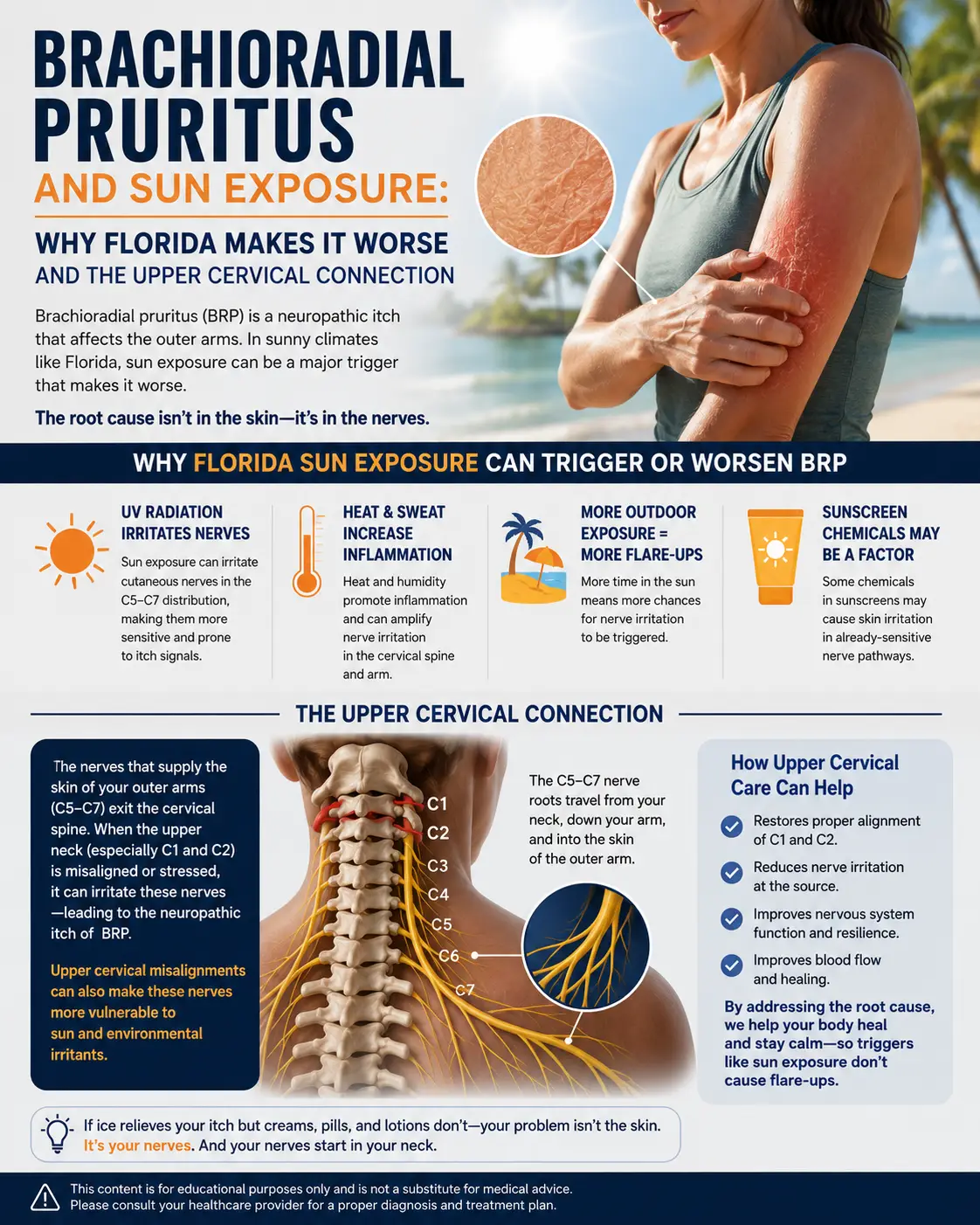
Ultraviolet radiation, particularly UVB and to a meaningful degree UVA, is absorbed by tissue at exactly the depth where those terminals live. The damage is not the sunburn you can see. Erythema — redness — is an inflammatory response that fades over days. The nerve injury is quieter and more cumulative. Repeated UV exposure over years is associated with a reduction in intraepidermal nerve fiber density, which is the standard laboratory measure of small fiber integrity. Skin biopsies taken from the affected forearms of brachioradial pruritus patients have shown reduced epidermal innervation compared to normal skin. In other words, the patch of skin that itches has fewer nerve endings than it should — not more.
That sounds backwards until you understand how neuropathic symptoms work. Damaged and dying sensory fibers do not go quiet. They become unstable. Injured C-fibers develop what neurophysiologists call ectopic firing — spontaneous, unprovoked electrical discharges generated not by any stimulus in the environment but by the damaged membrane itself. Sodium channel expression along the injured axon changes. The firing threshold drops. The nerve begins broadcasting signals that correspond to nothing happening on the surface of your skin. The brain receives that traffic and has to interpret it, and along the itch-specific pathways, the interpretation is: something is crawling on my arm, scratch it. This is precisely why scratching brings no relief. There is nothing on the skin to remove. The signal originates inside the wire.
Why the Dorsolateral Forearm Specifically
Patients often ask why this lands on the outer forearm and essentially nowhere else. Two factors converge on that exact strip of skin.
The first is pure sun geometry. Think about the resting position of your arms as you walk, drive, golf, garden, fish, or push a shopping cart. Your forearms hang in mild pronation with the dorsolateral surface — the outer, thumb-side aspect over the brachioradialis muscle — angled upward and outward toward the sky. That surface catches more direct and reflected ultraviolet radiation over a lifetime than almost any other part of the body except the face, the back of the neck, and the forearm’s cousin, the dorsum of the hand. In a short-sleeve climate like Sarasota’s, that skin is exposed nearly every day of the year. It is, in the most literal sense, the highest-mileage skin on your arms.
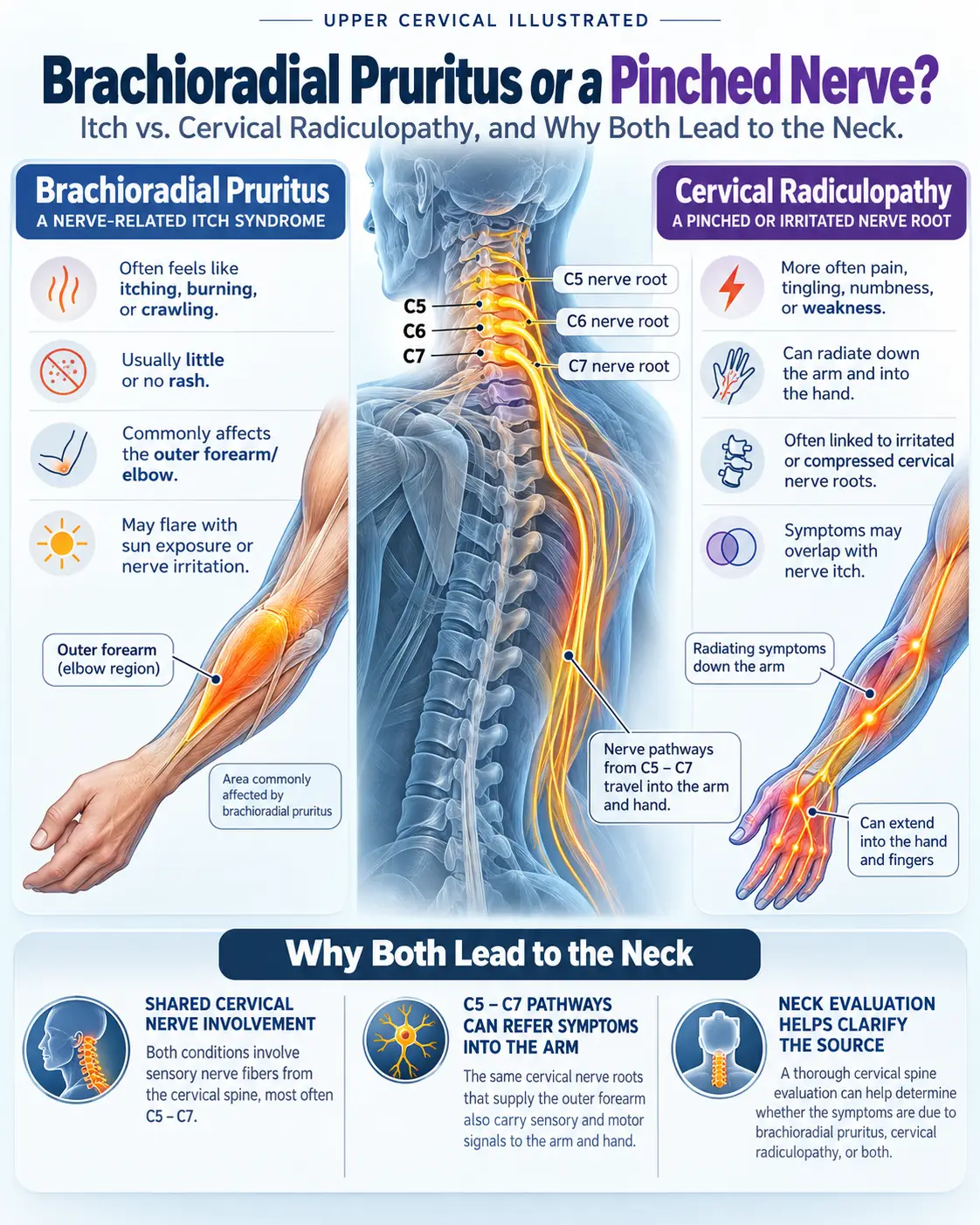
The second factor is neurological, and it is the hinge on which this entire article turns. That same strip of skin is served by sensory fibers that travel back through the lateral antebrachial cutaneous nerve and the superficial radial nerve, which trace their roots to the C5, C6, and C7 cervical nerve roots. The dermatomes of the dorsolateral forearm map cleanly onto the mid-to-lower cervical spine. So the region that receives the most ultraviolet punishment happens to also be the region whose nerve supply passes through the most mechanically stressed and most commonly degenerated segments of the human neck. Two independent risk factors landing on the same few square inches of skin is not a coincidence — it is the mechanism.
Fair Skin, Middle Age, and Cumulative Exposure
The demographic profile of brachioradial pruritus reads like a description of a large slice of Southwest Florida’s population. It is most common in fair-skinned adults — Fitzpatrick skin types I through III — because less melanin means less natural attenuation of ultraviolet penetration into the dermis. It is most common in the fourth through seventh decades of life, because the mechanism is cumulative rather than acute. It is more frequently reported in women, though men are well represented. And it is dramatically overrepresented in people who live in, or have vacationed extensively in, sunny latitudes.
Crucially, this is a lifetime-dose phenomenon, not a last-weekend phenomenon. The patient who moved to Bradenton three years ago and started itching last summer is not itching because of the last three Florida summers. They are itching because of fifty prior summers of sailing, farming, roofing, tennis, or beach vacations, and Florida has now pushed the accumulated total past the threshold where symptoms declare themselves. This is also why so many transplants to Sarasota develop symptoms within a few years of moving here — the relocation didn’t create the nerve damage, it finished it.
The StatPearls clinical reference on brachioradial pruritus (PMID 29083620) frames the condition as having a dual etiology — ultraviolet exposure and cervical spine pathology — and notes that the two are widely regarded as complementary rather than competing explanations. That dual framing is the foundation of everything that follows.
Why Symptoms Flare in Summer and Ease in Winter
The seasonality of brachioradial pruritus is so reliable that it functions almost as a diagnostic clue. Patients describe a rhythm: symptoms build through April and May, peak from June through September, and taper through late fall. Some people in northern climates report near-total remission during winter. In Sarasota, the winter relief is real but usually partial, because our “off season” still delivers UV index readings of 5 to 7 on clear January days — levels that would count as a strong summer day in New England.
Several things are happening at once during those high-exposure months.
Cumulative UV dose rises steeply. The solar zenith angle is higher, days are longer, and the atmosphere filters less. A midsummer noon hour in Sarasota can deliver a UV index of 10 to 12. The rate of ongoing injury to already-compromised small fibers accelerates, and inflammatory mediators released in sun-exposed skin — histamine, prostaglandins, neuropeptides such as substance P and CGRP — directly sensitize C-fiber terminals, lowering their firing threshold further.
Heat itself lowers the itch threshold. This is separate from UV. Thermal loading of the skin increases the excitability of TRPV1-expressing sensory neurons, the same channels that respond to capsaicin. On a 93-degree August afternoon in Florida with 80 percent humidity, forearm skin temperature climbs and those channels sit closer to their activation threshold. Many patients report that the itch fires up simply on walking from an air-conditioned building into the parking lot, before any meaningful new sun exposure has occurred.
Clothing coverage drops. From May through October, most of us are in short sleeves seven days a week. The single most protective variable — fabric between skin and sky — disappears for half the year.
Time outdoors increases. Boating, beach days, pool time, yard work, golf, and the general pull of Gulf Coast living all peak in the warm months. So does reflected UV, which is a genuinely underappreciated contributor here. Water reflects a meaningful fraction of incident UV, and dry sand reflects a substantial amount as well. A day on a boat delivers a dose from above and a second dose bouncing up off the surface, hitting exactly the underside-and-outside angles that clothing and hats never cover.
The mirror image explains the winter improvement. Cooler skin, longer sleeves, lower solar angle, and less outdoor exposure combine to let the irritable fibers settle. The itch quiets. And then April comes around, and the cycle restarts — which is precisely why so many people go years without seeking care, because every fall the problem seems to be going away on its own.
There is one more clinical clue worth naming here because it is so specific to this condition. The ice-pack sign — dramatic, immediate relief from applying something cold to the itching forearm — is described in the StatPearls reference as characteristic of brachioradial pruritus and is one of the features that distinguishes it from ordinary dermatologic itch, which typically responds better to antihistamines than to cold. If ice works for you and Benadryl doesn’t, that is a meaningful piece of information, and it points strongly toward a neuropathic mechanism rather than a skin-surface one.
The Dual-Hit Model: Sun Damage Plus Spinal Involvement
Now we arrive at the central question. If ultraviolet exposure damages small nerve fibers, and Florida delivers enormous ultraviolet exposure, why doesn’t every long-time Floridian have brachioradial pruritus?
Consider a realistic comparison. Two neighbors in Palmer Ranch, both 64, both fair-skinned, both retired here from the Midwest a decade ago, both play golf four mornings a week, both have decades of prior sun behind them. Their forearm skin has taken a nearly identical beating. One has been tormented by an unscratchable itch on the right forearm for two summers running. The other has never given her arms a second thought. Same sun. Same skin type. Same age. Completely different symptoms.
Sun exposure cannot be the whole explanation, because sun exposure is close to a constant in this population while the symptom is not. Something has to determine who converts damaged peripheral fibers into a conscious, relentless itch.
The literature’s answer is the cervical spine. When investigators have actually imaged the necks of brachioradial pruritus patients, they have found spinal pathology at a rate far above what you would expect by chance. In the largest such series, Marziniak and colleagues published in the Journal of the American Academy of Dermatology in 2011 (PMID 21641675) reported cervical MRI findings in 41 patients with brachioradial pruritus. They found evidence of nerve compression in 80.5 percent of them, and — importantly — the level of the compression corresponded to the dermatomal distribution of the patients’ itch. The pathology was not random; it lined up with where the symptoms were. Their imaging focused on the mid-to-lower cervical segments, the C5 through C8 territory that supplies the forearm.
A more recent case series reinforces the picture. Shields and colleagues, writing in Cureus in 2022 (PMID 35291549), described the clinical, electromyographic, and cervical MRI features of nine patients with brachioradial pruritus. They documented cervical spine abnormalities including disc pathology and foraminal narrowing in this group, again in the mid-to-lower cervical region, and used the findings to argue that brachioradial pruritus deserves to be evaluated as a cervical radiculopathy variant rather than as a purely dermatologic complaint.
And there is treatment-side evidence that the spine is not merely an incidental finding. Weinberg and colleagues reported in JAAD Case Reports in 2018 (PMID 30094306) on the use of a CT-guided cervical nerve root block to treat brachioradial pruritus, with symptomatic improvement following the intervention. That matters logically: when an intervention aimed at the cervical nerve root changes a symptom felt in the forearm skin, the cervical root is participating in the symptom.
So the working model — and this is where the whole field has landed — is a dual hit. Ultraviolet radiation supplies the peripheral injury: irritable, ectopically firing small fibers in the skin of the dorsolateral forearm. The cervical spine supplies the second hit: a compromised or hyperexcitable pathway that determines whether that peripheral noise ever becomes a conscious, tormenting symptom. Neither alone is reliably sufficient. Together they produce brachioradial pruritus.
Which brings us to the part of this model that is almost never discussed, and which I think is the most clinically important idea in this article.
Why the Upper Cervical Spine Is Central
I want to be scrupulously careful here, because this is where health content usually gets sloppy. The imaging studies I cited above looked at the mid and lower cervical spine — C5, C6, C7. None of them imaged or reported findings at the atlas and axis. I am not going to claim they did. What follows is mechanistic reasoning grounded in established neuroanatomy and in the accepted pathophysiology of neuropathic itch — it is a rationale for why the upper cervical region deserves attention, not a summary of trial results. I will flag clearly which parts are established science and which parts are my clinical reasoning.
There are two mechanisms, and the first is the more important of the two.
Mechanism One: Descending Inhibitory Control and Spinal Hyperexcitability
Here is the piece that reframes everything.
Itch is not simply transmitted from skin to brain like water through a pipe. It is actively gated at the spinal cord. When itch-carrying fibers from your forearm arrive at the dorsal horn of the spinal cord, they synapse in a densely regulated network of excitatory and inhibitory interneurons. Whether that incoming signal is amplified and relayed upward, or suppressed and never consciously perceived, depends on the balance of that local circuitry. Inhibitory interneurons in the dorsal horn continuously suppress itch transmission. This is not a passive filter — it is an active, energy-consuming brake that runs all day long.
And that brake is not autonomous. It is supervised from above. Descending pathways originating in the brainstem — including serotonergic and noradrenergic projections from regions such as the rostral ventromedial medulla and the locus coeruleus — travel down the spinal cord and modulate the excitability of dorsal horn circuits. These descending systems set the gain on the whole apparatus. When descending inhibition is robust, a substantial amount of peripheral itch traffic can arrive at the cord and simply never reach consciousness. When descending inhibition is diminished, the dorsal horn becomes hyperexcitable, and modest peripheral input produces disproportionate, persistent, sometimes agonizing symptoms.
This is not fringe theory. The review by Hachisuka, Chiang, and Ross in Pain in 2018, “Itch and neuropathic itch” (PMID 29389746), lays out precisely this architecture: itch is subject to inhibitory gating within the dorsal horn, and loss of inhibition — whether from disinhibition of local interneurons or from altered descending control — is a central mechanism in the generation of chronic neuropathic itch. In neuropathic itch conditions, the problem is not only that the periphery is damaged. It is that the spinal cord’s ability to suppress the resulting signal has been degraded, producing a state of central sensitization and spinal hyperexcitability.
Now hold that idea next to a piece of anatomy.
Those descending inhibitory pathways from the brainstem do not teleport to the thoracic cord. They exit the brainstem and travel down through the uppermost segment of the spinal cord — the region enclosed and mechanically defined by the first and second cervical vertebrae, the atlas (C1) and the axis (C2). Every descending modulatory fiber that will eventually govern dorsal horn excitability at C5, C6, and C7 first has to pass through the upper cervical canal. Anatomically, the upper cervical spine is the corridor through which the body’s brake on itch is routed.
The atlas is a structurally unusual bone. It has no disc above or below it. It carries the weight of the head on two shallow, relatively unlocked joint surfaces. It is stabilized primarily by ligament and by muscle rather than by bony interlock, and it sits at the junction where the brainstem transitions into spinal cord. It also has an unusually rich supply of proprioceptive receptors — the small suboccipital muscles connecting the skull, atlas, and axis have among the highest densities of muscle spindles anywhere in the body, feeding continuous positional information into the brainstem. This region is not just a mechanical hinge; it is a dense neurological interface.
Here is my clinical reasoning, offered as reasoning: if the upper cervical region is misaligned and the head is not sitting neutrally on the atlas, the neurological environment at the very corridor where descending inhibitory control passes is not operating under normal conditions. Altered proprioceptive input from the suboccipital region, altered mechanical relationships at the craniocervical junction, and the resulting changes in postural and autonomic tone all plausibly influence the tone of the descending systems that set spinal gain. If descending inhibition is even modestly less effective, the dorsal horn sits in a more excitable state, and identical peripheral input from sun-damaged forearm fibers produces a much larger perceived signal.
This is the explanation for the Palmer Ranch neighbors. Two people with identical sun exposure, identical skin damage, and identical peripheral nerve irritation can have completely different symptoms because they have different inhibitory capacity. One person’s spinal cord is suppressing the noise. The other person’s is amplifying it. The peripheral injury sets the stage; the state of the modulatory system determines whether the curtain goes up.
To say it plainly: the sun creates the signal. The upper cervical spine is where the body’s brake on that signal lives. And if you only ever address the periphery — sunscreen, sleeves, topical creams — you have done nothing about the brake.
I want to be explicit about the epistemic status of this. There is no published randomized trial testing upper cervical correction for brachioradial pruritus. What is established in the literature is that (a) itch is gated in the dorsal horn, (b) descending inhibitory control from the brainstem modulates that gate, and (c) loss of inhibition and spinal hyperexcitability are central to neuropathic itch. What is my mechanistic reasoning is the proposal that the biomechanical and neurological state of the upper cervical spine is a meaningful variable in that system and is therefore worth evaluating and correcting. I offer it as a rationale, not as proof.
Mechanism Two: Upstream Biomechanics and Downstream Degeneration
The second mechanism is more concrete and more mechanical.
The studies that imaged brachioradial pruritus patients found degenerative change, disc pathology, and foraminal narrowing in the lower cervical spine. The reflexive interpretation is that the lower cervical spine simply wore out on its own. But the cervical spine does not degenerate randomly. It degenerates where it is loaded, and the load pattern of the entire neck is set from the top down.
The head weighs roughly ten to twelve pounds and balances on the atlas. If the head-neck relationship at the top is off — even by a few degrees — the body cannot simply tolerate a tilted head. Your visual and vestibular systems demand that your eyes stay level with the horizon. So the body compensates, and it compensates below the site of the problem. The lower cervical segments tilt, rotate, and shear to bring the head back to level. Those compensations are not transient postures; they become the resting structural configuration, held for years.
The consequence is chronic asymmetric loading of the mid and lower cervical spine. Facet joints on one side bear more compressive load than the other. Discs are loaded eccentrically rather than evenly. Over decades, tissue responds to that loading exactly the way tissue always responds: with degenerative change, osteophyte formation, disc height loss, and narrowing of the intervertebral foramina — the bony canals through which the C5, C6, and C7 nerve roots exit toward the arm.
So when a study reports foraminal narrowing at C5-C6 in a brachioradial pruritus patient, my clinical question is not “what caused that segment to wear out?” but “what has this person’s head been doing to that segment for the last forty years?” The lower cervical findings in the literature are frequently the downstream consequence of an uncorrected upper cervical problem. Again — that is mechanical reasoning about how spines load and degenerate, not a finding reported by the imaging studies themselves. But it is reasoning consistent with how every other joint in the body behaves under chronic asymmetric load.
The practical implication is significant. If you address only the lower cervical segments where the imaging abnormality appears, you are treating the site of tissue failure while leaving the loading pattern that produced it fully intact. Correcting the upper cervical alignment addresses the loading pattern itself, which is upstream of the degeneration.
Putting the Two Mechanisms Together
Stack all of it and the full model looks like this:
Decades of Florida ultraviolet exposure damage the small sensory fibers in the skin of your dorsolateral forearm, leaving them irritable and prone to ectopic firing. That traffic travels through the C5-C7 nerve roots. If those roots pass through foramina narrowed by degeneration — degeneration itself driven in significant part by years of compensatory loading from an uncorrected upper cervical misalignment — the signal is further distorted along the way. It arrives at the dorsal horn of the cervical spinal cord, where it should be substantially suppressed by inhibitory gating under brainstem supervision. But if descending inhibitory control routed through the upper cervical cord is compromised, the dorsal horn is hyperexcitable, the gate fails to close, and the signal is amplified rather than filtered.
The result is an itch on your forearm that has no rash, no visible cause, no response to antihistamines, and no relief from scratching — because the problem was never on the surface of your skin.
You can learn more about how we evaluate and address the top of the neck on our upper cervical chiropractic care page, and our full overview of this condition lives on our brachioradial pruritus pillar page.
Sun Protection Strategies That Matter in Florida
None of the above means sun protection is irrelevant. It means sun protection is one half of a two-part problem. Reducing ongoing ultraviolet insult to already-injured fibers is genuinely worth doing, and doing it well in Florida requires more than a bottle of SPF 30 in the glove compartment.
UPF-rated long sleeves are the single highest-leverage change. Fabric is the only sun protection that does not wear off, sweat off, or require reapplication. Look for a UPF rating of 50+, which blocks approximately 98 percent of ultraviolet radiation. Modern lightweight performance fabrics are genuinely comfortable in Gulf Coast heat — the fishing and golf apparel industry has solved this problem. Long-sleeve sun shirts, sun sleeves that slip over the forearms, and UPF hoodies are all effective. Note that an ordinary white cotton t-shirt provides a UPF of roughly 5 to 7, and drops further when wet. Not all fabric is equal.
Broad-spectrum sunscreen, applied adequately and reapplied honestly. “Broad-spectrum” matters because you need UVA coverage, not just the UVB protection that SPF numbers primarily measure. Use SPF 30 or higher. The two most common failures are under-application — most people apply roughly a quarter to a half of the amount used in laboratory testing, which means real-world protection falls well short of the number on the bottle — and failure to reapply. Reapply every two hours of exposure, and immediately after swimming or heavy sweating. Set a phone timer if you’re on a boat.
Shade during peak hours. The window from roughly 10 a.m. to 4 p.m. delivers the large majority of daily ultraviolet dose. In Sarasota during summer, that midday window is genuinely intense. Shifting your golf round to an early tee time, walking the dog before nine, and gardening after five are simple structural changes that cut cumulative dose dramatically without cutting outdoor time.
Take car windows seriously — this one is underappreciated. Standard automotive windshields are laminated glass and block the large majority of UVA. Side and rear windows in most vehicles are tempered glass, which blocks UVB effectively but transmits a substantial fraction of UVA. UVA penetrates deeper into the dermis than UVB and reaches the small fiber terminals we care about. This is why dermatologists routinely observe asymmetric sun damage favoring the driver’s side in countries that drive on the right — for us in the United States, the left arm.
If your itch is unilateral and it’s on your left forearm, and you commute on I-75 or spend real time driving around Sarasota and Bradenton, your driver’s side window is a live exposure source every single day, including cloudy days and winter days. Consider having your side windows tinted with a UV-blocking film. Even clear, non-darkening films can block the overwhelming majority of UVA while remaining fully street-legal in Florida. A sun sleeve on the driving arm accomplishes much of the same thing for free. I have had patients report meaningful change from this one adjustment alone, simply because the daily driving dose was larger than they realized.
Plan seasonally. If you know your symptoms build every May, start protective habits in March rather than reacting in July. Prevention of accumulation works better than damage control after the fact. Snowbirds who spend winters here and summers north should be aware that their exposure is not lower during a Florida winter than during a northern summer — it is often comparable.
And get your skin checked. This is not optional advice, and I want to be emphatic about it. Anyone with the sun exposure history that goes along with brachioradial pruritus is, by definition, in an elevated-risk group for skin cancer including basal cell carcinoma, squamous cell carcinoma, and melanoma. Please establish care with a dermatologist and get regular full-body skin examinations. The same ultraviolet history that irritated your nerve endings has been affecting your keratinocytes and melanocytes too. Chiropractic care has nothing to offer for skin cancer screening, and skin cancer screening is genuinely important for you.
How Precise Upper Cervical Care Fits at Lavender Family Chiropractic
Let me describe what actually happens if you come to see us, because “chiropractic” means very different things in different offices and I want to be specific.
We start with a consultation and history. I want to know when the itching started, exactly where it is, whether it’s one arm or both, how it responds to ice versus antihistamines, what your sun history looks like across your whole life, and whether you’ve had neck injuries, whiplash, falls, concussions, or head trauma at any point. Old trauma matters enormously here, and patients frequently forget events from decades ago until asked directly. I also want to know what your physician or dermatologist has already found or ruled out.
We image the upper cervical spine with 3D CBCT. Cone beam computed tomography gives us three-dimensional visualization of the atlas, axis, and craniocervical junction. This matters because upper cervical misalignment is a three-dimensional problem involving rotation, lateral tilt, and translation simultaneously. A flat two-dimensional film cannot characterize that adequately. We are not guessing at your alignment and we are not adjusting based on a general theory of how necks work. We are measuring your specific anatomy and building a correction around it.
We assess neurological function with Tytron paraspinal infrared thermography. The Tytron scan measures paraspinal skin temperature symmetry, which reflects autonomic regulation of surface blood flow. Because that autonomic control is organized through the brainstem and cord, persistent thermal asymmetry gives us an objective, non-invasive window into whether the nervous system is regulating symmetrically. It also gives us a way to track change over time that does not depend on how you happen to feel on the day you walk in. Given that the mechanism we care most about is a modulatory one, having a functional measure alongside a structural one is important to us.
The correction itself uses the Knee Chest Upper Cervical technique. This is a precise, low-force correction delivered specifically to the upper cervical segment, calculated from your imaging. It is not high-velocity twisting manipulation. There is no cracking or popping of the neck, no rotational thrust, no general “adjust everything” approach. The contact is specific, the force is light, and the vector is determined by measurement rather than by feel. Patients who are apprehensive about having their neck twisted — and many people with neck-related symptoms are — are consistently surprised by how gentle it is.
Care is delivered through customized care plans. How often you’re seen and for how long depends on your imaging, your Tytron findings, your history, and how you hold your correction. Some people stabilize quickly. Others, particularly with long-standing changes and older trauma, take longer. We reassess along the way and adjust the plan to what we actually observe, rather than to a preset schedule.
We coordinate rather than compete. If you have brachioradial pruritus, you should have a relationship with a dermatologist and a primary care physician. Neuropathic itch on the forearm can reflect other conditions, and some of them need imaging, laboratory workup, or medical management. There are pharmacologic options — gabapentin and pregabalin among them — that some patients find helpful, and those are appropriate conversations to have with your physician. We are one input among several, and we are glad to work alongside your other providers.
What upper cervical care can and cannot do. It cannot undo ultraviolet damage to the small nerve fibers in your skin. Nothing can. It cannot reverse established degenerative change in the lower cervical spine. It does not cure brachioradial pruritus, and I am not going to suggest otherwise. What it aims to do is restore normal alignment and normal mechanics at the top of the neck — the region through which descending modulatory pathways travel, and the region that governs loading through the rest of the cervical chain. The reasoning is that improving conditions in that corridor supports better nervous system regulation, and that better regulation may change how much of the peripheral signal reaches consciousness. Some patients report meaningful change. Some report modest change. Some do not respond. I would rather tell you that honestly up front than oversell it.
Ready to find out whether your upper cervical spine is part of your picture? Call Lavender Family Chiropractic at (941) 243-3729 or book your consultation online. We are located at 5899 Whitfield Avenue, Suite 107, Sarasota, FL 34243 — right at the corner of University and Whitfield, convenient to Sarasota, Bradenton, Lakewood Ranch, and University Park.
What the Research Says
Five sources form the evidentiary spine of this article. Here is what each actually found, stated accurately.
1. Brachioradial Pruritus — StatPearls, NCBI Bookshelf (PMID 29083620) This clinical reference describes brachioradial pruritus as a neuropathic itch condition affecting the dorsolateral forearm, and presents the widely accepted dual etiology in which chronic ultraviolet exposure and cervical spine pathology both contribute. It documents the characteristic demographic profile — fair-skinned, middle-aged and older adults in sunny climates — the typical absence of primary skin lesions, and the “ice-pack sign,” the strong relief from cold application that helps distinguish neuropathic itch from dermatologic itch.
2. Shields LB, et al. Cureus, 2022 — clinical, EMG, and cervical MRI features in nine patients (PMID 35291549) A case series of nine patients with brachioradial pruritus in which the authors characterized clinical presentation alongside electromyographic testing and cervical spine MRI. They identified cervical spine abnormalities including disc pathology and foraminal narrowing in the mid-to-lower cervical region, and argued that brachioradial pruritus should be evaluated with the cervical spine in view rather than treated as a purely dermatologic complaint. Note: this study imaged the mid and lower cervical spine; it did not report findings at the atlas or axis.
3. Marziniak M, et al. Journal of the American Academy of Dermatology, 2011 — cervical MRI in 41 patients(PMID 21641675) The largest imaging series in this condition. Among 41 patients with brachioradial pruritus who underwent cervical spine MRI, 80.5 percent showed evidence of nerve compression, and the affected cervical levels corresponded to the dermatomal distribution of each patient’s itch. This correspondence between imaging level and symptom location is the strongest published evidence linking the cervical spine to brachioradial pruritus. As above, this work concerned the mid-to-lower cervical segments serving the forearm.
4. Weinberg BD, et al. JAAD Case Reports, 2018 — CT-guided cervical nerve root block (PMID 30094306) A report describing treatment of brachioradial pruritus with a CT-guided cervical nerve root block, with symptomatic improvement following the procedure. Its significance is directional: an intervention targeting the cervical nerve root altered a symptom experienced in forearm skin, supporting the cervical spine’s causal participation rather than incidental association.
5. Hachisuka J, Chiang MC, Ross SE. “Itch and neuropathic itch.” Pain, 2018 (PMID 29389746) A review of itch neurobiology that describes how itch signals are gated within the dorsal horn of the spinal cord by inhibitory interneurons, and how this gating is modulated by descending pathways originating in the brainstem. The review addresses loss of inhibition as a mechanism in chronic neuropathic itch, in which reduced inhibitory control produces spinal hyperexcitability and disproportionate symptoms relative to peripheral input. This paper supports the descending-inhibition framework described earlier; it is a review of itch neurobiology and does not study chiropractic care or the upper cervical spine specifically.
A note on integrity: none of these five papers tested upper cervical chiropractic care, and none of them imaged the atlas or axis. The upper cervical mechanisms I described are my mechanistic reasoning built on top of what these papers establish — that itch is gated in the cord, that descending brainstem control sets that gate, that those pathways traverse the upper cervical cord, and that cervical pathology correlates with brachioradial pruritus. Reasoning is not proof, and I have tried to keep the line between them visible.
Additional Self-Care
Alongside sun protection and whatever clinical care you pursue, several practical measures are worth adopting.
Use cold deliberately. The ice-pack sign is not just diagnostic — it is usable. A cold pack, a bag of frozen peas, a cool washcloth, or cold running water applied to the forearm often produces immediate relief. Cooling reduces the excitability of the small fibers generating the signal. Keep a gel pack in the freezer and one in a cooler if you’re out on the boat. Wrap it in a thin towel and limit application to ten to fifteen minutes at a stretch to protect the skin. This is symptom management rather than a solution to the underlying mechanism, but it is safe, free, and it works for a lot of people.
Stop scratching — and set up your environment so it’s easier to stop. This is hard and it matters. Scratching provides no relief in brachioradial pruritus because there is no surface irritant to remove, but it does cause real damage. Repeated scratching produces excoriation, lichenification, and secondary infection, and it drives an itch-scratch cycle in which mechanical trauma sensitizes the very fibers that are already firing abnormally. It can also inflame the skin enough to obscure a dermatologist’s examination. Keep fingernails cut short. Wear a long-sleeve layer at night if you scratch in your sleep. Reach for the ice pack as the substitute behavior rather than trying to resist through willpower alone.
Pay attention to your neck mechanics. If the cervical spine is participating in your symptoms, the hours you spend loading it matter. Bring your phone up to eye level rather than dropping your head down to it. Set your monitor so the top third of the screen is at eye height. Avoid sleeping on your stomach, which forces sustained end-range rotation of the upper cervical spine for hours at a time. Use a pillow that supports your neck in neutral — for side sleepers, thick enough to keep the head level with the spine; for back sleepers, thinner. Take a break from sustained forward head posture every twenty to thirty minutes. None of this substitutes for correcting a genuine misalignment, but it reduces the daily load working against you.
Track your pattern. Note when symptoms flare, what you were doing the previous day, how much sun you got, how hot it was, and what helped. Patterns emerge that are invisible day to day, and they are useful clinical information.
If you want a deeper walkthrough of the symptom picture and how it differs from ordinary skin itch, our article Why Won’t My Elbow Stop Itching? covers that ground in detail, and our brachioradial pruritus care page explains our clinical approach.
Serving Sarasota and Surrounding Communities
Lavender Family Chiropractic is located at 5899 Whitfield Avenue, Suite 107, Sarasota, FL 34243, at the corner of University and Whitfield — a location chosen because it sits at the natural crossroads between Sarasota and Manatee counties and is easy to reach from either direction.
We serve patients from Sarasota, Bradenton, Lakewood Ranch, Venice, Palmer Ranch, Osprey, Siesta Key, Longboat Key, Lido Key, University Park, Parrish, Ellenton, Myakka City, Punta Gorda, and St. Petersburg.
Because upper cervical care is a specialized approach and there are relatively few practitioners doing this specific work, patients regularly travel to us from well beyond the immediate area. If you are coming from Punta Gorda, St. Petersburg, or farther afield, let us know when you call at (941) 243-3729 and we will do our best to structure your visits efficiently around the drive.
Top 15 Questions About Brachioradial Pruritus, Sun Exposure, and Upper Cervical Care
1. Can you cure brachioradial pruritus? No. We do not cure brachioradial pruritus, and I want to be direct about that. There is no chiropractic cure for this condition. What we work toward is correcting upper cervical misalignment and improving how your nervous system is regulating, which is one part of a multi-part problem. Sun damage to your skin’s nerve endings is not something any provider can undo. Some patients report meaningful improvement in symptoms with care, some report modest change, and some do not respond. Anyone promising you a cure for this condition is not being straight with you.
2. Will avoiding the sun make it go away? Honestly — usually not by itself, though it often helps meaningfully. Here is the nuance. Reducing ongoing ultraviolet exposure reduces continuing injury and inflammation in already-irritable fibers, and many patients do notice their symptoms are less intense when they protect aggressively. But the nerve damage that already exists doesn’t reverse when you put on a long sleeve, and if the cervical component is present, it remains present regardless of what you wear. Many patients protect diligently and still itch. Sun protection is necessary and worthwhile; it is rarely sufficient on its own.
3. Should I see a dermatologist? Yes, absolutely, and please do this. Two reasons. First, diagnosis: an itching forearm with no rash needs proper evaluation, and a dermatologist can rule out conditions that mimic this presentation. Second, and just as important — you should be getting regular full-body skin cancer screenings. The lifetime sun exposure history that goes along with brachioradial pruritus places you in an elevated-risk group for basal cell carcinoma, squamous cell carcinoma, and melanoma. Establish care with a dermatologist and keep up with periodic skin checks. This is genuinely important and it is entirely outside what chiropractic care addresses.
4. Why is my itch on only one arm? Unilateral presentation is common and often informative. It may reflect asymmetric sun exposure — the classic example is the left forearm getting a daily UVA dose through the driver’s side window. It may reflect an asymmetric cervical finding, since degenerative and foraminal changes are frequently worse on one side. Often it reflects both. Marziniak and colleagues found that cervical levels corresponded to the dermatomal location of symptoms, so which arm itches can be a clue about which side of the neck is involved.
5. Do you take my insurance? We are a cash-pay, out-of-network practice. We are not contracted with insurance carriers, which means the care we provide is determined by clinical need rather than by what a payer has decided to authorize. Fees are transparent and discussed with you before care begins.
6. What is a superbill and can I get one? Yes, we provide superbills on request. A superbill is an itemized receipt containing the diagnosis and procedure codes your insurer needs to process an out-of-network claim. You submit it to your carrier for possible reimbursement according to your out-of-network benefits. Reimbursement depends entirely on your specific plan and is never something we can promise — but many patients with out-of-network coverage recover a portion of their costs this way. Superbills are also typically usable for HSA and FSA purposes.
7. Is the adjustment going to involve twisting or cracking my neck? No. The Knee Chest Upper Cervical technique is a precise, low-force correction. There is no high-velocity twisting manipulation, no rotational thrust, and no popping or cracking of the neck. The contact point is specific, the force applied is light, and the direction is calculated from your 3D imaging. Patients who are nervous about having their neck handled are usually surprised by how gentle it is.
8. Why 3D CBCT imaging instead of a regular X-ray? Because upper cervical misalignment happens in three dimensions at once — rotation, lateral tilt, and translation — and a flat two-dimensional image cannot characterize that adequately. Cone beam CT lets us see the actual three-dimensional relationships of your atlas, axis, and skull base, so the correction is built from measurement of your anatomy rather than from an assumption about how necks generally look.
9. What does the Tytron scan actually tell you? It measures paraspinal skin temperature symmetry, which reflects autonomic regulation of blood flow to the surface. Because that regulation is organized through the brainstem and spinal cord, persistent left-to-right thermal asymmetry provides an objective signal about how the nervous system is functioning — not just how the bones are sitting. It also gives us a way to track change over time that isn’t dependent on how you happen to feel that particular day.
10. How long before I’d know whether this is helping? It varies genuinely, and I won’t give you a number that sounds authoritative but isn’t. It depends on how long the misalignment has been present, how much degenerative change exists, your age, your history of trauma, and how well you hold a correction between visits. Some patients notice change within a few weeks; others take considerably longer; some do not respond. We reassess with objective measures along the way so that we are evaluating your actual response rather than waiting indefinitely and hoping.
11. My MRI showed problems at C5 and C6. Why would you focus on my upper neck? This is a fair and important question. Two reasons. First, the descending inhibitory pathways that regulate how much itch signal gets through at the dorsal horn travel down through the upper cervical cord — so the upper neck is relevant to the gain on the signal regardless of where the structural finding sits. Second, and this is mechanical reasoning rather than a study finding, the lower cervical spine typically degenerates under chronic asymmetric load, and the loading pattern for the whole cervical chain is set by how the head balances on the atlas. The C5-C6 finding is often downstream of an upper cervical problem, not independent of it.
12. Would neck surgery help? That is a question for a spine surgeon, not for me, and it depends entirely on your specific imaging and clinical picture. What I would say is that surgical decompression is a substantial intervention with real considerations, and most people prefer to explore conservative options before going down that road. Some patients with severe, well-localized compression and correlating symptoms are appropriate surgical candidates. That determination belongs to a surgeon who has reviewed your imaging.
13. Do gabapentin or pregabalin work for this? Some patients find these medications helpful, since they act on neuropathic mechanisms rather than on the skin. They are prescription medications with side effect profiles, and the decision to try them belongs between you and your prescribing physician. We do not prescribe and we do not advise anyone to discontinue medication a physician has prescribed. Medication and structural care are not mutually exclusive.
14. Why don’t antihistamines help? Because brachioradial pruritus is not histamine-driven. Antihistamines work on itch mediated by histamine release from mast cells — hives, allergic reactions, insect bites. Neuropathic itch originates from abnormal firing in the nerve pathway itself, and no amount of histamine blockade quiets a nerve that is misfiring for structural reasons. This is exactly why the ice-pack sign is diagnostically useful: cold reduces nerve excitability, which is the actual problem, while antihistamines address a mechanism that isn’t operating here.
15. It gets better every winter. Should I just wait it out? That is a reasonable instinct, and it is also the reason many people live with this for a decade before addressing it. The winter remission is real, but it does not mean the underlying situation is improving. Sun damage accumulates year over year, and cervical degeneration progresses over time. Most patients I see describe a pattern where each summer is somewhat worse than the last and the winter relief becomes less complete. Waiting doesn’t reverse either component. Evaluating what’s actually driving it is a better use of the quiet season than waiting for the next flare.
Ready to Take a Closer Look at Your Neck?
If you have been dealing with an unscratchable itch on your forearm that gets worse every Florida summer, and no one has evaluated your cervical spine, there is a piece of your picture that has not been examined. The sun is real, and it is part of the story. But the sun is not why you have this and your neighbor doesn’t. That answer lives in how your nervous system is modulating the signal — and the upper cervical spine sits at the center of that system.
Call Lavender Family Chiropractic at (941) 243-3729 to schedule a consultation, or book online here.
5899 Whitfield Avenue, Suite 107, Sarasota, FL 34243 — corner of University and Whitfield.
We serve Sarasota, Bradenton, Lakewood Ranch, Venice, Palmer Ranch, Osprey, Siesta Key, Longboat Key, Lido Key, University Park, Parrish, Ellenton, Myakka City, Punta Gorda, and St. Petersburg. Questions about whether we’re the right fit? Reach out through our contact page and we’ll talk it through honestly.
Related Articles
- Brachioradial Pruritus – Overview
- The Ice-Pack Sign Explained
- Treatment Options for Brachioradial Pruritus
This article is provided for educational purposes only and does not constitute medical advice, diagnosis, or treatment. Chiropractic care does not cure brachioradial pruritus or any other condition. Individual results vary. Please consult your physician and a dermatologist for evaluation of persistent itching, and maintain regular skin cancer screenings given the sun exposure associated with this condition. Lavender Family Chiropractic is a cash-pay, out-of-network practice; superbills are available on request, and reimbursement depends on your individual insurance plan.


Get our upper cervical articles first.