
Why Brachioradial Pruritus Is Worse at Night — and How to Get Through It
By Dr. Rusty Lavender, D.C. — upper cervical chiropractor, Lavender Family Chiropractic, Sarasota, FL. Reviewed and updated October 2026.
Almost every brachioradial pruritus patient tells us the same thing: “It’s fine during the day. The second I get into bed, my arms light up.” Then it’s an hour of scratching, an ice pack from the freezer, maybe a second one at 3 a.m., and a day that starts tired and ends with dread about the next night. Some people haven’t slept through the night in years.
If that’s your night, this article explains why nerve itch has a clock, what’s happening in your body between ten at night and two in the morning, why brachioradial pruritus specifically peaks after dark, and what actually gets people through to sleep — including the one change that addresses why the itch is there at all: the neck. We’ll cover the physiology of nocturnal itch, the two things about nighttime that make an irritated cervical nerve louder, a practical bedtime plan, the research behind all of it, and what an upper cervical evaluation adds.
This is educational content, not medical advice. Itching that wakes you nightly along with night sweats, fever, or unexplained weight loss should be evaluated by a physician.
Nighttime Itch Is Real and It’s Measurable
You’re not imagining that it’s worse at night. Itch of almost every kind follows a circadian rhythm, and researchers have mapped it. Patel, Ishiuji, and Yosipovitch (2007), in a review titled “Nocturnal itch: why do we itch at night?”, laid out the physiology, and Lavery and colleagues (2016) updated it. Several things change in the evening, all in the wrong direction:
Skin temperature rises. Your core temperature drops at night to initiate sleep, and your body does that by pushing heat outward to the skin — your arms and legs get warmer. Warm skin itches more, and warmth specifically aggravates nerve-based itch.
Cortisol falls. Cortisol, the body’s natural anti-inflammatory and signal-dampening hormone, peaks in the morning and bottoms out around midnight. Its evening low removes a brake on itch signaling.
The skin barrier leaks more. Water loss through the skin increases at night, which dries the surface and adds a skin-level itch on top of whatever’s already there.
Distraction disappears. During the day your brain is processing a thousand inputs, and itch has to compete for attention. In a dark, quiet room, the itch signal has the stage to itself. This is not “in your head” in the dismissive sense; it’s how attention and sensation work, and it’s measurable.
Sleep itself changes sensation. The transition into sleep and the lighter sleep stages are when the brain is most responsive to sensory input from the body. Itch that would barely register at noon can wake you at midnight.
For skin conditions like eczema, that’s the whole story. For brachioradial pruritus, there’s another layer — and it’s the one that matters most.
Brachioradial Pruritus Is a Nerve Itch From the Neck
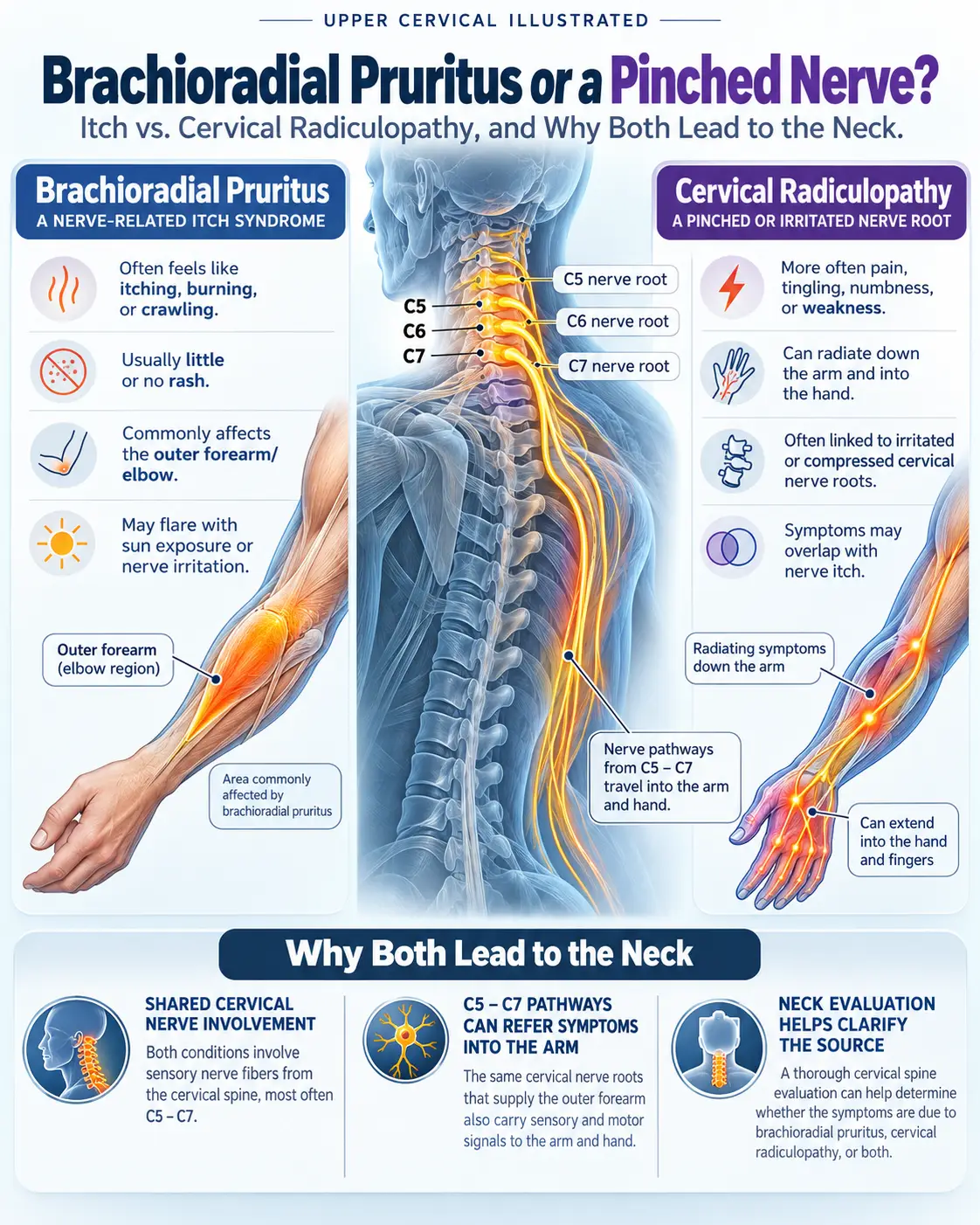
Brachioradial pruritus (BRP) is a nerve itch, not a skin itch. The research is consistent that it originates not in the skin but upstream. Cohen and colleagues (2003) called it “a symptom of neuropathy,” and Wallengren and Sundler (2005) found that the itchy skin has fewer small nerve fibers than normal — it’s being affected from above — and that the fiber density recovers during symptom-free periods.
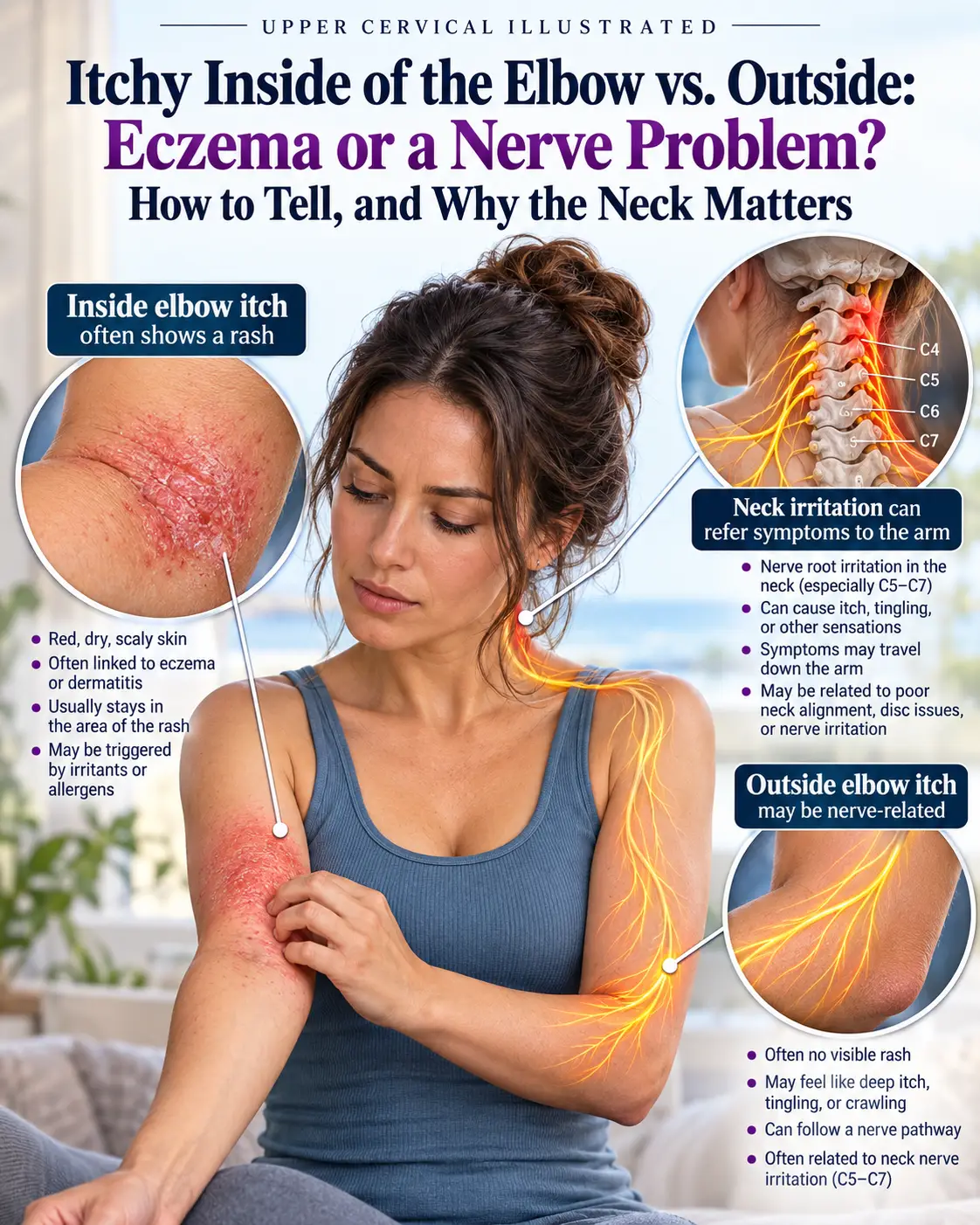
Where above? The neck. Marziniak and colleagues (2011) found cervical spine changes on MRI in the large majority of BRP patients, at levels matching the itchy area, and Goodkin, Wingard, and Bernhard (2003) proposed cervical spine disease as the common mechanism. The nerve roots in the lower neck — C5 and C6, which supply the outer forearm — are irritated, and the brain reads the signal as itch on the arm.
That’s the general picture. Now, what nighttime does to it specifically.
Why BRP Peaks at Night: Two More Reasons
Position. Lying down changes the mechanics of the neck. A pillow that’s too high or too low holds the lower cervical spine in a bent or extended position for hours — exactly where the C5–C6 nerve roots exit. Side-sleepers who tuck an arm under the pillow stretch the same nerves and compress the shoulder they run through. Many BRP patients notice the itch starts within minutes of lying down and eases when they sit up. That is a positional clue, not a coincidence, and it’s the clue that points most directly to the neck.
The day’s sun catching up. BRP is triggered by sun on the forearms — Wallengren (1998) named it a “recurrent solar dermopathy” for that reason. A day of driving with your arm on the window, yard work, boating, or the beach primes the nerve endings in the forearm skin. The flare is delayed, often arriving at bedtime when the other nighttime factors pile on. Patients frequently can’t connect the two because the sun was hours ago.
So the nightly pattern is the general nocturnal-itch physiology, plus a nerve that’s already sensitized at the neck, plus a sleeping position that may be irritating it further, plus the afternoon’s sun. Four things stacking at the same hour.
The Upper Cervical Connection
Our office looks at the top of the neck, not just the C5–C6 level where the itch nerves exit, and nighttime is the reason that matters most.
The cervical spine is organized from the top down. The atlas (C1) and axis (C2) carry the head and set the alignment for everything below. When the atlas is misaligned, the head sits off-center and the lower neck compensates — the curve flattens or reverses, the lower discs take uneven load, and over years the openings where the nerve roots exit change shape. The cervical changes the MRI studies describe develop in a spine that’s been carrying its load unevenly. Lying down on a pillow doesn’t create that problem; it exposes it, by holding the compensated lower neck in a provocative position for seven hours.
The upper cervical spine also sits against the brainstem, the relay station through which every itch signal passes and which acts as a volume control. The small muscles and joints of the upper neck feed the brainstem continuous input. Irritation at the top of the neck turns up the gain on signals from below. At night — with cortisol low and distraction gone — that extra gain is the difference between an itch you can ignore and one that wakes you.
An upper cervical evaluation in a BRP patient whose nights are the problem asks: is the top of the neck positioned in a way that’s loading the lower neck unevenly, and is the nervous system at the upper neck showing irritation? Both are measurable, and when the answer is yes, nights are typically the first thing that changes when it’s corrected.
Getting Through the Night: A Practical Plan
Everything here manages the nights. The section after it addresses the source.
Cold, applied the right way. Cold is the single most reliable relief for BRP; it’s so specific that Bernhard and Bordeaux (2005) described the ice-pack sign as a diagnostic test. For nighttime: keep two soft gel packs in the refrigerator — not the freezer, which makes them too cold to leave on and you’ll take them off. Wrap each in a thin cloth and lay it along the forearm as you settle in; swap when it warms. A refrigerated cooling gel or menthol lotion works between packs. Our article on the ice-pack sign explains why cold overrides the itch signal and how to use it well.
Cool the room and the arms. Since warm skin drives the nighttime spike, a cooler bedroom, a fan on the arms, lightweight bedding, and bare forearms — no long sleeves to bed — all help. Many patients sleep with their forearms outside the covers for this reason.
Fix the pillow and the arm position. The pillow should hold your neck in a neutral line with your spine — not propped forward, not dropped back. Side-sleepers: a pillow that fills the gap between ear and shoulder, and no arm under the pillow. Back-sleepers: a lower pillow with support under the neck curve. Stomach sleeping rotates the neck for hours and is the worst option for an irritated cervical nerve. Our guide to choosing a pillow for neck-related symptoms applies here.
Protect the forearms during the day. Less sun on the arms by day means a smaller flare at night. Sleeves or UPF arm covers while driving and outdoors are the single most effective daytime step. Our article on BRP and sun exposure covers the Florida problem.
Keep the skin moisturized. Nerve itch isn’t a dry-skin problem, but scratched skin becomes one and adds a second itch at night when the barrier leaks most. A plain, fragrance-free moisturizer at bedtime prevents that layer.
Don’t scratch — and plan for the urge. Scratching feels like relief for seconds and makes the nerve louder for hours. Worse, Kwatra and colleagues (2013) described BRP as a trigger for generalized itch — chronic scratching can teach the nervous system to itch beyond the arms. Keep nails short, keep the cold pack within reach, and if you wake scratching, cold first.
Wind down the nervous system. Stress and a racing mind lower the threshold at which the brain registers itch. A consistent bedtime, no screens for the last half hour, and slow breathing for a few minutes in bed won’t address the nerve itself, but they lower the gain.
Medication, when prescribed. For severe nightly itch, physicians sometimes prescribe medications aimed at nerve pain rather than at skin — gabapentin is the most common, often dosed at bedtime because it also aids sleep. Topical capsaicin is another option, though it burns for the first week. These are medical decisions; our article on BRP treatment optionsexplains each honestly, including what the evidence does and doesn’t show.
Upper Cervical Care at Lavender Family Chiropractic
When someone whose nights are ruined by BRP comes to our Sarasota office, the first visit is an evaluation, not an adjustment.
History and examination. The timing pattern — when it starts, what position provokes it, what helps — tells us a great deal. We confirm the ice-pack response and screen for anything that belongs with a physician.
Neurological examination. Reflexes, strength, and sensation by nerve root.
Paraspinal infrared thermography. A non-invasive scan of the heat pattern along the spine, reflecting nervous-system activity — an objective baseline of irritation and a way to track change visit to visit.
3D cone-beam CT (CBCT) imaging of the upper cervical spine. The position of the atlas and axis relative to the skull, in three dimensions and to the degree. If your physician has already ordered a cervical MRI, bring it; the two studies answer different questions, and our article on what a cervical MRI shows in BRP explains the difference.
Review of findings before any care.
Correction, if indicated. A precise, low-force procedure specific to your measurements — no twisting, no cracking, no rotation of the neck. Most patients describe it as pressure.
Remeasurement. Thermography after each visit and follow-up imaging when indicated.
Upper cervical care addresses the mechanical source the research points to — the neck — with measurement before and after, so progress is objective rather than guessed at. Results vary from person to person, and we tell you plainly what the findings show. When the upper neck is a contributor and it’s corrected, nights are usually the first thing patients report improving, because the positional component is addressed directly. Gentle neck exercises help maintain progress between visits.
If brachioradial pruritus is costing you sleep, call (941) 243-3729 or request an appointment online for an upper cervical evaluation.
What the Research Says
Itch has a clock. Patel, Ishiuji, and Yosipovitch (2007) and Lavery and colleagues (2016) reviewed the circadian physiology of nocturnal itch: rising skin temperature, falling cortisol, increased water loss through the skin, and loss of distraction.
BRP is a nerve itch. Cohen and colleagues (2003) documented neuropathic findings; Wallengren and Sundler (2005)showed the skin’s nerve supply being affected from upstream and recovering in remission.
The source is the cervical spine. Marziniak and colleagues (2011) and Goodkin, Wingard, and Bernhard (2003) linked BRP to cervical spine findings at matching levels.
Sun primes the flare. Wallengren (1998) described the recurrent, sun-triggered pattern.
Cold is the test and the relief. Bernhard and Bordeaux (2005) described the ice-pack sign.
Scratching spreads it. Kwatra and colleagues (2013) described BRP as a trigger for generalized itch.
For the bigger picture — how long BRP typically lasts and what shortens it — see how long does brachioradial pruritus last and our full brachioradial pruritus guide.
Serving Sarasota, Bradenton, Lakewood Ranch, and the Suncoast
Our office is on Whitfield Avenue in north Sarasota, minutes from the Manatee County line, and we see brachioradial pruritus patients from Sarasota, Bradenton, Lakewood Ranch, Palmetto, Parrish, Ellenton, Longboat Key, Siesta Key, Osprey, Nokomis, Venice, and North Port. Sleepless nights from arm itch are more common here than almost anywhere because of our sun, and they’re more fixable than most people have been told — once the neck is examined.
Top 15 FAQs About Brachioradial Pruritus at Night
1. Why do my arms itch only at night? Skin temperature rises, cortisol falls, the skin barrier leaks more, and there’s nothing to distract you — all itch worsens at night. BRP adds a sensitized nerve from the neck and, often, a sleeping position that irritates it further.
2. Why does it start the moment I lie down? That’s a positional clue. Lying down changes the angle of the lower neck where the nerve roots to the forearm exit; a pillow that bends or extends the neck can provoke the itch within minutes.
3. Is it safe to sleep with ice packs on my arms? Use refrigerated gel packs, not frozen ones, wrapped in cloth, and don’t tape them on. Frozen packs left on skin for long periods can cause cold injury.
4. Will Benadryl help me sleep through it? It may make you drowsy, but it doesn’t address nerve itch — BRP isn’t histamine-driven. Many patients find they’re sedated and still itching.
5. Does gabapentin help BRP at night? It’s one of the more commonly prescribed options for neuropathic itch and is often dosed at bedtime. Whether it’s right for you is a conversation with your physician.
6. Should I sleep with long sleeves? Usually not — warmth worsens it. Bare, cool forearms are better. Sleeves are for daytime sun protection.
7. Can my pillow really affect itching in my arms? If the itch is coming from irritated nerve roots in the lower neck, the position the pillow holds your neck in for seven hours matters. Patients often notice a difference within a few nights of changing it.
8. Why is it worse after a day outside, even hours later? Sun on the forearm skin primes the sensitized nerve endings; the flare is delayed and lands at bedtime when the other nighttime factors stack on top.
9. What sleeping position is best? Back or side with the neck neutral and no arm under the pillow. Stomach sleeping rotates the neck for hours and is the worst option.
10. Does a cool bedroom actually help? Yes. Rising skin temperature is one of the main drivers of nocturnal itch, and cooling the room and the arms directly counters it.
11. Why does scratching make it worse the next night? Scratching sensitizes the nerve further and damages the skin barrier, adding a skin-level itch on top. Research also shows chronic scratching can spread BRP beyond the arms.
12. Is it dangerous to lose this much sleep? Chronic sleep loss has real health costs, which is one more reason to address the source rather than only the symptom.
13. Does upper cervical care help with the nighttime itch specifically? When the upper neck is a contributor and it’s corrected, nights are usually the first thing patients report improving, because the positional component is addressed. We measure before and after so you’re not guessing.
14. How soon would I notice a difference? Typically within the first several weeks when the neck is a factor. If we don’t see objective change on thermography and in your nights, we say so.
15. Do you take insurance? Call the office and we’ll go through costs and coverage before anything begins.
Lavender Family Chiropractic in Sarasota, Florida offers a thorough upper cervical evaluation to find out whether we can help. Call (941) 243-3729 or request an appointment. 5899 Whitfield Avenue, Suite 107, Sarasota, FL 34243.
Related Articles
- Brachioradial Pruritus: Our Complete Guide
- The Ice-Pack Sign
- How Long Does Brachioradial Pruritus Last?
- Brachioradial Pruritus Treatment Options Explained
- Brachioradial Pruritus and Sun Exposure
- Neck Exercises for Brachioradial Pruritus
References
- Patel T, Ishiuji Y, Yosipovitch G. Nocturnal itch: why do we itch at night? Acta Derm Venereol. 2007. PMID 17598030
- Lavery MJ, et al. Nocturnal Pruritus: The Battle for a Peaceful Night’s Sleep. Int J Mol Sci. 2016. PMID 27011178
- Cohen AD, et al. Brachioradial pruritus: a symptom of neuropathy. J Am Acad Dermatol. 2003. PMID 12789170
- Wallengren J, Sundler F. Brachioradial pruritus is associated with a reduction in cutaneous innervation that normalizes during the symptom-free remissions. J Am Acad Dermatol. 2005. PMID 15627097
- Marziniak M, et al. Brachioradial pruritus as a result of cervical spine pathology: the results of a magnetic resonance tomography study. J Am Acad Dermatol. 2011. PMID 21641675
- Goodkin R, Wingard E, Bernhard JD. Brachioradial pruritus: cervical spine disease and neurogenic/neuropathic pruritus. J Am Acad Dermatol. 2003. PMID 12664013
- Wallengren J. Brachioradial pruritus: a recurrent solar dermopathy. J Am Acad Dermatol. 1998. PMID 9810902
- Bernhard JD, Bordeaux JS. Medical pearl: the ice-pack sign in brachioradial pruritus. J Am Acad Dermatol. 2005. PMID 15928630
- Kwatra SG, et al. Brachioradial pruritus: a trigger for generalization of itch. J Am Acad Dermatol. 2013. PMID 23374230
Related Posts


Get our upper cervical articles first.