Best Pillow for Headaches — What to Look For, and the Neck Piece Most People Miss
By Dr. Rusty Lavender — Lavender Family Chiropractic, Sarasota, FL
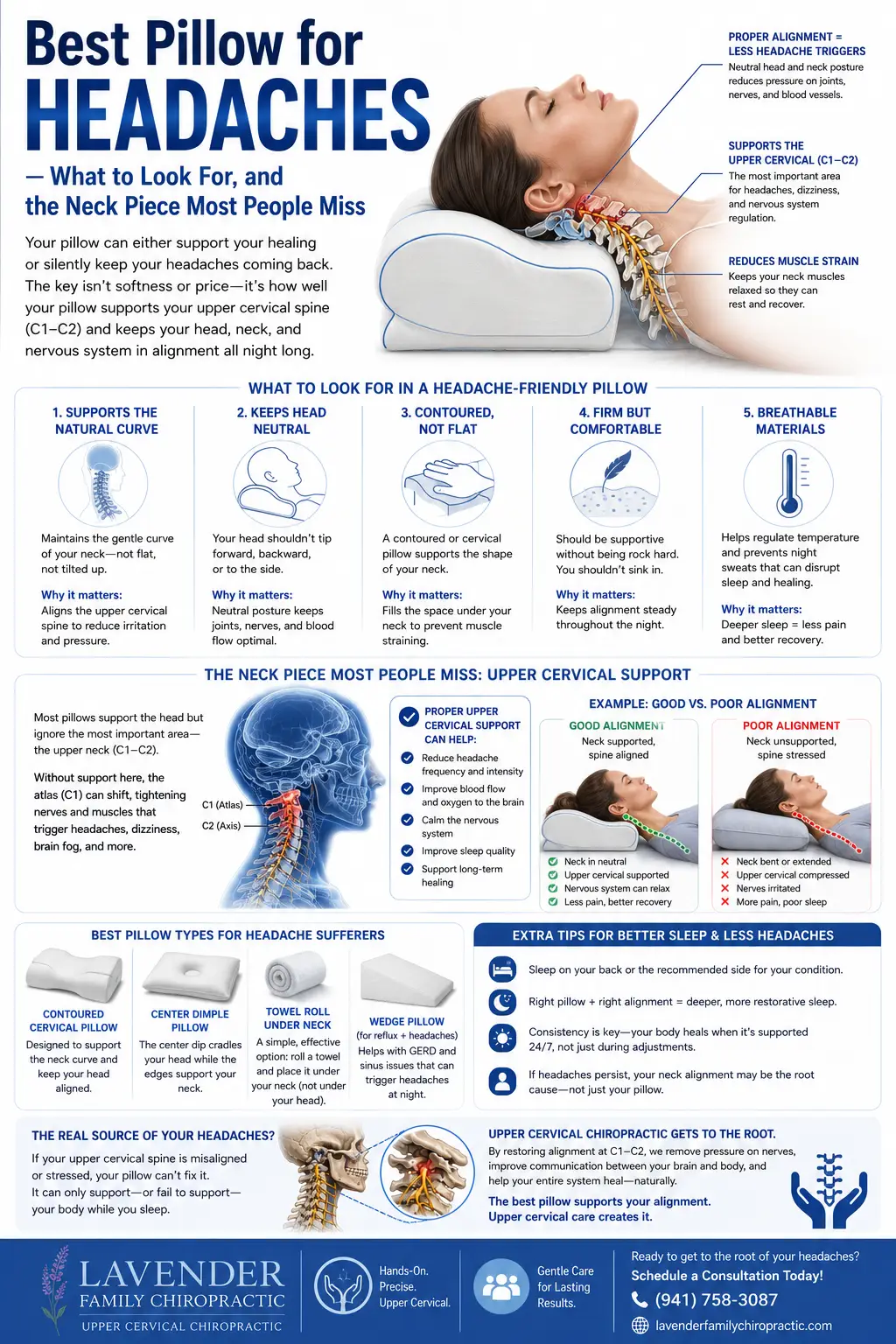
If you wake up with a headache, or your headaches get worse as the day drags on, the thing under your head for eight hours a night deserves a hard look. The wrong pillow keeps your neck bent, tensed, or unsupported all night long — and the muscles and joints at the base of your skull are a well-known source of tension-type and cervicogenic headaches. A better pillow can genuinely reduce that strain, and this article walks you through exactly how to choose one. But here’s the honest part almost no pillow guide will tell you: a pillow supports your neck, it doesn’t correct it. If your headaches keep coming back no matter what you sleep on, the missing piece may be an alignment problem at the very top of your spine that no pillow can reach.
This is a practical guide to the best pillow for headaches — height, shape, materials, and sleep position — grounded in what the research actually supports. Then we’ll get to the part that matters most for the people who’ve already bought three pillows and still wake up hurting: why the upper neck itself is worth evaluating when headaches won’t let go.
A quick note before we start: this article is about general, tension-type, and cervicogenic headaches — the everyday, muscular, neck-related kind. It is not about migraines, which are their own neurological condition with their own triggers and management, and it’s not about dizziness or vertigo. If migraine is your main problem, see our companion guide on the best pillow for migraines instead, because the priorities are different. Here, we’re staying firmly in the headache lane.
This article is educational and not a substitute for medical advice. If you have a health condition, are pregnant, take medications, or your headaches are new, severe, or changing, talk with your physician.
How Your Pillow and Sleep Position Actually Cause Headaches
Most people think of a pillow as a comfort item. Mechanically, it’s a support device — the only thing holding your head and neck in position for a third of your life. Get that support wrong and you spend seven or eight hours a night with the joints and muscles of your neck under low-grade strain, and that strain has a direct line to your head.
Here’s the anatomy that makes this matter. The muscles at the back of your neck and the base of your skull — the suboccipital muscles and the upper trapezius — attach to the head and to the top vertebrae of your spine. When those muscles are held in a shortened, tensed, or overstretched position all night, they fatigue and tighten. Tight suboccipital muscles are a classic driver of tension-type headache, the band-like, pressing ache that often sits at the back of the head, the temples, or across the forehead. And when the actual joints of the upper neck are irritated or stiff, pain can be referred up into the head as a cervicogenic headache — literally, a headache generated by the neck. In both cases, the common thread is the same: the neck is unhappy, and the head pays for it.
Now picture what a poor pillow does across a full night. Too high, and your head is shoved forward and up, cranking the back of your neck into flexion for hours. Too flat, and your head drops back or sideways, letting the neck sag out of its natural curve. Too soft, and there’s no support at all — your head sinks and your neck twists to find a resting spot. Sleep on your stomach, and your head is rotated hard to one side the entire night just so you can breathe. Every one of these positions loads the very muscles and joints that generate headaches. You wake up, or you get through your morning, and by mid-day the ache sets in — and it never occurs to most people that it started on their pillow.
This is why the pillow conversation is a real one, not a gimmick. It won’t fix everything, but for a meaningful number of people, the difference between a neck held in a neutral, supported position all night and a neck bent out of shape all night is the difference between waking up clear and waking up with your head already throbbing.
What the Research Says About Pillows and Neck Pain
Before the specifics, it’s worth being straight about the evidence, because pillow marketing is full of confident claims and the actual science is more modest — but it’s real, and it points in a consistent direction.
Pillow support genuinely affects neck comfort and pain. A randomized controlled trial comparing pillow types for their effect on cervical pain and comfort found that pillow choice measurably influences how the neck feels — not every pillow is equal, and the design matters. In a separate line of research, a study on the effects of a supportive pillow reported that a well-designed, supportive pillow reduced neck, thoracic, and head pain compared with participants’ usual pillows. And an earlier controlled study on pillow preferences and the effect of pillow design examined how shape and support change comfort and next-morning symptoms, reinforcing that the physical characteristics of a pillow — not just personal preference — shape the outcome.
What does this add up to honestly? Not a miracle, and not a cure for headaches. It adds up to this: the right pillow can reduce the neck strain that feeds tension-type and cervicogenic headaches, and the wrong one can add to it. That’s a worthwhile lever to pull — it’s just not the whole machine. Keep that framing in mind as we go through the how-to, because it’s exactly the point we’ll return to at the end.
Pillow Height and Loft — The Single Most Important Factor
If you change one thing, change the height. The loft of a pillow — how tall it is when your head rests on it — is the biggest driver of whether your neck stays neutral or gets bent all night, and it’s the factor people get wrong most often.
The goal is simple to state and specific to your body: when you’re lying down, your head and neck should stay in line with the rest of your spine, in roughly the same neutral position you’d hold if you were standing tall with good posture. Your nose should point straight ahead, not tipped up toward the ceiling or down toward your chest. Your head should not be pushed up and forward, and it should not be dropping back or sagging to the side. Neutral is the target — the natural, gentle curve of the neck, supported, not forced.
Here’s the catch that trips people up: the right loft depends on your sleeping position, so there is no single “correct” pillow height for everyone.
- Side sleepers need a higher, firmer pillow. When you’re on your side, there’s a real gap to fill — the distance from the outer edge of your shoulder up to your head. The pillow has to bridge that entire width to keep your head level and your neck straight. Too low, and your head drops toward the mattress, bending your neck downward all night. A taller, firmer pillow that fills the shoulder-to-head gap keeps the spine level.
- Back sleepers need a lower, thinner pillow. On your back, the gap to fill is much smaller — just the natural curve behind your neck. A tall pillow here shoves your head forward into flexion, chin toward chest, which is exactly the position that fatigues the suboccipital muscles and feeds tension headaches. A lower pillow with a bit of support under the neck’s curve keeps things neutral.
A quick self-check: lie down in your normal sleeping position and have someone look at you from the front (side sleeping) or the side (back sleeping). Is your head level with your spine, or is it cocked up, dropped down, or tilted? If your neck isn’t in a straight, comfortable line, your loft is wrong — and no amount of “premium memory foam” marketing changes that.
Cervical and Contour Pillows — Support Where the Neck Curves
Beyond raw height, shape matters. A flat, uniform pillow supports your head but does nothing for the space behind your neck, where the curve leaves a gap. That unsupported curve is often where the trouble lives.
A cervical pillow — sometimes called a contour or orthopedic pillow — is designed with a raised section to cradle the neck’s natural curve and a lower section for the head. The idea is to actively support the cervical curve rather than leaving it to sag. For back sleepers especially, that neck support under the curve can help keep the upper cervical region in a neutral, relaxed position instead of unsupported all night. The controlled research on pillow design suggests this kind of shaped, supportive contour can reduce neck and head symptoms compared with an unsupportive pillow.
A few honest caveats. Contour pillows aren’t magic, and they aren’t for everyone — some people find them too tall, too firm, or awkward if they change position a lot during the night. The correct contour height still has to match your body and your dominant sleep position; a cervical pillow sized for a broad-shouldered side sleeper will be wrong for a petite back sleeper. And if you’re a committed side sleeper, a well-fitted firm pillow of the right height can serve you just as well as a fancy contour. The principle to carry away isn’t “buy a contour pillow” — it’s “get support under the curve of your neck, not just under your head.”
Materials — What the Fill Actually Does
Once height and shape are right, material is mostly about how well the pillow holds that support through the night and how it feels. Here’s the practical rundown without the marketing gloss.
- Memory foam (solid). Contours to your head and neck and holds its shape well, which is good for maintaining consistent support all night. A solid molded memory-foam cervical pillow keeps its loft rather than compressing flat. Downsides: it can sleep warm, and some people dislike the slow, dense feel.
- Shredded memory foam or adjustable fill. Often the most practical choice, because you can add or remove fill to dial in the exact loft for your body and position. Since correct height is the number-one factor and everyone’s different, adjustability is a genuine advantage.
- Latex. Supportive and responsive with a bit more bounce than memory foam, holds its shape well, tends to sleep cooler, and is naturally durable. A solid middle-ground option.
- Down and down-alternative. Soft and comfortable, but they compress easily, so they often collapse below the loft your neck needs and leave your head sagging by morning. If you love the feel, look for a firmer, higher-fill version, or use it on top of more supportive support — but for neck-driven headaches, pure soft down is usually not the best pillow for headaches.
- Feather. Similar issue to down: it molds nicely but flattens, and you end up fluffing it all night to keep any support at all.
The takeaway: prioritize a material that maintains its loft and support for the hours you’re actually asleep — a pillow that’s perfect when you lie down but flat by 3 a.m. is a pillow that bends your neck for the second half of the night. Firmness and durability of support beat plushness when headaches are the concern.
Sleep Position — And Why Stomach Sleeping Has to Go
You can buy the finest pillow made and still wreck your neck with the wrong position. Position and pillow work together, so let’s be specific.
Side sleeping and back sleeping are both neck-friendly when paired with the right loft. Side sleeping needs the taller, firmer pillow to fill the shoulder gap; back sleeping needs the lower pillow with neck support. Both can keep your spine neutral all night.
Stomach sleeping is the one to eliminate, and it’s worth being blunt about why. To breathe while lying face-down, you have to turn your head hard to one side and hold it there for hours. That’s sustained, maximal rotation of the upper neck — the exact opposite of neutral — plus the flattening of your neck’s natural curve because your face is pressed into the pillow. It loads the upper cervical joints and suboccipital muscles about as badly as any position can, and it’s a common hidden driver of morning headaches and stiff, aching necks. There’s no pillow that makes stomach sleeping safe for your neck; the fix is to stop.
Changing your sleep position is genuinely hard, because your body defaults to it once you’re asleep. A few tactics that help: start the night on your side or back with a pillow height that makes that position comfortable (comfort is what keeps you there); hug a body pillow to make side sleeping feel more stable and to physically block yourself from rolling onto your stomach; and place a pillow against your abdomen or lower chest so that rolling face-down feels wrong. It takes a few weeks, but people do retrain, and the payoff for a headache-prone neck is real. If back sleeping bothers your lower back, a pillow under the knees keeps the spine comfortable and makes the position easier to hold.
While we’re on habits — the neck strain that feeds headaches doesn’t only happen at night. Hours hunched over a phone or laptop with your head jutting forward loads the same suboccipital muscles all day. If you’re serious about your headaches, the daytime posture matters as much as the pillow, and the two together are what determine how much strain the base of your skull carries. Persistent neck pain and neck-driven headaches usually share the same roots.
The Piece a Pillow Can’t Fix: Upper Cervical Misalignment
Here’s where nearly every pillow guide stops — right before the most important part for the people who need it most. Everything above assumes one thing: that your neck is structurally sound and simply needs to be supported in a good position. For a lot of people, that’s true, and the right pillow is enough to settle their headaches. But there’s a group this doesn’t cover, and if you’re one of them, no pillow on earth will do it.
Think about what a pillow actually does. It holds your neck in a good position while you sleep. What it cannot do is change how the bones of your neck are aligned in the first place. And the two most important bones in this whole conversation are the top two: the atlas (C1) and the axis (C2) — the small vertebrae at the very top of your spine that carry the weight of your head and allow it to nod and turn. This upper cervical region is held largely by ligaments and surrounded by the exact suboccipital muscles and nerves involved in tension-type and cervicogenic headaches.
If the atlas or axis is misaligned — shifted out of its proper position — it creates ongoing mechanical strain and irritation right at the junction where headaches are generated, and it does this regardless of what you sleep on. A supportive pillow can hold a misaligned neck in a slightly better position, and that may take the edge off. But the moment you get up, the misalignment is still there, still straining the same joints and muscles, still feeding the same headache. You’ve supported the problem without correcting it. That’s why someone can do everything right — perfect pillow, side sleeping, good posture — and still wake up, week after week, with the same ache.
This also explains a pattern we see constantly: headaches that trace back to a specific event. A car accident, a whiplash, a fall, a sports impact, a concussion — any trauma to the head or neck can shift that top segment out of alignment, and from then on the person carries a structural driver their pillow can’t address. If your headaches started or clearly worsened after something happened to your head or neck, that’s a loud clue the problem may be structural, sitting one inch below your skull, in a region a standard headache workup almost never examines.
None of this means the pillow doesn’t matter — it does, and you should get it right. It means that for a meaningful subset of headache sufferers, the pillow is managing the symptom while the underlying misalignment goes unaddressed. A good pillow reduces strain and supports the neck. It does not correct an atlas or axis that has shifted out of place. If your headaches persist despite doing all the right things, the upper cervical spine is the piece to get evaluated — the root-cause step, not another product to buy.
How We Evaluate the Upper Neck at Lavender Family Chiropractic
At Lavender Family Chiropractic, we focus exclusively on the upper cervical spine — the atlas, the axis, and the junction where the skull meets the neck, the same region that generates so many stubborn headaches. Our approach is built on measurement, not guesswork. We use 3D CBCT imaging to see your upper cervical alignment in three dimensions, so if the atlas or axis has shifted, we can see precisely how. And we use paraspinal infrared thermography to read how your nervous system is behaving along the spine, which helps us understand the pattern behind your symptoms rather than guessing at it.
When a correction is warranted, we use the Knee Chest Upper Cervical technique: precise, gentle, and low-force, with no twisting, cracking, or popping. For a neck that’s already irritated and a head that already hurts, that gentleness is the entire point — the aim is to restore proper alignment to the top of the spine so the joints and muscles that have been driving your headaches are no longer under constant strain.
The goal is straightforward: address the structural driver a pillow can’t reach, so your neck has a chance to stop generating headaches in the first place. Keep your good pillow, keep sleeping on your side or back, keep working on your posture — all of that matters and it all works better on top of a well-aligned foundation. What we add is attention to the one region that sits at the crossroads of your neck and your headaches, the piece the pillow guides leave out. If you’ve optimized your sleep setup and still hurt, that’s the evaluation you’ve been missing. You can learn more about our approach to upper cervical chiropractic care and how it applies to headaches.
→ Call Lavender Family Chiropractic at (941) 243-3729 to schedule a complimentary consultation. We’re at 5899 Whitfield Avenue, Suite 107, Sarasota, FL 34243 — corner of University and Whitfield, minutes from Bradenton and Lakewood Ranch.
When a Headache Is an Emergency — Don’t Wait
Almost all tension-type and cervicogenic headaches are benign, if miserable. But some headaches are warning signs of something serious, and a pillow is the last thing you should be thinking about. Seek prompt or emergency medical care— call 911 or go to the nearest emergency room — if you have any of the following:
- A sudden, severe headache that comes on like a thunderclap, or the worst headache of your life.
- A new or different headache that isn’t like your usual pattern, especially if you’re over 50 or have never been a headache person.
- Headache with fever and a stiff neck, which can signal meningitis.
- Headache with any neurological symptoms — vision loss or double vision, slurred speech, confusion, weakness or numbness on one side of the body, trouble walking, a drooping face, or a seizure.
- A headache that follows a blow to the head, a fall, or any head injury — particularly if it’s worsening, or comes with vomiting, drowsiness, or confusion.
- A headache that steadily worsens over days or weeks, or one that’s consistently worse with coughing, straining, or lying down.
These are not situations to manage with a new pillow or to “wait out.” When in doubt, get evaluated urgently. Upper cervical care and pillow choice are for the ordinary, mechanical, neck-driven headaches — not for red-flag symptoms that need a physician’s immediate attention.
Top Questions
What’s the single most important thing in a pillow for headaches? Height, or loft. The pillow has to hold your head and neck in line with your spine — neutral, not bent up, down, or sideways. Side sleepers need a taller, firmer pillow to fill the shoulder gap; back sleepers need a lower one with support under the neck’s curve. Get the height right for your position and you’ve done most of the work.
Are contour or cervical pillows better than regular pillows? They can be, because they support the curve of your neck instead of leaving it to sag — which the research on pillow design supports. But they’re not universally better; the contour height still has to match your body and sleep position, and some people find them too tall or firm. The real principle is support under the neck’s curve, whatever pillow achieves that for you.
Is memory foam the best material for headache-prone necks? Solid or shredded memory foam holds its support well through the night, which matters, but it’s not the only good choice — latex is supportive and cooler, and adjustable shredded fill lets you dial in exact height. Avoid soft down or feather as your only support, because they compress flat and let your head sag by morning. Prioritize a material that keeps its loft all night.
I sleep on my stomach and get headaches. What should I do? Stop sleeping on your stomach — it’s the worst position for the neck because it forces your head into hard rotation for hours. No pillow makes it safe. Retrain to your side or back using a comfortable pillow height and a body pillow to block yourself from rolling over. It takes a few weeks, but it’s one of the highest-impact changes you can make for morning headaches.
Is this the same advice as for migraines? No — and that’s important. This guide is about tension-type and cervicogenic headaches, the everyday neck-driven kind. Migraines are a distinct neurological condition with different triggers and priorities. If migraine is your main issue, see our separate guide on the best pillow for migraines, and learn more about migraines and how the upper neck can play a role there too.
If a good pillow helps, why would I need my neck evaluated? Because a pillow supports your neck in a good position — it doesn’t correct how the bones are actually aligned. If your atlas or axis has shifted out of place, that misalignment keeps straining the joints and muscles that generate headaches all day, no matter what you sleep on. The pillow manages the symptom; the misalignment is the potential root cause. If headaches persist despite doing everything right, the upper cervical spine is the piece worth evaluating.
My headaches started after a car accident. Does that change things? It matters a great deal. Whiplash and other head or neck trauma can shift the top of the spine out of alignment, leaving a structural driver a pillow can’t reach. If your headaches began or worsened after an injury, the upper cervical region is worth evaluating rather than assuming it’s just muscle tension.
Is the adjustment forceful? No — it’s precise, gentle, and low-force, with no twisting, cracking, or popping.
Is any of this a substitute for medical care? No. This article is educational. If your headaches are new, severe, changing, or come with any of the red-flag symptoms above, see a physician promptly. Pillow choice and upper cervical care are for ordinary neck-driven headaches, and they complement good medical care rather than replacing it.
Serving Sarasota, Bradenton & Lakewood Ranch
If you’ve upgraded your pillow, fixed your sleep position, and still wake up with headaches, and you’re anywhere around Sarasota, Bradenton, or Lakewood Ranch, the structural evaluation you’re missing is close by. Lavender Family Chiropractic (NeckWise North Sarasota) sits at 5899 Whitfield Avenue — the corner of University and Whitfield — minutes from the Lakewood Ranch corridor and just across from Bradenton, so patients from all three communities reach us easily. We also see headache and neck patients from Venice, Osprey, Port Charlotte, Parrish, and the Myakka area who are done cycling through pillows and want the upper cervical region itself evaluated. Wherever you are in the region, we look at the top of your neck — the atlas and axis — using 3D CBCT imaging and paraspinal infrared thermography, so the piece a pillow can’t fix finally gets checked.
Get the Pillow Right — Then Check the Piece It Can’t Fix
Your pillow is not a small thing. It’s the only support your neck has for a third of your life, and getting it right — the correct height for your sleep position, support under the curve of your neck, a material that holds its loft, and side or back sleeping instead of stomach sleeping — can genuinely reduce the strain that feeds tension-type and cervicogenic headaches. That’s real, it’s backed by controlled research on pillow support, and it’s worth doing. Start there.
But if you’ve done all of that and the headaches keep coming back, don’t conclude you’re failing at it. Ask the question the pillow guides never do: is my neck simply being supported in a better position, or is there an underlying misalignment at the top of my spine that no pillow can correct? For a meaningful number of headache sufferers, that upper cervical piece is exactly what’s been missing — and it’s the one region no one has looked at. For every headache type we evaluate and how the upper neck is involved, see our guide to headache treatment in Sarasota.
Let us look at what the pillow can’t reach. Call (941) 243-3729 or book a consultation. Get the pillow right — and make sure the neck underneath it is right too.
Lavender Family Chiropractic (NeckWise North Sarasota) · 5899 Whitfield Avenue, Suite 107, Sarasota, FL 34243 · (941) 243-3729
This article is for general educational purposes only and is not medical advice, diagnosis, or treatment. Please consult your physician before making changes to your health routine, especially if your headaches are new, severe, or changing, if you have a medical condition, are pregnant, or take medication.
Related Articles


Get our upper cervical articles first.
Patients Experience

Popular Posts