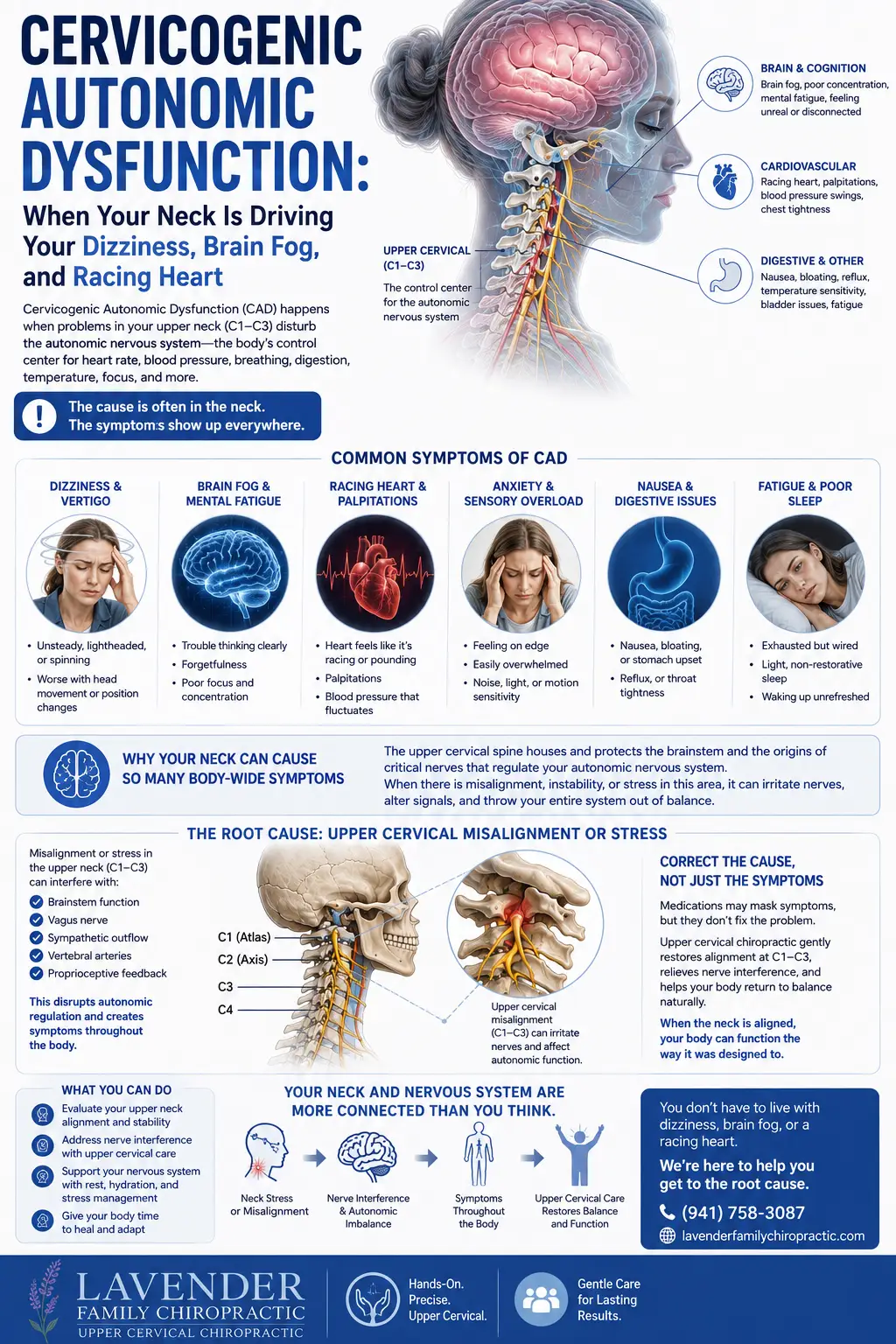
Cervicogenic Autonomic Dysfunction: When Your Neck Is Driving Your Dizziness, Brain Fog, and Racing Heart
By Dr. Rusty Lavender, D.C. — upper cervical chiropractor, Lavender Family Chiropractic, Sarasota, FL. Reviewed and updated September 2026.
You’ve been told your dizziness is “anxiety.” Your brain fog is “just stress.” Your racing heart, the lightheadedness when you stand, the wave of nausea that comes from nowhere — each one got its own explanation, its own specialist, its own dead end. But what if they aren’t separate problems at all? What if they trace back to one overlooked place: the top of your neck, where the spine meets the brainstem and the body’s automatic control systems live? When neck dysfunction — especially in the upper cervical spine — feeds faulty signals into that region, the result is a cluster of autonomic symptoms that no single specialty owns. It’s called cervicogenic autonomic dysfunction, and it may be the connection nobody has checked.
This article gives you the honest version. What the autonomic nervous system actually does, why the upper cervical spine sits at the crossroads of that system, how a neck problem can genuinely produce dizziness and lightheadedness and heart-rate changes, and why head or neck trauma so often comes first. We’ll be straight about what the evidence supports and what it doesn’t — because you deserve a real explanation, not another guess. And we’ll be clear about when these symptoms need urgent medical attention, because some of them do.
This article is educational and not a substitute for medical advice. Autonomic symptoms should be evaluated by your physician first. If you have a health condition, are pregnant, or take medications, coordinate any new care with your doctor.
What the Autonomic Nervous System Actually Does
Your autonomic nervous system is the part of you that runs without asking permission. It sets your heart rate, adjusts your blood pressure when you stand, decides how much you sweat, drives digestion, controls the diameter of your blood vessels, and manages the constant, invisible balancing act that keeps you upright and steady. You never think about any of it — until it stops working smoothly.
It has two main branches. The sympathetic branch is your accelerator: it speeds the heart, tightens blood vessels, and mobilizes you for action — the “fight or flight” side. The parasympathetic branch is your brake: it slows the heart, aids digestion, and settles the body toward “rest and regulate.” The vagus nerve is the great highway of that parasympathetic side, wandering from the brainstem down through the neck to the heart, lungs, and gut. Health isn’t one branch winning; it’s the two staying in a responsive, moment-to-moment balance.
Here’s what matters for this discussion: the master control centers for all of this sit low in the brain — in the brainstemand its neighbors — and they depend on a steady stream of accurate sensory information to do their job. When you stand up, your autonomic system has to instantly tighten blood vessels and nudge the heart faster so blood doesn’t pool in your legs and starve your brain. To pull that off, it needs to know, reliably, where your head and body are in space. A lot of that information comes from your inner ear, your eyes — and, crucially, from the muscles and joints of your upper neck.When the neck’s contribution to that stream gets distorted, the control centers are working from bad data. That’s the door through which cervicogenic autonomic dysfunction walks in.
Where the Upper Cervical Spine Fits — The Anatomy That Explains Everything
Pay close attention to the geography here, because it’s the whole point.
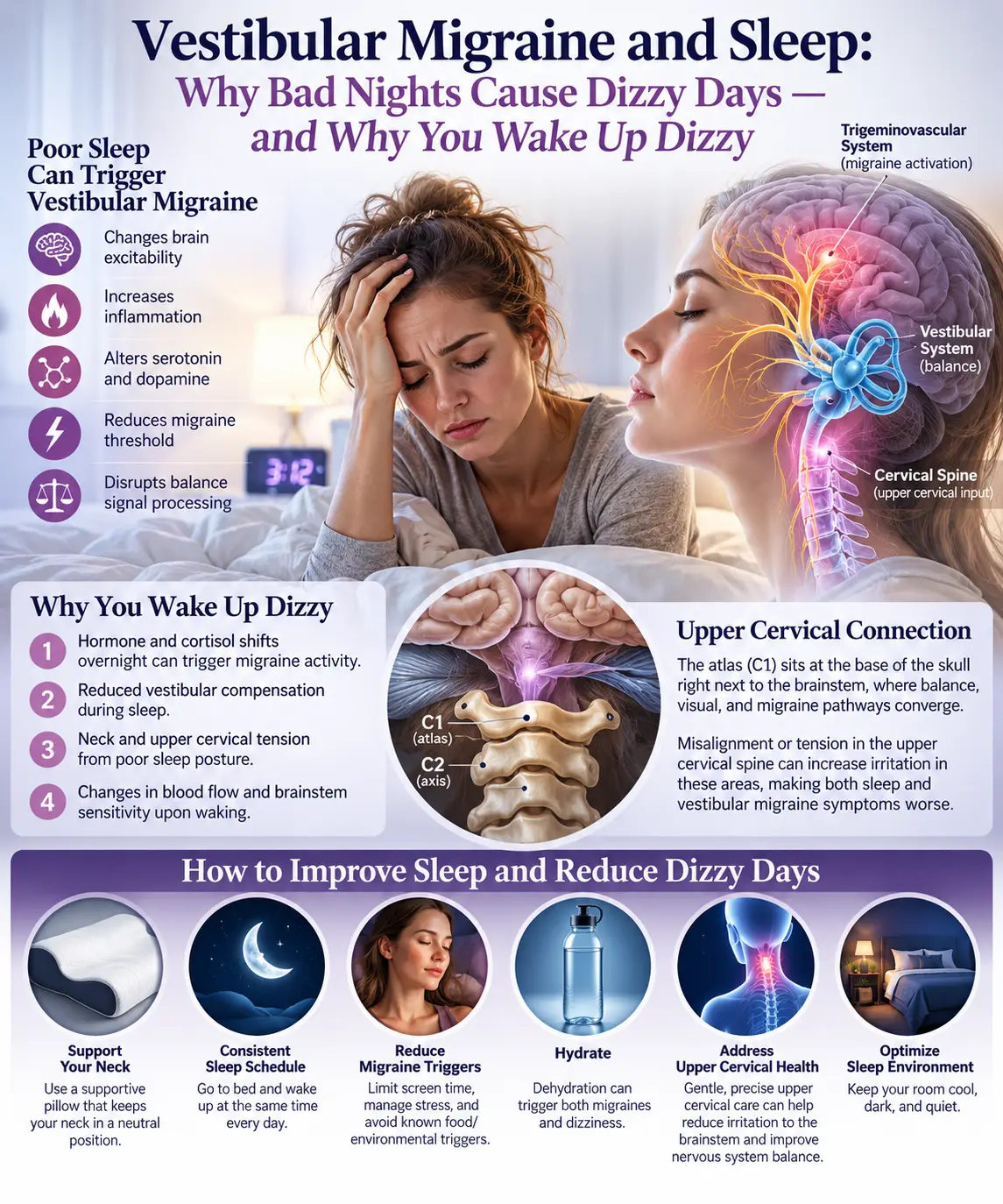
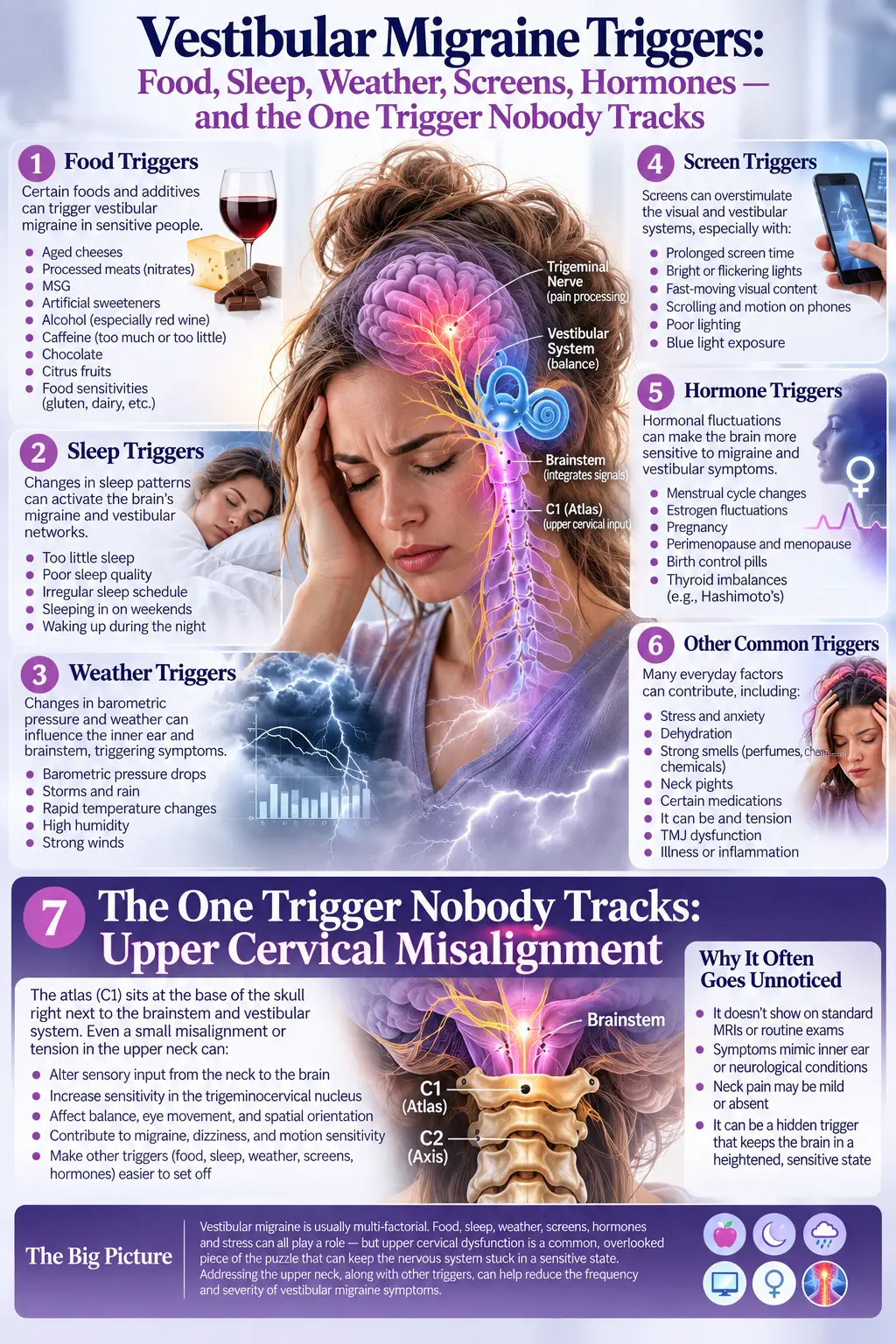
The top of your spine — the atlas (C1) and axis (C2) — sits directly beneath the skull at the craniocervical junction, the transition zone where your brainstem descends and becomes your spinal cord. This is the most mobile, most heavily instrumented, and most neurologically dense segment of the entire spine. It carries the full weight of your head, roughly the weight of a bowling ball, and it’s held in place mostly by ligaments rather than the interlocking bony architecture that stabilizes the rest of your spine. That design buys you an enormous range of motion — you can turn, tilt, and nod your head freely — at the cost of stability.
Now consider what lives in this neighborhood. The brainstem, home to those autonomic control centers, sits right here. The vagus nerve exits the skull at the base and passes down through the upper neck within a finger’s width of the atlas. The upper cervical spine is also the single richest source of proprioception — position sense — in the whole body. The small suboccipital muscles at the base of the skull are packed with an extraordinary density of muscle spindles, the tiny sensors that report exactly how your head is oriented. This region is wired to be a primary reference point for balance and spatial orientation.
So the upper cervical spine isn’t just “the top of the neck.” It’s a control-rich junction where the machinery of autonomic regulation, the vagus nerve, and the body’s densest proprioceptive sensor array all converge in the same few centimeters. That convergence is exactly why a mechanical problem there doesn’t stay a neck problem. It has direct lines into the systems that govern how dizzy, how foggy, how steady, and how regulated you feel. When people search for why a neck could possibly be causing autonomic symptoms, this anatomy is the answer.
The Best-Documented Mechanism: Cervicogenic Dizziness and Sensory Mismatch
Let’s start with the piece of this that has the strongest research foundation, because being honest means leading with what’s well established.
Your sense of balance is a three-way partnership. Your inner ear (the vestibular system) senses head motion and gravity. Your eyes track the visual world. And the proprioceptors in your upper neck report your head’s position relative to your body. Your brain constantly cross-checks these three inputs against each other. As long as they agree, you feel steady and grounded without a second thought.
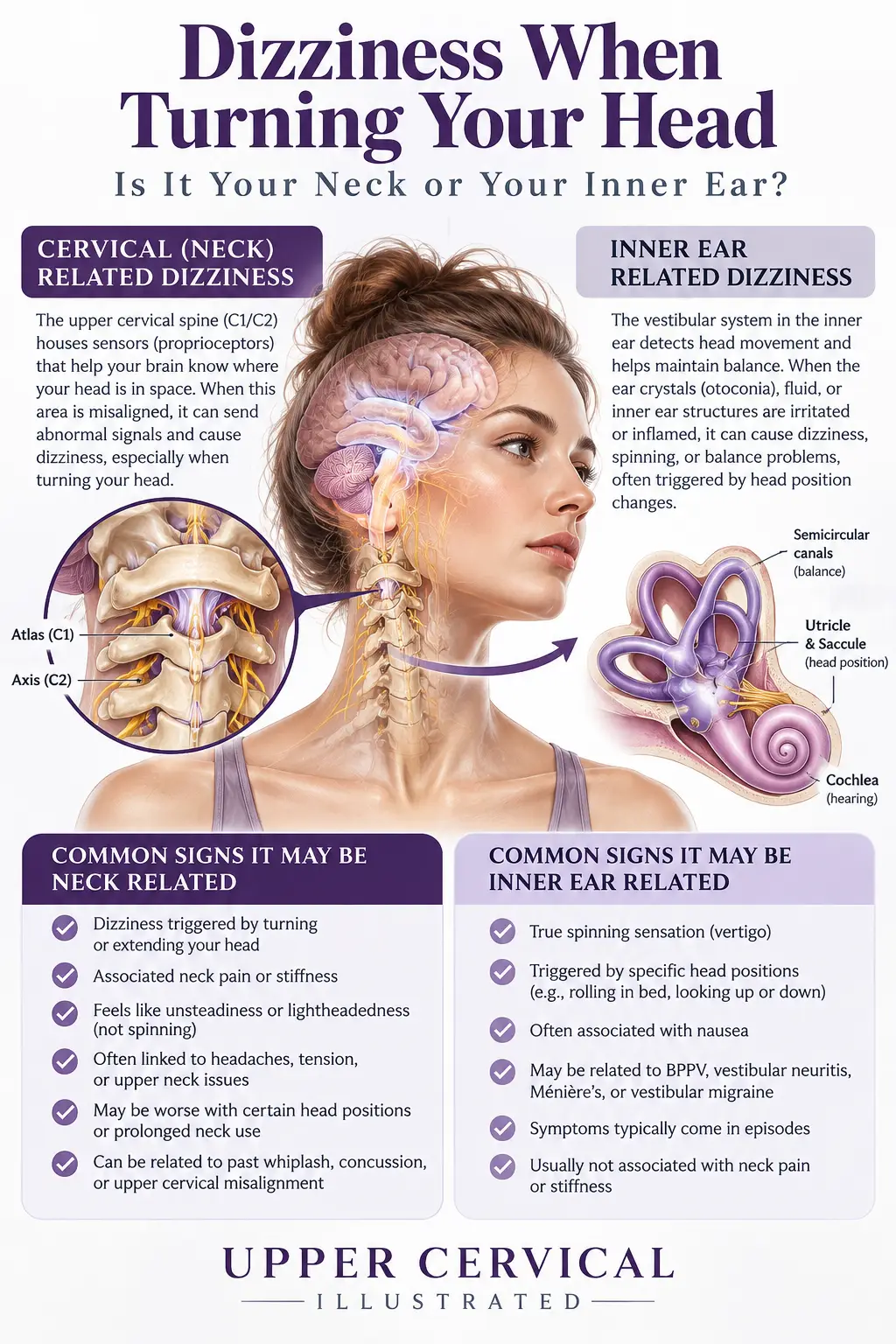
The trouble starts when they disagree. If the upper cervical spine is dysfunctional — restricted, injured, or misaligned — those densely packed neck sensors start sending inaccurate or noisy signals about where your head is. Now your neck is telling your brain one thing while your eyes and inner ear are telling it another. Your brain receives contradictory reports about a basic fact — where your own head is in space — and can’t reconcile them. That sensory mismatch is experienced as dizziness, unsteadiness, floating, disorientation, or a vague “off” feeling that’s hard to describe. This is cervicogenic dizziness: dizziness that originates from the neck rather than the inner ear.
This isn’t a fringe idea. It’s a recognized clinical entity with a substantial body of research behind it. A comprehensive review of the proprioceptive mechanisms and management of cervicogenic dizziness lays out exactly this model — that disturbed cervical proprioception produces a sensory conflict the brain reads as dizziness (review of proprioceptive cervicogenic dizziness). The evidence also points toward treatment that addresses the neck itself: a systematic review of manual therapy for cervicogenic dizziness found that hands-on treatment directed at the cervical spine can improve dizziness and related symptoms (manual therapy for cervicogenic dizziness). In other words, when the neck is the source, addressing the neck is a rational response — not a leap of faith.
Cervicogenic dizziness is typically described as a non-spinning dizziness or unsteadiness that tends to accompany or follow neck pain and stiffness, and that often worsens with head and neck movement or after sustained awkward positions. It’s frequently a diagnosis of careful exclusion — ruled in after inner-ear and central causes have been considered — which is one reason it goes unrecognized for so long. Patients get sent from ENT to neurology to cardiology, each ruling out their own domain, and the neck is never on the list because nobody’s specialty owns it.
From Dizziness to the Full Autonomic Picture
If faulty neck proprioception can distort balance, it’s a reasonable and increasingly discussed step to ask whether the same disturbed signaling — arising in a region so intimately tied to the brainstem, the vagus nerve, and autonomic control — can ripple into the broader autonomic picture. This is where we need to be careful and honest with you: the sensory-mismatch model of cervicogenic dizziness is well documented, while the extension to the fuller range of autonomic symptoms is more mechanistic reasoning than settled proof. We’ll frame it as what it is — a plausible, anatomy-grounded model worth evaluating, not a proven certainty.
With that honesty on the table, here’s the reasoning. The autonomic control centers in the brainstem sit inches from the upper cervical spine and depend on accurate sensory input to regulate heart rate, blood pressure, and vascular tone. The vagus nerve — the body’s parasympathetic backbone — passes directly through this region. When the upper cervical junction is dysfunctional, the surrounding muscles and tissues at the skull base come under abnormal tension and stress, and the sensory stream feeding the control centers is degraded. The plausible consequence is a nervous system that struggles to regulate smoothly, which can show up as far more than dizziness:
- Lightheadedness, especially on standing, as blood-pressure and heart-rate adjustments lag
- Heart-rate and blood-pressure changes — a racing or pounding heart, or a sense that these shift unpredictably
- Brain fog — that heavy, cotton-wool feeling of impaired focus and mental clarity
- Nausea, often paired with the dizziness and disorientation
- Changes in sweating — too much, too little, or in the wrong situations
- Fatigue — the deep, unrefreshing tiredness of a nervous system stuck working overtime
This is the constellation that we describe as cervicogenic autonomic dysfunction: autonomic symptoms in which upper cervical dysfunction is a contributing driver rather than an incidental bystander. It overlaps with, and is worth distinguishing from, conditions like POTS and other forms of dysautonomia, where the body’s automatic regulation of heart rate and blood pressure goes awry. The upper cervical connection doesn’t replace those diagnoses — it may be an overlooked structural piece sitting underneath them, which is precisely why it’s worth evaluating rather than assuming.
The reason this matters so much clinically is that these symptoms almost never get considered together. Dizziness goes to ENT. Palpitations go to cardiology. Fog and fatigue get labeled stress or written off entirely. But when one region — the upper cervical spine — has direct lines into the systems behind all of them, a single overlooked driver can masquerade as five unrelated problems. Considering the neck is what lets you ask whether there’s one thread tying them together.
Why Trauma So Often Comes First
Here’s a pattern we see constantly, and it’s one of the strongest clues that the neck belongs in the conversation: these symptoms frequently begin — or sharply worsen — after something happened to the head or neck.
A car accident. A whiplash injury. A concussion. A fall, a sports collision, a hard hit to the head. People will tell us their dizziness, fog, palpitations, and fatigue all started in the weeks or months following an injury, and yet in the entire workup that followed, no one ever examined the upper cervical spine itself. The imaging looked for fractures and bleeds, found none, and the neck was declared “fine” — meaning nothing was broken, not that nothing was wrong with how it moves and signals.
This connection is well recognized in the whiplash literature. Whiplash and similar neck traumas are commonly followed by dizziness and balance complaints, and the cervical spine is understood to be a genuine contributor to those symptoms — the injured neck’s disturbed proprioception feeding the same sensory-mismatch process described above (cervical factors in whiplash-associated dizziness). The mechanism makes intuitive sense: a whiplash or concussive force loads and destabilizes the very craniocervical junction where balance sensing, autonomic control, and the vagus nerve all converge. Even if bones aren’t broken, the ligament-dependent upper cervical segment can be left dysfunctional — and the sensors packed into it can be left reporting bad information for a long time afterward.
In more significant injuries, the concern extends to the stability of the ligaments that hold the head on, which is a separate and important consideration — you can read more about craniocervical instability and why the upper cervical region deserves careful, imaging-informed evaluation after trauma. The takeaway is simple and important: if your autonomic symptoms started or worsened after a head or neck injury, that timing is a loud clue. It points toward the upper cervical spine as a driver worth evaluating rather than a region to assume is fine because nothing showed up as broken.
Why This Gets Missed for Years
It’s worth naming why so many people carry these symptoms for years without anyone connecting them to the neck. The reasons are structural, not personal — you didn’t miss something obvious.
First, no single specialty owns this cluster. Dizziness is ENT or neurology. Heart symptoms are cardiology. Fatigue and fog are primary care, or nowhere. Each specialist competently rules out their own domain and refers you onward. The neck, sitting at the crossroads of all of them, falls into the gap between specialties.
Second, standard imaging isn’t looking for this. An MRI or CT ordered to exclude a tumor or a bleed is not assessing how the atlas and axis are positioned and moving, or how the nervous system is behaving along the spine. “Your scan is normal” answers a different question than “is my upper cervical spine functioning properly.”
Third, the symptoms are easy to psychologize. Dizziness, palpitations, fog, and fatigue with a “normal” workup get labeled anxiety or stress with striking frequency. Sometimes anxiety is genuinely part of the picture — but a nervous system stuck in sympathetic overdrive because of a structural driver can produce anxiety-like symptoms, and calling it anxiety ends the search before the neck is ever examined.
None of this is a knock on the physicians involved — ruling out serious disease is exactly what they should do first, and you want that done thoroughly. It simply means that after the serious causes are excluded, there’s often one more place to look that the standard pathway skips. Considering the upper cervical spine isn’t a rejection of medical care; it’s a complement to it, aimed at the region the workup left out.
Red Flags: When Autonomic Symptoms Are an Emergency
Before we go further, this is the most important section in the article. Autonomic symptoms can occasionally signal something serious, and some situations require urgent or emergency medical care — not a chiropractic evaluation. Please read carefully.
Call 911 or go to the emergency room immediately if you experience:
- Fainting (loss of consciousness), especially with or after a head or neck injury — this needs urgent evaluation, not a wait-and-see approach.
- Chest pain, chest pressure, or pain spreading to the arm, jaw, or back — treat as a possible cardiac emergency.
- Severe shortness of breath or difficulty breathing.
- Sudden neurological symptoms — slurred speech, facial droop, weakness or numbness on one side, sudden severe headache (“worst headache of your life”), sudden vision loss or double vision, difficulty speaking or understanding speech, sudden loss of coordination, or trouble walking. These can indicate a stroke or other emergency and are time-critical.
See your physician promptly (not emergently, but soon) if you have: recurrent unexplained fainting or near-fainting, a persistently racing or irregular heartbeat, significant unexplained blood-pressure swings, dizziness that is new, worsening, or accompanied by hearing changes, or any autonomic symptoms that are progressing.
The rule that matters: autonomic symptoms should be medically evaluated first. Your physician needs to rule out cardiac, neurological, inner-ear, endocrine, and medication-related causes before a structural upper cervical evaluation is the right next step. Upper cervical care is something to consider after serious and treatable medical causes have been assessed and appropriately managed — and always in coordination with your physician, never instead of the medical workup. If you’re ever unsure whether a symptom is an emergency, treat it as one and seek care.
How We Evaluate the Upper Cervical Piece at Lavender Family Chiropractic
Once your physician has evaluated your symptoms and serious causes have been addressed, and if the picture points toward the neck, this is where a focused upper cervical evaluation earns its place. At Lavender Family Chiropractic (NeckWise North Sarasota), we work exclusively on the upper cervical spine — the atlas, the axis, and the craniocervical junction where the skull meets the neck and where autonomic control, the vagus nerve, and the body’s densest balance sensors all converge.
Our approach is built on measurement, not guesswork. We use 3D CBCT imaging to see your upper cervical alignment in three dimensions — the precise, individualized picture that a standard flat X-ray or a “rule out disease” scan simply doesn’t provide. We use paraspinal infrared thermography to read how your nervous system is actually behaving along the spine, which is directly relevant when the entire question is autonomic regulation. Together these tools tell us whether there’s an upper cervical problem worth addressing and, if so, exactly what it looks like for you.
When a correction is warranted, we use the Knee Chest Upper Cervical technique: a precise, gentle, low-force adjustment with no twisting, cracking, or popping. For a nervous system that may already be stuck in overdrive — one producing dizziness, palpitations, and fog — that gentleness isn’t a marketing line, it’s the entire point. You do not calm an overwhelmed system by forcing it.
The goal is straightforward: give an overstressed nervous system a calmer, better-aligned structural environment at the one junction where balance sensing and autonomic control meet, so those systems have a chance to regulate more normally. This is a complement to your medical care, not a replacement for it. Keep your physician, keep your cardiologist or neurologist if you have one, keep every appropriate medical treatment — and let us evaluate the structural piece that the standard pathway leaves out. If your symptoms won’t settle and the upper cervical spine has never been examined, that’s the evaluation you may have been missing.
→ Call Lavender Family Chiropractic at (941) 243-3729 to schedule a complimentary consultation. We’re at 5899 Whitfield Avenue, Suite 107, Sarasota, FL 34243 — corner of University and Whitfield, serving Sarasota, Bradenton, and Lakewood Ranch.
Top Questions
What is cervicogenic autonomic dysfunction? It’s the pattern where dysfunction of the neck — especially the upper cervical spine — contributes to autonomic symptoms like dizziness, lightheadedness, brain fog, heart-rate or blood-pressure changes, nausea, sweating changes, and fatigue. The upper cervical spine sits at the craniocervical junction, right at the brainstem where autonomic control and the vagus nerve live, and it’s the body’s richest source of position sense. When it malfunctions, it can feed distorted signals into the systems that regulate all of those functions. It’s best understood as a contributing driver worth evaluating, not a one-size explanation.
What is cervicogenic dizziness, exactly? It’s dizziness or unsteadiness that originates from the neck rather than the inner ear. When the upper cervical spine sends inaccurate position information, it conflicts with what your eyes and inner ear report, and your brain reads that sensory mismatch as dizziness, floating, or feeling “off.” It’s a recognized clinical entity, and research supports both the proprioceptive mechanism and the use of manual therapy directed at the neck.
Can a neck problem really cause a racing heart or lightheadedness? The strongest evidence is for the neck causing dizziness through sensory mismatch. Extending that to heart rate, blood pressure, and the broader autonomic picture is a reasonable, anatomy-based model — the upper cervical region sits at the brainstem where these functions are controlled and where the vagus nerve passes — but it’s more mechanistic reasoning than proven fact. We present it honestly as a driver worth evaluating, especially after other causes have been medically assessed.
My symptoms started after a car accident / whiplash / concussion. Does that matter? It matters a great deal. Head and neck trauma commonly precede these symptoms, and the whiplash literature recognizes the cervical spine as a genuine contributor to post-injury dizziness. Trauma loads and destabilizes the exact junction where balance sensing and autonomic control converge, and even when nothing is “broken,” the neck can be left dysfunctional. If your symptoms began or worsened after an injury, the upper cervical spine is worth evaluating.
Shouldn’t I see a medical doctor first? Yes — absolutely. Autonomic symptoms should be medically evaluated first so that cardiac, neurological, inner-ear, endocrine, and medication causes are ruled out or treated. Upper cervical evaluation is a step to consider afterward, in coordination with your physician, if the picture points toward the neck. It complements medical care; it never replaces it.
When are these symptoms an emergency? Fainting (especially with an injury), chest pain, severe shortness of breath, and sudden neurological symptoms like slurred speech, one-sided weakness, facial droop, sudden severe headache, or sudden vision changes are emergencies — call 911. Recurrent fainting, an irregular racing heartbeat, or worsening symptoms warrant prompt medical attention. When in doubt, treat it as urgent.
Is the adjustment forceful? No — it’s precise, gentle, and low-force, with no twisting, cracking, or popping. For a nervous system that may already be overwhelmed, that gentleness is deliberate and central to the approach.
What makes your evaluation different from a regular scan? We use 3D CBCT imaging to assess your upper cervical alignment in three dimensions and paraspinal infrared thermography to read how your nervous system is behaving along the spine. A standard “rule out disease” MRI or CT answers a different question — it looks for tumors and bleeds, not for how your atlas and axis are positioned and functioning.
Is any of this a cure or a guarantee? No. Nothing here is a cure, and we make no guarantees. Upper cervical care aims to address a possible structural contributor and to work alongside your medical care. Results vary from person to person, which is exactly why we evaluate first rather than promise outcomes.
Serving Sarasota, Bradenton & Lakewood Ranch
If you’ve been passed from specialist to specialist for dizziness, lightheadedness, brain fog, or a racing heart with a “normal” workup — and you’re anywhere around Sarasota, Bradenton, or Lakewood Ranch — the structural evaluation you may be missing is close by. Lavender Family Chiropractic (NeckWise North Sarasota) sits at 5899 Whitfield Avenue, the corner of University and Whitfield, minutes from the Lakewood Ranch corridor and just across from Bradenton, so patients from all three communities reach us easily. We also welcome patients traveling in from Venice, Osprey, Parrish, Port Charlotte, and Myakka who have been searching for someone to evaluate the one region their workup skipped.
Whether you’re in Sarasota, Bradenton, or Lakewood Ranch, we focus on the upper cervical junction where balance sensing, the vagus nerve, and autonomic control all converge — using 3D CBCT imaging and paraspinal infrared thermography — so that if the neck is a contributing driver of your symptoms, it’s finally examined instead of assumed. And we do it in coordination with your physician, as a complement to the medical care you should absolutely continue.
The Thread That Ties It Together
Your autonomic nervous system is doing extraordinary work every second you’re alive — steadying your balance, adjusting your blood pressure as you stand, keeping your heart in rhythm, letting you feel grounded in your own body. When that regulation falters, the symptoms scatter across so many systems that they look like separate problems, and the medical pathway naturally splits them apart to rule out the serious causes, which is exactly what should happen first.
But once those causes have been evaluated, and especially if your symptoms trace back to a head or neck injury, there’s one region that ties the thread together — the upper cervical spine, sitting at the brainstem where autonomic control and the vagus nerve live, packed with the position sensors your balance depends on. It’s the place that faulty cervical proprioception disrupts in well-documented cervicogenic dizziness, and it’s the overlooked driver worth evaluating when a whole cluster of autonomic symptoms won’t settle and nobody has looked there.
Let us look at the region the standard pathway skips. Call (941) 243-3729 or book a complimentary consultation.Coordinate with your physician, keep your medical care — and make sure the one junction where balance and autonomic control meet has actually been checked.
Lavender Family Chiropractic (NeckWise North Sarasota) · 5899 Whitfield Avenue, Suite 107, Sarasota, FL 34243 · (941) 243-3729
This article is for general educational purposes only and is not medical advice, diagnosis, or treatment. Autonomic symptoms should be evaluated by your physician first. Please consult your physician before making changes to your health routine, especially if you have a medical condition, are pregnant, or take medication. Upper cervical chiropractic care is intended to complement, not replace, appropriate medical care.
Related Articles
Get our upper cervical articles first.
Patients Experience