Can Eustachian Tube Dysfunction Cause Headaches? The Ear-Pressure and Head-Pain Overlap Nobody Explains
By Dr. Rusty Lavender — Lavender Family Chiropractic, Sarasota, FL
You’ve felt it: a plugged, full, underwater feeling in one or both ears that won’t pop — and somehow, right alongside it, a headache that seems to live behind your eye, at your temple, or crawling up the back of your skull. You’ve tried yawning, swallowing, the “hold your nose and blow” trick, maybe a decongestant. The ear clears for a minute, then closes back up, and the headache lingers. Here’s the honest question almost no one answers straight: can Eustachian tube dysfunction actually cause headaches, or do the two just happen to travel together? The real answer is more interesting than a simple yes or no — and it points to a region at the top of your neck that your workup almost certainly never examined.
This article gives you the straight version. We’ll cover what Eustachian tube dysfunction (ETD) actually is, why ear pressure and headache overlap so often, why some people get both when the barometric pressure swings — and then the mechanistic angle the ENT visit usually skips: the shared nerve wiring between the muscle that opens your Eustachian tube and the upper cervical spine. I’m not going to tell you a study proved ETD causes headaches, because it hasn’t. What the anatomy does show is a plausible, testable overlap worth understanding — and worth evaluating.
This article is educational and not a substitute for medical advice. If you have ear pain, hearing changes, or persistent headaches, see your physician or an ENT to rule out infection and other conditions before assuming a mechanical cause.
What the Eustachian Tube Actually Does — and What “Dysfunction” Means
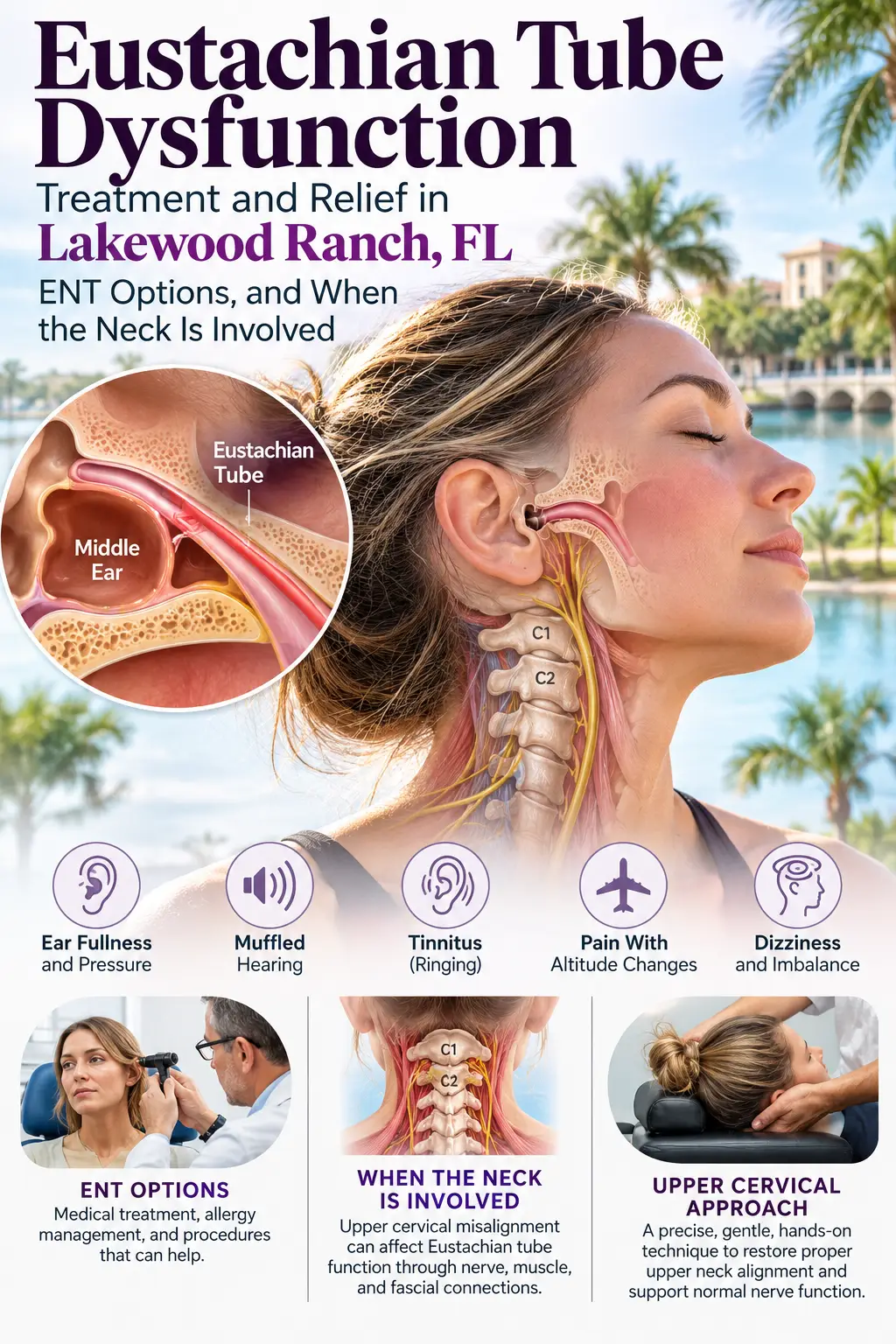
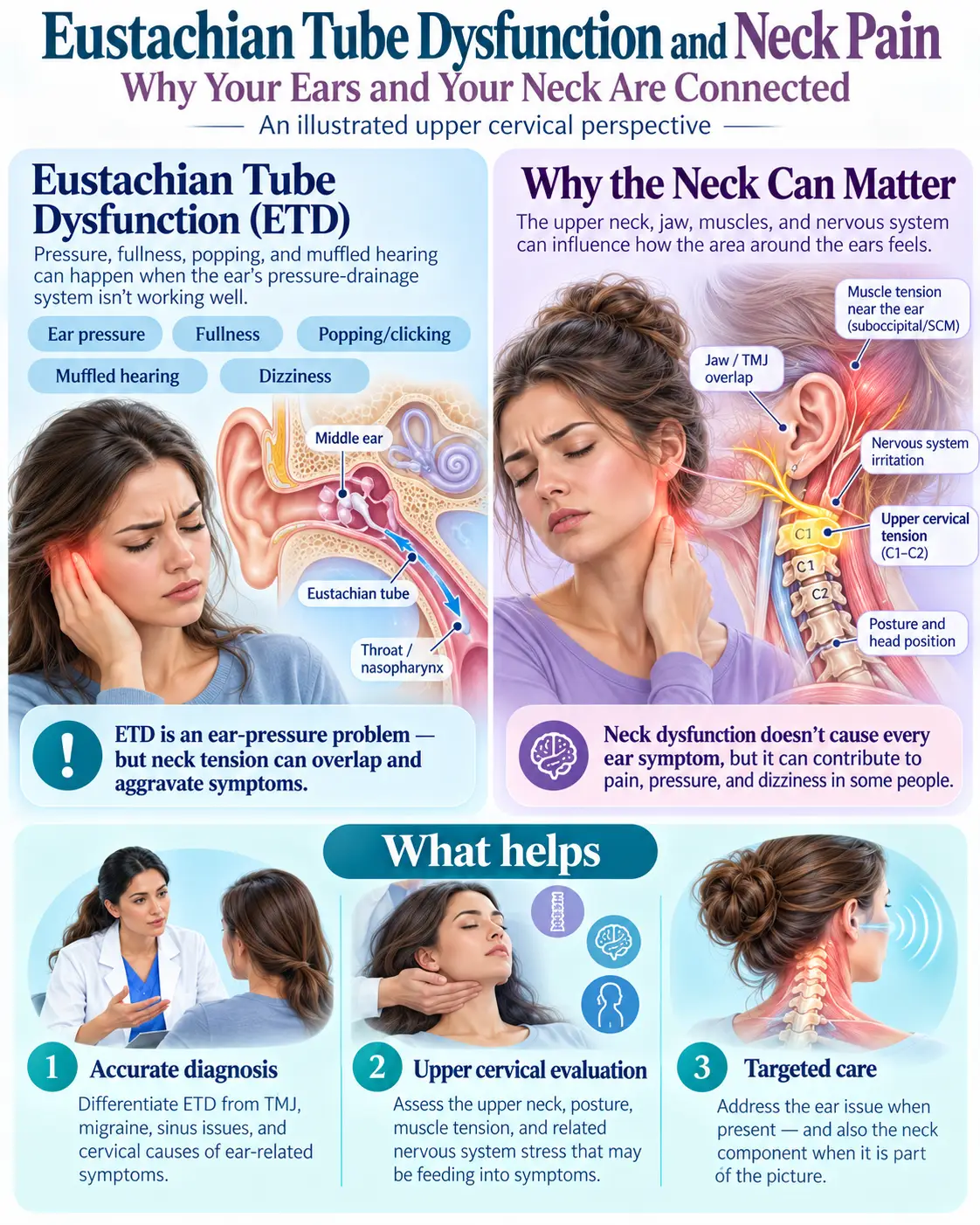
Your Eustachian tube is a narrow channel — a little under an inch and a half long — that connects your middle ear (the air-filled space behind your eardrum) to the back of your nose and throat, a region called the nasopharynx. Its job is quiet and constant: it equalizes the air pressure on both sides of your eardrum and drains the small amount of fluid the middle ear naturally produces.
Here’s the part most people don’t realize. That tube is normally closed. It doesn’t hang open like a drainpipe. It sits collapsed most of the time, and it opens for a fraction of a second when you swallow, yawn, or chew — that little “click” or “pop” you feel is the tube briefly opening to let a puff of air through and re-balance the pressure. What opens it is not the tube deciding to open on its own; it’s a set of small muscles at the base of the skull that pull it open. Hold onto that fact, because the muscle doing most of the work is where this whole story turns.
Eustachian tube dysfunction is what we call it when that open-and-close mechanism stops working smoothly. The tube either fails to open when it should (so pressure can’t equalize and the middle ear develops a vacuum), or it stays irritated and inflamed and won’t clear. Either way, the result is the same cluster of miserable symptoms:
- A feeling of fullness, pressure, or “stuffiness” in the ear — the sensation of being underwater or on an airplane that never lands
- Muffled or reduced hearing, like there’s a cotton ball in your ear
- Popping, crackling, or clicking sounds when you swallow or yawn
- A sense that your ear needs to “pop” but won’t
- Sometimes mild ear discomfort, tinnitus (ringing), or a feeling of being off-balance
- And — the reason you may be reading this — headache or head pressure that seems to travel with the ear symptoms
ETD has plenty of ordinary triggers: colds and sinus infections, allergies, sinus congestion, altitude and air-travel pressure changes, and anatomical factors. Those deserve to be evaluated and treated, and often that’s the whole story. But when the ear-fullness keeps coming back, keeps pairing with headache, and never fully resolves no matter how many decongestants you cycle through, it’s fair to ask whether something upstream is keeping the system irritated. That’s where this article goes.
Can Eustachian Tube Dysfunction Cause Headaches? The Honest Answer
Let me be precise here, because the internet is full of confident claims in both directions. There is no study that has proven Eustachian tube dysfunction causes headaches in a clean cause-and-effect way. Anyone telling you otherwise is overselling. So I won’t.
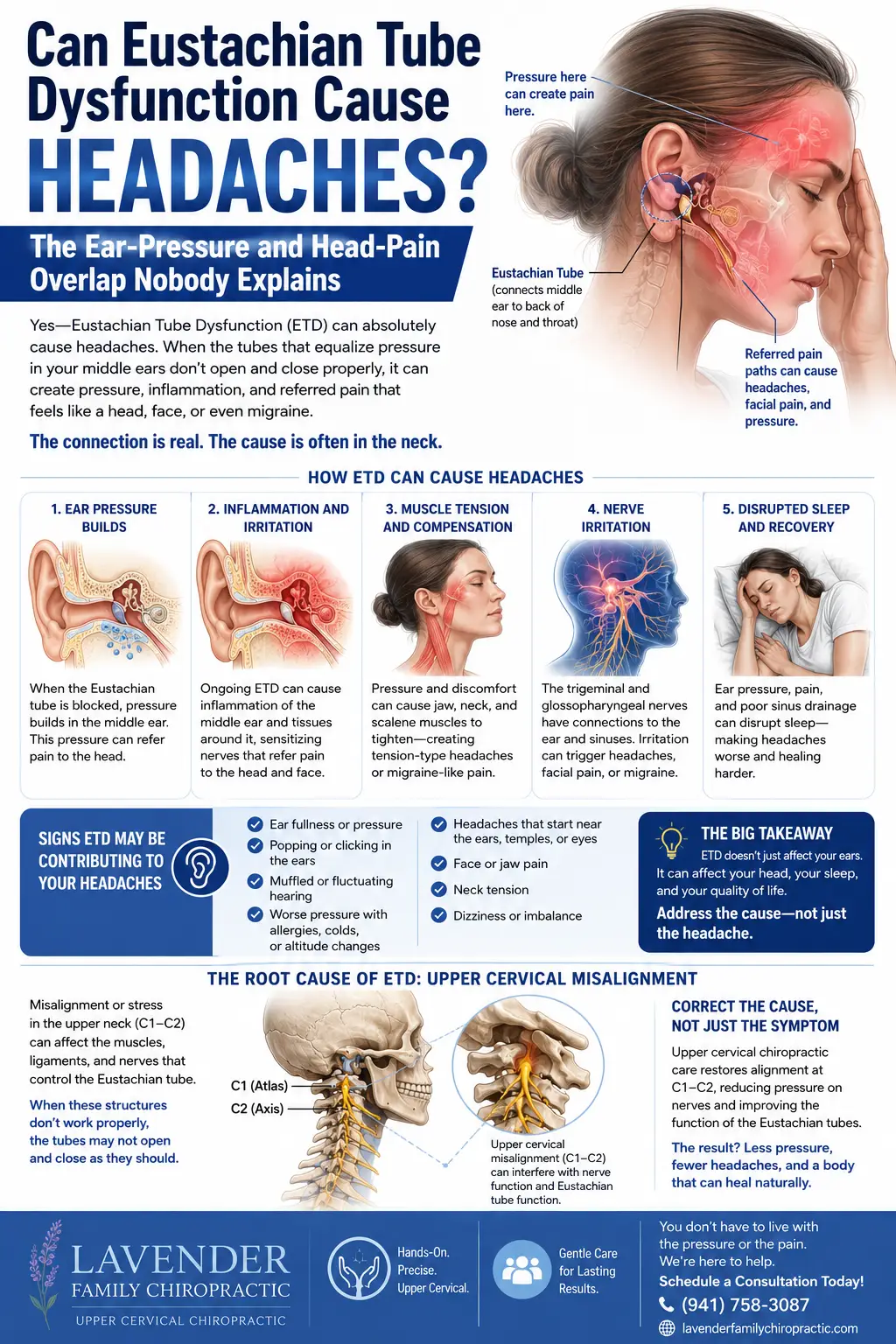
What is well documented is that ear pressure and headache overlap constantly — they show up together far more often than random chance would predict, and patients describe them as feeling linked. There are a few honest ways to understand why:
1. Shared pressure and shared plumbing. The middle ear, the sinuses, and the nasal passages are all connected, air-filled, pressure-sensitive spaces packed into the same crowded real estate of your skull. When one gets congested or develops a pressure imbalance, the whole neighborhood feels it. A middle ear stuck under a vacuum can produce a deep, dull ache that radiates — and the same underlying congestion driving the ETD can drive sinus-type head pain at the same time. So sometimes the headache and the ear-fullness aren’t cause-and-effect; they’re two symptoms of one shared upstream problem.
2. Referred pain and dense nerve supply. The ear, the jaw, the upper throat, and the head all share a remarkably dense and overlapping nerve supply. Pain in one structure is notoriously easy to feel in a neighboring one — this is called referred pain, and the head and neck are where it happens most. A problem centered on the Eustachian tube region can be experienced as head pain, and head or neck pain can be experienced as ear pressure. Your brain is not great at pinpointing exactly which structure in that crowded zone is unhappy.
3. A shared nerve — and a shared muscle. This is the mechanistic piece that makes the overlap more than a coincidence, and it’s where the upper neck enters the picture. To understand it, we need to look at the one muscle that actually opens your Eustachian tube.
The key point for now: the honest framing is not “ETD causes headaches.” It’s that ear-pressure symptoms and headache can share a common driver, and one of the most overlooked candidates for that driver sits at the junction of your skull and your spine.
The Muscle That Opens the Tube — and the Nerve It Answers To
Meet the tensor veli palatini. It’s a small, thin muscle that sits at the side of the base of your skull, near the opening of the Eustachian tube. When you swallow or yawn, the tensor veli palatini contracts and — this is its defining job — pulls the Eustachian tube open so pressure can equalize. It is, functionally, the muscle that “pops” your ears. When it works, your ears stay balanced and comfortable. When it doesn’t fire cleanly, the tube doesn’t open properly, and you get exactly the fullness-and-pressure picture of ETD.
Two anatomical facts about this muscle are the heart of this whole article.
Fact one: the tensor veli palatini is innervated by the trigeminal nerve. Specifically, it’s supplied by the mandibular division (the third branch, V3) of the trigeminal nerve — the fifth cranial nerve. This is unusual and important. Most of the muscles of the soft palate answer to a different nerve, but the tensor veli palatini is the odd one out, wired instead into the trigeminal system. The trigeminal nerve is the great sensory nerve of your face and head — it’s the nerve most deeply involved in headache and facial pain of nearly every kind. So the muscle that opens your ear tube is on the same nerve network as your headaches. The foundational anatomy of the tensor veli palatini and its trigeminal (mandibular division) innervation is well established in the standard literature.
Fact two: the tensor veli palatini, the Eustachian tube, and the cranial base are structurally intertwined. This muscle doesn’t float in space. It attaches to and pulls against the bones at the base of the skull, right where the Eustachian tube runs. An osteological study of the Eustachian tube, tensor veli palatini muscle, and the cranial base relationshipdocumented just how tightly this muscle’s function is tied to the surrounding skull-base architecture — meaning the tube’s ability to open depends on the mechanical relationships at the very base of the skull. And research recording tensor veli palatini muscle activity and Eustachian tube function confirms the direct link between how well this muscle fires and whether the tube actually opens to do its job. When the muscle’s function is compromised, tube function follows.
Put those two facts side by side. The muscle that opens your Eustachian tube is (a) mechanically dependent on the cranial base and (b) wired into the trigeminal nerve — the headache nerve. That is not a coincidence you can dismiss. It’s a shared circuit. And that shared circuit is exactly where the upper neck plugs in.
Trigeminocervical Convergence: Where the Ear, the Head, and the Neck Meet
Here’s the piece that ties it together, and it’s the most important paragraph in this article. The trigeminal nerve — the one supplying the tensor veli palatini and carrying most of your head and face sensation — does not operate in isolation from your neck. Deep in the brainstem, the sensory fibers of the trigeminal nerve converge and mingle with the sensory nerves from the top of your neck, the first three cervical nerves (C1, C2, and C3). This shared processing zone is called the trigeminocervical nucleus, and the phenomenon is known as trigeminocervical convergence.
What does convergence mean in plain terms? It means the brainstem cannot always tell whether a signal originated in the trigeminal territory (your face, your head, the tensor veli palatini, the ear region) or in the upper cervical territory (the top of your neck). The wiring pools together before your brain interprets it. This is precisely why irritation from the upper neck can be felt as head pain — a well-recognized condition called cervicogenic headache, in which a source in the cervical spine produces headache referred into the head and face. The clinical reality of cervicogenic headache — head pain driven by an upper cervical source is well described in the literature, and the trigeminocervical convergence is the accepted mechanism behind it.
Now follow the logic all the way through, carefully, because this is the honest mechanistic case — not a proven cure, but a plausible, anatomically grounded driver worth evaluating:
- The muscle that opens your Eustachian tube (tensor veli palatini) runs on the trigeminal nerve and depends on the mechanics of the cranial base.
- The trigeminal nerve converges with the upper cervical nerves (C1–C3) in the brainstem.
- Therefore, dysfunction at the top of your neck — the atlas and axis, the junction where the skull meets the spine — sits at the crossroads of both systems at once: the same convergence zone that feeds your headache and the same trigeminal circuit that governs the ear-tube muscle.
The plausible consequence is this: upper cervical dysfunction can contribute to BOTH the ear-pressure symptoms and the headache — not because ETD “causes” the headache, but because a single upstream driver at the top of the neck can irritate a shared circuit that expresses itself as ear fullness and head pain together. That’s why the two so often travel as a pair. And it reframes the whole problem: instead of two separate complaints chasing two separate treatments, you may be looking at one overlooked driver that never got examined.
This is not a claim that every case of ear pressure and headache comes from the neck. Colds, allergies, sinus disease, and true middle-ear pathology are real and common, and they need real medical care. But when the symptoms are stubborn, recurrent, and paired — and especially when they started after something happened to your head or neck — the upper cervical spine becomes a driver genuinely worth evaluating rather than assuming away.
Ear Pressure and Headache When the Weather Changes: The Barometric Link
If your ear pressure and headache both flare when a storm rolls in or the weather turns — and in Sarasota, with our afternoon thunderstorms and shifting Gulf systems, they turn a lot — that pattern makes complete sense given everything above.
Your Eustachian tube’s entire job is managing pressure. When the barometric (atmospheric) pressure outside changes, the pressure inside your middle ear has to be re-equalized, and that requires the tube to open cleanly, over and over, as the front moves through. If your tube already opens sluggishly — because the tensor veli palatini isn’t firing well, because the cranial-base mechanics are off, because the whole region is irritated — then a barometric swing is exactly the stress test that exposes it. The tube can’t keep up, the middle ear develops a pressure imbalance, and you feel the fullness surge.
At the same time, barometric pressure changes are a well-known headache trigger for many people, and the same trigeminal-and-upper-cervical circuitry we’ve been discussing is central to how the head registers those changes as pain. So a weather front can hit both ends of the shared system simultaneously: the pressure-management side (ear fullness) and the pain-processing side (headache). The result is the classic “the storm is coming and my whole head feels it” experience — ear pressure and headache arriving together, on cue.
The people who suffer most with barometric ear-and-head symptoms are often the ones whose baseline is already compromised. A tube that opened perfectly wouldn’t be so easily overwhelmed by a pressure change. So barometric sensitivity, rather than being random bad luck, can be a clue that the underlying pressure-and-pain system is running with less margin than it should — and that the structural region governing that system is worth a look. (If weather-driven head pain is your main complaint, our deeper piece on barometric pressure headaches walks through that overlap in detail.)
The Overlooked Driver: Why the Upper Neck Belongs in This Conversation
Here’s where nearly every article and most clinical workups stop short. When you show up with ear fullness and a headache, the standard path is to look in the ear, at the sinuses, and at the nasopharynx — all reasonable, all worth doing. But that path assumes the problem lives entirely inside those structures. What it almost never examines is the region sitting one inch below your skull: the upper cervical spine.
Remember the anatomy we built. The atlas (C1) and axis (C2) are the top two vertebrae of your spine — the ones that carry the entire weight of your head, held in place mostly by ligaments and muscle rather than the interlocking bony architecture that stabilizes the rest of your spine. That gives the region enormous mobility (it’s why you can nod and rotate your head) but also makes it vulnerable to shifting out of its ideal alignment. And this junction is precisely where the trigeminocervical convergence lives, where the upper cervical nerves feed into the same brainstem pool as the trigeminal nerve, and it’s adjacent to the cranial-base mechanics that the tensor veli palatini depends on.
When that top segment isn’t sitting right, the surrounding tissues, muscles, and structures at the skull base come under abnormal tension — at the exact crossroads where the ear-tube circuit and the headache circuit share wiring. The plausible result isn’t just a stiff neck. It’s a system-wide irritation that can express itself as ear pressure that won’t clear and a headache that won’t quit — the two symptoms you’ve been treating separately, potentially sharing one root.
This also explains a pattern we see over and over: people whose stubborn ear-and-head symptoms trace back to a head or neck event. A car accident, a whiplash, a concussion, a hard fall, or even years of forward-head posture hunched over a phone or laptop loads and destabilizes the very region where these circuits converge. If your ear fullness and headaches started or worsened after something happened to your head or neck, that timing is a loud clue that the driver may be structural — sitting in a region your ear exam and sinus scan never covered.
None of this replaces good medical care for your ears. Keep your ENT. Rule out infection, rule out true middle-ear pathology, treat your allergies. But if you’ve done all of that and the ear pressure and headache keep coming back as a pair, the honest next question is the one nobody asked: is the top of your neck contributing to both? For a meaningful number of people, that’s the missing piece — and it’s the one region no one looked at. (Because these symptoms so often overlap with migraine, our page on migraines and upper cervical care is a useful companion, and if autonomic symptoms like dizziness or fullness dominate, vagus nerve dysfunction is worth understanding too.)
How We Evaluate the Structural Piece at Lavender Family Chiropractic
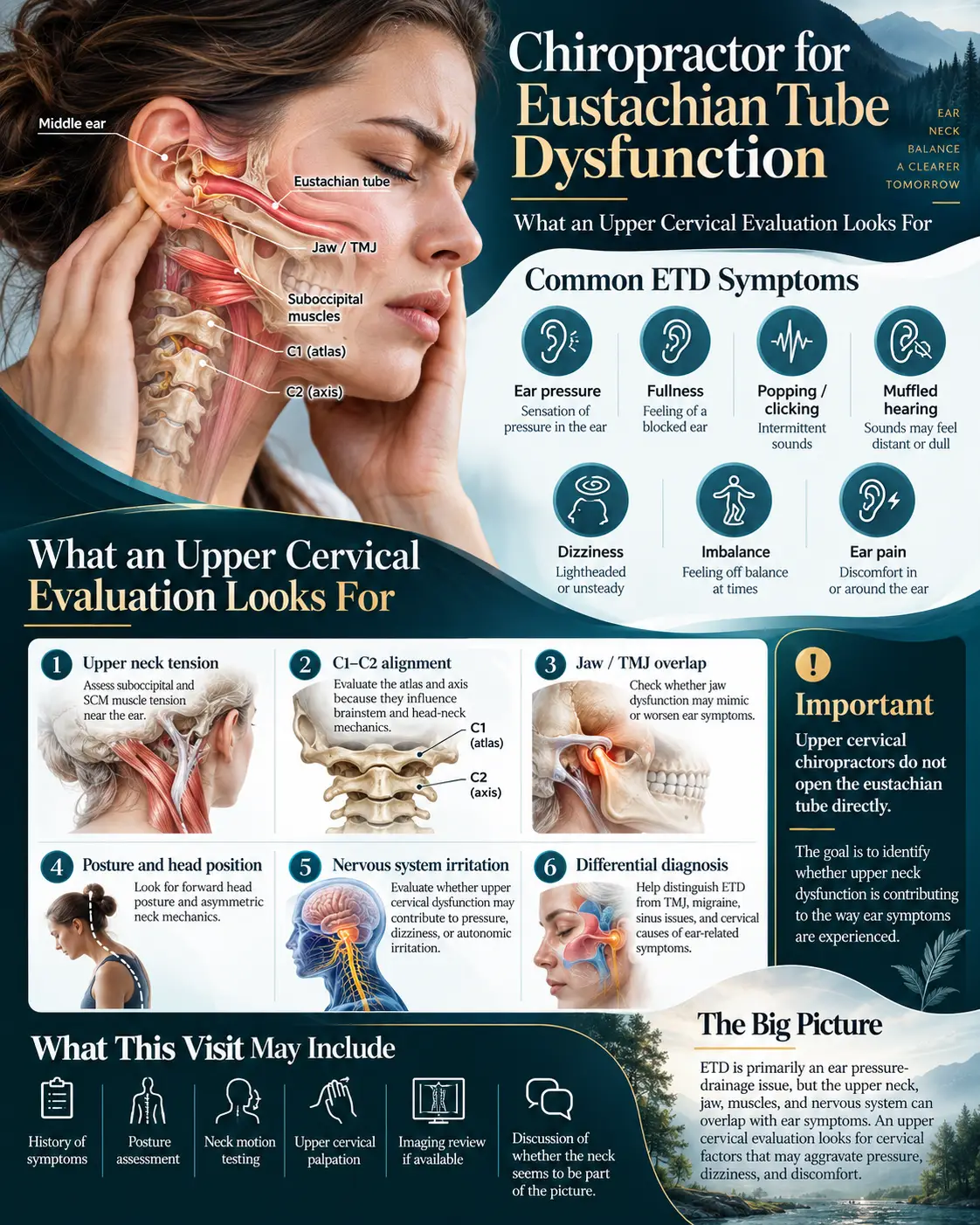
At Lavender Family Chiropractic, we focus exclusively on the upper cervical spine — the atlas, the axis, and the junction where the skull meets the neck, the same region where the trigeminal and upper cervical nerves converge and where the cranial-base mechanics governing the Eustachian tube live. Our approach is built on measurement, not guesswork.
We use 3D CBCT imaging (cone-beam computed tomography) to see your upper cervical alignment in three dimensions — not a flat, single-angle guess, but a true spatial picture of how your atlas and axis are actually oriented relative to your skull. We pair that with paraspinal infrared thermography, which reads how your nervous system is behaving along the spine — directly relevant when the whole question is whether an irritated upper cervical region is feeding a shared pain-and-pressure circuit. Together, those tools let us evaluate whether the structural piece is contributing to your ear-and-head symptoms, rather than assuming it one way or the other.
When a correction is warranted, we use the Knee Chest Upper Cervical technique: precise, gentle, and low-force, with no twisting, cracking, or popping. For a region this delicate — sitting at the crossroads of your head, your ears, and your nervous system — that gentleness is the entire point. We’re not trying to force anything. We’re trying to give an irritated junction a calmer, better-aligned structural environment so the circuits running through it can settle.
The goal is straightforward: keep your physician and your ENT, keep treating the infections and allergies that need treating — and add attention to the one region that sits at the intersection of the ear-tube nerve supply and the headache system, the piece the standard workup leaves out. If you’ve chased the ear pressure and the headache separately and still feel stuck, that’s the evaluation you’ve been missing. (You can read more about our specific focus on upper cervical chiropractic care and about Eustachian tube dysfunction on our dedicated pages.)
→ Call Lavender Family Chiropractic at (941) 243-3729 to schedule a complimentary consultation. We’re at 5899 Whitfield Avenue, Suite 107, Sarasota, FL 34243 — corner of University and Whitfield, minutes from Bradenton and the Lakewood Ranch corridor.
When Ear and Head Symptoms Are a Red Flag: Get Seen Promptly
Before we go further, the safety part — because not all ear-and-head symptoms are mechanical, and some deserve urgent medical attention. Please seek prompt or emergency care, rather than assuming a structural cause, if you experience any of the following:
- Sudden hearing loss, especially in one ear — this can be a medical emergency and needs to be evaluated immediately, not “watched.”
- A severe headache, or the “worst headache of your life,” or one that comes on like a thunderclap.
- Fever with a stiff neck, which can signal a serious infection requiring emergency care.
- Facial weakness, drooping, or numbness on one side.
- Any neurological symptoms — sudden vision changes, difficulty speaking, weakness or numbness in an arm or leg, confusion, trouble with balance or coordination, or fainting.
- Severe ear pain, drainage of fluid or blood from the ear, or a rapidly worsening picture.
None of those are candidates for “let’s try upper cervical care and see.” They are candidates for a physician or the emergency room, now. Upper cervical evaluation is for the stubborn, recurrent, mechanical-pattern ear-pressure-and-headache picture after serious causes have been ruled out — not a substitute for urgent medical assessment when the warning signs above are present.
Top Questions
Can Eustachian tube dysfunction cause headaches? Honestly, no study has proven that ETD causes headaches in a direct cause-and-effect way. What’s clear is that ear pressure and headache overlap constantly, and there’s a real anatomical reason: the muscle that opens the Eustachian tube (tensor veli palatini) runs on the trigeminal nerve — the main headache nerve — which converges with the upper neck nerves in the brainstem. So rather than one causing the other, both can share a common driver, including dysfunction at the top of the neck. That’s a driver worth evaluating.
Why do my ear pressure and headache always show up together? Because they may be two expressions of one shared circuit. The ear-tube muscle is wired into the trigeminal nerve, that nerve converges with your upper cervical nerves, and the whole region shares crowded, pressure-sensitive anatomy at the base of the skull. Irritation in that shared zone can register as ear fullness and head pain at the same time.
Why does the weather make both worse? Your Eustachian tube manages middle-ear pressure, so barometric swings are a direct stress test — if the tube already opens sluggishly, a pressure change overwhelms it and you feel fullness. At the same time, barometric changes are a common headache trigger through the same trigeminal circuitry. A front can hit both ends of the shared system at once.
What is the tensor veli palatini, and why does it matter here? It’s the small muscle at the base of your skull that actually pulls your Eustachian tube open when you swallow or yawn. It matters because it’s innervated by the trigeminal nerve — unusual among palate muscles — which links ear-tube function directly to the headache nerve network, and because its function depends on the mechanics of the cranial base right next to your upper neck.
What is trigeminocervical convergence? It’s the well-established fact that the trigeminal nerve (head and face sensation, plus the ear-tube muscle) and the upper cervical nerves (C1–C3, the top of your neck) share a processing zone in the brainstem. Because the signals pool together, the brain can’t always tell head-origin from neck-origin — which is why an upper neck source can produce headache (cervicogenic headache) and plausibly contribute to ear-region symptoms too.
My symptoms started after a car accident / whiplash / concussion. Does that matter? It matters a great deal. Trauma to the head and neck loads and destabilizes the exact upper cervical region where these circuits converge. If your ear fullness and headaches began or worsened after a neck injury, the upper cervical spine is a driver worth evaluating rather than assuming away.
Is the adjustment forceful? No — precise, gentle, and low-force, with no twisting, cracking, or popping. For a region this close to your head, ears, and nervous system, gentleness is the whole point.
Do I still need to see my doctor or ENT? Yes. This article is educational and complements medical care, it doesn’t replace it. Have your ears examined, rule out infection and true middle-ear pathology, and treat allergies and sinus issues that need treating. Upper cervical evaluation is an added lens for stubborn, recurrent symptoms — not a substitute for medical assessment, and never a substitute for urgent care when red-flag symptoms are present.
Who should be extra cautious? Anyone with sudden hearing loss, a severe or “worst-ever” headache, fever with a stiff neck, facial weakness, or any neurological symptoms should seek prompt or emergency medical care first. When in doubt, get evaluated medically before assuming a mechanical cause.
Serving Sarasota, Bradenton & Lakewood Ranch
If your ears stay plugged and full, your headaches keep pairing up with them, and you’re anywhere around Sarasota, Bradenton, or Lakewood Ranch, the structural evaluation you may be missing is close by. Lavender Family Chiropractic (NeckWise North Sarasota) sits at 5899 Whitfield Avenue — the corner of University and Whitfield — minutes from Bradenton and right along the Lakewood Ranch corridor, so patients from all three communities reach us easily. We also see patients traveling in from Venice, Osprey, Port Charlotte, Parrish, and the Myakka area who’ve had enough of chasing ear pressure and headache separately with no lasting answer.
Whether you’re in Sarasota, Bradenton, or Lakewood Ranch, we evaluate the upper cervical region where the ear-tube nerve supply and the headache system converge — using 3D CBCT imaging and paraspinal infrared thermography — so we can see whether the top of your neck is contributing to both of your symptoms instead of leaving that region unexamined the way the standard workup does.
The Piece Nobody Looked At
Ear pressure and headache that travel together are one of the most frustrating symptom pairs there is — partly because they’re so easy to treat as two separate problems and so hard to actually resolve that way. The honest science says ETD hasn’t been proven to cause headaches. But the anatomy tells a richer story: the muscle that opens your ear tube runs on the trigeminal nerve, that nerve converges with the nerves at the top of your neck, and the whole crossroads sits at the junction where your skull meets your spine. A single overlooked driver in that region can plausibly feed both the fullness and the pain.
So if you’ve cleared the infections, treated the allergies, cycled through the decongestants, and still find yourself plugged-up and aching — especially every time the weather turns — don’t assume you’ve run out of options. Ask the question the standard workup never does: is the top of my neck contributing to both? For a lot of people, that upper cervical region is exactly the piece that was never examined.
Let us look at what the standard workup skips. Call (941) 243-3729 or book a complimentary consultation. Let’s find out whether the driver of your ear pressure and your headache has been sitting one inch below your skull all along.
Lavender Family Chiropractic (NeckWise North Sarasota) · 5899 Whitfield Avenue, Suite 107, Sarasota, FL 34243 · (941) 243-3729
This article is for general educational purposes only and is not medical advice, diagnosis, or treatment. It does not claim that Eustachian tube dysfunction causes headaches or that upper cervical care treats any specific condition. Please consult your physician or ENT before making changes to your health routine, especially if you have ear pain, hearing changes, persistent headaches, a medical condition, are pregnant, or take medication. Seek emergency care for sudden hearing loss, a severe or worst-ever headache, fever with a stiff neck, facial weakness, or any neurological symptoms.
Related Articles
Get our upper cervical articles first.
Patients Experience