Neck Exercises for Brachioradial Pruritus: Gentle Self-Care, and the One Step That Actually Reaches the Source
By Dr. Rusty Lavender — Lavender Family Chiropractic, Sarasota, FL
If your forearms burn, tingle, and itch with no rash to explain it, you’ve probably figured out by now that the creams don’t work — and you may have started searching for neck exercises for brachioradial pruritus. That instinct is exactly right. The itch you feel on your arm is coming from your neck, not your skin. But here’s the honest part almost nobody tells you: gentle exercises can genuinely help you feel better and support the region, yet they can’t correct a misaligned upper cervical spine on their own. Stretching a joint that’s out of position doesn’t put it back. That’s why the highest-value move isn’t a better stretch — it’s finally getting the top of your neck evaluated.
This article gives you the straight version. First, the gentle, general neck and posture self-care you can reasonably try at home — the mobility, the ergonomics, the symptom-relief measures that make living with brachioradial pruritus (BRP) more bearable. Then the part the exercise videos skip: because BRP is driven by irritated nerves in the cervical spine, the real leverage is at the source, and the source is a structural question that stretching alone can’t answer. We’ll be clear about what exercises can do, what they can’t, and why the missing piece for so many people is an upper cervical evaluation.
This article is educational and is not a substitute for medical advice, diagnosis, or treatment. Brachioradial pruritus should be evaluated by qualified healthcare professionals, and other causes of chronic itch should be ruled out. If you have a medical condition, are pregnant, or take medication, talk with your physician before starting any new exercise or routine.
First, Why the Neck — and Why Exercises Enter the Picture at All
Let’s ground this, because it’s the whole reason “neck exercises” and “an itch on your arm” belong in the same sentence.
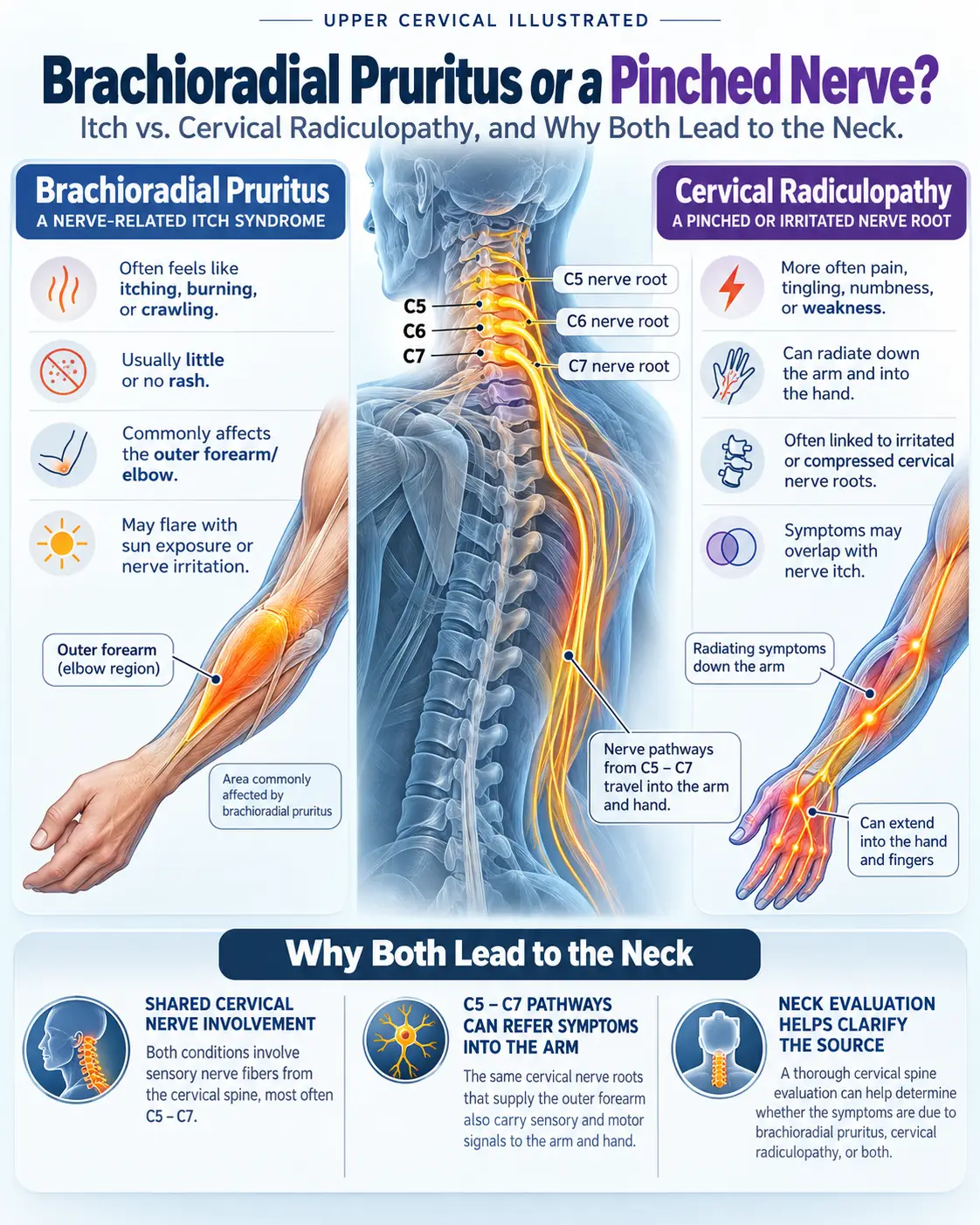
Brachioradial pruritus is a neuropathic itch — an itch generated by irritated nerves, not by anything happening in the skin. The skin on your outer forearm doesn’t itch on its own; every sensation it reports travels up a nerve, through a nerve root where that nerve exits the spine in your neck, and on into your spinal cord and brain. Irritate or crowd that nerve root anywhere along the way — most often where it exits the cervical spine — and the nerve can fire a faulty signal that your brain interprets as an itch on the arm. The arm is healthy. The trouble is upstream, in the neck.
That’s why antihistamines and steroid creams do nothing: they’re aimed at histamine in the skin, and histamine in the skin was never the problem. And it’s why the single most telling clue in BRP is the ice-pack sign — cold brings near-instant relief because it quiets the firing of the irritated nerve, and the itch returns the moment the cold comes off. That response is a fingerprint of a nerve-driven itch, and it points straight back to the nerve and the neck it comes from.
The evidence that BRP originates in the cervical spine is unusually strong for something most people think of as “just skin.” A landmark magnetic resonance investigation of the cervical spine in brachioradial pruritus, published in the Journal of the American Academy of Dermatology, imaged patients with BRP and found cervical spine changes corresponding to the levels that supply the itchy skin. Earlier work in the same journal documented that the itch follows the dermatomal map of the cervical nerve roots — the outer forearm territory served by C5, C6, and C7. Reports combining nerve conduction testing with cervical MRI show the pinched nerve and the itch tracking the same spinal level. And there are documented cases where treating the cervical spine directly resolved the itch — a patient whose brachioradial pruritus resolved after cervical spine surgery decompressed the involved level, and a 2024 report describing BRP as an atypical cervical radiculopathy, an itch that behaved like a pinched nerve because that is what it was.
So here’s the logic that brings exercise in: if the itch comes from an irritated nerve in your neck, then anything that reduces the mechanical strain on that neck — how your head sits, how your joints move, how much your posture crowds those nerve roots through the day — is a reasonable thing to support. That’s the legitimate role of neck exercises in BRP. Not as a cure. As supportive self-care that improves the environment around an irritated nerve. To learn more about the condition itself, our overview of brachioradial pruritus and upper cervical care walks through the full picture.
What Exercises Can Do — and What They Honestly Can’t
Let me be straight with you, because being cause-forward doesn’t mean overselling a stretch.
What gentle neck exercises and posture work can do: ease muscle tension around the neck and shoulders, improve range of motion so you’re not holding one strained position all day, reduce the postural loads that crowd nerve roots, and give you a sense of agency over a condition that can feel maddeningly out of your control. For some people, lowering the day-to-day mechanical stress on the neck genuinely turns the volume down on symptoms. Those are real benefits, and they’re worth pursuing.
What exercises cannot do: put a misaligned vertebra back into position. This is the distinction that matters most, and it’s the one the internet blurs. If the top of your neck — the atlas (C1) and axis (C2) that carry the weight of your head — has shifted out of alignment, no amount of stretching, chin-tucking, or foam-rolling repositions it. Mobility work moves the joints through their available range; it doesn’t correct where a joint is anchored. Think of a door hanging off a bent hinge: you can swing it back and forth all day, and it will still hang crooked, because the swinging was never going to straighten the hinge. Exercises move the door. They don’t fix the hinge.
This is why so many people do “everything right” — the stretches, the posture app, the standing desk — and still itch. They’ve been working hard on mobility while the structural driver, a misalignment at the top of the neck, sits unaddressed. The exercises weren’t wrong. They just can’t reach the thing generating the signal. That’s the gap this article exists to name.
So use the guidance below as what it is: supportive care that makes you more comfortable and supports the region while you pursue the step that can actually reach the source.
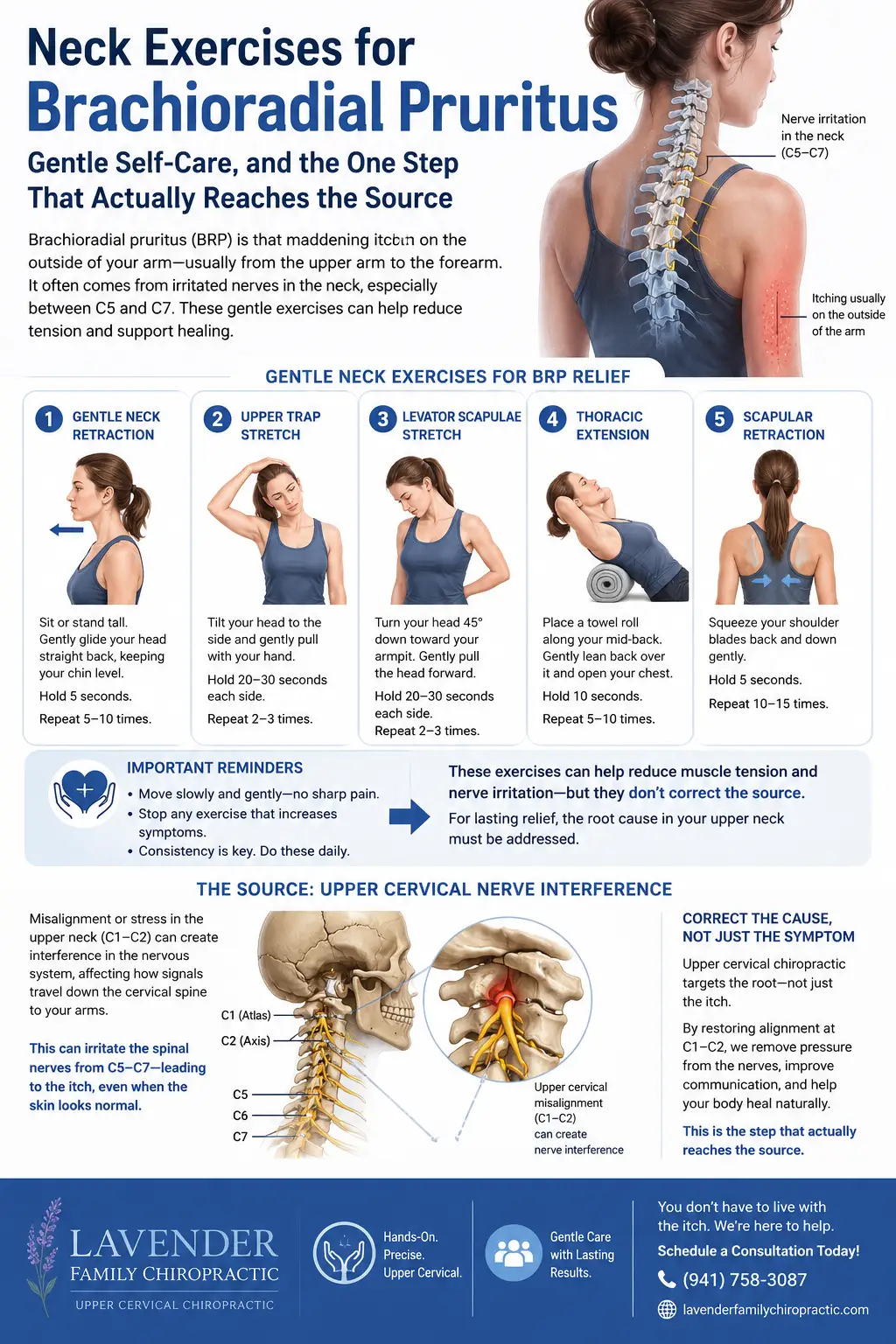
Gentle Neck Mobility You Can Try
A quick word before the movements. Gentle and slow are the entire point here. This is not a workout, and more is not better. The nerves in question are already irritable, and aggressive stretching or end-range cranking can flare symptoms. Every movement below should stay within a comfortable, pain-free range. If any of these increase your itch, burning, tingling, or pain — stop. That’s your nervous system telling you the movement is provoking the irritated nerve, and pushing through is the opposite of helpful. When in doubt, do less, and clear a new routine with your physician or physical therapist first, especially if you have any diagnosed neck condition.
With that firmly in mind, a few common gentle range-of-motion movements people use to keep the neck mobile and relaxed:
- Slow chin nods (gentle flexion/extension). Sitting tall, let your chin drift down toward your chest a small, comfortable amount, then gently return to neutral and let it tip slightly back — a small, easy arc, not a deep bend. Move slowly, a few unhurried repetitions.
- Easy side bends (lateral flexion). Bring one ear toward the same-side shoulder a comfortable distance, feeling a light stretch along the opposite side of the neck. Return to center, then the other side. Keep the shoulders relaxed and down.
- Gentle rotations. Turn your head slowly to look over one shoulder within a comfortable range, return to center, then the other side. No forcing the end range.
- Shoulder rolls. Roll the shoulders slowly backward several times to release the upper-trap and shoulder-girdle tension that so often travels with neck strain.
- A gentle chin-tuck (postural cue more than a stretch). Without tipping the head, draw the chin straight back a small amount, as if making a “double chin,” to bring the head back over the shoulders — then relax. This is really a posture reset; keep it light and brief.
Do these gently and only within comfort. The goal is easy mobility and reduced tension, not a maximal stretch. Consistency and gentleness beat intensity every time. And again: these support the region — they are not a correction for a misalignment.
Posture and Ergonomics: The Loads You Carry All Day Matter More Than Any Single Stretch
Here’s a truth that reframes the whole exercise question. You might spend five minutes stretching your neck — and then spend eight hours loading it in exactly the position that irritates the nerve. For most people, the posture they hold all day matters far more than any short mobility routine, because it’s the sustained, repeated load that shapes how the neck functions.
The main culprit is forward-head posture — the head drifting out in front of the shoulders as you lean toward a screen or look down at a phone. Your head is heavy, and the farther forward it sits, the more strain it places on the neck and the joints and nerve exits at the base of the neck. Over years, that sustained load is precisely the kind of stress that crowds nerve roots and sets up the irritation behind a neuropathic itch. Fixing your daytime posture isn’t glamorous, but it’s often the highest-yield self-care change you can make.
Practical adjustments worth making:
- Screen at eye level. Raise your monitor (or use a laptop stand plus an external keyboard) so the top of the screen is at roughly eye height and you’re looking straight ahead, not down. This single change spares your neck hours of forward-head loading every day.
- Bring the phone up. Instead of dropping your head to look down at your phone, raise the phone toward eye level. “Tech neck” is a real, cumulative load.
- Set up your chair. Feet flat, hips and knees roughly level, low back supported, shoulders relaxed — so your head can stack over your shoulders rather than jutting forward.
- Break up static time. Even the best posture becomes a strain if you hold it for hours. Every 30 to 60 minutes, stand, roll your shoulders, and reset your head over your shoulders. Movement variety beats rigid stillness.
- Mind your sleep setup. A pillow that keeps your neck in a neutral position — neither cranked up nor dropped down — spares the neck hours of overnight strain. Sleeping on your stomach, which forces the head into prolonged rotation, tends to be hardest on the neck.
These changes reduce the daily mechanical stress feeding into your symptoms. They’re genuinely worth doing. But notice what they have in common with the stretches: they lower the load on the neck; they don’t reposition a segment that’s already out of alignment. Supportive, yes. Corrective, no.
Symptom Relief You Can Reach For
Separate from mobility and posture, a few simple measures can make the itch itself more bearable while you pursue the underlying cause:
- Cold. The ice-pack sign isn’t just diagnostic — it’s practical relief. A cool pack or a cold compress on the itchy forearm quiets the firing of the irritated nerve and can settle a flare quickly. It’s temporary, and it doesn’t fix the source, but it’s a safe, effective way to get through a bad spell. Wrap ice in a cloth rather than applying it directly, and don’t overdo it on numb or compromised skin.
- Don’t scratch. In BRP, scratching gives no real relief because the problem isn’t in the skin — and it damages the skin you’re clawing at, sometimes badly. Cold is the far better response to the urge.
- Sun protection. UV exposure is a recognized aggravating factor in BRP; the itch often flares in summer and in sun-exposed people, likely because UV further irritates the small nerve fibers in already-sensitized skin. Covering the forearms with clothing or a broad-spectrum sunscreen removes one aggravator. It won’t resolve BRP on its own — because it doesn’t address the neck source — but it takes a finger off the trigger. Here in sunny Sarasota, this one matters more than it might elsewhere.
- Keep the skin intact. Gentle moisturizing and avoiding harsh scratching help prevent the secondary skin damage that a relentless itch can cause, even though moisturizer doesn’t touch the nerve signal itself.
These are comfort measures. They help you cope. None of them reaches the irritated nerve at its source — which brings us to the part that does.
The Missing Piece: Why the Highest-Value Step Is an Upper Cervical Evaluation
Here’s where nearly every “neck exercises for brachioradial pruritus” article stops short, and it’s the most important part.
Every stretch, every posture fix, every cold pack shares one limitation: they manage the environment around an irritated nerve without answering the underlying structural question — is the top of your neck aligned, or isn’t it? And that question can’t be stretched away. It has to be evaluated.
Consider the anatomy. Your atlas (C1) carries the entire weight of your head, balanced on the axis (C2), and this top segment is held mostly by ligaments rather than by interlocking bone — which makes it both remarkably mobile and uniquely vulnerable to shifting out of position. When that top segment misaligns, your head is no longer centered, and every level below it compensates: leaning, loading unevenly, absorbing strain it was never built to carry. Do that for years and you get exactly the picture that cervical imaging so often finds lower down in BRP — crowding and irritation at the C5–C7 nerve roots that feed the outer forearm. In other words, the lower-neck irritation generating your itch is frequently the downstream consequence of an uncorrected problem at the very top of the neck.
There’s a second reason the upper neck matters. The descending pathways from the brainstem that normally quiet down pain and itch signals — the nervous system’s own “brake” on these sensations — run directly through the upper cervical spinal cord. When that region is misaligned and stressed, the brake can weaken, and the itch signal gets amplified. So the upper cervical spine influences BRP twice over: it drives the mechanical load that irritates the lower levels, and it governs how loudly the itch gets turned up. It’s the one region most capable of affecting the entire pathway — and it’s the one region a stretching routine can’t reach and a standard workup rarely examines.
This is why the exercises, helpful as they are, hit a ceiling. You can spend a year faithfully mobilizing and correcting your posture, and if the atlas is sitting out of alignment, the driver of your symptoms is still there. The exercises were treating around the problem. The evaluation looks at it. For a deeper look at how the neck generates this itch and what imaging reveals, see our article on brachioradial pruritus and cervical MRI, and our overview of how upper cervical involvement relates to nerve conditions and neuropathy.
How We Evaluate the Structural Piece at Lavender Family Chiropractic
At Lavender Family Chiropractic, we focus exclusively on the upper cervical spine — the atlas, the axis, and the junction where the skull meets the neck. Our approach is built on measurement, not guesswork, which is exactly what the “just do these stretches” advice can’t offer.
We use 3D CBCT imaging to measure your atlas and axis alignment in three dimensions — precision a standard X-ray or a general stretch program isn’t designed for — and paraspinal infrared thermography to read how your nervous system is actually behaving along the spine, which is directly relevant when the whole problem is a hyperexcitable, misfiring nerve. If you already have a cervical MRI, bring it: it tells us which level is irritated, and our imaging tells us what’s driving the load onto it from the top.
When a correction is warranted, we use the Knee Chest Upper Cervical technique — precise, gentle, and low-force, with no twisting, cracking, or popping. For a nervous system that’s already firing an itch it can’t switch off, that gentleness is the entire point. This is the piece that stretching cannot substitute for, because it addresses where the joint sits, not just how far it moves. You can read more about our upper cervical chiropractic care and how it fits alongside the self-care in this article.
Keep working with your dermatologist and, if you have one, your neurologist — confirming the diagnosis and ruling out other causes of chronic itch matters, and we’re glad to work alongside them. Keep doing your gentle mobility and posture work; it supports the region and helps you feel better. What we add is attention to the one region that sits at the crossroads of this condition — the top of your neck — the piece exercises can’t reach on their own.
→ Call Lavender Family Chiropractic at (941) 243-3729 to schedule a complimentary consultation. We’re at 5899 Whitfield Avenue, Suite 107, Sarasota, FL 34243 — the corner of University and Whitfield. We serve patients across Sarasota, Bradenton, and Lakewood Ranch.
Putting It Together: A Sensible Self-Care Routine
If you want a simple, realistic way to fold this into your day while you arrange an evaluation, it might look like this:
- Morning: a few minutes of gentle neck mobility — slow nods, easy side bends, gentle rotations, shoulder rolls — all within comfort, none of it forced.
- Through the day: screen at eye level, phone up, chair set well, and a posture reset every 30 to 60 minutes. This is where most of the real load-reduction happens.
- During flares: a cold pack on the itchy forearm for relief, instead of scratching.
- Outdoors: cover the forearms or use sunscreen to remove the UV trigger — especially important under the Florida sun.
- The keystone step: get the upper cervical spine evaluated, so the self-care is supporting a neck that’s actually being addressed at its source rather than propping up a misalignment no stretch can fix.
That last item is the difference between managing symptoms indefinitely and aiming at the driver. The routine makes you more comfortable. The evaluation reaches the cause.
When to Stop and Seek Prompt Medical Care — Red Flags
An itch is usually not an emergency, but the neck is a serious neighborhood, and some symptoms call for urgent evaluation rather than home exercises. Stop any exercise immediately if it worsens your symptoms — increased itch, burning, tingling, pain, or numbness during or after a movement means that movement is provoking the irritated nerve, and it should not be pushed through.
Beyond that, seek prompt medical care if you develop any of the following:
- Progressive weakness or numbness in an arm, hand, or leg.
- Clumsiness or loss of fine motor control — dropping things, trouble with buttons or a key.
- Problems with balance or walking.
- Any change in bowel or bladder control.
These can signal nerve-root or spinal-cord compression that needs timely medical assessment, and they are not situations to stretch through or wait out. Getting checked is never an overreaction. If you’re ever unsure whether a symptom is a red flag, treat it as one and call your physician.
Top Questions
Can neck exercises cure brachioradial pruritus? No. Gentle neck exercises and posture changes are supportive self-care — they can ease tension, reduce daily strain, and make symptoms more bearable, but they can’t correct a misaligned upper cervical spine, which for many people is the underlying driver. Exercises move the joints; they don’t reposition a segment that’s out of alignment. That’s why the highest-value step is getting the neck evaluated, not just stretched.
What are the best brachioradial pruritus exercises to start with? Start gentle and slow: small chin nods, easy side bends, gentle rotations, and shoulder rolls, all within a comfortable, pain-free range, plus a light postural chin-tuck. Just as important as any exercise is your all-day posture — screen at eye level, phone up, chair set well. Stop anything that increases your itch or pain, and consider clearing a routine with your physician or physical therapist first.
Why do my forearms itch if the problem is my neck? Because brachioradial pruritus is a neuropathic itch — the itch signal is generated by irritated nerves where they exit the cervical spine, and your brain projects that faulty signal onto the outer-forearm skin those nerves serve. The skin is healthy; the source is upstream in the neck. That’s also why creams don’t work and cold does.
If exercises help, why would I still need an evaluation? Because exercises reduce the load around an irritated nerve but can’t answer the structural question of whether the top of your neck is aligned — and they can’t correct it if it isn’t. Many people do the stretches and posture work faithfully and still itch, because the driver, a misalignment at the atlas or axis, was never addressed. The exercises support the region; the evaluation reaches the source.
Is cold safe to use for the itch? Yes, used sensibly — a cloth-wrapped cold pack on the itchy forearm quiets the irritated nerve and is one of the more effective ways to settle a flare. It’s temporary relief, not a fix for the neck, and you should avoid applying ice directly to skin or overusing it on numb or damaged skin.
Does sun really make it worse? Sun exposure is a recognized aggravating factor — UV appears to further irritate the small nerve fibers in already-sensitized skin, which is why BRP often flares in summer and in sun-exposed people. Covering the forearms or using sunscreen removes one trigger. It won’t resolve BRP on its own, because it doesn’t address the neck, but it helps.
Is the upper cervical adjustment forceful? No — it’s precise, gentle, and low-force, with no twisting, cracking, or popping. For a nervous system already firing an itch it can’t switch off, that gentleness is the entire point.
Should I stop my other treatments? No. This is supportive information, not a replacement for medical care. Keep working with your dermatologist and physician, keep any prescribed treatments, and rule out other causes of chronic itch. Upper cervical evaluation and gentle self-care complement good medical care — they don’t replace it.
Serving Sarasota, Bradenton & Lakewood Ranch
That relentless forearm itch — and the search for exercises to quiet it — has sent people all over Sarasota, Bradenton, and Lakewood Ranch from cream to cream and specialist to specialist with little to show for it. Lavender Family Chiropractic (NeckWise North Sarasota) sits at 5899 Whitfield Avenue, the corner of University and Whitfield — minutes from the Lakewood Ranch corridor and just across from Bradenton — so patients from all three communities reach us easily. We also welcome patients from Venice, Osprey, Port Charlotte, Parrish, and the Myakka area who are ready to look past the skin. Whether you’re in Sarasota, Bradenton, or Lakewood Ranch, we evaluate the region that generates the itch — the top of your neck — using 3D CBCT imaging and paraspinal infrared thermography, and we coordinate with your dermatologist. Bring your cervical MRI if you have one.
Stretch If It Helps — Then Reach the Source
Neck exercises for brachioradial pruritus are a reasonable place to start, and if gentle mobility, better posture, cold for relief, and sun protection make your days more bearable, keep doing them. They’re genuinely supportive. But be clear-eyed about their ceiling: exercises can improve the environment around an irritated nerve, yet they can’t put a misaligned upper cervical spine back where it belongs. If you’ve been faithful to the stretches and the ergonomics and you still itch, that’s not a sign you’re failing at the exercises — it’s a sign the driver is somewhere a stretch can’t reach.
That somewhere is usually the top of your neck, and it’s the one region most people with BRP have never had properly evaluated. Let us look at the piece the exercise videos leave out. Call (941) 243-3729 or book a complimentary consultation. Do the gentle self-care — and then go find where your itch actually starts.
Lavender Family Chiropractic (NeckWise North Sarasota) · 5899 Whitfield Avenue, Suite 107, Sarasota, FL 34243 · (941) 243-3729
This article is for general educational purposes only and is not medical advice, diagnosis, or treatment. Brachioradial pruritus should be evaluated by qualified healthcare professionals, and other causes of chronic itch should be ruled out. Please consult your physician before starting any new exercise or making changes to your health routine, especially if you have a medical condition, are pregnant, or take medication. If you develop progressive weakness, numbness, balance problems, or any change in bowel or bladder function, seek prompt medical attention.
Related Articles


Get our upper cervical articles first.