Dizziness When Turning Your Head: Is It Your Neck or Your Inner Ear?
By Dr. Rusty Lavender, D.C. — upper cervical chiropractor, Lavender Family Chiropractic, Sarasota, FL. Reviewed and updated October 2026.
You turn to check your blind spot, or look up at a shelf, or roll over in bed, and for a moment the world lurches. It settles, and you go on with your day — but it keeps happening, and you’ve started moving your head carefully, like someone carrying a full cup. That specific pattern, dizziness that arrives with head movement, has two main sources, and they are treated completely differently. One is in the inner ear. The other is in the neck. This article is about telling them apart, because the difference decides who should treat you.
This is educational content, not medical advice. New dizziness with head movement that comes with a severe headache, double vision, trouble speaking, weakness, or numbness needs emergency care, not this article.
The Two Systems Your Head Turn Involves
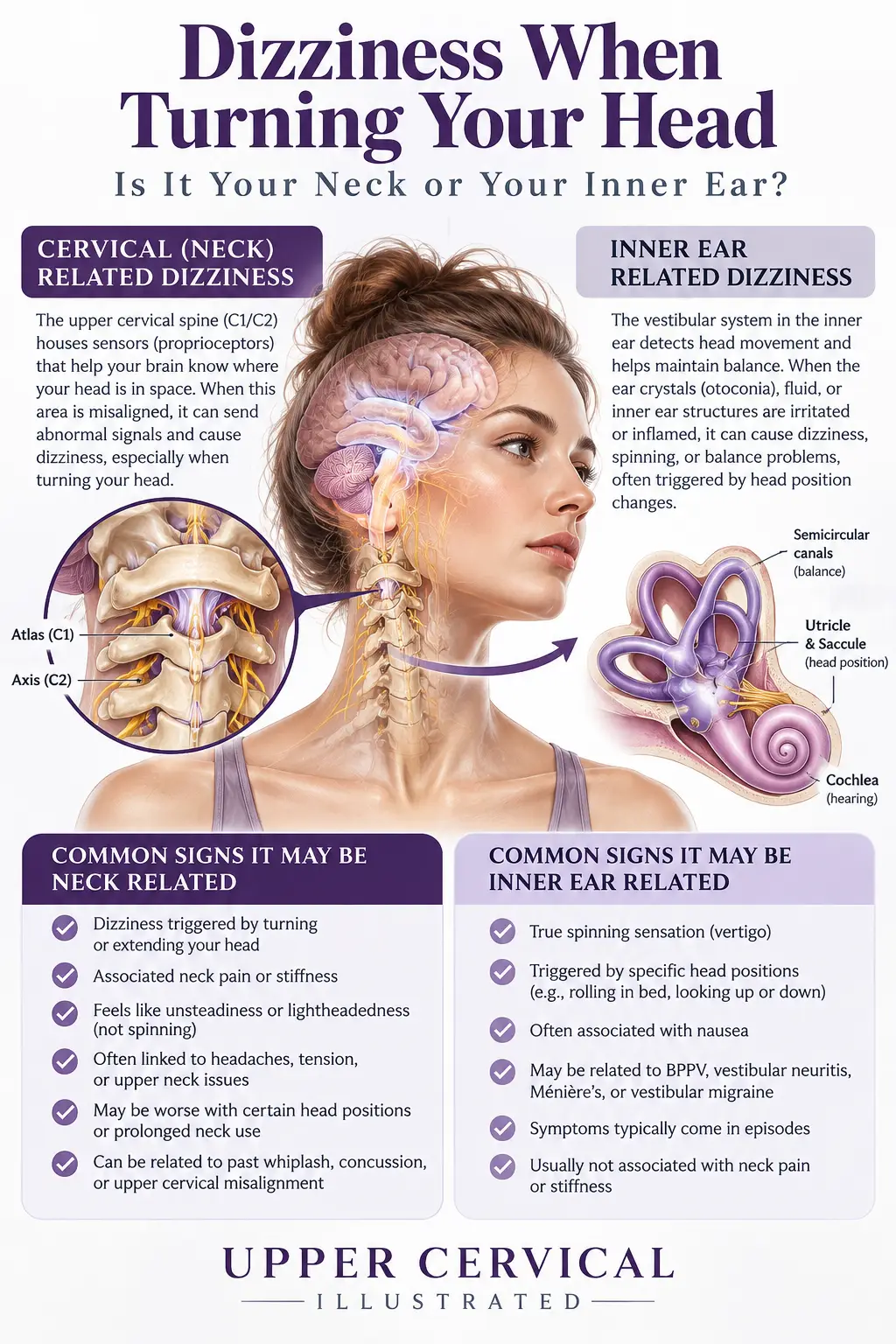
Every time you move your head, two sets of sensors report the motion to your brain. The inner ear’s semicircular canals sense rotation directly. At the same time, the small muscles and joints at the top of your neck — the atlas and axis, and the suboccipital muscles that connect them to the skull — report how far the head has turned relative to the body. Your brain expects those two reports to agree. When they do, you feel steady. When one of them is wrong, you feel dizzy.
That’s the whole distinction in one sentence: inner-ear dizziness comes from a bad signal in the canals; neck-related dizziness comes from a bad signal in the cervical spine. Both are triggered by the same movement, which is why they’re so often confused — including by clinicians.
What Inner-Ear Dizziness Feels Like
The most common inner-ear cause is benign paroxysmal positional vertigo, or BPPV. Loose calcium crystals drift into one of the canals and make it fire when it shouldn’t. The clinical practice guideline from the American Academy of Otolaryngology, published by Bhattacharyya and colleagues (2017), describes the pattern precisely:
- It spins. True rotational vertigo — the room turns, or you do.
- It’s brief. Seconds to under a minute, then it fades.
- It’s positional, not just movement-related. Lying down, rolling over in bed, tipping the head back to look up, and bending forward are the classic triggers. Turning the head while upright is less typical.
- It’s the same every time. Same direction, same trigger.
- It comes with nystagmus — a rhythmic eye movement a clinician can see during a positioning test.
BPPV is confirmed with the Dix-Hallpike maneuver and treated with canalith repositioning — the Epley maneuver — which resolves most cases in one to three sessions. A population study by von Brevern and colleagues (2007) found that only a small fraction of people with BPPV ever received that treatment, which is a reason to get checked rather than wait. Our BPPV treatment article covers it in detail.
What Neck-Related Dizziness Feels Like
Cervicogenic dizziness — dizziness arising from the cervical spine — has a different signature. The clinical descriptions by Yacovino and Hain (2013) and Hain (2015), and the diagnostic framework from Reiley and colleagues (2017), converge on these features:
- It usually doesn’t spin. Unsteadiness, swaying, a “floating” or “off” feeling, a sense of the head not sitting right on the body.
- It lasts longer. Minutes to hours, often lingering after the movement that set it off.
- It’s tied to neck movement and neck position — turning, holding the head in one position (driving, screens), or after sleeping wrong — rather than to lying down specifically.
- It travels with neck symptoms. Neck pain, stiffness, reduced range of motion, headache at the base of the skull.
- There’s often a history. Whiplash, a fall, a concussion, sometimes years earlier. Treleaven and colleagues (2003)showed that whiplash patients with dizziness had measurably worse head-position sense than those without.
- No hearing changes, no ringing — the ear is not involved.
The mechanism is well described: the upper neck is one of the brain’s richest sources of position information, and Kristjansson and Treleaven (2009) reviewed how disturbed cervical input produces dizziness, unsteadiness, and altered eye-movement control. Our cervicogenic dizziness guide goes deeper.
A Test You Can Understand (Do Not Do Alone)
Clinicians separate the two with a simple idea: move the neck without moving the head, and see if the dizziness follows. In the cervical torsion test, the head is held still while the body is rotated beneath it. The inner ear feels no motion — the head hasn’t moved — so if dizziness or nystagmus appears, the signal came from the neck. L’Heureux-Lebeau and colleagues (2014) evaluated this and other bedside tests and found they help distinguish cervicogenic dizziness from other causes, though none is a stand-alone confirmation. Combined with a positioning test for BPPV, the two together usually sort out which system is talking.
Side by Side
| Inner ear (BPPV) | Neck (cervicogenic) | |
|---|---|---|
| Sensation | spinning | unsteady, swaying, “off” |
| Duration | seconds | minutes to hours |
| Trigger | lying down, rolling, looking up | turning, sustained neck positions |
| Neck pain or stiffness | usually absent | usually present |
| Injury history | not typical | common (whiplash, fall, concussion) |
| Eye movement on testing | positional nystagmus | may appear with neck torsion |
| Treatment | canalith repositioning (Epley) | treatment directed at the neck |
Many people have some of both, and a person with BPPV whose neck was also injured in the same fall is not unusual. That’s why the evaluation matters more than the label.
What Treats Each
For BPPV, canalith repositioning. It’s quick, it’s well studied, and we refer for it or screen for it ourselves — if your pattern is brief positional spinning, that’s what you need first.
For cervicogenic dizziness, the evidence supports treating the neck. In a randomized trial published in Physical Therapy, Reid and colleagues (2014) found that gentle manual therapy to the cervical spine reduced dizziness intensity and frequency compared with placebo, with benefits maintained at twelve months. Those trials used physiotherapy techniques, not the upper cervical chiropractic procedure we use; they establish that treating the neck helps neck-related dizziness, not that our specific method does. What we add is measurement: 3D CBCT imaging of the atlas and axis, paraspinal thermography, and a head-repositioning assessment to see whether the neck is feeding the brain accurate information — then a precise, low-force correction only if the imaging shows something to correct. No twisting, cracking, or popping.
When to See Whom
Start with a physician if the dizziness is new, severe, or comes with any red flag. See an ENT or vestibular therapist if the pattern is brief positional spinning. Consider an upper cervical evaluation if the dizziness is unsteadiness rather than spinning, follows neck movement, travels with neck pain or stiffness, and especially if it began after an injury — or if BPPV has been treated and something is still off. Our dizziness guide walks through how the types are told apart.
Frequently Asked Questions
Can turning my head trigger both BPPV and neck dizziness? Yes. Head turns move both the inner ear and the neck, which is why the trigger alone doesn’t tell you the source. Duration, sensation, and neck symptoms do.
If the Epley maneuver didn’t help, does that mean it’s my neck? Not automatically — BPPV can involve a different canal than was treated, or recur. But if repositioning was done correctly, the spinning stopped, and you’re still unsteady with neck movement, the neck is the next thing to evaluate.
Why do I get dizzy turning my head while driving? Sustained neck rotation and vibration are classic cervicogenic triggers, especially in someone with a prior whiplash. BPPV is less likely to fire while upright and turning.
Can a chiropractor diagnose BPPV? We screen for it with positional testing and refer for repositioning when that’s the picture. We don’t treat the inner ear; we evaluate the neck.
Is dizziness when turning my head dangerous? Usually not. It becomes urgent with a severe headache, vision or speech changes, weakness, numbness, or inability to walk — those need emergency care.
Does an MRI show cervicogenic dizziness? No. It’s a functional problem, diagnosed by history, exam, and by excluding the ear and brain. A normal MRI doesn’t rule it in or out.
How is upper cervical care different from a regular neck adjustment? It’s limited to the top two vertebrae, guided by 3D imaging, and delivered with a low-force technique — no rotation of the neck, which matters in a person who gets dizzy from turning it.
How soon would I know if the neck is the source? Cervicogenic dizziness that responds to neck care usually changes within the first several weeks. If we don’t see movement, we say so.
Lavender Family Chiropractic in Sarasota, Florida offers a thorough upper cervical evaluation to find out whether we can help. Call (941) 243-3729 or request an appointment. 5899 Whitfield Avenue, Suite 107, Sarasota, FL 34243.
References
- Bhattacharyya N, et al. Clinical Practice Guideline: Benign Paroxysmal Positional Vertigo (Update). Otolaryngol Head Neck Surg. 2017. PMID 28248609
- von Brevern M, et al. Epidemiology of benign paroxysmal positional vertigo: a population based study. J Neurol Neurosurg Psychiatry. 2007. PMID 17135456
- Yacovino DA, Hain TC. Clinical characteristics of cervicogenic-related dizziness and vertigo. Semin Neurol. 2013. PMID 24057828
- Hain TC. Cervicogenic causes of vertigo. Curr Opin Neurol. 2015. PMID 25502050
- Reiley AS, et al. How to diagnose cervicogenic dizziness. Arch Physiother. 2017. PMID 29340206
- Treleaven J, et al. Dizziness and unsteadiness following whiplash injury. J Rehabil Med. 2003. PMID 12610847
- Kristjansson E, Treleaven J. Sensorimotor function and dizziness in neck pain. J Orthop Sports Phys Ther. 2009. PMID 19411769
- L’Heureux-Lebeau B, et al. Evaluation of paraclinical tests in the diagnosis of cervicogenic dizziness. Otol Neurotol. 2014. PMID 25058834
- Reid SA, et al. Comparison of Mulligan SNAGs and Maitland mobilizations for cervicogenic dizziness: a randomized controlled trial. Phys Ther. 2014. PMID 24336477
Related Posts


Get our upper cervical articles first.
Patients Experience