
How Long Does Brachioradial Pruritus Last? The Full Picture, From First Flare to Lasting Relief
By Dr. Rusty Lavender, D.C. — upper cervical chiropractor, Lavender Family Chiropractic, Sarasota, FL. Reviewed and updated October 2026.
If you’ve just been told the maddening itch on your forearms is brachioradial pruritus, the first question is usually “how do I make it stop,” and the second — the one people are almost afraid to ask — is “how long is this going to last?” You’ve probably already tried the creams. You may have been to a dermatologist, an allergist, maybe your primary care doctor twice. Somebody finally gave the thing a name, and now you want to know whether you’re looking at a bad summer or a bad decade.
This article answers that question as directly as the research allows. It covers what brachioradial pruritus is and why it behaves the way it does; the typical course from first flare through the seasonal cycle; why it drags on for some people and quiets for others; what the “it went away in winter” pattern really means; the research on where the condition actually comes from; and what changes the course — including the piece of the puzzle most people with BRP have never had examined, the upper neck. We’ll also cover what living with it day to day looks like, what we see in our Sarasota office, and the fifteen questions patients ask us most.
This is educational content, not medical advice. New itching with a rash, fever, unexplained weight loss, or night sweats should be evaluated by a physician first.
The Short Answer
Brachioradial pruritus (BRP) is a chronic, relapsing condition. Left alone, it typically lasts months to years, and for many people it follows a seasonal cycle — flaring through the sunny months, easing in winter, and returning the next spring. It is not dangerous and it does not progress into anything worse. But it rarely burns out on its own in a few weeks the way a rash would, and the people who get lasting relief are almost always the ones who found and addressed what was driving it rather than waiting it out.
In most cases, what’s driving it is the neck. That’s why this article — written by an upper cervical office — ends at the upper cervical spine. Everything in between is the evidence for why.
What Brachioradial Pruritus Is
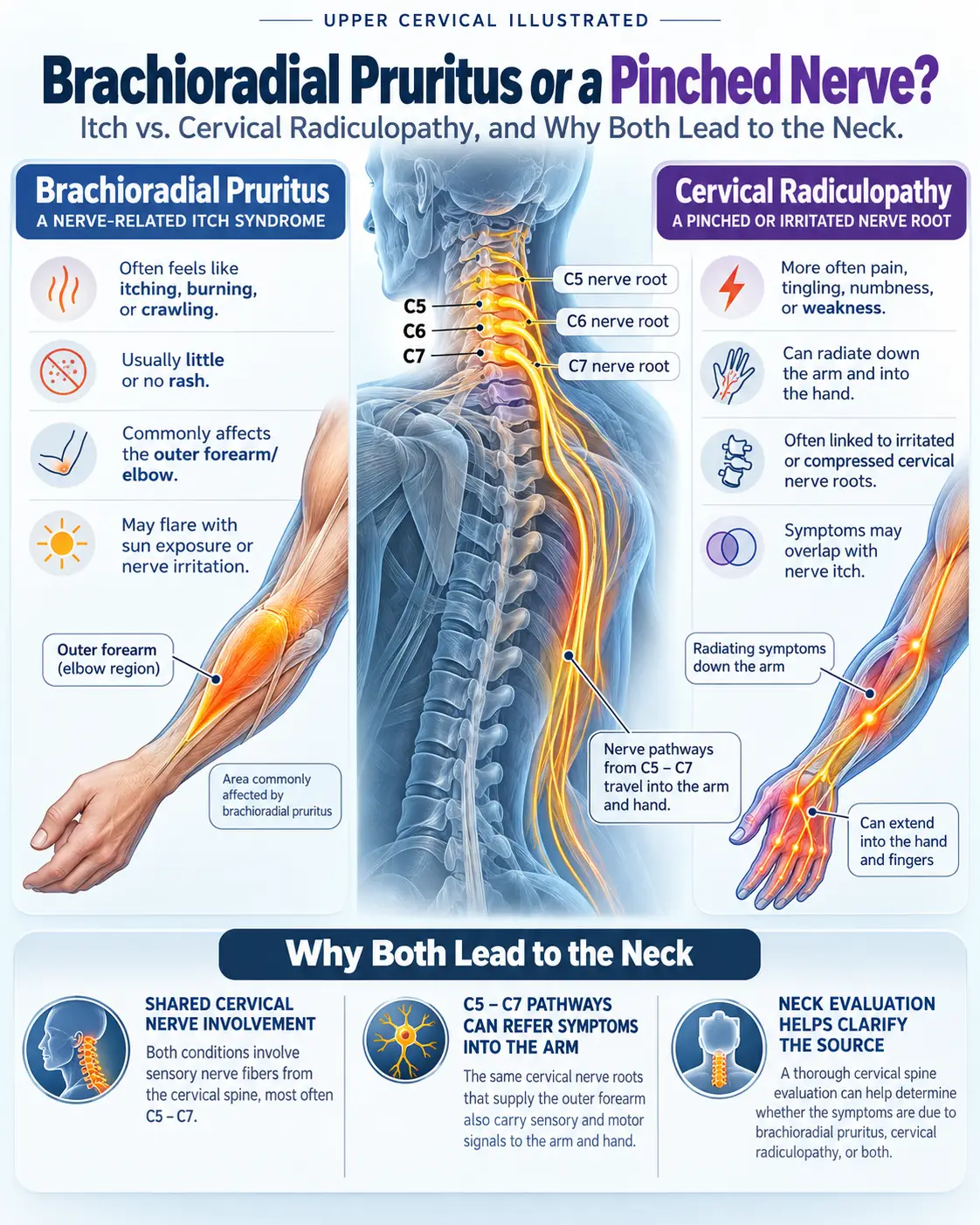
The name is anatomical. Brachioradialis is the long muscle on the thumb side of your forearm that stands out when you make a fist with your palm facing sideways; pruritus is the medical word for itch. Brachioradial pruritus is a persistent itch over that muscle — the outer forearm, from the elbow toward the wrist — sometimes extending up the outer arm to the shoulder, occasionally into the upper back. It’s usually on both sides, though one is often worse.
What makes it unusual, and what makes it so frustrating, is that there is nothing on the skin. No rash, no hives, no bumps, no scaling — until you scratch, and then there are only the marks you made. The itch is often mixed with other sensations: tingling, burning, stinging, a crawling or “ants under the skin” feeling. Antihistamines don’t touch it. Steroid creams don’t touch it. And the one thing that does — an ice pack — works so dramatically and so specifically that doctors use it as a diagnostic sign.
That combination of a vivid symptom with a normal-looking skin surface is the first clue to what BRP really is: not a skin disease, but a nerve problem that happens to be felt in the skin.
Why It Behaves the Way It Does: The Nerve Behind the Itch
Itch is carried by its own population of small nerve fibers — it’s not just “mild pain,” it has dedicated wiring. Those fibers run from the skin of the forearm, up the arm, through the shoulder, and into the spinal cord at the lower part of the neck, where the fifth and sixth cervical nerve roots (C5 and C6) enter the spine. From there the signal travels up through the brainstem to the brain, which decides where it feels the itch.
If anything along that path is irritated, the brain can receive an itch signal with nothing happening in the skin at all. That’s what the research says is happening in BRP. Cohen and colleagues (2003) titled their study “Brachioradial pruritus: a symptom of neuropathy” and documented nerve-conduction findings in patients. Wallengren and Sundler (2005) biopsied the itchy skin of BRP patients and found something remarkable: fewer small nerve fibers than normal in the affected areas — the skin’s nerve supply was being affected from upstream — and the fiber density returned toward normal after a symptom-free period.
Hold onto that finding, because it answers both halves of the “how long” question. The nerves in the skin are being affected by irritation somewhere above them. As long as the upstream irritation continues, the itch continues. When the irritation stops, the skin recovers. BRP lasts because the source persists; it can end because the skin heals.
Where the Upstream Irritation Is: The Cervical Spine
Follow the C5–C6 nerve roots back to where they exit the spine and you arrive at the lower neck — and that is exactly where the imaging research points.
Marziniak and colleagues (2011) performed MRI on patients with BRP and found that the large majority had cervical spine changes — disc protrusions, degenerative narrowing, nerve root involvement — and that in most, the spinal level of the finding matched the area of itch on the arm. Goodkin, Wingard, and Bernhard (2003) reached the same conclusion from a clinical series and proposed that cervical spine disease is the common thread. The Mayo Clinic’s ten-year review by Mirzoyev and Davis (2013), covering 111 patients, found a high rate of cervical spine findings when the neck was imaged.
This is why BRP outlasts creams, antihistamines, and patience. Those treat the skin. The skin isn’t the source. Our article on what a cervical MRI shows in brachioradial pruritus walks through the imaging findings in detail, and why antihistamines and steroid creams don’t work explains the mismatch.
The Upper Cervical Connection
Here is where our office’s perspective comes in, and why we look higher than the C5–C6 level where the itch nerves enter.
The neck works as a unit. The top two vertebrae — the atlas (C1) and axis (C2) — carry the weight of the head and determine how the rest of the cervical spine lines up beneath them. When the atlas is misaligned, the head sits off-center, and the lower neck compensates: the curve flattens or reverses, the discs below take uneven load, and the openings where the nerve roots exit — including C5 and C6 — change shape over time. The degenerative changes the MRI studies found at the lower neck don’t appear from nowhere; they develop over years in a spine that’s carrying its load unevenly.
The upper cervical spine also sits against the brainstem, where every itch signal from the body is relayed on its way to the brain. The brainstem is the gatekeeper that decides how loudly a signal gets through, and the small muscles and joints of the upper neck feed it a constant stream of information. Irritation at the top of the neck can turn the gain up on signals coming from below.
So in a person with BRP, an upper cervical evaluation is asking two questions: is the top of the neck positioned in a way that’s loading the lower neck unevenly, and is the nervous system at the upper neck showing irritation? Both are measurable, and both bear on how long the condition lasts.
The Seasonal Pattern, Explained
Many patients tell us, “It went away last winter, so I thought I was done, and then it came back in May.” That’s the classic course. Wallengren (1998) called BRP a “recurrent solar dermopathy” because of exactly this cycle.
The current understanding is that the neck sets the stage and the sun pulls the trigger. Nerves that are already irritated at the spinal level become sensitized; ultraviolet exposure on the forearm skin — where those nerves end — is enough to set them off. In winter, with less sun and more sleeves, the trigger is removed and the itch quiets. But the upstream irritation is still there, which is why it returns.
Florida makes this worse than almost anywhere. Our sun is strong year-round, the driving-arm-on-the-window habit is universal, and “winter” here means a few weeks of long sleeves. Many of our Sarasota BRP patients have no real off-season at all. Our article on brachioradial pruritus and sun exposure covers the Florida problem and how to manage it.
The practical point: a winter remission is real relief, but it isn’t resolution. If the neck component is never addressed, the next sunny season usually brings it back.
How Long Does a Flare Last?
Within the chronic course, individual flares vary enormously.
A bad evening can be hours of relentless itching, typically starting after sundown and peaking at bedtime, when skin temperature rises and there’s nothing to distract you.
A seasonal flare in Sarasota can run from late spring through fall — six months or more — with daily or near-daily symptoms, worse after days in the sun.
Between flares there may be days or weeks of quiet, which is what fools people into thinking it’s gone.
The ice-pack test — cold relieves BRP almost instantly, in a way that’s nearly unique to this condition — is useful both for diagnosis and for getting through a bad night. Bernhard and Bordeaux (2005) described it as a “medical pearl,” and we explain how to use it in the ice-pack sign.
One important caution about flares: scratching can make BRP spread. Kwatra and colleagues (2013) described BRP acting as a trigger for generalized itch — a localized forearm problem that, with enough scratching, teaches the nervous system to itch more broadly. That’s a reason not to simply ride it out.
Why It Drags On for Some People and Not Others
Not everyone with BRP has the same course. From the research and from what we see, the factors that stretch it out are:
How much cervical change is present. More degenerative change at the lower neck means more persistent nerve root irritation and a longer, more stubborn course.
How much sun the forearms get. Outdoor workers, boaters, golfers, and anyone who drives with the window down have more trigger exposure.
Whether scratching has become a habit. Chronic scratching sensitizes the nervous system further and can add a skin-level itch on top of the nerve itch.
Whether the source has ever been addressed. This is the biggest one. Patients who have spent years treating the skin have, by definition, spent years not treating the neck.
Age. BRP is most common in middle age and later, alongside the cervical disc changes that come with age. It doesn’t inevitably worsen, but the underlying neck changes don’t reverse on their own either.
Upper Cervical Care at Lavender Family Chiropractic
When someone with brachioradial pruritus comes to our Sarasota office, the first visit is an evaluation, not an adjustment.
History and examination. We go through the pattern of your itch — location, timing, triggers, what helps — and the ice-pack response. We screen for the things BRP can be confused with, and for any red flags that belong with a physician.
Neurological examination. Reflexes, strength, and sensation by nerve root, so we know whether the C5–C6 roots are showing signs beyond the itch.
Paraspinal infrared thermography. A non-invasive scan that reads the heat pattern along your spine, which reflects nervous-system activity. It gives us an objective baseline of where the nervous system is irritated and a way to track change over time without guesswork.
3D cone-beam CT (CBCT) imaging of the upper cervical spine. This shows the actual position of the atlas and axis relative to the skull, in three dimensions and to the degree — information a flat X-ray can’t provide and an MRI doesn’t address. If your physician has already ordered a cervical MRI, bring it; the two images answer different questions, and together they give the fullest picture.
Review of findings. We sit down and go through what the imaging and thermography show before any care begins.
Correction, if indicated. If the imaging shows a measurable misalignment of the upper cervical spine, we correct it with a precise, low-force procedure specific to your measurements. There is no twisting, no cracking, and no rotation of the neck — the head is positioned and a gentle correction is delivered to the atlas. Most patients describe it as pressure.
Remeasurement. Thermography after each visit and follow-up imaging when indicated, so progress is measured rather than assumed.
Upper cervical care addresses the mechanical source the research points to — the neck — with measurement before and after, so progress is objective rather than guessed at. Results vary from person to person, and we tell you plainly what the findings show.
If brachioradial pruritus has been running your summers, call (941) 243-3729 or request an appointment online for an upper cervical evaluation.
What the Research Says
Here, in one place, is the evidence this article rests on, so you can read it yourself or bring it to your physician.
BRP is a nerve condition, not a skin condition. Cohen and colleagues (2003) documented neuropathic findings and named BRP “a symptom of neuropathy.” Wallengren and Sundler (2005) showed reduced small-nerve-fiber density in the itchy skin that normalized during remission — the skin is being affected from upstream and can recover.
The source is the cervical spine in most patients. Marziniak and colleagues (2011) found cervical spine changes on MRI in the large majority of BRP patients, at levels matching the itch. Goodkin, Wingard, and Bernhard (2003) proposed cervical spine disease as the common mechanism. Mirzoyev and Davis (2013), reviewing 111 Mayo Clinic patients over a decade, found a high rate of cervical findings.
The course is chronic and seasonal. Veien and colleagues (2001) described persistent, often years-long itch relieved by cold and poorly relieved by standard anti-itch treatment. Wallengren (1998) characterized the recurrent, sun-triggered pattern.
Cold is diagnostic and therapeutic. Bernhard and Bordeaux (2005) described the ice-pack sign.
Scratching can spread it. Kwatra and colleagues (2013) described BRP as a trigger for generalized itch.
Taken together: the research locates the problem in the neck, explains why skin treatments fail, and explains why the condition can both persist for years and resolve when the source is addressed.
Living With It While You Address It
Whatever else you do, these shorten the bad days.
Protect the forearms from sun. Lightweight long sleeves, UPF arm sleeves for driving and yard work, shade during peak hours. This is the single most effective daily step and it costs almost nothing.
Use cold, not scratching. Keep two soft gel packs in the refrigerator (not the freezer — too cold to leave on). Wrap in a thin cloth and lay along the forearm when a flare starts. A refrigerated cooling gel or menthol lotion works between packs.
Keep the skin moisturized. Nerve itch isn’t a dry-skin problem, but scratched skin becomes a dry-skin problem and adds a second itch on top. A plain, fragrance-free moisturizer prevents that.
Cool the bedroom. Flares peak at night partly because skin temperature rises as you fall asleep. A cooler room, a fan on the arms, and bare forearms outside the covers help. If nights are the worst part, our article on why brachioradial pruritus is worse at night has a full plan.
Mind your pillow and sleeping position. Because the nerve roots involved exit the lower neck, a pillow that holds your neck bent or extended for seven hours can aggravate them. A neutral neck line matters.
Stay active with the neck gently. Our neck exercises for brachioradial pruritus are designed to maintain mobility without provoking the nerves — no stretching into end range, no forced rotation.
Medication, when prescribed. For severe flares, physicians sometimes prescribe medication aimed at nerve pain rather than skin — gabapentin is the most common — or topical capsaicin. Our article on brachioradial pruritus treatment options explains each honestly.
What Our Patients Typically Experience
We can’t give you a number that applies to everyone, and anyone who does is guessing. What we can describe is the pattern.
When the upper cervical evaluation shows a measurable misalignment and we correct it, patients usually report a change in the intensity and frequency of the itch within the first several weeks. The nights tend to improve first, because the positional component is addressed. Over the following months, the seasonal pattern blunts — the summer flare comes later, lighter, or not at all. Thermography tracks alongside: as the nervous system settles, the heat pattern along the spine evens out.
When the evaluation shows nothing to correct at the upper cervical spine, we tell you that, and the path is sun protection plus medical management of the lower-neck findings with your physician. When we do correct and don’t see objective change, we say so and help you find the next step. Either way, you leave knowing what’s going on in your neck, which most people with BRP have never been told.
Serving Sarasota, Bradenton, Lakewood Ranch, and the Suncoast
Our office is on Whitfield Avenue in north Sarasota, a few minutes from the Manatee County line, and we see brachioradial pruritus patients from across the region — Sarasota, Bradenton, Lakewood Ranch, Palmetto, Parrish, Ellenton, Longboat Key, Siesta Key, Osprey, Nokomis, Venice, and North Port. BRP is more common here than almost anywhere in the country for one reason: the sun. If you’ve been told your itch is “just dry skin” or “just allergies” and nothing has worked, the upper neck is the piece that hasn’t yet been examined.
Top 15 FAQs About How Long Brachioradial Pruritus Lasts
1. Does brachioradial pruritus ever go away on its own? It can quiet for long stretches, especially in winter, and some people see it fade over years. But the research describes it as chronic and relapsing. Spontaneous permanent resolution is the exception, not the expectation.
2. Is brachioradial pruritus permanent? Not necessarily. The skin-biopsy research showed nerve fiber density recovering after a symptom-free period — the skin heals when the upstream irritation stops. “Chronic” describes the course if nothing changes, not the destiny.
3. Why does it come back every summer? Sun on the forearms triggers nerves that are already irritated at the neck. Winter removes the trigger, not the irritation, so the cycle repeats.
4. How long does a single flare last? Anywhere from an evening to a full season. In Sarasota, a seasonal flare commonly runs from late spring through fall.
5. How long until I see relief with upper cervical care? When the upper neck is a factor and it’s corrected, patients typically notice changes within the first several weeks, with nights improving first. We measure as we go so you’re not guessing.
6. Can brachioradial pruritus spread to other parts of my body? Yes — research described BRP triggering generalized itch, usually through persistent scratching. Controlling flares early, with cold rather than nails, matters.
7. Will antihistamines shorten it? Usually not. BRP is a nerve itch, not a histamine itch, which is why antihistamines and steroid creams disappoint.
8. Does it get worse with age? It’s most common in middle age and later, alongside cervical disc changes. It doesn’t inevitably worsen, but the underlying neck changes don’t reverse on their own.
9. Should I get a neck MRI? If your BRP is persistent, a cervical MRI is reasonable and your physician can order it. In our office, 3D CBCT shows the position of the upper neck, which an MRI doesn’t; the two answer different questions.
10. Is BRP dangerous? No. It doesn’t progress to weakness or any serious condition. It is persistent and disruptive, which is a different kind of problem.
11. Why does ice work when nothing else does? Cold input travels on nerve pathways that override the itch signal at the spinal cord. In BRP the relief is so specific that physicians use it as a diagnostic sign.
12. Can stress make it last longer? Stress amplifies most itch by lowering the threshold at which the brain registers it. It isn’t the cause, but it can lengthen and intensify flares.
13. I live in Florida and never really get a winter break. Is that normal? Yes. With strong sun year-round, many of our patients have no true off-season, which is why addressing the source rather than waiting for winter matters more here.
14. What’s the difference between what a dermatologist does and what you do? A dermatologist confirms the skin is normal and may prescribe nerve-directed medication. We evaluate and, when indicated, correct the upper cervical spine — the structural piece of the picture.
15. Do I need to keep coming forever? No. Care is front-loaded during correction and stabilization, then tapers to periodic checks. The goal is a neck that holds its position, not indefinite visits.
Lavender Family Chiropractic in Sarasota, Florida offers a thorough upper cervical evaluation to find out whether we can help. Call (941) 243-3729 or request an appointment. 5899 Whitfield Avenue, Suite 107, Sarasota, FL 34243.
Related Articles
- Brachioradial Pruritus: Our Complete Guide
- Why Won’t My Elbow Stop Itching?
- What a Cervical MRI Shows in Brachioradial Pruritus
- Brachioradial Pruritus and Sun Exposure: Why Florida Makes It Worse
- The Ice-Pack Sign
- Brachioradial Pruritus Treatment Options Explained
References
- Mirzoyev SA, Davis MD. Brachioradial pruritus: Mayo Clinic experience over the past decade. Br J Dermatol.2013. PMID 23796379
- Veien NK, et al. Brachioradial pruritus. J Am Acad Dermatol. 2001. PMID 11260554
- Wallengren J, Sundler F. Brachioradial pruritus is associated with a reduction in cutaneous innervation that normalizes during the symptom-free remissions. J Am Acad Dermatol. 2005. PMID 15627097
- Marziniak M, et al. Brachioradial pruritus as a result of cervical spine pathology: the results of a magnetic resonance tomography study. J Am Acad Dermatol. 2011. PMID 21641675
- Goodkin R, Wingard E, Bernhard JD. Brachioradial pruritus: cervical spine disease and neurogenic/neuropathic pruritus. J Am Acad Dermatol. 2003. PMID 12664013
- Cohen AD, et al. Brachioradial pruritus: a symptom of neuropathy. J Am Acad Dermatol. 2003. PMID 12789170
- Wallengren J. Brachioradial pruritus: a recurrent solar dermopathy. J Am Acad Dermatol. 1998. PMID 9810902
- Bernhard JD, Bordeaux JS. Medical pearl: the ice-pack sign in brachioradial pruritus. J Am Acad Dermatol. 2005. PMID 15928630
- Kwatra SG, et al. Brachioradial pruritus: a trigger for generalization of itch. J Am Acad Dermatol. 2013. PMID 23374230
Related Posts


Get our upper cervical articles first.