Why Antihistamines and Steroid Creams Don’t Work for Brachioradial Pruritus (And What Actually Targets the Nerve). Upper Cervical Chiropractic Care in Sarasota, Bradenton, and Lakewood Ranch FL
By Dr. Rusty Lavender, D.C. — upper cervical chiropractor, Lavender Family Chiropractic, Sarasota, FL. Reviewed and updated October 2026.
Antihistamines and Brachioradial Pruritus: There is a specific kind of frustration that comes with brachioradial pruritus, and almost every person who walks into our Sarasota office with it describes the same experience. You have a drawer full of things that were supposed to help. Loratadine. Cetirizine. Diphenhydramine for the nights when it gets bad. A tube of 1% hydrocortisone, then a stronger prescription steroid cream, then a thick ceramide moisturizer someone swore by. Maybe a colloidal oatmeal bath product. Maybe an anti-itch spray with pramoxine. You used all of it faithfully. And the itch on your forearms — that deep, electric, maddening burn on the outside of your arms between the elbow and the wrist — did not care.
What makes it worse is the implication that hangs in the air. If the medicine didn’t work, maybe you’re not using it right. Maybe it’s stress. Maybe it’s in your head. Maybe you have “sensitive skin.” Meanwhile the skin on your forearms often looks completely normal — no rash, no hives, no scaling — which somehow makes the whole thing harder to explain to other people and harder to get taken seriously.
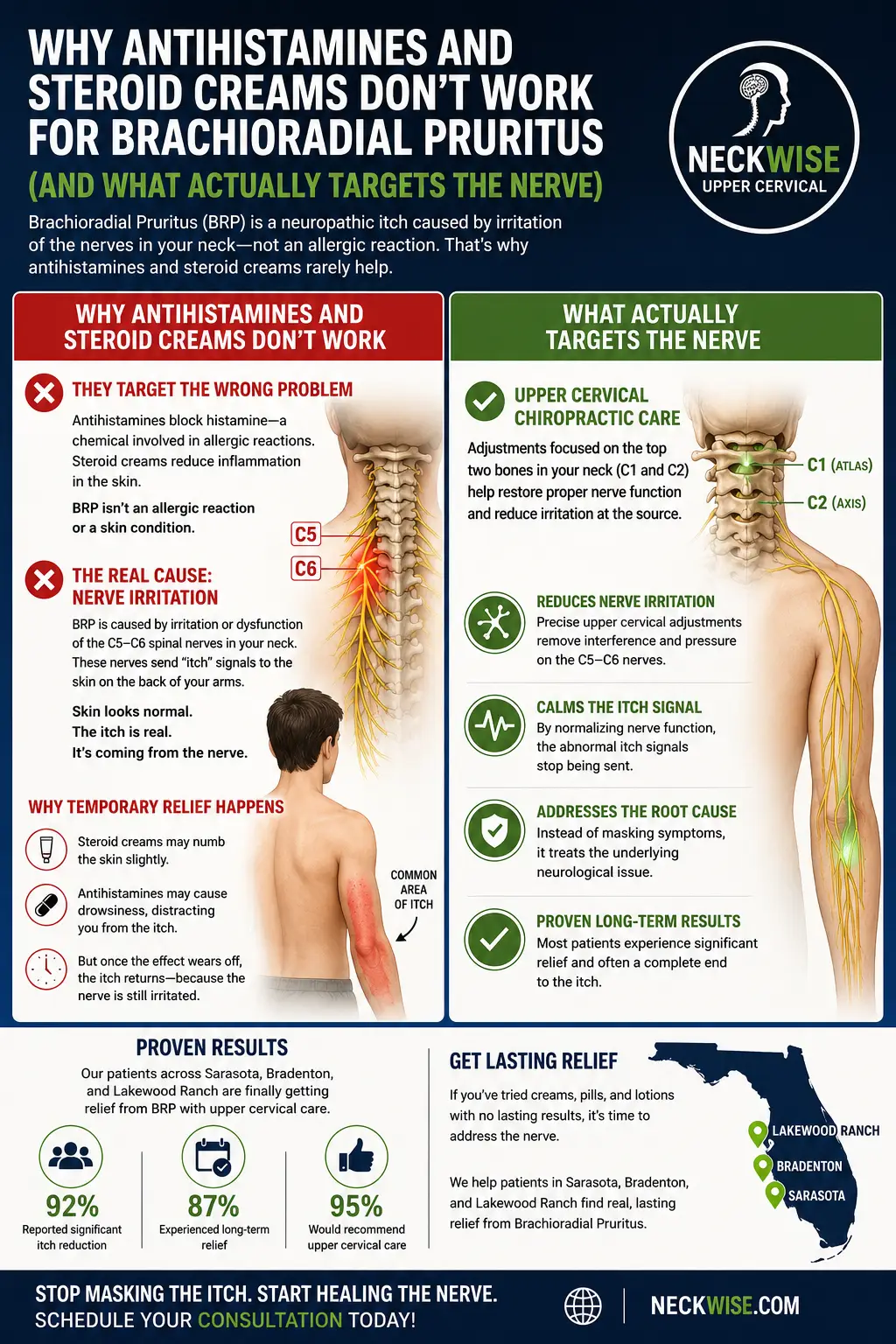
Here is the thing worth understanding, and it should be reassuring rather than discouraging: the medications didn’t fail because your case is unusually stubborn or because you did something wrong. They failed because they were designed for a completely different kind of itch. Antihistamines and topical steroids are built to interrupt a chemical inflammatory process happening in the skin. Brachioradial pruritus is a neuropathic itch — the signal is generated along the nerve pathway itself, upstream of the skin. Treating the forearm for a problem that originates in the nerve supply is like replacing the smoke detector because it keeps beeping, when the actual issue is the wiring in the wall. In this article I want to walk through exactly why the standard antipruritic toolkit misses, what categories of treatment actually engage the right mechanism, and why the upper cervical spine — the atlas and axis, the top two bones in your neck — deserves far more attention in this conversation than it usually gets.
Antihistamines and How Ordinary Itch Works: The Histamine Pathway
To understand why the pills and creams miss, it helps to understand what they were built to do — because in their intended lane, they work beautifully.
Think about a mosquito bite. Within minutes you have a raised, pink, warm, intensely itchy bump. What happened is that mast cells in your skin — immune cells that sit like little grenades in the dermis — degranulated and released a flood of histamine along with other inflammatory mediators. Histamine binds to H1 receptors on the free nerve endings of specialized itch-transmitting C-fibers in the skin. Those fibers fire. The signal travels up the peripheral nerve, into the dorsal horn of the spinal cord, crosses over, ascends the spinothalamic tract to the thalamus, and finally reaches the cortex, where you experience it as “my ankle itches.” Simultaneously, histamine causes local blood vessels to dilate and leak fluid, which is why you also get redness and a wheal.
This is histaminergic itch, and it has three defining features. First, there is an actual chemical event happening in the skin. Second, there is usually a visible sign — a hive, a wheal, a flare, a rash. Third, and most importantly for our purposes, the entire cascade has a chokepoint: the H1 receptor.
That chokepoint is what antihistamines exploit. An H1 antihistamine occupies the receptor so histamine cannot bind. No binding, no firing, no itch. This is why antihistamines are genuinely excellent for urticaria (hives), for allergic reactions, for insect bite reactions, for the itch of hay fever, and for the histamine-driven component of some drug reactions. The drug and the disease share a mechanism, so the drug lands.
Topical corticosteroids work by a different but complementary route. They suppress the transcription of inflammatory genes, calm down immune cell activity in the skin, reduce cytokine production, and constrict blood vessels. If your skin is genuinely inflamed — eczema, contact dermatitis from a new detergent, psoriasis, a poison ivy reaction — a steroid cream reduces the inflammation, and as the inflammation subsides the itch subsides with it. Again, the drug matches the disease.
Moisturizers and barrier repair creams fill in the third common scenario: xerosis, or dry skin itch. When the stratum corneum loses lipid and water content, the barrier becomes leaky and irritable, and nerve endings become more easily provoked. Restoring the barrier restores comfort.
So we have three good tools for three real problems: histamine release, cutaneous inflammation, and barrier disruption. Between them, they cover an enormous share of everyday itching. That is precisely why they are the first thing every clinician reaches for — and precisely why brachioradial pruritus is so often misdiagnosed and mistreated for years before anyone names it correctly.
Why Brachioradial Pruritus Is Different: Neuropathic Itch
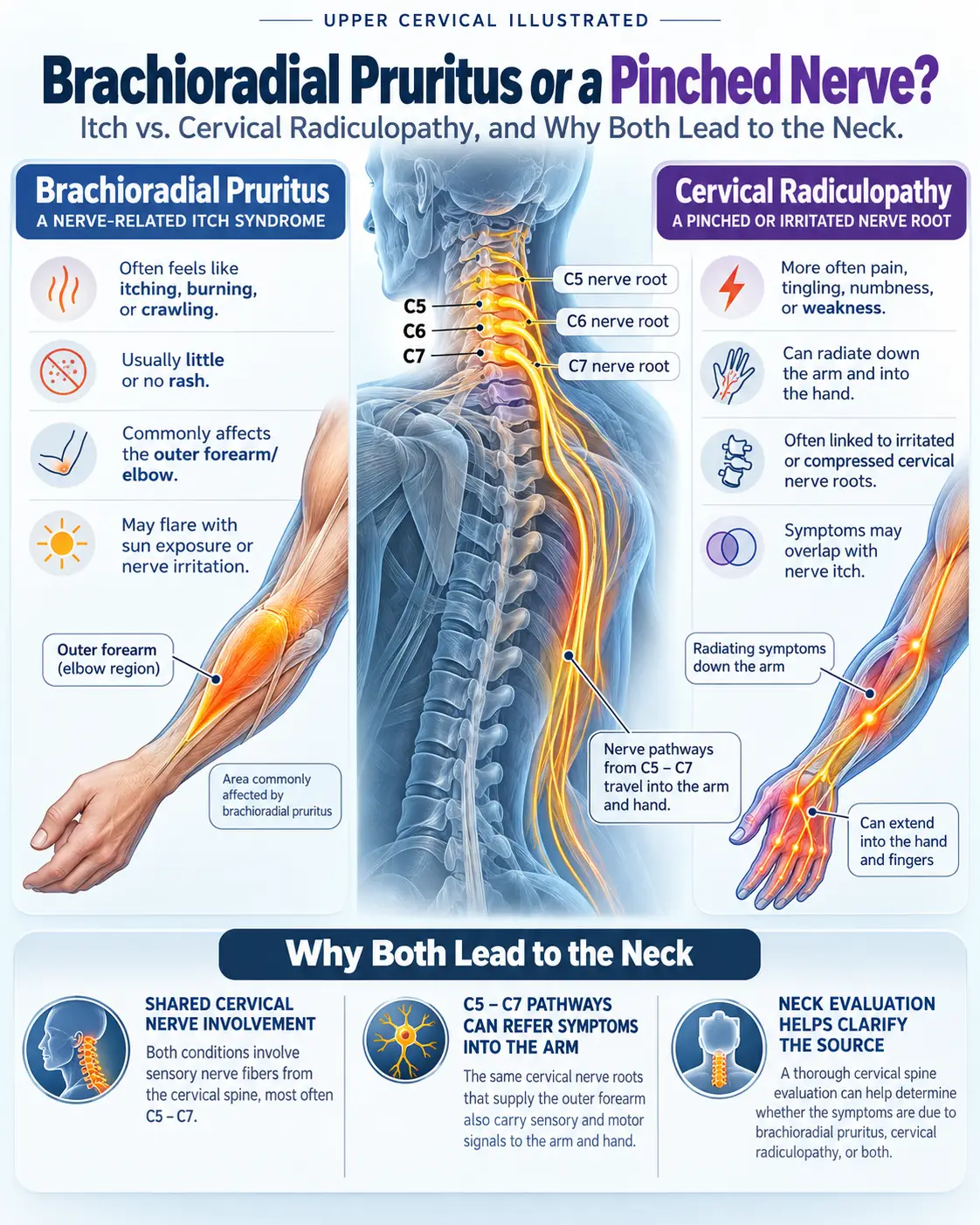
Brachioradial pruritus is not a skin disease that itches. It is a nerve signaling problem that reports as an itch in the skin.
Neuropathic itch is defined as chronic pruritus arising from dysfunction somewhere along the afferent nerve pathway — the sensory highway that runs from your skin, through the peripheral nerve, into the nerve root, into the spinal cord, and up to the brain. A 2025 review in the American Journal of Clinical Dermatology focused specifically on nerve impingement as a primary driver of neuropathic itch and grouped brachioradial pruritus together with notalgia paresthetica (the upper back version) and anogenital pruritus as conditions where nerve compression along the spine generates itch in the corresponding dermatome. That review notes neuropathic itch accounts for roughly 8% of chronic pruritus cases, and that the figure is likely an underestimate.
Here is what that means practically. In brachioradial pruritus, the itch signal is being generated along the wire, not at the sensor. Irritated or compressed sensory fibers can fire spontaneously — they generate action potentials without any stimulus at the skin at all. Your brain has no way to know where along the pathway a signal originated; it only knows which fiber carried it. So when a C5 or C6 sensory fiber fires abnormally at the level of the nerve root or the cord, your brain does the only thing it can do: it maps that signal back to the fiber’s territory and produces the conscious sensation “the outside of my forearm itches.” The skin there is an innocent bystander. It is reporting an itch that is not actually happening in it.
This explains several things that otherwise seem bizarre about brachioradial pruritus:
The skin usually looks normal. Physical examination of the affected area is typically unremarkable, with no primary skin lesions. Any excoriations, thickened lichenified patches, or prurigo nodules that do appear are secondary — the downstream result of scratching, not the cause of the itch.
Scratching doesn’t satisfy. With a mosquito bite, scratching provides a real if brief relief because you are producing competing sensory input at the site where the itch is generated. With neuropathic itch, you can scratch until the skin breaks and the underlying signal continues unabated, because you never touched the source. Many patients describe the futility of scratching as one of the most distressing features.
The distribution follows a dermatome, not a contact pattern. Allergic contact dermatitis follows wherever the offending substance touched you — a watchband, a necklace, a sleeve edge. Brachioradial pruritus follows the dorsolateral upper extremity in a pattern corresponding to C5–C6, sometimes extending to the upper arm, shoulder, or neck, and it is bilateral in roughly three-quarters of cases.
Cold helps far more than it should. More on this below, but the ice-pack response is a neurological signature, not a dermatological one.
Antihistamines specifically do not help. This is not a subjective impression; it is a documented clinical observation. The StatPearls clinical reference on brachioradial pruritus states plainly that despite their common use for other pruritic disorders, systemic antihistamines have not demonstrated benefit in this condition.
That last point deserves emphasis, because it is the crux of the article. If histamine were driving the itch, antihistamines would work. They don’t work. Therefore histamine is not driving the itch. The failure of the medication is itself a diagnostic clue.
There is one caveat worth being honest about. Sedating antihistamines like diphenhydramine or hydroxyzine sometimes appear to “help” at night. What is usually happening is that they are making the person drowsy enough to fall asleep despite the itch, not reducing the itch itself. That is a real benefit if you are desperate for sleep, but it should not be mistaken for the drug addressing the underlying problem — and it is a conversation to have with your prescribing physician rather than a self-directed strategy.
Why Steroid Creams and Moisturizers Also Disappoint
If antihistamines fail because there is no histamine problem, topical steroids fail because there is no primary inflammation problem.
Corticosteroids are anti-inflammatory drugs. Their entire mechanism depends on the presence of an inflammatory process to suppress. In brachioradial pruritus, the skin over the brachioradialis is, at baseline, not inflamed. There is no eczematous dermatitis, no immune infiltrate driving the sensation, no rash. Applying a potent anti-inflammatory to non-inflamed skin gives the drug nothing to do. StatPearls notes that topical corticosteroids are rarely effective in this condition and should be used cautiously, since prolonged application of superpotent agents can thin the skin over time.
That second half matters. When a cream isn’t working, the natural instinct is to use more of it, more often, or to ask for something stronger. With topical steroids, escalating without benefit carries real downside — cutaneous atrophy, telangiectasias, striae, and impaired barrier function. You can end up with more fragile skin and the same itch. This is worth raising with your dermatologist rather than escalating on your own.
There is a partial exception that creates genuine confusion. If you have been scratching an area for months or years, you may develop secondary changes — lichenification (thickened, leathery skin), prurigo nodules, excoriations, and low-grade secondary inflammation in the scratched skin. A steroid cream can meaningfully improve those changes. Patients sometimes report a modest improvement and conclude the cream is working, only to find the underlying itch is exactly where it was. What happened is that the medication addressed the consequences of the itch while the generator upstream continued firing untouched. Treating the scratch damage is worthwhile; it is simply not the same as addressing the cause.
Moisturizers fall into the same category. Good skin hydration is sensible general care, and in Florida — with sun exposure, salt water, chlorine, and air conditioning all working against your barrier — it is worth doing regardless. Dry, compromised skin is more easily provoked by any sensory input. But a barrier repair cream cannot quiet a nerve root. If your itch were driven by xerosis, a few weeks of consistent emollient use would make a substantial difference. When it doesn’t, that is more information pointing away from the skin.
The same logic applies to most of the other over-the-counter antipruritics: calamine, colloidal oatmeal, pramoxine, and menthol preparations. Some of these — particularly menthol, which activates cold-sensitive TRPM8 channels — can produce brief relief through counter-stimulation, which is really a variation of the ice-pack effect. But none of them engage the underlying mechanism.
What Actually Does Help, and Why
Look at the interventions that do produce results in brachioradial pruritus, and a pattern emerges immediately: every single one of them acts on nerve function rather than on skin biology.
Cold and the ice-pack sign. The single most reliable finding in brachioradial pruritus is that applying an ice pack produces immediate relief, and removing it brings the itch straight back. This response is considered pathognomonic — meaning it is characteristic enough to essentially confirm the diagnosis. It is also mechanistically revealing. Cooling changes the excitability of peripheral nerve fibers and floods the dorsal horn with competing sensory traffic, temporarily overwhelming the abnormal itch signal. Notice what it does not do: cold does not neutralize histamine, does not suppress inflammation, and does not repair a skin barrier. Patients with brachioradial pruritus routinely tell us that a bag of frozen peas outperformed every prescription they were given. That is not a failure of medicine; it is a clue about mechanism that everyone should be reading more carefully.
Capsaicin. Topical capsaicin, derived from chili peppers, works by acting on TRPV1 receptors on sensory nerve endings, depleting substance P — a neurotransmitter involved in transmitting pain and itch — from cutaneous nerve terminals. With repeated application it produces a functional desensitization of those fibers. Capsaicin has been among the more frequently used first-line topical agents for this condition, in both low-concentration cream formulations and high-concentration patches. Note again: this is a nerve-directed drug applied to the skin, not a skin-directed drug.
Gabapentin and pregabalin. These are anticonvulsants that reduce neuronal excitability by binding the α2δ subunit of voltage-gated calcium channels, dampening excitatory neurotransmitter release. They are mainstays of neuropathic pain management, and in brachioradial pruritus they are widely regarded as among the more effective options. In the Cureus case series of nine patients who underwent electrodiagnostic testing and cervical MRI, patients had variable improvement across several medications, with gabapentin providing the most relief. Antidepressants like amitriptyline — again, drugs that modulate neural signaling — occupy similar territory, sometimes compounded topically with ketamine and lidocaine for refractory cases.
Nerve blocks and cervical interventions. In a JAAD Case Reports case series, three patients with brachioradial pruritus were treated with CT-guided cervical nerve root injections; two experienced complete symptomatic improvement after a single injection, and the third had mild-to-moderate relief across three injections. Imaging in that series showed severe bilateral neural foraminal narrowing at C4-C5 and C5-C6 in one illustrative case. Reports also exist of symptom improvement following cervical spine manipulation, physical therapy, traction, and in refractory surgical cases, decompression.
Now step back and read that list as a whole. Cold. Capsaicin. Gabapentinoids. Tricyclics. Nerve root injections. Cervical decompression. Manual care directed at the neck. Every effective intervention is either quieting an over-firing nerve or reducing irritation of the nerve pathway. Nothing on that list is a skin treatment.
That is the entire answer to the question in the title. Antihistamines and steroid creams don’t work because they are aimed at the skin, and brachioradial pruritus is not a skin problem. The treatments that work are aimed at the nerve.
Which raises the obvious next question: if the nerve pathway is where the problem lives, where along that pathway should we be looking?
Why the Upper Cervical Spine Is Central
This is the part of the discussion that gets left out of most articles on brachioradial pruritus, and in my clinical opinion it is the most important part. There are two distinct mechanisms here, and they work together.
Mechanism One: Descending Inhibitory Control and the Brake on the Itch Signal
Your nervous system does not simply transmit sensation upward. It regulates it constantly, in both directions.
When itch-carrying C-fibers arrive at the dorsal horn of the spinal cord, they synapse onto second-order neurons that will carry the signal to the brain. But that synapse is not a straight-through wire — it is a heavily regulated gate. Local inhibitory interneurons in the dorsal horn suppress transmission. And crucially, descending inhibitory pathways from the brainstem — from regions including the periaqueductal gray and the rostral ventromedial medulla — travel down the spinal cord and tune that gate, deciding moment to moment how much of the incoming signal gets through. This is the same architecture that lets you stop noticing the sensation of your clothes, and the same architecture that explains why an injury can hurt less in a crisis and more when you are lying awake at 3 a.m.
Now consider what the pathophysiology literature actually says about brachioradial pruritus. In discussing mechanism, the authors of the Cureus case series describe brachioradial pruritus as potentially resulting from irritation of pruritus-sensitive neurons leading to spontaneous firing of damaged neurons, the loss of the feedback mechanism from their descending inhibitory neurons, or loss of inhibitory interneurons leading to spinal hyperexcitability. Loss of descending inhibition is likewise described in the broader chronic pruritus literature as a hallmark feature.
Read that carefully, because it reframes everything. The problem is not only that too much signal is being generated. It is that the brake has weakened. The system that is supposed to filter, dampen, and gate the itch signal at the cord level is not doing its job, and the result is a spinal cord segment that has become hyperexcitable — amplifying input that should have been filtered out.
So where do those descending inhibitory pathways run? They descend from the brainstem into the spinal cord, which means every one of them passes through the upper cervical spinal cord — the segment encircled by the atlas (C1) and the axis (C2). The upper cervical spine is not just another set of vertebrae; it is the anatomical junction where the brainstem becomes the spinal cord, where the descending regulatory traffic makes its transition. The upper cervical spine is, quite literally, where the body’s brake on the itch signal lives.
This is mechanistic reasoning rather than a claim established by an upper-cervical-specific trial, and I want to be transparent about that. The imaging studies in brachioradial pruritus have overwhelmingly focused on the lower cervical spine — C5, C6, C7 — because that is where the dermatome maps. Nobody has run a controlled trial of atlas correction for brachioradial pruritus. What I am arguing is that the field has been looking at the compression side of the equation while largely ignoring the inhibition side, and the inhibition side implicates the upper neck.
This framing also does something the compression-only model struggles with: it explains why symptom severity so often fails to match imaging severity. The Mayo Clinic review of 111 patients with brachioradial pruritus found that of the 45 patients who underwent neck imaging, only about a third had cervical abnormalities, and the authors concluded that the significance of those findings was unclear because no structural cause was identified in most cases. Meanwhile, the Cureus series found cervical spine disease in all nine of its patients. How can both be true? If the disease were purely mechanical compression, degree of stenosis should track with severity of symptoms. It frequently doesn’t. But if the clinical picture depends on the balance between how much abnormal input is being generated and how well the descending inhibitory system is suppressing it, then two people with identical MRIs can have completely different experiences — and someone with a nearly clean MRI can be miserable. The variable that isn’t being measured is the state of the regulatory system, and that system runs through the upper cervical cord.
Mechanism Two: Upstream Biomechanics and the Compensation Chain
The second mechanism is structural, and it is about sequence.
The atlas is a remarkable and unusual bone. It has no disc above it and no disc below it. It carries the weight of the head — ten to twelve pounds — on two small, relatively shallow joint surfaces, and the head balances on it with far more freedom than any other joint in the spine allows. It is held in position primarily by ligaments and muscular tone rather than by interlocking bony architecture. That design buys you the enormous range of motion you need to look around, but it also means that when alignment at that level is disturbed, the rest of the spine has to accommodate.
And accommodate it does. When the head is not sitting squarely over the atlas, your postural control system — which will defend a level eye line and level vestibular apparatus above almost anything else — compensates below. The lower cervical spine tilts, rotates, and shifts to bring the head back toward center. Muscles on one side work harder than the other, all day, for years. That asymmetric loading is not distributed evenly across the discs and facet joints of C4 through C7; it concentrates. Concentrated, asymmetric, chronic load is exactly the recipe for accelerated degenerative change — disc height loss, uncovertebral and facet hypertrophy, osteophyte formation, and narrowing of the intervertebral foramina through which the C5 and C6 nerve roots exit.
Now look again at what the brachioradial pruritus imaging studies actually found. The Cureus series documented disc protrusions, spondylosis, spinal stenosis, and foraminal stenosis in all nine patients, concentrated at C3-C4 through C6-C7, with eight of nine showing multi-level abnormalities. The JAAD Case Reports series showed severe bilateral foraminal narrowing at C4-C5 and C5-C6.
The conventional interpretation is: lower cervical degeneration causes nerve root irritation causes brachioradial pruritus. That interpretation is reasonable and probably correct as far as it goes. My argument is that it stops one step too early. It treats the lower cervical degeneration as the beginning of the story. Very often it is the middle of the story — the downstream, accumulated consequence of years of compensatory loading driven by an uncorrected upper cervical misalignment. The multi-level pattern is telling. Single-level pathology from a single injury looks different from the diffuse, multi-segment wear pattern these patients show, which is what you would expect from a whole-chain loading problem rather than one bad disc.
I want to be precise about citation integrity here: the studies above imaged and reported on the lower and mid cervical spine. They did not image or analyze the atlas and axis, and I am not attributing any upper cervical finding to them. What I am doing is offering a mechanistic account of why that lower cervical pattern develops, and arguing that if you address only the segment where the wear is visible, you have not addressed the loading pattern that produced it.
Put the two mechanisms together and you have a coherent picture. Upper cervical misalignment plausibly contributes to brachioradial pruritus through two routes simultaneously: it sits at the anatomical location where descending inhibitory control passes, and it drives the compensatory loading chain that produces the lower cervical foraminal narrowing documented in the literature. One problem, two pathways, converging on the same symptom.
How Precise Upper Cervical Care Fits at Lavender Family Chiropractic
Understanding a mechanism is only useful if it changes what you do. Here is how we approach brachioradial pruritus at our Sarasota practice.
We start with a real consultation. Not a five-minute intake. We want the history: when the itch started, what the pattern is, whether it is unilateral or bilateral, whether it is seasonal, whether sun exposure changes it, whether cold reliably helps, what you have already tried, and — critically — whether there was ever a head or neck event in your history. Car accidents, falls, sports impacts, a hard landing on a bike, a concussion in high school. People rarely connect a whiplash from twenty years ago to an itchy forearm today, but the compensation chain has a long memory.
3D CBCT imaging. Standard two-dimensional films are a poor way to assess upper cervical alignment, because you are trying to characterize a three-dimensional relationship between the skull, atlas, and axis by looking at overlapping shadows. Our 3D CBCT imaging lets us see your actual anatomy in three dimensions and measure the specific relationships in your specific spine. Everyone’s upper cervical anatomy is a little different — joint angles, facet orientation, bone morphology — and a correction based on someone else’s average is not a correction based on you.
Tytron paraspinal infrared thermography. Alignment tells us about structure. Paraspinal infrared thermography tells us something about function. The Tytron scan measures skin temperature differentials alongside the spine, which reflect autonomic nervous system activity. Because it is quick, non-invasive, and involves no radiation, we can repeat it over time — which gives us an objective way to track whether your nervous system is showing more stable, symmetric patterns as care progresses, rather than relying only on how you say you feel on a given day.
Precise, low-force Knee Chest Upper Cervical correction. This is where our approach differs most from what people picture when they hear “chiropractor.” The Knee Chest Upper Cervical technique is a precise, low-force correction directed specifically at the atlas and axis, calculated from your own imaging. There is no twisting of the neck, no rotational thrust, no popping or cracking. You are positioned on a specialized table, and the contact is specific and gentle. Given that the upper cervical spine is where the brainstem transitions into the spinal cord, precision is not a stylistic preference — it is the whole point. Many of our brachioradial pruritus patients arrive having deliberately avoided chiropractic care because they assumed all of it involved forceful neck manipulation. It does not, and our approach is not that.
Customized care plans. We do not run everyone through the same schedule. After the exam and imaging, we build a customized care plan based on your findings, how long the pattern has been present, your age, your prior injuries, and how your body holds a correction. Some people hold well from the beginning and need relatively few visits. Others, particularly with long-standing patterns, need more frequent attention early on while the supporting soft tissue adapts. You will know the plan before you start.
Coordination, not replacement. We work alongside your other providers, and we want you to have a confirmed diagnosis. If you have not been formally evaluated for brachioradial pruritus, we want you seen by a physician or dermatologist — both to confirm the diagnosis and to rule out systemic causes of chronic itch (thyroid disease, liver and kidney disease, iron deficiency, certain blood disorders, medication effects) and primary skin disease. If your neurologist, dermatologist, or pain specialist has you on gabapentin, pregabalin, capsaicin, or anything else, keep taking it as prescribed. Decisions about your medication belong to the physician who prescribed it.
What our care can and cannot do. Honestly: upper cervical chiropractic care does not cure brachioradial pruritus, and I will not tell you otherwise. What we do is assess and correct upper cervical alignment with precision, with the aim of reducing mechanical irritation along the cervical chain and supporting normal function through the region where descending regulatory pathways travel. Some patients report meaningful change in their symptoms. Some report partial change. Some do not respond, and if you are not responding we will tell you rather than keep you coming. If the mechanism I have described applies to your case, this addresses something no cream can reach. If it does not apply to your case, you deserve to know that early.
You can read more about our overall approach on our upper cervical chiropractic care page.
Ready to have your upper cervical spine actually looked at?
Call (941) 243-3729 to schedule a consultation, or book online here.
Lavender Family Chiropractic — 5899 Whitfield Avenue, Suite 107, Sarasota, FL 34243, at the corner of University and Whitfield.
What the Research Says
- Brachioradial Pruritus — StatPearls, NCBI Bookshelf (Bookshelf ID NBK459321; PMID 29083620). This peer-reviewed clinical reference characterizes brachioradial pruritus as a focal neuropathic dysesthesia of the dorsolateral upper extremities, describes the ice-pack sign as pathognomonic, and states directly that systemic antihistamines have not demonstrated benefit in the condition and that topical corticosteroids are rarely effective, while nerve-modulating agents such as gabapentin and pregabalin appear to be among the more effective options.
- Brachioradial Pruritus: Clinical, Electromyographic, and Cervical MRI Features in Nine Patients — Shields et al., Cureus, 2022 (PMCID PMC8896843; PMID 35291549). All nine patients in this series had cervical spine disease on MRI — disc protrusions, spondylosis, spinal stenosis, and/or foraminal stenosis, most at multiple levels — with electrodiagnostic evidence of chronic radiculopathy predominantly at C6; the discussion explicitly proposes loss of feedback from descending inhibitory neurons and loss of inhibitory interneurons leading to spinal hyperexcitability as mechanisms, and reports gabapentin gave these patients the most relief.
- Brachioradial Pruritus Treated With Computed Tomography-Guided Cervical Nerve Root Block: A Case Series — Weinberg et al., JAAD Case Reports, 2018 (PMID 30094306; PMCID PMC6080634). Three patients with brachioradial pruritus were treated with CT-guided cervical nerve root injections; two had complete symptomatic improvement after a single injection and the third had mild-to-moderate relief, with imaging in one illustrative case showing severe bilateral neural foraminal narrowing at C4-C5 and C5-C6 — direct evidence that intervening at the cervical nerve root can change forearm itch.
- From Compression to Itch: Exploring the Link Between Nerve Compression and Neuropathic Pruritus — Mashoudy et al., American Journal of Clinical Dermatology, 2024 (PMID 39417971; PMCID PMC11742002). This comprehensive review frames nerve impingement as the primary pathophysiological mechanism behind brachioradial pruritus, notalgia paresthetica, and anogenital itch, notes that neuropathic itch involves both peripheral and central mechanisms, and outlines a treatment ladder built entirely from nerve-directed agents — menthol, capsaicin, and lidocaine topically, gabapentin, pregabalin, and antidepressants systemically.
- Brachioradial Pruritus: Mayo Clinic Experience Over the Past Decade — Mirzoyev & Davis, British Journal of Dermatology, 2013 (PMID 23796379). In 111 patients diagnosed with brachioradial pruritus over twelve years, 72% were female, mean age 59, and symptoms were bilateral in 75.7%; of the 45 patients who underwent neck imaging, findings included foraminal stenosis, disc protrusion, and spinal canal stenosis, and the authors concluded the significance of those imaging findings was unclear because no structural cause was identified in most cases — a mismatch between imaging and symptoms that a purely mechanical model does not account for.
Self-Care That Actually Targets the Right Mechanism
None of this replaces professional care, and none of it should replace anything your physician has prescribed. But if you understand that the problem is neurological rather than dermatological, your daily choices can align with that instead of working against it.
Use cold deliberately, not desperately. Since the ice-pack response is characteristic of this condition, treat it as a tool rather than a last resort. Keep a gel pack in the freezer, a cool damp cloth in the refrigerator, or a cold water bottle nearby. Wrap anything frozen in a thin towel and limit application to ten to fifteen minutes at a time to protect the skin. Some people find a cool shower before bed reduces overnight symptoms enough to sleep.
Take sun exposure seriously. Ultraviolet exposure is a well-documented aggravating factor, which is why this condition was originally described in Florida and is often worse in the warmer months. That is not a small consideration on the Gulf Coast. Long-sleeved UV-protective clothing is often more practical and more consistent than sunscreen for the forearms specifically, and avoiding peak sun between roughly 10 a.m. and 2 p.m. helps. This one costs nothing and is within your control.
Interrupt the scratch cycle without punishing yourself for it. Scratching does not relieve neuropathic itch, and it does create secondary skin damage that adds a genuine inflammatory itch on top of the neuropathic one. Keep your nails short. Have a cold pack within reach so you have something to do with the impulse. Cotton sleeves at night reduce unconscious scratching. And go easy on yourself — the urge is neurologically real, not a discipline failure.
Pay attention to your neck, especially your head-forward hours. Every hour spent with your head jutted forward over a phone or laptop multiplies the load your cervical spine carries and reinforces exactly the compensation pattern described above. Raise your screen to eye level. Take a movement break every thirty minutes. Look at your pillow: you want one that supports the neck in neutral rather than propping your head forward, and side or back sleeping is generally kinder to the cervical spine than stomach sleeping, which requires sustained rotation all night. If you would like a deeper walk-through of the neck-and-forearm connection, see our related article, Why Won’t My Elbow Stop Itching?.
Keep the skin barrier healthy anyway. A moisturizer will not stop neuropathic itch, but compromised skin is more easily provoked by everything, and if you have been scratching, the barrier needs help. Fragrance-free, applied after showering, is sufficient. Keep expectations calibrated: this is supportive care, not treatment.
Track your symptoms. Keep a simple log — daily itch intensity from zero to ten, sun exposure, sleep quality, what you tried, what helped. Over eight to twelve weeks, patterns emerge that memory alone will not reveal, and it gives every clinician on your team something objective to work with.
Stay on your prescribed medications. If a physician has you on gabapentin, pregabalin, amitriptyline, capsaicin, or anything else, keep taking it as directed. Changes belong to your prescriber.
Serving Sarasota and Surrounding Communities
Lavender Family Chiropractic is located at 5899 Whitfield Avenue, Suite 107, Sarasota, FL 34243, at the corner of University and Whitfield — a convenient location for patients across the region.
We regularly care for people traveling in from Sarasota, Bradenton, Lakewood Ranch, Venice, Palmer Ranch, Osprey, Siesta Key, Longboat Key, Lido Key, University Park, Parrish, Ellenton, Myakka City, Punta Gorda, and St. Petersburg. Because precise upper cervical work is a specialized approach and not widely available, a number of our patients drive a considerable distance for it, and we build care schedules with travel time in mind.
Southwest Florida is also, for better or worse, an especially relevant place to be having this conversation. Brachioradial pruritus was first described in Florida in 1968, and the combination of intense year-round sun and an active outdoor population — boating, golf, tennis, pickleball, cycling, beach walking — means the aggravating factors are simply part of daily life here. If you have been managing this for years while assuming it was a skin condition, you are in very good company locally.
Top 15 Questions About Brachioradial Pruritus, Antihistamines, and Upper Cervical Care
1. Should I stop taking my antihistamine? That is your physician’s call, not ours and not something to decide from an article. Even if an antihistamine is not addressing the neuropathic mechanism, you may be taking it for allergies, urticaria, or sleep, and stopping abruptly can have consequences. Bring this conversation to your prescriber, tell them the antihistamine has not helped the forearm itch, and ask whether a nerve-directed approach is appropriate for you. Do not stop prescribed medication on your own.
2. Should I see a dermatologist? Yes. Absolutely. A dermatologist should confirm the diagnosis and rule out primary skin disease — eczema, contact dermatitis, urticaria, lichen simplex chronicus, or something rarer. Brachioradial pruritus is a clinical diagnosis of exclusion in many ways, and getting it named correctly matters. Research on this condition has documented significant diagnostic delays, with many patients seeing multiple clinicians over years before receiving the right diagnosis. Chiropractic care should be an addition to that workup, never a substitute for it.
3. Can you cure my brachioradial pruritus? No. I want to be completely direct about that. We do not cure brachioradial pruritus, and any practitioner who tells you they can is overpromising. What we do is assess whether an upper cervical misalignment is present and correct it precisely, with the goal of reducing irritation along the cervical chain and supporting normal function through the region where descending regulatory pathways travel. Some patients notice meaningful change. Some notice partial change. Some do not respond.
4. Why did my MRI look fine if my neck is the problem? Two reasons. First, MRI shows structure — disc height, stenosis, cord signal — but does not show functional alignment or how the joints move and load under weight. Second, and more importantly, the pathophysiology involves loss of descending inhibition and spinal hyperexcitability, and there is no imaging study that measures how well your inhibitory system is functioning. This is precisely why the Mayo Clinic series found imaging abnormalities in only about a third of imaged patients while concluding that the significance was unclear.
5. Do you take my insurance? We are a cash-pay, out-of-network practice. We do not bill insurance directly. This is a deliberate choice: it lets us make clinical decisions based on what your exam and imaging show rather than what a benefits administrator will authorize, and it means the time you spend with us is determined by your case rather than by a billing code.
6. What is a superbill and how do I use it? A superbill is an itemized receipt listing the services provided along with the appropriate diagnostic and procedure codes. We provide one on request. You submit it to your insurance carrier yourself, and depending on your out-of-network benefits, you may receive partial reimbursement. Many patients also use HSA or FSA funds. We recommend calling your carrier before your first visit and asking specifically about out-of-network chiropractic benefits, deductibles, and reimbursement rates.
7. How much does care cost, and do I have to buy a package up front? We will give you clear pricing before you commit to anything. After your exam and imaging we build a customized care plan with a defined structure and defined expectations, and you will know exactly what it involves and what it costs before you begin. No surprises, and no open-ended commitment without a plan behind it.
8. Is the adjustment going to hurt, or involve my neck being twisted? No. The Knee Chest Upper Cervical technique is a precise, low-force correction. There is no rotational thrust, no twisting, and no popping. You are positioned on a specialized table and the contact is specific and gentle. Most patients describe it as anticlimactic compared to what they were bracing for.
9. How is this different from a regular chiropractic adjustment? Most general chiropractic care involves adjusting multiple segments across the spine, often with a higher-velocity technique. Our approach is narrower and more specific: we focus on the atlas and axis, we calculate the correction from your own 3D imaging, and we apply it with low force. The premise is that correcting the top of the chain changes how everything below it loads.
10. How many visits will I need? It depends on your findings, how long the pattern has been present, your age, your injury history, and how well your body holds a correction. Some patients stabilize relatively quickly; long-standing patterns generally take longer because the supporting soft tissue has adapted around the misalignment and needs time to adapt back. We will give you a specific plan after your exam and imaging rather than a generic number.
11. How will I know whether it is working? We track it three ways: your reported symptoms (which is why the symptom log helps), objective postural and alignment measures, and repeat Tytron thermography to see whether your nervous system is showing more stable, symmetric patterns over time. If we are not seeing objective change and you are not feeling change, we will tell you rather than keep you on the schedule indefinitely.
12. Why does ice help so much when nothing else does? Because cold works neurologically rather than dermatologically. It alters peripheral nerve excitability and floods the dorsal horn with competing sensory input, temporarily suppressing the abnormal itch signal. The fact that a frozen gel pack outperforms prescription creams for you is not strange — it is a strong hint about what kind of problem you have.
13. Is brachioradial pruritus harmful, or a sign of something serious? It is generally considered a benign condition, though it can substantially affect quality of life through sleep disruption and constant discomfort. That said, chronic itch has many possible causes, and rarely brachioradial pruritus has been associated with spinal cord findings such as tumors or syrinx. That is exactly why physician evaluation is important — not to alarm you, but so that the uncommon causes are properly ruled out by someone qualified to do it.
14. My symptoms are much worse in summer. Does that mean it is sun-related and not my neck? Not necessarily — the two are not mutually exclusive. The prevailing model is bifactorial: ultraviolet exposure and cervical nerve irritation together. A useful way to think about it is that sun exposure raises the volume of input while diminished inhibitory control lowers your capacity to filter it. Seasonal worsening tells you UV matters in your case; it does not tell you the cervical component is absent.
15. What actually happens at my first visit? A thorough consultation and history, a physical and neurological examination, 3D CBCT imaging of your upper cervical spine, and a Tytron thermographic scan. We then review the findings with you in plain language, tell you honestly whether we believe you are a good candidate, and if so, present a specific care plan with clear costs. If we do not think we can help you, we will say so and, where we can, point you toward someone who might.
Ready to Look Upstream?
If you have been treating your forearms for years with creams and pills that were designed for a completely different kind of itch, it may be time to have the other end of the nerve pathway examined properly.
Call (941) 243-3729 to schedule your consultation, or book your appointment online.
Lavender Family Chiropractic 5899 Whitfield Avenue, Suite 107 Sarasota, FL 34243 Corner of University and Whitfield Phone: (941) 243-3729
You can also reach us through our contact page. We serve patients throughout Sarasota, Bradenton, Lakewood Ranch, Venice, and the surrounding Gulf Coast communities.
This article is for educational purposes and is not medical advice, diagnosis, or treatment. Chiropractic care does not cure brachioradial pruritus. Please see a physician or dermatologist to confirm your diagnosis and rule out systemic causes of chronic itch and primary skin disease, and do not stop or change any prescribed medication without speaking to the physician who prescribed it.
Related Articles


Get our upper cervical articles first.