
Forward Head Posture and Tech Neck in Sarasota, Florida: How Upper Cervical Chiropractic Care at Lavender Family Chiropractic Helps Restore Healthy Alignment
By Dr. Rusty Lavender, D.C. — upper cervical chiropractor, Lavender Family Chiropractic, Sarasota, FL. Reviewed and updated October 2026.
Forward Head Posture: Pick up your phone. Look down at the screen. Do it the way you actually do it — not the way an ergonomics poster would tell you to. That single posture, repeated thousands of times a day, is reshaping the spines of an entire generation. It has a clinical name — forward head posture — and a cultural nickname — tech neck. And while it may look harmless, the cumulative load it places on your upper cervical spine, your nervous system, and your long-term health is anything but harmless.
At Lavender Family Chiropractic in Sarasota, Florida, we see forward head posture in nearly every new patient who walks through our door. We see it in college students, in retired professionals, in remote workers who spend ten hours a day in front of a laptop, in mothers who scroll through their phones during the only quiet moments of their day, and in high schoolers whose necks have never known a world without smartphones. The shape of the modern human neck is changing, and so is the cluster of symptoms that come with it — chronic neck pain, tension headaches, jaw dysfunction, dizziness, brain fog, sleep problems, and a baseline level of fatigue that nobody can quite explain.
This guide is for anyone in Sarasota, Bradenton, Lakewood Ranch, or the surrounding areas who has caught themselves in a window reflection and wondered, when did my head start sitting so far forward? Whether you are dealing with active pain or simply trying to prevent the consequences of a posture you know is wrecking you, Dr. Rusty Lavender and Dr. Jacob Temple can help you understand what forward head posture really is, why it matters, and what you can do about it.
What Is Forward Head Posture?
Forward head posture, or FHP, is a postural deviation in which the head sits anterior to the body’s natural vertical line of gravity. In ideal alignment, the external auditory meatus — the opening of the ear canal — sits directly above the shoulder when viewed from the side. The head is balanced on top of the cervical spine like a bowling ball on a perfectly stacked stack of dishes. The muscles of the neck, shoulders, and upper back are required to do almost no work to hold this position because gravity is doing the work for them.
In forward head posture, that alignment is lost. The head shifts forward of the shoulder, sometimes by an inch, sometimes by three or four inches in advanced cases. Once the head sits in front of the line of gravity, the muscles of the posterior neck and upper back are forced into a constant, low-grade contraction to keep the head from falling further forward. This is the foundational problem with FHP: a posture that should require almost no muscular effort now requires constant effort to maintain.
Clinically, FHP is measured using the craniovertebral angle, or CVA — the angle formed between a horizontal line through the C7 vertebra and a line drawn from C7 to the tragus of the ear. A healthy CVA is typically above 50 degrees. Angles below 50 degrees indicate clinically significant forward head posture, and the lower the angle, the more severe the postural deviation.
The closely related term “tech neck” — sometimes called “text neck” — refers specifically to the forward head and flexed neck posture that smartphone use, tablet use, and prolonged screen time produce. Tech neck is essentially the modern lifestyle driver of forward head posture. The two terms are often used interchangeably, though FHP can result from many other contributors beyond technology — including past whiplash injuries, occupational postures, poor sleep positions, and inadequate core and upper back strength.
How common is this problem? The numbers are staggering. A recent review reported global prevalence rates of text neck syndrome ranging from 32% to 68.1% across different populations, with particularly high rates among university and medical students. Studies of smartphone users have reported neck pain prevalence ranging from 17.3% to 67.8% depending on the population, and one cross-sectional study found that nearly 96% of college students reported neck pain attributable to smartphone use. In a study of university students using both ruler and craniovertebral angle methods, forward head posture was identified in 47.9% to 62.1% of subjects, with the higher numbers corresponding to the more clinically accurate measurement method.
In other words, anywhere from a third to two-thirds of the people sitting next to you on a flight, in a coffee shop, or in a Sarasota traffic light queue are walking around with measurable forward head posture right now. And almost none of them have had it identified, addressed, or corrected.
The Biomechanics: Why Your Head Position Matters So Much
The human head is heavy. An adult head weighs between 10 and 12 pounds in neutral alignment — roughly the weight of a bowling ball. When the head sits directly above the shoulders, gravity pulls it straight down through the cervical spine, the vertebrae stack efficiently, and the load is distributed evenly across the discs and joints.
The moment the head tilts forward, the math changes dramatically. In a landmark 2014 biomechanical study published in Surgical Technology International, spine surgeon Dr. Kenneth Hansraj used a computer-generated model of the cervical spine to calculate the forces seen by the neck at varying degrees of forward flexion. The results were sobering. At a 15-degree forward tilt, the effective load on the cervical spine roughly doubles to 27 pounds. At 30 degrees, it climbs to 40 pounds. At 45 degrees, 49 pounds. At 60 degrees — the angle most people adopt when staring down at a smartphone — the load reaches 60 pounds.
Think about that. A person looking down at their phone is, from a mechanical standpoint, asking their neck to support the equivalent weight of an eight-year-old child. For hours every day. For years on end.
The average smartphone user spends two to four hours per day with their head in this position. That works out to between 700 and 1,400 hours per year of excess loading on the cervical spine. For a high school or college student, the number can climb even higher — by some estimates, an additional 5,000 hours over their formative years. These are forces the human cervical spine simply did not evolve to absorb on a chronic basis.
The result is predictable. The intervertebral discs in the lower cervical spine experience increased compression and accelerated degeneration. The facet joints — the small paired joints at the back of each vertebra that govern neck motion — wear down asymmetrically. The deep neck flexors weaken from chronic underuse, while the upper trapezius, levator scapulae, and posterior cervical muscles become overactive, tight, and tender.
The thoracic spine compensates by rounding forward, the shoulders roll inward, and the entire upper body adopts the postural pattern known as upper crossed syndrome. If you are already struggling with daily neck pain, forward head posture is almost certainly part of the picture.
But the biomechanical story is only half of the picture. The neurological consequences are arguably more important — and they are where upper cervical chiropractic care becomes essential.
The Upper Cervical Connection: Why Forward Head Posture Is a Nervous System Problem
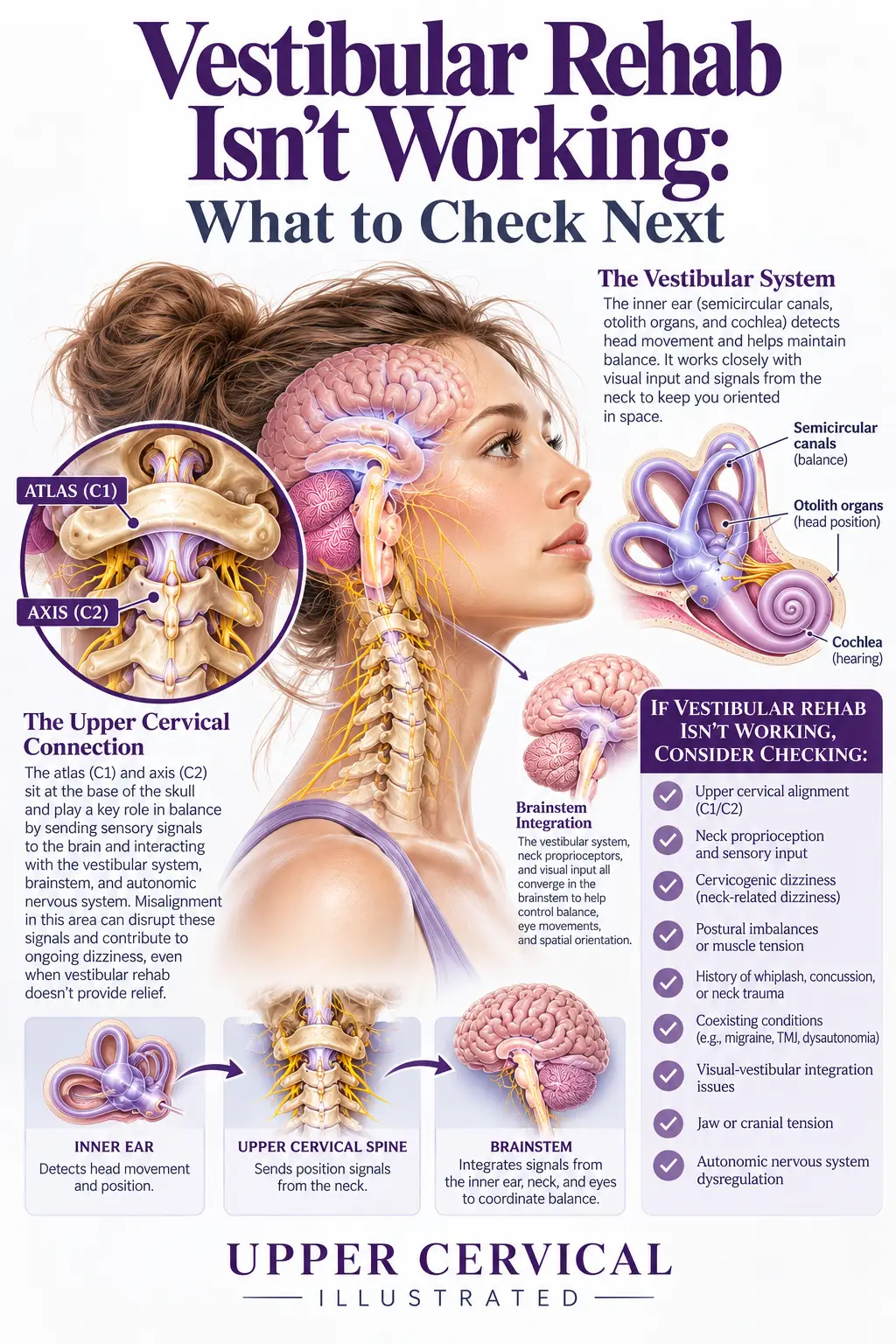
The atlas (C1) and axis (C2) — the two uppermost vertebrae of the spine — are the foundation on which the head balances. Together, they form the craniocervical junction, where the skull, the upper neck, and the brainstem all meet. This is the most neurologically dense and biomechanically sensitive region in the entire spine.
When the head shifts forward of the body’s center of gravity, the upper cervical alignment is forced to compensate. The atlas tips, rotates, or laterally shifts to keep the eyes level — a phenomenon called the ocular righting reflex. This compensation can persist as a chronic upper cervical misalignment long after the original forward head posture is acknowledged or addressed. In other words, forward head posture is not just a downstream postural problem — it directly drives misalignment at the top of the cervical spine, where the brainstem lives.
A 2020 case study published in the Journal of Family Medicine and Primary Care examined the radiographic findings of symptomatic adults with forward head posture and concluded that FHP can contribute to a multitude of disorders including cervical radiculopathy, cervicogenic headaches, and cervicogenic dizziness — and that the cantilever loads created by forward head deviation can be particularly damaging to the upper cervical joints specifically. The authors explicitly identified the upper cervical spine as the structural site most vulnerable to FHP-related damage.
This makes sense once you understand the anatomy. The atlas cradles the base of the skull, the axis pivots beneath it, and together they surround and protect the brainstem — the area of the central nervous system where cranial nerves originate, where autonomic regulation occurs, where balance integration happens, and where pain signals from the upper neck converge with input from the trigeminal nerve. A misalignment here does not simply cause neck pain. It alters the function of the most critical real estate in the nervous system.
A 2025 cross-sectional study published in the Journal of Oral & Facial Pain and Headache examined 117 patients with forward head posture and found that 53.8% of them met the diagnostic criteria for cervicogenic headache — and that lower craniovertebral angles were significantly associated with higher headache disability, poorer sleep quality, and greater depression scores. This study is important because it documents what we see clinically every day: forward head posture is not just a cosmetic issue. It is a measurable driver of headache, sleep disruption, and mood disturbance, and the mechanism runs directly through the upper cervical spine and the trigeminocervical convergence at the brainstem.
The implication is straightforward. If forward head posture is driving symptoms by destabilizing the upper cervical spine, then addressing the upper cervical spine specifically is one of the most direct ways to interrupt the cascade.
Why Upper Cervical Care Matters for Forward Head Posture
At Lavender Family Chiropractic in Sarasota, we use the Knee Chest Upper Cervical technique — a precise, gentle approach to correcting atlas and axis misalignments without any twisting, popping, or forceful manipulation. For forward head posture patients, this matters for several interlocking reasons.
First, restoring proper alignment of the atlas and axis allows the head to sit back over the shoulders in its biomechanically correct position. Many patients who have struggled for years with forward head posture report a dramatic, immediate shift in how they hold their head after their first upper cervical correction — not because we manipulated their thoracic spine or did postural exercises with them, but because removing the upper cervical misalignment removed the neurological driver of the compensatory pattern. The body, in many cases, does not want to hold a forward head posture. It is doing so because the upper cervical spine is asking it to. Correct the upper cervical spine, and the rest of the postural chain often begins to reorganize itself.
Second, upper cervical correction restores proper neurological input to the brainstem and the postural control centers. Posture is not just a mechanical phenomenon — it is a neurological one. The vestibular system, the proprioceptive input from the upper cervical joints, and the visual system all feed into the brainstem to determine how your head is held in space. When upper cervical alignment is restored, the brainstem receives accurate, symmetric input, and the postural control system can finally do its job properly.
Third, addressing the upper cervical spine breaks the pain-tension-posture cycle that keeps forward head posture self-perpetuating. Patients with chronic FHP develop tight, painful muscles in the back of the neck and upper shoulders. These tight muscles further pull the head forward and contribute to ongoing pain, which leads to more postural guarding, which leads to more tightness, and so on. The TMJ system also commonly gets pulled into this cycle, because forward head posture changes the resting position of the mandible — which is why so many TMJ/TMD patients also have measurable forward head posture on examination. Upper cervical correction interrupts this cycle at its source.
This is fundamentally different from generic posture coaching or one-off chiropractic adjustments. We use paraspinal infrared thermography to objectively measure how your nervous system is firing along your spine, advanced imaging to visualize exactly how your atlas and axis are positioned, and the Knee Chest technique to deliver corrections with sub-millimeter precision. The result is a structural and neurological reset — not a band-aid.
What Care Looks Like at Lavender Family Chiropractic
If you come to our Sarasota office for a forward head posture evaluation, here is what to expect.
Your first visit begins with a thorough consultation. Dr. Lavender or Dr. Temple will sit down with you and review your full history — what symptoms you are experiencing, how long they have been present, what occupational and lifestyle factors are contributing, and what previous care you have received. We want the full picture, not just the chief complaint.
The examination includes advanced 3D imaging to visualize your upper cervical alignment with sub-millimeter precision, postural and gait analysis, range of motion testing, neurological assessment, and functional nervous system scans to objectively measure how your nervous system is operating before care begins. This level of diagnostic detail is what separates upper cervical care from general posture programs — we are not guessing where your problem lives, we are measuring it.
If the examination reveals an upper cervical misalignment that is contributing to your forward head posture and associated symptoms, we will explain our recommendations openly with you. Care is delivered through the Knee Chest Upper Cervical technique. There is no popping, twisting, or cracking. The correction is so gentle that most patients describe it as anticlimactic — and yet the response the body has over the following days, weeks, and months is anything but.
We offer customized treatment plans tailored to each patient’s specific situation. Forward head posture has typically taken years or decades to develop, and meaningful, lasting correction takes time. Our care plans are designed to give your body the consistent input it needs to actually remodel the postural and neurological patterns driving the problem.
📞 Call (941) 243-3729 to schedule your consultation 📅 Book your consultation online 📍 5899 Whitfield Avenue, Suite 107, Sarasota, FL 34243 — at the corner of University and Whitfield
What the Research Says About Forward Head Posture, Tech Neck, and the Upper Cervical Spine
The body of research connecting forward head posture to musculoskeletal, neurological, and quality-of-life symptoms has grown substantially over the past decade, and it paints a coherent picture.
The seminal biomechanical work remains the 2014 Hansraj study published in Surgical Technology International, which used a computer-generated spine model to quantify the loads experienced by the cervical spine at varying degrees of forward head tilt. At 60 degrees of forward flexion, the effective load on the cervical spine reaches approximately 60 pounds — a sixfold increase over the load seen in neutral alignment. The author warned that this chronic loading would lead to early wear, degeneration, and potentially surgical intervention in a generation of smartphone users.
A 2019 systematic review and meta-analysis by Mahmoud and colleagues published in Current Reviews in Musculoskeletal Medicine examined the relationship between forward head posture and neck pain across multiple studies and confirmed a significant association between FHP and the presence of neck pain in adult populations — establishing FHP not just as a cosmetic concern but as a measurable contributor to musculoskeletal symptoms.
A 2020 case study in the Journal of Family Medicine and Primary Care examined the radiographic implications of FHP and concluded that the upper cervical spine is the structural site most vulnerable to the cantilever loads created by forward head deviation, and that FHP can contribute to cervical radiculopathy, cervicogenic headaches, and cervicogenic dizziness — directly tying postural deviation to upper cervical instability.
A 2024 study on the prevalence of forward head posture among university students found rates between 47.9% and 62.1% depending on measurement method, with a statistically significant correlation between smartphone use duration and craniovertebral angle deviation. The takeaway is clear: the longer young adults spend on their phones, the more measurable the postural damage.
Finally, the 2025 cross-sectional study published in the Journal of Oral & Facial Pain and Headache documented the downstream symptomatic consequences of FHP. Among 117 patients with documented forward head posture, 53.8% met the criteria for cervicogenic headache, and lower craniovertebral angles were significantly associated with greater headache disability, poorer sleep quality, and higher depression scores. This is the most current evidence that FHP is not just a structural curiosity — it is a measurable driver of headache, sleep dysfunction, and mood disturbance.
Taken together, this body of research establishes forward head posture as a high-prevalence, biomechanically measurable, and symptomatically meaningful condition that warrants targeted clinical attention — and that the upper cervical spine is the structural and neurological site where the most effective intervention is likely to occur.
Lifestyle Factors That Support Forward Head Posture Correction
Upper cervical chiropractic care is powerful, but lasting correction of forward head posture requires the patient to address the daily inputs that created the problem in the first place. The patients who do best are the ones who combine structural correction with intelligent lifestyle changes.
Screen ergonomics. The single highest-leverage change you can make is to bring your screen up to eye level. Laptop on a stand. Monitor at the proper height. Phone held up at face level when possible rather than dropped to lap height. Your eyes can move down — your head does not need to.
Microbreaks. Every 20 to 30 minutes of screen time, take 30 to 60 seconds to look up, roll your shoulders back, and reset your posture. This is not about doing it perfectly. It is about doing it consistently.
Strengthen the deep neck flexors. The deep cervical flexors — the longus colli and longus capitis muscles in the front of the neck — atrophy in patients with chronic FHP. Gentle chin tucks performed throughout the day help reactivate these muscles and pull the head back over the shoulders.
Strengthen the upper back. Rounded shoulders are the postural cousin of forward head posture. Rows, face pulls, band pull-aparts, and Y-T-W exercises strengthen the muscles that pull the shoulders back and counteract the forward-pulling effects of computer and phone use.
Open the chest. Tight pectoral muscles pull the shoulders forward and contribute to the entire upper crossed pattern. Doorway pec stretches, foam rolling the upper back, and yoga postures that open the chest are valuable additions to your daily routine.
Sleep position. A pillow that is too thick pushes the head forward all night. A pillow that supports the natural curve of the neck — typically thinner than most people use — allows the upper cervical spine to rest in a more neutral position for the seven to nine hours you spend in bed.
Hydration. The intervertebral discs are 80% water, and chronic dehydration accelerates disc degeneration. In the Florida heat, this is particularly important. Aim for at least half your body weight in ounces of water daily.
Stress and breathing. Chronic stress drives shallow chest breathing, which engages the scalenes and upper trapezius muscles and reinforces forward head and rounded shoulder patterns. Diaphragmatic breathing — slow, deep belly breaths — helps reset the postural muscles and the autonomic nervous system simultaneously.
If you found this guide useful, you may also want to read our blog on tinnitus and the upper neck, which explores how upper cervical dysfunction — often driven by chronic postural patterns — can produce ringing and buzzing that no ENT exam can explain.
Serving Sarasota and the Surrounding Communities
Lavender Family Chiropractic is located in Sarasota, Florida, at 5899 Whitfield Avenue, Suite 107 — at the corner of University and Whitfield. From this central location, we serve patients throughout the region, including Bradenton, Lakewood Ranch, Palmetto, Parrish, Venice, Osprey, Nokomis, Ellenton, Ruskin, Myakka City, North Port, and the greater Tampa Bay area. Patients also travel from St. Pete, Riverview, and Manatee County to receive specialized upper cervical care here.
Forward head posture affects nearly every demographic and nearly every profession, but it tends to be especially severe in remote workers, students, healthcare professionals, dentists, surgeons, mechanics, and anyone who spends prolonged hours looking down at their work. If you fit any of these categories — or if you have caught yourself in a window reflection and noticed how far forward your head sits — we encourage you to reach out.
Top 15 FAQs About Forward Head Posture, Tech Neck, and Upper Cervical Chiropractic Care
1. Is forward head posture reversible? In most cases, yes — particularly when the underlying upper cervical component is addressed. The degree of reversibility depends on how long the posture has been present, how much degenerative change has already occurred, and how consistently the patient combines care with the supporting lifestyle changes.
2. How much does my head weigh when I look at my phone? A neutral head weighs about 10 to 12 pounds. At a 60-degree forward tilt — the angle most people use when texting — the effective load on the cervical spine reaches approximately 60 pounds, according to the landmark 2014 Hansraj biomechanical study.
3. Can forward head posture cause headaches? Yes. Recent research has documented that more than half of patients with measurable forward head posture meet the diagnostic criteria for cervicogenic headache. The mechanism involves convergence between upper cervical nerve input and the trigeminal nerve at the brainstem.
4. Can FHP cause dizziness or vertigo? Yes. Forward head posture destabilizes the upper cervical spine, which is a critical source of proprioceptive input for the balance system. Cervicogenic dizziness is a well-documented consequence of upper cervical dysfunction.
5. Is tech neck just forward head posture with a different name? Essentially yes. Tech neck describes the specific lifestyle driver — prolonged smartphone and tablet use — while forward head posture is the clinical term for the postural deviation that results. Tech neck is a major modern cause of FHP, but not the only one.
6. How long does it take to correct forward head posture? There is no single answer. Some patients see meaningful changes within weeks. Others, particularly those with longer-standing FHP or significant degenerative change, require months of consistent care combined with lifestyle correction. We will give you a realistic timeline based on your specific examination findings.
7. Will posture exercises alone fix forward head posture? For some people with mild, early-stage FHP, yes — posture exercises, ergonomic changes, and strengthening can be sufficient. For patients with established FHP and associated upper cervical misalignment, exercises alone are usually inadequate. The underlying structural and neurological driver needs to be addressed.
8. Is upper cervical chiropractic safe for children with tech neck? Yes. The Knee Chest Upper Cervical technique is exceptionally gentle and is appropriate for patients of all ages, including children and adolescents. Given how early tech neck patterns are developing in modern children, early correction is particularly valuable.
9. Can FHP cause TMJ problems? Yes. The temporomandibular joint and the upper cervical spine are biomechanically and neurologically linked. Forward head posture changes the resting position of the mandible and contributes to TMJ dysfunction in many patients.
10. Will my pain go away if I just buy a standing desk? A standing desk helps, but it is not a complete solution. Many patients with standing desks still develop FHP because their screen is not at eye level, their core is weak, or their underlying upper cervical alignment is already compromised. Ergonomic changes work best in combination with structural correction.
11. Does forward head posture affect breathing? Yes. FHP reduces the available space in the upper chest and inhibits diaphragmatic excursion, leading to shallower, more chest-dominant breathing patterns. Many patients are surprised to find their breathing improves noticeably after upper cervical correction.
12. Can I cause permanent damage to my spine from tech neck? With chronic, untreated FHP, yes — accelerated disc degeneration, facet joint wear, and degenerative changes in the cervical spine have all been documented. This is why prevention and early correction matter, particularly in younger patients.
13. What is upper crossed syndrome and how does it relate to FHP? Upper crossed syndrome is the combined postural pattern of forward head posture, rounded shoulders, tight upper trapezius and pectoralis muscles, and weak deep neck flexors and middle/lower trapezius muscles. It is essentially the full-body manifestation of FHP and tech neck.
14. How will I know if upper cervical care is right for me? The only way to know definitively is to come in for an evaluation. Our examination will identify whether you have an upper cervical misalignment that is contributing to your forward head posture. If you do, we will explain exactly what we recommend. If you do not, we will tell you honestly.
15. How do I get started? Call our Sarasota office at (941) 243-3729 or book your consultation online. We will sit down with you, perform a thorough examination, and give you a straight answer about whether upper cervical care is a good fit for your situation.
Take the Next Step Toward Better Posture and Better Health
Forward head posture is not just a cosmetic issue. It is a measurable, well-documented driver of neck pain, headaches, dizziness, jaw dysfunction, sleep disruption, and accelerated cervical spine degeneration. It is also one of the most reversible postural patterns when the underlying upper cervical component is identified and corrected.
If you are in Sarasota, Bradenton, Lakewood Ranch, or anywhere in the surrounding region and you have noticed your head sitting further and further forward — or you are dealing with the cluster of symptoms that come with chronic tech neck — Dr. Rusty Lavender and Dr. Jacob Temple at Lavender Family Chiropractic are here to help you understand the upper cervical piece of your healing puzzle.
📞 Call (941) 243-3729 today to schedule your consultation 📅 Book online here 📍 5899 Whitfield Avenue, Suite 107, Sarasota, FL 34243 — at the corner of University and Whitfield
Related Articles
Related Posts


Get our upper cervical articles first.