Eustachian Tube Dysfunction in Sarasota, Florida: How Upper Cervical Chiropractic Care Addresses the Root Cause of Ear Fullness, Popping, and Pressure That Won’t Go Away
By Dr. Rusty Lavender, D.C. — upper cervical chiropractor, Lavender Family Chiropractic, Sarasota, FL. Reviewed and updated October 2026.
Eustachian tube dysfunction: If you’ve been living with ear fullness, constant popping, muffled hearing, or that “underwater” feeling that just won’t clear — and your ENT has told you everything looks fine — you’re not imagining it. You’re not exaggerating. And you’re not alone. According to a 2019 study in JAMA Otolaryngology–Head & Neck Surgery, an estimated 4.6% of US adults— roughly 11 million people — live with Eustachian Tube Dysfunction (ETD). For adults over 65, that number climbs to over 8%. And for the patients we see at Lavender Family Chiropractic in Sarasota, Florida, those numbers aren’t statistics — they’re a daily reality that decongestants, antihistamines, and nasal sprays haven’t fixed.
Here’s what most ETD sufferers in Sarasota never get told: the Eustachian tube itself is rarely the origin of the problem. The muscles that open and close it are controlled by nerves that originate at the very top of your neck — and when the atlas (C1) and axis (C2) vertebrae are misaligned, those nerve signals get disrupted. Your Eustachian tube stops doing its job, and no amount of Sudafed will fix a neurological signaling problem.
In this guide, we’ll walk through what ETD actually is, why it shows up so often in patients with a history of neck trauma, why Sarasota’s coastal climate makes it worse, and how the gentle Knee Chest Upper Cervical technique used at Lavender Family Chiropractic addresses the root cause — not just the symptoms.
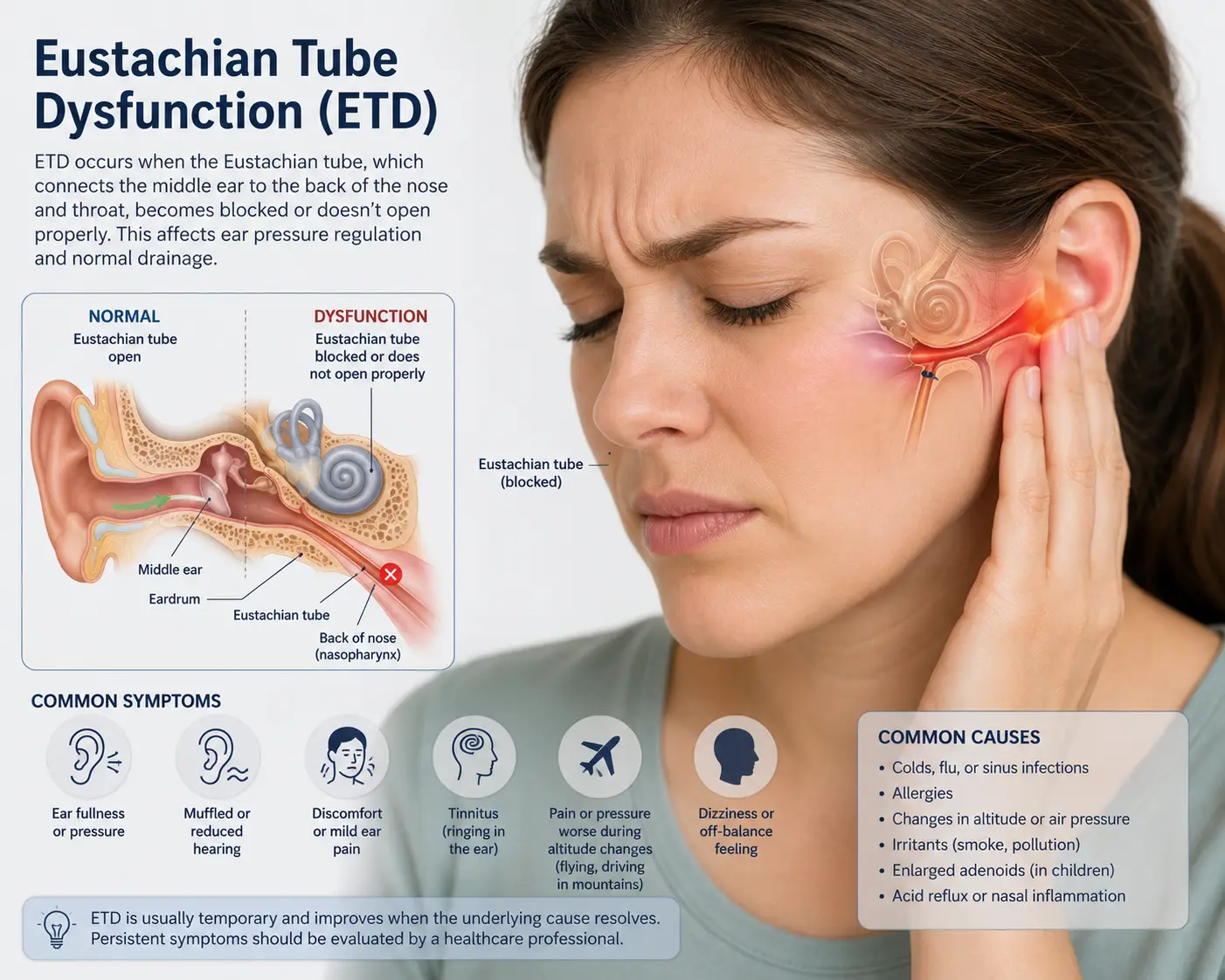
What Is Eustachian Tube Dysfunction?
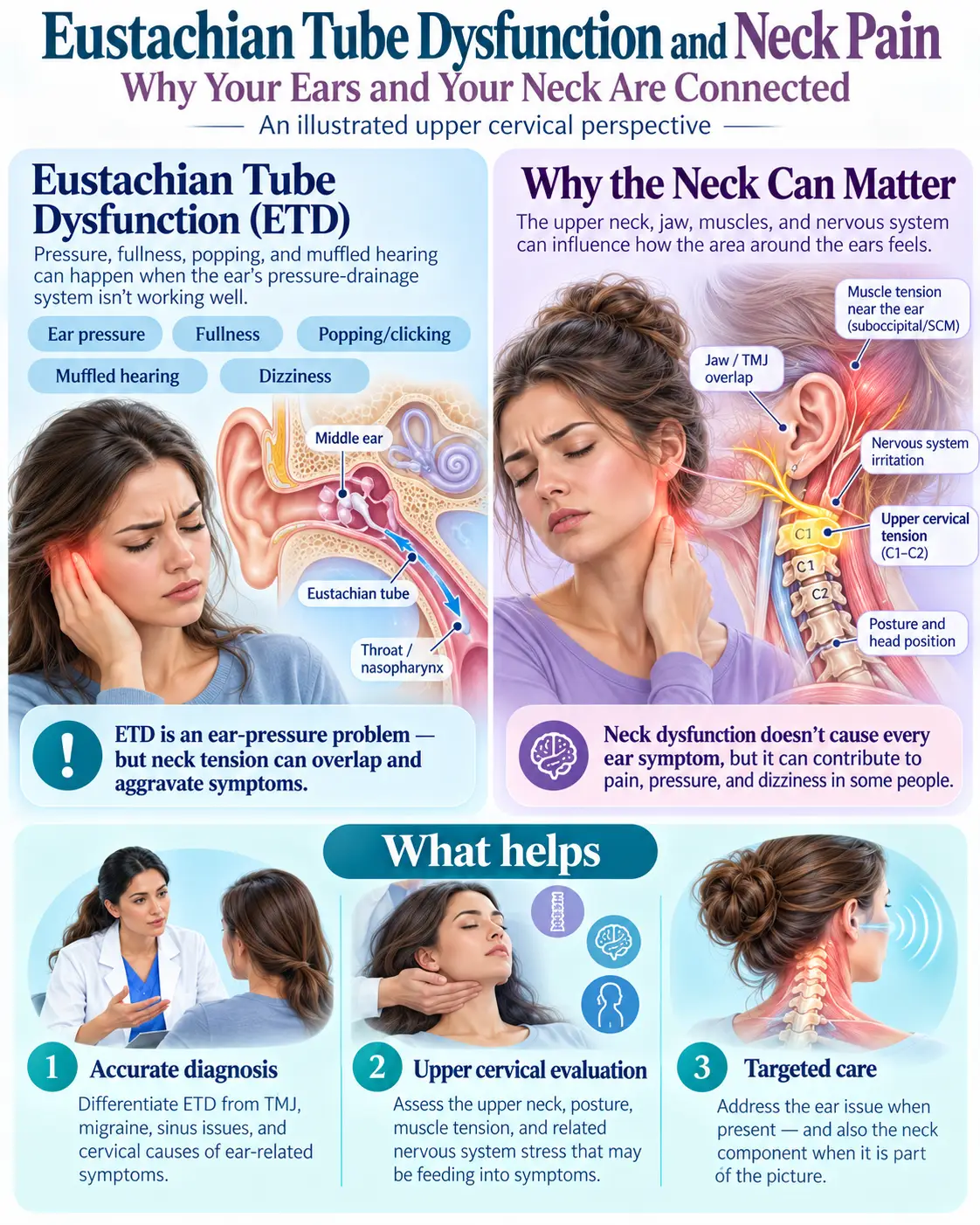
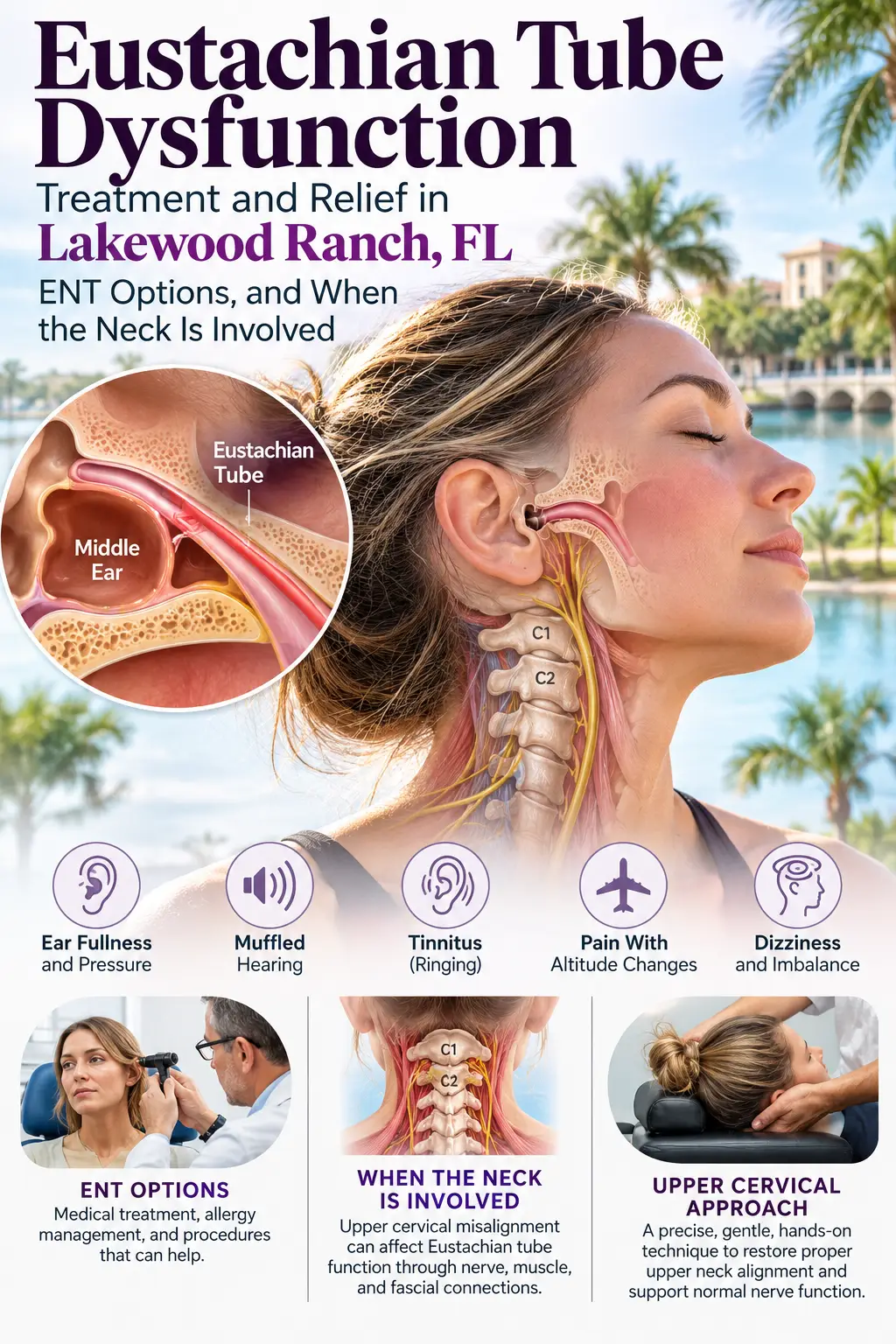
Your Eustachian tubes are narrow canals about 1.5 inches long that connect each middle ear to the back of your throat (the nasopharynx). When they’re working properly, they perform three essential functions:
- Pressure equalization — they open briefly each time you swallow, yawn, or chew, allowing air pressure in your middle ear to match the outside world
- Drainage — they let mucus and fluid drain from the middle ear into the throat
- Protection — they shield the middle ear from pathogens, sounds, and reflux
When that system breaks down, you get Eustachian Tube Dysfunction. There are two main types:
- Obstructive ETD — the tube stays stuck closed, trapping pressure and fluid
- Patulous ETD — the tube stays stuck open, causing autophony (hearing your own breathing or voice unusually loud)
Both feel awful, and both can persist for weeks, months, or years.
Common Symptoms of ETD
Patients at our Sarasota office describe ETD in remarkably consistent ways:
- A persistent feeling of fullness or pressure in one or both ears
- Constant popping, crackling, or clicking when swallowing
- Muffled or distant-sounding hearing
- A sensation of being “underwater”
- Tinnitus (ringing, buzzing, or whooshing)
- Dizziness or vertigo with weather changes
- Ear pain that comes and goes without infection
- Worsening symptoms on airplanes, in storms, or when driving over bridges
For many, the symptoms come in waves — better some days, intolerable others. That fluctuation is itself a clue that the root cause isn’t inside the ear.
The Conventional Treatment Trap
Most ETD patients in Sarasota arrive at our office after months — or years — of conventional treatment. They’ve tried:
- Decongestants and antihistamines
- Nasal corticosteroid sprays
- Antibiotics for suspected ear infections
- Tympanostomy tubes (ear tubes) in some cases
- Eustachian tube balloon dilation
For some, these treatments help. For many, they don’t — or the relief is temporary. That’s because these interventions all assume the problem is inside the ear or sinuses. When the actual problem is a nerve signaling issue from the upper cervical spine, no amount of decongestant will solve it.
The Anatomy of the Problem: Why Your Neck Controls Your Eustachian Tube
This is where most patients have their “aha” moment. The Eustachian tube doesn’t open passively. It opens because a small muscle called the tensor veli palatini contracts and pulls it open every time you swallow.
That muscle is innervated by the mandibular branch of the trigeminal nerve (cranial nerve V). And here’s the key: the trigeminal nerve doesn’t operate in isolation. Its central processing center — the spinal trigeminal nucleus — extends down into the upper cervical spinal cord, where it meets and integrates with sensory input from the upper three cervical nerves (C1, C2, and C3).
Neurologists call this convergence the trigeminocervical complex (TCC), and it’s well-documented in the peer-reviewed literature. Piovesan and colleagues (2003) and Bartsch and Goadsby (2003) established that nerve signals from the upper neck and the face/head share the same brainstem processing pathway. Irritation in one area produces symptoms in the other.
Translation: when your atlas or axis is misaligned and irritating the upper cervical nerves, your nervous system can disrupt signaling to the very muscle that opens your Eustachian tube. The result is impaired tube function — and the cascade of fullness, pressure, popping, and dizziness that follows.
Other Mechanisms at Play
Upper cervical misalignment doesn’t just affect the trigeminal nerve. It can also:
- Compromise vagus nerve function — the vagus nerve exits the skull right next to the atlas and helps regulate inflammation and mucous membrane function
- Disrupt lymphatic drainage from the head and neck, leading to chronic congestion
- Affect the cervical sympathetic chain that controls vasodilation in the middle ear
- Alter posture and jaw mechanics, increasing tension in the muscles around the Eustachian tube
- Restrict cerebrospinal fluid flow, contributing to intracranial pressure changes
When you stack these mechanisms together, you understand why ETD so often coexists with TMJ dysfunction, vertigo, tinnitus, and headaches — and why correcting the upper cervical spine often addresses several of them at once.
The Whiplash–ETD Connection: What Most Patients Don’t Know
Here’s something most ETD patients have never heard from any provider. A history of head or neck trauma is one of the strongest hidden contributors to chronic Eustachian Tube Dysfunction.
Chiropractic researcher Dr. Michael Burcon’s 2016 paper in the Journal of Upper Cervical Chiropractic Researchfollowed 300 patients with medically diagnosed Meniere’s disease — a condition closely related to ETD that includes ear fullness, vertigo, tinnitus, and low-frequency hearing loss. Every single one of the 300 patients had a prior history of whiplash trauma. The average time between the trauma and the onset of symptoms was approximately 15 years.
That delay is part of why the connection gets missed. Patients don’t link the car accident from a decade ago to the ear fullness they’re experiencing today. But the upper cervical misalignment from that whiplash can quietly persist for years, slowly disrupting the nerves that control Eustachian tube function until symptoms finally cross a threshold and demand attention.
Common trauma triggers we see in our Sarasota patients include:
- Motor vehicle accidents — even low-speed rear-end collisions
- Sports-related concussions or whiplash
- Falls — slips on stairs, falls from bikes, falls during childhood
- Difficult births (forceps or vacuum-assisted deliveries)
- Repetitive impact activities — gymnastics, football, hockey
If you’ve had any of these and now live with chronic ETD, the connection deserves investigation. See our page on car accident chiropractic care for more on the post-trauma connection.
How Lavender Family Chiropractic Approaches ETD
At Lavender Family Chiropractic, we don’t treat ETD directly. What we do is correct the upper cervical misalignment that may be the root cause of your symptoms — so your nervous system can do what it’s designed to do and your Eustachian tube can resume normal function.
Here’s what makes our approach different.
1. We Use 3D CBCT Imaging, Not Flat X-rays
Our office is equipped with a 3D Cone Beam Computed Tomography (CBCT) scanner. This gives us a true three-dimensional view of your upper cervical spine — something a regular flat X-ray simply can’t provide. We can see exactly how your atlas and axis are positioned, the angle and degree of misalignment, and the specific correction your spine needs.
For ETD cases this matters enormously. The misalignments we’re looking for are often subtle and rotational — easily missed on conventional imaging, but clearly visible in 3D.
2. We Use the Knee Chest Upper Cervical Technique
Our doctors — Dr. Rusty Lavender and Dr. Jacob Temple — are trained in the Knee Chest Upper Cervical technique. You rest comfortably in a knee-chest position while we deliver a precise, low-force adjustment to the atlas or axis based on your individual imaging.
There’s no twisting. No popping. No cracking. Just a specific, gentle correction tailored to your spine. The Knee Chest technique is gentle enough for children, seniors, and patients with sensitive conditions like Ehlers-Danlos syndrome or post-concussion symptoms.
3. We Build Personalized Care Plans
ETD that’s been brewing for years doesn’t resolve in a single visit. We design personalized care plans based on your imaging, exam findings, and symptom history. Your plan is built to:
- Correct the upper cervical misalignment
- Hold the correction over time
- Allow your nervous system to recalibrate
- Transition you into long-term wellness care
We explain your plan completely before you commit to anything. To learn more about our team and approach, visit the Meet the Team page or see What to Expect at your first visit.
Tired of the Fullness, the Popping, and the “Underwater” Feeling?
You don’t have to keep living with ETD. Call Lavender Family Chiropractic at (941) 243-3729 to schedule your consultation. Dr. Rusty Lavender or Dr. Jacob Temple will sit down with you, look at your upper cervical spine, and tell you honestly whether the root cause of your ear symptoms might be in your neck.
What the Research Says
The research supporting the connection between upper cervical care and Eustachian tube dysfunction is growing. Here’s what the published literature actually shows.
Prevalence and Burden of ETD
The 2019 JAMA Otolaryngology study by Shan and colleagues established that ETD affects approximately 11 million US adults — a prevalence of 4.6%, climbing to 8.25% among adults over 65. A separate 2020 study in Otolaryngology–Head and Neck Surgery confirmed prevalence above 5% in adults over 65, with strong associations between ETD and chronic rhinitis, chronic sinusitis, allergic rhinitis, and GERD.
For context, that means ETD is far more common than most patients realize — but the research base on treatment remains thin. Most conventional ETD interventions (decongestants, balloon dilation, tubes) have variable success rates, leaving millions of patients searching for alternatives.
The Trigeminocervical Complex and Eustachian Tube Function
The neuroanatomical basis for the upper cervical–Eustachian tube connection is well-established:
- Piovesan, Kowacs, and Oshinsky (2003) in Current Pain and Headache Reports documented the convergence of cervical and trigeminal sensory afferents at the brainstem
- Bartsch and Goadsby (2003) described how the trigeminocervical complex integrates upper cervical input with trigeminal nerve signaling
- A 2017 review on somatosensory tinnitus explicitly linked trigeminal over-activation with disrupted tensor veli palatini function and altered middle ear pressure
Upper Cervical Care for ETD-Related Conditions
The largest body of chiropractic evidence comes from Dr. Michael Burcon’s 2016 paper in the Journal of Upper Cervical Chiropractic Research: “Health Outcomes Following Cervical Specific Protocol in 300 Patients with Meniere’s Followed Over Six Years.” Although the primary diagnosis was Meniere’s, the patient population had overlapping ETD symptoms including aural fullness. Patients reported a 97% improvement in vertigo intensity, with the mean self-reported score dropping from 8.5 to below 1 on a 10-point scale. All 300 patients had a prior history of whiplash — pointing directly to the upper cervical spine as the common denominator.
Additional case-level evidence includes:
- A 2012 case study in JUCCR (Jones & Salminen) documenting Meniere’s symptom resolution including aural fullness following specific upper cervical care
- A 2015 case study in JUCCR (Pennington & Miller) documenting improvement in a post-vestibular-nerve-section patient
- A 2004 case report in the Journal of Manipulative and Physiological Therapeutics documenting improvement in vertigo, tinnitus, and hearing loss following upper cervical care
The Honest Limitations
We want to be transparent. Most chiropractic ETD evidence consists of case reports and case series — not large randomized controlled trials. The research is suggestive, not definitive. What it supports is this: in patients where upper cervical misalignment is a contributing factor, gentle correction can produce meaningful improvement. It doesn’t prove that every ETD case is rooted in the neck.
That’s exactly why we use 3D CBCT imaging. We don’t assume — we look.
Lifestyle Habits That Support ETD Relief
While correcting the upper cervical spine addresses the structural and neurological root cause, these habits help reduce inflammation, support drainage, and accelerate your results:
- Hydrate aggressively. Thin mucus moves. Thick mucus sticks. Aim for at least half your body weight in ounces of water daily.
- Use a saline nasal rinse. Daily neti pot or saline spray flushes allergens and reduces nasal inflammation that compresses the Eustachian tube opening.
- Try the Valsalva maneuver gently. Pinch your nose, close your mouth, and gently blow against the closed nostrils to force the Eustachian tube open. Gently — over-aggressive Valsalva can cause middle ear damage.
- Chew xylitol gum. Some research suggests xylitol gum can reduce the risk of middle ear infections by promoting Eustachian tube opening and inhibiting bacterial adhesion.
- Reduce dairy temporarily. Dairy thickens mucus in many people. A two-week elimination trial is a low-risk experiment.
- Use a humidifier. Dry indoor air aggravates the nasal passages and surrounding tissues. Humidifying your bedroom often produces overnight improvement.
- Manage allergies. Sarasota’s pollen, mold, and humidity are relentless. A HEPA air filter and proactive allergy management make a real difference.
- Avoid stomach sleeping. Hours with your neck rotated aggravates upper cervical misalignment.
For patients whose ETD is worsened by sinus pressure and allergies, see our companion guide on sinus pressure, allergies, and ear fullness in Sarasota for a deeper dive on the sinus connection.
Serving Sarasota and the Surrounding Communities
Lavender Family Chiropractic is located at 5899 Whitfield Avenue, Suite 107, Sarasota, FL 34243 — right at the corner of University and Whitfield. We’re easy to reach from anywhere on the Suncoast and proud to serve patients from across the region, including Bradenton, Lakewood Ranch, Parrish, Ellenton, Palmetto, University Park, Longboat Key, Siesta Key, Osprey, Venice, Myakka City, Ruskin, Tampa, and St. Petersburg.
If you’ve been chasing ETD from one ENT to the next with no real answers, we’d love to help you investigate the upper cervical connection. See more about the areas we service and the conditions we help at our practice. Our complete guide to Eustachian tube dysfunction and the upper cervical spine covers the types of ETD, why the ear and the neck are connected, and how we evaluate it in Sarasota.
Top 15 FAQs About Eustachian Tube Dysfunction and Upper Cervical Care
1. Can a chiropractor really help Eustachian Tube Dysfunction?
We don’t treat the Eustachian tube directly — but when the upper cervical spine is misaligned, the nerves controlling the tensor veli palatini muscle (the muscle that opens your Eustachian tube) get disrupted. Correcting that misalignment often allows the tube to resume normal function, and patients report significant relief from chronic fullness, popping, and pressure.
2. How is upper cervical chiropractic different from regular chiropractic?
Regular chiropractic adjusts many segments of the spine, often with twisting, popping, or cracking. Upper cervical focuses only on the top two vertebrae — the atlas (C1) and axis (C2) — with a specific, low-force adjustment guided by 3D CBCT imaging. There’s no twisting and no popping.
3. Does the adjustment hurt?
No. The Knee Chest Upper Cervical technique uses light, specific pressure while you rest comfortably in a knee-chest position. Most patients describe it as gentle and surprisingly subtle.
4. How long until I notice relief from ETD?
Some patients notice changes within the first few visits. Others — especially those with long-standing symptoms or a history of significant trauma — need several weeks of consistent care. We’ll give you a realistic timeline based on your imaging and exam findings.
5. My ENT did a balloon dilation and it didn’t fully work. Is upper cervical care still worth trying?
Yes. Balloon dilation addresses the mechanical anatomy of the tube itself. Upper cervical care addresses the nerve and muscle signaling that controls the tube. These are different mechanisms, and many patients who didn’t respond fully to dilation see additional improvement once the upper cervical contribution is addressed.
6. Will my ETD come back if I stop coming?
Holding the correction is the goal. That’s why we build personalized care plans designed to stabilize the upper cervical correction over time. Patients who complete the corrective phase and follow through with wellness care tend to see the longest-lasting results.
7. Is upper cervical care safe for kids with chronic ear problems?
Yes. The Knee Chest technique is gentle enough for children. Many of our pediatric patients come in for chronic ear infections, ETD, and persistent ear fullness that hasn’t responded to conventional care.
8. Do I need a referral from my ENT?
No referral is needed. You can call us directly at (941) 243-3729 or book online.
9. I had a car accident years ago. Could that be causing my current ETD?
Possibly — and the research suggests this connection is far more common than most patients realize. Dr. Burcon’s research found that 100% of his 300 Meniere’s patients had a prior whiplash history, with an average 15-year delay between trauma and symptom onset. If you’ve had any head or neck trauma, even decades ago, it’s worth investigating.
10. What’s the difference between obstructive and patulous ETD?
Obstructive ETD means the tube stays stuck closed — you feel fullness, pressure, and muffled hearing. Patulous ETD means the tube stays stuck open — you hear your own breathing and voice unusually loud (autophony). Both can respond to upper cervical care because both involve disrupted nerve signaling to the muscles controlling the tube.
11. Do you accept insurance?
We’ll walk you through your options during your consultation. Our care plans are designed to make consistent, long-term care affordable regardless of insurance coverage.
12. What is 3D CBCT and why do you use it for ETD?
3D Cone Beam Computed Tomography gives us a true three-dimensional view of your upper cervical spine. For ETD cases this matters because the misalignments we’re looking for are often subtle and rotational — easily missed on standard X-rays but clearly visible in 3D.
13. Why does my ETD get worse with weather changes or on airplanes?
Because your Eustachian tube has to actively open and close to equalize pressure with the environment. When the nerves controlling that mechanism are compromised by upper cervical misalignment, your tube can’t keep up with pressure changes — and storms, flights, altitude shifts, and bridge crossings all become symptom triggers.
14. Can ETD cause vertigo or dizziness?
Yes. Pressure imbalances in the middle ear can disrupt the inner ear’s vestibular system, which controls balance. That’s why many ETD patients also experience vertigo, dizziness, or lightheadedness, especially during flare-ups.
15. How do I get started?
Call (941) 243-3729 or book your consultation online. You’ll sit down with Dr. Rusty Lavender or Dr. Jacob Temple, talk through your symptoms, and find out whether upper cervical chiropractic is the right fit for you.
Ready to Get to the Root Cause? Call Lavender Family Chiropractic
You don’t have to keep living with ear fullness, popping, pressure, and that exhausting “underwater” feeling. At Lavender Family Chiropractic, Dr. Rusty Lavender and Dr. Jacob Temple use precise 3D CBCT imaging and the gentle Knee Chest Upper Cervical technique to address the upper cervical spine — the structural and neurological gateway between your brain and the muscles that control your Eustachian tube.
📞 Call (941) 243-3729 today 📅 Book your consultation online 📍 5899 Whitfield Avenue, Suite 107, Sarasota, FL 34243 — at the corner of University and Whitfield
Related Articles
Related Posts


Get our upper cervical articles first.
Patients Experience