Numbness and Tingling in the Feet in Sarasota, Florida: What It Means, What Causes It, and How Lavender Family Chiropractic Approaches the Whole-Body Nerve Pathway
By Dr. Rusty Lavender, D.C. — upper cervical chiropractor, Lavender Family Chiropractic, Sarasota, FL. Reviewed and updated October 2026.
Numbness and Tingling in the Feet: It often starts as something subtle. A patch of numbness on your foot that you only notice when you take your shoes off. A tingling that comes and goes when you sit too long. A sensation that your feet are wearing invisible socks, or that you are walking on a thin layer of cotton. For some people, it becomes burning, stabbing, or sharp electric pain — often worse at night, often disrupting sleep. For others, it is mostly silent — a slow, creeping loss of sensation that they only notice when they step on something they should have felt or when their balance starts to falter. Whatever the form, numbness and tingling in the feet is one of the most common and most frequently misattributed neurological symptoms there is.
To be clear from the first sentence: foot numbness has many possible causes, the most common cause by far is diabetic peripheral neuropathy, and the appropriate first step for nearly every patient with this symptom is a thorough medical workup to identify the underlying cause. We are an upper cervical chiropractic practice. We do not treat diabetic neuropathy, we do not replace neurological care, and we do not claim that chiropractic adjustments fix metabolic nerve damage. That is the truth, and any provider who tells you otherwise is overpromising on a symptom that often signals a serious underlying condition.
What we can offer, and what this guide explains in detail, is something more focused: for the subset of foot numbness patients whose symptoms involve lumbar nerve compression, postural strain, whole-spine biomechanical factors, or the lower-extremity equivalent of the “double crush” phenomenon, addressing the structural and biomechanical components of the picture can be a reasonable part of comprehensive care. This guide is for anyone in Sarasota, Bradenton, Lakewood Ranch, or the surrounding areas who is dealing with foot numbness and wants to understand what it might mean, when it warrants concern, and where chiropractic care does — and does not — fit into the picture.
What Numbness and Tingling in the Feet Actually Means
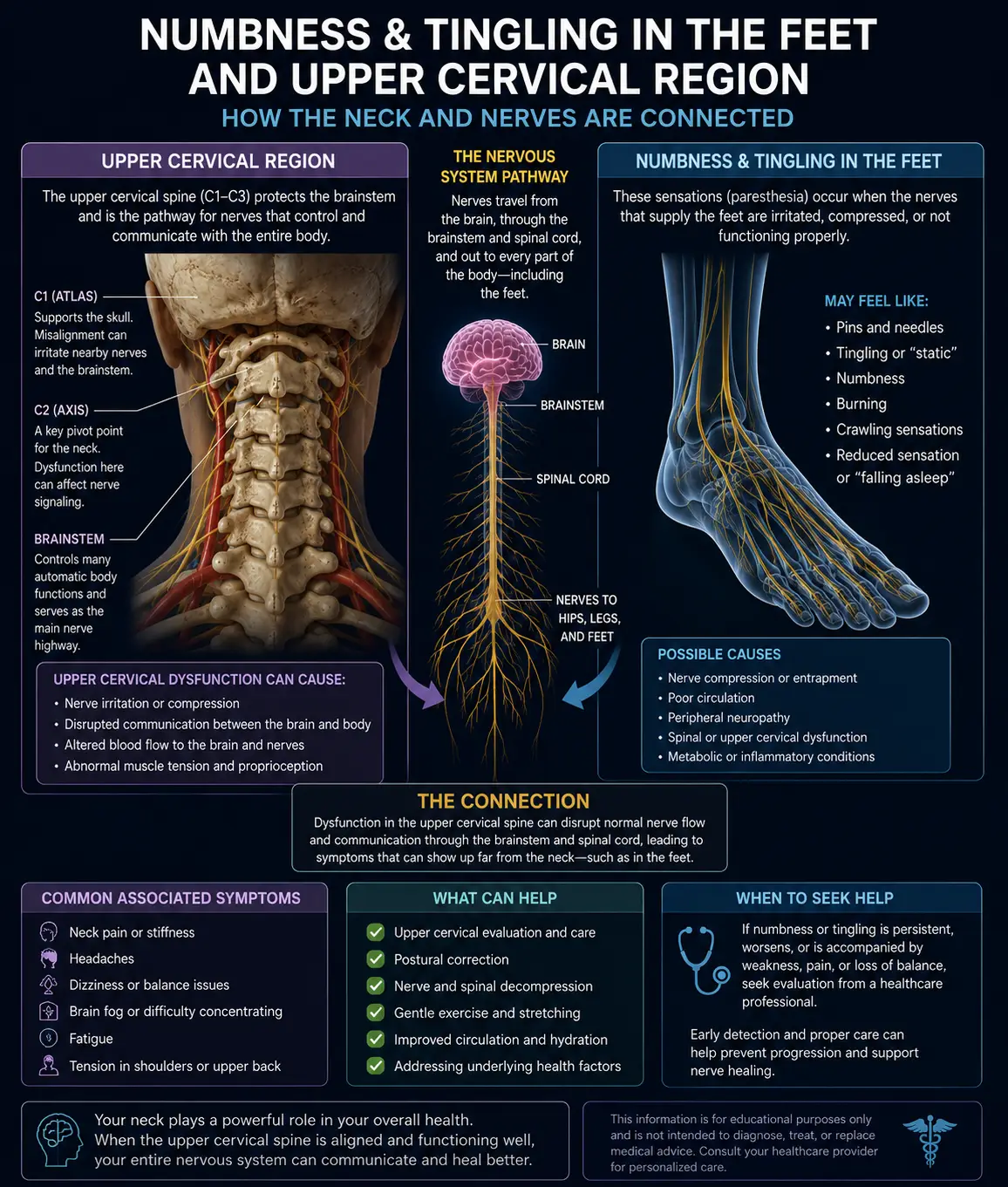
The medical term for the abnormal sensations of numbness, tingling, pins and needles, burning, or that “asleep” feeling in the feet is paresthesia. These sensations occur when something interferes with the normal functioning of the sensory nerves that supply the feet — anywhere along their path from the spinal cord, through the lumbar and sacral nerve roots, down the leg, and to the foot itself.
To understand foot numbness, it helps to know the basic wiring. The nerves that supply your feet originate as nerve roots exiting your lower lumbar and sacral spine — primarily L4, L5, and S1. These nerve roots merge to form the major nerves of the leg, including the sciatic nerve, which then branches further to supply the lower leg, ankle, and foot through the tibial nerve, peroneal (fibular) nerve, and their branches. Each of these nerves supplies a specific part of the foot, which is why the pattern of your numbness is such a powerful clue to its source.
Beyond the structural nerve pathway, the feet are also vulnerable to systemic, metabolic, and circulatory factors. The small nerves in the feet — the longest peripheral nerves in the body — are particularly susceptible to damage from blood sugar elevations, vitamin deficiencies, alcohol, certain medications, and circulatory problems. This is why foot numbness is one of the earliest and most common symptoms of conditions like diabetes, peripheral artery disease, and several systemic illnesses.
How common is foot numbness? Far more common than its profile suggests, and the dominant cause is unfortunately a condition that is itself epidemic. According to clinical references, the most prevalent subtype of peripheral neuropathy is diabetic peripheral neuropathy, which can lead to significant complications ranging from paresthesia to loss of limb and life. According to a Frontiers in Endocrinology review, 10 to 15% of newly diagnosed type 2 diabetes patients already have diabetic peripheral neuropathy, and the prevalence can exceed 50% in patients with diabetes for more than 10 years. The Mayo Clinic and other major references note that diabetic neuropathy affects the feet and legs first, followed by the hands and arms, and symptoms are often worse at night.
For a region like Sarasota with a large retired and older population, where rates of diabetes and pre-diabetes are substantial, foot numbness is genuinely common — and the first priority for nearly every patient is establishing whether diabetes, vitamin deficiency, or another systemic cause is at the root of the problem.
This is why honest care for foot numbness begins with thorough evaluation and, in many cases, blood work — not with adjustments or treatments aimed at the symptom.
Decoding Your Symptoms: Pattern, Distribution, and Timing
The single most useful thing you can do to understand your foot numbness is pay close attention to the pattern. Different sources produce characteristically different patterns, and these patterns are how clinicians localize the problem.
Which parts of the foot are affected? This is the most powerful single piece of information.
If your numbness affects both feet symmetrically in a “stocking” distribution — starting at the toes and gradually creeping upward — this is the classic pattern of peripheral neuropathy. The most common cause by far is diabetes, but other systemic and metabolic causes can produce the same pattern: prediabetes, hypothyroidism, vitamin B12 deficiency, alcohol-related neuropathy, certain medications (especially chemotherapy), kidney disease, and autoimmune conditions. This pattern requires medical workup — not chiropractic care.
If your numbness affects the top of one foot, possibly with weakness lifting the foot or toes, this may follow the L5 dermatomal pattern, suggesting an L5 nerve root problem in the lumbar spine. According to Mayo Clinic clinical references, L5 radiculopathy is usually associated with numbness down the side of the leg and into the top of the foot.
If your numbness affects the outer side or bottom of one foot, sometimes with weakness pushing off when walking, this may follow the S1 dermatomal pattern, suggesting an S1 nerve root problem. The Mayo Clinic reference establishes that S1 radiculopathy typically results in numbness down the back of the leg into the outside or bottom of the foot.
If your numbness involves the bottom of the foot, often with burning, tingling, or shooting pain that worsens with walking or standing, this may suggest tarsal tunnel syndrome — entrapment of the posterior tibial nerve as it passes through the tarsal tunnel on the inside of the ankle. Tarsal tunnel syndrome is essentially the foot equivalent of carpal tunnel syndrome at the wrist.
If your numbness is accompanied by significant cold feet, color changes in the skin (pale, bluish, or red), and pain when walking that resolves at rest, this may suggest peripheral artery disease — a circulatory problem requiring prompt medical evaluation.
When does it happen? Timing matters too. Numbness that is worst at night is classic for both diabetic neuropathy and certain compression neuropathies. Numbness that worsens with standing or walking and improves when leaning forward (the “shopping cart sign”) suggests lumbar spinal stenosis — narrowing of the spinal canal that compresses nerve roots. Numbness that worsens with certain back positions points toward a lumbar source. Numbness that is constant, slowly progressive, and bilateral points toward a systemic or metabolic cause.
One foot or both? Symptoms in one foot generally suggest a localized compression somewhere along that leg’s nerve pathway. Symptoms in both feet, especially symmetrically, raise strong suspicion of a systemic cause that requires medical workup before considering any biomechanical intervention.
This decoding process is exactly what a thorough evaluation is designed to do — and it is why guessing or assuming every case of foot numbness is the same condition leads so many patients astray.
The Many Causes of Foot Numbness — A Complete and Honest Picture
Because foot numbness has so many possible sources, an honest discussion has to acknowledge the full range, with the most common and serious causes named first.
Diabetic peripheral neuropathy. This is by far the most common cause of foot numbness. According to clinical references on diabetic neuropathy, around 50% of diabetic patients develop peripheral neuropathy within 25 years of their diagnosis, with painful diabetic neuropathy manifesting as burning, excruciating, stabbing or intractable pain, or as tingling or numbness. The first step in management is tight blood sugar control. This is not chiropractic territory.
Prediabetes and metabolic syndrome. Even before formal diabetes, elevated blood sugar can begin damaging peripheral nerves. Anyone with foot numbness and risk factors for diabetes should have blood sugar testing.
Vitamin B12 deficiency. A common, easily-tested, easily-treated cause of foot numbness, particularly in older adults, vegetarians and vegans, those on certain medications (metformin, proton pump inhibitors), and those with absorption issues.
Hypothyroidism. Underactive thyroid can produce neuropathy and should be on the workup list.
Alcohol-related neuropathy. Chronic heavy alcohol use is a direct cause of peripheral neuropathy.
Medication-induced neuropathy. Chemotherapy is the most common medical cause, but many other medications can produce neuropathy as a side effect.
Kidney disease and other systemic conditions. Advanced kidney disease, autoimmune conditions, certain infections, and other systemic illnesses can produce neuropathy.
Lumbar radiculopathy. Compression of the L4, L5, or S1 nerve roots in the lumbar spine can produce dermatomal numbness in the foot. This is documented as a common cause of sciatica and is one of the few categories of foot numbness where conservative spinal care has a defensible role.
Lumbar spinal stenosis. Narrowing of the spinal canal, more common in older adults, can compress multiple nerve roots and produce bilateral or unilateral foot numbness, typically worse with standing and walking.
Tarsal tunnel syndrome. Entrapment of the posterior tibial nerve at the ankle, producing burning, tingling, and numbness in the sole of the foot.
Peripheral artery disease. A circulatory problem causing reduced blood flow to the legs, producing numbness, cold feet, and pain with walking. Requires prompt medical evaluation.
Inflammatory and other causes. Less common but real — Guillain-Barré syndrome, inflammatory neuropathies, and other neurological conditions.
Serious causes requiring urgent evaluation. Sudden numbness with weakness, especially on one side, can signal stroke and is a medical emergency. Numbness with loss of bowel or bladder control or saddle numbness can signal cauda equina syndrome and is also an emergency.
This is why we never assume we know the cause of someone’s foot numbness before a thorough evaluation. Responsible care begins with identifying which category applies and ensuring that systemic and serious causes are properly worked up and managed.
The Spinal and Biomechanical Connection: Where Chiropractic Care May Fit
For the subset of foot numbness patients whose symptoms originate from or involve the lumbar and sacral spine — rather than from diabetes, vitamin deficiency, or other systemic causes — spinal and biomechanical care has a legitimate role.
The most common spinal source is lumbar radiculopathy from disc herniation or lumbar stenosis. According to clinical references, 95% of clinically important lumbar disc herniations occur at the L4-L5 or L5-S1 levels, producing neurologic impairments in the motor and sensory dermatomes of the L5 and S1 nerve roots — corresponding to the dorsum of the foot for L5 and the lateral foot for S1. When a patient’s foot numbness follows one of these dermatomal patterns and is associated with low back pain, sciatica-pattern leg pain, or aggravation by spinal movement, the lumbar source is genuinely worth evaluating and addressing.
There is also a documented “double crush” phenomenon in the lower extremity, though it is less common than the upper-extremity version. According to a recent review, the lower-extremity double crush syndrome — most often involving simultaneous L5 nerve root compression and a downstream entrapment such as tarsal tunnel syndrome or common peroneal nerve compression — has been documented since 1985, and delayed diagnosis is a real concern because clinicians may miss the proximal-distal combination. For patients whose foot numbness involves both a lumbar component and a more distal entrapment, addressing the proximal contribution can reduce the overall nerve irritation load.
This brings us to where upper cervical chiropractic care fits into foot numbness — and this is where we have to be especially honest. Upper cervical care does not directly affect the lumbar nerve roots, the sciatic nerve, or the tibial nerve. It does not repair diabetic nerve damage. It does not treat tarsal tunnel syndrome at the ankle. The connection to foot numbness, when it exists, is more modest and more indirect than for many other conditions we address.
What upper cervical care can offer is influence on the whole-spine biomechanical and dural-tension picture. The dura mater — the protective membrane surrounding the entire central nervous system — is continuous from the skull to the sacrum, and tension is transmitted along its length. When the upper cervical spine is misaligned, postural compensations cascade down the entire spine, altering how the lumbar segments are loaded. For patients whose foot numbness is being perpetuated by global postural and lumbar biomechanical factors, addressing the upper cervical foundation is one piece — typically a modest piece — of comprehensive whole-spine care.
We want to be very clear about this. For most foot numbness patients, the appropriate care pathway is medical workup first (especially for diabetes, vitamin levels, and thyroid function), followed by targeted treatment of the identified cause. If the workup identifies a lumbar component, lumbar-focused chiropractic care, physical therapy, or other interventions are typically more directly relevant than upper cervical work. Upper cervical care fits in as part of a whole-spine approach for selected patients where the global biomechanical picture is contributing — never as the primary or stand-alone treatment for foot symptoms.
How Lavender Family Chiropractic Approaches Foot Numbness
At Lavender Family Chiropractic, we use the Knee Chest Upper Cervical technique — a precise, gentle method of correcting atlas and axis misalignments without any twisting, popping, or forceful manipulation. For foot numbness patients, our role is shaped by a careful, honest evaluation of where their symptoms are actually coming from.
For patients whose foot numbness has a clear systemic cause — diabetes, vitamin deficiency, thyroid dysfunction — our job is to recognize this, ensure they are working with appropriate medical providers, and be honest that our specialty is not the right match for their primary problem. Many of these patients still benefit from learning about our existing neuropathy service page, which addresses peripheral neuropathy from a broader perspective.
For patients whose foot numbness has a clear lumbar source — radiculopathy from a disc herniation or stenosis — our role is to evaluate the whole-spine biomechanical picture, address the upper cervical and postural contributors that influence how the lumbar spine is loaded, and coordinate with other providers (lumbar-focused chiropractors, physical therapists, and physicians) who address the lumbar source more directly. Our blog on sciatica addresses the lumbar radiculopathy picture in depth.
For patients with a complex picture involving multiple contributors — a lumbar component, a postural component, and perhaps a distal entrapment — addressing the upper cervical and whole-spine contribution can be a meaningful piece of a multidisciplinary approach.
For patients with red flags — sudden numbness with weakness, bowel/bladder symptoms, signs of stroke, signs of significant vascular disease — we refer immediately for emergency or specialist medical evaluation.
What we promise is honesty about where your foot numbness is most likely coming from, careful screening for serious and systemic causes, and a clear assessment of whether upper cervical care has a meaningful role in your particular situation. We are not the right care for every patient with foot numbness, and we will tell you so directly when that is the case.
What Care Looks Like at Lavender Family Chiropractic
If you come to our Sarasota office for evaluation of foot numbness, here is what to expect.
Your first visit begins with a thorough consultation. Dr. Lavender or Dr. Temple will sit down with you and carefully map your symptoms — which parts of the feet, when symptoms occur, one foot or both, what makes them better or worse, whether you have low back pain or leg pain, your medical history including diabetes status and recent blood work, your medications, and any other relevant factors. This symptom mapping and history-taking is the heart of localizing the source.
The examination includes a detailed neurological evaluation (sensation, strength, reflexes — particularly the ankle reflex for S1, and dorsiflexion strength for L5), provocative testing for lumbar radiculopathy and tarsal tunnel syndrome, postural and gait analysis, vascular assessment (checking pulses, skin color, temperature), and advanced 3D imaging of your upper cervical alignment. We screen carefully for red flags and for signs of systemic causes that require medical workup.
If your evaluation suggests a clearly systemic cause (such as diabetic neuropathy in a patient with diabetes and the classic stocking distribution), we will tell you directly that this is not our specialty and help you ensure you are working with the right providers. If the evaluation suggests a lumbar source or a whole-spine biomechanical component, we will explain honestly how upper cervical and whole-spine care fits — and where it does not. We coordinate with other providers, because foot numbness so often benefits from a team approach.
Care, when appropriate, is delivered through the gentle Knee Chest Upper Cervical technique. We offer customized treatment plans tailored to your specific situation, with honest expectations about what care can and cannot accomplish.
📞 Call (941) 243-3729 to schedule your consultation 📅 Book your consultation online 📍 5899 Whitfield Avenue, Suite 107, Sarasota, FL 34243 — at the corner of University and Whitfield
What the Research Says About Foot Numbness and Its Sources
The research on foot numbness is extensive, and the dominant theme is the dominance of diabetes as a cause and the importance of accurate localization.
The diabetic neuropathy foundation is overwhelming. A Frontiers in Endocrinology review documented that 10 to 15% of newly diagnosed type 2 diabetes patients already have diabetic peripheral neuropathy, and prevalence can exceed 50% in patients with diabetes for more than 10 years. A PMC review on painful diabetic neuropathy reported that around 50% of diabetic patients develop peripheral neuropathy within 25 years, and that the first step in management is tight glycemic control. These figures establish that for any patient with foot numbness, evaluating for diabetes is an essential first step.
The dermatomal mapping for lumbar sources is well established. According to clinical references on lumbosacral radiculopathy, L5 radiculopathy typically produces sensory changes on the dorsum of the foot, while S1 radiculopathy affects the lateral foot, with 95% of clinically important lumbar disc herniations occurring at L4-L5 or L5-S1 — establishing the anatomical basis for the lumbar contribution to foot numbness in selected patients.
The clinical reality of distinguishing causes is documented. According to a clinical reference for foot and ankle providers, careful evaluation of dermatomal patterns, motor deficits like difficulty heel walking (L5) or toe walking (S1), and symptom behavior modulated by spinal mechanics is essential for distinguishing lumbosacral spine disorders from local foot pathology. This is the systematic evaluation approach that proper care requires.
The lower-extremity double crush phenomenon, while less common than its upper-extremity counterpart, is documented in the literature. According to a recent review, the lower extremity double crush syndrome — typically involving combined L5 nerve root compression and tarsal tunnel syndrome or common peroneal nerve compression — has been documented since 1985, with delayed diagnosis being a real concern because clinicians may miss the proximal-distal combination — providing the basis for considering a whole-pathway evaluation in selected patients.
This body of research establishes that diabetes is the dominant cause of foot numbness, that accurate dermatomal localization is essential for identifying lumbar sources, that the double-crush phenomenon does occur in the lower extremity though less commonly than in the upper, and that responsible care requires careful screening before any single intervention is pursued.
Lifestyle Factors That Support Recovery from Foot Numbness
Whether or not chiropractic care is part of your strategy, the daily inputs you control matter enormously for foot numbness — particularly the systemic and metabolic causes.
Blood sugar control. If you have diabetes or prediabetes, this is the single most important factor. Tight glycemic control is the foundation of preventing and slowing diabetic neuropathy. Work closely with your medical providers on this.
Get your blood work done. If you have not had recent blood work including hemoglobin A1c (blood sugar), vitamin B12, thyroid function, and a metabolic panel, this is often the right first step. Foot numbness is one of the most common presentations of treatable systemic conditions.
Limit alcohol. Excessive alcohol is a direct cause of peripheral neuropathy and worsens nearly every form of foot numbness.
Maintain healthy weight. Obesity is a risk factor for diabetes, lumbar disc problems, and peripheral artery disease — three of the most common causes of foot numbness.
Stay active. Regular movement supports circulation, nerve health, and weight management. Walking is particularly valuable.
Foot care. If you have any loss of sensation, daily foot inspection becomes important. Patients with neuropathy can develop injuries they do not feel, which can progress to serious complications. Take your foot care seriously.
Anti-inflammatory nutrition. Minimize processed foods, refined sugars, and seed oils; emphasize whole foods, omega-3-rich fish, and adequate protein. Adequate B vitamins and hydration matter too.
Smoking cessation. Smoking impairs circulation, is a risk factor for both diabetes complications and peripheral artery disease, and is harmful in many other ways. This is one of the most impactful changes you can make.
Posture and ergonomics. For patients with a lumbar source, posture matters. Avoid prolonged sitting with poor posture, address ergonomics, and maintain core strength.
Do not ignore progression. If your numbness is worsening, spreading, accompanied by weakness, or interfering with balance, get evaluated promptly. Early intervention generally produces better outcomes.
If you found this guide useful, you may also want to read our blog on numbness and tingling in the hands, the upper-body symptom companion — and our blog on sciatica, which addresses the lumbar radiculopathy picture in detail.
Serving Sarasota and the Surrounding Communities
Lavender Family Chiropractic is located in Sarasota, Florida, at 5899 Whitfield Avenue, Suite 107 — at the corner of University and Whitfield. From this central location, we serve patients throughout the region, including Bradenton, Lakewood Ranch, Palmetto, Parrish, Venice, Osprey, Nokomis, Ellenton, Ruskin, Myakka City, North Port, and the greater Tampa Bay area. Patients also travel from St. Pete, Riverview, and Manatee County to receive specialized upper cervical care here.
Foot numbness is genuinely one of the most common and most confusing neurological symptoms there is. Many patients have spent years cycling between providers without ever getting a clear answer about where their symptoms are coming from. If you want a thorough, honest evaluation — including straightforward acknowledgment when your primary care needs are outside our specialty — we encourage you to reach out.
Top 15 FAQs About Foot Numbness and Chiropractic Care
1. What does numbness and tingling in my feet actually mean? It means a nerve somewhere along its pathway — from your spinal cord through your lumbar and sacral spine, down your leg, to your foot — is being compressed, irritated, or damaged. The specific pattern of your numbness is a powerful clue to where the problem is located.
2. Could it be diabetes? Diabetes is by far the most common cause of foot numbness. If you have not had recent blood sugar testing, getting it done is often the right first step. Diabetic neuropathy typically affects both feet symmetrically in a stocking distribution, often worse at night.
3. What other systemic causes should I consider? Vitamin B12 deficiency, hypothyroidism, prediabetes, alcohol-related neuropathy, medication side effects (especially chemotherapy), kidney disease, and autoimmune conditions. All of these warrant medical workup.
4. When is foot numbness an emergency? Sudden numbness with weakness, especially on one side, can signal stroke and is a medical emergency. Numbness with loss of bowel or bladder control or saddle numbness can signal cauda equina syndrome and requires immediate medical care.
5. Can a problem in my back cause foot numbness? Yes. Lumbar radiculopathy from a disc herniation or stenosis can compress the L4, L5, or S1 nerve roots and produce dermatomal numbness in specific parts of the foot. This is one of the few categories of foot numbness where chiropractic and conservative spinal care have a defensible role.
6. Can upper cervical chiropractic help my foot numbness? Honestly, the upper cervical case for foot symptoms is more modest than for many other conditions. Upper cervical care does not directly affect lumbar nerve roots or repair diabetic nerve damage. It can influence whole-spine biomechanics and dural tension as part of comprehensive care for the subset of patients with a lumbar or postural component. For systemic causes like diabetic neuropathy, it is not the right care.
7. What is the difference between diabetic neuropathy and a pinched nerve? Diabetic neuropathy typically affects both feet symmetrically in a stocking distribution, develops gradually, and is caused by metabolic damage to the small nerves. A pinched nerve in the lumbar spine typically affects one foot in a specific dermatomal pattern, often with associated back or leg pain, and is caused by mechanical compression of a nerve root.
8. Should I get blood tests? For most patients with foot numbness, yes — at minimum, blood sugar (A1c), vitamin B12, thyroid function, and a metabolic panel. This is often the right first step before any biomechanical evaluation.
9. Why is my foot numbness worse at night? Both diabetic neuropathy and many compression neuropathies are worse at night. The exact reasons vary, but reduced distraction, certain sleeping positions, and reduced blood flow patterns at night all contribute.
10. Why do both my feet feel numb? Bilateral symmetric foot numbness raises strong suspicion of a systemic cause, most commonly diabetic neuropathy or another metabolic neuropathy. Bilateral symptoms warrant medical workup including blood testing.
11. What is tarsal tunnel syndrome? Tarsal tunnel syndrome is entrapment of the posterior tibial nerve as it passes through the tarsal tunnel on the inside of the ankle, essentially the foot equivalent of carpal tunnel at the wrist. It typically produces burning, tingling, or numbness in the sole of the foot. Conservative care, including addressing any contributing biomechanical factors, can sometimes help.
12. Is there a “double crush” in the legs like there is in the arms? Yes, though it is less common than the upper-extremity version. The lower-extremity double crush — typically involving L5 nerve root compression plus a downstream entrapment like tarsal tunnel syndrome — is documented in the literature, and missing the proximal-distal combination is a recognized clinical pitfall.
13. Can chiropractic care reverse diabetic neuropathy? No. Chiropractic care does not repair the metabolic nerve damage caused by diabetes. The foundation of diabetic neuropathy management is tight glycemic control and the targeted medical treatments your physicians provide. We will tell you honestly that this is not our specialty.
14. How will I know if chiropractic care is right for me? The only way to know is a thorough evaluation, which includes screening for systemic and serious causes. If your foot numbness has a clearly systemic cause, we will tell you so and direct you toward appropriate medical care. If it has a lumbar or whole-spine biomechanical component, we will explain honestly how chiropractic care fits.
15. How do I get started? Call our Sarasota office at (941) 243-3729 or book your consultation online. We will map your symptoms, perform a thorough examination, screen for red flags and systemic causes, and give you a straight answer about where your numbness is coming from and how chiropractic care fits in — or whether you need something else.
Take the Next Step Toward Answers
Numbness and tingling in the feet is one of the most common symptoms there is, and one of the most frequently mismanaged because of how often providers either miss the systemic cause or assume one without proper workup. Diabetes is the dominant cause; vitamin deficiencies, thyroid problems, and several other systemic conditions account for much of the rest; and a smaller but real subset involves lumbar nerve compression, tarsal tunnel syndrome, and whole-spine biomechanical factors. Getting the source right is the difference between effective care and months or years of treating the wrong target.
If you are in Sarasota, Bradenton, Lakewood Ranch, or anywhere in the surrounding region and you are dealing with persistent or unexplained foot numbness, Dr. Rusty Lavender and Dr. Jacob Temple at Lavender Family Chiropractic are here to give you a thorough, honest evaluation of where your symptoms are coming from. We will not promise to treat what is not ours to treat. We will tell you directly when you need medical workup. And for the subset of patients where whole-spine biomechanical care is genuinely relevant, we will be honest about how it fits into a comprehensive approach.
📞 Call (941) 243-3729 today to schedule your consultation 📅 Book online here 📍 5899 Whitfield Avenue, Suite 107, Sarasota, FL 34243 — at the corner of University and Whitfield
Related Articles
Related Posts


Get our upper cervical articles first.