Visual Vertigo: Why Do Grocery Stores Make Me Dizzy? Overstimulation, Visual Vertigo, and How Upper Cervical Care at Lavender Family Chiropractic May Help in Sarasota, Florida
By Dr. Rusty Lavender, D.C. — upper cervical chiropractor, Lavender Family Chiropractic, Sarasota, FL. Reviewed and updated October 2026.
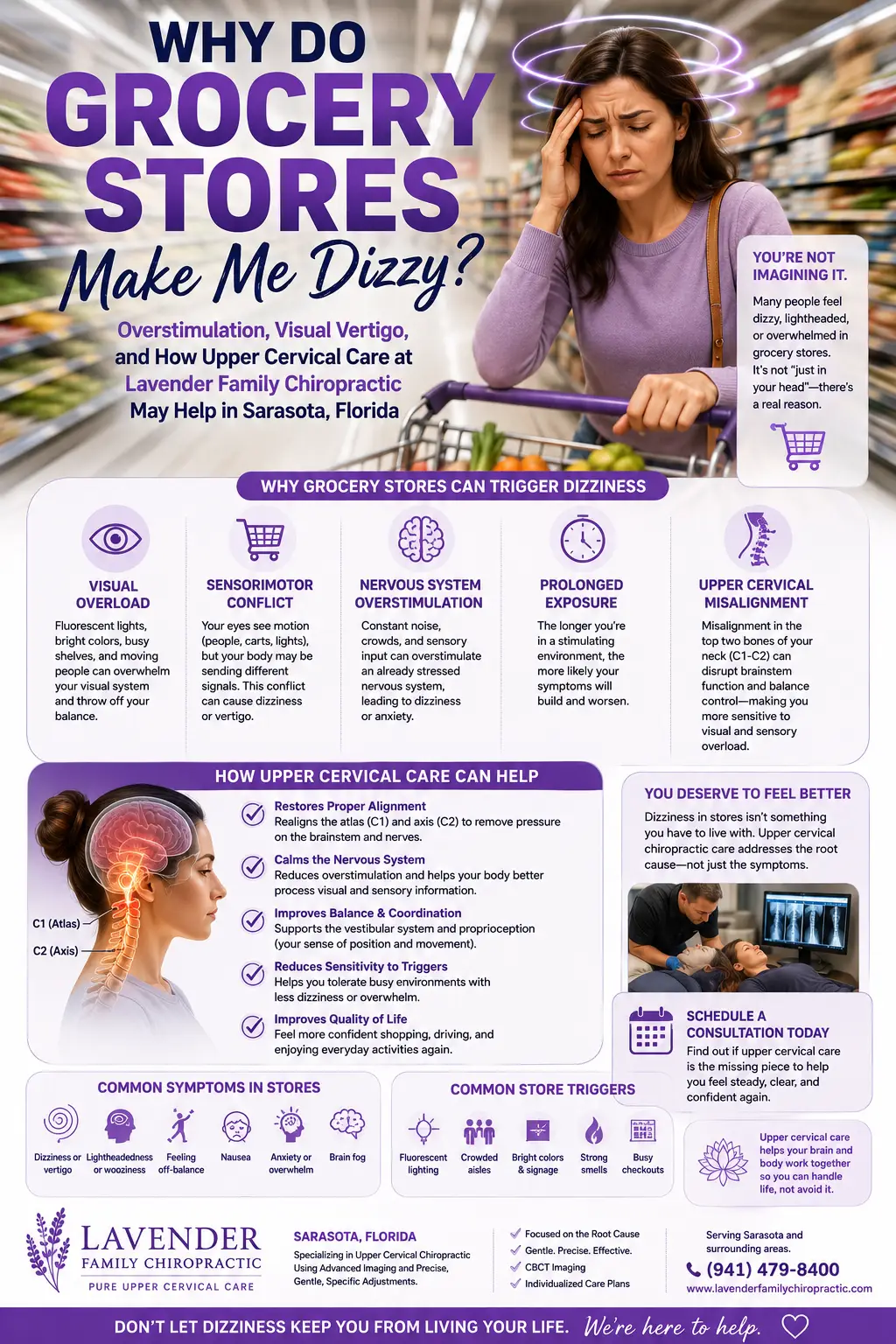
Visual Vertigo: You are halfway down the cereal aisle when it hits: a wave of unsteadiness, a floating or swaying feeling, a tightening of anxiety, and the sudden urge to grip the cart and get out. The fluorescent lights, the towering shelves of busy packaging, the people and carts moving in every direction — it all seems to close in at once. If bright, crowded, visually busy places like the grocery store reliably make you dizzy, you are experiencing something real and surprisingly common, and it has a name.
At Lavender Family Chiropractic in Sarasota, this is one of the most frequent stories we hear from people seeking natural vertigo relief. The grocery store, the big-box warehouse, the mall, the airport, scrolling on a phone — these visually overwhelming environments can provoke dizziness, unsteadiness, and a spike of anxiety in people whose balance systems have become over-reliant on vision. This guide explains why overstimulation and busy peripheral visual motion trigger vertigo, how that feeds an anxiety loop, what the research shows, and how upper cervical chiropractic care may fit into a comprehensive plan.
What Is Visual Vertigo, and Why Does the Grocery Store Trigger It?
Visual vertigo — sometimes called “supermarket syndrome” or visually induced dizziness — is a false or exaggerated sense of movement that is triggered or worsened by complex, moving, or repetitive visual environments. Instead of the room spinning on its own, your dizziness is set off by what your eyes are taking in: rows of patterned packaging, moving crowds, scrolling screens, striped floors, or motion in your peripheral vision.
To understand why the grocery store is such a common trigger, it helps to know how your brain keeps you balanced. Your sense of stability depends on three information streams arriving together: the inner ear, which senses head motion and gravity; the eyes, which report what is moving around you; and the neck and body, which signal the position of your head relative to your torso. The brain blends these three inputs into one steady sense of where you are in space.
When one of those inputs becomes unreliable — often the inner ear or the neck — the brain compensates by leaning more heavily on vision to stay oriented. That workaround is fine in a calm, simple environment. But a grocery store is the opposite of calm and simple. It floods your vision with conflicting, high-contrast, moving information: a long aisle that creates a strong sense of depth, shelves packed with repetitive patterns, other shoppers and carts drifting through your peripheral field, and overhead lighting with subtle flicker. A brain that is over-relying on vision suddenly receives too much visual “noise” to sort out, the three streams disagree, and the result is dizziness, disorientation, and unsteadiness.
How Overstimulation and Peripheral Visual Motion Provoke Dizziness
The specific trigger in these environments is usually motion and pattern in your peripheral vision — the edges of your visual field that your brain uses heavily for balance and spatial orientation.
Peripheral motion is a balance signal. Your peripheral vision is exquisitely tuned to detect movement. From an evolutionary standpoint, motion at the edge of your sight meant something was approaching, so the brain wired peripheral motion directly into the systems that keep you upright and oriented. In a grocery store, carts, shoppers, and your own movement past densely packed shelves fill that peripheral field with constant motion. To a vision-dependent balance system, all of that reads as “the world is moving,” even though you are the one moving — and the mismatch produces dizziness.
Repetitive patterns overload the visual system. Long aisles lined with rows of similar products create dense, repeating visual patterns. These high-contrast, repetitive scenes are demanding for the brain to process and are well known to provoke visually induced dizziness in sensitive people.
Depth and scale distort orientation. A deep aisle draws strong perspective lines toward a vanishing point, and tall shelves loom overhead. For a balance system that is already uncertain, these exaggerated depth cues can intensify the sense that the environment — not you — is tilting or moving.
Lighting adds another layer. Bright fluorescent and LED lighting, sometimes with imperceptible flicker, adds visual strain on top of everything else, lowering your tolerance and making the whole scene harder to filter.
Put together, the grocery store is almost a perfect storm of peripheral motion, repetitive pattern, exaggerated depth, and harsh light. For a person whose balance already leans too hard on vision, it is one of the most provocative everyday environments there is.
The Overstimulation–Anxiety–Vertigo Loop
Here is where the experience becomes especially difficult: overstimulation, dizziness, and anxiety feed one another in a self-reinforcing cycle.
It often starts with the dizziness. A wave of unsteadiness in a busy store is inherently alarming — losing your sense of stability triggers a primal threat response. Your heart races, your breathing quickens, and a jolt of anxiety takes hold. But that anxiety is not just an emotional reaction; it physically amplifies the dizziness. Rapid, shallow breathing changes your blood chemistry and can add its own lightheadedness. Stress chemistry tightens the muscles of your neck and shoulders, which distorts the position signals your upper neck sends to the balance centers. And your brain becomes hypervigilant, scanning for the next wave, which lowers the threshold at which ordinary visual motion gets interpreted as threatening.
Over time, anticipation becomes its own trigger. You start to tense up in the parking lot before you have even walked in. The brain, expecting trouble, primes the alarm system, so the next episode arrives faster and feels stronger. Many people begin to avoid the places where episodes happen — shopping at odd hours, sending someone else, or wearing sunglasses indoors to dim the overwhelm. Avoidance brings short-term relief but tends to deepen the sensitivity over time, shrinking the world a little more with each avoided trip.
This is why treating only one piece rarely settles the whole picture. The overstimulation, the balance disturbance, and the anxiety are woven together. We explore the emotional half of this in depth in our article on whether anxiety can cause vertigo.
The Nerve and Balance Mechanisms Behind Visual Vertigo
Several concrete physiological mechanisms explain why busy environments provoke dizziness in some people and not others.
Visual dependence. When the inner ear or neck input becomes unreliable, the brain shifts its weighting toward vision to stay oriented. People who have become “visually dependent” in this way are far more sensitive to complex and moving visual scenes, because the very sense they are leaning on is the one being overloaded.
Sensory mismatch and conflict. Balance is a multisensory calculation. When the eyes report heavy motion while the inner ear and body report that you are standing still (or moving slowly and steadily), the brainstem receives contradictory data. This vestibulo-visual conflict is a core driver of the dizzy, disoriented feeling in stores, cinemas, and traffic.
Autonomic activation. The systems that process balance are tightly linked to the autonomic nervous system — the network that controls heart rate, breathing, and the fight-or-flight response. When a visually overwhelming environment provokes dizziness, it readily spills into racing heart, sweating, nausea, and a floating sense of unreality, blurring the line between a balance episode and a panic episode.
Neck proprioception. Roughly half of the body’s position-sensing receptors for the head and neck sit in the joints of the upper cervical spine. If those joints are misaligned or chronically tense, the head-position signals they send become “noisy,” pushing the brain to rely even more on vision — and setting the stage for visual vertigo in busy places.
The Upper Neck Connection
The upper cervical spine — the atlas (C1) and axis (C2) at the very top of the neck — plays a quietly central role in this whole picture. This small region sits just beneath the brainstem, cradles the skull, and contains one of the densest concentrations of proprioceptive (position-sensing) receptors in the body. It is also anatomically close to structures that influence autonomic function.
When the upper cervical spine is misaligned or chronically guarded, the position information it sends to the balance centers can become inaccurate. Faced with an unreliable neck signal, the brain compensates by leaning harder on vision — exactly the pattern that makes a person vulnerable to visual vertigo in a crowded, moving environment. In other words, an upper neck problem can be one of the reasons your balance system became over-dependent on vision in the first place.
There is a second layer, too. Because the upper neck sits so close to structures involved in autonomic regulation, chronic tension and misalignment there can contribute to the over-reactive, on-edge nervous-system state that amplifies both dizziness and anxiety. This helps explain why so many people with grocery-store dizziness also report neck tightness, tension headaches at the base of the skull, and jaw clenching. Our article on whether neck pain can cause dizzinessexplores this mechanism in more depth.
Different Environments That Trigger Visual Vertigo
While the grocery store is the classic example, the same mechanism shows up in many everyday settings. Recognizing your own triggers can help you make sense of the pattern.
Big-box and warehouse stores combine everything the grocery store does — long aisles, repetitive shelving, crowds, and bright lighting — on an even larger scale, which is why they are frequently reported as difficult.
Screens and scrolling provoke many people with visual vertigo. Fast-scrolling social media, action video, or rapidly changing content floods the visual system with motion your body does not feel, creating the same conflict on a small screen.
Traffic and driving can be provocative, especially passing rows of oncoming cars, driving past fences or guardrails, or sitting at a light while a large vehicle beside you creeps forward. This overlaps with motion-related dizziness, which we cover in our article on whether vertigo and motion sickness are the same thing.
Crowds and open spaces — malls, airports, stadiums, and busy sidewalks — surround you with peripheral motion and can leave you feeling adrift, particularly in wide-open areas with few fixed reference points.
Patterned and moving surfaces such as escalators, striped or shiny floors, and busy carpet can all set off the same visually induced unsteadiness.
Across all of these, the common thread is a balance system that has become over-reliant on vision, then overwhelmed by too much visual motion at once.
Upper Cervical Care at Lavender Family Chiropractic
At Lavender Family Chiropractic in Sarasota, we take a root-cause approach to dizziness rather than simply chasing the symptom. When busy environments reliably provoke your vertigo, our focus is on the physical contributors we can objectively measure and address — particularly the alignment and function of the upper cervical spine and its influence on the nervous system and balance.
Our evaluation is detailed and individualized. We use 3D CBCT imaging to precisely assess the position of your atlas and axis, and paraspinal infrared thermography to evaluate how your nervous system is functioning. Because visual vertigo so often reflects a balance system compensating for an unreliable neck signal — and an over-reactive autonomic state — this objective look at upper cervical alignment and nervous-system function is especially useful.
When a correction is indicated, we use the Knee Chest Upper Cervical technique to restore upper cervical alignment gently and precisely, without forceful twisting or cracking. The goal is to help the upper neck send accurate position information to the balance centers so the brain can rely less heavily on vision, and to support healthier autonomic regulation. From there we develop customized treatment plans built around your specific goals.
We are also clear about scope. Upper cervical care addresses the physical and nervous-system contributors to visual vertigo; it is not a substitute for vestibular rehabilitation or mental-health support when those are needed. For many people, the most effective path combines care for the neck and balance system with visual habituation exercises and, when anxiety is significant, appropriate psychological support. We are glad to work alongside your other providers.
Take the First Step Toward Steadier Days
If busy, overstimulating places have started to shrink your world, we would like to help you understand the physical side of the picture. Call Lavender Family Chiropractic at (941) 243-3729 to schedule a consultation, or book online here: https://intake.chirohd.com/new-patient-scheduling/724/lavender-family-chiropractic. We will examine your upper cervical spine and explain whether it may be contributing to your symptoms.
What the Research Says About Visual Vertigo and Overstimulation
The connection between busy visual environments, dizziness, and anxiety is one of the more actively studied areas in balance medicine. Here are five studies that illuminate the mechanisms behind grocery-store vertigo.
Research on the influence of visual and vestibular hypersensitivity on derealization and depersonalization in chronic dizziness found that people with heightened sensitivity to visual and vestibular stimulation were more likely to experience the detached, “unreal” sensations that often accompany dizziness in overwhelming environments. This helps explain why a busy store can produce not just unsteadiness but a disorienting, foggy sense of disconnection.
A study on visual and vestibular motion perception in persistent postural-perceptual dizziness examined how people with chronic, environment-triggered dizziness process motion. It found measurable differences in how these individuals weigh visual versus vestibular information, supporting the idea that visual over-reliance is central to why complex scenes provoke symptoms.
Research on gaze instability after exposure to moving visual stimuli in patients with persistent postural-perceptual dizziness showed that exposure to moving visual patterns produced lingering instability in eye control among affected people. This is a direct, objective window into why peripheral motion in a store — carts, crowds, scrolling shelves — leaves sensitive individuals feeling unsteady well after the trigger.
A study on persistent postural-perceptual dizziness: precipitating conditions, co-morbidities, and treatment mapped how this common form of chronic, visually triggered dizziness typically begins and what conditions accompany it. It highlights the strong overlap with anxiety and the way an initial balance event can set off a lasting pattern of environment-triggered symptoms.
Finally, connecting the neck to this picture, a review of cervicogenic dizziness explains how dysfunction in the upper cervical spine can generate dizziness through faulty proprioceptive input to the balance centers. This is directly relevant to visual vertigo, because a noisy neck signal is one of the reasons the brain becomes over-dependent on vision in the first place.
Lifestyle Strategies to Reduce Overstimulation Dizziness
Alongside professional care, daily habits can help settle both the balance system and the stress response that amplifies it in busy environments.
Anchor your gaze. In an overwhelming store, fix your eyes on a single stable target — the end of the aisle, a sign, or your list — rather than letting them dart across the moving scene. Giving the brain one steady reference point reduces the visual conflict that drives the dizziness.
Slow down and breathe. Because rapid, shallow breathing directly fuels anxiety-related dizziness, slowing your breath — a longer exhale than inhale — can interrupt an episode before it escalates. Moving through the store deliberately rather than rushing also lowers the visual-motion load.
Reduce visual overwhelm when symptomatic. Some people find that lightly tinted glasses or a brimmed hat cuts glare and dampens peripheral motion enough to make a trip manageable. Shopping at quieter hours, when aisles are less crowded, can also help.
Release upper-neck and jaw tension. Gentle mobility work, warm compresses at the base of the skull, and awareness of jaw clenching can reduce the muscle guarding that distorts neck proprioception and pushes the brain toward visual over-reliance.
Gradually re-expose rather than avoid. Avoidance feels protective but tends to deepen visual sensitivity over time. Slowly and safely re-engaging with busy environments — short trips at first, building up — helps retrain the balance system and rebuild confidence. This kind of visual habituation is a cornerstone of vestibular rehabilitation.
Support the basics. Adequate sleep, steady hydration — which matters year-round in Florida’s heat — and limiting excess caffeine when symptoms are flaring all raise your threshold for both dizziness and anxiety.
What to Expect at Your First Visit
If busy environments have made you cautious about new places, it helps to know exactly what your first visit involves so there are no surprises.
We start with an unhurried conversation about your history. We want to understand which environments trigger you, how the dizziness and anxiety relate, how long the pattern has been building, and what you have already tried. Because visual vertigo so often traces back to an unreliable neck or inner-ear signal, this careful listening helps us sort out the physical contributors.
Next, we gather objective data. The 3D CBCT imaging shows us the precise position of your atlas and axis, while paraspinal infrared thermography helps us evaluate nervous-system function — particularly relevant given how central the autonomic system is to environment-triggered dizziness. These findings guide whether an upper cervical correction is appropriate for you.
If care is indicated, we explain what we found in clear terms and outline a customized treatment plan built around your goals. We practice on a cash-pay basis and review the details with you in advance. We will also be candid about where upper cervical care fits and where vestibular rehabilitation or mental-health support belongs, because the most durable results usually come from addressing the whole picture. If you would like to talk through anything before scheduling, call us any time at (941) 243-3729.
Areas We Serve Around Sarasota
Lavender Family Chiropractic is located at 5899 Whitfield Avenue, Suite 107, in Sarasota, at the corner of University and Whitfield. We care for patients seeking natural vertigo relief from throughout the region, including Bradenton, Lakewood Ranch, Palmetto, Ellenton, Ruskin, Venice, Osprey, Myakka, Tampa, and St. Pete. If the thought of a busy waiting room makes you anxious, tell us when you call and we will help you plan a comfortable first visit.
Top 15 Frequently Asked Questions About Grocery Store Vertigo
1. Why do grocery stores specifically make me dizzy? Grocery stores combine several potent triggers at once — long aisles with strong depth cues, shelves of repetitive patterns, crowds and carts moving in your peripheral vision, and bright lighting. For a balance system that leans too heavily on vision, that visual overload produces dizziness and unsteadiness.
2. Is this a real medical condition or is it in my head? It is real and recognized. Visually induced dizziness — sometimes called visual vertigo or “supermarket syndrome” — has documented physical mechanisms involving the visual, vestibular, and neck-position systems. The sensation is genuine, not imagined.
3. Why does my anxiety spike in these environments? Dizziness triggers a threat response, and anxiety in turn amplifies the dizziness through rapid breathing, muscle tension, and heightened vigilance. Overstimulation, dizziness, and anxiety form a self-reinforcing loop in busy places.
4. What is visual dependence? When the inner ear or neck sends an unreliable balance signal, the brain compensates by relying more on vision. That over-reliance leaves you far more sensitive to complex, moving visual scenes like a crowded store.
5. Could my neck be part of the problem? It can be. The upper cervical spine holds a large share of the body’s head-position sensors. If that signal is inaccurate, the brain leans harder on vision — one of the underlying reasons visual vertigo develops.
6. Can upper cervical chiropractic care help visual vertigo? It can address the physical contributors — upper cervical alignment and autonomic function — that may be feeding your visual dependence. It works best as part of a comprehensive approach that may also include visual habituation and, when needed, mental-health support.
7. Why do screens and scrolling also make me dizzy? Fast-scrolling or fast-moving screen content floods your visual system with motion your body does not feel, creating the same visual-vestibular conflict as a busy store, just on a smaller scale.
8. Should I just avoid grocery stores and crowds? Avoidance brings short-term relief but tends to deepen visual sensitivity over time. Gradual, supported re-exposure generally helps retrain the balance system, which is why avoidance is not a long-term solution.
9. Do sunglasses or tinted glasses really help? For some people, dimming glare and dampening peripheral motion makes a difficult trip more manageable. It is a helpful coping tool, though the aim is to reduce the underlying sensitivity, not to depend on them permanently.
10. Is this the same as motion sickness? They are related and overlap, but not identical. Motion sickness usually involves actual movement, while visual vertigo can be triggered by moving visual scenes even when you are standing still. Our article on vertigo and motion sickness explains the distinction.
11. What testing do you perform? We use 3D CBCT imaging to assess upper cervical alignment and paraspinal infrared thermography to evaluate nervous-system function, giving us objective information to guide care.
12. Could my dizziness be something more serious? Dizziness has many causes, and some require medical evaluation. Sudden, severe vertigo with symptoms such as slurred speech, weakness, double vision, or a severe headache warrants emergency care. We are happy to coordinate with your medical team.
13. How long does it take to feel steadier in busy places? It varies with the person and the underlying contributors. Progress usually comes gradually as the balance system is supported and re-exposed to visual environments over time, rather than all at once.
14. Does breathing really affect the dizziness? Yes. Rapid, shallow breathing during anxiety changes blood chemistry and adds its own lightheadedness. Slow, controlled breathing is one of the most accessible ways to interrupt an episode in a store.
15. Where are you located and who do you serve? We are at 5899 Whitfield Avenue, Suite 107, in Sarasota, serving patients from Bradenton, Lakewood Ranch, Venice, Palmetto, Ellenton, and the surrounding area.
Ready to Shop Without the Spin?
When busy, overstimulating environments provoke your vertigo, addressing the physical side of the picture — how your upper neck and nervous system shape your balance — can be a meaningful part of finding steadier days. If you are ready to understand whether your upper cervical spine is contributing to your dizziness, call Lavender Family Chiropractic at (941) 243-3729 or book your consultation online at https://intake.chirohd.com/new-patient-scheduling/724/lavender-family-chiropractic. Our Sarasota team is here to help you pursue natural vertigo relief as part of a comprehensive plan.
Related Articles
Related Posts


Get our upper cervical articles first.
Patients Experience